SECTION 12-3
CONDITIONAL PROBABILITY
ESSENTIAL QUESTIONS
• How do you find probabilities of events
given the occurrence of other events?
• How do you use contingency tables to find
conditional probabilities?
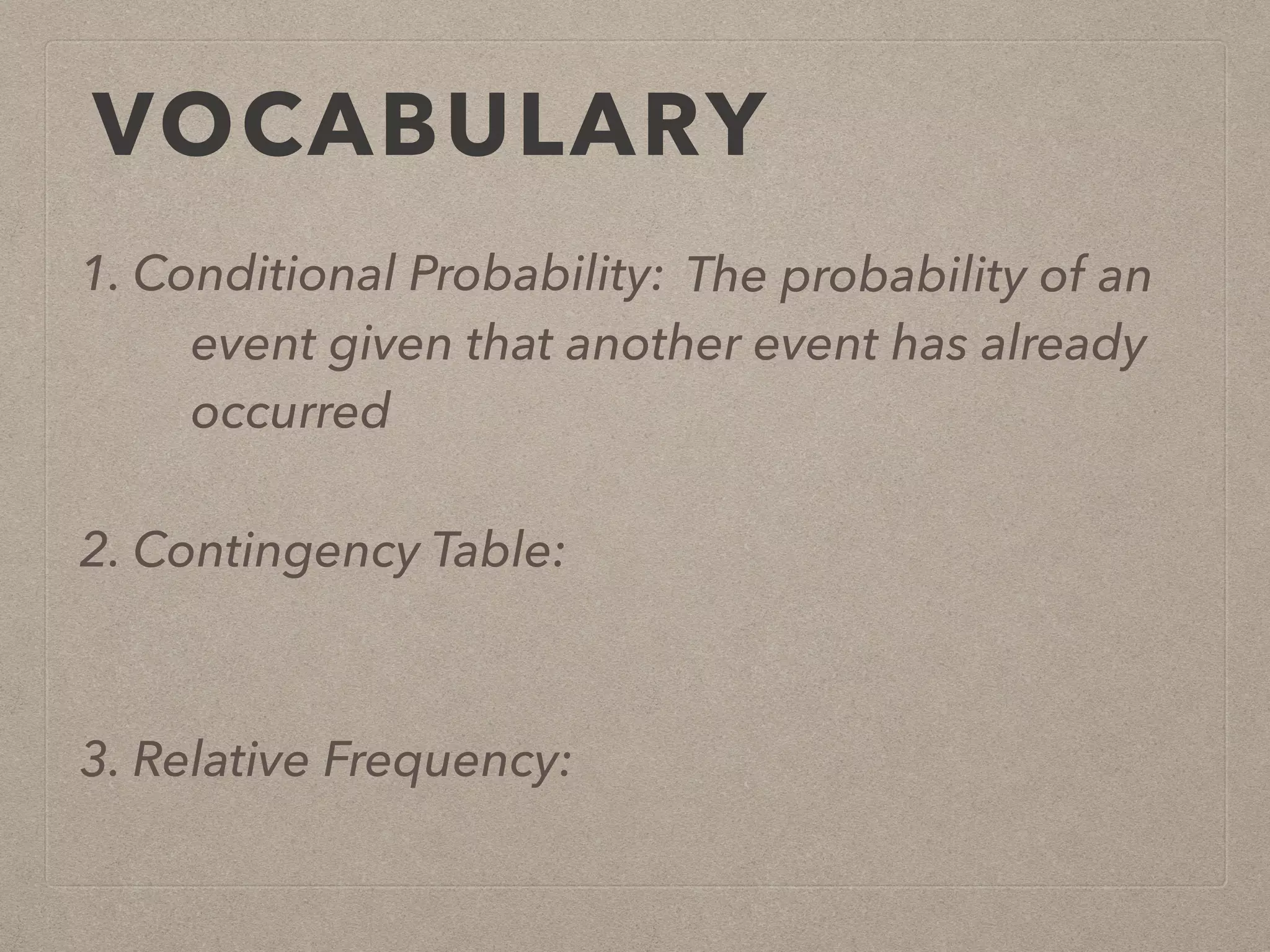
VOCABULARY
1. Conditional Probability:
2. Contingency Table:
3. Relative Frequency:
VOCABULARY
1. Conditional Probability:
2. Contingency Table:
3. Relative Frequency:
The probability of an
event given that another event has already
occurred
VOCABULARY
1. Conditional Probability:
2. Contingency Table:
3. Relative Frequency:
The probability of an
event given that another event has already
occurred P (B | A) =
P (A and B )
P (A)
,P (A) ≠ 0
VOCABULARY
1. Conditional Probability:
2. Contingency Table:
3. Relative Frequency:
The probability of an
event given that another event has already
occurred P (B | A) =
P (A and B )
P (A)
,P (A) ≠ 0
Collects the data that
shows how the different situations have
different possible outcomes
VOCABULARY
1. Conditional Probability:
2. Contingency Table:
3. Relative Frequency:
The probability of an
event given that another event has already
occurred P (B | A) =
P (A and B )
P (A)
,P (A) ≠ 0
Collects the data that
shows how the different situations have
different possible outcomes
How many times an
outcome occurs
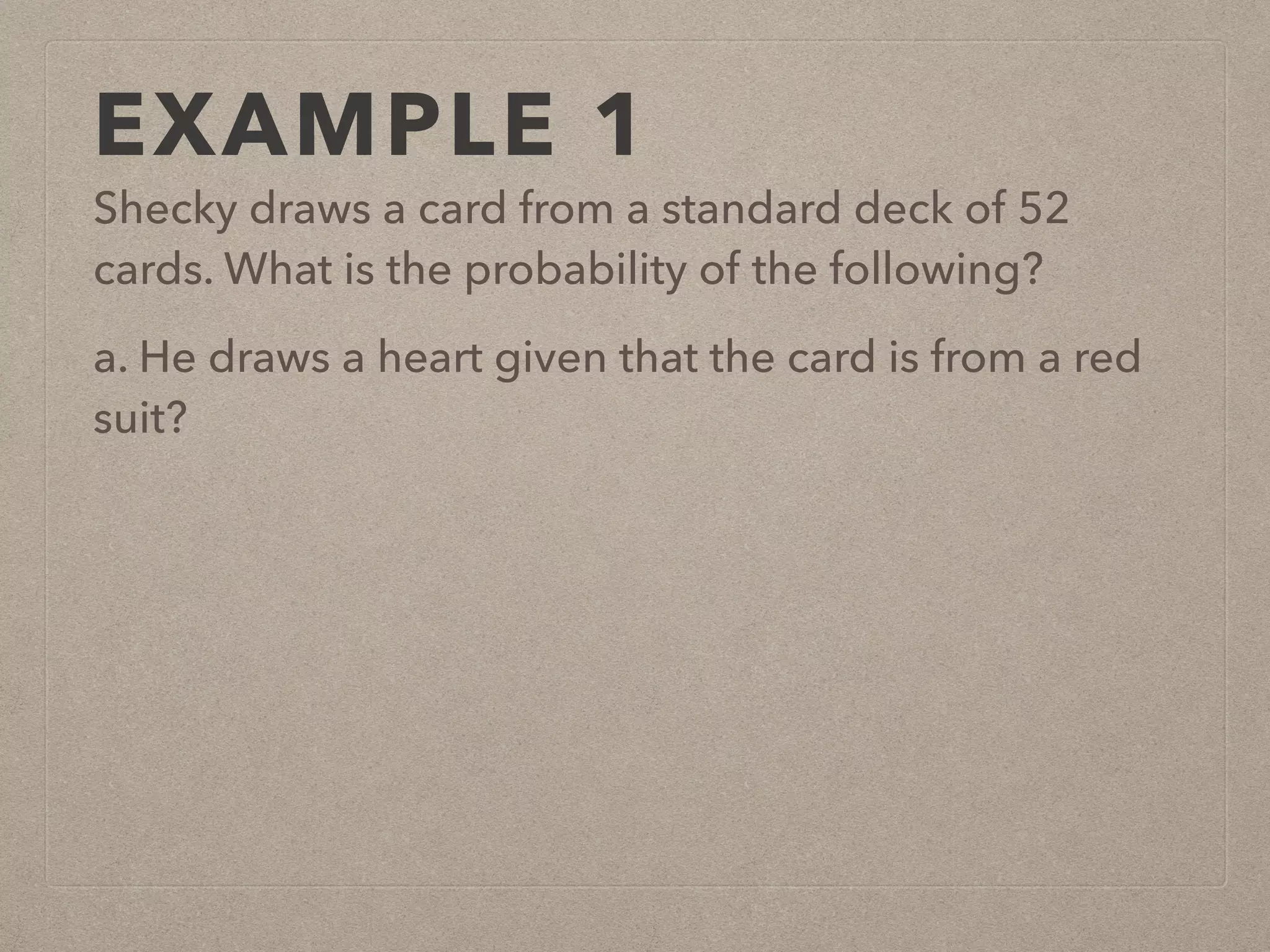
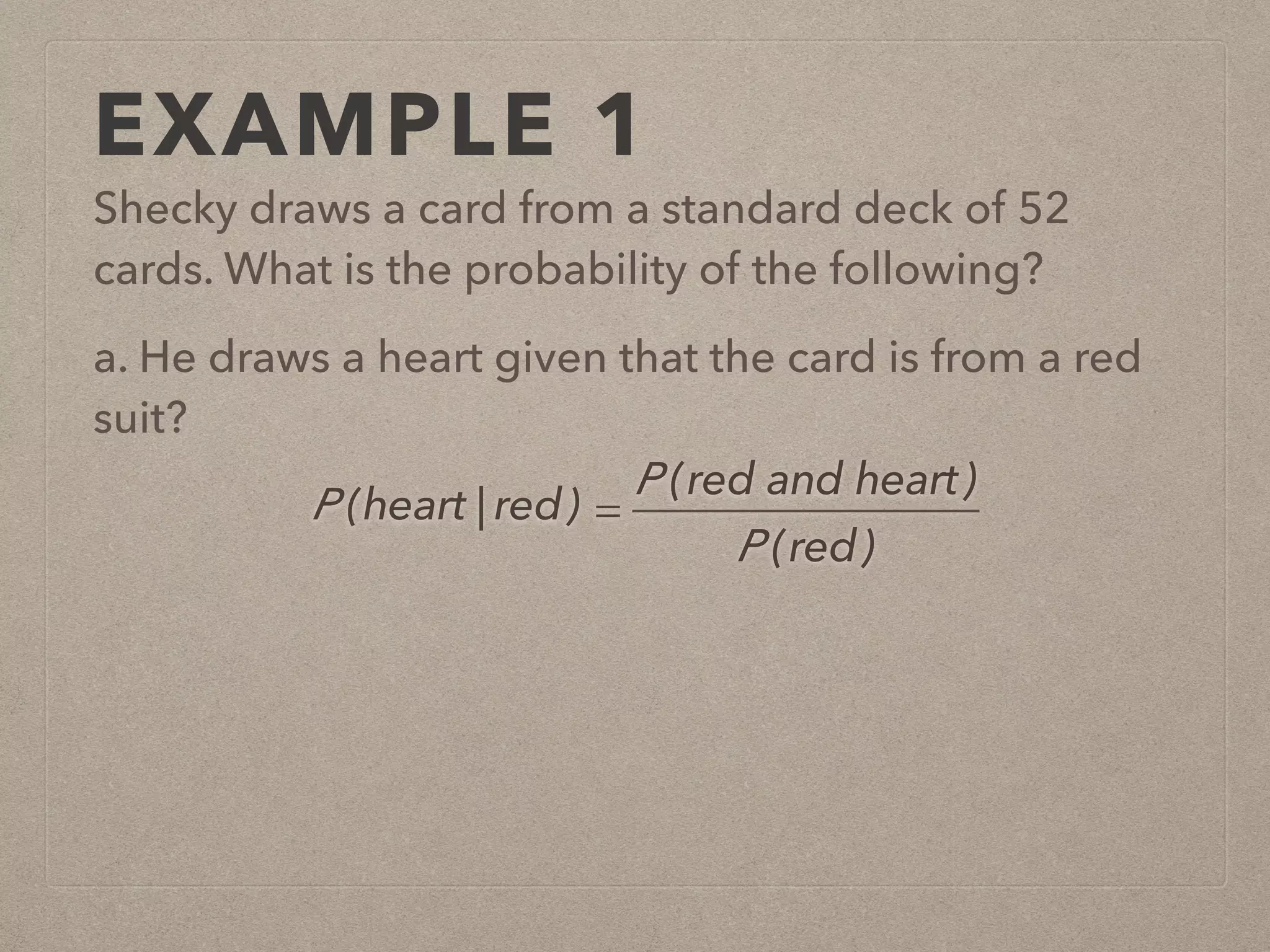
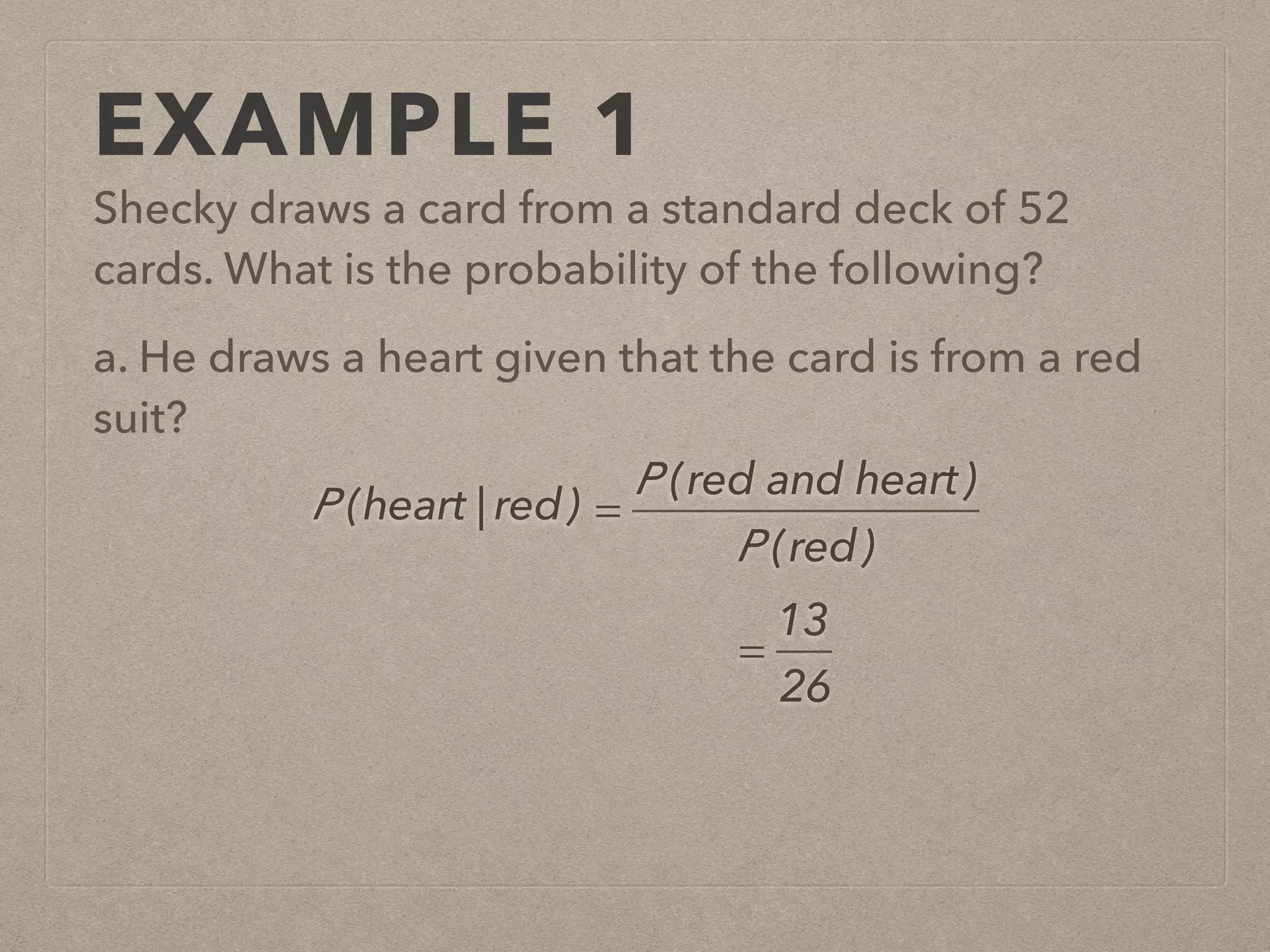
EXAMPLE 1
Shecky draws a card from a standard deck of 52
cards. What is the probability of the following?
a. He draws a heart given that the card is from a red
suit?
EXAMPLE 1
Shecky draws a card from a standard deck of 52
cards. What is the probability of the following?
a. He draws a heart given that the card is from a red
suit?
P (heart | red)
EXAMPLE 1
Shecky draws a card from a standard deck of 52
cards. What is the probability of the following?
a. He draws a heart given that the card is from a red
suit?
P (heart | red) =
P (red and heart)
P (red)
EXAMPLE 1
Shecky draws a card from a standard deck of 52
cards. What is the probability of the following?
a. He draws a heart given that the card is from a red
suit?
P (heart | red) =
P (red and heart)
P (red)
=
13
26
EXAMPLE 1
Shecky draws a card from a standard deck of 52
cards. What is the probability of the following?
a. He draws a heart given that the card is from a red
suit?
P (heart | red) =
P (red and heart)
P (red)
=
13
26
=
1
2
EXAMPLE 1
Shecky draws a card from a standard deck of 52
cards. What is the probability of the following?
b. He draws an odd card given that the card is a
spade?
EXAMPLE 1
Shecky draws a card from a standard deck of 52
cards. What is the probability of the following?
b. He draws an odd card given that the card is a
spade?
P (odd | spade)
EXAMPLE 1
Shecky draws a card from a standard deck of 52
cards. What is the probability of the following?
b. He draws an odd card given that the card is a
spade?
P (odd | spade) =
P (spade and odd)
P (spade)
EXAMPLE 1
Shecky draws a card from a standard deck of 52
cards. What is the probability of the following?
b. He draws an odd card given that the card is a
spade?
P (odd | spade) =
P (spade and odd)
P (spade)
=
4
13
EXAMPLE 1
Shecky draws a card from a standard deck of 52
cards. What is the probability of the following?
b. He draws an odd card given that the card is a
spade?
P (odd | spade) =
P (spade and odd)
P (spade)
=
4
13
≈ 30.8%
EXAMPLE 2
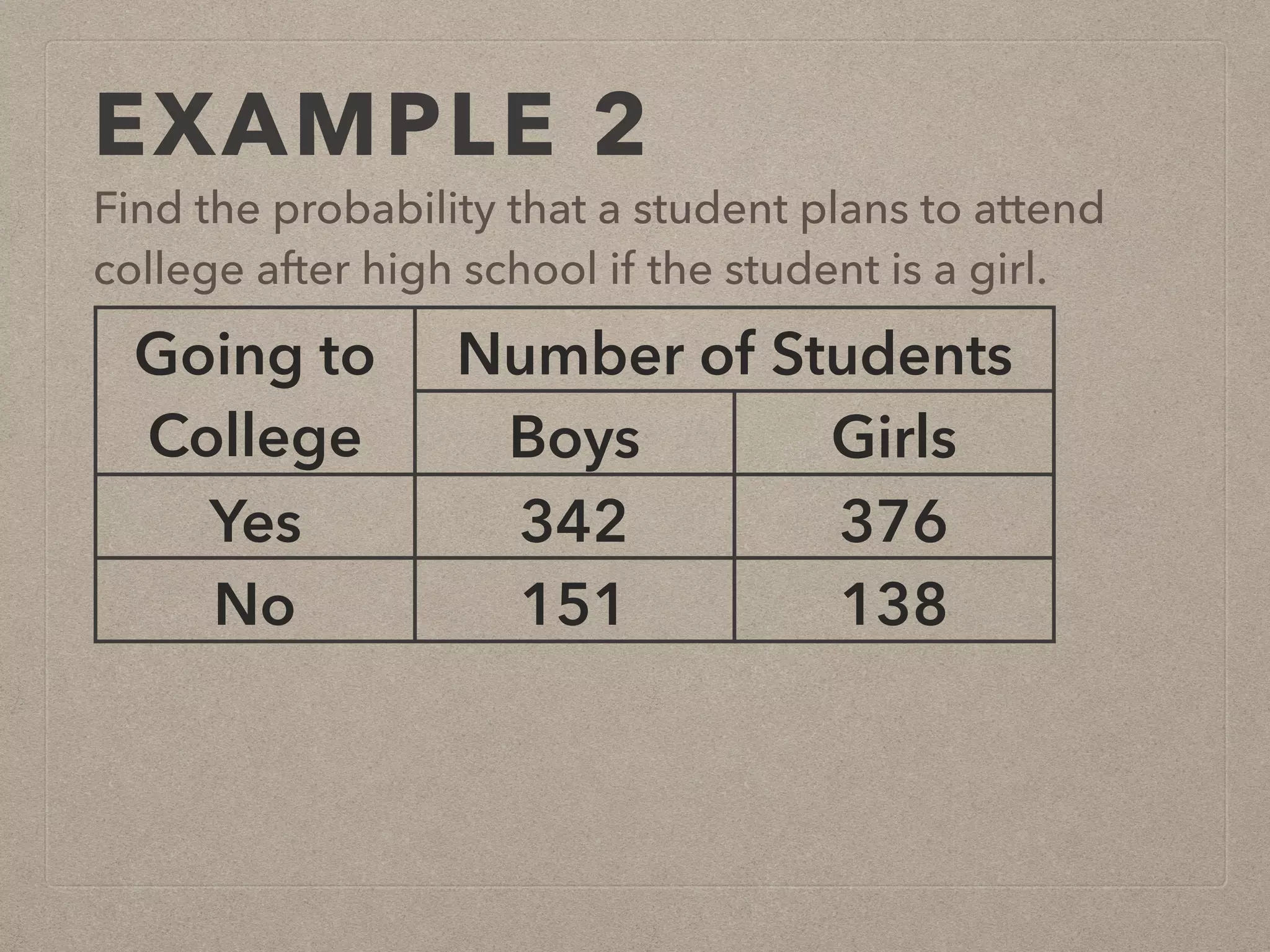
Find the probability that a student plans to attend
college after high school if the student is a girl.
Going to
College
Number of Students
Boys Girls
Yes 342 376
No 151 138
EXAMPLE 2
Find the probability that a student plans to attend
college after high school if the student is a girl.
Going to
College
Number of Students
Boys Girls
Yes 342 376
No 151 138
718
EXAMPLE 2
Find the probability that a student plans to attend
college after high school if the student is a girl.
Going to
College
Number of Students
Boys Girls
Yes 342 376
No 151 138
718
289
EXAMPLE 2
Find the probability that a student plans to attend
college after high school if the student is a girl.
Going to
College
Number of Students
Boys Girls
Yes 342 376
No 151 138
718
289
493
EXAMPLE 2
Find the probability that a student plans to attend
college after high school if the student is a girl.
Going to
College
Number of Students
Boys Girls
Yes 342 376
No 151 138
718
289
493 514
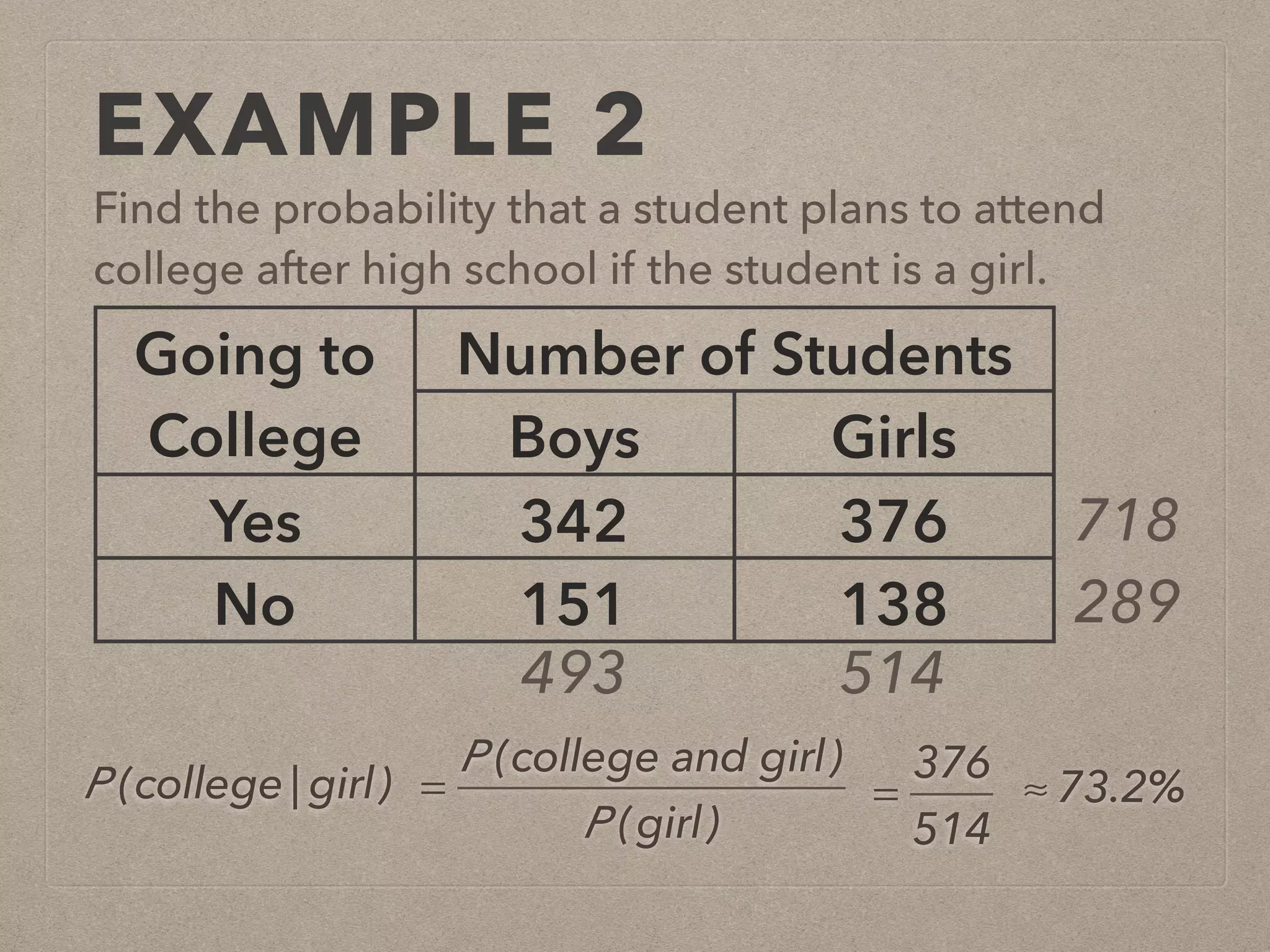
EXAMPLE 2
Find the probability that a student plans to attend
college after high school if the student is a girl.
P (college| girl)
Going to
College
Number of Students
Boys Girls
Yes 342 376
No 151 138
718
289
493 514
EXAMPLE 2
Find the probability that a student plans to attend
college after high school if the student is a girl.
P (college| girl) =
P (college and girl)
P (girl)
Going to
College
Number of Students
Boys Girls
Yes 342 376
No 151 138
718
289
493 514
EXAMPLE 2
Find the probability that a student plans to attend
college after high school if the student is a girl.
P (college| girl) =
P (college and girl)
P (girl)
=
376
514
Going to
College
Number of Students
Boys Girls
Yes 342 376
No 151 138
718
289
493 514
EXAMPLE 2
Find the probability that a student plans to attend
college after high school if the student is a girl.
P (college| girl) =
P (college and girl)
P (girl)
=
376
514
Going to
College
Number of Students
Boys Girls
Yes 342 376
No 151 138
718
289
493 514
≈ 73.2%
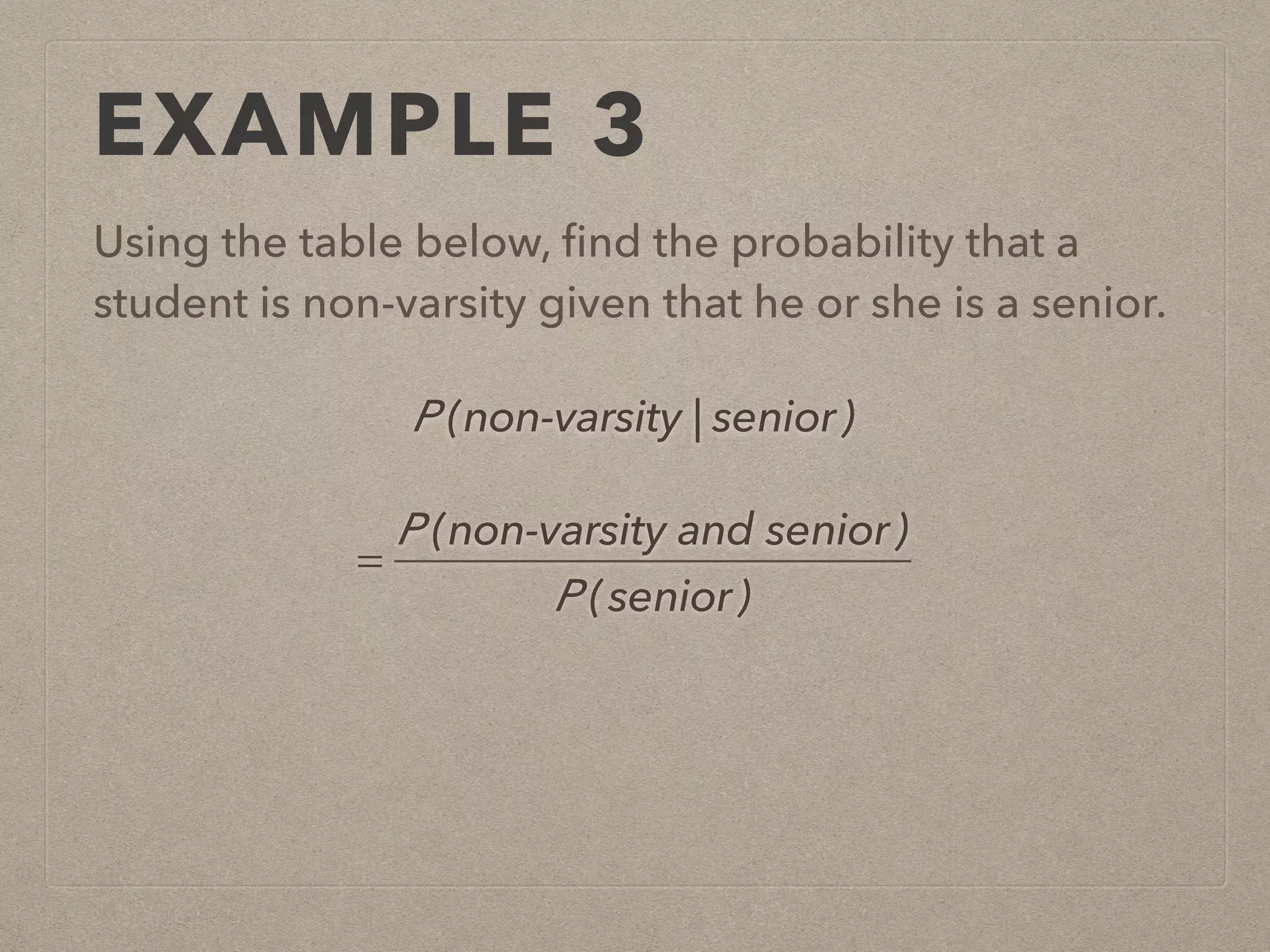
EXAMPLE 3
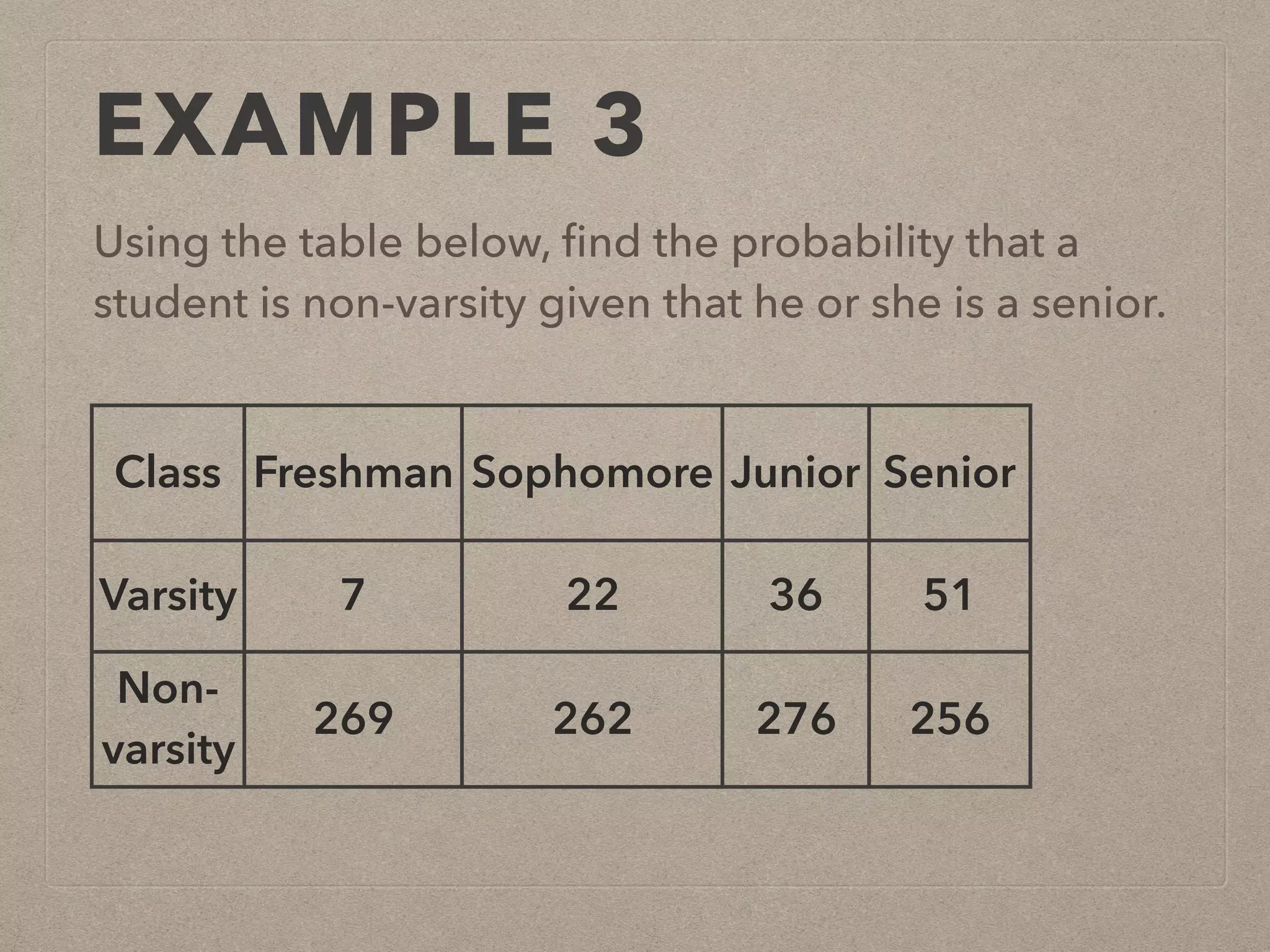
Using the table below, find the probability that a
student is non-varsity given that he or she is a senior.
Class Freshman Sophomore Junior Senior
Varsity 7 22 36 51
Non-
varsity
269 262 276 256
EXAMPLE 3
Using the table below, find the probability that a
student is non-varsity given that he or she is a senior.
Class Freshman Sophomore Junior Senior
Varsity 7 22 36 51
Non-
varsity
269 262 276 256
116
EXAMPLE 3
Using the table below, find the probability that a
student is non-varsity given that he or she is a senior.
Class Freshman Sophomore Junior Senior
Varsity 7 22 36 51
Non-
varsity
269 262 276 256
116
1063
EXAMPLE 3
Using the table below, find the probability that a
student is non-varsity given that he or she is a senior.
Class Freshman Sophomore Junior Senior
Varsity 7 22 36 51
Non-
varsity
269 262 276 256
116
1063
276
EXAMPLE 3
Using the table below, find the probability that a
student is non-varsity given that he or she is a senior.
Class Freshman Sophomore Junior Senior
Varsity 7 22 36 51
Non-
varsity
269 262 276 256
116
1063
276 284
EXAMPLE 3
Using the table below, find the probability that a
student is non-varsity given that he or she is a senior.
Class Freshman Sophomore Junior Senior
Varsity 7 22 36 51
Non-
varsity
269 262 276 256
116
1063
276 284 312
EXAMPLE 3
Using the table below, find the probability that a
student is non-varsity given that he or she is a senior.
Class Freshman Sophomore Junior Senior
Varsity 7 22 36 51
Non-
varsity
269 262 276 256
116
1063
276 284 312 307
EXAMPLE 3
Using the table below, find the probability that a
student is non-varsity given that he or she is a senior.
EXAMPLE 3
Using the table below, find the probability that a
student is non-varsity given that he or she is a senior.
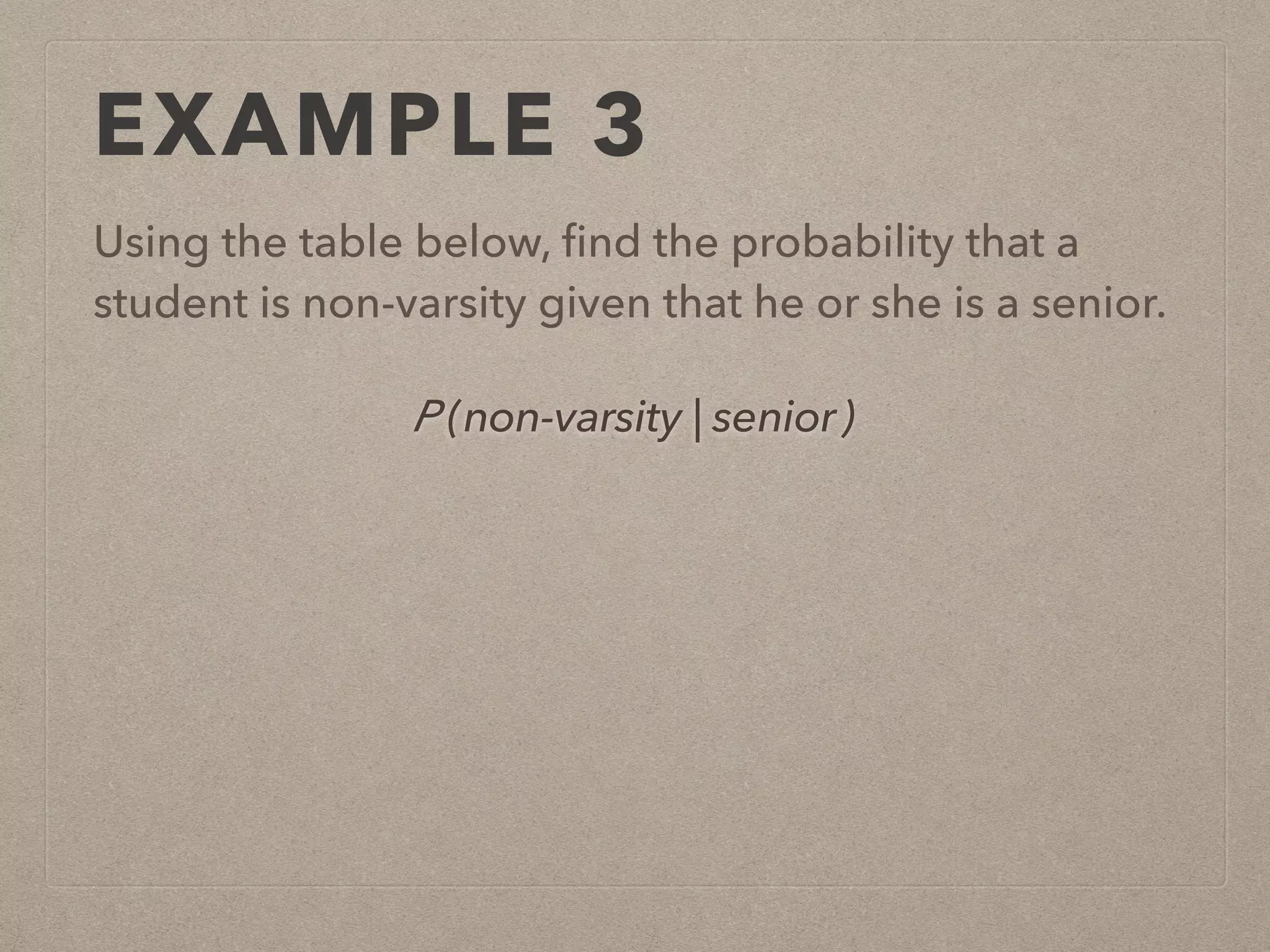
P (non-varsity | senior)
EXAMPLE 3
Using the table below, find the probability that a
student is non-varsity given that he or she is a senior.
P (non-varsity | senior)
=
P (non-varsity and senior)
P (senior)
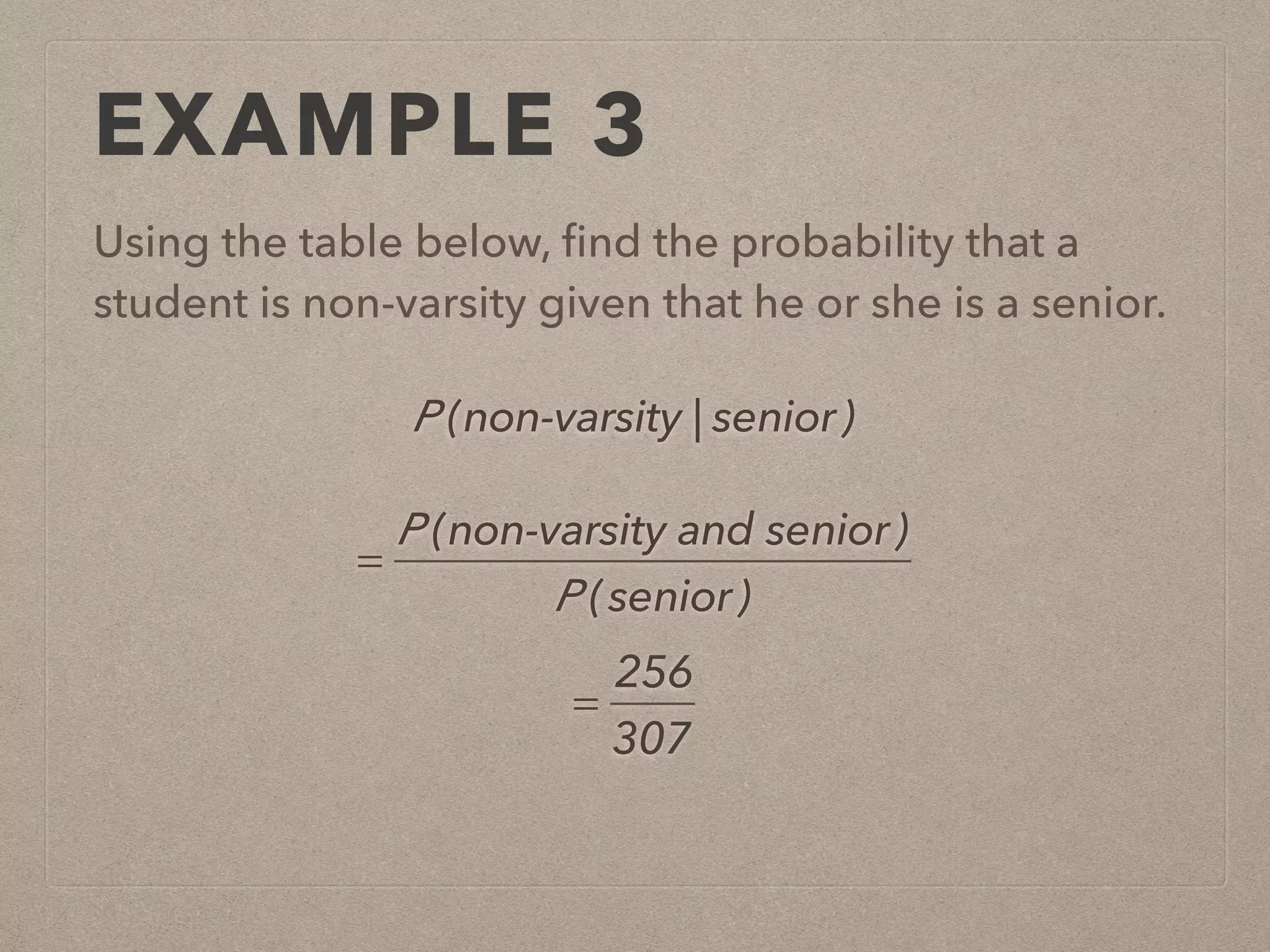
EXAMPLE 3
Using the table below, find the probability that a
student is non-varsity given that he or she is a senior.
P (non-varsity | senior)
=
P (non-varsity and senior)
P (senior)
=
256
307
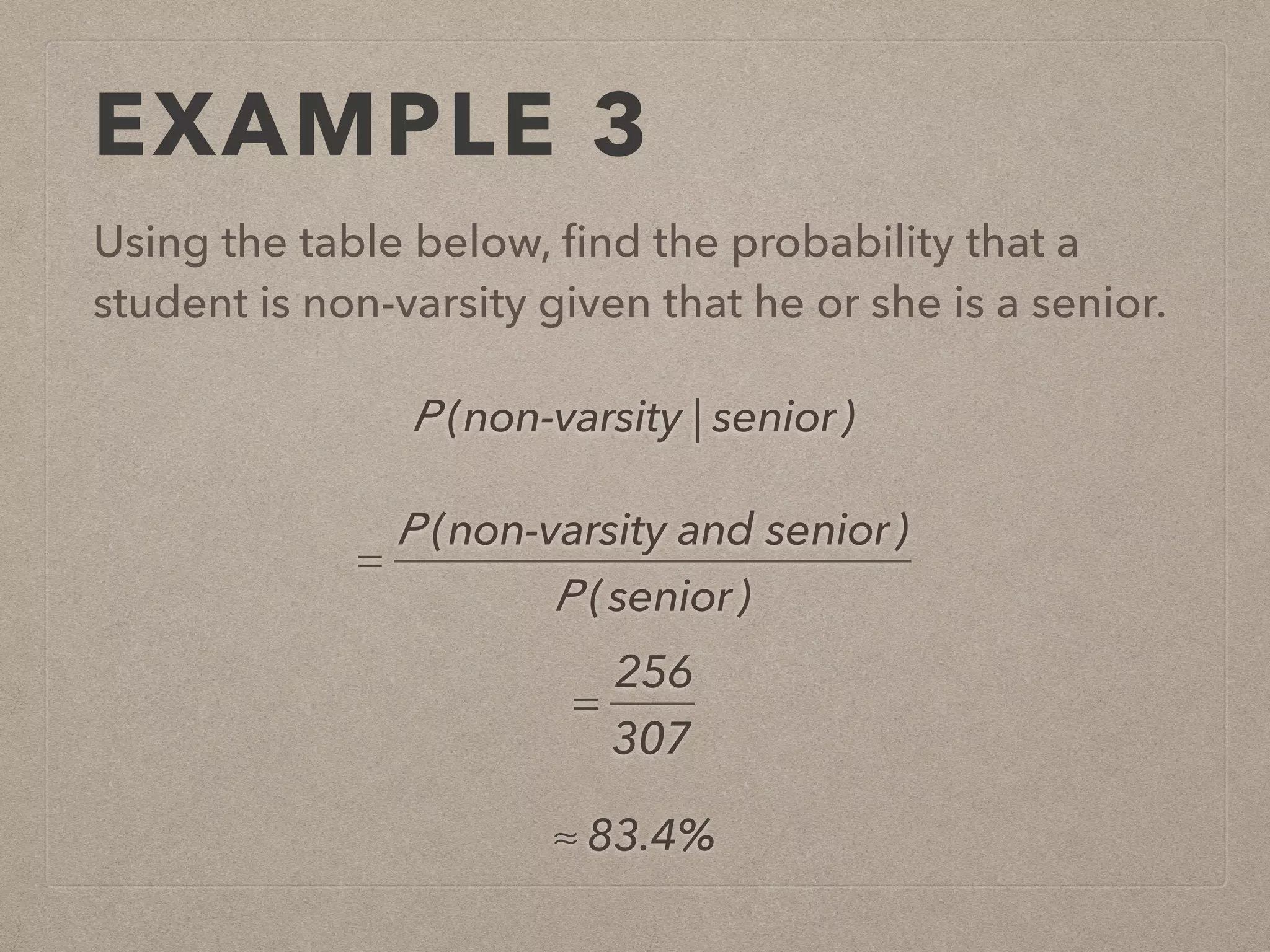
EXAMPLE 3
Using the table below, find the probability that a
student is non-varsity given that he or she is a senior.
P (non-varsity | senior)
=
P (non-varsity and senior)
P (senior)
=
256
307
≈ 83.4%

Section 12-3 Algebra 2

  • 1.
  • 2.
    ESSENTIAL QUESTIONS • Howdo you find probabilities of events given the occurrence of other events? • How do you use contingency tables to find conditional probabilities?
  • 3.
    VOCABULARY 1. Conditional Probability: 2.Contingency Table: 3. Relative Frequency:
  • 4.
    VOCABULARY 1. Conditional Probability: 2.Contingency Table: 3. Relative Frequency: The probability of an event given that another event has already occurred
  • 5.
    VOCABULARY 1. Conditional Probability: 2.Contingency Table: 3. Relative Frequency: The probability of an event given that another event has already occurred P (B | A) = P (A and B ) P (A) ,P (A) ≠ 0
  • 6.
    VOCABULARY 1. Conditional Probability: 2.Contingency Table: 3. Relative Frequency: The probability of an event given that another event has already occurred P (B | A) = P (A and B ) P (A) ,P (A) ≠ 0 Collects the data that shows how the different situations have different possible outcomes
  • 7.
    VOCABULARY 1. Conditional Probability: 2.Contingency Table: 3. Relative Frequency: The probability of an event given that another event has already occurred P (B | A) = P (A and B ) P (A) ,P (A) ≠ 0 Collects the data that shows how the different situations have different possible outcomes How many times an outcome occurs
  • 8.
    EXAMPLE 1 Shecky drawsa card from a standard deck of 52 cards. What is the probability of the following? a. He draws a heart given that the card is from a red suit?
  • 9.
    EXAMPLE 1 Shecky drawsa card from a standard deck of 52 cards. What is the probability of the following? a. He draws a heart given that the card is from a red suit? P (heart | red)
  • 10.
    EXAMPLE 1 Shecky drawsa card from a standard deck of 52 cards. What is the probability of the following? a. He draws a heart given that the card is from a red suit? P (heart | red) = P (red and heart) P (red)
  • 11.
    EXAMPLE 1 Shecky drawsa card from a standard deck of 52 cards. What is the probability of the following? a. He draws a heart given that the card is from a red suit? P (heart | red) = P (red and heart) P (red) = 13 26
  • 12.
    EXAMPLE 1 Shecky drawsa card from a standard deck of 52 cards. What is the probability of the following? a. He draws a heart given that the card is from a red suit? P (heart | red) = P (red and heart) P (red) = 13 26 = 1 2
  • 13.
    EXAMPLE 1 Shecky drawsa card from a standard deck of 52 cards. What is the probability of the following? b. He draws an odd card given that the card is a spade?
  • 14.
    EXAMPLE 1 Shecky drawsa card from a standard deck of 52 cards. What is the probability of the following? b. He draws an odd card given that the card is a spade? P (odd | spade)
  • 15.
    EXAMPLE 1 Shecky drawsa card from a standard deck of 52 cards. What is the probability of the following? b. He draws an odd card given that the card is a spade? P (odd | spade) = P (spade and odd) P (spade)
  • 16.
    EXAMPLE 1 Shecky drawsa card from a standard deck of 52 cards. What is the probability of the following? b. He draws an odd card given that the card is a spade? P (odd | spade) = P (spade and odd) P (spade) = 4 13
  • 17.
    EXAMPLE 1 Shecky drawsa card from a standard deck of 52 cards. What is the probability of the following? b. He draws an odd card given that the card is a spade? P (odd | spade) = P (spade and odd) P (spade) = 4 13 ≈ 30.8%
  • 18.
    EXAMPLE 2 Find theprobability that a student plans to attend college after high school if the student is a girl. Going to College Number of Students Boys Girls Yes 342 376 No 151 138
  • 19.
    EXAMPLE 2 Find theprobability that a student plans to attend college after high school if the student is a girl. Going to College Number of Students Boys Girls Yes 342 376 No 151 138 718
  • 20.
    EXAMPLE 2 Find theprobability that a student plans to attend college after high school if the student is a girl. Going to College Number of Students Boys Girls Yes 342 376 No 151 138 718 289
  • 21.
    EXAMPLE 2 Find theprobability that a student plans to attend college after high school if the student is a girl. Going to College Number of Students Boys Girls Yes 342 376 No 151 138 718 289 493
  • 22.
    EXAMPLE 2 Find theprobability that a student plans to attend college after high school if the student is a girl. Going to College Number of Students Boys Girls Yes 342 376 No 151 138 718 289 493 514
  • 23.
    EXAMPLE 2 Find theprobability that a student plans to attend college after high school if the student is a girl. P (college| girl) Going to College Number of Students Boys Girls Yes 342 376 No 151 138 718 289 493 514
  • 24.
    EXAMPLE 2 Find theprobability that a student plans to attend college after high school if the student is a girl. P (college| girl) = P (college and girl) P (girl) Going to College Number of Students Boys Girls Yes 342 376 No 151 138 718 289 493 514
  • 25.
    EXAMPLE 2 Find theprobability that a student plans to attend college after high school if the student is a girl. P (college| girl) = P (college and girl) P (girl) = 376 514 Going to College Number of Students Boys Girls Yes 342 376 No 151 138 718 289 493 514
  • 26.
    EXAMPLE 2 Find theprobability that a student plans to attend college after high school if the student is a girl. P (college| girl) = P (college and girl) P (girl) = 376 514 Going to College Number of Students Boys Girls Yes 342 376 No 151 138 718 289 493 514 ≈ 73.2%
  • 27.
    EXAMPLE 3 Using thetable below, find the probability that a student is non-varsity given that he or she is a senior. Class Freshman Sophomore Junior Senior Varsity 7 22 36 51 Non- varsity 269 262 276 256
  • 28.
    EXAMPLE 3 Using thetable below, find the probability that a student is non-varsity given that he or she is a senior. Class Freshman Sophomore Junior Senior Varsity 7 22 36 51 Non- varsity 269 262 276 256 116
  • 29.
    EXAMPLE 3 Using thetable below, find the probability that a student is non-varsity given that he or she is a senior. Class Freshman Sophomore Junior Senior Varsity 7 22 36 51 Non- varsity 269 262 276 256 116 1063
  • 30.
    EXAMPLE 3 Using thetable below, find the probability that a student is non-varsity given that he or she is a senior. Class Freshman Sophomore Junior Senior Varsity 7 22 36 51 Non- varsity 269 262 276 256 116 1063 276
  • 31.
    EXAMPLE 3 Using thetable below, find the probability that a student is non-varsity given that he or she is a senior. Class Freshman Sophomore Junior Senior Varsity 7 22 36 51 Non- varsity 269 262 276 256 116 1063 276 284
  • 32.
    EXAMPLE 3 Using thetable below, find the probability that a student is non-varsity given that he or she is a senior. Class Freshman Sophomore Junior Senior Varsity 7 22 36 51 Non- varsity 269 262 276 256 116 1063 276 284 312
  • 33.
    EXAMPLE 3 Using thetable below, find the probability that a student is non-varsity given that he or she is a senior. Class Freshman Sophomore Junior Senior Varsity 7 22 36 51 Non- varsity 269 262 276 256 116 1063 276 284 312 307
  • 34.
    EXAMPLE 3 Using thetable below, find the probability that a student is non-varsity given that he or she is a senior.
  • 35.
    EXAMPLE 3 Using thetable below, find the probability that a student is non-varsity given that he or she is a senior. P (non-varsity | senior)
  • 36.
    EXAMPLE 3 Using thetable below, find the probability that a student is non-varsity given that he or she is a senior. P (non-varsity | senior) = P (non-varsity and senior) P (senior)
  • 37.
    EXAMPLE 3 Using thetable below, find the probability that a student is non-varsity given that he or she is a senior. P (non-varsity | senior) = P (non-varsity and senior) P (senior) = 256 307
  • 38.
    EXAMPLE 3 Using thetable below, find the probability that a student is non-varsity given that he or she is a senior. P (non-varsity | senior) = P (non-varsity and senior) P (senior) = 256 307 ≈ 83.4%