Assessment of skin lesion
Presented by:
Abeer Alenzy, Amjad , Suaad , Smaher , Manar
omar
Supervisor:
Miss.mary
Objectives:
at the end of the presentation , students
will be able to:
-know the type of skin lesions.
-Differentiate between
primary, secondary, vascular lesions.
-Perform assessment of skin lesions.
Out line:
-definition of skin lesions.
-Types of skin lesions:
primary , secondary , vascular skin lesions.
-how to assess the lesions.
-determine The normal and abnormal findings
Introduction:
• What is a skin lesion?
• A skin lesion is any change in the normal character
of your skin and may occur on any part of your body
and cover a tiny or large area , can be singular or
multiple, confined to one specific area of your body
or distributed widely.
• Skin lesions include rash, cysts, pus-filled sacs,
blisters, swelling, discolorations, bumps, hardening,
or any other change in or on your skin.
• Skin lesions may result from a wide range of causes,
as harmless as a small scrape or as serious as skin
cancer.
Skin Lesion Symptoms
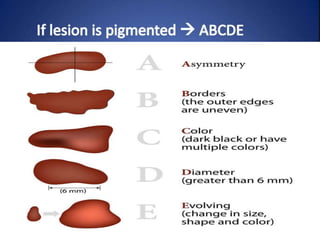
• A normal skin mole is tan, brown, or black.
• Moles are usually round and less than 1/4
inch (6 mm) in diameter.
• Symptoms of a skin lesion include a new
mole, and an old mole that has changed
shape, color, or size.
• Additional symptoms of a skin lesion
include skin lumps that increase in size,
bleed, ooze, contain blood vessels, or
become scaly or crusty.
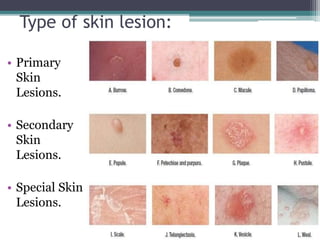
Type of skin lesion:
• Primary
Skin
Lesions.
• Secondary
Skin
Lesions.
• Special Skin
Lesions.
Primary lesions
• Primary Lesions: Those lesions that
are the direct result of a pathologic
process
Definition:
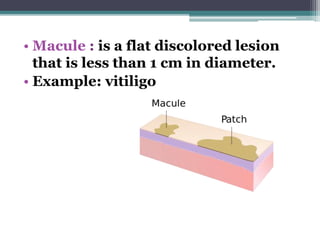
• Macule : is a flat discolored lesion
that is less than 1 cm in diameter.
• Example: vitiligo
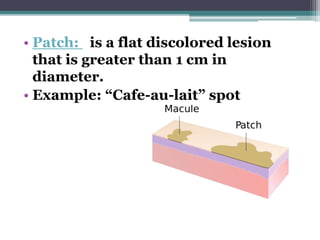
• Patch: is a flat discolored lesion
that is greater than 1 cm in
diameter.
• Example: “Cafe-au-lait” spot
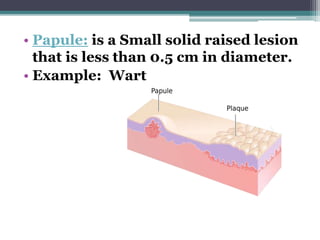
• Papule: is a Small solid raised lesion
that is less than 0.5 cm in diameter.
• Example: Wart
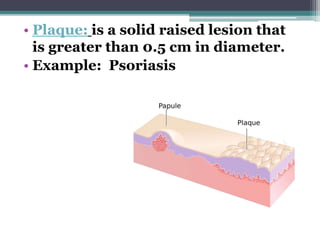
• Plaque: is a solid raised lesion that
is greater than 0.5 cm in diameter.
• Example: Psoriasis
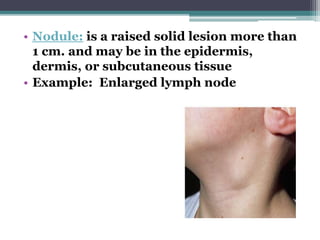
• Nodule: is a raised solid lesion more than
1 cm. and may be in the epidermis,
dermis, or subcutaneous tissue
• Example: Enlarged lymph node
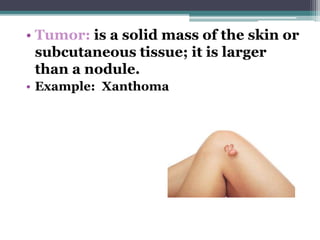
• Tumor: is a solid mass of the skin or
subcutaneous tissue; it is larger
than a nodule.
• Example: Xanthoma
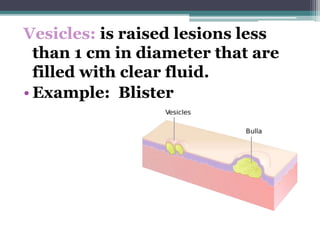
Vesicles: is raised lesions less
than 1 cm in diameter that are
filled with clear fluid.
• Example: Blister
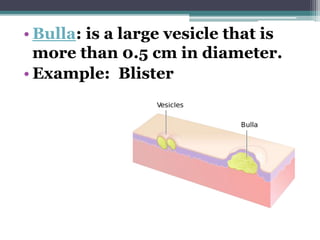
• Bulla: is a large vesicle that is
more than 0.5 cm in diameter.
• Example: Blister
• Pustule: is circumscribed elevated
lesions that contain pus, They are
most commonly infected but may be
sterile.
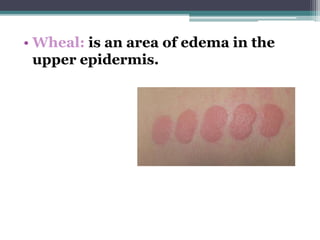
• Wheal: is an area of edema in the
upper epidermis.
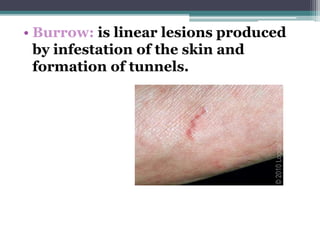
• Burrow: is linear lesions produced
by infestation of the skin and
formation of tunnels.
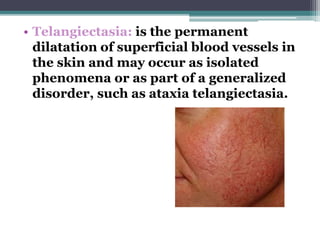
• Telangiectasia: is the permanent
dilatation of superficial blood vessels in
the skin and may occur as isolated
phenomena or as part of a generalized
disorder, such as ataxia telangiectasia.
Secondary Skin Lesions
Scale
Crust
Erosion
Fissure
Sinus
Scar
Atrophy
Lichenification
Scale
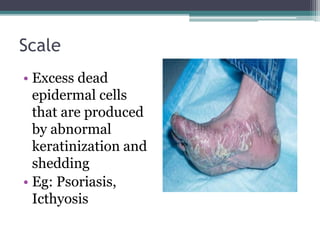
• Excess dead
epidermal cells
that are produced
by abnormal
keratinization and
shedding
• Eg: Psoriasis,
Icthyosis
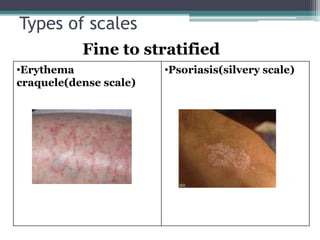
Types of scales
Fine to stratified
•Erythema
craquele(dense scale)
•Psoriasis(silvery scale)
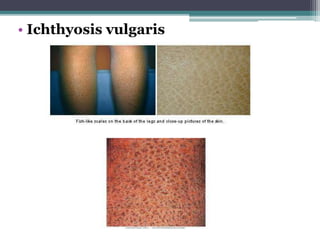
• Ichthyosis vulgaris
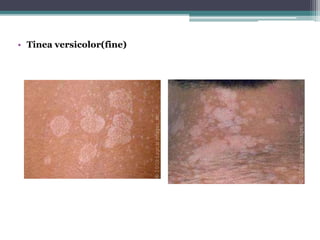
• Tinea versicolor(fine)
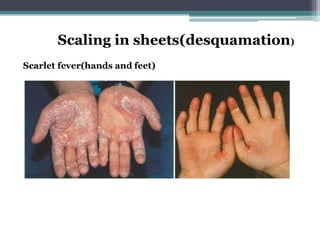
Scaling in sheets(desquamation)
Scarlet fever(hands and feet)
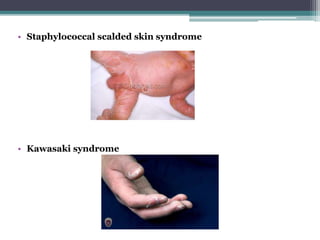
• Staphylococcal scalded skin syndrome
• Kawasaki syndrome
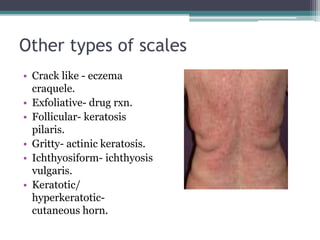
Other types of scales
• Crack like - eczema
craquele.
• Exfoliative- drug rxn.
• Follicular- keratosis
pilaris.
• Gritty- actinic keratosis.
• Ichthyosiform- ichthyosis
vulgaris.
• Keratotic/
hyperkeratotic-
cutaneous horn.
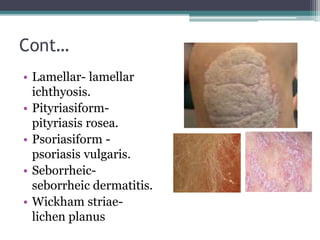
Cont…
• Lamellar- lamellar
ichthyosis.
• Pityriasiform-
pityriasis rosea.
• Psoriasiform -
psoriasis vulgaris.
• Seborrheic-
seborrheic dermatitis.
• Wickham striae-
lichen planus
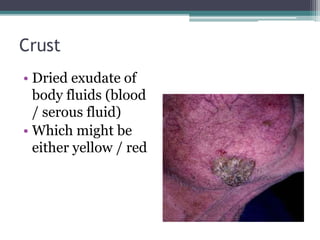
Crust
• Dried exudate of
body fluids (blood
/ serous fluid)
• Which might be
either yellow / red
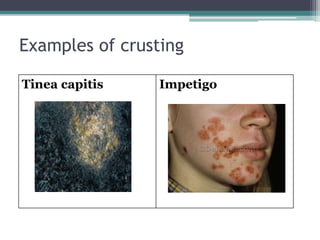
Examples of crusting
Tinea capitis Impetigo
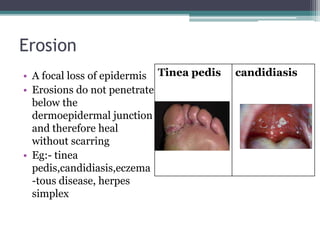
Erosion
• A focal loss of epidermis
• Erosions do not penetrate
below the
dermoepidermal junction
and therefore heal
without scarring
• Eg:- tinea
pedis,candidiasis,eczema
-tous disease, herpes
simplex
Tinea pedis candidiasis
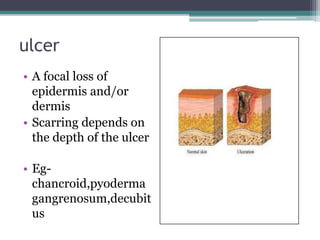
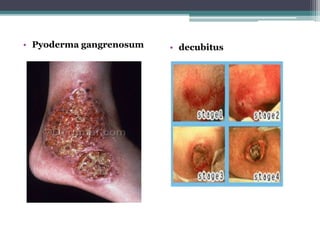
ulcer
• A focal loss of
epidermis and/or
dermis
• Scarring depends on
the depth of the ulcer
• Eg-
chancroid,pyoderma
gangrenosum,decubit
us
• Pyoderma gangrenosum • decubitus
Fissure
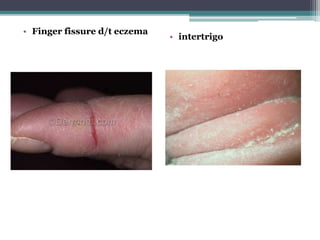
•It is a linear loss of continuity of
skin due to excessive tension.
•Eg:- eczema(fingertips),intertrigo
• Finger fissure d/t eczema
• intertrigo
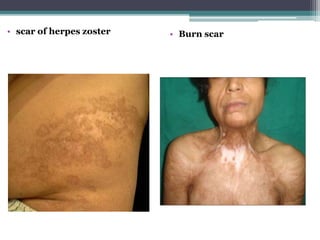
Scar
• It is replacement of normal skin by fibrous tissue
in the process of healing of damaged skin.
• Scars are of two types- hypertrophic and
atrophic.
• Eg:- acne, burns, herpes zoster, keloid
• scar of herpes zoster • Burn scar
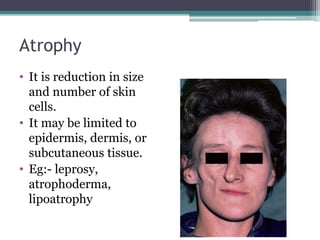
Atrophy
• It is reduction in size
and number of skin
cells.
• It may be limited to
epidermis, dermis, or
subcutaneous tissue.
• Eg:- leprosy,
atrophoderma,
lipoatrophy
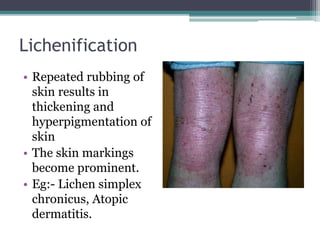
Lichenification
• Repeated rubbing of
skin results in
thickening and
hyperpigmentation of
skin
• The skin markings
become prominent.
• Eg:- Lichen simplex
chronicus, Atopic
dermatitis.
Vascular skin lesions
• Vascular lesions include acquired lesions (eg,
pyogenic granuloma) and those that are present
at birth or arise shortly after birth (vascular
birthmarks). Vascular birthmarks include
vascular tumors (eg, infantile hemangioma) and
vascular malformations. Vascular malformations
are congenital, life-long, localized defects in
vascular morphogenesis and include capillary
(eg, nevus flammeus), venous, arteriovenous (eg,
cirsoid aneurysm), and lymphatic
malformations.
definition of vascular lesion
• Vascular skin lesions are very common ,
occurring in about 40% all children 20% oh
hemangiomas are present at birth and most
begin in the first month of life
Type of vascular lesions
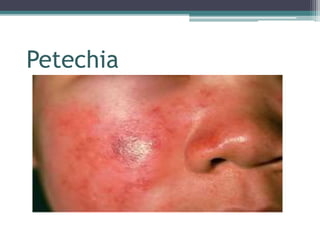
▫ Petechia
▫ Ecchymosis
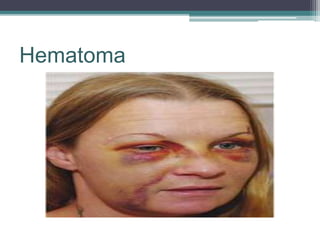
▫ Hematoma
▫ Cherry Angioma
▫ Spider Angioma
▫ Telangiectasis
Petechia
Ecchymosis
Hematoma
Spider Angioma
Causes and Characteristics
• Causes are unclear but thought to include:
• family history
• environmental factors such as sun exposure
• gender (women are affected more than men)
• age (usually appear between the ages of 40-50)
• Usually symptomless, benign condition not
associated with any complications
• Most often occur on feet, ankles, and lower legs
ASSESSING LESION
The skin shouId be a continuous tissue and so note breaks
erosions and lesions
Document localized and pigmenteg variations including moles
freckles and vascular lesion and examine them closely
Lesion solid or fluid filled
Fluid filled lesions have a yellow or pink glow whereas solid
lesions do not
Vascular lesions are red topurple in color They may be causded of
extra vasationof blood into the skin tissue or by visible
superficial vascular irregularities
Example the axillae are usually more moist than other areas
PALPATION
• Is used to determine skins temperature
texture and turgor.
Temperature
• Compare side to side using the dorsal
aspect of your hand
• Temperature varies depending on area
being assessed for example exposed areas
may be cooler than unexposed areas
MOISTURE• Use light palpation to assess skin moisture
• Dependson environmental condition and
patients age Elderly people have drier skin
because 0f decrease sweat production
• Exposed areas are usully drier than unexposed
areas Also moisture varies varies according to
body area
TEXTURE
• USELIGHT PALPATION TO ASSESS texture
• Varies fromsoft and fine to coarse and thick
depending on area assessed and patients age
Exposed skin usually not as soft as unexposed
• Extensor surfaces such as elbows ha coarser skin
• Usually the younger the patient the sofer the skin
Summery
• ●Most benign skin lesions are diagnosed on the
basis of clinical appearance and history. If the
diagnosis of a lesion is uncertain, or if a lesion has
exhibited unexpected changes in appearance or
symptoms, a diagnostic procedure (eg, biopsy,
excision) is indicated to confirm the diagnosis.
• ●Benign lesions that are symptomatic or
cosmetically bothersome can often be managed
with simple procedures, such as cryotherapy,
electrosurgery, or excision.
Reference
• http://www.healthline.com/health/tinea-
versicolor#Treatment6
• Medical surgical nursing
• http://www.webmd.com/
• http://missinglink.ucsf.edu/lm/DermatologyGlo
ssary/secondarylesions1a.html
• https://ar.wikipedia.org/wiki/%D8%A5%D9%8
3%D8%B2%D9%8A%D9%85%D8%A7
Secondary skin lesions

Secondary skin lesions

  • 1.
    Assessment of skinlesion Presented by: Abeer Alenzy, Amjad , Suaad , Smaher , Manar omar Supervisor: Miss.mary
  • 2.
    Objectives: at the endof the presentation , students will be able to: -know the type of skin lesions. -Differentiate between primary, secondary, vascular lesions. -Perform assessment of skin lesions.
  • 3.
    Out line: -definition ofskin lesions. -Types of skin lesions: primary , secondary , vascular skin lesions. -how to assess the lesions. -determine The normal and abnormal findings
  • 4.
    Introduction: • What isa skin lesion? • A skin lesion is any change in the normal character of your skin and may occur on any part of your body and cover a tiny or large area , can be singular or multiple, confined to one specific area of your body or distributed widely. • Skin lesions include rash, cysts, pus-filled sacs, blisters, swelling, discolorations, bumps, hardening, or any other change in or on your skin. • Skin lesions may result from a wide range of causes, as harmless as a small scrape or as serious as skin cancer.
  • 5.
    Skin Lesion Symptoms •A normal skin mole is tan, brown, or black. • Moles are usually round and less than 1/4 inch (6 mm) in diameter. • Symptoms of a skin lesion include a new mole, and an old mole that has changed shape, color, or size. • Additional symptoms of a skin lesion include skin lumps that increase in size, bleed, ooze, contain blood vessels, or become scaly or crusty.
  • 7.
    Type of skinlesion: • Primary Skin Lesions. • Secondary Skin Lesions. • Special Skin Lesions.
  • 8.
  • 9.
    • Primary Lesions:Those lesions that are the direct result of a pathologic process Definition:
  • 10.
    • Macule :is a flat discolored lesion that is less than 1 cm in diameter. • Example: vitiligo
  • 11.
    • Patch: isa flat discolored lesion that is greater than 1 cm in diameter. • Example: “Cafe-au-lait” spot
  • 12.
    • Papule: isa Small solid raised lesion that is less than 0.5 cm in diameter. • Example: Wart
  • 13.
    • Plaque: isa solid raised lesion that is greater than 0.5 cm in diameter. • Example: Psoriasis
  • 14.
    • Nodule: isa raised solid lesion more than 1 cm. and may be in the epidermis, dermis, or subcutaneous tissue • Example: Enlarged lymph node
  • 15.
    • Tumor: isa solid mass of the skin or subcutaneous tissue; it is larger than a nodule. • Example: Xanthoma
  • 16.
    Vesicles: is raisedlesions less than 1 cm in diameter that are filled with clear fluid. • Example: Blister
  • 17.
    • Bulla: isa large vesicle that is more than 0.5 cm in diameter. • Example: Blister
  • 18.
    • Pustule: iscircumscribed elevated lesions that contain pus, They are most commonly infected but may be sterile.
  • 19.
    • Wheal: isan area of edema in the upper epidermis.
  • 20.
    • Burrow: islinear lesions produced by infestation of the skin and formation of tunnels.
  • 21.
    • Telangiectasia: isthe permanent dilatation of superficial blood vessels in the skin and may occur as isolated phenomena or as part of a generalized disorder, such as ataxia telangiectasia.
  • 22.
  • 23.
    Scale • Excess dead epidermalcells that are produced by abnormal keratinization and shedding • Eg: Psoriasis, Icthyosis
  • 24.
    Types of scales Fineto stratified •Erythema craquele(dense scale) •Psoriasis(silvery scale)
  • 25.
  • 26.
  • 27.
  • 28.
    • Staphylococcal scaldedskin syndrome • Kawasaki syndrome
  • 29.
    Other types ofscales • Crack like - eczema craquele. • Exfoliative- drug rxn. • Follicular- keratosis pilaris. • Gritty- actinic keratosis. • Ichthyosiform- ichthyosis vulgaris. • Keratotic/ hyperkeratotic- cutaneous horn.
  • 30.
    Cont… • Lamellar- lamellar ichthyosis. •Pityriasiform- pityriasis rosea. • Psoriasiform - psoriasis vulgaris. • Seborrheic- seborrheic dermatitis. • Wickham striae- lichen planus
  • 31.
    Crust • Dried exudateof body fluids (blood / serous fluid) • Which might be either yellow / red
  • 32.
  • 33.
    Erosion • A focalloss of epidermis • Erosions do not penetrate below the dermoepidermal junction and therefore heal without scarring • Eg:- tinea pedis,candidiasis,eczema -tous disease, herpes simplex Tinea pedis candidiasis
  • 34.
    ulcer • A focalloss of epidermis and/or dermis • Scarring depends on the depth of the ulcer • Eg- chancroid,pyoderma gangrenosum,decubit us
  • 35.
  • 36.
    Fissure •It is alinear loss of continuity of skin due to excessive tension. •Eg:- eczema(fingertips),intertrigo
  • 37.
    • Finger fissured/t eczema • intertrigo
  • 38.
    Scar • It isreplacement of normal skin by fibrous tissue in the process of healing of damaged skin. • Scars are of two types- hypertrophic and atrophic. • Eg:- acne, burns, herpes zoster, keloid
  • 39.
    • scar ofherpes zoster • Burn scar
  • 40.
    Atrophy • It isreduction in size and number of skin cells. • It may be limited to epidermis, dermis, or subcutaneous tissue. • Eg:- leprosy, atrophoderma, lipoatrophy
  • 41.
    Lichenification • Repeated rubbingof skin results in thickening and hyperpigmentation of skin • The skin markings become prominent. • Eg:- Lichen simplex chronicus, Atopic dermatitis.
  • 42.
    Vascular skin lesions •Vascular lesions include acquired lesions (eg, pyogenic granuloma) and those that are present at birth or arise shortly after birth (vascular birthmarks). Vascular birthmarks include vascular tumors (eg, infantile hemangioma) and vascular malformations. Vascular malformations are congenital, life-long, localized defects in vascular morphogenesis and include capillary (eg, nevus flammeus), venous, arteriovenous (eg, cirsoid aneurysm), and lymphatic malformations.
  • 43.
    definition of vascularlesion • Vascular skin lesions are very common , occurring in about 40% all children 20% oh hemangiomas are present at birth and most begin in the first month of life
  • 44.
    Type of vascularlesions ▫ Petechia ▫ Ecchymosis ▫ Hematoma ▫ Cherry Angioma ▫ Spider Angioma ▫ Telangiectasis
  • 45.
  • 46.
  • 47.
  • 48.
  • 49.
    Causes and Characteristics •Causes are unclear but thought to include: • family history • environmental factors such as sun exposure • gender (women are affected more than men) • age (usually appear between the ages of 40-50) • Usually symptomless, benign condition not associated with any complications • Most often occur on feet, ankles, and lower legs
  • 50.
    ASSESSING LESION The skinshouId be a continuous tissue and so note breaks erosions and lesions Document localized and pigmenteg variations including moles freckles and vascular lesion and examine them closely Lesion solid or fluid filled Fluid filled lesions have a yellow or pink glow whereas solid lesions do not Vascular lesions are red topurple in color They may be causded of extra vasationof blood into the skin tissue or by visible superficial vascular irregularities Example the axillae are usually more moist than other areas
  • 51.
    PALPATION • Is usedto determine skins temperature texture and turgor.
  • 52.
    Temperature • Compare sideto side using the dorsal aspect of your hand • Temperature varies depending on area being assessed for example exposed areas may be cooler than unexposed areas
  • 53.
    MOISTURE• Use lightpalpation to assess skin moisture • Dependson environmental condition and patients age Elderly people have drier skin because 0f decrease sweat production • Exposed areas are usully drier than unexposed areas Also moisture varies varies according to body area
  • 54.
    TEXTURE • USELIGHT PALPATIONTO ASSESS texture • Varies fromsoft and fine to coarse and thick depending on area assessed and patients age Exposed skin usually not as soft as unexposed • Extensor surfaces such as elbows ha coarser skin • Usually the younger the patient the sofer the skin
  • 55.
    Summery • ●Most benignskin lesions are diagnosed on the basis of clinical appearance and history. If the diagnosis of a lesion is uncertain, or if a lesion has exhibited unexpected changes in appearance or symptoms, a diagnostic procedure (eg, biopsy, excision) is indicated to confirm the diagnosis. • ●Benign lesions that are symptomatic or cosmetically bothersome can often be managed with simple procedures, such as cryotherapy, electrosurgery, or excision.
  • 56.
    Reference • http://www.healthline.com/health/tinea- versicolor#Treatment6 • Medicalsurgical nursing • http://www.webmd.com/ • http://missinglink.ucsf.edu/lm/DermatologyGlo ssary/secondarylesions1a.html • https://ar.wikipedia.org/wiki/%D8%A5%D9%8 3%D8%B2%D9%8A%D9%85%D8%A7