UNIVERSIDAD TECNICA DE AMBATO
FACULTAD DE CIENCIAS HUMANAS Y DE LA
EDUCACIÓN
CARRERA DE IDIOMAS
“LANGUAGE TEACHING AND STRATEGIES”
CHAPTER II
PRESENTATION:
SECOND LANGUAGE ACQUISITION THEORY
• NAME: Viviana Manobanda
• COURSE: 6th semester
WHAT IS A SLA THEORY?
• “Second language acquisition is the scholarly field of
inquiry that investigates the human capacity to learn
languages other than the first, during late childhood,
adolescence or adulthood, and once the first language or
languages have been acquired” (Ortega, 2009) .
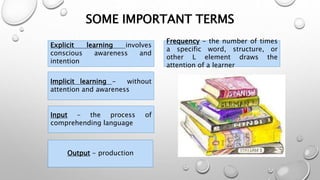
SOME IMPORTANT TERMS
Explicit learning involves
conscious awareness and
intention
Implicit learning - without
attention and awareness
Input – the process of
comprehending language
Output - production
Frequency – the number of times
a specific word, structure, or
other L element draws the
attention of a learner
A) FIVE HYPOTHESES ON SECOND LANGUAGE
ACQUISITION
1. THE ACQUISITION LEARNING HYPOTHESIS
2. THE NATURAL ORDER HYPOTHESIS
3. THE MONITOR HYPOTHESIS
4. THE INPUT HYPOTHESIS
5. THE AFFECTIVE FILTER HYPOTHESIS
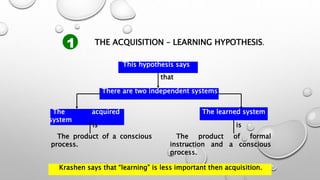
THE ACQUISITION – LEARNING HYPOTHESIS.
This hypothesis says
that
There are two independent systems
The learned systemThe acquired
system
is
The product of formal
instruction and a conscious
process.
is
The product of a conscious
process.
Krashen says that “learning” is less important then acquisition.
THE ACQUISITION-LEARNING HYPOTHESIS
• ACQUISITION = SUBCONSCIOUSLY PICKING UP
• LEARNING = CONSCIOUS
• ERROR CORRECTION
• EXPLICIT INSTRUCTION
• CHILDREN ACQUIRE LANGUAGE BETTER THAN ADULTS.
.
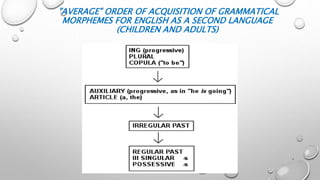
THE NATURAL ORDER HYPOTHESIS.
• Grammar structures are acquired in a predictable
order.
• L2 learning order is different from L1 order.
• L2 learning adults and children show similar order.
"AVERAGE" ORDER OF ACQUISITION OF GRAMMATICAL
MORPHEMES FOR ENGLISH AS A SECOND LANGUAGE
(CHILDREN AND ADULTS)
8
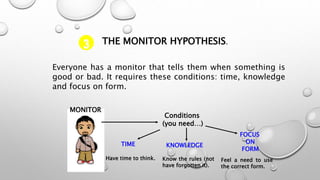
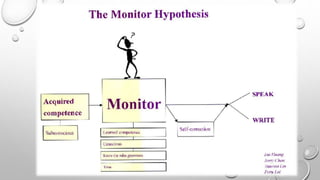
THE MONITOR HYPOTHESIS.
Everyone has a monitor that tells them when something is
good or bad. It requires these conditions: time, knowledge
and focus on form.
MONITOR
Conditions
(you need…)
TIME KNOWLEDGE
FOCUS
ON
FORM
Have time to think. Know the rules (not
have forgotten it).
Feel a need to use
the correct form.
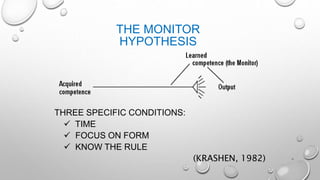
THE MONITOR
HYPOTHESIS
THREE SPECIFIC CONDITIONS:
 TIME
 FOCUS ON FORM
 KNOW THE RULE
(KRASHEN, 1982) 10
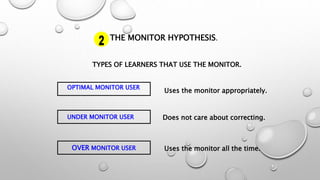
THE MONITOR HYPOTHESIS.
TYPES OF LEARNERS THAT USE THE MONITOR.
OPTIMAL MONITOR USER
Uses the monitor appropriately.
UNDER MONITOR USER Does not care about correcting.
OVER MONITOR USER Uses the monitor all the time.
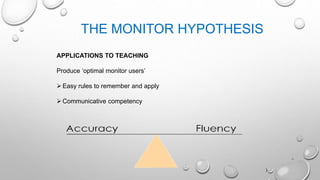
THE MONITOR HYPOTHESIS
APPLICATIONS TO TEACHING
Produce ‘optimal monitor users’
 Easy rules to remember and apply
 Communicative competency
)
12
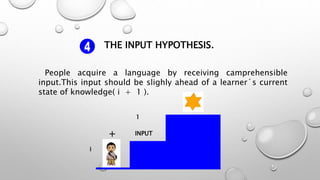
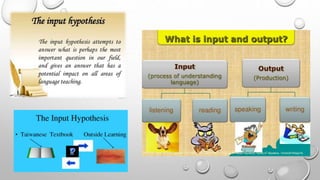
THE INPUT HYPOTHESIS.
People acquire a language by receiving camprehensible
input.This input should be slighly ahead of a learner´s current
state of knowledge( i + 1 ).
+ INPUT
1
i
16
THE AFFECTIVE FILTER HYPOTHESIS.
When the learner is experiencing high anxiaty, low-steem or
low motivation, the filter turns on and causes the learner to
block out input.
INPUT INPUT
MOTIVATION
SELF - STEEM
ANXIATY
FILTER
HIGH
FILTER
LOW
MOTIVATION
SELF - STEEM
ANXIATY
THE AFFECTIVE FILTER HYPOTHESIS
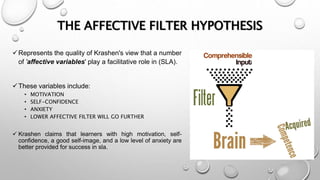
Represents the quality of Krashen's view that a number
of 'affective variables' play a facilitative role in (SLA).
These variables include:
• MOTIVATION
• SELF-CONFIDENCE
• ANXIETY
• LOWER AFFECTIVE FILTER WILL GO FURTHER
 Krashen claims that learners with high motivation, self-
confidence, a good self-image, and a low level of anxiety are
better provided for success in sla.
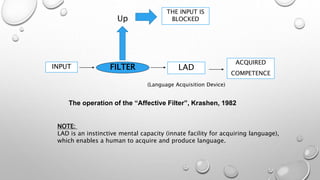
FILTER LAD
(Language Acquisition Device)
ACQUIRED
COMPETENCE
The operation of the “Affective Filter”, Krashen, 1982
Up
INPUT
THE INPUT IS
BLOCKED
NOTE:
LAD is an instinctive mental capacity (innate facility for acquiring language),
which enables a human to acquire and produce language.
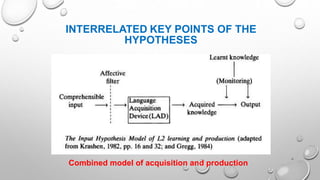
INTERRELATED KEY POINTS OF THE
HYPOTHESES
Combined model of acquisition and production
20
B. THE CAUSATIVE VARIABLE IN SECOND
LANGUAGE ACQUISITION
• COMPREHENSIBLE INPUT (CAUSATIVE)
• STRENGTH OF THE FILTER (CAUSATIVE)
• LANGUAGE TEACHING
• EXPOSURE VARIABLE
• AGE
• ACCULTURATION
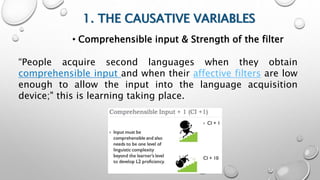
1. THE CAUSATIVE VARIABLES
• Comprehensible input & Strength of the filter
“People acquire second languages when they obtain
comprehensible input and when their affective filters are low
enough to allow the input into the language acquisition
device;" this is learning taking place.
2.- LANGUAGE TEACHING: DOES IT HELP?
• The more we know about language and language
learning, the more informed decisions we make about
language teaching.
3.- EXPOSURE VARIABLE
 THERE IS NO VARIATION IN THE ACQUISITION PROCESS ITSELF, BUT
THERE IS IN:
1. The rate and the extent acquisition as a result of the amount of
comprehensible input received, and the strength of the affective filter.
2. Performance, brought about by the extent of the learner’s
reliance on ‘learnt’ knowledge.
3 TYPES OF MONITOR USERS:
1. Over-users
2. Under-users
3. Optimal users (i.e. those who apply conscious knowledge when it
is appropriate.
4.- AGE
 Affects the amount of comprehensible input that is obtained
 Influences the affective state of the learner
 After puberty the affective filter is likely to increase in strength.
 Younger learners may get more than older learners.
 Age also affects ‘learning’; older learners are better in studying
language form and using ‘learnt’ knowledge in monitoring.
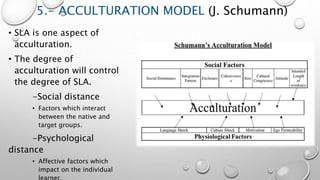
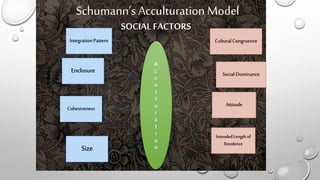
5.- ACCULTURATION MODEL (J. Schumann)
• SLA is one aspect of
acculturation.
• The degree of
acculturation will control
the degree of SLA.
-Social distance
• Factors which interact
between the native and
target groups.
-Psychological
distance
• Affective factors which
impact on the individual
Schumann’s Acculturation Model
A
c
c
u
l
t
u
r
a
t
i
o
n
CulturalCongruenceIntegrationPattern
Enclosure
Cohesiveness
Size
SocialDominance
Attitude
IntendedLength of
Residence
SOCIAL FACTORS
REFERENCES
• KRASHEN, STEPHEN D. PRINCIPLES AND PRACTICE IN
SECOND LANGUAGE ACQUISITION. NEW YORK, NY:
PRENTICE HALL, 1987.

SECOND LANGUAGE ACQUISITION THEORY

  • 1.
    UNIVERSIDAD TECNICA DEAMBATO FACULTAD DE CIENCIAS HUMANAS Y DE LA EDUCACIÓN CARRERA DE IDIOMAS “LANGUAGE TEACHING AND STRATEGIES” CHAPTER II PRESENTATION: SECOND LANGUAGE ACQUISITION THEORY • NAME: Viviana Manobanda • COURSE: 6th semester
  • 2.
    WHAT IS ASLA THEORY? • “Second language acquisition is the scholarly field of inquiry that investigates the human capacity to learn languages other than the first, during late childhood, adolescence or adulthood, and once the first language or languages have been acquired” (Ortega, 2009) .
  • 3.
    SOME IMPORTANT TERMS Explicitlearning involves conscious awareness and intention Implicit learning - without attention and awareness Input – the process of comprehending language Output - production Frequency – the number of times a specific word, structure, or other L element draws the attention of a learner
  • 4.
    A) FIVE HYPOTHESESON SECOND LANGUAGE ACQUISITION 1. THE ACQUISITION LEARNING HYPOTHESIS 2. THE NATURAL ORDER HYPOTHESIS 3. THE MONITOR HYPOTHESIS 4. THE INPUT HYPOTHESIS 5. THE AFFECTIVE FILTER HYPOTHESIS
  • 5.
    THE ACQUISITION –LEARNING HYPOTHESIS. This hypothesis says that There are two independent systems The learned systemThe acquired system is The product of formal instruction and a conscious process. is The product of a conscious process. Krashen says that “learning” is less important then acquisition.
  • 6.
    THE ACQUISITION-LEARNING HYPOTHESIS •ACQUISITION = SUBCONSCIOUSLY PICKING UP • LEARNING = CONSCIOUS • ERROR CORRECTION • EXPLICIT INSTRUCTION • CHILDREN ACQUIRE LANGUAGE BETTER THAN ADULTS.
  • 7.
    . THE NATURAL ORDERHYPOTHESIS. • Grammar structures are acquired in a predictable order. • L2 learning order is different from L1 order. • L2 learning adults and children show similar order.
  • 8.
    "AVERAGE" ORDER OFACQUISITION OF GRAMMATICAL MORPHEMES FOR ENGLISH AS A SECOND LANGUAGE (CHILDREN AND ADULTS) 8
  • 9.
    THE MONITOR HYPOTHESIS. Everyonehas a monitor that tells them when something is good or bad. It requires these conditions: time, knowledge and focus on form. MONITOR Conditions (you need…) TIME KNOWLEDGE FOCUS ON FORM Have time to think. Know the rules (not have forgotten it). Feel a need to use the correct form.
  • 10.
    THE MONITOR HYPOTHESIS THREE SPECIFICCONDITIONS:  TIME  FOCUS ON FORM  KNOW THE RULE (KRASHEN, 1982) 10
  • 11.
    THE MONITOR HYPOTHESIS. TYPESOF LEARNERS THAT USE THE MONITOR. OPTIMAL MONITOR USER Uses the monitor appropriately. UNDER MONITOR USER Does not care about correcting. OVER MONITOR USER Uses the monitor all the time.
  • 12.
    THE MONITOR HYPOTHESIS APPLICATIONSTO TEACHING Produce ‘optimal monitor users’  Easy rules to remember and apply  Communicative competency ) 12
  • 14.
    THE INPUT HYPOTHESIS. Peopleacquire a language by receiving camprehensible input.This input should be slighly ahead of a learner´s current state of knowledge( i + 1 ). + INPUT 1 i
  • 16.
  • 17.
    THE AFFECTIVE FILTERHYPOTHESIS. When the learner is experiencing high anxiaty, low-steem or low motivation, the filter turns on and causes the learner to block out input. INPUT INPUT MOTIVATION SELF - STEEM ANXIATY FILTER HIGH FILTER LOW MOTIVATION SELF - STEEM ANXIATY
  • 18.
    THE AFFECTIVE FILTERHYPOTHESIS Represents the quality of Krashen's view that a number of 'affective variables' play a facilitative role in (SLA). These variables include: • MOTIVATION • SELF-CONFIDENCE • ANXIETY • LOWER AFFECTIVE FILTER WILL GO FURTHER  Krashen claims that learners with high motivation, self- confidence, a good self-image, and a low level of anxiety are better provided for success in sla.
  • 19.
    FILTER LAD (Language AcquisitionDevice) ACQUIRED COMPETENCE The operation of the “Affective Filter”, Krashen, 1982 Up INPUT THE INPUT IS BLOCKED NOTE: LAD is an instinctive mental capacity (innate facility for acquiring language), which enables a human to acquire and produce language.
  • 20.
    INTERRELATED KEY POINTSOF THE HYPOTHESES Combined model of acquisition and production 20
  • 21.
    B. THE CAUSATIVEVARIABLE IN SECOND LANGUAGE ACQUISITION • COMPREHENSIBLE INPUT (CAUSATIVE) • STRENGTH OF THE FILTER (CAUSATIVE) • LANGUAGE TEACHING • EXPOSURE VARIABLE • AGE • ACCULTURATION
  • 22.
    1. THE CAUSATIVEVARIABLES • Comprehensible input & Strength of the filter “People acquire second languages when they obtain comprehensible input and when their affective filters are low enough to allow the input into the language acquisition device;" this is learning taking place.
  • 23.
    2.- LANGUAGE TEACHING:DOES IT HELP? • The more we know about language and language learning, the more informed decisions we make about language teaching.
  • 24.
    3.- EXPOSURE VARIABLE THERE IS NO VARIATION IN THE ACQUISITION PROCESS ITSELF, BUT THERE IS IN: 1. The rate and the extent acquisition as a result of the amount of comprehensible input received, and the strength of the affective filter. 2. Performance, brought about by the extent of the learner’s reliance on ‘learnt’ knowledge. 3 TYPES OF MONITOR USERS: 1. Over-users 2. Under-users 3. Optimal users (i.e. those who apply conscious knowledge when it is appropriate.
  • 25.
    4.- AGE  Affectsthe amount of comprehensible input that is obtained  Influences the affective state of the learner  After puberty the affective filter is likely to increase in strength.  Younger learners may get more than older learners.  Age also affects ‘learning’; older learners are better in studying language form and using ‘learnt’ knowledge in monitoring.
  • 26.
    5.- ACCULTURATION MODEL(J. Schumann) • SLA is one aspect of acculturation. • The degree of acculturation will control the degree of SLA. -Social distance • Factors which interact between the native and target groups. -Psychological distance • Affective factors which impact on the individual
  • 27.
  • 28.
    REFERENCES • KRASHEN, STEPHEND. PRINCIPLES AND PRACTICE IN SECOND LANGUAGE ACQUISITION. NEW YORK, NY: PRENTICE HALL, 1987.