Name:                                                     (    ) Class:

                      CRESCENT GIRLS' SCHOOL
                           Secondary Two
                        Mid-Year Examination
                              HISTORY
                                   5 May 2008                    Total: 60 Marks

                                                                       1 hr 45 mins


INSTRUCTIONS TO STUDENTS

Do not turn over this paper until you are told to do so.


Write your name, index number and class in the spaces provided at the top of
this page and on all separate answer sheets used.

You must answer ALL parts of Section A and Section B.

You must answer 1 out of 2 questions of Section C.

Begin each section on a FRESH sheet of paper.

If you use more than one sheet of paper, fasten the sheets together.

The number of marks is given in brackets [ ] at the end
of each part question.


Additional Material
Answer sheet for Section A


______________________________________________________________________

        This paper consists of 11 printed pages (including the cover page).


                                        1
Section A
                         Multiple Choice Questions [22m]
     Answer all questions and write your answers on the answer sheet provided

1.      In the 14th century, Temasek was known by various historical sources as a
        _____________.
             I.   fishing village
          II.     centre of Islamic learning
         III.     well known trading centre
         IV.      Melaka Sultanate province


        A         I and II
        B         I and III
        C         II and III
        D         III and IV


2.      Raffles recognised __________ as the Sultan of Johor and signed the
        treaty in 1819.

        A         Tengku Hussein
        B         Tengku Mahmud
        C         Tengku Abdul Rahman
        D         Temenggong Abdul Rahman


3.      The British had two ports in Southeast Asia before 1819. They were
         __________.
        A         Penang and Melaka
        B         Bencoolen and Melaka
        C         Penang and Bencoolen
         D        Penang and Palembang


                                               2
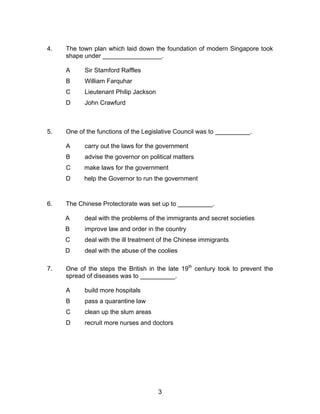
4.   The town plan which laid down the foundation of modern Singapore took
     shape under _________________.

     A     Sir Stamford Raffles
     B     William Farquhar
     C     Lieutenant Philip Jackson
     D     John Crawfurd


5.   One of the functions of the Legislative Council was to __________.

     A     carry out the laws for the government
     B     advise the governor on political matters
     C     make laws for the government
     D     help the Governor to run the government


6.   The Chinese Protectorate was set up to __________.

     A     deal with the problems of the immigrants and secret societies
     B     improve law and order in the country
     C     deal with the ill treatment of the Chinese immigrants
     D     deal with the abuse of the coolies

7.   One of the steps the British in the late 19th century took to prevent the
     spread of diseases was to __________.

     A     build more hospitals
     B     pass a quarantine law
     C     clean up the slum areas
     D     recruit more nurses and doctors


                                       3
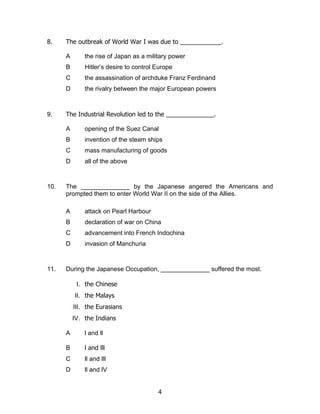
8.    The outbreak of World War I was due to ____________.

      A       the rise of Japan as a military power
      B       Hitler’s desire to control Europe
      C       the assassination of archduke Franz Ferdinand
      D       the rivalry between the major European powers


9.    The Industrial Revolution led to the ______________.

      A       opening of the Suez Canal
      B       invention of the steam ships
      C       mass manufacturing of goods
      D       all of the above


10.   The ______________ by the Japanese angered the Americans and
      prompted them to enter World War II on the side of the Allies.

      A       attack on Pearl Harbour
      B       declaration of war on China
      C       advancement into French Indochina
      D       invasion of Manchuria


11.   During the Japanese Occupation, ______________ suffered the most.

           I. the Chinese
          II. the Malays
          III. the Eurasians
          IV. the Indians

      A       l and ll

      B       l and lll
      C       ll and lll
      D       ll and lV


                                         4
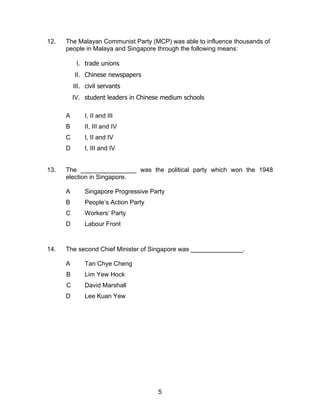
12.   The Malayan Communist Party (MCP) was able to influence thousands of
      people in Malaya and Singapore through the following means:

           I. trade unions
          II. Chinese newspapers
          III. civil servants
          IV. student leaders in Chinese medium schools

      A       I, II and III
      B       II, III and IV
      C       I, II and IV
      D       I, III and IV


13.   The ________________ was the political party which won the 1948
      election in Singapore.

      A       Singapore Progressive Party
      B       People’s Action Party
      C       Workers’ Party
      D       Labour Front


14.   The second Chief Minister of Singapore was _______________.

      A       Tan Chye Cheng
      B       Lim Yew Hock
      C       David Marshall
      D       Lee Kuan Yew


                                       5
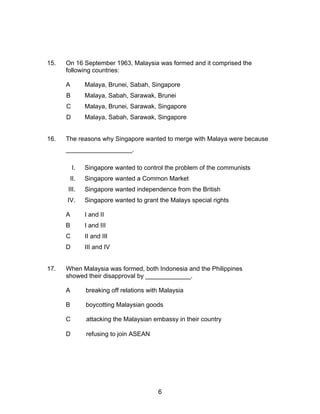
15.   On 16 September 1963, Malaysia was formed and it comprised the
      following countries:

      A        Malaya, Brunei, Sabah, Singapore
      B        Malaya, Sabah, Sarawak, Brunei
      C        Malaya, Brunei, Sarawak, Singapore
      D        Malaya, Sabah, Sarawak, Singapore


16.   The reasons why Singapore wanted to merge with Malaya were because
      ___________________.

          I.   Singapore wanted to control the problem of the communists
       II.     Singapore wanted a Common Market
      III.     Singapore wanted independence from the British
      IV.      Singapore wanted to grant the Malays special rights

      A        I and II
      B        I and III
      C        II and III
      D        III and IV


17.   When Malaysia was formed, both Indonesia and the Philippines
      showed their disapproval by _____________.

      A        breaking off relations with Malaysia

      B        boycotting Malaysian goods

      C        attacking the Malaysian embassy in their country

      D        refusing to join ASEAN


                                         6
18. The separation of Singapore from Malaysia was the result of:

        I. the Singapore loan to Sabah and Sarawak
       II. the Malaysian Solidarity Convention
       III. the Indonesian Konfrontasi
       IV. the racial riots of 1964

   A       I and II

   B       II and III

   C       II and IV

   D       I and III


19. World War I started due to the secret treaties signed amongst the
    following groups of countries:

   A       Russia, Germany & France; Britain, Italy & Austria-Hungary

   B       The United States of America, Britain & France; Japan, Germany &
           Italy

   C       Austria-Hungary, Germany & France; Britain, Russia & the
           United States of America

   D       Britain, France & Russia; Germany, Austria-Hungary & Italy


20. The main reason for the Japanese conquest of Asia was to
    ___________.

   A       to retaliate against the United States of America for stopping their
           supply of oil to them

   B       to obtain coal, iron and other raw materials for their homeland

   C       to create a better life for the people of Asia

   D       to free the Asian people from their European masters


                                       7
21.   The British were not able to stop the Japanese from taking over Malaya
      and Singapore because

           I. Britain was channeling a lot of resources to the war in Europe

          II. the British did not act on the advice given by their intelligence
              service

          III. the British did not adequately prepare for a Japanese attack via the
               sea

          IV. the Japanese had a superior air force and navy

      A       I and II

      B       I and IV

      C       II and III

      D       II and IV


22.   1959 was significant in Singapore’s political history because Singapore
       __________.

      A       was given limited self-government

      B       became part of Malaysia

      C       gained independence

      D       achieved full self-government


                                          8
Section B
                Compulsory Source-Based Questions [25 marks]

23. Syonan-to: The Years of Japanese Occupation
Read and examine the sources carefully and answer all the questions that follow.


Source A: The following extract explains why the Japanese arrested
          the Chinese in Singapore.

Many Chinese in Syonan-to have been in sympathy with the government in China, and
many of them supported the Chinese government in China. Moreover, they have helped
the British Army, forming volunteer corps and secretly sabotaging the military activities of
the Japanese Army. Thus, it is most important to sweep away these disloyal Chinese
elements and to establish peace and promote the welfare of the population. However,
many Chinese continued to resist the Japanese rule in their own secret ways.
.

Source B: An extract about the ‘Sook Ching’ campaign carried out by the
Japanese in Singapore.

On 18 February 1942, all Chinese males between the ages of 18 and 50 were ordered to
report to various screening centres for examination. The order, the brainchild of Colonel
Masanobu Tsuji and issued by the Japanese 25th Army, was carried out all over the
island. There were 28 centres in all. At some centres, there were hooded men before
whom the people had to march past. If any of the hooded men nodded his head, the
person so marked would be marched off to a parked lorry nearby. The men in the lorries
were taken to remote areas such as Punggol, Changi and Bedok where they were shot.
The Chinese did not know if they would still be alive the following month, as so many of
them were executed.


Source C: An oral history account by a survivor, Soon Kim Seng.

People would be wondering when their turn would be for the Kempeitai to come and take
them away. All someone needed to do was to spread a false rumour or say something
about somebody and the Kempeitai would look out for that person and say, ‘Oh, you are
pro-British, pro-American or pro-China, or you are a black marketeer.’ They would
accuse you of anything and they could just come and take you away for questioning and
detain you. This happened regardless of one’s skin colour or faith.


                                             9
Source D: The drawing below was done by a Chinese who lived through
          the Japanese Occupation.


(a) Study Source A
        What does the source tell you about the attitude of the [5]
        Japanese towards the Chinese in Singapore during the
        Japanese Occupation? Explain your answer.

(b) Study Sources B and C
        How different are the two sources in describing how the [7]
        Japanese maintained law and order in Singapore? Explain
        your answer.

(c) Study Source C
        How reliable is the source in telling us about the plight of the [6]
        people in Singapore during the Japanese Occupation? Explain
        your answer.

(d) Study Source D
        How useful is the source in telling us about how the people in [7]
        Singapore have to behave during the Syonan years? Explain
        your answer.


                                       10
Section C
                     Structured Essay Question [13 marks]

24. Answer only 1 of the questions below and write your answers on the writing
paper provided.


a.     Singapore before World War II

“The Chinese immigrants contributed the most to the development of Singapore before
 the onset of the Second World War.” Do you agree? Explain your answer.
                                                                              [13m]


b.     Post-war Situation in Singapore

“The Maria Hertogh Riots was the worst riot in Singapore after 1945.” Do you agree?
Explain your answer.
                                                                                [13m]


                                       The End


Acknowledgement:
Source A: Adapted from: The Japanese Occupation of Malaya, 1941-1945, by
Paul H.Kratoska
Source B: Adapted from: Sook Ching: An Oral History Publication, by the National
Archives of Singapore
Source C: Adapted from: A Battle to be Remembered: Oral History extracts of
War-time Singapore, by the National Archives of Singapore.
Source D: Taken from: The Japanese Occupation 1942-1945, by Tan Beng Luan
and Irene Quah.


                                          11
Crescent Girls’ School Modular Examination 2008
Sec Two
History

Name: ___________________________________ (           )
Class: _________

Section A – Answer Sheet

Please write your answers for the Multiple Choice Questions on this sheet.

1
2
3
4
5
6
7
8
9
10
11
12
13
14
15
16
17
18
19
20
21
22


                                       12
Answer Scheme (60 MARKS)

Section A – Multiple Choice Questions (22 MARKS)
1. B
2. A
3. C
4. D
5. C
6. A
7. B
8. C
9. D
10. A
11. B
12. C
13. A
14. B
15. D
16. C
17. A
18. C
19. D
20. B
21. B
22. D


Section B – Source based Question (25 MARKS)

23. Answer all questions and write your answers on the writing paper provided


(a) Study Source A
        What does the source tell you about the attitude of the [5]
        Japanese towards the Chinese in Singapore during the
        Japanese Occupation? Explain your answer.
L1        Inference unsupported
1m        The Japanese wanted to maintain peace and order in Singapore.

          The Japanese disliked how the Chinese in Singapore feel for China.
L2        2 inferences, supported with source content
2-3m      (2m for 1 inference, 3m for 2 inferences)


L3        2 Inferences, supported with contextual knowledge
3-4m      (3m for 1 inference, 4m for 2 inference)


                                          13
L4         L3 + Purpose
5m


(b) Study Sources B and C
 How different are the two sources in describing how the [7]
Japanese maintain law and order in Singapore? Explain your
answer.


L1            Answers based on similarity or /and difference in provenance
[1]           Award 1 mark for 1 similarity and 1 difference in provenance/topic identified
L2            Answers bring out similarities OR/AND differences in content, unsupported
[2-3]         Award 2 marks for 1 similarity OR 1 difference identified
              Award 3 marks for 1 more similarity or difference identified

              Similarity
              The sources are similar with regard to the fear the people in Singapore felt
              under the Japanese.

              Difference
              The sources are different with regard to who fell victim to the Japanese
              during the Occupation.

              The sources are different with regard to how organized the Japanese were in
              the way they dealt with people in Singapore.
L3            Answers bring out similarities OR differences in content, supported
[4]           Award 4 marks for 1 similarity or 1 difference with source details


L4            Both elements of L3 supported
[5-6]         Award 5 marks for 1 similarity and 1 difference with source details
              Award 6 marks for additional point with source details
L5            L4 + Purpose
[7]


(c) Study Source C
        How reliable is the source in telling us about the plight of the [6]
        people in Singapore during the Japanese Occupation? Explain
        your answer.
L1
[1]     Reliable AND/OR unreliable, unsupported /

        OR Uncritical acceptance of source provenance/content

        e.g. Reliable – The source is reliable as it is the real life account of someone
        who survived the Occupation.

        e.g. Unreliable – The source is unreliable as it is only the perspective of only
        one person who had gone through the Occupation.


                                            14
L2
[2-3]    Reliable OR unreliable, supported/cross reference
         2m for 1 point explained.
         3m for 2 points explained.

L3
[4-5]    Both elements of L3 – Reliable AND unreliable, supported/cross reference
         4m for reliable & unreliable, explained.
         5m for 1 more point, explained

L4
[6]      L3 + Explicit consideration of reliability through purpose, supported


(d) Study Source D
        How useful is the source in telling us about how the people in [7]
        Singapore have to behave during the Syonan years? Explain your
        answer.
L1       Answers based on provenance
[1]
         Eg. This source is taken from the drawing of a survivor of the Occupation.

L2       Answers based on typicality OR unsupported
[2]
         Yes
         Eg. The source is useful because the drawing is a depiction of what happened
         during the Syonan years, done by someone who had gone through the period of
         Occupation.

         No
         Eg. The source is not useful because the source does not tell me about how the
         people behaved in other situations.

L3       Answers Useful OR Not Useful
[3-4]    Award 3 marks for either Useful OR Not useful and 4 marks for further details.

L4       L3 + Useful AND Not Useful
[5-6]    Award 5 marks for Useful AND Not Useful.
         Award 6 marks for additional point.
L5       L4 + Purpose
[7]


Section C – Structured Essay Question (13 Marks)

24.
a.      Singapore before World War II

“The Chinese immigrants contributed the most to the development of Singapore before
 the onset of the Second World War.” Do you agree? Explain your answer.
                                                                              [13m]


                                             15
Level 1          Unsupported (dis)agreement
[1]              E.g. I agree because the the Chinese were the biggest community in Singapore
                 thus they were able to contribute most to Singapore’s development.

                 OR

                 E.g. I disagree because the other communities were able to contribute to the
                 different aspects of Singapore’s economy.


Level 2          Describes the topic but not addressing the statement (No explanation)
[2-3]


Level 3          Agrees with the statement and explains why
[4-6]            OR
                 Disagrees with the statement and explains why
                 Based on a scale of 1-3 where
                 1(weak) - 2(average)- 3(sound)

                 Award
                    - 6m for sound explanation (3)
                    - 5m for average explanation (2)
                    - 4m for weak explanation (1)

                 *always award the highest mark as a starting point until you are convinced
                 the answer is not deserving of the highest mark.

Level 4          Both aspects of L3
[7-11]
                 W= weak explanation
                 S= sound explanation

                  7              W (for) + W (against)
                  8              W (for/against) + S (for/against)
                  9              S (for) + S (against) or 2W (for/against) + 1W (for/against)
                  10             (2S + 1W) or (2W +1S)
                  11             (2S + 1S) or (1S + 3W)

Level 5          As L4 but reaches a balanced conclusion explicitly addressing ‘how far?’
[12-13]


b.        Post-war Situation in Singapore

“The Maria Hertogh Riots was the worst riot in Singapore after 1945.” Do you agree?
Explain your answer.
                                                                                [13m]

Level 1          Unsupported (dis)agreement
[1]              E.g. I agree because the Maria Hertogh Riot caused bloodshed between the
                 Muslim and the European communities in Singapore.


                                              16
OR

          E.g. I disagree because there were other very serious unrests in Singapore after
          the Second World War.


Level 2   Describes the topic but not addressing the statement (No explanation)
[2-3]


Level 3   Agrees with the statement and explains why
[4-6]     OR
          Disagrees with the statement and explains why


          Based on a scale of 1-3 where
          1(weak) - 2(average)- 3(sound)

          Award
             - 6m for sound explanation (3)
             - 5m for average explanation (2)
             - 4m for weak explanation (1)

          *always award the highest mark as a starting point until you are convinced
          the answer is not deserving of the highest mark.

Level 4   Both aspects of L3
[7-11]
          W= weak explanation
          S= sound explanation

           7              W (for) + W (against)
           8              W (for/against) + S (for/against)
           9              S (for) + S (against) or 2W (for/against) + 1W (for/against)
           10             (2S + 1W) or (2W +1S)
           11             (2S + 1S) or (1S + 3W)

Level 5   As L4 but reaches a balanced conclusion explicitly addressing ‘how far?’
[12-13]


                                       17

Sec 2 Hist Mye 08 (Qn & Ans For Sharing)

  • 1.
    Name: ( ) Class: CRESCENT GIRLS' SCHOOL Secondary Two Mid-Year Examination HISTORY 5 May 2008 Total: 60 Marks 1 hr 45 mins INSTRUCTIONS TO STUDENTS Do not turn over this paper until you are told to do so. Write your name, index number and class in the spaces provided at the top of this page and on all separate answer sheets used. You must answer ALL parts of Section A and Section B. You must answer 1 out of 2 questions of Section C. Begin each section on a FRESH sheet of paper. If you use more than one sheet of paper, fasten the sheets together. The number of marks is given in brackets [ ] at the end of each part question. Additional Material Answer sheet for Section A ______________________________________________________________________ This paper consists of 11 printed pages (including the cover page). 1
  • 2.
    Section A Multiple Choice Questions [22m] Answer all questions and write your answers on the answer sheet provided 1. In the 14th century, Temasek was known by various historical sources as a _____________. I. fishing village II. centre of Islamic learning III. well known trading centre IV. Melaka Sultanate province A I and II B I and III C II and III D III and IV 2. Raffles recognised __________ as the Sultan of Johor and signed the treaty in 1819. A Tengku Hussein B Tengku Mahmud C Tengku Abdul Rahman D Temenggong Abdul Rahman 3. The British had two ports in Southeast Asia before 1819. They were __________. A Penang and Melaka B Bencoolen and Melaka C Penang and Bencoolen D Penang and Palembang 2
  • 3.
    4. The town plan which laid down the foundation of modern Singapore took shape under _________________. A Sir Stamford Raffles B William Farquhar C Lieutenant Philip Jackson D John Crawfurd 5. One of the functions of the Legislative Council was to __________. A carry out the laws for the government B advise the governor on political matters C make laws for the government D help the Governor to run the government 6. The Chinese Protectorate was set up to __________. A deal with the problems of the immigrants and secret societies B improve law and order in the country C deal with the ill treatment of the Chinese immigrants D deal with the abuse of the coolies 7. One of the steps the British in the late 19th century took to prevent the spread of diseases was to __________. A build more hospitals B pass a quarantine law C clean up the slum areas D recruit more nurses and doctors 3
  • 4.
    8. The outbreak of World War I was due to ____________. A the rise of Japan as a military power B Hitler’s desire to control Europe C the assassination of archduke Franz Ferdinand D the rivalry between the major European powers 9. The Industrial Revolution led to the ______________. A opening of the Suez Canal B invention of the steam ships C mass manufacturing of goods D all of the above 10. The ______________ by the Japanese angered the Americans and prompted them to enter World War II on the side of the Allies. A attack on Pearl Harbour B declaration of war on China C advancement into French Indochina D invasion of Manchuria 11. During the Japanese Occupation, ______________ suffered the most. I. the Chinese II. the Malays III. the Eurasians IV. the Indians A l and ll B l and lll C ll and lll D ll and lV 4
  • 5.
    12. The Malayan Communist Party (MCP) was able to influence thousands of people in Malaya and Singapore through the following means: I. trade unions II. Chinese newspapers III. civil servants IV. student leaders in Chinese medium schools A I, II and III B II, III and IV C I, II and IV D I, III and IV 13. The ________________ was the political party which won the 1948 election in Singapore. A Singapore Progressive Party B People’s Action Party C Workers’ Party D Labour Front 14. The second Chief Minister of Singapore was _______________. A Tan Chye Cheng B Lim Yew Hock C David Marshall D Lee Kuan Yew 5
  • 6.
    15. On 16 September 1963, Malaysia was formed and it comprised the following countries: A Malaya, Brunei, Sabah, Singapore B Malaya, Sabah, Sarawak, Brunei C Malaya, Brunei, Sarawak, Singapore D Malaya, Sabah, Sarawak, Singapore 16. The reasons why Singapore wanted to merge with Malaya were because ___________________. I. Singapore wanted to control the problem of the communists II. Singapore wanted a Common Market III. Singapore wanted independence from the British IV. Singapore wanted to grant the Malays special rights A I and II B I and III C II and III D III and IV 17. When Malaysia was formed, both Indonesia and the Philippines showed their disapproval by _____________. A breaking off relations with Malaysia B boycotting Malaysian goods C attacking the Malaysian embassy in their country D refusing to join ASEAN 6
  • 7.
    18. The separationof Singapore from Malaysia was the result of: I. the Singapore loan to Sabah and Sarawak II. the Malaysian Solidarity Convention III. the Indonesian Konfrontasi IV. the racial riots of 1964 A I and II B II and III C II and IV D I and III 19. World War I started due to the secret treaties signed amongst the following groups of countries: A Russia, Germany & France; Britain, Italy & Austria-Hungary B The United States of America, Britain & France; Japan, Germany & Italy C Austria-Hungary, Germany & France; Britain, Russia & the United States of America D Britain, France & Russia; Germany, Austria-Hungary & Italy 20. The main reason for the Japanese conquest of Asia was to ___________. A to retaliate against the United States of America for stopping their supply of oil to them B to obtain coal, iron and other raw materials for their homeland C to create a better life for the people of Asia D to free the Asian people from their European masters 7
  • 8.
    21. The British were not able to stop the Japanese from taking over Malaya and Singapore because I. Britain was channeling a lot of resources to the war in Europe II. the British did not act on the advice given by their intelligence service III. the British did not adequately prepare for a Japanese attack via the sea IV. the Japanese had a superior air force and navy A I and II B I and IV C II and III D II and IV 22. 1959 was significant in Singapore’s political history because Singapore __________. A was given limited self-government B became part of Malaysia C gained independence D achieved full self-government 8
  • 9.
    Section B Compulsory Source-Based Questions [25 marks] 23. Syonan-to: The Years of Japanese Occupation Read and examine the sources carefully and answer all the questions that follow. Source A: The following extract explains why the Japanese arrested the Chinese in Singapore. Many Chinese in Syonan-to have been in sympathy with the government in China, and many of them supported the Chinese government in China. Moreover, they have helped the British Army, forming volunteer corps and secretly sabotaging the military activities of the Japanese Army. Thus, it is most important to sweep away these disloyal Chinese elements and to establish peace and promote the welfare of the population. However, many Chinese continued to resist the Japanese rule in their own secret ways. . Source B: An extract about the ‘Sook Ching’ campaign carried out by the Japanese in Singapore. On 18 February 1942, all Chinese males between the ages of 18 and 50 were ordered to report to various screening centres for examination. The order, the brainchild of Colonel Masanobu Tsuji and issued by the Japanese 25th Army, was carried out all over the island. There were 28 centres in all. At some centres, there were hooded men before whom the people had to march past. If any of the hooded men nodded his head, the person so marked would be marched off to a parked lorry nearby. The men in the lorries were taken to remote areas such as Punggol, Changi and Bedok where they were shot. The Chinese did not know if they would still be alive the following month, as so many of them were executed. Source C: An oral history account by a survivor, Soon Kim Seng. People would be wondering when their turn would be for the Kempeitai to come and take them away. All someone needed to do was to spread a false rumour or say something about somebody and the Kempeitai would look out for that person and say, ‘Oh, you are pro-British, pro-American or pro-China, or you are a black marketeer.’ They would accuse you of anything and they could just come and take you away for questioning and detain you. This happened regardless of one’s skin colour or faith. 9
  • 10.
    Source D: Thedrawing below was done by a Chinese who lived through the Japanese Occupation. (a) Study Source A What does the source tell you about the attitude of the [5] Japanese towards the Chinese in Singapore during the Japanese Occupation? Explain your answer. (b) Study Sources B and C How different are the two sources in describing how the [7] Japanese maintained law and order in Singapore? Explain your answer. (c) Study Source C How reliable is the source in telling us about the plight of the [6] people in Singapore during the Japanese Occupation? Explain your answer. (d) Study Source D How useful is the source in telling us about how the people in [7] Singapore have to behave during the Syonan years? Explain your answer. 10
  • 11.
    Section C Structured Essay Question [13 marks] 24. Answer only 1 of the questions below and write your answers on the writing paper provided. a. Singapore before World War II “The Chinese immigrants contributed the most to the development of Singapore before the onset of the Second World War.” Do you agree? Explain your answer. [13m] b. Post-war Situation in Singapore “The Maria Hertogh Riots was the worst riot in Singapore after 1945.” Do you agree? Explain your answer. [13m] The End Acknowledgement: Source A: Adapted from: The Japanese Occupation of Malaya, 1941-1945, by Paul H.Kratoska Source B: Adapted from: Sook Ching: An Oral History Publication, by the National Archives of Singapore Source C: Adapted from: A Battle to be Remembered: Oral History extracts of War-time Singapore, by the National Archives of Singapore. Source D: Taken from: The Japanese Occupation 1942-1945, by Tan Beng Luan and Irene Quah. 11
  • 12.
    Crescent Girls’ SchoolModular Examination 2008 Sec Two History Name: ___________________________________ ( ) Class: _________ Section A – Answer Sheet Please write your answers for the Multiple Choice Questions on this sheet. 1 2 3 4 5 6 7 8 9 10 11 12 13 14 15 16 17 18 19 20 21 22 12
  • 13.
    Answer Scheme (60MARKS) Section A – Multiple Choice Questions (22 MARKS) 1. B 2. A 3. C 4. D 5. C 6. A 7. B 8. C 9. D 10. A 11. B 12. C 13. A 14. B 15. D 16. C 17. A 18. C 19. D 20. B 21. B 22. D Section B – Source based Question (25 MARKS) 23. Answer all questions and write your answers on the writing paper provided (a) Study Source A What does the source tell you about the attitude of the [5] Japanese towards the Chinese in Singapore during the Japanese Occupation? Explain your answer. L1 Inference unsupported 1m The Japanese wanted to maintain peace and order in Singapore. The Japanese disliked how the Chinese in Singapore feel for China. L2 2 inferences, supported with source content 2-3m (2m for 1 inference, 3m for 2 inferences) L3 2 Inferences, supported with contextual knowledge 3-4m (3m for 1 inference, 4m for 2 inference) 13
  • 14.
    L4 L3 + Purpose 5m (b) Study Sources B and C How different are the two sources in describing how the [7] Japanese maintain law and order in Singapore? Explain your answer. L1 Answers based on similarity or /and difference in provenance [1] Award 1 mark for 1 similarity and 1 difference in provenance/topic identified L2 Answers bring out similarities OR/AND differences in content, unsupported [2-3] Award 2 marks for 1 similarity OR 1 difference identified Award 3 marks for 1 more similarity or difference identified Similarity The sources are similar with regard to the fear the people in Singapore felt under the Japanese. Difference The sources are different with regard to who fell victim to the Japanese during the Occupation. The sources are different with regard to how organized the Japanese were in the way they dealt with people in Singapore. L3 Answers bring out similarities OR differences in content, supported [4] Award 4 marks for 1 similarity or 1 difference with source details L4 Both elements of L3 supported [5-6] Award 5 marks for 1 similarity and 1 difference with source details Award 6 marks for additional point with source details L5 L4 + Purpose [7] (c) Study Source C How reliable is the source in telling us about the plight of the [6] people in Singapore during the Japanese Occupation? Explain your answer. L1 [1] Reliable AND/OR unreliable, unsupported / OR Uncritical acceptance of source provenance/content e.g. Reliable – The source is reliable as it is the real life account of someone who survived the Occupation. e.g. Unreliable – The source is unreliable as it is only the perspective of only one person who had gone through the Occupation. 14
  • 15.
    L2 [2-3] Reliable OR unreliable, supported/cross reference 2m for 1 point explained. 3m for 2 points explained. L3 [4-5] Both elements of L3 – Reliable AND unreliable, supported/cross reference 4m for reliable & unreliable, explained. 5m for 1 more point, explained L4 [6] L3 + Explicit consideration of reliability through purpose, supported (d) Study Source D How useful is the source in telling us about how the people in [7] Singapore have to behave during the Syonan years? Explain your answer. L1 Answers based on provenance [1] Eg. This source is taken from the drawing of a survivor of the Occupation. L2 Answers based on typicality OR unsupported [2] Yes Eg. The source is useful because the drawing is a depiction of what happened during the Syonan years, done by someone who had gone through the period of Occupation. No Eg. The source is not useful because the source does not tell me about how the people behaved in other situations. L3 Answers Useful OR Not Useful [3-4] Award 3 marks for either Useful OR Not useful and 4 marks for further details. L4 L3 + Useful AND Not Useful [5-6] Award 5 marks for Useful AND Not Useful. Award 6 marks for additional point. L5 L4 + Purpose [7] Section C – Structured Essay Question (13 Marks) 24. a. Singapore before World War II “The Chinese immigrants contributed the most to the development of Singapore before the onset of the Second World War.” Do you agree? Explain your answer. [13m] 15
  • 16.
    Level 1 Unsupported (dis)agreement [1] E.g. I agree because the the Chinese were the biggest community in Singapore thus they were able to contribute most to Singapore’s development. OR E.g. I disagree because the other communities were able to contribute to the different aspects of Singapore’s economy. Level 2 Describes the topic but not addressing the statement (No explanation) [2-3] Level 3 Agrees with the statement and explains why [4-6] OR Disagrees with the statement and explains why Based on a scale of 1-3 where 1(weak) - 2(average)- 3(sound) Award - 6m for sound explanation (3) - 5m for average explanation (2) - 4m for weak explanation (1) *always award the highest mark as a starting point until you are convinced the answer is not deserving of the highest mark. Level 4 Both aspects of L3 [7-11] W= weak explanation S= sound explanation 7 W (for) + W (against) 8 W (for/against) + S (for/against) 9 S (for) + S (against) or 2W (for/against) + 1W (for/against) 10 (2S + 1W) or (2W +1S) 11 (2S + 1S) or (1S + 3W) Level 5 As L4 but reaches a balanced conclusion explicitly addressing ‘how far?’ [12-13] b. Post-war Situation in Singapore “The Maria Hertogh Riots was the worst riot in Singapore after 1945.” Do you agree? Explain your answer. [13m] Level 1 Unsupported (dis)agreement [1] E.g. I agree because the Maria Hertogh Riot caused bloodshed between the Muslim and the European communities in Singapore. 16
  • 17.
    OR E.g. I disagree because there were other very serious unrests in Singapore after the Second World War. Level 2 Describes the topic but not addressing the statement (No explanation) [2-3] Level 3 Agrees with the statement and explains why [4-6] OR Disagrees with the statement and explains why Based on a scale of 1-3 where 1(weak) - 2(average)- 3(sound) Award - 6m for sound explanation (3) - 5m for average explanation (2) - 4m for weak explanation (1) *always award the highest mark as a starting point until you are convinced the answer is not deserving of the highest mark. Level 4 Both aspects of L3 [7-11] W= weak explanation S= sound explanation 7 W (for) + W (against) 8 W (for/against) + S (for/against) 9 S (for) + S (against) or 2W (for/against) + 1W (for/against) 10 (2S + 1W) or (2W +1S) 11 (2S + 1S) or (1S + 3W) Level 5 As L4 but reaches a balanced conclusion explicitly addressing ‘how far?’ [12-13] 17