Presented By.
Swapnil Mayekar 76
Neha Mishra 80
Steffy Mathew 74
Alka Nishad 72
Makarand mhapadi 78
Initially SEBI was a non statutory body without any statutory power.
However in 1995, the SEBI was given additional statutory power by the
Government of
India through an amendment to the securities and Exchange Board of India
Act 1992.
In April, 1998 the SEBI was constituted as the regulator of capital market in
India under a resolution of the Government of India.
Formed : 12april,1992
Jurisdiction : Government of India
Headquarters : Mumbai, Maharashtra
Employees : 525 in2009
SEBI was constituted on April 12, 1988 as a Non statutory body
The Securities and Exchange Board of India was established on April 12, 1992 in accordance
with the provisions of the Securities and Exchange Board of India Act, 1992.
Its main function is to stop fraudulent activities of stock market.
Purpose and Role of SEBI
SEBI was set up with main purpose of keeping a check on malpractices and
protect the interest of Investors.
It was set up to meet the need of three groups,
Issuers
Intermedi
aries
Investors
Mission of SEBI
Securities & Exchange Board of India (SEBI) formed under the SEBI Act, 1992 with
the prime objective of
 Protecting the interests of investors in securities,
 Promoting the development of, and
 Regulating, the securities market and for matters connected therewith or incidental
there to.
Focus being the greater investor protection, SEBI has become a vigilant watchdog
Various Departments under
SEBI
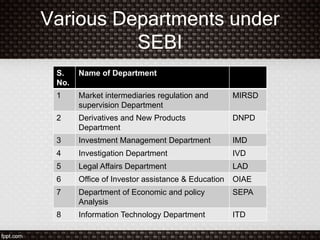
S.
No.
Name of Department
1 Market intermediaries regulation and
supervision Department
MIRSD
2 Derivatives and New Products
Department
DNPD
3 Investment Management Department IMD
4 Investigation Department IVD
5 Legal Affairs Department LAD
6 Office of Investor assistance & Education OIAE
7 Department of Economic and policy
Analysis
SEPA
8 Information Technology Department ITD
Function
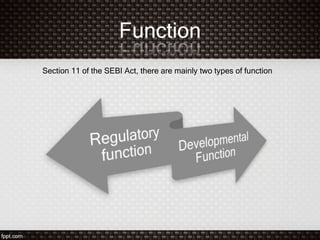
Section 11 of the SEBI Act, there are mainly two types of function
Regulatory Functions
 Regulation of stock exchange and self regulatory organizations.
 Registration and regulation of stock brokers, sub-brokers, registrar to all issue,
merchant bankers, underwriters, portfolio managers and such other intermediaries
who are associated with securities market.
 Registration and regulation of the working of collective investment schemes
including mutual funds.
 Prohibition of fraudulent and unfair trade practices relating to securities market.
 Prohibition of insider trading in securities.
 Regulating substantial acquisitions of shares and take over of companies.
Developmental Function
 Promoting investor’s education.
 Training of intermediaries.
 Conducting research and published information useful to all market
participants.
 Promotion of fair practices. Code of conduct for self- regulatory organizations.
Promoting self-regulatory organizations.
Structure of SEBI
The board shall consist of following members.
Chairman
 Two members, one from amongst the officials of the Central government
dealing with finance and another from the administration of Companies
Act,1956.
 One member from amongst the officials of the Reserve Bank of India.
 Five other members of whom at three shall be the whole time members to be
appointed by the Central Government.
Objective
 To protect the interest of investors so that there is a steady flow
of savings into the capital market.
 To promote the development and to regulate the securities
market .
 Ensure fair practices by the issuers of securities so that they can
raise resources at minimum cost.
 To promote efficient services by brokers, merchant bankers and
other intermediaries so that they become competitive and
professional.
Powers of SEBI
 Power to inspect sec11(3)
 Powers of civil court exercisable by SEBI sec11(3).
 Powers of SEBI where inquiry and investigation are pending sec11(4).
 Power to grant approval to bye-laws of recognized stock exchanges.
 Power to control and regulate stock exchanges.
Powers of SEBI
 Powers relating prohibition and regulation to issue of prospectus sec11A.
 Powers to issue direction sec11B .
 Investigating authority.
 Cease and desist proceedings sec11D
 Power to declare applicability of Section 17 of the Securities Contract
(Regulation) Act 1956, in any State or area, to grant licenses to dealers in
securities.
SEBI

SEBI

  • 1.
    Presented By. Swapnil Mayekar76 Neha Mishra 80 Steffy Mathew 74 Alka Nishad 72 Makarand mhapadi 78
  • 2.
    Initially SEBI wasa non statutory body without any statutory power. However in 1995, the SEBI was given additional statutory power by the Government of India through an amendment to the securities and Exchange Board of India Act 1992. In April, 1998 the SEBI was constituted as the regulator of capital market in India under a resolution of the Government of India.
  • 3.
    Formed : 12april,1992 Jurisdiction: Government of India Headquarters : Mumbai, Maharashtra Employees : 525 in2009 SEBI was constituted on April 12, 1988 as a Non statutory body The Securities and Exchange Board of India was established on April 12, 1992 in accordance with the provisions of the Securities and Exchange Board of India Act, 1992. Its main function is to stop fraudulent activities of stock market.
  • 4.
    Purpose and Roleof SEBI SEBI was set up with main purpose of keeping a check on malpractices and protect the interest of Investors. It was set up to meet the need of three groups, Issuers Intermedi aries Investors
  • 5.
    Mission of SEBI Securities& Exchange Board of India (SEBI) formed under the SEBI Act, 1992 with the prime objective of  Protecting the interests of investors in securities,  Promoting the development of, and  Regulating, the securities market and for matters connected therewith or incidental there to. Focus being the greater investor protection, SEBI has become a vigilant watchdog
  • 6.
    Various Departments under SEBI S. No. Nameof Department 1 Market intermediaries regulation and supervision Department MIRSD 2 Derivatives and New Products Department DNPD 3 Investment Management Department IMD 4 Investigation Department IVD 5 Legal Affairs Department LAD 6 Office of Investor assistance & Education OIAE 7 Department of Economic and policy Analysis SEPA 8 Information Technology Department ITD
  • 7.
    Function Section 11 ofthe SEBI Act, there are mainly two types of function
  • 8.
    Regulatory Functions  Regulationof stock exchange and self regulatory organizations.  Registration and regulation of stock brokers, sub-brokers, registrar to all issue, merchant bankers, underwriters, portfolio managers and such other intermediaries who are associated with securities market.  Registration and regulation of the working of collective investment schemes including mutual funds.  Prohibition of fraudulent and unfair trade practices relating to securities market.  Prohibition of insider trading in securities.  Regulating substantial acquisitions of shares and take over of companies.
  • 9.
    Developmental Function  Promotinginvestor’s education.  Training of intermediaries.  Conducting research and published information useful to all market participants.  Promotion of fair practices. Code of conduct for self- regulatory organizations. Promoting self-regulatory organizations.
  • 10.
    Structure of SEBI Theboard shall consist of following members. Chairman  Two members, one from amongst the officials of the Central government dealing with finance and another from the administration of Companies Act,1956.  One member from amongst the officials of the Reserve Bank of India.  Five other members of whom at three shall be the whole time members to be appointed by the Central Government.
  • 11.
    Objective  To protectthe interest of investors so that there is a steady flow of savings into the capital market.  To promote the development and to regulate the securities market .  Ensure fair practices by the issuers of securities so that they can raise resources at minimum cost.  To promote efficient services by brokers, merchant bankers and other intermediaries so that they become competitive and professional.
  • 12.
    Powers of SEBI Power to inspect sec11(3)  Powers of civil court exercisable by SEBI sec11(3).  Powers of SEBI where inquiry and investigation are pending sec11(4).  Power to grant approval to bye-laws of recognized stock exchanges.  Power to control and regulate stock exchanges.
  • 13.
    Powers of SEBI Powers relating prohibition and regulation to issue of prospectus sec11A.  Powers to issue direction sec11B .  Investigating authority.  Cease and desist proceedings sec11D  Power to declare applicability of Section 17 of the Securities Contract (Regulation) Act 1956, in any State or area, to grant licenses to dealers in securities.