






S.E.B.I(SECURITY AND EXCHANGE

       BOARD OF INDIA)


                                1
In 1988 the Securities and Exchange Board of India (SEBI) was
established by the Government of India through an executive
resolution, and was subsequently upgraded as a fully autonomous
body (a statutory Board) in the year 1992 with the passing of the
Securities and Exchange Board of India Act (SEBI Act) on 30th
January 1992.
PREAMBLE
The Preamble of the Securities and Exchange Board of India
describes the basic functions of the Securities and Exchange Board
of India as
“…..to protect the interests of investors in securities and to
promote the development of, and to regulate the securities
market and for matters connected therewith or incidental
thereto”                                                           2
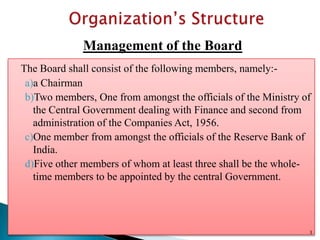
Management of the Board
The Board shall consist of the following members, namely:-
 a)a Chairman
 b)Two members, One from amongst the officials of the Ministry of
   the Central Government dealing with Finance and second from
   administration of the Companies Act, 1956.
 c)One member from amongst the officials of the Reserve Bank of
   India.
 d)Five other members of whom at least three shall be the whole-
   time members to be appointed by the central Government.


                                                                3
The primary objective of SEBI is to promote healthy and orderly
    growth -of the securities market and secure investor protection. The
    objectives of SEBI are as follows:
   To protect the interest of investors, so that, there is a steady flow of
    savings into the capital market.
   To regulate the securities market and ensure fair practices.
   To promote efficient services by brokers, merchant bankers, and
    other intermediaries, so that, they become competitive and
    professional.


                                                                           4
The SEBI Act, 1992 has entrusted with two
functions, they are
◦ Regulatory functions And
◦ Developmental functions


                                            5
   Regulation of stock exchange and self regulatory organizations.
   Registration and regulation of stock brokers, sub-brokers,
    Registrars to all issues, merchant bankers, underwriters, portfolio
    managers etc.
   Registration and regulation of the working of collective investment
    schemes including mutual funds.
   Prohibition of fraudulent and unfair trade practices relating to
    securities market.
   Prohibition of insider trading
   Regulating substantial acquisition of shares and takeover of
    companies.


                                                                          6
   Promoting investor’s education
   Training of intermediaries
   Conducting research and publishing information useful to
    all market participants.
   Promotion of fair practices
   Promotion of self regulatory organizations


                                                               7
8

Sebi

  • 1.
  • 2.
    In 1988 theSecurities and Exchange Board of India (SEBI) was established by the Government of India through an executive resolution, and was subsequently upgraded as a fully autonomous body (a statutory Board) in the year 1992 with the passing of the Securities and Exchange Board of India Act (SEBI Act) on 30th January 1992. PREAMBLE The Preamble of the Securities and Exchange Board of India describes the basic functions of the Securities and Exchange Board of India as “…..to protect the interests of investors in securities and to promote the development of, and to regulate the securities market and for matters connected therewith or incidental thereto” 2
  • 3.
    Management of theBoard The Board shall consist of the following members, namely:- a)a Chairman b)Two members, One from amongst the officials of the Ministry of the Central Government dealing with Finance and second from administration of the Companies Act, 1956. c)One member from amongst the officials of the Reserve Bank of India. d)Five other members of whom at least three shall be the whole- time members to be appointed by the central Government. 3
  • 4.
    The primary objectiveof SEBI is to promote healthy and orderly growth -of the securities market and secure investor protection. The objectives of SEBI are as follows:  To protect the interest of investors, so that, there is a steady flow of savings into the capital market.  To regulate the securities market and ensure fair practices.  To promote efficient services by brokers, merchant bankers, and other intermediaries, so that, they become competitive and professional. 4
  • 5.
    The SEBI Act,1992 has entrusted with two functions, they are ◦ Regulatory functions And ◦ Developmental functions 5
  • 6.
    Regulation of stock exchange and self regulatory organizations.  Registration and regulation of stock brokers, sub-brokers, Registrars to all issues, merchant bankers, underwriters, portfolio managers etc.  Registration and regulation of the working of collective investment schemes including mutual funds.  Prohibition of fraudulent and unfair trade practices relating to securities market.  Prohibition of insider trading  Regulating substantial acquisition of shares and takeover of companies. 6
  • 7.
    Promoting investor’s education  Training of intermediaries  Conducting research and publishing information useful to all market participants.  Promotion of fair practices  Promotion of self regulatory organizations 7
  • 8.