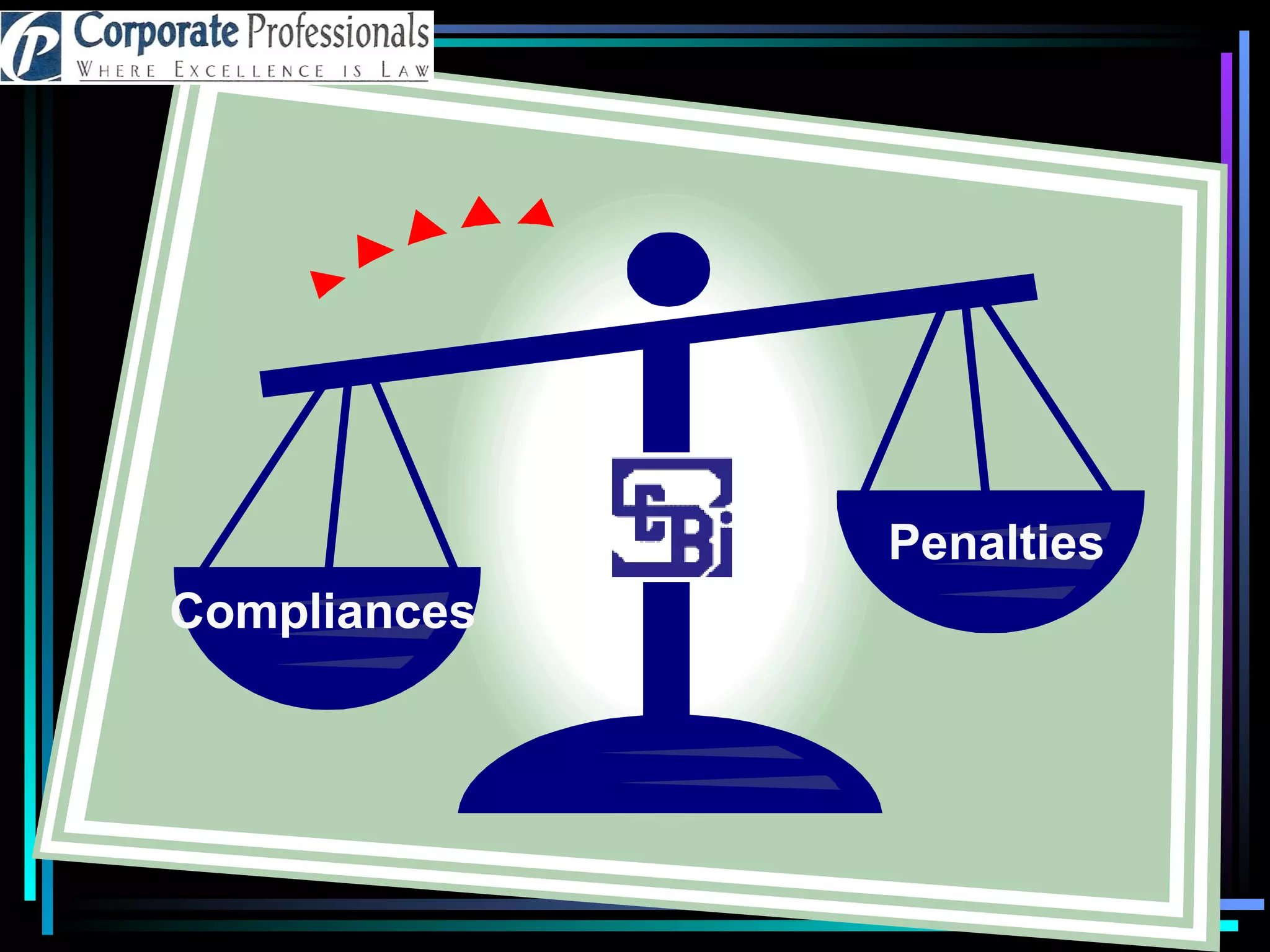
Compliances Penalties
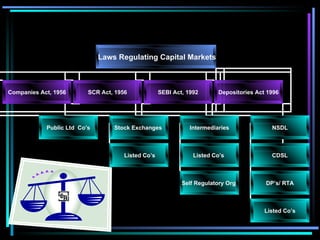
Laws Regulating Capital Markets Companies Act, 1956 SCR Act, 1956 SEBI Act, 1992 Public Ltd  Co’s Stock Exchanges  Intermediaries Listed Co’s Listed Co’s  Self Regulatory Org  Depositories Act 1996 NSDL CDSL DP’s/ RTA Listed Co’s
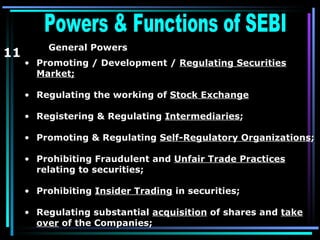
Powers & Functions of SEBI  11 General Powers   Promoting / Development /  Regulating Securities Market; Regulating the working of  Stock Exchange Registering & Regulating  Intermediaries ; Promoting & Regulating  Self-Regulatory Organizations ; Prohibiting Fraudulent and  Unfair Trade Practices  relating to securities;  Prohibiting  Insider Trading  in securities; Regulating substantial  acquisition  of shares and  take over  of the Companies;
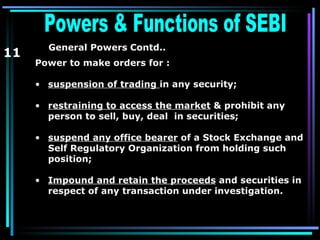
Powers & Functions of SEBI  11 General Powers   Contd.. Power to make orders for : suspension of trading  in any security; restraining to access the market  & prohibit any person to sell, buy, deal  in securities; suspend any office bearer  of a Stock Exchange and Self Regulatory Organization from holding such position; Impound and retain the proceeds  and securities in respect of any transaction under investigation.
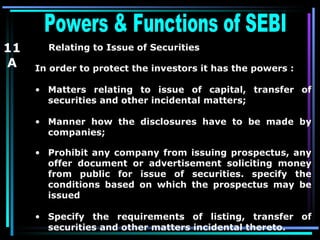
Powers & Functions of SEBI  11 A Relating to Issue of Securities   In order to protect the investors it has the powers : Matters relating to issue of capital, transfer of securities and other incidental matters; Manner how the disclosures have to be made by companies; Prohibit any company from issuing prospectus, any offer document or advertisement soliciting money from public for issue of securities. specify the conditions based on which the prospectus may be issued  Specify the requirements of listing, transfer of securities and other matters incidental thereto.
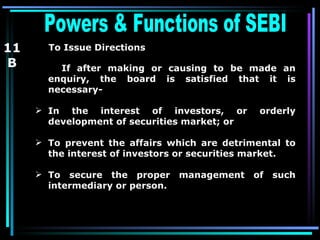
Powers & Functions of SEBI  To Issue Directions   If after making or causing to be made an enquiry, the board is satisfied that it is necessary- In the interest of investors, or orderly development of securities market; or To prevent the affairs which are detrimental to the interest of investors or securities market. To secure the proper management of such intermediary or person. 11 B
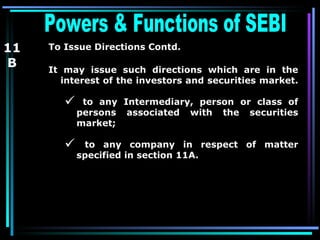
It may issue such directions which are in the interest of the investors and securities market.  to any Intermediary, person or class of persons associated with the securities market; to any company in respect of matter specified in section 11A. Powers & Functions of SEBI  To Issue Directions Contd. 11 B
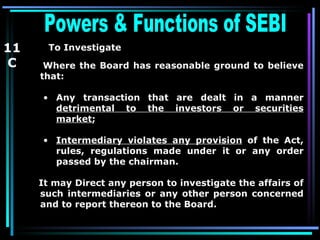
Powers & Functions of SEBI  To Investigate   Where the Board has reasonable ground to believe that: Any transaction that are dealt in a manner  detrimental to the investors or securities market ; Intermediary violates any provision  of the Act, rules, regulations made under it or any order passed by the chairman. It may Direct any person to investigate the affairs of such intermediaries or any other person concerned and to report thereon to the Board. 11 C
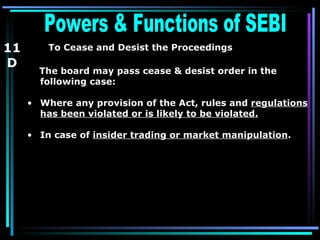
Powers & Functions of SEBI  To Cease and Desist the Proceedings   The board may pass cease & desist order in the following case:  Where any provision of the Act, rules and  regulations has been violated or is likely to be violated.   In case of  insider trading or market manipulation . 11 D
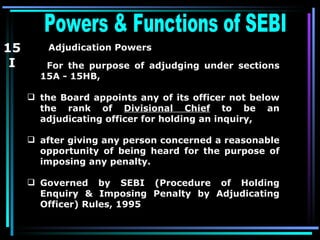
Powers & Functions of SEBI  Adjudication Powers   For the purpose of adjudging under sections 15A - 15HB,   the Board appoints any of its officer not below the rank of  Divisional Chief  to be an adjudicating officer for holding an inquiry,  after giving any person concerned a reasonable opportunity of being heard for the purpose of imposing any penalty.   Governed by SEBI (Procedure of Holding Enquiry & Imposing Penalty by Adjudicating Officer) Rules, 1995  15 I
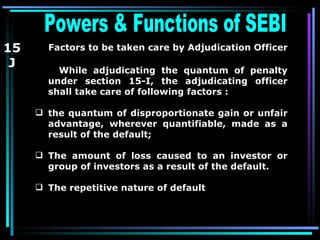
Powers & Functions of SEBI  15 J Factors to be taken care by Adjudication Officer   While adjudicating the quantum of penalty under section 15-I, the adjudicating officer shall take care of following factors :   the quantum of disproportionate gain or unfair advantage, wherever quantifiable, made as a result of the default;  The amount of loss caused to an investor or group of investors as a result of the default.   The repetitive nature of default
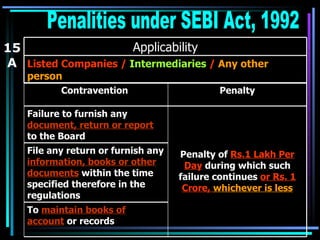
15 A Penalities under SEBI Act, 1992 Listed Companies /  Intermediaries  /  Any other person Applicability To  maintain books of account  or records File any return or furnish any  information, books or other documents  within the time specified therefore in the regulations Penalty of  Rs.1 Lakh Per Day  during which such failure continues  or Rs. 1 Crore,  whichever is less Failure to furnish any  document, return or report  to the Board Penalty Contravention
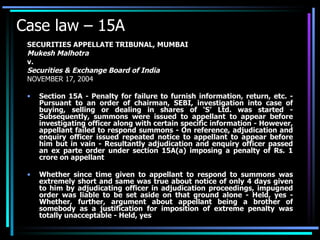
Case law – 15A SECURITIES APPELLATE TRIBUNAL, MUMBAI Mukesh Malhotra v. Securities & Exchange Board of India NOVEMBER 17, 2004 Section 15A - Penalty for failure to furnish information, return, etc. - Pursuant to an order of chairman, SEBI, investigation into case of buying, selling or dealing in shares of ‘S’ Ltd. was started - Subsequently, summons were issued to appellant to appear before investigating officer along with certain specific information - However, appellant failed to respond summons - On reference, adjudication and enquiry officer issued repeated notice to appellant to appear before him but in vain - Resultantly adjudication and enquiry officer passed an ex parte order under section 15A(a) imposing a penalty of Rs. 1 crore on appellant  Whether since time given to appellant to respond to summons was extremely short and same was true about notice of only 4 days given to him by adjudicating officer in adjudication proceedings, impugned order was liable to be set aside on that ground alone - Held, yes - Whether, further, argument about appellant being a brother of somebody as a justification for imposition of extreme penalty was totally unacceptable - Held, yes
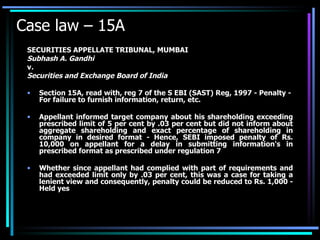
Case law – 15A SECURITIES APPELLATE TRIBUNAL, MUMBAI Subhash A. Gandhi v . Securities and Exchange Board of India Section 15A, read with, reg 7 of the S EBI (SAST) Reg, 1997 - Penalty - For failure to furnish information, return, etc.  Appellant informed target company about his shareholding exceeding prescribed limit of 5 per cent by .03 per cent but did not inform about aggregate shareholding and exact percentage of shareholding in company in desired format - Hence, SEBI imposed penalty of Rs. 10,000 on appellant for a delay in submitting information's in prescribed format as prescribed under regulation 7  Whether since appellant had complied with part of requirements and had exceeded limit only by .03 per cent, this was a case for taking a lenient view and consequently, penalty could be reduced to Rs. 1,000 - Held yes
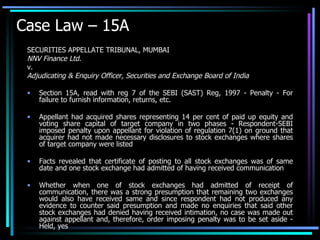
Case Law – 15A SECURITIES APPELLATE TRIBUNAL, MUMBAI NNV Finance Ltd. v. Adjudicating & Enquiry Officer, Securities and Exchange Board of India Section 15A, read with reg 7 of the SEBI (SAST) Reg, 1997 - Penalty - For failure to furnish information, returns, etc.  Appellant had acquired shares representing 14 per cent of paid up equity and voting share capital of target company in two phases - Respondent-SEBI imposed penalty upon appellant for violation of regulation 7(1) on ground that acquirer had not made necessary disclosures to stock exchanges where shares of target company were listed  Facts revealed that certificate of posting to all stock exchanges was of same date and one stock exchange had admitted of having received communication  Whether when one of stock exchanges had admitted of receipt of communication, there was a strong presumption that remaining two exchanges would also have received same and since respondent had not produced any evidence to counter said presumption and made no enquiries that said other stock exchanges had denied having received intimation, no case was made out against appellant and, therefore, order imposing penalty was to be set aside - Held, yes
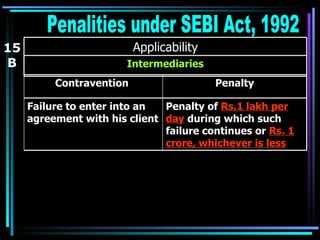
15 B Penalities under SEBI Act, 1992 Intermediaries Applicability Penalty of  Rs.1 lakh per day  during which such failure continues or  Rs. 1 crore, whichever is less Failure to enter into an agreement with his client  Penalty Contravention
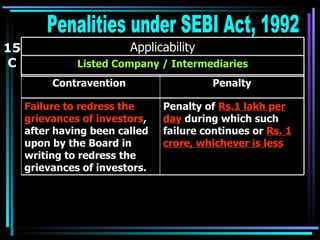
15 C Penalities under SEBI Act, 1992 Listed Company / Intermediaries Applicability Penalty of  Rs.1 lakh per day  during which such failure continues or  Rs. 1 crore, whichever is less Failure to redress the grievances of investors , after having been called upon by the Board in writing to redress the grievances of investors. Penalty Contravention
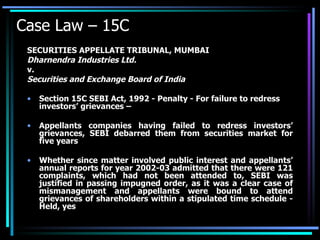
Case Law – 15C SECURITIES APPELLATE TRIBUNAL, MUMBAI Dharnendra Industries Ltd. v. Securities and Exchange Board of India Section 15C SEBI Act, 1992 - Penalty - For failure to redress investors’ grievances –  Appellants companies having failed to redress investors’ grievances, SEBI debarred them from securities market for five years  Whether since matter involved public interest and appellants’ annual reports for year 2002-03 admitted that there were 121 complaints, which had not been attended to, SEBI was justified in passing impugned order, as it was a clear case of mismanagement and appellants were bound to attend grievances of shareholders within a stipulated time schedule - Held, yes
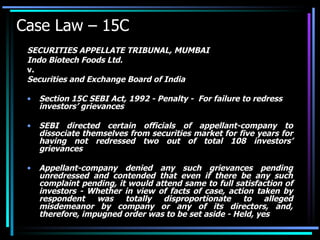
Case Law – 15C SECURITIES APPELLATE TRIBUNAL, MUMBAI Indo Biotech Foods Ltd. v. Securities and Exchange Board of India Section 15C SEBI Act, 1992 - Penalty -  For failure to redress investors’ grievances  SEBI directed certain officials of appellant-company to dissociate themselves from securities market for five years for having not redressed two out of total 108 investors’ grievances  Appellant-company denied any such grievances pending unredressed and contended that even if there be any such complaint pending, it would attend same to full satisfaction of investors - Whether in view of facts of case, action taken by respondent was totally disproportionate to alleged misdemeanor by company or any of its directors, and, therefore, impugned order was to be set aside - Held, yes
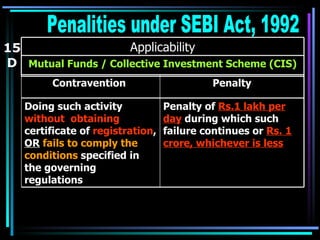
15 D Penalities under SEBI Act, 1992 Mutual Funds / Collective Investment Scheme (CIS) Applicability Penalty of  Rs.1 lakh per day  during which such failure continues or  Rs. 1 crore, whichever is less Doing such activity  without  obtaining  certificate of  registration ,  OR   fails to comply the conditions  specified in the governing regulations Penalty Contravention
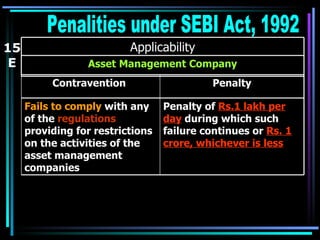
15 E Penalities under SEBI Act, 1992 Asset Management Company Applicability Penalty of  Rs.1 lakh per day  during which such failure continues or  Rs. 1 crore, whichever is less Fails to comply  with any of the  regulations  providing for restrictions on the activities of the asset management companies Penalty Contravention
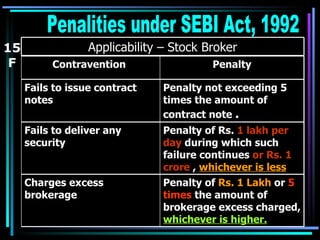
15 F Penalities under SEBI Act, 1992 Applicability – Stock Broker Penalty of  Rs. 1 Lakh  or  5 times  the amount of brokerage excess charged,  whichever is higher. Charges excess brokerage Penalty of Rs.  1 lakh per day  during which such failure continues  or Rs. 1 crore  ,  whichever is less Fails to deliver any security  Penalty not exceeding 5 times the amount of  contract note  . Fails to issue contract notes  Penalty Contravention
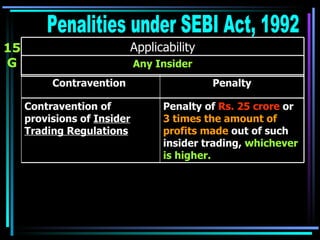
15 G Penalities under SEBI Act, 1992 Any Insider Applicability Penalty of  Rs. 25 crore  or  3 times the amount of profits made  out of such insider trading,  whichever is higher.  Contravention of provisions of  Insider Trading Regulations Penalty Contravention
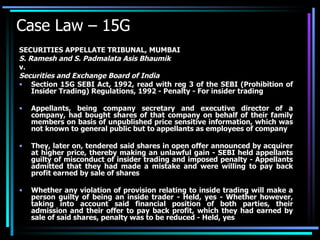
Case Law – 15G SECURITIES APPELLATE TRIBUNAL, MUMBAI S. Ramesh and S. Padmalata Asis Bhaumik v. Securities and Exchange Board of India Section 15G SEBI Act, 1992, read with reg 3 of the SEBI (Prohibition of Insider Trading) Regulations, 1992 - Penalty - For insider trading  Appellants, being company secretary and executive director of a company, had bought shares of that company on behalf of their family members on basis of unpublished price sensitive information, which was not known to general public but to appellants as employees of company  They, later on, tendered said shares in open offer announced by acquirer at higher price, thereby making an unlawful gain - SEBI held appellants guilty of misconduct of insider trading and imposed penalty - Appellants admitted that they had made a mistake and were willing to pay back profit earned by sale of shares  Whether any violation of provision relating to inside trading will make a person guilty of being an inside trader - Held, yes - Whether however, taking into account said financial position of both parties, their admission and their offer to pay back profit, which they had earned by sale of said shares, penalty was to be reduced - Held, yes
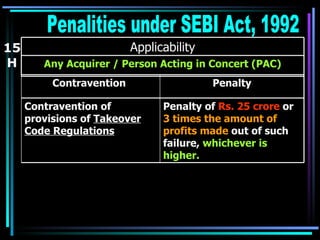
15 H Penalities under SEBI Act, 1992 Any Acquirer / Person Acting in Concert (PAC) Applicability Penalty of  Rs. 25 crore  or  3 times the amount of profits made  out of such failure,  whichever is higher.  Contravention of provisions of  Takeover Code Regulations Penalty Contravention
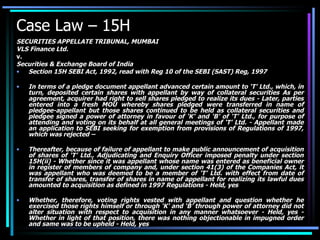
Case Law – 15H SECURITIES APPELLATE TRIBUNAL, MUMBAI VLS Finance Ltd. v. Securities & Exchange Board of India Section 15H SEBI Act, 1992, read with Reg 10 of the SEBI (SAST) Reg, 1997  In terms of a pledge document appellant advanced certain amount to ‘T’ Ltd., which, in turn, deposited certain shares with appellant by way of collateral securities As per agreement, acquirer had right to sell shares pledged to realize its dues - Later, parties entered into a fresh MOU whereby shares pledged were transferred in name of pledgee-appellant but those shares continued to be held as collateral securities and pledgee signed a power of attorney in favour of ‘K’ and ‘B’ of ‘T’ Ltd., for purpose of attending and voting on its behalf at all general meetings of ‘T’ Ltd. - Appellant made an application to SEBI seeking for exemption from provisions of Regulations of 1997, which was rejected – Thereafter, because of failure of appellant to make public announcement of acquisition of shares of ‘T’ Ltd., Adjudicating and Enquiry Officer imposed penalty under section 15H(ii) - Whether since it was appellant whose name was entered as beneficial owner in register of members of company and, under section 41(3) of the Companies Act, it was appellant who was deemed to be a member of ‘T’ Ltd. with effect from date of transfer of shares, transfer of shares in name of appellant for realizing its lawful dues amounted to acquisition as defined in 1997 Regulations - Held, yes  Whether, therefore, voting rights vested with appellant and question whether he exercised those rights himself or through ‘K’ and ‘B’ through power of attorney did not alter situation with respect to acquisition in any manner whatsoever - Held, yes - Whether in light of that position, there was nothing objectionable in impugned order and same was to be upheld - Held, yes
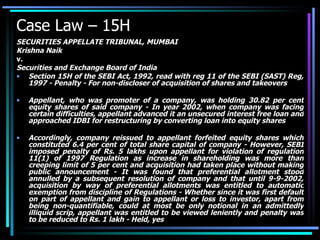
Case Law – 15H SECURITIES APPELLATE TRIBUNAL, MUMBAI Krishna Naik v. Securities and Exchange Board of India Section 15H of the SEBI Act, 1992, read with reg 11 of the SEBI (SAST) Reg, 1997 - Penalty - For non-discloser of acquisition of shares and takeovers  Appellant, who was promoter of a company, was holding 30.82 per cent equity shares of said company - In year 2002, when company was facing certain difficulties, appellant advanced it an unsecured interest free loan and approached IDBI for restructuring by converting loan into equity shares  Accordingly, company reissued to appellant forfeited equity shares which constituted 6.4 per cent of total share capital of company - However, SEBI imposed penalty of Rs. 5 lakhs upon appellant for violation of regulation 11(1) of 1997 Regulation as increase in shareholding was more than creeping limit of 5 per cent and acquisition had taken place without making public announcement - It was found that preferential allotment stood annulled by a subsequent resolution of company and that until 9-9-2002, acquisition by way of preferential allotments was entitled to automatic exemption from discipline of Regulations - Whether since it was first default on part of appellant and gain to appellant or loss to investor, apart from being non-quantifiable, could at most be only notional in an admittedly illiquid scrip, appellant was entitled to be viewed leniently and penalty was to be reduced to Rs. 1 lakh - Held, yes
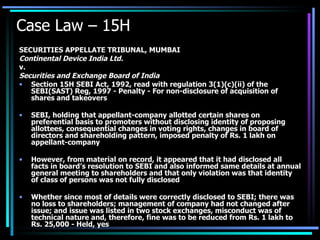
Case Law – 15H SECURITIES APPELLATE TRIBUNAL, MUMBAI Continental Device India Ltd. v. Securities and Exchange Board of India Section 15H SEBI Act, 1992, read with regulation 3(1)(c)(ii) of the SEBI(SAST) Reg, 1997 - Penalty - For non-disclosure of acquisition of shares and takeovers  SEBI, holding that appellant-company allotted certain shares on preferential basis to promoters without disclosing identity of proposing allottees, consequential changes in voting rights, changes in board of directors and shareholding pattern, imposed penalty of Rs. 1 lakh on appellant-company  However, from material on record, it appeared that it had disclosed all facts in board’s resolution to SEBI and also informed same details at annual general meeting to shareholders and that only violation was that identity of class of persons was not fully disclosed  Whether since most of details were correctly disclosed to SEBI; there was no loss to shareholders; management of company had not changed after issue; and issue was listed in two stock exchanges, misconduct was of technical nature and, therefore, fine was to be reduced from Rs. 1 lakh to Rs. 25,000 - Held, yes
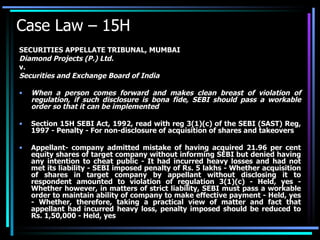
Case Law – 15H SECURITIES APPELLATE TRIBUNAL, MUMBAI Diamond Projects (P.) Ltd. v. Securities and Exchange Board of India When a person comes forward and makes clean breast of violation of regulation, if such disclosure is bona fide, SEBI should pass a workable order so that it can be implemented Section 15H SEBI Act, 1992, read with reg 3(1)(c) of the SEBI (SAST) Reg, 1997 - Penalty - For non-disclosure of acquisition of shares and takeovers  Appellant- company admitted mistake of having acquired 21.96 per cent equity shares of target company without informing SEBI but denied having any intention to cheat public - It had incurred heavy losses and had not met its liability - SEBI imposed penalty of Rs. 5 lakhs - Whether acquisition of shares in target company by appellant without disclosing it to respondent amounted to violation of regulation 3(1)(c) - Held, yes - Whether however, in matters of strict liability, SEBI must pass a workable order to maintain ability of company to make effective payment - Held, yes - Whether, therefore, taking a practical view of matter and fact that appellant had incurred heavy loss, penalty imposed should be reduced to Rs. 1,50,000 - Held, yes
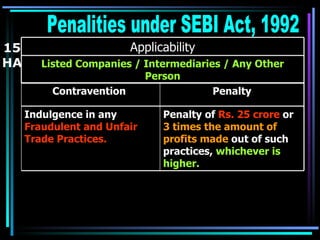
15 HA Penalities under SEBI Act, 1992 Listed Companies / Intermediaries / Any Other Person Applicability Penalty of  Rs. 25 crore  or  3 times the amount of profits made  out of such practices,  whichever is higher.  Indulgence in any  Fraudulent and Unfair Trade Practices.   Penalty Contravention
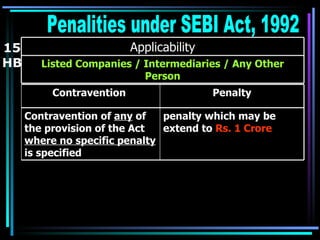
15 HB Penalities under SEBI Act, 1992 Listed Companies / Intermediaries / Any Other Person Applicability penalty which may be extend to  Rs. 1 Crore  Contravention of  any  of the provision of the Act  where no specific penalty  is specified Penalty Contravention
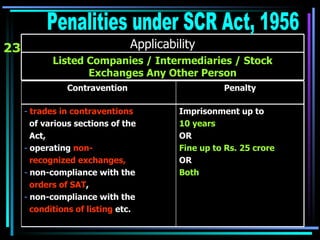
23 Penalities under SCR Act, 1956 Listed Companies / Intermediaries / Stock Exchanges Any Other Person Applicability Imprisonment up to 10 years   OR  Fine up to Rs. 25 crore  OR  Both   trades in contraventions  of various sections of the  Act,  operating  non- recognized exchanges,   non-compliance with the  orders of SAT ,  non-compliance with the  conditions of listing  etc.   Penalty Contravention
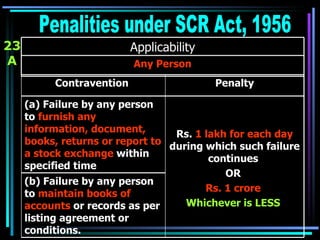
23 A Penalities under SCR Act, 1956 Any Person Applicability (b) Failure by any person to  maintain books of accounts  or records as per listing agreement or conditions.   Rs.  1 lakh for each day  during which such failure continues  OR  Rs. 1 crore  Whichever is LESS   (a) Failure by any person to  furnish any information, document, books, returns or report to a stock exchange  within specified time   Penalty Contravention
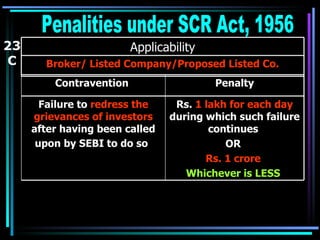
23 C Penalities under SCR Act, 1956 Broker/ Listed Company/Proposed Listed Co. Applicability Rs.  1 lakh for each day  during which such failure continues  OR  Rs. 1 crore  Whichever is LESS  Failure to  redress the grievances of investors  after having been called upon by SEBI to do so   Penalty Contravention
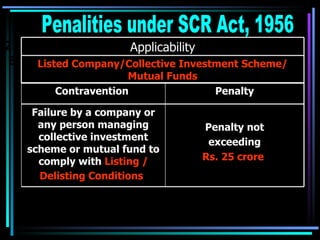
23 E Penalities under SCR Act, 1956 Listed Company/Collective Investment Scheme/ Mutual Funds Applicability Penalty not exceeding Rs. 25 crore   Failure by a company or any person managing collective investment scheme or mutual fund to comply with  Listing / Delisting Conditions   Penalty Contravention
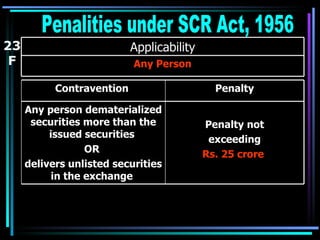
23 F Penalities under SCR Act, 1956 Any Person Applicability Penalty not exceeding Rs. 25 crore   Any person dematerialized securities more than the issued securities  OR  delivers unlisted securities in the exchange   Penalty Contravention
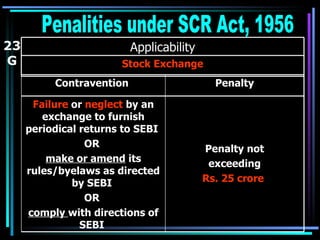
23 G Penalities under SCR Act, 1956 Stock Exchange Applicability Penalty not exceeding Rs. 25 crore   Failure  or  neglect  by an exchange to furnish periodical returns to SEBI  OR  make or amend  its rules/byelaws as directed by SEBI  OR  comply  with directions of SEBI   Penalty Contravention
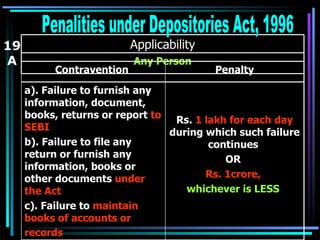
19 A Penalities under Depositories Act, 1996 Any Person Applicability Rs.  1 lakh for each day  during which such failure continues  OR  Rs. 1crore,   whichever is LESS   a). Failure to furnish any information, document, books, returns or report  to SEBI  b). Failure to file any return or furnish any information, books or  other documents  under the Act  c). Failure to  maintain books of accounts or records  Penalty Contravention
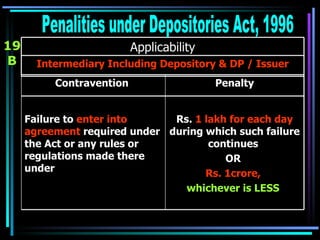
19 B Penalities under Depositories Act, 1996 Intermediary Including Depository & DP / Issuer Applicability Rs.  1 lakh for each day  during which such failure continues  OR  Rs. 1crore,   whichever is LESS   Failure to  enter into agreement  required under the Act or any rules or regulations made there under Penalty Contravention
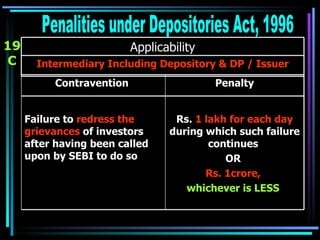
19 C Penalities under Depositories Act, 1996 Intermediary Including Depository & DP / Issuer Applicability Rs.  1 lakh for each day  during which such failure continues  OR  Rs. 1crore,   whichever is LESS   Failure to  redress the grievances  of investors after having been called upon by SEBI to do so   Penalty Contravention
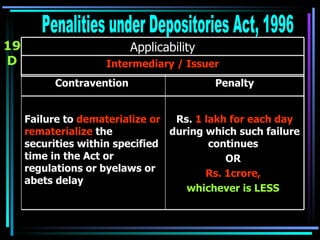
19 D Penalities under Depositories Act, 1996 Intermediary / Issuer Applicability Rs.  1 lakh for each day  during which such failure continues  OR  Rs. 1crore,   whichever is LESS   Failure to  dematerialize or rematerialize  the securities within specified time in the Act or regulations or byelaws or abets delay   Penalty Contravention
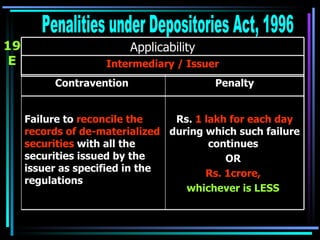
19 E Penalities under Depositories Act, 1996 Intermediary / Issuer Applicability Rs.  1 lakh for each day  during which such failure continues  OR  Rs. 1crore,   whichever is LESS   Failure to  reconcile the records of de-materialized securities  with all the securities issued by the issuer as specified in the regulations   Penalty Contravention
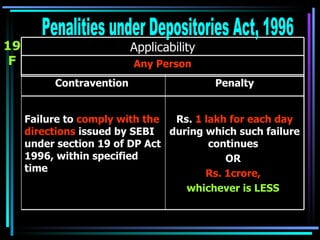
19 F Penalities under Depositories Act, 1996 Any Person Applicability Rs.  1 lakh for each day  during which such failure continues  OR  Rs. 1crore,   whichever is LESS   Failure to  comply with the directions  issued by SEBI under section 19 of DP Act 1996, within specified time  Penalty Contravention
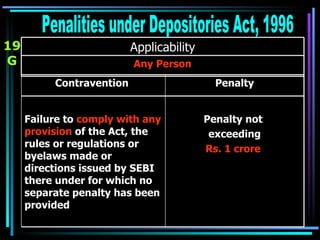
19 G Penalities under Depositories Act, 1996 Any Person Applicability Penalty not  exceeding Rs. 1 crore   Failure to  comply with any provision  of the Act, the rules or regulations or byelaws made or directions issued by SEBI there under for which no separate penalty has been provided   Penalty Contravention
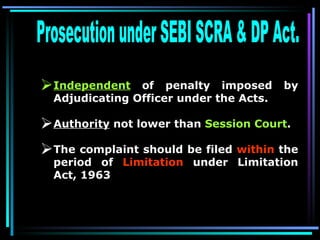
Prosecution under SEBI SCRA & DP Act. Independent  of penalty imposed by Adjudicating Officer under the Acts. Authority  not lower than  Session Court .  The complaint should be filed  within  the period of  Limitation  under Limitation Act, 1963
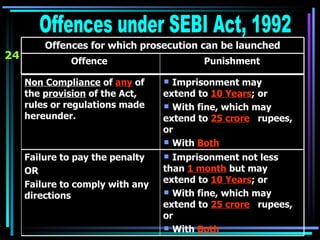
24 Offences under SEBI Act, 1992 Offences for which prosecution can be launched Imprisonment not less than  1 month  but may  extend to  10 Years ; or  With fine, which may  extend to  25 crore   rupees, or  With  Both   Failure to pay the penalty  OR Failure to comply with any directions  Imprisonment may  extend to  10 Years ; or  With fine, which may  extend to  25 crore   rupees, or  With  Both   Non Compliance  of  any  of the  provision  of the Act, rules or regulations made hereunder. Punishment Offence
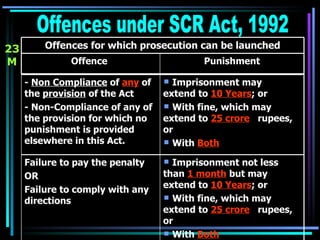
23 M Offences under SCR Act, 1992 Offences for which prosecution can be launched Imprisonment not less than  1 month  but may  extend to  10 Years ; or  With fine, which may  extend to  25 crore   rupees, or  With  Both   Failure to pay the penalty  OR Failure to comply with any directions  Imprisonment may  extend to  10 Years ; or  With fine, which may  extend to  25 crore   rupees, or  With  Both   -  Non Compliance  of  any  of the  provision  of the Act - Non-Compliance of any of the provision for which no punishment is provided elsewhere in this Act. Punishment Offence
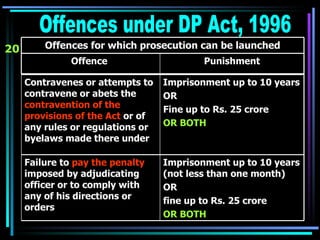
20 Offences under DP Act, 1996 Offences for which prosecution can be launched Imprisonment up to 10 years (not less than one month)  OR  fine up to Rs. 25 crore  OR BOTH   Failure to  pay the penalty  imposed by adjudicating officer or to comply with any of his directions or orders   Imprisonment up to 10 years  OR Fine up to Rs. 25 crore  OR BOTH   Contravenes or attempts to contravene or abets the  contravention of the provisions of the Act  or of any rules or regulations or byelaws made there under   Punishment Offence
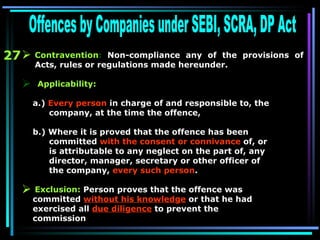
27 Offences by Companies under SEBI, SCRA, DP Act Contravention :  Non-compliance any of the provisions of Acts, rules or regulations made hereunder. Applicability:  a.)  Every person  in charge of and responsible to, the  company, at the time the offence,  b.) Where it is proved that the offence has been  committed  with the consent or connivance  of, or  is attributable to any neglect on the part of, any  director, manager, secretary or other officer of  the company,  every such person .   Exclusion:  Person proves that the offence was committed  without his knowledge  or that he had exercised all  due diligence  to prevent the commission  
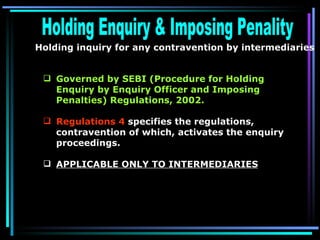
Holding Enquiry & Imposing Penality Holding inquiry for any contravention by intermediaries  Governed by SEBI (Procedure for Holding Enquiry by Enquiry Officer and Imposing Penalties) Regulations, 2002. Regulations 4  specifies the regulations, contravention of which, activates the enquiry proceedings.  APPLICABLE ONLY TO INTERMEDIARIES
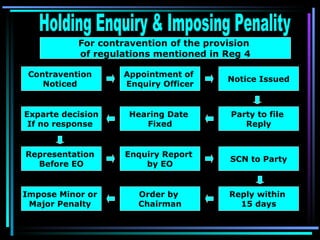
Holding Enquiry & Imposing Penality Contravention  Noticed  Exparte decision If no response  SCN to Party Party to file  Reply Appointment of  Enquiry Officer Notice Issued Reply within  15 days Hearing Date  Fixed Enquiry Report  by EO Representation  Before EO Order by  Chairman Impose Minor or  Major Penalty  For contravention of the provision  of regulations mentioned in Reg 4
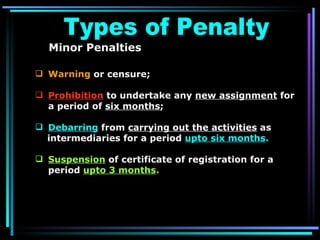
Types of Penalty Minor Penalties Warning  or censure; Prohibition  to undertake any  new assignment  for a period of  six months ; Debarring   from  carrying out the activities  as intermediaries for a period  upto six months . Suspension  of certificate of registration for a period  upto 3 months .
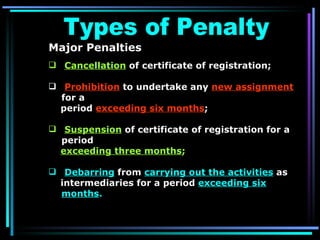
Major Penalties Cancellation  of certificate of registration; Prohibition  to undertake any  new assignment  for a  period  exceeding six months ; Suspension  of certificate of registration for a period  exceeding three months ; Debarring  from  carrying out the activities  as intermediaries for a period  exceeding six months . Types of Penalty
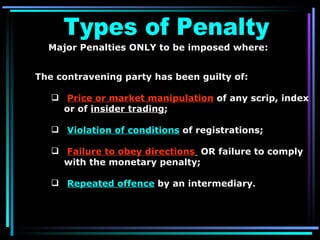
Major Penalties ONLY to be imposed where:  The contravening party has been guilty of:  Price or market manipulation  of any scrip, index or of  insider trading ; Violation of conditions  of registrations; Failure to obey directions   OR failure to comply with the monetary penalty;  Repeated offence  by an intermediary . Types of Penalty
Appeals To Securities Appellate Tribunal (SAT)  Appeals can be made in following cases:   Orders passed by SEBI  (after Securities Laws amendment Act, 1999)   OR Orders passed by an adjudicating officer   OR Refusal, Omission or failure of Stock Exchange to list the securities
Appeals To Securities Appellate Tribunal (SAT)  Time limit for filing appeal:   In case of  orders of SEBI or adjudicating officer , within  45 days  from the date on which copy of order is received. AND In case of  Stock Exchange refusal , failure or omission within  15 days  of specified date of section 73(1A) of the Companies Act, 1956
Appeals To Securities Appellate Tribunal (SAT)  Appearance before SAT   Any person aggrieved by the orders can either appear in person or authorize the following persons to appear before SAT: Chartered Accountant or;  Company Secretary or;  Cost Accountant or;  Legal practitioner or;  Any of its officers.
Appeals To Securities Appellate Tribunal (SAT)  Bar of Jurisdiction of Civil Courts:   EXCEPT for the appeals to SAT under section 15 T of or to Central Government under section 20  No civil court shall have the jurisdiction to entertain any matter which the Board or the adjudicating officer is empowered to act  And  No injunction shall be granted by any court or authority in respect of any action taken or in pursuance of any order passed by the Board or the adjudicating officer.
Appeals To Securities Appellate Tribunal (SAT)  Appeal to Supreme Court:   Aggrieved by the decision of or order of SAT or for determining any question of law arising out of the order,  Appeal can be filed to Supreme Court within 60 days of the date of communication of the decision or order of SAT.
Case Law – 15T  SECURITIES APPELLATE TRIBUNAL, MUMBAI B.P. Kanani v. Securities and Exchange Board of India  Section 15T of SEBI Act, 1992, read with section 21, of the Chartered Accountants Act, 1949 - Securities Appellate Tribunal - Appeals to  SEBI, while passing order against company and its directors, debarring them from associating with capital market activities and capital market intermediaries, observed that appellant who was a Chartered Accountant, had made misrepresentation about use of funds by company which would amount professional misconduct on part of appellant and, therefore, matter should be referred to Institute of Chartered Accountants of India for appropriate action against him  Appellant, aggrieved by said observation, filed appeal - SEBI questioned locus standi of appellant to file appeal on ground that order was not passed against him - Whether under section 15T right of appeal is restricted only to parties before SEBI in proceedings - Held, no  Whether anybody, whether he was party or not before SEBI, is entitled to prefer appeal provided he is aggrieved by that order - Held, yes - Whether, mere decision to refer matter to Institute by itself could be considered cause of grievance to approach Tribunal by way of appeal - Held, no - Whether moreover, since SEBI’s order was operative only against company and its directors, there was no reason to hold that appellant was legitimately aggrieved so as to be entitled to file appeal under section 15T - Held, yes
Composition of Offences Offences can be compounded   subject to following conditions  : The offence must not be punishable with Imprisonment only or with imprisonment and fine under SEBI Act , The offences can be compounded either before or after the institution of proceedings, The offence can be compounded by SAT or by the Court under which the proceedings are pending, The provision of SEBI Act shall be applicable notwithstanding any thing stated in Criminal Procedure Code. 24 A
Power to Grant Immunity  Special Powers to grant immunity   from Penalty  Can be granted by Central Government Where the alleged person gives a full and true disclosure in respect of the alleged violation Central government imposes such conditions as it may think fit. No immunity granted where the prosecution has already been instituted. Immunity once granted can be withdrawn on non compliance of any condition imposed or giving of false evidence.  24 B
Thanks

Sebi Penalty

  • 1.
  • 2.
    Laws Regulating CapitalMarkets Companies Act, 1956 SCR Act, 1956 SEBI Act, 1992 Public Ltd Co’s Stock Exchanges Intermediaries Listed Co’s Listed Co’s Self Regulatory Org Depositories Act 1996 NSDL CDSL DP’s/ RTA Listed Co’s
  • 3.
    Powers & Functionsof SEBI 11 General Powers Promoting / Development / Regulating Securities Market; Regulating the working of Stock Exchange Registering & Regulating Intermediaries ; Promoting & Regulating Self-Regulatory Organizations ; Prohibiting Fraudulent and Unfair Trade Practices relating to securities; Prohibiting Insider Trading in securities; Regulating substantial acquisition of shares and take over of the Companies;
  • 4.
    Powers & Functionsof SEBI 11 General Powers Contd.. Power to make orders for : suspension of trading in any security; restraining to access the market & prohibit any person to sell, buy, deal in securities; suspend any office bearer of a Stock Exchange and Self Regulatory Organization from holding such position; Impound and retain the proceeds and securities in respect of any transaction under investigation.
  • 5.
    Powers & Functionsof SEBI 11 A Relating to Issue of Securities In order to protect the investors it has the powers : Matters relating to issue of capital, transfer of securities and other incidental matters; Manner how the disclosures have to be made by companies; Prohibit any company from issuing prospectus, any offer document or advertisement soliciting money from public for issue of securities. specify the conditions based on which the prospectus may be issued Specify the requirements of listing, transfer of securities and other matters incidental thereto.
  • 6.
    Powers & Functionsof SEBI To Issue Directions If after making or causing to be made an enquiry, the board is satisfied that it is necessary- In the interest of investors, or orderly development of securities market; or To prevent the affairs which are detrimental to the interest of investors or securities market. To secure the proper management of such intermediary or person. 11 B
  • 7.
    It may issuesuch directions which are in the interest of the investors and securities market. to any Intermediary, person or class of persons associated with the securities market; to any company in respect of matter specified in section 11A. Powers & Functions of SEBI To Issue Directions Contd. 11 B
  • 8.
    Powers & Functionsof SEBI To Investigate Where the Board has reasonable ground to believe that: Any transaction that are dealt in a manner detrimental to the investors or securities market ; Intermediary violates any provision of the Act, rules, regulations made under it or any order passed by the chairman. It may Direct any person to investigate the affairs of such intermediaries or any other person concerned and to report thereon to the Board. 11 C
  • 9.
    Powers & Functionsof SEBI To Cease and Desist the Proceedings The board may pass cease & desist order in the following case: Where any provision of the Act, rules and regulations has been violated or is likely to be violated. In case of insider trading or market manipulation . 11 D
  • 10.
    Powers & Functionsof SEBI Adjudication Powers For the purpose of adjudging under sections 15A - 15HB, the Board appoints any of its officer not below the rank of Divisional Chief to be an adjudicating officer for holding an inquiry, after giving any person concerned a reasonable opportunity of being heard for the purpose of imposing any penalty.  Governed by SEBI (Procedure of Holding Enquiry & Imposing Penalty by Adjudicating Officer) Rules, 1995 15 I
  • 11.
    Powers & Functionsof SEBI 15 J Factors to be taken care by Adjudication Officer While adjudicating the quantum of penalty under section 15-I, the adjudicating officer shall take care of following factors : the quantum of disproportionate gain or unfair advantage, wherever quantifiable, made as a result of the default; The amount of loss caused to an investor or group of investors as a result of the default.  The repetitive nature of default
  • 12.
    15 A Penalitiesunder SEBI Act, 1992 Listed Companies / Intermediaries / Any other person Applicability To maintain books of account or records File any return or furnish any information, books or other documents within the time specified therefore in the regulations Penalty of Rs.1 Lakh Per Day during which such failure continues or Rs. 1 Crore, whichever is less Failure to furnish any document, return or report to the Board Penalty Contravention
  • 13.
    Case law –15A SECURITIES APPELLATE TRIBUNAL, MUMBAI Mukesh Malhotra v. Securities & Exchange Board of India NOVEMBER 17, 2004 Section 15A - Penalty for failure to furnish information, return, etc. - Pursuant to an order of chairman, SEBI, investigation into case of buying, selling or dealing in shares of ‘S’ Ltd. was started - Subsequently, summons were issued to appellant to appear before investigating officer along with certain specific information - However, appellant failed to respond summons - On reference, adjudication and enquiry officer issued repeated notice to appellant to appear before him but in vain - Resultantly adjudication and enquiry officer passed an ex parte order under section 15A(a) imposing a penalty of Rs. 1 crore on appellant Whether since time given to appellant to respond to summons was extremely short and same was true about notice of only 4 days given to him by adjudicating officer in adjudication proceedings, impugned order was liable to be set aside on that ground alone - Held, yes - Whether, further, argument about appellant being a brother of somebody as a justification for imposition of extreme penalty was totally unacceptable - Held, yes
  • 14.
    Case law –15A SECURITIES APPELLATE TRIBUNAL, MUMBAI Subhash A. Gandhi v . Securities and Exchange Board of India Section 15A, read with, reg 7 of the S EBI (SAST) Reg, 1997 - Penalty - For failure to furnish information, return, etc. Appellant informed target company about his shareholding exceeding prescribed limit of 5 per cent by .03 per cent but did not inform about aggregate shareholding and exact percentage of shareholding in company in desired format - Hence, SEBI imposed penalty of Rs. 10,000 on appellant for a delay in submitting information's in prescribed format as prescribed under regulation 7 Whether since appellant had complied with part of requirements and had exceeded limit only by .03 per cent, this was a case for taking a lenient view and consequently, penalty could be reduced to Rs. 1,000 - Held yes
  • 15.
    Case Law –15A SECURITIES APPELLATE TRIBUNAL, MUMBAI NNV Finance Ltd. v. Adjudicating & Enquiry Officer, Securities and Exchange Board of India Section 15A, read with reg 7 of the SEBI (SAST) Reg, 1997 - Penalty - For failure to furnish information, returns, etc. Appellant had acquired shares representing 14 per cent of paid up equity and voting share capital of target company in two phases - Respondent-SEBI imposed penalty upon appellant for violation of regulation 7(1) on ground that acquirer had not made necessary disclosures to stock exchanges where shares of target company were listed Facts revealed that certificate of posting to all stock exchanges was of same date and one stock exchange had admitted of having received communication Whether when one of stock exchanges had admitted of receipt of communication, there was a strong presumption that remaining two exchanges would also have received same and since respondent had not produced any evidence to counter said presumption and made no enquiries that said other stock exchanges had denied having received intimation, no case was made out against appellant and, therefore, order imposing penalty was to be set aside - Held, yes
  • 16.
    15 B Penalitiesunder SEBI Act, 1992 Intermediaries Applicability Penalty of Rs.1 lakh per day during which such failure continues or Rs. 1 crore, whichever is less Failure to enter into an agreement with his client Penalty Contravention
  • 17.
    15 C Penalitiesunder SEBI Act, 1992 Listed Company / Intermediaries Applicability Penalty of Rs.1 lakh per day during which such failure continues or Rs. 1 crore, whichever is less Failure to redress the grievances of investors , after having been called upon by the Board in writing to redress the grievances of investors. Penalty Contravention
  • 18.
    Case Law –15C SECURITIES APPELLATE TRIBUNAL, MUMBAI Dharnendra Industries Ltd. v. Securities and Exchange Board of India Section 15C SEBI Act, 1992 - Penalty - For failure to redress investors’ grievances – Appellants companies having failed to redress investors’ grievances, SEBI debarred them from securities market for five years Whether since matter involved public interest and appellants’ annual reports for year 2002-03 admitted that there were 121 complaints, which had not been attended to, SEBI was justified in passing impugned order, as it was a clear case of mismanagement and appellants were bound to attend grievances of shareholders within a stipulated time schedule - Held, yes
  • 19.
    Case Law –15C SECURITIES APPELLATE TRIBUNAL, MUMBAI Indo Biotech Foods Ltd. v. Securities and Exchange Board of India Section 15C SEBI Act, 1992 - Penalty - For failure to redress investors’ grievances SEBI directed certain officials of appellant-company to dissociate themselves from securities market for five years for having not redressed two out of total 108 investors’ grievances Appellant-company denied any such grievances pending unredressed and contended that even if there be any such complaint pending, it would attend same to full satisfaction of investors - Whether in view of facts of case, action taken by respondent was totally disproportionate to alleged misdemeanor by company or any of its directors, and, therefore, impugned order was to be set aside - Held, yes
  • 20.
    15 D Penalitiesunder SEBI Act, 1992 Mutual Funds / Collective Investment Scheme (CIS) Applicability Penalty of Rs.1 lakh per day during which such failure continues or Rs. 1 crore, whichever is less Doing such activity without obtaining certificate of registration , OR fails to comply the conditions specified in the governing regulations Penalty Contravention
  • 21.
    15 E Penalitiesunder SEBI Act, 1992 Asset Management Company Applicability Penalty of Rs.1 lakh per day during which such failure continues or Rs. 1 crore, whichever is less Fails to comply with any of the regulations providing for restrictions on the activities of the asset management companies Penalty Contravention
  • 22.
    15 F Penalitiesunder SEBI Act, 1992 Applicability – Stock Broker Penalty of Rs. 1 Lakh or 5 times the amount of brokerage excess charged, whichever is higher. Charges excess brokerage Penalty of Rs. 1 lakh per day during which such failure continues or Rs. 1 crore , whichever is less Fails to deliver any security Penalty not exceeding 5 times the amount of contract note . Fails to issue contract notes Penalty Contravention
  • 23.
    15 G Penalitiesunder SEBI Act, 1992 Any Insider Applicability Penalty of Rs. 25 crore or 3 times the amount of profits made out of such insider trading, whichever is higher. Contravention of provisions of Insider Trading Regulations Penalty Contravention
  • 24.
    Case Law –15G SECURITIES APPELLATE TRIBUNAL, MUMBAI S. Ramesh and S. Padmalata Asis Bhaumik v. Securities and Exchange Board of India Section 15G SEBI Act, 1992, read with reg 3 of the SEBI (Prohibition of Insider Trading) Regulations, 1992 - Penalty - For insider trading Appellants, being company secretary and executive director of a company, had bought shares of that company on behalf of their family members on basis of unpublished price sensitive information, which was not known to general public but to appellants as employees of company They, later on, tendered said shares in open offer announced by acquirer at higher price, thereby making an unlawful gain - SEBI held appellants guilty of misconduct of insider trading and imposed penalty - Appellants admitted that they had made a mistake and were willing to pay back profit earned by sale of shares Whether any violation of provision relating to inside trading will make a person guilty of being an inside trader - Held, yes - Whether however, taking into account said financial position of both parties, their admission and their offer to pay back profit, which they had earned by sale of said shares, penalty was to be reduced - Held, yes
  • 25.
    15 H Penalitiesunder SEBI Act, 1992 Any Acquirer / Person Acting in Concert (PAC) Applicability Penalty of Rs. 25 crore or 3 times the amount of profits made out of such failure, whichever is higher. Contravention of provisions of Takeover Code Regulations Penalty Contravention
  • 26.
    Case Law –15H SECURITIES APPELLATE TRIBUNAL, MUMBAI VLS Finance Ltd. v. Securities & Exchange Board of India Section 15H SEBI Act, 1992, read with Reg 10 of the SEBI (SAST) Reg, 1997 In terms of a pledge document appellant advanced certain amount to ‘T’ Ltd., which, in turn, deposited certain shares with appellant by way of collateral securities As per agreement, acquirer had right to sell shares pledged to realize its dues - Later, parties entered into a fresh MOU whereby shares pledged were transferred in name of pledgee-appellant but those shares continued to be held as collateral securities and pledgee signed a power of attorney in favour of ‘K’ and ‘B’ of ‘T’ Ltd., for purpose of attending and voting on its behalf at all general meetings of ‘T’ Ltd. - Appellant made an application to SEBI seeking for exemption from provisions of Regulations of 1997, which was rejected – Thereafter, because of failure of appellant to make public announcement of acquisition of shares of ‘T’ Ltd., Adjudicating and Enquiry Officer imposed penalty under section 15H(ii) - Whether since it was appellant whose name was entered as beneficial owner in register of members of company and, under section 41(3) of the Companies Act, it was appellant who was deemed to be a member of ‘T’ Ltd. with effect from date of transfer of shares, transfer of shares in name of appellant for realizing its lawful dues amounted to acquisition as defined in 1997 Regulations - Held, yes Whether, therefore, voting rights vested with appellant and question whether he exercised those rights himself or through ‘K’ and ‘B’ through power of attorney did not alter situation with respect to acquisition in any manner whatsoever - Held, yes - Whether in light of that position, there was nothing objectionable in impugned order and same was to be upheld - Held, yes
  • 27.
    Case Law –15H SECURITIES APPELLATE TRIBUNAL, MUMBAI Krishna Naik v. Securities and Exchange Board of India Section 15H of the SEBI Act, 1992, read with reg 11 of the SEBI (SAST) Reg, 1997 - Penalty - For non-discloser of acquisition of shares and takeovers Appellant, who was promoter of a company, was holding 30.82 per cent equity shares of said company - In year 2002, when company was facing certain difficulties, appellant advanced it an unsecured interest free loan and approached IDBI for restructuring by converting loan into equity shares Accordingly, company reissued to appellant forfeited equity shares which constituted 6.4 per cent of total share capital of company - However, SEBI imposed penalty of Rs. 5 lakhs upon appellant for violation of regulation 11(1) of 1997 Regulation as increase in shareholding was more than creeping limit of 5 per cent and acquisition had taken place without making public announcement - It was found that preferential allotment stood annulled by a subsequent resolution of company and that until 9-9-2002, acquisition by way of preferential allotments was entitled to automatic exemption from discipline of Regulations - Whether since it was first default on part of appellant and gain to appellant or loss to investor, apart from being non-quantifiable, could at most be only notional in an admittedly illiquid scrip, appellant was entitled to be viewed leniently and penalty was to be reduced to Rs. 1 lakh - Held, yes
  • 28.
    Case Law –15H SECURITIES APPELLATE TRIBUNAL, MUMBAI Continental Device India Ltd. v. Securities and Exchange Board of India Section 15H SEBI Act, 1992, read with regulation 3(1)(c)(ii) of the SEBI(SAST) Reg, 1997 - Penalty - For non-disclosure of acquisition of shares and takeovers SEBI, holding that appellant-company allotted certain shares on preferential basis to promoters without disclosing identity of proposing allottees, consequential changes in voting rights, changes in board of directors and shareholding pattern, imposed penalty of Rs. 1 lakh on appellant-company However, from material on record, it appeared that it had disclosed all facts in board’s resolution to SEBI and also informed same details at annual general meeting to shareholders and that only violation was that identity of class of persons was not fully disclosed Whether since most of details were correctly disclosed to SEBI; there was no loss to shareholders; management of company had not changed after issue; and issue was listed in two stock exchanges, misconduct was of technical nature and, therefore, fine was to be reduced from Rs. 1 lakh to Rs. 25,000 - Held, yes
  • 29.
    Case Law –15H SECURITIES APPELLATE TRIBUNAL, MUMBAI Diamond Projects (P.) Ltd. v. Securities and Exchange Board of India When a person comes forward and makes clean breast of violation of regulation, if such disclosure is bona fide, SEBI should pass a workable order so that it can be implemented Section 15H SEBI Act, 1992, read with reg 3(1)(c) of the SEBI (SAST) Reg, 1997 - Penalty - For non-disclosure of acquisition of shares and takeovers Appellant- company admitted mistake of having acquired 21.96 per cent equity shares of target company without informing SEBI but denied having any intention to cheat public - It had incurred heavy losses and had not met its liability - SEBI imposed penalty of Rs. 5 lakhs - Whether acquisition of shares in target company by appellant without disclosing it to respondent amounted to violation of regulation 3(1)(c) - Held, yes - Whether however, in matters of strict liability, SEBI must pass a workable order to maintain ability of company to make effective payment - Held, yes - Whether, therefore, taking a practical view of matter and fact that appellant had incurred heavy loss, penalty imposed should be reduced to Rs. 1,50,000 - Held, yes
  • 30.
    15 HA Penalitiesunder SEBI Act, 1992 Listed Companies / Intermediaries / Any Other Person Applicability Penalty of Rs. 25 crore or 3 times the amount of profits made out of such practices, whichever is higher. Indulgence in any Fraudulent and Unfair Trade Practices. Penalty Contravention
  • 31.
    15 HB Penalitiesunder SEBI Act, 1992 Listed Companies / Intermediaries / Any Other Person Applicability penalty which may be extend to Rs. 1 Crore Contravention of any of the provision of the Act where no specific penalty is specified Penalty Contravention
  • 32.
    23 Penalities underSCR Act, 1956 Listed Companies / Intermediaries / Stock Exchanges Any Other Person Applicability Imprisonment up to 10 years OR Fine up to Rs. 25 crore OR Both trades in contraventions of various sections of the Act, operating non- recognized exchanges, non-compliance with the orders of SAT , non-compliance with the conditions of listing etc. Penalty Contravention
  • 33.
    23 A Penalitiesunder SCR Act, 1956 Any Person Applicability (b) Failure by any person to maintain books of accounts or records as per listing agreement or conditions. Rs. 1 lakh for each day during which such failure continues OR Rs. 1 crore Whichever is LESS (a) Failure by any person to furnish any information, document, books, returns or report to a stock exchange within specified time Penalty Contravention
  • 34.
    23 C Penalitiesunder SCR Act, 1956 Broker/ Listed Company/Proposed Listed Co. Applicability Rs. 1 lakh for each day during which such failure continues OR Rs. 1 crore Whichever is LESS Failure to redress the grievances of investors after having been called upon by SEBI to do so Penalty Contravention
  • 35.
    23 E Penalitiesunder SCR Act, 1956 Listed Company/Collective Investment Scheme/ Mutual Funds Applicability Penalty not exceeding Rs. 25 crore Failure by a company or any person managing collective investment scheme or mutual fund to comply with Listing / Delisting Conditions Penalty Contravention
  • 36.
    23 F Penalitiesunder SCR Act, 1956 Any Person Applicability Penalty not exceeding Rs. 25 crore Any person dematerialized securities more than the issued securities OR delivers unlisted securities in the exchange Penalty Contravention
  • 37.
    23 G Penalitiesunder SCR Act, 1956 Stock Exchange Applicability Penalty not exceeding Rs. 25 crore Failure or neglect by an exchange to furnish periodical returns to SEBI OR make or amend its rules/byelaws as directed by SEBI OR comply with directions of SEBI Penalty Contravention
  • 38.
    19 A Penalitiesunder Depositories Act, 1996 Any Person Applicability Rs. 1 lakh for each day during which such failure continues OR Rs. 1crore, whichever is LESS a). Failure to furnish any information, document, books, returns or report to SEBI b). Failure to file any return or furnish any information, books or other documents under the Act c). Failure to maintain books of accounts or records Penalty Contravention
  • 39.
    19 B Penalitiesunder Depositories Act, 1996 Intermediary Including Depository & DP / Issuer Applicability Rs. 1 lakh for each day during which such failure continues OR Rs. 1crore, whichever is LESS Failure to enter into agreement required under the Act or any rules or regulations made there under Penalty Contravention
  • 40.
    19 C Penalitiesunder Depositories Act, 1996 Intermediary Including Depository & DP / Issuer Applicability Rs. 1 lakh for each day during which such failure continues OR Rs. 1crore, whichever is LESS Failure to redress the grievances of investors after having been called upon by SEBI to do so Penalty Contravention
  • 41.
    19 D Penalitiesunder Depositories Act, 1996 Intermediary / Issuer Applicability Rs. 1 lakh for each day during which such failure continues OR Rs. 1crore, whichever is LESS Failure to dematerialize or rematerialize the securities within specified time in the Act or regulations or byelaws or abets delay Penalty Contravention
  • 42.
    19 E Penalitiesunder Depositories Act, 1996 Intermediary / Issuer Applicability Rs. 1 lakh for each day during which such failure continues OR Rs. 1crore, whichever is LESS Failure to reconcile the records of de-materialized securities with all the securities issued by the issuer as specified in the regulations Penalty Contravention
  • 43.
    19 F Penalitiesunder Depositories Act, 1996 Any Person Applicability Rs. 1 lakh for each day during which such failure continues OR Rs. 1crore, whichever is LESS Failure to comply with the directions issued by SEBI under section 19 of DP Act 1996, within specified time Penalty Contravention
  • 44.
    19 G Penalitiesunder Depositories Act, 1996 Any Person Applicability Penalty not exceeding Rs. 1 crore Failure to comply with any provision of the Act, the rules or regulations or byelaws made or directions issued by SEBI there under for which no separate penalty has been provided Penalty Contravention
  • 45.
    Prosecution under SEBISCRA & DP Act. Independent of penalty imposed by Adjudicating Officer under the Acts. Authority not lower than Session Court . The complaint should be filed within the period of Limitation under Limitation Act, 1963
  • 46.
    24 Offences underSEBI Act, 1992 Offences for which prosecution can be launched Imprisonment not less than 1 month but may extend to 10 Years ; or With fine, which may extend to 25 crore rupees, or With Both Failure to pay the penalty OR Failure to comply with any directions Imprisonment may extend to 10 Years ; or With fine, which may extend to 25 crore rupees, or With Both Non Compliance of any of the provision of the Act, rules or regulations made hereunder. Punishment Offence
  • 47.
    23 M Offencesunder SCR Act, 1992 Offences for which prosecution can be launched Imprisonment not less than 1 month but may extend to 10 Years ; or With fine, which may extend to 25 crore rupees, or With Both Failure to pay the penalty OR Failure to comply with any directions Imprisonment may extend to 10 Years ; or With fine, which may extend to 25 crore rupees, or With Both - Non Compliance of any of the provision of the Act - Non-Compliance of any of the provision for which no punishment is provided elsewhere in this Act. Punishment Offence
  • 48.
    20 Offences underDP Act, 1996 Offences for which prosecution can be launched Imprisonment up to 10 years (not less than one month) OR fine up to Rs. 25 crore OR BOTH Failure to pay the penalty imposed by adjudicating officer or to comply with any of his directions or orders Imprisonment up to 10 years OR Fine up to Rs. 25 crore OR BOTH Contravenes or attempts to contravene or abets the contravention of the provisions of the Act or of any rules or regulations or byelaws made there under Punishment Offence
  • 49.
    27 Offences byCompanies under SEBI, SCRA, DP Act Contravention : Non-compliance any of the provisions of Acts, rules or regulations made hereunder. Applicability: a.) Every person in charge of and responsible to, the company, at the time the offence, b.) Where it is proved that the offence has been committed with the consent or connivance of, or is attributable to any neglect on the part of, any director, manager, secretary or other officer of the company, every such person . Exclusion: Person proves that the offence was committed without his knowledge or that he had exercised all due diligence to prevent the commission  
  • 50.
    Holding Enquiry &Imposing Penality Holding inquiry for any contravention by intermediaries Governed by SEBI (Procedure for Holding Enquiry by Enquiry Officer and Imposing Penalties) Regulations, 2002. Regulations 4 specifies the regulations, contravention of which, activates the enquiry proceedings. APPLICABLE ONLY TO INTERMEDIARIES
  • 51.
    Holding Enquiry &Imposing Penality Contravention Noticed Exparte decision If no response SCN to Party Party to file Reply Appointment of Enquiry Officer Notice Issued Reply within 15 days Hearing Date Fixed Enquiry Report by EO Representation Before EO Order by Chairman Impose Minor or Major Penalty For contravention of the provision of regulations mentioned in Reg 4
  • 52.
    Types of PenaltyMinor Penalties Warning or censure; Prohibition to undertake any new assignment for a period of six months ; Debarring from carrying out the activities as intermediaries for a period upto six months . Suspension of certificate of registration for a period upto 3 months .
  • 53.
    Major Penalties Cancellation of certificate of registration; Prohibition to undertake any new assignment for a period exceeding six months ; Suspension of certificate of registration for a period exceeding three months ; Debarring from carrying out the activities as intermediaries for a period exceeding six months . Types of Penalty
  • 54.
    Major Penalties ONLYto be imposed where: The contravening party has been guilty of: Price or market manipulation of any scrip, index or of insider trading ; Violation of conditions of registrations; Failure to obey directions OR failure to comply with the monetary penalty; Repeated offence by an intermediary . Types of Penalty
  • 55.
    Appeals To SecuritiesAppellate Tribunal (SAT) Appeals can be made in following cases: Orders passed by SEBI (after Securities Laws amendment Act, 1999) OR Orders passed by an adjudicating officer OR Refusal, Omission or failure of Stock Exchange to list the securities
  • 56.
    Appeals To SecuritiesAppellate Tribunal (SAT) Time limit for filing appeal: In case of orders of SEBI or adjudicating officer , within 45 days from the date on which copy of order is received. AND In case of Stock Exchange refusal , failure or omission within 15 days of specified date of section 73(1A) of the Companies Act, 1956
  • 57.
    Appeals To SecuritiesAppellate Tribunal (SAT) Appearance before SAT Any person aggrieved by the orders can either appear in person or authorize the following persons to appear before SAT: Chartered Accountant or; Company Secretary or; Cost Accountant or; Legal practitioner or; Any of its officers.
  • 58.
    Appeals To SecuritiesAppellate Tribunal (SAT) Bar of Jurisdiction of Civil Courts: EXCEPT for the appeals to SAT under section 15 T of or to Central Government under section 20 No civil court shall have the jurisdiction to entertain any matter which the Board or the adjudicating officer is empowered to act And No injunction shall be granted by any court or authority in respect of any action taken or in pursuance of any order passed by the Board or the adjudicating officer.
  • 59.
    Appeals To SecuritiesAppellate Tribunal (SAT) Appeal to Supreme Court: Aggrieved by the decision of or order of SAT or for determining any question of law arising out of the order, Appeal can be filed to Supreme Court within 60 days of the date of communication of the decision or order of SAT.
  • 60.
    Case Law –15T SECURITIES APPELLATE TRIBUNAL, MUMBAI B.P. Kanani v. Securities and Exchange Board of India Section 15T of SEBI Act, 1992, read with section 21, of the Chartered Accountants Act, 1949 - Securities Appellate Tribunal - Appeals to SEBI, while passing order against company and its directors, debarring them from associating with capital market activities and capital market intermediaries, observed that appellant who was a Chartered Accountant, had made misrepresentation about use of funds by company which would amount professional misconduct on part of appellant and, therefore, matter should be referred to Institute of Chartered Accountants of India for appropriate action against him Appellant, aggrieved by said observation, filed appeal - SEBI questioned locus standi of appellant to file appeal on ground that order was not passed against him - Whether under section 15T right of appeal is restricted only to parties before SEBI in proceedings - Held, no Whether anybody, whether he was party or not before SEBI, is entitled to prefer appeal provided he is aggrieved by that order - Held, yes - Whether, mere decision to refer matter to Institute by itself could be considered cause of grievance to approach Tribunal by way of appeal - Held, no - Whether moreover, since SEBI’s order was operative only against company and its directors, there was no reason to hold that appellant was legitimately aggrieved so as to be entitled to file appeal under section 15T - Held, yes
  • 61.
    Composition of OffencesOffences can be compounded subject to following conditions : The offence must not be punishable with Imprisonment only or with imprisonment and fine under SEBI Act , The offences can be compounded either before or after the institution of proceedings, The offence can be compounded by SAT or by the Court under which the proceedings are pending, The provision of SEBI Act shall be applicable notwithstanding any thing stated in Criminal Procedure Code. 24 A
  • 62.
    Power to GrantImmunity Special Powers to grant immunity from Penalty Can be granted by Central Government Where the alleged person gives a full and true disclosure in respect of the alleged violation Central government imposes such conditions as it may think fit. No immunity granted where the prosecution has already been instituted. Immunity once granted can be withdrawn on non compliance of any condition imposed or giving of false evidence. 24 B
  • 63.