
COMPANY
MEETINGS
Presented to: Mr. Sumit Maheshwari
Presented by: Swasti Chaturvedi
B.B.A. LL.B. VI SEM SEC- ‘B’
Subject: Company Law
INTRODUCTION
• A meeting may broadly be defined as the gathering, assembly or the
coming together of two or more persons for transaction of any lawful
business.
• Since the term ‘meeting’ connotes coming together of two or more
persons, therefore, a single person cannot usually constitute a meeting
even though he holds proxies for several other persons.
• The Company Law, however, provides certain exceptions when
presence of one member alone would constitute a valid meeting of the
company.
CHARACTERISTICS
• Two or more persons (who are the members of the Company) must be
present at the meeting.
• The assembly of persons must be for discussion and transaction of
some lawful business.
• A previous notice would be given for convening a meeting.
• The meeting must be held at a particular place, date and time.
• The meeting must be held as per provisions/rules of Companies Act.
KINDS OF MEETINGS
• The meetings of members of a company may be categorized into two
broad heads, namely:
• General Meetings
• Class Meetings
• The General Meetings of a company may be of two kinds, namely:
• Annual General Meeting
• Extraordinary General Meeting
ANNUAL GENERAL MEETING
{SECTION 96}
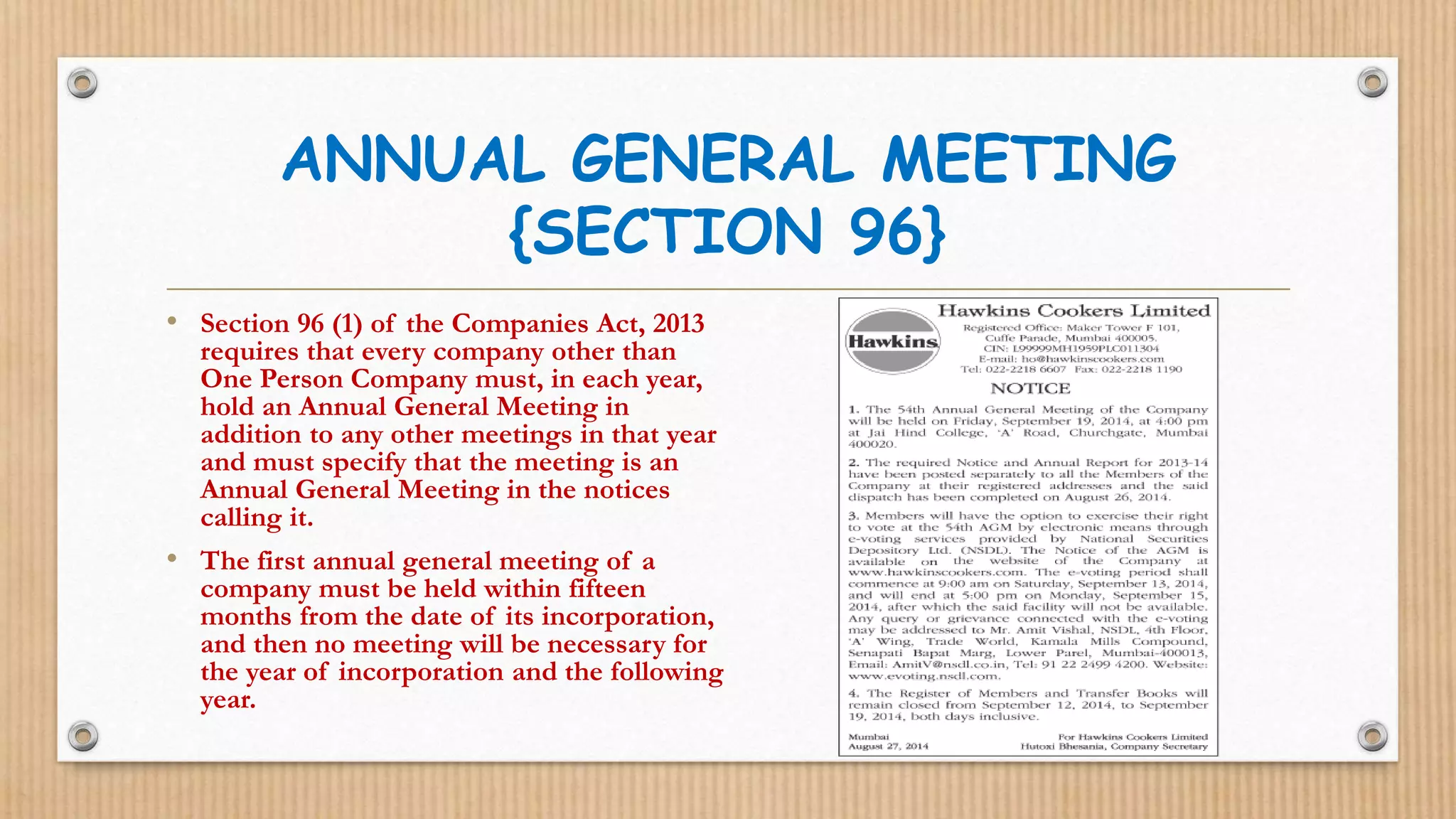
• Section 96 (1) of the Companies Act, 2013
requires that every company other than
One Person Company must, in each year,
hold an Annual General Meeting in
addition to any other meetings in that year
and must specify that the meeting is an
Annual General Meeting in the notices
calling it.
• The first annual general meeting of a
company must be held within fifteen
months from the date of its incorporation,
and then no meeting will be necessary for
the year of incorporation and the following
year.
EXTRAORDINARY MEETING
{SECTION 100}
• All general meetings of a company other than
the statutory and the annual general meeting
are called extraordinary general meetings.
• Extraordinary meetings may either be called
by the Board of Directors voluntarily
whenever they wish to transact some special
or urgent business or it may also be called on
the requisition of a specified number of
members.
• The meeting can be called by giving not less
than twenty one days notice in writing by the
requisitionists and the meeting should be
actually held within forty-five days from the
date of requisition.
CLASS MEETING
• Class meetings are those meetings
which are held by shareholders of a
particular class of shares e.g.
preference shares.
• The class meetings are usually
required to be held when it is proposed
to alter, vary or affect the rights of a
particular class of shares.
• For effecting such changes, it becomes
necessary to call separate class
meetings of the holders of those
shares and seek their approval.
BOARD MEETING
• The directors of a company collectively
constitute the Board of Directors which
exercises its powers at periodical meetings of
the Board.
• Section 173 of the Companies Act, 2013
provides that a meeting of the Board of
Directors of the Company should be held at
least once in every three months and at least
four meetings should be held in every year.
• The quorum for the Board’s meeting is one
third of its total strength (any fraction to be
rounded off as one) or two directors,
whichever is higher.
• Section 173(2) provides for Board Meeting
through Video Conferencing.
REQUISITES OF A VALID MEETING:
• properly convened
• properly constituted, and
• properly conducted.
MINUTES: {SECTION 118}
• The word ‘minutes’ denotes a brief summary of the proceedings of a
meeting. Each company has to maintain a record of the proceedings
of its general meetings and the meetings of its Board of Directors or
of every committee of the Board.
CASE LAWS
• Bejoy Kumar Karnani v. Asstt. Registrar of Companies
• Parasuram v. Tata Industrial Bank Ltd.
• Narayana Chettiar v. Kaleeswara Mills
• Cousins v. International Brick Co.
CONCLUSION
A meeting therefore, can be defined as a lawful association, or assembly
of two or more persons by previous notice for transacting some
business. The meeting must be validly summoned and convened. Such
gatherings of the members of companies are known as company
meetings. To convene a meeting, two or more persons must be present.
A meeting cannot be constituted by one person. However, there are
certain circumstances where one person can constitute a valid meeting.
Meetings under Company Law (Companies Act, 2013)

Meetings under Company Law (Companies Act, 2013)

  • 1.
    COMPANY MEETINGS Presented to: Mr.Sumit Maheshwari Presented by: Swasti Chaturvedi B.B.A. LL.B. VI SEM SEC- ‘B’ Subject: Company Law
  • 2.
    INTRODUCTION • A meetingmay broadly be defined as the gathering, assembly or the coming together of two or more persons for transaction of any lawful business. • Since the term ‘meeting’ connotes coming together of two or more persons, therefore, a single person cannot usually constitute a meeting even though he holds proxies for several other persons. • The Company Law, however, provides certain exceptions when presence of one member alone would constitute a valid meeting of the company.
  • 3.
    CHARACTERISTICS • Two ormore persons (who are the members of the Company) must be present at the meeting. • The assembly of persons must be for discussion and transaction of some lawful business. • A previous notice would be given for convening a meeting. • The meeting must be held at a particular place, date and time. • The meeting must be held as per provisions/rules of Companies Act.
  • 4.
    KINDS OF MEETINGS •The meetings of members of a company may be categorized into two broad heads, namely: • General Meetings • Class Meetings • The General Meetings of a company may be of two kinds, namely: • Annual General Meeting • Extraordinary General Meeting
  • 5.
    ANNUAL GENERAL MEETING {SECTION96} • Section 96 (1) of the Companies Act, 2013 requires that every company other than One Person Company must, in each year, hold an Annual General Meeting in addition to any other meetings in that year and must specify that the meeting is an Annual General Meeting in the notices calling it. • The first annual general meeting of a company must be held within fifteen months from the date of its incorporation, and then no meeting will be necessary for the year of incorporation and the following year.
  • 6.
    EXTRAORDINARY MEETING {SECTION 100} •All general meetings of a company other than the statutory and the annual general meeting are called extraordinary general meetings. • Extraordinary meetings may either be called by the Board of Directors voluntarily whenever they wish to transact some special or urgent business or it may also be called on the requisition of a specified number of members. • The meeting can be called by giving not less than twenty one days notice in writing by the requisitionists and the meeting should be actually held within forty-five days from the date of requisition.
  • 7.
    CLASS MEETING • Classmeetings are those meetings which are held by shareholders of a particular class of shares e.g. preference shares. • The class meetings are usually required to be held when it is proposed to alter, vary or affect the rights of a particular class of shares. • For effecting such changes, it becomes necessary to call separate class meetings of the holders of those shares and seek their approval.
  • 8.
    BOARD MEETING • Thedirectors of a company collectively constitute the Board of Directors which exercises its powers at periodical meetings of the Board. • Section 173 of the Companies Act, 2013 provides that a meeting of the Board of Directors of the Company should be held at least once in every three months and at least four meetings should be held in every year. • The quorum for the Board’s meeting is one third of its total strength (any fraction to be rounded off as one) or two directors, whichever is higher. • Section 173(2) provides for Board Meeting through Video Conferencing.
  • 9.
    REQUISITES OF AVALID MEETING: • properly convened • properly constituted, and • properly conducted. MINUTES: {SECTION 118} • The word ‘minutes’ denotes a brief summary of the proceedings of a meeting. Each company has to maintain a record of the proceedings of its general meetings and the meetings of its Board of Directors or of every committee of the Board.
  • 10.
    CASE LAWS • BejoyKumar Karnani v. Asstt. Registrar of Companies • Parasuram v. Tata Industrial Bank Ltd. • Narayana Chettiar v. Kaleeswara Mills • Cousins v. International Brick Co.
  • 11.
    CONCLUSION A meeting therefore,can be defined as a lawful association, or assembly of two or more persons by previous notice for transacting some business. The meeting must be validly summoned and convened. Such gatherings of the members of companies are known as company meetings. To convene a meeting, two or more persons must be present. A meeting cannot be constituted by one person. However, there are certain circumstances where one person can constitute a valid meeting.