SECURITIES EXCHANGE
BOARD OF INDIA(SEBI)
SEBI
Securities and Exchange Board of India
(SEBI) - A statutory body established
under the SEBI Act, 1992
Objectives
 Protect the interests of Investors
 Promote and Development the Securities
Market
 Regulate the Securities Market
4/23/2020 SAPM3
Functions of SEBI
Regulating the business in stock exchange and
any other securities market
Registering and regulating the workings of
intermediaries associated with securities market
Registering and regulating the working of
collective investment schemes including mutual
funds
Promoting and regulating self-regulatory
organizations
Prohibiting fraudulent and unfair trade practices
in the securities market
4/23/2020 SAPM4
Functions of SEBI
Promoting investors education and training of
intermediaries in securities market
Prohibiting insiders trading in securities
Regulating substantial acquisition of shares and
take-over of companies
Calling for information, undertaking inspection,
conducting enquiries and audits of the stock
exchanges, intermediaries and self-regulatory
organizations in the securities market
4/23/2020 SAPM5
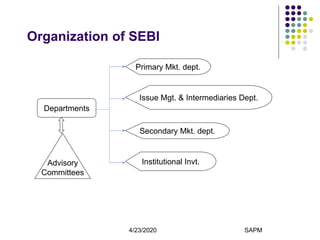
Organization of SEBI
Departments
Primary Mkt. dept.
Issue Mgt. & Intermediaries Dept.
Secondary Mkt. dept.
Institutional Invt.Advisory
Committees
4/23/2020 SAPM6
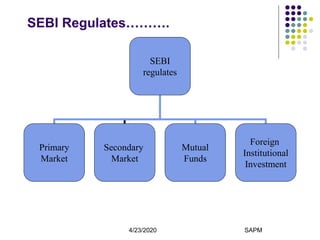
SEBI Regulates……….
SEBI
regulates
Primary
Market
Secondary
Market
Mutual
Funds
Foreign
Institutional
Investment
4/23/2020 SAPM7
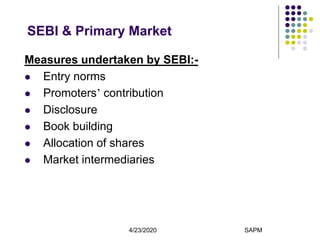
SEBI & Primary Market
Measures undertaken by SEBI:-
 Entry norms
 Promoters’ contribution
 Disclosure
 Book building
 Allocation of shares
 Market intermediaries
4/23/2020 SAPM8
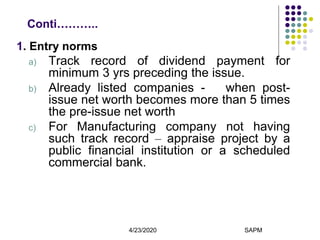
Conti………..
1. Entry norms
a) Track record of dividend payment for
minimum 3 yrs preceding the issue.
b) Already listed companies - when post-
issue net worth becomes more than 5 times
the pre-issue net worth
c) For Manufacturing company not having
such track record – appraise project by a
public financial institution or a scheduled
commercial bank.
4/23/2020 SAPM9
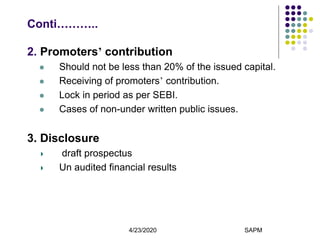
Conti………..
2. Promoters’ contribution
 Should not be less than 20% of the issued capital.
 Receiving of promoters’ contribution.
 Lock in period as per SEBI.
 Cases of non-under written public issues.
3. Disclosure
draft prospectus
Un audited financial results
4/23/2020 SAPM10
Conti………..
4. Book building
SEBI recommends two-tier under writing system
One of the mode of public issue thru prospectus.
Role of syndicate members and book runners.
Minimum 30 centers.
5. Allocation of shares
Minimum application of shares
Reservation for small investors
Allotment of securities
4/23/2020 SAPM11
Conti………..
6. Market intermediaries
Licensing of merchant bankers
Licensing of underwriters, registrars, transfer agents,
etc.,
Merchant bankers net worth – Rs.5 crores
Segregate fund based from fee based activities.
4/23/2020 SAPM12
SEBI & Secondary Market
Reforms in the secondary market:-
1. Governing board
2. Infrastructure
3. Clearing & Settlement
4. Debt market
5. Price stabilization
6. Delisting
7. Brokers
8. Insider Trading
4/23/2020 SAPM13
Conti………..
1. Governing board
Brokers and non-brokers representation
made 50:50
60% of brokers in arbitration, disciplinary &
default committees
For trading members 40% representation
2. Infrastructure
On-line screen based trading terminals
4/23/2020 SAPM14
Conti………..
3. Settlement & clearing
Weekly settlements
Auctions for non-delivered shares within 80 days of
settlement
Advice to set up clearing houses, clearing corporation
or settlement guarantee fund
Warehousing facilities permitted by SEBI.
4/23/2020 SAPM15
Conti………..
4. Debt market segment
Regulates thru SEBI (depository & participants)
regulation Act 1996.
Listing of debt instruments
Invt. Range for FIIs
Dual rating for above Rs.500 million
4/23/2020 SAPM16
Conti………..
5. Price stabilization
Division to monitor the unusual movements in prices.
Monitor prices of newly listed scrip from the first day
of trading.
Circuit breaker system and other monitoring
restrictions could be applied
Imposing of special margins of 25% on purchase in
addition to regular margin.
Price filters
Price bands
Conti………..
6. Delisting
 On voluntary de-listing from regional stock exchanges –
buy offer to all share holders
 Promoters to buy or arrange buyers for the securities
 3 yrs listing fees from companies and be kept in Escrow
A/c with the stock exchange.
4/23/2020 SAPM17
SEBI and the FIIs
Union Govt. allowed-
Foreign Institutional Investors (FIIs)
Non-Resident Indians (NRIs), and
Persons of Indian Origin (PIOs)
to enter into both Primary & Secondary market in India through the portfolio
investment scheme (PIS), under Liberalized policy regime. Under this scheme,
FIIs/NRIs can acquire shares/debentures of Indian companies through the stock
exchanges in India.
Implications:-
Affects the sensex movements
Determines the market indications
Guidelines announced in 1992
In 1993, 12 FIIs got registered
At the end of 1996-97, 439 FIIs were registered
Can trade in securities of listed companies including OTCEI.
The ceiling for overall investment for FIIs:-
24% of the paid up capital of the Indian company
10% for NRIs/PIOs.
20% of the paid up capital in the case of public sector banks, including
the State Bank of India.
Modifications in ceilings:-
The ceiling of 24 % for FII investment can be raised up to sectoral
cap/statutory ceiling, subject to the approval of the board and the
general body of the company passing a special resolution to that effect.
The ceiling of 10 % for NRIs/PIOs can be raised to 24% subject to the
approval of the general body of the company passing a resolution to
that effect.
Monitoring Foreign Investments
The Reserve Bank of India
monitors the ceilings on FII/NRI/PIO investments in Indian companies
on a daily basis.
For effective monitoring of foreign investment ceiling limits, the Reserve
Bank has fixed cut-off points that are two percentage points lower than
the actual ceilings.
SEBI guidelines for FIIs:-
According to the 1995 regulations, FIIs should hold certificate granted
by SEBI to trade in Indian stock market.
To grant the certificate the applicant should –
1. Have track record, professional & competence record, financial
soundness, general reputation of fairness and integrity.
2. Regulated by an appropriate foreign regulatory authority.
3. Permission under the provisions of FERA Act 1973.(FEMA - 2006)
Valid up to 5 yrs.
4/23/2020 SAPM 22
Custodians
Is an agency
appointment of the custodian
Maintenance of accounts
Submission of semi-annual reports (SEBI & RBI)
Inspection of accounts
SEBI Guidelines:-
Foreign brokers can operate only on behalf of registered FIIs.
Execution of orders for sale and purchase of securities are done
by a member of an Indian stock exchange
Time stipulation for transaction b/w custodian & member of ISE is
48 hrs.
4/23/2020 SAPM 23
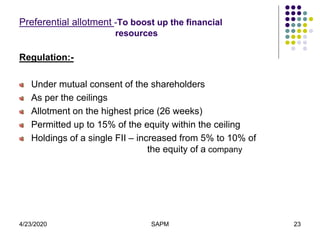
Preferential allotment -To boost up the financial
resources
Regulation:-
Under mutual consent of the shareholders
As per the ceilings
Allotment on the highest price (26 weeks)
Permitted up to 15% of the equity within the ceiling
Holdings of a single FII – increased from 5% to 10% of
the equity of a company
4/23/2020 SAPM 24
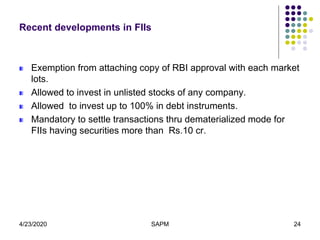
Recent developments in FIIs
Exemption from attaching copy of RBI approval with each market
lots.
Allowed to invest in unlisted stocks of any company.
Allowed to invest up to 100% in debt instruments.
Mandatory to settle transactions thru dematerialized mode for
FIIs having securities more than Rs.10 cr.

Sebi

  • 1.
  • 2.
    SEBI Securities and ExchangeBoard of India (SEBI) - A statutory body established under the SEBI Act, 1992 Objectives  Protect the interests of Investors  Promote and Development the Securities Market  Regulate the Securities Market
  • 3.
    4/23/2020 SAPM3 Functions ofSEBI Regulating the business in stock exchange and any other securities market Registering and regulating the workings of intermediaries associated with securities market Registering and regulating the working of collective investment schemes including mutual funds Promoting and regulating self-regulatory organizations Prohibiting fraudulent and unfair trade practices in the securities market
  • 4.
    4/23/2020 SAPM4 Functions ofSEBI Promoting investors education and training of intermediaries in securities market Prohibiting insiders trading in securities Regulating substantial acquisition of shares and take-over of companies Calling for information, undertaking inspection, conducting enquiries and audits of the stock exchanges, intermediaries and self-regulatory organizations in the securities market
  • 5.
    4/23/2020 SAPM5 Organization ofSEBI Departments Primary Mkt. dept. Issue Mgt. & Intermediaries Dept. Secondary Mkt. dept. Institutional Invt.Advisory Committees
  • 6.
  • 7.
    4/23/2020 SAPM7 SEBI &Primary Market Measures undertaken by SEBI:-  Entry norms  Promoters’ contribution  Disclosure  Book building  Allocation of shares  Market intermediaries
  • 8.
    4/23/2020 SAPM8 Conti……….. 1. Entrynorms a) Track record of dividend payment for minimum 3 yrs preceding the issue. b) Already listed companies - when post- issue net worth becomes more than 5 times the pre-issue net worth c) For Manufacturing company not having such track record – appraise project by a public financial institution or a scheduled commercial bank.
  • 9.
    4/23/2020 SAPM9 Conti……….. 2. Promoters’contribution  Should not be less than 20% of the issued capital.  Receiving of promoters’ contribution.  Lock in period as per SEBI.  Cases of non-under written public issues. 3. Disclosure draft prospectus Un audited financial results
  • 10.
    4/23/2020 SAPM10 Conti……….. 4. Bookbuilding SEBI recommends two-tier under writing system One of the mode of public issue thru prospectus. Role of syndicate members and book runners. Minimum 30 centers. 5. Allocation of shares Minimum application of shares Reservation for small investors Allotment of securities
  • 11.
    4/23/2020 SAPM11 Conti……….. 6. Marketintermediaries Licensing of merchant bankers Licensing of underwriters, registrars, transfer agents, etc., Merchant bankers net worth – Rs.5 crores Segregate fund based from fee based activities.
  • 12.
    4/23/2020 SAPM12 SEBI &Secondary Market Reforms in the secondary market:- 1. Governing board 2. Infrastructure 3. Clearing & Settlement 4. Debt market 5. Price stabilization 6. Delisting 7. Brokers 8. Insider Trading
  • 13.
    4/23/2020 SAPM13 Conti……….. 1. Governingboard Brokers and non-brokers representation made 50:50 60% of brokers in arbitration, disciplinary & default committees For trading members 40% representation 2. Infrastructure On-line screen based trading terminals
  • 14.
    4/23/2020 SAPM14 Conti……….. 3. Settlement& clearing Weekly settlements Auctions for non-delivered shares within 80 days of settlement Advice to set up clearing houses, clearing corporation or settlement guarantee fund Warehousing facilities permitted by SEBI.
  • 15.
    4/23/2020 SAPM15 Conti……….. 4. Debtmarket segment Regulates thru SEBI (depository & participants) regulation Act 1996. Listing of debt instruments Invt. Range for FIIs Dual rating for above Rs.500 million
  • 16.
    4/23/2020 SAPM16 Conti……….. 5. Pricestabilization Division to monitor the unusual movements in prices. Monitor prices of newly listed scrip from the first day of trading. Circuit breaker system and other monitoring restrictions could be applied Imposing of special margins of 25% on purchase in addition to regular margin. Price filters Price bands
  • 17.
    Conti……….. 6. Delisting  Onvoluntary de-listing from regional stock exchanges – buy offer to all share holders  Promoters to buy or arrange buyers for the securities  3 yrs listing fees from companies and be kept in Escrow A/c with the stock exchange. 4/23/2020 SAPM17
  • 18.
    SEBI and theFIIs Union Govt. allowed- Foreign Institutional Investors (FIIs) Non-Resident Indians (NRIs), and Persons of Indian Origin (PIOs) to enter into both Primary & Secondary market in India through the portfolio investment scheme (PIS), under Liberalized policy regime. Under this scheme, FIIs/NRIs can acquire shares/debentures of Indian companies through the stock exchanges in India. Implications:- Affects the sensex movements Determines the market indications Guidelines announced in 1992 In 1993, 12 FIIs got registered At the end of 1996-97, 439 FIIs were registered Can trade in securities of listed companies including OTCEI.
  • 19.
    The ceiling foroverall investment for FIIs:- 24% of the paid up capital of the Indian company 10% for NRIs/PIOs. 20% of the paid up capital in the case of public sector banks, including the State Bank of India. Modifications in ceilings:- The ceiling of 24 % for FII investment can be raised up to sectoral cap/statutory ceiling, subject to the approval of the board and the general body of the company passing a special resolution to that effect. The ceiling of 10 % for NRIs/PIOs can be raised to 24% subject to the approval of the general body of the company passing a resolution to that effect.
  • 20.
    Monitoring Foreign Investments TheReserve Bank of India monitors the ceilings on FII/NRI/PIO investments in Indian companies on a daily basis. For effective monitoring of foreign investment ceiling limits, the Reserve Bank has fixed cut-off points that are two percentage points lower than the actual ceilings.
  • 21.
    SEBI guidelines forFIIs:- According to the 1995 regulations, FIIs should hold certificate granted by SEBI to trade in Indian stock market. To grant the certificate the applicant should – 1. Have track record, professional & competence record, financial soundness, general reputation of fairness and integrity. 2. Regulated by an appropriate foreign regulatory authority. 3. Permission under the provisions of FERA Act 1973.(FEMA - 2006) Valid up to 5 yrs.
  • 22.
    4/23/2020 SAPM 22 Custodians Isan agency appointment of the custodian Maintenance of accounts Submission of semi-annual reports (SEBI & RBI) Inspection of accounts SEBI Guidelines:- Foreign brokers can operate only on behalf of registered FIIs. Execution of orders for sale and purchase of securities are done by a member of an Indian stock exchange Time stipulation for transaction b/w custodian & member of ISE is 48 hrs.
  • 23.
    4/23/2020 SAPM 23 Preferentialallotment -To boost up the financial resources Regulation:- Under mutual consent of the shareholders As per the ceilings Allotment on the highest price (26 weeks) Permitted up to 15% of the equity within the ceiling Holdings of a single FII – increased from 5% to 10% of the equity of a company
  • 24.
    4/23/2020 SAPM 24 Recentdevelopments in FIIs Exemption from attaching copy of RBI approval with each market lots. Allowed to invest in unlisted stocks of any company. Allowed to invest up to 100% in debt instruments. Mandatory to settle transactions thru dematerialized mode for FIIs having securities more than Rs.10 cr.