UNIT –II
Financial Market
What is a Financial market?
 A market is a venue where goods
and services are exchanged.
 A financial market is a place where
individuals and organizations
wanting to borrow funds are
brought together with those having
a surplus of funds.
2-3
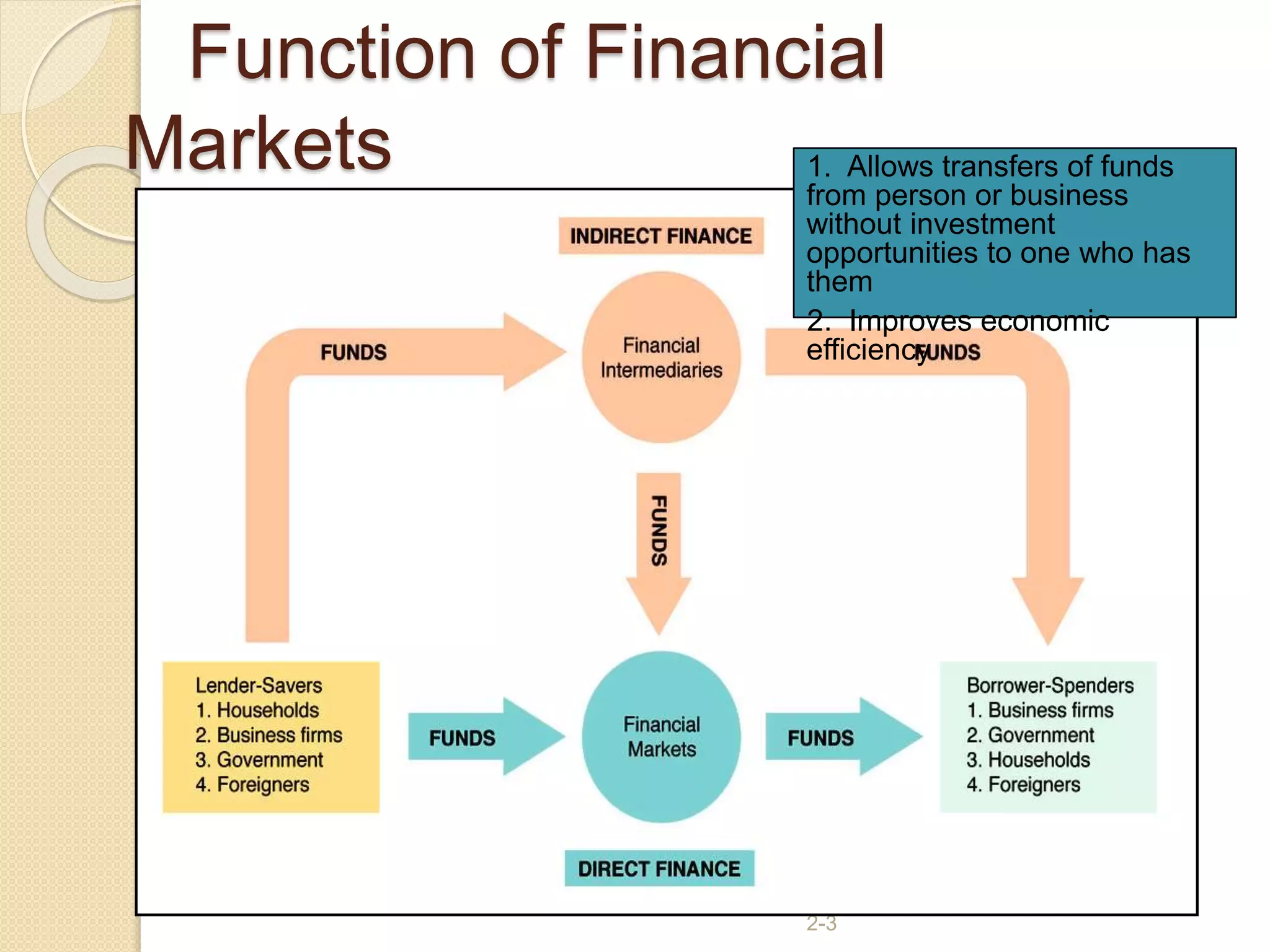
Function of Financial
Markets 1. Allows transfers of funds
from person or business
without investment
opportunities to one who has
them
2. Improves economic
efficiency
Funds Flow in Securities Market
Employees and
Employers
Policy Holders
Corporates
Individual
Surplus
Units
Pension
Funds
Insurance
Companies
Mutual
Funds
Banks
FIIs
Deficit
Units
Regulation of Financial
Markets
 RBI - All Banks & Currencies
 SEBI - Stock Market & Mutual Funds
 IRDA - Insurance Companies
 FMC - Commodity Market
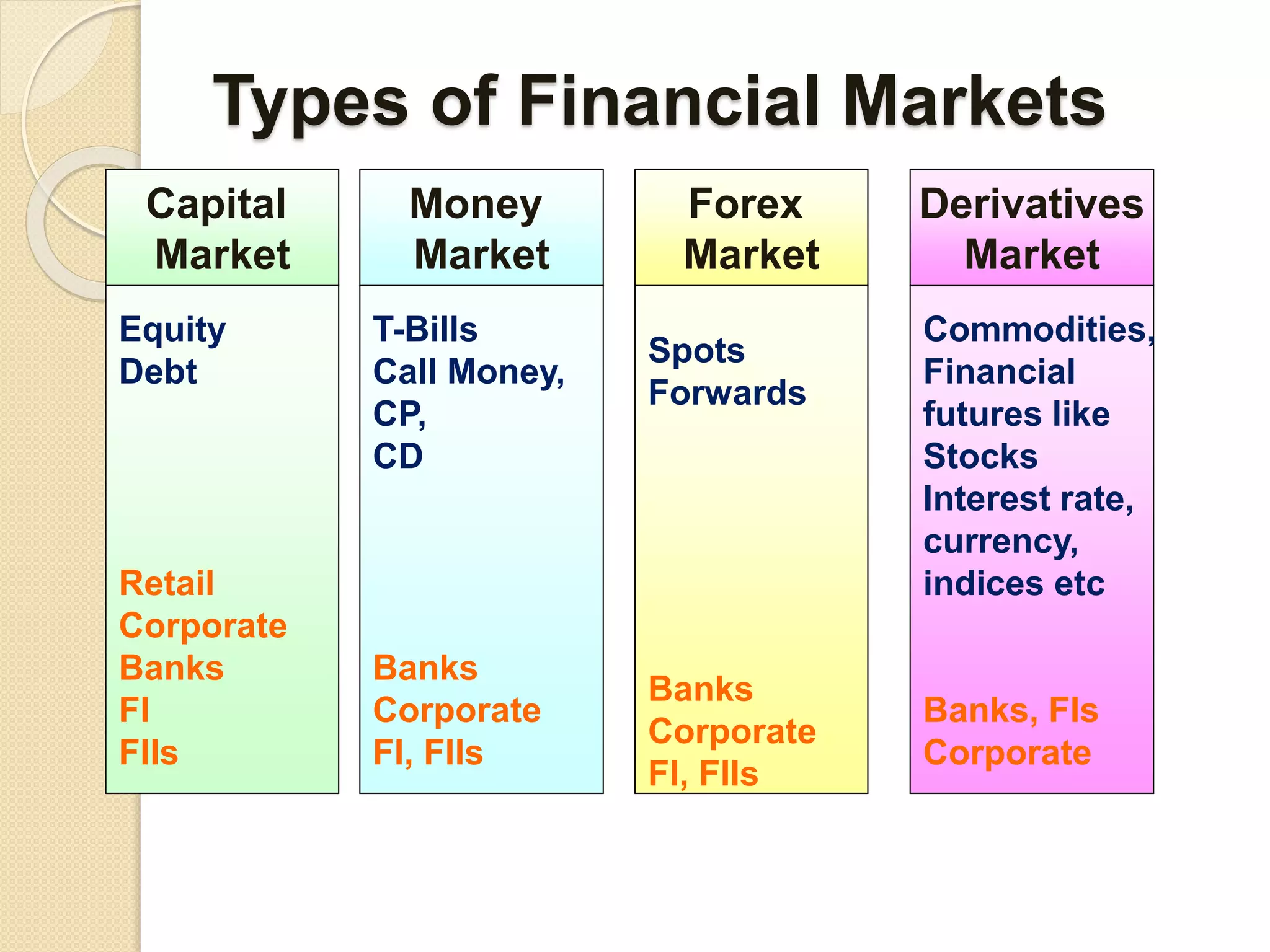
Types of Financial Markets
Capital
Market
Money
Market
Forex
Market
Equity
Debt
Retail
Corporate
Banks
FI
FIIs
T-Bills
Call Money,
CP,
CD
Banks
Corporate
FI, FIIs
Spots
Forwards
Banks
Corporate
FI, FIIs
Commodities,
Financial
futures like
Stocks
Interest rate,
currency,
indices etc
Banks, FIs
Corporate
Derivatives
Market
Capital Market
Capital Market is the market for long term
finance with the maturity period more than
one year.
The Capital Market deals with the stock
markets which provide financing through the
issuance of shares or common stock in the
primary market, and enable the subsequent
trading in the secondary market.
Indian Capital Market
 Development Financial Institutions
◦ Industrial Finance Corporation of India (IFCI)
◦ State Finance Corporations (SFCs)
◦ Industrial Development Finance Corporation (IDFC)
 Financial Intermediaries
◦ Merchant Banks
◦ Mutual Funds
◦ Leasing Companies
◦ Venture Capital Companies
Types of capital market
There are two types of capital market:
Primary market,
Secondary market
Primary Market
 It is that market in which shares,
debentures and other securities are sold
for the first time for collecting long-
term capital.
This market is concerned with new
issues. Therefore, the primary market is
also called NEW ISSUE MARKET.
Features of Primary Market
 It Is Related With New Issues
 It Has No Particular Place
 It Has Various Methods Of Float Capital:
Following are the methods of raising capital in
the primary market:
i) Public Issue
ii) Offer For Sale
iii) Private Placement
iv) Right Issue
v) Electronic-Initial Public Offer
 It comes before Secondary Market
Secondary Market
 The secondary market is that market in
which the buying and selling of the
previously issued securities is done.
The transactions of the secondary
market are generally done through the
medium of stock exchange.
The chief purpose of the secondary
market is to create liquidity in securities.
Cont
 If an individual has bought some security
and he now wants to sell it, he can do so
through the medium of stock exchange to sell
or purchase through the medium of stock
exchange requires the services of the broker
presently, their are 24 stock exchange in
India.
.
Features of Secondary Market
 It Creates Liquidity
 It Comes After Primary Market
 It Has A Particular Place
 It Encourage New Investments
Capital market Investments in the Stock
Market
 The stock market is basically the trading
ground capital market investment in the following:
i) Company’s stocks
ii) Derivatives
iii) Other securities
 The capital market investments in the stock market
take place by:
1) Small individual stock investors
2) Large hedge fund traders.
 The capital market investments can occur either in:
1) The physical market by a method known as the
open outcry.
Capital Market Investments in the
Bond Market
 The bond market is a financial market where the
participants buy and sell debt securities.
 The bond market is also differently known as the
debt, credit or fixed income market.
 There are different types of bond markets based on
the different types of bonds that are traded. They
are:
 Corporate,
 Government and agency,
 Municipal,
 Bonds backed by mortgages & assets,
 Collateralized Debt Obligation.
Money Market
 The Money Markets are associated
with the issuance and trading of short-
term(less than a year).
Investors in Money Market
Instruments include corporations and
FIs who have idle cash but are
restricted to a short-term investment
horizon.
The Money Markets essentially serve
to allocate the nation’s supply of liquid
funds among major short-term lenders
and borrowers
Money Market
 Organised (Call money market)
 Bill Market
◦ Treasury bills
◦ Commercial bills
 Bank loans (short-term)
 Organised money market comprises RBI, banks
(commercial and co-operatives)
 Unorganised (money lenders,
chit funds, etc.)
19
The foreign exchange market is the
mechanism by which participants:
◦ Transfer purchasing power between
countries;
◦ Obtain or provide credit for international
trade transactions, and
◦ Minimize exposure to the risks of exchange
rate changes.
Forex Market
20
A Spot transaction in the interbank market is
the purchase of foreign exchange, with
delivery and payment between banks to take
place, normally, on the second following
business day. The date of settlement is
referred to as the value date.
Forward exchange rates are usually quoted
for value dates of one, two, three, six and
twelve months. Buying Forward and Selling
Forward describe the same transaction (the
only difference is the order in which
currencies are referenced.)
Types of Transactions
21
A swap transaction in the interbank
market is the simultaneous purchase and
sale of a given amount of foreign exchange
for two different value dates.
Both purchase and sale are conducted with
the same counterparty.
Some different types of swaps are:
◦ spot against forward,
◦ forward-forward,
◦ nondeliverable forwards (NDF).
Types of Transactions

Financial market

  • 1.
  • 2.
    What is aFinancial market?  A market is a venue where goods and services are exchanged.  A financial market is a place where individuals and organizations wanting to borrow funds are brought together with those having a surplus of funds.
  • 3.
    2-3 Function of Financial Markets1. Allows transfers of funds from person or business without investment opportunities to one who has them 2. Improves economic efficiency
  • 4.
    Funds Flow inSecurities Market Employees and Employers Policy Holders Corporates Individual Surplus Units Pension Funds Insurance Companies Mutual Funds Banks FIIs Deficit Units
  • 5.
    Regulation of Financial Markets RBI - All Banks & Currencies  SEBI - Stock Market & Mutual Funds  IRDA - Insurance Companies  FMC - Commodity Market
  • 6.
    Types of FinancialMarkets Capital Market Money Market Forex Market Equity Debt Retail Corporate Banks FI FIIs T-Bills Call Money, CP, CD Banks Corporate FI, FIIs Spots Forwards Banks Corporate FI, FIIs Commodities, Financial futures like Stocks Interest rate, currency, indices etc Banks, FIs Corporate Derivatives Market
  • 7.
    Capital Market Capital Marketis the market for long term finance with the maturity period more than one year. The Capital Market deals with the stock markets which provide financing through the issuance of shares or common stock in the primary market, and enable the subsequent trading in the secondary market.
  • 8.
    Indian Capital Market Development Financial Institutions ◦ Industrial Finance Corporation of India (IFCI) ◦ State Finance Corporations (SFCs) ◦ Industrial Development Finance Corporation (IDFC)  Financial Intermediaries ◦ Merchant Banks ◦ Mutual Funds ◦ Leasing Companies ◦ Venture Capital Companies
  • 9.
    Types of capitalmarket There are two types of capital market: Primary market, Secondary market
  • 10.
    Primary Market  Itis that market in which shares, debentures and other securities are sold for the first time for collecting long- term capital. This market is concerned with new issues. Therefore, the primary market is also called NEW ISSUE MARKET.
  • 11.
    Features of PrimaryMarket  It Is Related With New Issues  It Has No Particular Place  It Has Various Methods Of Float Capital: Following are the methods of raising capital in the primary market: i) Public Issue ii) Offer For Sale iii) Private Placement iv) Right Issue v) Electronic-Initial Public Offer  It comes before Secondary Market
  • 12.
    Secondary Market  Thesecondary market is that market in which the buying and selling of the previously issued securities is done. The transactions of the secondary market are generally done through the medium of stock exchange. The chief purpose of the secondary market is to create liquidity in securities.
  • 13.
    Cont  If anindividual has bought some security and he now wants to sell it, he can do so through the medium of stock exchange to sell or purchase through the medium of stock exchange requires the services of the broker presently, their are 24 stock exchange in India. .
  • 14.
    Features of SecondaryMarket  It Creates Liquidity  It Comes After Primary Market  It Has A Particular Place  It Encourage New Investments
  • 15.
    Capital market Investmentsin the Stock Market  The stock market is basically the trading ground capital market investment in the following: i) Company’s stocks ii) Derivatives iii) Other securities  The capital market investments in the stock market take place by: 1) Small individual stock investors 2) Large hedge fund traders.  The capital market investments can occur either in: 1) The physical market by a method known as the open outcry.
  • 16.
    Capital Market Investmentsin the Bond Market  The bond market is a financial market where the participants buy and sell debt securities.  The bond market is also differently known as the debt, credit or fixed income market.  There are different types of bond markets based on the different types of bonds that are traded. They are:  Corporate,  Government and agency,  Municipal,  Bonds backed by mortgages & assets,  Collateralized Debt Obligation.
  • 17.
    Money Market  TheMoney Markets are associated with the issuance and trading of short- term(less than a year). Investors in Money Market Instruments include corporations and FIs who have idle cash but are restricted to a short-term investment horizon. The Money Markets essentially serve to allocate the nation’s supply of liquid funds among major short-term lenders and borrowers
  • 18.
    Money Market  Organised(Call money market)  Bill Market ◦ Treasury bills ◦ Commercial bills  Bank loans (short-term)  Organised money market comprises RBI, banks (commercial and co-operatives)  Unorganised (money lenders, chit funds, etc.)
  • 19.
    19 The foreign exchangemarket is the mechanism by which participants: ◦ Transfer purchasing power between countries; ◦ Obtain or provide credit for international trade transactions, and ◦ Minimize exposure to the risks of exchange rate changes. Forex Market
  • 20.
    20 A Spot transactionin the interbank market is the purchase of foreign exchange, with delivery and payment between banks to take place, normally, on the second following business day. The date of settlement is referred to as the value date. Forward exchange rates are usually quoted for value dates of one, two, three, six and twelve months. Buying Forward and Selling Forward describe the same transaction (the only difference is the order in which currencies are referenced.) Types of Transactions
  • 21.
    21 A swap transactionin the interbank market is the simultaneous purchase and sale of a given amount of foreign exchange for two different value dates. Both purchase and sale are conducted with the same counterparty. Some different types of swaps are: ◦ spot against forward, ◦ forward-forward, ◦ nondeliverable forwards (NDF). Types of Transactions