Single Entry System
Dr.S.PASUPATHI
Associate Professor of Commerce
Vivekananda College
Tiruvedakam West
There is no system of accounts
Incomplete, inaccurate, unscientific and
unsystematic system of book keeping.
Double aspects of business transactions are not
recorded.
Suitable for sole traders and partnership firms
All transactions are not recorded
Profit only an estimate
True financial position can not be ascertained
Simple method
Number of books maintained is less
It is suitable for sole trader, partnership
firms
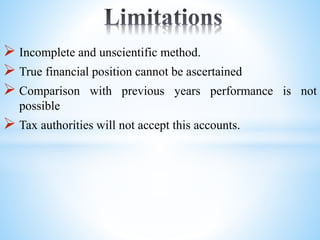
 Incomplete and unscientific method.
 True financial position cannot be ascertained
 Comparison with previous years performance is not
possible
 Tax authorities will not accept this accounts.
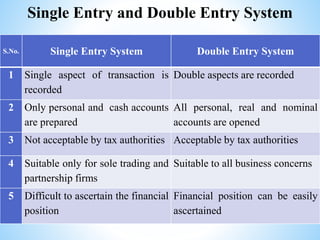
S.No. Single Entry System Double Entry System
1 Single aspect of transaction is
recorded
Double aspects are recorded
2 Only personal and cash accounts
are prepared
All personal, real and nominal
accounts are opened
3 Not acceptable by tax authorities Acceptable by tax authorities
4 Suitable only for sole trading and
partnership firms
Suitable to all business concerns
5 Difficult to ascertain the financial
position
Financial position can be easily
ascertained
Single Entry and Double Entry System
Like a balance sheet, shows the assets and
liabilities.
The balancing figure of the assets and
liabilities are taken.
Collection of estimated assets and liabilities.
Sl.No. Balance Sheet Statement of Affairs
1 It is prepared on the basis of
ledgers
It is prepared on the basis of
incomplete books
2 Arithmetical accuracy can be
verified
Arithmetical accuracy cannot
be verified
3 It shows the financial position of
the business
It shows the capital balances
4 Assets and liabilities are taken
from ledgers maintained
Assets and liabilities are taken
as estimates
5 Easy to find the omissions Difficult to find the omissions
Balance Sheet and Statement of Affairs
Arun a retail merchant commenced business with a
capital of Rs. 12000 on 1.1.2018. Subsequently on 1.5.2018 he
invested further capital of Rs.5000. During the year, he has
withdrawn Rs.2000 for his personal use. On 31.12.2018, his
assets and liabilities were as follows.
Calculate the profit or loss made during the year 2018
PARTICULARS AMOUNT
Cash at Bank 3000
Debtors 4000
Furniture 2000
Stock 16000
Creditors 5000
Liabilities Rs. Assets Rs.
Creditors 5000 Cash at bank 3000
Capital (Bal.fig.) 20000 Debtors 4000
Furniture 2000
Stock 16000
25000 25000
Statement of affairs of Arun as on 31.12.2018
Solution:
Closing Capital 20000
Add: Drawings 2000
22000
Less: Additional Capital 5000
17000
Less: Opening Capital 12000
Profit 5000
Statement of Profit or Loss as on 31.12.2018
From the following information, find out the credit sales:
PARTRICULARS AMOUNT
Cash Received from Debtors 53000
Discount Allowed 800
Return Inwards 1500
Balance of Debtors on Jan. 2018 10000
Balance of Debtors on Dec. 2018 9500
Bills Receivable from Debtors 13000
Bad Debts during 2018 700
Bills Receivable Dishonoured 950
TOTAL DEBTORS ACCOUNT
PARTICULARS AMOUNT PARTICULARS AMOUNT
To Balance b/d 10000 By Cash 53000
To Bills Dishonoured 950 By Discount Allowed 800
To Credit Sales
(Bal. Fig) 67550 By Returns Inwards 1500
By Bills Receivable 13000
By Bad Debts 700
By Balance c/d 9500
78500 78500
References
 T.S.Reddy and T.Murthy – Advanced Accounting
Volume-I, Margham Publications, Chennai 2013.
 M.C. Shukla, T.S. Grewal and S.C.Gupta,”Advanced
Accounts”, S.Chand, New Delhi.
 S.P. Jain and K.L Narang, “Advanced Accountancy”, Kalyani
Publishers, New Delhi.
 S.N. Maheshwari, “Advanced Accountancy”, Sultan Chand
& Sons, New Delhi.
Single entry

Single entry

  • 1.
    Single Entry System Dr.S.PASUPATHI AssociateProfessor of Commerce Vivekananda College Tiruvedakam West
  • 2.
    There is nosystem of accounts Incomplete, inaccurate, unscientific and unsystematic system of book keeping. Double aspects of business transactions are not recorded.
  • 3.
    Suitable for soletraders and partnership firms All transactions are not recorded Profit only an estimate True financial position can not be ascertained
  • 4.
    Simple method Number ofbooks maintained is less It is suitable for sole trader, partnership firms
  • 5.
     Incomplete andunscientific method.  True financial position cannot be ascertained  Comparison with previous years performance is not possible  Tax authorities will not accept this accounts.
  • 6.
    S.No. Single EntrySystem Double Entry System 1 Single aspect of transaction is recorded Double aspects are recorded 2 Only personal and cash accounts are prepared All personal, real and nominal accounts are opened 3 Not acceptable by tax authorities Acceptable by tax authorities 4 Suitable only for sole trading and partnership firms Suitable to all business concerns 5 Difficult to ascertain the financial position Financial position can be easily ascertained Single Entry and Double Entry System
  • 7.
    Like a balancesheet, shows the assets and liabilities. The balancing figure of the assets and liabilities are taken. Collection of estimated assets and liabilities.
  • 8.
    Sl.No. Balance SheetStatement of Affairs 1 It is prepared on the basis of ledgers It is prepared on the basis of incomplete books 2 Arithmetical accuracy can be verified Arithmetical accuracy cannot be verified 3 It shows the financial position of the business It shows the capital balances 4 Assets and liabilities are taken from ledgers maintained Assets and liabilities are taken as estimates 5 Easy to find the omissions Difficult to find the omissions Balance Sheet and Statement of Affairs
  • 9.
    Arun a retailmerchant commenced business with a capital of Rs. 12000 on 1.1.2018. Subsequently on 1.5.2018 he invested further capital of Rs.5000. During the year, he has withdrawn Rs.2000 for his personal use. On 31.12.2018, his assets and liabilities were as follows. Calculate the profit or loss made during the year 2018 PARTICULARS AMOUNT Cash at Bank 3000 Debtors 4000 Furniture 2000 Stock 16000 Creditors 5000
  • 10.
    Liabilities Rs. AssetsRs. Creditors 5000 Cash at bank 3000 Capital (Bal.fig.) 20000 Debtors 4000 Furniture 2000 Stock 16000 25000 25000 Statement of affairs of Arun as on 31.12.2018 Solution:
  • 11.
    Closing Capital 20000 Add:Drawings 2000 22000 Less: Additional Capital 5000 17000 Less: Opening Capital 12000 Profit 5000 Statement of Profit or Loss as on 31.12.2018
  • 12.
    From the followinginformation, find out the credit sales: PARTRICULARS AMOUNT Cash Received from Debtors 53000 Discount Allowed 800 Return Inwards 1500 Balance of Debtors on Jan. 2018 10000 Balance of Debtors on Dec. 2018 9500 Bills Receivable from Debtors 13000 Bad Debts during 2018 700 Bills Receivable Dishonoured 950
  • 13.
    TOTAL DEBTORS ACCOUNT PARTICULARSAMOUNT PARTICULARS AMOUNT To Balance b/d 10000 By Cash 53000 To Bills Dishonoured 950 By Discount Allowed 800 To Credit Sales (Bal. Fig) 67550 By Returns Inwards 1500 By Bills Receivable 13000 By Bad Debts 700 By Balance c/d 9500 78500 78500
  • 14.
    References  T.S.Reddy andT.Murthy – Advanced Accounting Volume-I, Margham Publications, Chennai 2013.  M.C. Shukla, T.S. Grewal and S.C.Gupta,”Advanced Accounts”, S.Chand, New Delhi.  S.P. Jain and K.L Narang, “Advanced Accountancy”, Kalyani Publishers, New Delhi.  S.N. Maheshwari, “Advanced Accountancy”, Sultan Chand & Sons, New Delhi.