SEARCHING FOR SUSTAINABILITY IN AN
ENCROACHING AND TRANSFORMING WORLD
BRIEFING TO P2 & HWM CONFERENCE & EXHIBITION
SAN ANTONIO, TX
22 AUGUST 2002
DAVID S. EADY
ARMY ENVIRONMENTAL POLICY INSTITUTE
Assistant Secretary of the Army (Installations and Environment)
3-28-02 OASA (I&E) 2
Outline
• Define installation sustainability
• Discuss basic sustainability principles,
practices and benefits
• Identify strategic and operational
opportunities to address sustainability
• Suggest alignment / integration in support of
transformation to sustainable installations
Assistant Secretary of the Army (Installations and Environment)
3-28-02 OASA (I&E) 3
What is sustainability?
the “academic” response
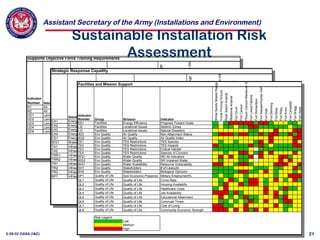
“…broadly refers to the persistence of the
integrity and structure of a system over
time.”
– (Costanza et al. 2001)
“…the ability of a system to continue
functioning into the future without being
forced into decline through the exhaustion or
overloading of the key resources on which that
system depends”
– (Gilman 1996; AIA 1996)
Assistant Secretary of the Army (Installations and Environment)
3-28-02 OASA (I&E) 4
What is sustainability?
the “text book” response
“…meeting the needs of the present,
without compromising the ability of future
generations to meet their own needs.”
– (World Commission on Environment and Development 1987)
Assistant Secretary of the Army (Installations and Environment)
3-28-02 OASA (I&E) 5
What is installation sustainability?
… a condition in which an installation is able to
fully execute its present missions without
compromising either its ability to accomplish
future missions or the ability of its neighboring
communities to realize their aspirations.
– Emphasis on sustaining the mission must incorporate link
with the natural and built environments within which
soldiers and civilians live, work, play and train.
– Requires additional focus on the social, economic and
physical well-being of soldiers and civilian personnel,
their families and communities, all of whom are
impacted.
Assistant Secretary of the Army (Installations and Environment)
3-28-02 OASA (I&E) 6
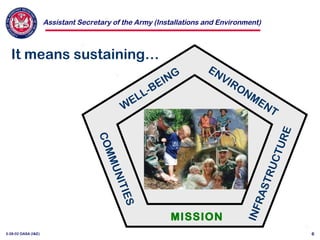
It means sustaining…
W
ELL-BEING
MISSION
INFRASTRUCTURE
COMMUNITIES
ENVIRONMENT
Assistant Secretary of the Army (Installations and Environment)
3-28-02 OASA (I&E) 7
Principles
two “popular” perspectives
• The Natural Step
– Karl-Henrik Robèrt
• Natural Capitalism
– Paul Hawken, Amory Lovins and Hunter Lovins
• Natural Capitalism
– Paul Hawken, Amory Lovins and Hunter Lovins
Assistant Secretary of the Army (Installations and Environment)
3-28-02 OASA (I&E) 8
The Natural Step - “System Conditions”
In order for a society to be sustainable:
Nature’s functions and diversity must not be
systematically:
1 …subject to increasing concentrations of substances
extracted from the Earth’s crust;
2 …subject to increasing concentrations of substances
produced by society; or
3 …impoverished by over-harvesting or other forms of
ecosystem manipulation.
And,
4 Resources must be used fairly and efficiently in order
to meet basic human needs worldwide.
Assistant Secretary of the Army (Installations and Environment)
3-28-02 OASA (I&E) 9
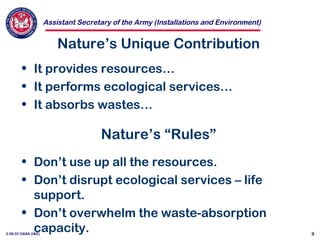
Nature’s Unique Contribution
• It provides resources…
• It performs ecological services…
• It absorbs wastes…
Nature’s “Rules”
• Don’t use up all the resources.
• Don’t disrupt ecological services – life
support.
• Don’t overwhelm the waste-absorption
capacity.
Assistant Secretary of the Army (Installations and Environment)
3-28-02 OASA (I&E) 10
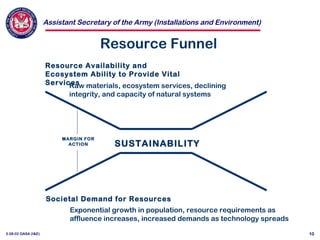
Resource Funnel
SUSTAINABILITY
MARGIN FOR
ACTION
Resource Availability and
Ecosystem Ability to Provide Vital
ServicesRaw materials, ecosystem services, declining
integrity, and capacity of natural systems
Societal Demand for Resources
Exponential growth in population, resource requirements as
affluence increases, increased demands as technology spreads
Assistant Secretary of the Army (Installations and Environment)
3-28-02 OASA (I&E) 11
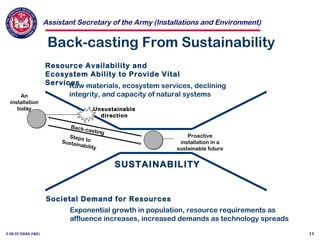
Back-casting From Sustainability
SUSTAINABILITY
Resource Availability and
Ecosystem Ability to Provide Vital
ServicesRaw materials, ecosystem services, declining
integrity, and capacity of natural systems
Societal Demand for Resources
Exponential growth in population, resource requirements as
affluence increases, increased demands as technology spreads
An
installation
today Unsustainable
direction
Proactive
installation in a
sustainable future
Back-casting
Steps toSustainability
Assistant Secretary of the Army (Installations and Environment)
3-28-02 OASA (I&E) 12
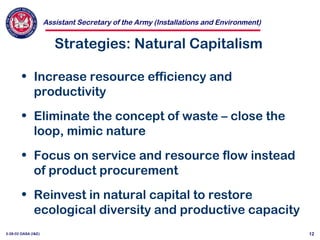
Strategies: Natural Capitalism
• Increase resource efficiency and
productivity
• Eliminate the concept of waste – close the
loop, mimic nature
• Focus on service and resource flow instead
of product procurement
• Reinvest in natural capital to restore
ecological diversity and productive capacity
Assistant Secretary of the Army (Installations and Environment)
3-28-02 OASA (I&E) 13
Practices – Army Examples
• Deployable Photovoltaic Technology
• Green Neighborhood Development
• Zero Footprint Camp
• Private Lands Initiative
• “Bio-mimicry” of Spider Silk
• Installation Sustainability Program
Assistant Secretary of the Army (Installations and Environment)
3-28-02 OASA (I&E) 14
Benefits
• Enhanced operational effectiveness
• Increased resource efficiency
• Minimized waste production
• Optimized lifecycle costs
• Strengthened relationships
• Restored ecological functions
Assistant Secretary of the Army (Installations and Environment)
3-28-02 OASA (I&E) 15
Issues
• Encroachment pressures
• Stove-piped management
• Tunnel vision
• Short-sightedness
• Resource fragmentation
Assistant Secretary of the Army (Installations and Environment)
3-28-02 OASA (I&E) 16
Opportunities
• Stationing actions
• Installation planning
• Management systems
Assistant Secretary of the Army (Installations and Environment)
3-28-02 OASA (I&E) 17
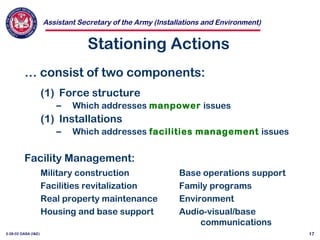
Stationing Actions
… consist of two components:
(1) Force structure
– Which addresses manpower issues
(1) Installations
– Which addresses facilities management issues
Facility Management:
Military construction
Facilities revitalization
Real property maintenance
Housing and base support
Base operations support
Family programs
Environment
Audio-visual/base
communications
Assistant Secretary of the Army (Installations and Environment)
3-28-02 OASA (I&E) 18
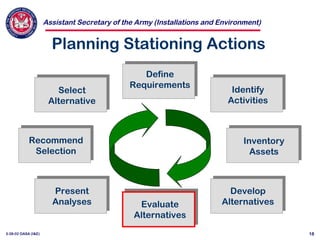
Planning Stationing Actions
Define
Requirements
Inventory
Assets
Identify
Activities
Develop
AlternativesEvaluate
Alternatives
Present
Analyses
Recommend
Selection
Select
Alternative
Assistant Secretary of the Army (Installations and Environment)
3-28-02 OASA (I&E) 19
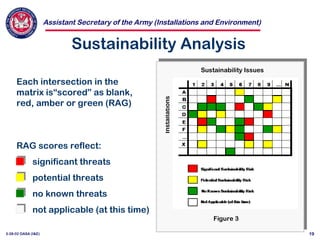
Sustainability Analysis
Sustainability Issues
Figure 3
Installations
Sustainability Issues
Figure 3
Installations
RAG scores reflect:
significant threats
potential threats
no known threats
not applicable (at this time)
Each intersection in the
matrix is“scored” as blank,
red, amber or green (RAG)
Assistant Secretary of the Army (Installations and Environment)
3-28-02 OASA (I&E) 20
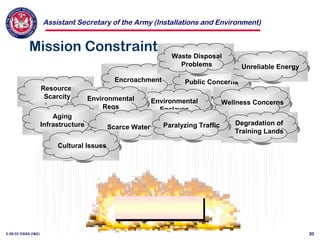
Mission Constraints
Resource
Scarcity
Encroachment Public Concerns
Wellness ConcernsEnvironmental
Enclaves
Environmental
Regs
Aging
Infrastructure Degradation of
Training Lands
Unreliable Energy
Waste Disposal
Problems
Scarce Water Paralyzing Traffic
Cultural Issues
Resource
Scarcity
Resource
Scarcity
EncroachmentEncroachment Public ConcernsPublic Concerns
Wellness ConcernsWellness ConcernsEnvironmental
Enclaves
Environmental
Enclaves
Environmental
Regs
Environmental
Regs
Aging
Infrastructure
Aging
Infrastructure Degradation of
Training Lands
Degradation of
Training Lands
Unreliable EnergyUnreliable Energy
Waste Disposal
Problems
Waste Disposal
Problems
Scarce WaterScarce Water Paralyzing TrafficParalyzing Traffic
Cultural IssuesCultural Issues
Assistant Secretary of the Army (Installations and Environment)
3-28-02 OASA (I&E) 21
Indicator
Number Issue Stressor Indicator
WhiteSandsMissileRange
YumaProvingGrouns
RockIslandArsenal
RedstoneArsenal
FortDrum
FortCarson
PinyonCanyonManeuverSite
FortLewis/Yakima
FortRichardson
FortStewart/HunterAAF
FortPolk
FortBenning
FortBliss
FortRiley
FortKnox
FortCampbell
FortBragg
FortHood
N1 Air Noise Complaints
N2 Air Noise Joint Land Use Study
UD1 Land Use Urban Development Regional Population Density
UD2 Land Use Urban Development Increasing Regional Growth Rate
UD3 Land Use Urban Development Regional Population Growth
UD4 Land Use Urban Development Regional Land Urbanization
UD5 Land Use Urban Development State Smart Growth Plans
Risk Legend
Low
Medium
High
Supports Objective Force Training Requirements
Indicator
Number Issue Stressor Indicator
WhiteSandsMissileRange
YumaProvingGrouns
RockIslandArsenal
RedstoneArsenal
FortDrum
FortCarson
PinyonCanyonManeuverSite
FortLewis/Yakima
FortRichardson
FortStewart/HunterAAF
FortPolk
FortBenning
FortBliss
FortRiley
FortKnox
FortCampbell
FortBragg
FortHood
N1 Air Noise Complaints
N2 Air Noise Joint Land Use Study
UD1 Land Use Urban Development Regional Population Density
UD2 Land Use Urban Development Increasing Regional Growth Rate
UD3 Land Use Urban Development Regional Population Growth
UD4 Land Use Urban Development Regional Land Urbanization
UD5 Land Use Urban Development State Smart Growth Plans
Risk Legend
Low
Medium
High
Supports Objective Force Training Requirements
Issue Stressor Indicator
WhiteSandsMissileRange
YumaProvingGrouns
RockIslandArsenal
RedstoneArsenal
FortDrum
FortCarson
PinyonCanyonManeuverSite
FortLewis/Yakima
FortRichardson
FortStewart/HunterAAF
FortPolk
FortBenning
FortBliss
FortRiley
FortKnox
FortCampbell
FortBragg
FortHood
EA1 Energy Energy Availabity Electrical Source
EA2 Energy Energy Availabity Regionally Imported Natural Gas
EA3 Energy Energy Availabity Regionally Imported Petroleum
EA4 Energy Energy Availabity Electrical Price Structure
ES1 Energy Energy Security DG Regulations: Net Metering
WS1 Water Water Security Sole-Source Aquifer
TA1 Infrastructure Transportation Air Proximity
TA2 Infrastructure Transportation Air Capacity
TRR1 Infrastructure Transportation Rail Proximity
TRR2 Infrastructure Transportation Rail Capacity
TR1 Infrastructure Transportation Road Proximaty
TR2 Infrastructure Transportation Road Congestion
TR3 Infrastructure Transportation Road Access
SP1 Infrastructure Infrastructure Security Proximity to MSA
Risk Legend
Low
Medium
High
Strategic Response Capaility
Issue Stressor Indicator
WhiteSandsMissileRange
YumaProvingGrouns
RockIslandArsenal
RedstoneArsenal
FortDrum
FortCarson
PinyonCanyonManeuverSite
FortLewis/Yakima
FortRichardson
FortStewart/HunterAAF
FortPolk
FortBenning
FortBliss
FortRiley
FortKnox
FortCampbell
FortBragg
FortHood
EA1 Energy Energy Availabity Electrical Source
EA2 Energy Energy Availabity Regionally Imported Natural Gas
EA3 Energy Energy Availabity Regionally Imported Petroleum
EA4 Energy Energy Availabity Electrical Price Structure
ES1 Energy Energy Security DG Regulations: Net Metering
WS1 Water Water Security Sole-Source Aquifer
TA1 Infrastructure Transportation Air Proximity
TA2 Infrastructure Transportation Air Capacity
TRR1 Infrastructure Transportation Rail Proximity
TRR2 Infrastructure Transportation Rail Capacity
TR1 Infrastructure Transportation Road Proximaty
TR2 Infrastructure Transportation Road Congestion
TR3 Infrastructure Transportation Road Access
SP1 Infrastructure Infrastructure Security Proximity to MSA
Risk Legend
Low
Medium
High
Strategic Response Capaility
Inidcator
Number Group Stressor Indicator
WhiteSandsMissileRange
YumaProvingGrouns
RockIslandArsenal
RedstoneArsenal
FortDrum
FortCarson
PinyonCanyonManeuverSite
FortLewis/Yakima
FortRichardson
FortStewart/HunterAAF
FortPolk
FortBenning
FortBliss
FortRiley
FortKnox
FortCampbell
FortBragg
FortHood
EE1 Facilities Energy Efficiency Progress Toward Goals
LI2 Facilities Locational Issues Seismic Zones
LI3 Facilities Locational Issues Natural Disasters
AQ1 Env Quality Air Quality Non-Attainment Status
AQ2 Env Quality Air Quality Air Quality Index
TE1 Env Quality TES Restrictions TES Species
TE2 Env Quality TES Restrictions TES Impacts
TE3 Env Quality TES Restrictions Critical Habitat
TE4 Env Quality TES Restrictions Species of Concern
WQ1 Env Quality Water Quality IWI All Indicators
WQ2 Env Quality Water Quality IWI Impaired Water
WA1 Env Quality Water Availability Resource Vulnerability
SH1 Env Quality Stakeholders # of Lawsuits
SH2 Env Quality Stakeholders Biological Opinions
DP1 Quality of Life DoD Economic Presence Military Employment%
QL1 Quality of Life Quality of Life Crime Rate
QL2 Quality of Life Quality of Life Housing Availabilty
QL3 Quality of Life Quality of Life Healthcare Costs
QL4 Quality of Life Quality of Life Job Availability
QL5 Quality of Life Quality of Life Educational Attainment
QL6 Quality of Life Quality of Life Commute Times
QL7 Quality of Life Quality of Life Cost of Living
QL8 Quality of Life Quality of Life Community Economic Strength
Risk Legend
Low
Medium
High
Facilities and Mission Support
Inidcator
Number Group Stressor Indicator
WhiteSandsMissileRange
YumaProvingGrouns
RockIslandArsenal
RedstoneArsenal
FortDrum
FortCarson
PinyonCanyonManeuverSite
FortLewis/Yakima
FortRichardson
FortStewart/HunterAAF
FortPolk
FortBenning
FortBliss
FortRiley
FortKnox
FortCampbell
FortBragg
FortHood
EE1 Facilities Energy Efficiency Progress Toward Goals
LI2 Facilities Locational Issues Seismic Zones
LI3 Facilities Locational Issues Natural Disasters
AQ1 Env Quality Air Quality Non-Attainment Status
AQ2 Env Quality Air Quality Air Quality Index
TE1 Env Quality TES Restrictions TES Species
TE2 Env Quality TES Restrictions TES Impacts
TE3 Env Quality TES Restrictions Critical Habitat
TE4 Env Quality TES Restrictions Species of Concern
WQ1 Env Quality Water Quality IWI All Indicators
WQ2 Env Quality Water Quality IWI Impaired Water
WA1 Env Quality Water Availability Resource Vulnerability
SH1 Env Quality Stakeholders # of Lawsuits
SH2 Env Quality Stakeholders Biological Opinions
DP1 Quality of Life DoD Economic Presence Military Employment%
QL1 Quality of Life Quality of Life Crime Rate
QL2 Quality of Life Quality of Life Housing Availabilty
QL3 Quality of Life Quality of Life Healthcare Costs
QL4 Quality of Life Quality of Life Job Availability
QL5 Quality of Life Quality of Life Educational Attainment
QL6 Quality of Life Quality of Life Commute Times
QL7 Quality of Life Quality of Life Cost of Living
QL8 Quality of Life Quality of Life Community Economic Strength
Risk Legend
Low
Medium
High
Facilities and Mission Support
Sustainable Installation Risk
Assessment
Assistant Secretary of the Army (Installations and Environment)
3-28-02 OASA (I&E) 22
Installation (Master) Planning
• Develop a vision of the desired end-state
• Understand and document the baseline conditions
• Develop an overall strategy and implementation
plan
– Step-wise goals and objectives
– Metrics and indicators
– Programs and resources
“… a blueprint to enable the installation to effectively
respond to future Army missions and community
aspirations, while providing the capability to train, project,
sustain and [transform] today’s force.”
– AR 210-20, Master Planning for Army Installations
Assistant Secretary of the Army (Installations and Environment)
3-28-02 OASA (I&E) 23
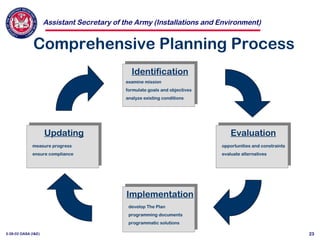
Comprehensive Planning Process
Identification
Evaluation
Implementation
Updating
examine mission
formulate goals and objectives
analyze existing conditions
opportunities and constraints
evaluate alternatives
develop The Plan
programming documents
programmatic solutions
measure progress
ensure compliance
Assistant Secretary of the Army (Installations and Environment)
3-28-02 OASA (I&E) 24
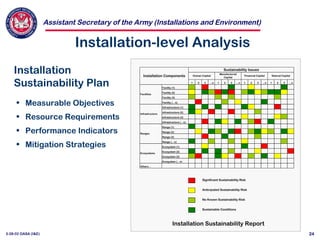
Installation-level Analysis
1 2 3 …n 1 2 3 …n 1 2 3 …n 1 2 3 …n
Facility (1)
Facility (2)
Facility (3)
Facility (…n)
Infrastructure (1)
Infrastructure (2)
Infrastructure (3)
Infrastructure (…n)
Range (1)
Range (2)
Range (3)
Range (…n)
Ecosystem (1)
Ecosystem (2)
Ecosystem (3)
Ecosystem (…n)
Others…
No Known Sustainability Risk
Sustainable Conditions
Ecosystems
Significant Sustainability Risk
Anticipated Sustainability Risk
Installation Components
Facilities
Infrastructure
Ranges
Human Capital
Manufactured
Capital
Financial Capital Natural Capital
Sustainability Issues
Installation Sustainability Report
1 2 3 …n 1 2 3 …n 1 2 3 …n 1 2 3 …n
Facility (1)
Facility (2)
Facility (3)
Facility (…n)
Infrastructure (1)
Infrastructure (2)
Infrastructure (3)
Infrastructure (…n)
Range (1)
Range (2)
Range (3)
Range (…n)
Ecosystem (1)
Ecosystem (2)
Ecosystem (3)
Ecosystem (…n)
Others…
No Known Sustainability Risk
Sustainable Conditions
Ecosystems
Significant Sustainability Risk
Anticipated Sustainability Risk
Installation Components
Facilities
Infrastructure
Ranges
Human Capital
Manufactured
Capital
Financial Capital Natural Capital
Sustainability Issues
1 2 3 …n 1 2 3 …n 1 2 3 …n 1 2 3 …n
Facility (1)
Facility (2)
Facility (3)
Facility (…n)
Infrastructure (1)
Infrastructure (2)
Infrastructure (3)
Infrastructure (…n)
Range (1)
Range (2)
Range (3)
Range (…n)
Ecosystem (1)
Ecosystem (2)
Ecosystem (3)
Ecosystem (…n)
Others…
No Known Sustainability Risk
Sustainable Conditions
Ecosystems
Significant Sustainability Risk
Anticipated Sustainability Risk
Installation Components
Facilities
Infrastructure
Ranges
Human Capital
Manufactured
Capital
Financial Capital Natural Capital
Sustainability Issues
Installation Sustainability Report
Installation
Sustainability Plan
• Measurable Objectives
• Resource Requirements
• Performance Indicators
• Mitigation Strategies
Assistant Secretary of the Army (Installations and Environment)
3-28-02 OASA (I&E) 25
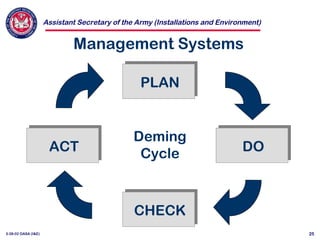
Management Systems
PLAN
DO
CHECK
ACT
Deming
Cycle
Assistant Secretary of the Army (Installations and Environment)
3-28-02 OASA (I&E) 26
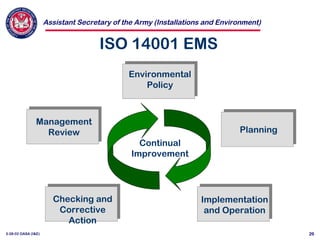
ISO 14001 EMS
Environmental
Policy
Implementation
and Operation
Planning
Checking and
Corrective
Action
Management
Review
Continual
Improvement
Assistant Secretary of the Army (Installations and Environment)
3-28-02 OASA (I&E) 27
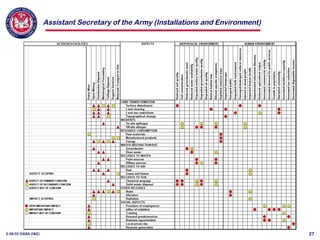
Assistant Secretary of the Army (Installations and Environment)
3-28-02 OASA (I&E) 28
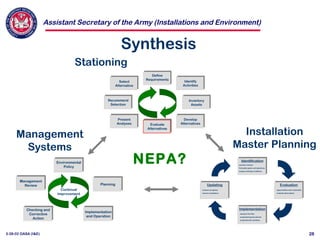
Synthesis
Identification
Evaluation
Implementation
Updating
examine mission
formulate goals and objectives
analyze existing conditions
opportunities and constraints
evaluate alternatives
develop The Plan
programming documents
programmatic solutions
measure progress
ensure compliance
Define
Requirements
Inventory
Assets
Identify
Activities
Develop
AlternativesEvaluate
Alternatives
Present
Analyses
Recommend
Selection
Select
Alternative
Environmental
Policy
Implementation
and Operation
Planning
Checking and
Corrective
Action
Management
Review
Continual
Improvement
NEPA?
Stationing
Installation
Master Planning
Management
Systems
Assistant Secretary of the Army (Installations and Environment)
3-28-02 OASA (I&E) 29
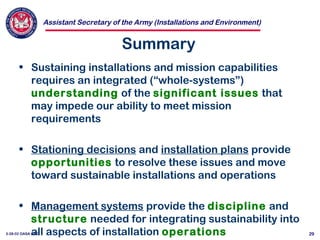
Summary
• Sustaining installations and mission capabilities
requires an integrated (“whole-systems”)
understanding of the significant issues that
may impede our ability to meet mission
requirements
• Stationing decisions and installation plans provide
opportunities to resolve these issues and move
toward sustainable installations and operations
• Management systems provide the discipline and
structure needed for integrating sustainability into
all aspects of installation operations
Assistant Secretary of the Army (Installations and Environment)
3-28-02 OASA (I&E) 30
A sustainable installation:
• Optimizes military training and support
missions
• Contributes to the well-being of soldiers,
civilians, their families, and the community
– Provides world-class facilities
– Makes a positive contribution to the community
• Is cost-effective to operate (“cradle-to-
cradle”)
• Is ecologically sustainable:
– Uses only renewable materials and energy
resources
Assistant Secretary of the Army (Installations and Environment)
3-28-02 OASA (I&E) 31
Closing thoughts
• It’s worse than you think!
• It’s not too late!!
• You can make a difference!!!
Source: Mathis Wackernagel
co-author, Our Ecological Footprint and Sharing
Nature’s Interest
Assistant Secretary of the Army (Installations and Environment)
3-28-02 OASA (I&E) 32
Questions?
Contact info:
David S. Eady
(404) 524-9364, ext. 286
deady@aepi.army.mil

Searching For Sustainability

  • 1.
    SEARCHING FOR SUSTAINABILITYIN AN ENCROACHING AND TRANSFORMING WORLD BRIEFING TO P2 & HWM CONFERENCE & EXHIBITION SAN ANTONIO, TX 22 AUGUST 2002 DAVID S. EADY ARMY ENVIRONMENTAL POLICY INSTITUTE
  • 2.
    Assistant Secretary ofthe Army (Installations and Environment) 3-28-02 OASA (I&E) 2 Outline • Define installation sustainability • Discuss basic sustainability principles, practices and benefits • Identify strategic and operational opportunities to address sustainability • Suggest alignment / integration in support of transformation to sustainable installations
  • 3.
    Assistant Secretary ofthe Army (Installations and Environment) 3-28-02 OASA (I&E) 3 What is sustainability? the “academic” response “…broadly refers to the persistence of the integrity and structure of a system over time.” – (Costanza et al. 2001) “…the ability of a system to continue functioning into the future without being forced into decline through the exhaustion or overloading of the key resources on which that system depends” – (Gilman 1996; AIA 1996)
  • 4.
    Assistant Secretary ofthe Army (Installations and Environment) 3-28-02 OASA (I&E) 4 What is sustainability? the “text book” response “…meeting the needs of the present, without compromising the ability of future generations to meet their own needs.” – (World Commission on Environment and Development 1987)
  • 5.
    Assistant Secretary ofthe Army (Installations and Environment) 3-28-02 OASA (I&E) 5 What is installation sustainability? … a condition in which an installation is able to fully execute its present missions without compromising either its ability to accomplish future missions or the ability of its neighboring communities to realize their aspirations. – Emphasis on sustaining the mission must incorporate link with the natural and built environments within which soldiers and civilians live, work, play and train. – Requires additional focus on the social, economic and physical well-being of soldiers and civilian personnel, their families and communities, all of whom are impacted.
  • 6.
    Assistant Secretary ofthe Army (Installations and Environment) 3-28-02 OASA (I&E) 6 It means sustaining… W ELL-BEING MISSION INFRASTRUCTURE COMMUNITIES ENVIRONMENT
  • 7.
    Assistant Secretary ofthe Army (Installations and Environment) 3-28-02 OASA (I&E) 7 Principles two “popular” perspectives • The Natural Step – Karl-Henrik Robèrt • Natural Capitalism – Paul Hawken, Amory Lovins and Hunter Lovins • Natural Capitalism – Paul Hawken, Amory Lovins and Hunter Lovins
  • 8.
    Assistant Secretary ofthe Army (Installations and Environment) 3-28-02 OASA (I&E) 8 The Natural Step - “System Conditions” In order for a society to be sustainable: Nature’s functions and diversity must not be systematically: 1 …subject to increasing concentrations of substances extracted from the Earth’s crust; 2 …subject to increasing concentrations of substances produced by society; or 3 …impoverished by over-harvesting or other forms of ecosystem manipulation. And, 4 Resources must be used fairly and efficiently in order to meet basic human needs worldwide.
  • 9.
    Assistant Secretary ofthe Army (Installations and Environment) 3-28-02 OASA (I&E) 9 Nature’s Unique Contribution • It provides resources… • It performs ecological services… • It absorbs wastes… Nature’s “Rules” • Don’t use up all the resources. • Don’t disrupt ecological services – life support. • Don’t overwhelm the waste-absorption capacity.
  • 10.
    Assistant Secretary ofthe Army (Installations and Environment) 3-28-02 OASA (I&E) 10 Resource Funnel SUSTAINABILITY MARGIN FOR ACTION Resource Availability and Ecosystem Ability to Provide Vital ServicesRaw materials, ecosystem services, declining integrity, and capacity of natural systems Societal Demand for Resources Exponential growth in population, resource requirements as affluence increases, increased demands as technology spreads
  • 11.
    Assistant Secretary ofthe Army (Installations and Environment) 3-28-02 OASA (I&E) 11 Back-casting From Sustainability SUSTAINABILITY Resource Availability and Ecosystem Ability to Provide Vital ServicesRaw materials, ecosystem services, declining integrity, and capacity of natural systems Societal Demand for Resources Exponential growth in population, resource requirements as affluence increases, increased demands as technology spreads An installation today Unsustainable direction Proactive installation in a sustainable future Back-casting Steps toSustainability
  • 12.
    Assistant Secretary ofthe Army (Installations and Environment) 3-28-02 OASA (I&E) 12 Strategies: Natural Capitalism • Increase resource efficiency and productivity • Eliminate the concept of waste – close the loop, mimic nature • Focus on service and resource flow instead of product procurement • Reinvest in natural capital to restore ecological diversity and productive capacity
  • 13.
    Assistant Secretary ofthe Army (Installations and Environment) 3-28-02 OASA (I&E) 13 Practices – Army Examples • Deployable Photovoltaic Technology • Green Neighborhood Development • Zero Footprint Camp • Private Lands Initiative • “Bio-mimicry” of Spider Silk • Installation Sustainability Program
  • 14.
    Assistant Secretary ofthe Army (Installations and Environment) 3-28-02 OASA (I&E) 14 Benefits • Enhanced operational effectiveness • Increased resource efficiency • Minimized waste production • Optimized lifecycle costs • Strengthened relationships • Restored ecological functions
  • 15.
    Assistant Secretary ofthe Army (Installations and Environment) 3-28-02 OASA (I&E) 15 Issues • Encroachment pressures • Stove-piped management • Tunnel vision • Short-sightedness • Resource fragmentation
  • 16.
    Assistant Secretary ofthe Army (Installations and Environment) 3-28-02 OASA (I&E) 16 Opportunities • Stationing actions • Installation planning • Management systems
  • 17.
    Assistant Secretary ofthe Army (Installations and Environment) 3-28-02 OASA (I&E) 17 Stationing Actions … consist of two components: (1) Force structure – Which addresses manpower issues (1) Installations – Which addresses facilities management issues Facility Management: Military construction Facilities revitalization Real property maintenance Housing and base support Base operations support Family programs Environment Audio-visual/base communications
  • 18.
    Assistant Secretary ofthe Army (Installations and Environment) 3-28-02 OASA (I&E) 18 Planning Stationing Actions Define Requirements Inventory Assets Identify Activities Develop AlternativesEvaluate Alternatives Present Analyses Recommend Selection Select Alternative
  • 19.
    Assistant Secretary ofthe Army (Installations and Environment) 3-28-02 OASA (I&E) 19 Sustainability Analysis Sustainability Issues Figure 3 Installations Sustainability Issues Figure 3 Installations RAG scores reflect: significant threats potential threats no known threats not applicable (at this time) Each intersection in the matrix is“scored” as blank, red, amber or green (RAG)
  • 20.
    Assistant Secretary ofthe Army (Installations and Environment) 3-28-02 OASA (I&E) 20 Mission Constraints Resource Scarcity Encroachment Public Concerns Wellness ConcernsEnvironmental Enclaves Environmental Regs Aging Infrastructure Degradation of Training Lands Unreliable Energy Waste Disposal Problems Scarce Water Paralyzing Traffic Cultural Issues Resource Scarcity Resource Scarcity EncroachmentEncroachment Public ConcernsPublic Concerns Wellness ConcernsWellness ConcernsEnvironmental Enclaves Environmental Enclaves Environmental Regs Environmental Regs Aging Infrastructure Aging Infrastructure Degradation of Training Lands Degradation of Training Lands Unreliable EnergyUnreliable Energy Waste Disposal Problems Waste Disposal Problems Scarce WaterScarce Water Paralyzing TrafficParalyzing Traffic Cultural IssuesCultural Issues
  • 21.
    Assistant Secretary ofthe Army (Installations and Environment) 3-28-02 OASA (I&E) 21 Indicator Number Issue Stressor Indicator WhiteSandsMissileRange YumaProvingGrouns RockIslandArsenal RedstoneArsenal FortDrum FortCarson PinyonCanyonManeuverSite FortLewis/Yakima FortRichardson FortStewart/HunterAAF FortPolk FortBenning FortBliss FortRiley FortKnox FortCampbell FortBragg FortHood N1 Air Noise Complaints N2 Air Noise Joint Land Use Study UD1 Land Use Urban Development Regional Population Density UD2 Land Use Urban Development Increasing Regional Growth Rate UD3 Land Use Urban Development Regional Population Growth UD4 Land Use Urban Development Regional Land Urbanization UD5 Land Use Urban Development State Smart Growth Plans Risk Legend Low Medium High Supports Objective Force Training Requirements Indicator Number Issue Stressor Indicator WhiteSandsMissileRange YumaProvingGrouns RockIslandArsenal RedstoneArsenal FortDrum FortCarson PinyonCanyonManeuverSite FortLewis/Yakima FortRichardson FortStewart/HunterAAF FortPolk FortBenning FortBliss FortRiley FortKnox FortCampbell FortBragg FortHood N1 Air Noise Complaints N2 Air Noise Joint Land Use Study UD1 Land Use Urban Development Regional Population Density UD2 Land Use Urban Development Increasing Regional Growth Rate UD3 Land Use Urban Development Regional Population Growth UD4 Land Use Urban Development Regional Land Urbanization UD5 Land Use Urban Development State Smart Growth Plans Risk Legend Low Medium High Supports Objective Force Training Requirements Issue Stressor Indicator WhiteSandsMissileRange YumaProvingGrouns RockIslandArsenal RedstoneArsenal FortDrum FortCarson PinyonCanyonManeuverSite FortLewis/Yakima FortRichardson FortStewart/HunterAAF FortPolk FortBenning FortBliss FortRiley FortKnox FortCampbell FortBragg FortHood EA1 Energy Energy Availabity Electrical Source EA2 Energy Energy Availabity Regionally Imported Natural Gas EA3 Energy Energy Availabity Regionally Imported Petroleum EA4 Energy Energy Availabity Electrical Price Structure ES1 Energy Energy Security DG Regulations: Net Metering WS1 Water Water Security Sole-Source Aquifer TA1 Infrastructure Transportation Air Proximity TA2 Infrastructure Transportation Air Capacity TRR1 Infrastructure Transportation Rail Proximity TRR2 Infrastructure Transportation Rail Capacity TR1 Infrastructure Transportation Road Proximaty TR2 Infrastructure Transportation Road Congestion TR3 Infrastructure Transportation Road Access SP1 Infrastructure Infrastructure Security Proximity to MSA Risk Legend Low Medium High Strategic Response Capaility Issue Stressor Indicator WhiteSandsMissileRange YumaProvingGrouns RockIslandArsenal RedstoneArsenal FortDrum FortCarson PinyonCanyonManeuverSite FortLewis/Yakima FortRichardson FortStewart/HunterAAF FortPolk FortBenning FortBliss FortRiley FortKnox FortCampbell FortBragg FortHood EA1 Energy Energy Availabity Electrical Source EA2 Energy Energy Availabity Regionally Imported Natural Gas EA3 Energy Energy Availabity Regionally Imported Petroleum EA4 Energy Energy Availabity Electrical Price Structure ES1 Energy Energy Security DG Regulations: Net Metering WS1 Water Water Security Sole-Source Aquifer TA1 Infrastructure Transportation Air Proximity TA2 Infrastructure Transportation Air Capacity TRR1 Infrastructure Transportation Rail Proximity TRR2 Infrastructure Transportation Rail Capacity TR1 Infrastructure Transportation Road Proximaty TR2 Infrastructure Transportation Road Congestion TR3 Infrastructure Transportation Road Access SP1 Infrastructure Infrastructure Security Proximity to MSA Risk Legend Low Medium High Strategic Response Capaility Inidcator Number Group Stressor Indicator WhiteSandsMissileRange YumaProvingGrouns RockIslandArsenal RedstoneArsenal FortDrum FortCarson PinyonCanyonManeuverSite FortLewis/Yakima FortRichardson FortStewart/HunterAAF FortPolk FortBenning FortBliss FortRiley FortKnox FortCampbell FortBragg FortHood EE1 Facilities Energy Efficiency Progress Toward Goals LI2 Facilities Locational Issues Seismic Zones LI3 Facilities Locational Issues Natural Disasters AQ1 Env Quality Air Quality Non-Attainment Status AQ2 Env Quality Air Quality Air Quality Index TE1 Env Quality TES Restrictions TES Species TE2 Env Quality TES Restrictions TES Impacts TE3 Env Quality TES Restrictions Critical Habitat TE4 Env Quality TES Restrictions Species of Concern WQ1 Env Quality Water Quality IWI All Indicators WQ2 Env Quality Water Quality IWI Impaired Water WA1 Env Quality Water Availability Resource Vulnerability SH1 Env Quality Stakeholders # of Lawsuits SH2 Env Quality Stakeholders Biological Opinions DP1 Quality of Life DoD Economic Presence Military Employment% QL1 Quality of Life Quality of Life Crime Rate QL2 Quality of Life Quality of Life Housing Availabilty QL3 Quality of Life Quality of Life Healthcare Costs QL4 Quality of Life Quality of Life Job Availability QL5 Quality of Life Quality of Life Educational Attainment QL6 Quality of Life Quality of Life Commute Times QL7 Quality of Life Quality of Life Cost of Living QL8 Quality of Life Quality of Life Community Economic Strength Risk Legend Low Medium High Facilities and Mission Support Inidcator Number Group Stressor Indicator WhiteSandsMissileRange YumaProvingGrouns RockIslandArsenal RedstoneArsenal FortDrum FortCarson PinyonCanyonManeuverSite FortLewis/Yakima FortRichardson FortStewart/HunterAAF FortPolk FortBenning FortBliss FortRiley FortKnox FortCampbell FortBragg FortHood EE1 Facilities Energy Efficiency Progress Toward Goals LI2 Facilities Locational Issues Seismic Zones LI3 Facilities Locational Issues Natural Disasters AQ1 Env Quality Air Quality Non-Attainment Status AQ2 Env Quality Air Quality Air Quality Index TE1 Env Quality TES Restrictions TES Species TE2 Env Quality TES Restrictions TES Impacts TE3 Env Quality TES Restrictions Critical Habitat TE4 Env Quality TES Restrictions Species of Concern WQ1 Env Quality Water Quality IWI All Indicators WQ2 Env Quality Water Quality IWI Impaired Water WA1 Env Quality Water Availability Resource Vulnerability SH1 Env Quality Stakeholders # of Lawsuits SH2 Env Quality Stakeholders Biological Opinions DP1 Quality of Life DoD Economic Presence Military Employment% QL1 Quality of Life Quality of Life Crime Rate QL2 Quality of Life Quality of Life Housing Availabilty QL3 Quality of Life Quality of Life Healthcare Costs QL4 Quality of Life Quality of Life Job Availability QL5 Quality of Life Quality of Life Educational Attainment QL6 Quality of Life Quality of Life Commute Times QL7 Quality of Life Quality of Life Cost of Living QL8 Quality of Life Quality of Life Community Economic Strength Risk Legend Low Medium High Facilities and Mission Support Sustainable Installation Risk Assessment
  • 22.
    Assistant Secretary ofthe Army (Installations and Environment) 3-28-02 OASA (I&E) 22 Installation (Master) Planning • Develop a vision of the desired end-state • Understand and document the baseline conditions • Develop an overall strategy and implementation plan – Step-wise goals and objectives – Metrics and indicators – Programs and resources “… a blueprint to enable the installation to effectively respond to future Army missions and community aspirations, while providing the capability to train, project, sustain and [transform] today’s force.” – AR 210-20, Master Planning for Army Installations
  • 23.
    Assistant Secretary ofthe Army (Installations and Environment) 3-28-02 OASA (I&E) 23 Comprehensive Planning Process Identification Evaluation Implementation Updating examine mission formulate goals and objectives analyze existing conditions opportunities and constraints evaluate alternatives develop The Plan programming documents programmatic solutions measure progress ensure compliance
  • 24.
    Assistant Secretary ofthe Army (Installations and Environment) 3-28-02 OASA (I&E) 24 Installation-level Analysis 1 2 3 …n 1 2 3 …n 1 2 3 …n 1 2 3 …n Facility (1) Facility (2) Facility (3) Facility (…n) Infrastructure (1) Infrastructure (2) Infrastructure (3) Infrastructure (…n) Range (1) Range (2) Range (3) Range (…n) Ecosystem (1) Ecosystem (2) Ecosystem (3) Ecosystem (…n) Others… No Known Sustainability Risk Sustainable Conditions Ecosystems Significant Sustainability Risk Anticipated Sustainability Risk Installation Components Facilities Infrastructure Ranges Human Capital Manufactured Capital Financial Capital Natural Capital Sustainability Issues Installation Sustainability Report 1 2 3 …n 1 2 3 …n 1 2 3 …n 1 2 3 …n Facility (1) Facility (2) Facility (3) Facility (…n) Infrastructure (1) Infrastructure (2) Infrastructure (3) Infrastructure (…n) Range (1) Range (2) Range (3) Range (…n) Ecosystem (1) Ecosystem (2) Ecosystem (3) Ecosystem (…n) Others… No Known Sustainability Risk Sustainable Conditions Ecosystems Significant Sustainability Risk Anticipated Sustainability Risk Installation Components Facilities Infrastructure Ranges Human Capital Manufactured Capital Financial Capital Natural Capital Sustainability Issues 1 2 3 …n 1 2 3 …n 1 2 3 …n 1 2 3 …n Facility (1) Facility (2) Facility (3) Facility (…n) Infrastructure (1) Infrastructure (2) Infrastructure (3) Infrastructure (…n) Range (1) Range (2) Range (3) Range (…n) Ecosystem (1) Ecosystem (2) Ecosystem (3) Ecosystem (…n) Others… No Known Sustainability Risk Sustainable Conditions Ecosystems Significant Sustainability Risk Anticipated Sustainability Risk Installation Components Facilities Infrastructure Ranges Human Capital Manufactured Capital Financial Capital Natural Capital Sustainability Issues Installation Sustainability Report Installation Sustainability Plan • Measurable Objectives • Resource Requirements • Performance Indicators • Mitigation Strategies
  • 25.
    Assistant Secretary ofthe Army (Installations and Environment) 3-28-02 OASA (I&E) 25 Management Systems PLAN DO CHECK ACT Deming Cycle
  • 26.
    Assistant Secretary ofthe Army (Installations and Environment) 3-28-02 OASA (I&E) 26 ISO 14001 EMS Environmental Policy Implementation and Operation Planning Checking and Corrective Action Management Review Continual Improvement
  • 27.
    Assistant Secretary ofthe Army (Installations and Environment) 3-28-02 OASA (I&E) 27
  • 28.
    Assistant Secretary ofthe Army (Installations and Environment) 3-28-02 OASA (I&E) 28 Synthesis Identification Evaluation Implementation Updating examine mission formulate goals and objectives analyze existing conditions opportunities and constraints evaluate alternatives develop The Plan programming documents programmatic solutions measure progress ensure compliance Define Requirements Inventory Assets Identify Activities Develop AlternativesEvaluate Alternatives Present Analyses Recommend Selection Select Alternative Environmental Policy Implementation and Operation Planning Checking and Corrective Action Management Review Continual Improvement NEPA? Stationing Installation Master Planning Management Systems
  • 29.
    Assistant Secretary ofthe Army (Installations and Environment) 3-28-02 OASA (I&E) 29 Summary • Sustaining installations and mission capabilities requires an integrated (“whole-systems”) understanding of the significant issues that may impede our ability to meet mission requirements • Stationing decisions and installation plans provide opportunities to resolve these issues and move toward sustainable installations and operations • Management systems provide the discipline and structure needed for integrating sustainability into all aspects of installation operations
  • 30.
    Assistant Secretary ofthe Army (Installations and Environment) 3-28-02 OASA (I&E) 30 A sustainable installation: • Optimizes military training and support missions • Contributes to the well-being of soldiers, civilians, their families, and the community – Provides world-class facilities – Makes a positive contribution to the community • Is cost-effective to operate (“cradle-to- cradle”) • Is ecologically sustainable: – Uses only renewable materials and energy resources
  • 31.
    Assistant Secretary ofthe Army (Installations and Environment) 3-28-02 OASA (I&E) 31 Closing thoughts • It’s worse than you think! • It’s not too late!! • You can make a difference!!! Source: Mathis Wackernagel co-author, Our Ecological Footprint and Sharing Nature’s Interest
  • 32.
    Assistant Secretary ofthe Army (Installations and Environment) 3-28-02 OASA (I&E) 32 Questions? Contact info: David S. Eady (404) 524-9364, ext. 286 deady@aepi.army.mil

Editor's Notes

  • #21 These challenges are acting together to force the Army to seek innovative solutions to difficult problems.First – the diverse nature of the threats around the world have dictated the need for the Army to change. Army TRANFORMATION will radically change the way the Army operates and have a “ripple effect” on all the other activities touched by Army operations. Second – America – the “land of plenty” is feeling the pinch of resources in short supply - The resulting competition is raising prices and creating questions of availability. Fuel is the most obvious resource – and the Army is a MAJOR consumer. Gas shortages and price increases always lead the nagging question – “what is our plan B for conducting operations without fossil fuels? Third - The public’s concern about health concerns associated with pollution has increased dramatically. This awareness has prompted concerned citizens to form groups and influence policy to address real (and suspected ) causes of pollution. At Massachusetts Military Reservation, live fire was halted 4 years ago by EPA, while studies to determine the threat to a sole source aquifer are completed. Finally Encroachment has become an IMMEDIATE threat to maintaining combat readiness. Urban development along installation fencelines can severely limit realistic training. The Army – in pursuing a non-confrontational relationship with its neighbors – has repeatedly curtailed training—to the point now where MOST of the ranges are operating at MAXIMUM capacity to provide the MINIMUM standard of READINESS. The bottom line is READINESS.
  • #31 And to that end, I’ve been kicking around this definition with some of my colleagues, which attempts to capture all those moving parts in one definition: our productivity in terms of military training; the wellbeing of individuals on the installation and in the community; The Natural Step definition of environmental sustainability.