Hydropower and Water Framework Directive
Outputs from the 2nd Workshop on Water Management, WFD & Hydropower (Brussels September 2011)


                    Multi criteria analyses (e.g. EIA)

 Aosta 24.05.2012
Inhalt/Agenda


            I.         Hydropower in the framework of renewable energies

            II.        Study on hydropower (DG Environment)

            III.       Facts from Austria

            IV.        MCA – Construction of new hydropower plants (EIA)

            V.         Conclusions


    Aosta 24.05.2012    Folie 2   Dr. Schletterer (TIWAG)   Hydropower & Water Framework Directive
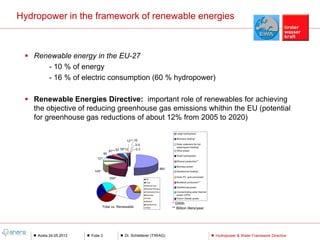
Hydropower in the framework of renewable energies


  Renewable energy in the EU-27
      - 10 % of energy
      - 16 % of electric consumption (60 % hydropower)

  Renewable Energies Directive: important role of renewables for achieving
   the objective of reducing greenhouse gas emissions whithin the EU (potential
   for greenhouse gas reductions of about 12% from 2005 to 2020)


    Aosta 24.05.2012   Folie 3   Dr. Schletterer (TIWAG)   Hydropower & Water Framework Directive
Hydropower in the framework of renewable energies


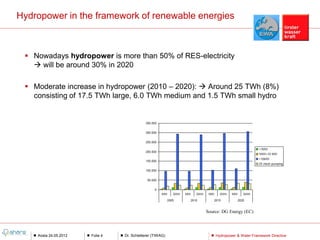
  Nowadays hydropower is more than 50% of RES-electricity
    will be around 30% in 2020

  Moderate increase in hydropower (2010 – 2020):  Around 25 TWh (8%)
   consisting of 17.5 TWh large, 6.0 TWh medium and 1.5 TWh small hydro


                                                           Source: DG Energy (EC)


    Aosta 24.05.2012   Folie 4   Dr. Schletterer (TIWAG)       Hydropower & Water Framework Directive
Hydropower in the framework of renewable energies


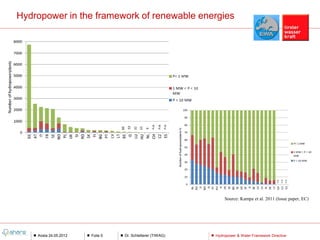
                                                               Source: Kampa et al. 2011 (Issue paper, EC)


    Aosta 24.05.2012   Folie 5   Dr. Schletterer (TIWAG)   Hydropower & Water Framework Directive
Hydropower in the framework of renewable energies

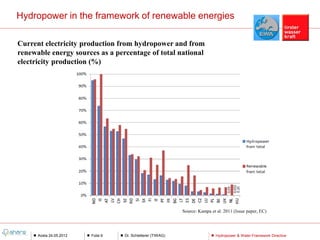
Current electricity production from hydropower and from
renewable energy sources as a percentage of total national
electricity production (%)


                                                             Source: Kampa et al. 2011 (Issue paper, EC)


      Aosta 24.05.2012   Folie 6   Dr. Schletterer (TIWAG)                    Hydropower & Water Framework Directive
Hydropower in the framework of renewable energies

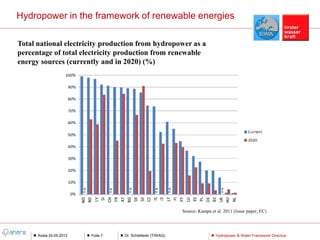
Total national electricity production from hydropower as a
percentage of total electricity production from renewable
energy sources (currently and in 2020) (%)


                                                             Source: Kampa et al. 2011 (Issue paper, EC)


      Aosta 24.05.2012   Folie 7   Dr. Schletterer (TIWAG)                    Hydropower & Water Framework Directive
Study on hydropower (DG Environment)


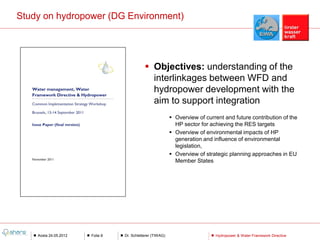
                                             Objectives: understanding of the
                                              interlinkages between WFD and
                                              hydropower development with the
                                              aim to support integration
                                                            Overview of current and future contribution of the
                                                             HP sector for achieving the RES targets
                                                            Overview of environmental impacts of HP
                                                             generation and influence of environmental
                                                             legislation,
                                                            Overview of strategic planning approaches in EU
                                                             Member States


    Aosta 24.05.2012   Folie 8   Dr. Schletterer (TIWAG)                     Hydropower & Water Framework Directive
Study on hydropower (DG Environment)

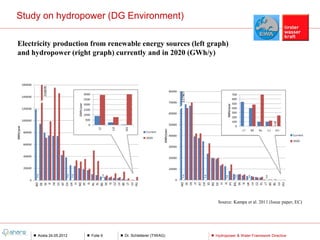
Electricity production from renewable energy sources (left graph)
and hydropower (right graph) currently and in 2020 (GWh/y)


                                                              Source: Kampa et al. 2011 (Issue paper, EC)


      Aosta 24.05.2012   Folie 9   Dr. Schletterer (TIWAG)   Hydropower & Water Framework Directive
Study on hydropower (DG Environment)


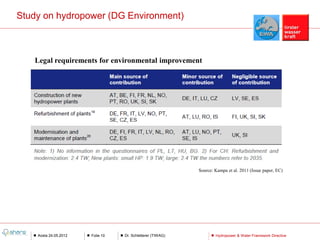
   Legal requirements for environmental improvement


                                                            Source: Kampa et al. 2011 (Issue paper, EC)


    Aosta 24.05.2012   Folie 10   Dr. Schletterer (TIWAG)           Hydropower & Water Framework Directive
Study on hydropower (DG Environment)


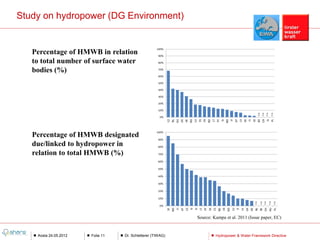
   Percentage of HMWB in relation
   to total number of surface water
   bodies (%)


   Percentage of HMWB designated
   due/linked to hydropower in
   relation to total HMWB (%)


                                                            Source: Kampa et al. 2011 (Issue paper, EC)


    Aosta 24.05.2012   Folie 11   Dr. Schletterer (TIWAG)            Hydropower & Water Framework Directive
Study on hydropower (DG Environment)


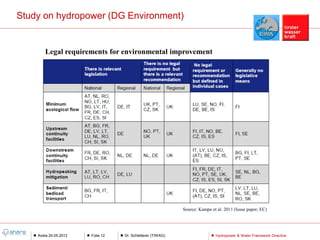
       Legal requirements for environmental improvement


                                                            Source: Kampa et al. 2011 (Issue paper, EC)


    Aosta 24.05.2012   Folie 12   Dr. Schletterer (TIWAG)                   Hydropower & Water Framework Directive
Study on hydropower (DG Environment)


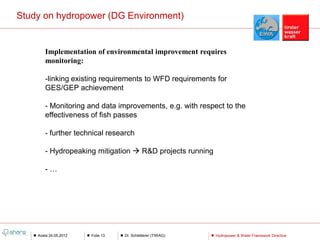
       Implementation of environmental improvement requires
       monitoring:

       -linking existing requirements to WFD requirements for
       GES/GEP achievement

       - Monitoring and data improvements, e.g. with respect to the
       effectiveness of fish passes

       - further technical research

       - Hydropeaking mitigation  R&D projects running

       -…


    Aosta 24.05.2012   Folie 13   Dr. Schletterer (TIWAG)   Hydropower & Water Framework Directive
Study on hydropower (DG Environment)


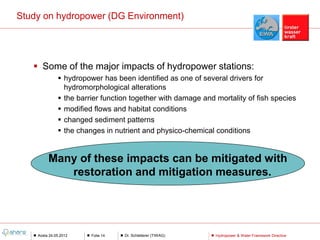
    Some of the major impacts of hydropower stations:
               hydropower has been identified as one of several drivers for
                hydromorphological alterations
               the barrier function together with damage and mortality of fish species
               modified flows and habitat conditions
               changed sediment patterns
               the changes in nutrient and physico-chemical conditions


         Many of these impacts can be mitigated with
            restoration and mitigation measures.


    Aosta 24.05.2012    Folie 14   Dr. Schletterer (TIWAG)    Hydropower & Water Framework Directive
Study on hydropower (DG Environment)


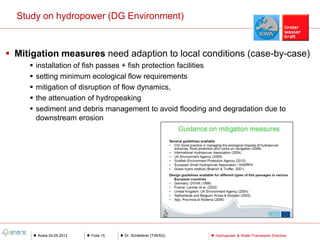
 Mitigation measures need adaption to local conditions (case-by-case)
        installation of fish passes + fish protection facilities
        setting minimum ecological flow requirements
        mitigation of disruption of flow dynamics,
        the attenuation of hydropeaking
        sediment and debris management to avoid flooding and degradation due to
         downstream erosion


         Aosta 24.05.2012   Folie 15   Dr. Schletterer (TIWAG)   Hydropower & Water Framework Directive
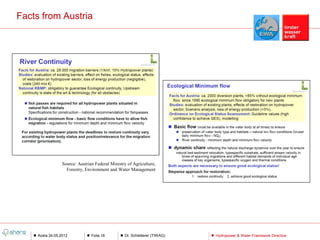
Facts from Austria


                  Source: Austrian Federal Ministry of Agriculture,
                    Forestry, Environment and Water Management


     Aosta 24.05.2012            Folie 16         Dr. Schletterer (TIWAG)   Hydropower & Water Framework Directive
Construction of new hydropower plants (EIA)


Bundesgesetz über die Prüfung der
Umweltverträglichkeit
(Umweltverträglichkeitsprüfungsgesetz 2000 idgF kurz UVP-G)


„Austrian EIA-law“

 assessing direct and indirect effects of a
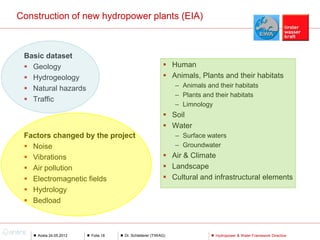
project, concernign following topics….


     Aosta 24.05.2012   Folie 17   Dr. Schletterer (TIWAG)   Hydropower & Water Framework Directive
Construction of new hydropower plants (EIA)


 Basic dataset
  Geology                                              Human
  Hydrogeology                                         Animals, Plants and their habitats
  Natural hazards                                          – Animals and their habitats
                                                            – Plants and their habitats
  Traffic
                                                            – Limnology
                                                        Soil
                                                        Water
 Factors changed by the project                             – Surface waters
  Noise                                                    – Groundwater
  Vibrations                                           Air & Climate
  Air pollution                                        Landscape
  Electromagnetic fields                               Cultural and infrastructural elements
  Hydrology
  Bedload


    Aosta 24.05.2012   Folie 18   Dr. Schletterer (TIWAG)                Hydropower & Water Framework Directive
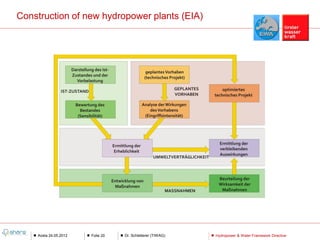
Construction of new hydropower plants (EIA)


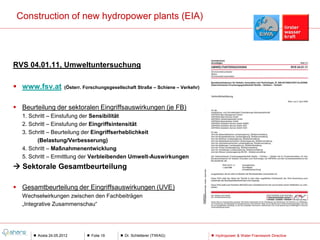
RVS 04.01.11, Umweltuntersuchung

 www.fsv.at          (Österr. Forschungsgesellschaft Straße – Schiene – Verkehr)


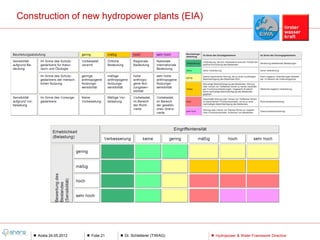
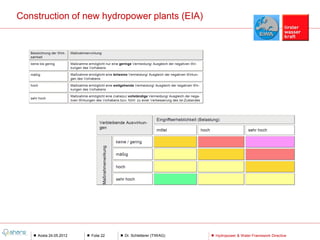
 Beurteilung der sektoralen Eingriffsauswirkungen (je FB)
   1. Schritt – Einstufung der Sensibilität
   2. Schritt – Einstufung der Eingriffsintensität
   3. Schritt – Beurteilung der Eingriffserheblichkeit
         (Belastung/Verbesserung)
   4. Schritt – Maßnahmenentwicklung
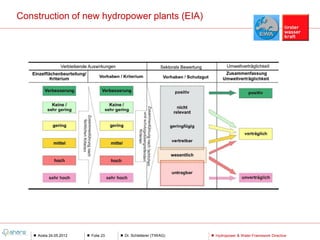
   5. Schritt – Ermittlung der Verbleibenden Umwelt-Auswirkungen
 Sektorale Gesamtbeurteilung

 Gesamtbeurteilung der Eingriffsauswirkungen (UVE)
   Wechselwirkungen zwischen den Fachbeiträgen
   „Integrative Zusammenschau“


        Aosta 24.05.2012         Folie 19       Dr. Schletterer (TIWAG)             Hydropower & Water Framework Directive
Construction of new hydropower plants (EIA)


    Aosta 24.05.2012   Folie 20   Dr. Schletterer (TIWAG)   Hydropower & Water Framework Directive
Construction of new hydropower plants (EIA)


    Aosta 24.05.2012   Folie 21   Dr. Schletterer (TIWAG)   Hydropower & Water Framework Directive
Construction of new hydropower plants (EIA)


    Aosta 24.05.2012   Folie 22   Dr. Schletterer (TIWAG)   Hydropower & Water Framework Directive
Construction of new hydropower plants (EIA)


    Aosta 24.05.2012   Folie 23   Dr. Schletterer (TIWAG)   Hydropower & Water Framework Directive
Conclusions


The challenge: Balancing requirements of 2 directives

   Renewable Energies Directive (RES-e)
   achieving a 20% share of energy
   from renewable sources by 2020


                           Water Framework Directive (WFD):
                        achieving good ecological status/potential
                       in surface waters and groundwater by 2015


    Aosta 24.05.2012   Folie 24   Dr. Schletterer (TIWAG)   Hydropower & Water Framework Directive
Conclusions


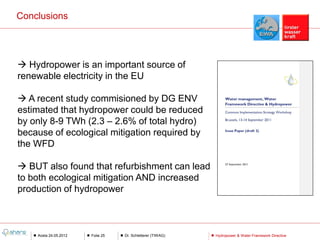
 Hydropower is an important source of
renewable electricity in the EU

 A recent study commisioned by DG ENV
estimated that hydropower could be reduced
by only 8-9 TWh (2.3 – 2.6% of total hydro)
because of ecological mitigation required by
the WFD

 BUT also found that refurbishment can lead
to both ecological mitigation AND increased
production of hydropower


    Aosta 24.05.2012   Folie 25   Dr. Schletterer (TIWAG)   Hydropower & Water Framework Directive
Thanks for your attention!
Aosta 24.05.2012   Folie 26   Dr. Schletterer (TIWAG)   Hydropower & Water Framework Directive

Session4.3 tiwag martin schletterer

  • 1.
    Hydropower and WaterFramework Directive Outputs from the 2nd Workshop on Water Management, WFD & Hydropower (Brussels September 2011) Multi criteria analyses (e.g. EIA) Aosta 24.05.2012
  • 2.
    Inhalt/Agenda I. Hydropower in the framework of renewable energies II. Study on hydropower (DG Environment) III. Facts from Austria IV. MCA – Construction of new hydropower plants (EIA) V. Conclusions Aosta 24.05.2012 Folie 2 Dr. Schletterer (TIWAG) Hydropower & Water Framework Directive
  • 3.
    Hydropower in theframework of renewable energies  Renewable energy in the EU-27 - 10 % of energy - 16 % of electric consumption (60 % hydropower)  Renewable Energies Directive: important role of renewables for achieving the objective of reducing greenhouse gas emissions whithin the EU (potential for greenhouse gas reductions of about 12% from 2005 to 2020) Aosta 24.05.2012 Folie 3 Dr. Schletterer (TIWAG) Hydropower & Water Framework Directive
  • 4.
    Hydropower in theframework of renewable energies  Nowadays hydropower is more than 50% of RES-electricity  will be around 30% in 2020  Moderate increase in hydropower (2010 – 2020):  Around 25 TWh (8%) consisting of 17.5 TWh large, 6.0 TWh medium and 1.5 TWh small hydro Source: DG Energy (EC) Aosta 24.05.2012 Folie 4 Dr. Schletterer (TIWAG) Hydropower & Water Framework Directive
  • 5.
    Hydropower in theframework of renewable energies Source: Kampa et al. 2011 (Issue paper, EC) Aosta 24.05.2012 Folie 5 Dr. Schletterer (TIWAG) Hydropower & Water Framework Directive
  • 6.
    Hydropower in theframework of renewable energies Current electricity production from hydropower and from renewable energy sources as a percentage of total national electricity production (%) Source: Kampa et al. 2011 (Issue paper, EC) Aosta 24.05.2012 Folie 6 Dr. Schletterer (TIWAG) Hydropower & Water Framework Directive
  • 7.
    Hydropower in theframework of renewable energies Total national electricity production from hydropower as a percentage of total electricity production from renewable energy sources (currently and in 2020) (%) Source: Kampa et al. 2011 (Issue paper, EC) Aosta 24.05.2012 Folie 7 Dr. Schletterer (TIWAG) Hydropower & Water Framework Directive
  • 8.
    Study on hydropower(DG Environment)  Objectives: understanding of the interlinkages between WFD and hydropower development with the aim to support integration  Overview of current and future contribution of the HP sector for achieving the RES targets  Overview of environmental impacts of HP generation and influence of environmental legislation,  Overview of strategic planning approaches in EU Member States Aosta 24.05.2012 Folie 8 Dr. Schletterer (TIWAG) Hydropower & Water Framework Directive
  • 9.
    Study on hydropower(DG Environment) Electricity production from renewable energy sources (left graph) and hydropower (right graph) currently and in 2020 (GWh/y) Source: Kampa et al. 2011 (Issue paper, EC) Aosta 24.05.2012 Folie 9 Dr. Schletterer (TIWAG) Hydropower & Water Framework Directive
  • 10.
    Study on hydropower(DG Environment) Legal requirements for environmental improvement Source: Kampa et al. 2011 (Issue paper, EC) Aosta 24.05.2012 Folie 10 Dr. Schletterer (TIWAG) Hydropower & Water Framework Directive
  • 11.
    Study on hydropower(DG Environment) Percentage of HMWB in relation to total number of surface water bodies (%) Percentage of HMWB designated due/linked to hydropower in relation to total HMWB (%) Source: Kampa et al. 2011 (Issue paper, EC) Aosta 24.05.2012 Folie 11 Dr. Schletterer (TIWAG) Hydropower & Water Framework Directive
  • 12.
    Study on hydropower(DG Environment) Legal requirements for environmental improvement Source: Kampa et al. 2011 (Issue paper, EC) Aosta 24.05.2012 Folie 12 Dr. Schletterer (TIWAG) Hydropower & Water Framework Directive
  • 13.
    Study on hydropower(DG Environment) Implementation of environmental improvement requires monitoring: -linking existing requirements to WFD requirements for GES/GEP achievement - Monitoring and data improvements, e.g. with respect to the effectiveness of fish passes - further technical research - Hydropeaking mitigation  R&D projects running -… Aosta 24.05.2012 Folie 13 Dr. Schletterer (TIWAG) Hydropower & Water Framework Directive
  • 14.
    Study on hydropower(DG Environment)  Some of the major impacts of hydropower stations:  hydropower has been identified as one of several drivers for hydromorphological alterations  the barrier function together with damage and mortality of fish species  modified flows and habitat conditions  changed sediment patterns  the changes in nutrient and physico-chemical conditions Many of these impacts can be mitigated with restoration and mitigation measures. Aosta 24.05.2012 Folie 14 Dr. Schletterer (TIWAG) Hydropower & Water Framework Directive
  • 15.
    Study on hydropower(DG Environment)  Mitigation measures need adaption to local conditions (case-by-case)  installation of fish passes + fish protection facilities  setting minimum ecological flow requirements  mitigation of disruption of flow dynamics,  the attenuation of hydropeaking  sediment and debris management to avoid flooding and degradation due to downstream erosion Aosta 24.05.2012 Folie 15 Dr. Schletterer (TIWAG) Hydropower & Water Framework Directive
  • 16.
    Facts from Austria Source: Austrian Federal Ministry of Agriculture, Forestry, Environment and Water Management Aosta 24.05.2012 Folie 16 Dr. Schletterer (TIWAG) Hydropower & Water Framework Directive
  • 17.
    Construction of newhydropower plants (EIA) Bundesgesetz über die Prüfung der Umweltverträglichkeit (Umweltverträglichkeitsprüfungsgesetz 2000 idgF kurz UVP-G) „Austrian EIA-law“  assessing direct and indirect effects of a project, concernign following topics…. Aosta 24.05.2012 Folie 17 Dr. Schletterer (TIWAG) Hydropower & Water Framework Directive
  • 18.
    Construction of newhydropower plants (EIA) Basic dataset  Geology  Human  Hydrogeology  Animals, Plants and their habitats  Natural hazards – Animals and their habitats – Plants and their habitats  Traffic – Limnology  Soil  Water Factors changed by the project – Surface waters  Noise – Groundwater  Vibrations  Air & Climate  Air pollution  Landscape  Electromagnetic fields  Cultural and infrastructural elements  Hydrology  Bedload Aosta 24.05.2012 Folie 18 Dr. Schletterer (TIWAG) Hydropower & Water Framework Directive
  • 19.
    Construction of newhydropower plants (EIA) RVS 04.01.11, Umweltuntersuchung  www.fsv.at (Österr. Forschungsgesellschaft Straße – Schiene – Verkehr)  Beurteilung der sektoralen Eingriffsauswirkungen (je FB) 1. Schritt – Einstufung der Sensibilität 2. Schritt – Einstufung der Eingriffsintensität 3. Schritt – Beurteilung der Eingriffserheblichkeit (Belastung/Verbesserung) 4. Schritt – Maßnahmenentwicklung 5. Schritt – Ermittlung der Verbleibenden Umwelt-Auswirkungen  Sektorale Gesamtbeurteilung  Gesamtbeurteilung der Eingriffsauswirkungen (UVE) Wechselwirkungen zwischen den Fachbeiträgen „Integrative Zusammenschau“ Aosta 24.05.2012 Folie 19 Dr. Schletterer (TIWAG) Hydropower & Water Framework Directive
  • 20.
    Construction of newhydropower plants (EIA) Aosta 24.05.2012 Folie 20 Dr. Schletterer (TIWAG) Hydropower & Water Framework Directive
  • 21.
    Construction of newhydropower plants (EIA) Aosta 24.05.2012 Folie 21 Dr. Schletterer (TIWAG) Hydropower & Water Framework Directive
  • 22.
    Construction of newhydropower plants (EIA) Aosta 24.05.2012 Folie 22 Dr. Schletterer (TIWAG) Hydropower & Water Framework Directive
  • 23.
    Construction of newhydropower plants (EIA) Aosta 24.05.2012 Folie 23 Dr. Schletterer (TIWAG) Hydropower & Water Framework Directive
  • 24.
    Conclusions The challenge: Balancingrequirements of 2 directives Renewable Energies Directive (RES-e) achieving a 20% share of energy from renewable sources by 2020 Water Framework Directive (WFD): achieving good ecological status/potential in surface waters and groundwater by 2015 Aosta 24.05.2012 Folie 24 Dr. Schletterer (TIWAG) Hydropower & Water Framework Directive
  • 25.
    Conclusions  Hydropower isan important source of renewable electricity in the EU  A recent study commisioned by DG ENV estimated that hydropower could be reduced by only 8-9 TWh (2.3 – 2.6% of total hydro) because of ecological mitigation required by the WFD  BUT also found that refurbishment can lead to both ecological mitigation AND increased production of hydropower Aosta 24.05.2012 Folie 25 Dr. Schletterer (TIWAG) Hydropower & Water Framework Directive
  • 26.
    Thanks for yourattention! Aosta 24.05.2012 Folie 26 Dr. Schletterer (TIWAG) Hydropower & Water Framework Directive