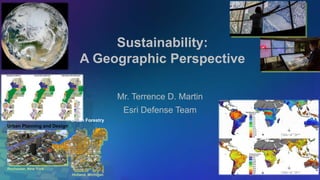



Sustainability: 
A Geographic Perspective 
Mr. Terrence D. Martin 
Esri Defense Team 
Urban Planning and Design 
Rochester, New York 
Urban Forestry 
Holland, Michigan
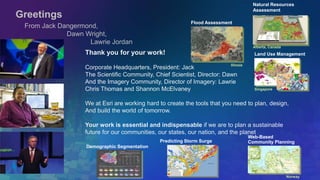
Greetings 
From Jack Dangermond, 
Dawn Wright, 
Lawrie Jordan 
Thank you for your work! 
Flood Assessment 
Corporate Headquarters, President: Jack 
The Scientific Community, Chief Scientist, Director: Dawn 
And the Imagery Community, Director of Imagery: Lawrie 
Chris Thomas and Shannon McElvaney 
Natural Resources 
Assessment 
Alberta, Canada 
Land Use Management 
Singapore 
We at Esri are working hard to create the tools that you need to plan, design, 
And build the world of tomorrow. 
Your work is essential and indispensable if we are to plan a sustainable 
future for our communities, our states, our nation, and the planet 
Demographic Segmentation 
Predicting Storm Surge 
Web-Based 
Community Planning 
Norway 
Illinois
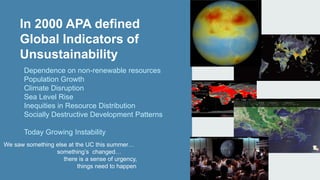
In 2000 APA defined 
Global Indicators of 
Unsustainability 
Dependence on non-renewable resources 
Population Growth 
Climate Disruption 
Sea Level Rise 
Inequities in Resource Distribution 
Socially Destructive Development Patterns 
Today Growing Instability 
We saw something else at the UC this summer… 
something’s changed… 
there is a sense of urgency, 
things need to happen
APA is a leader: 
August 16, 2000 
Policy Guide on Planning for Sustainability 
Sustainable Communities Division of APA 
• A place to tackle deep sustainability 
challenges through planning by connecting 
with peers to discuss, organize, and 
collaborate 
• Something is happening here… 
• Only you can do this. 
• You are the Architects of the Future.
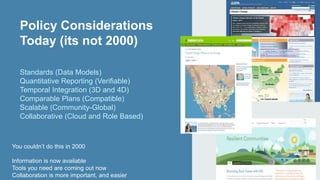
Policy Considerations 
Today (its not 2000) 
Standards (Data Models) 
Quantitative Reporting (Verifiable) 
Temporal Integration (3D and 4D) 
Comparable Plans (Compatible) 
Scalable (Community-Global) 
Collaborative (Cloud and Role Based) 
You couldn’t do this in 2000 
Information is now available 
Tools you need are coming out now 
Collaboration is more important, and easier
Geography Is Now 
More Important Than Ever 
Providing the Content and Context 
for Understanding Everything
The Problem 
Planning a sustainable future
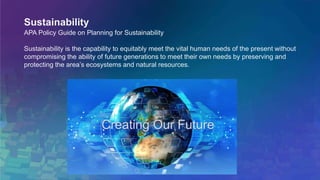
Sustainability 
APA Policy Guide on Planning for Sustainability 
Sustainability is the capability to equitably meet the vital human needs of the present without 
compromising the ability of future generations to meet their own needs by preserving and 
protecting the area’s ecosystems and natural resources. 
Creating Our Future
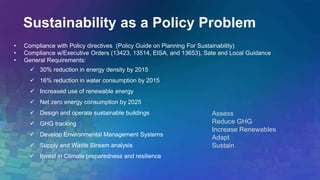
Sustainability as a Policy Problem 
• Compliance with Policy directives (Policy Guide on Planning For Sustainability) 
• Compliance w/Executive Orders (13423, 13514, EISA, and 13653), Sate and Local Guidance 
• General Requirements: 
 30% reduction in energy density by 2015 
 16% reduction in water consumption by 2015 
 Increased use of renewable energy 
 Net zero energy consumption by 2025 
 Design and operate sustainable buildings 
 GHG tracking 
 Develop Environmental Management Systems 
 Supply and Waste Stream analysis 
 Invest in Climate preparedness and resilience 
Assess 
Reduce GHG 
Increase Renewables 
Adapt 
Sustain
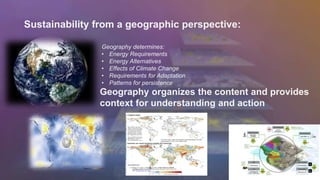
Sustainability from a geographic perspective: 
Geography determines: 
• Energy Requirements 
• Energy Alternatives 
• Effects of Climate Change 
• Requirements for Adaptation 
• Patterns for persistence 
Geography organizes the content and provides 
context for understanding and action
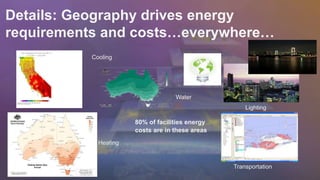
Details: Geography drives energy 
requirements and costs…everywhere… 
Cooling 
Heating 
Lighting 
Water 
Transportation 
80% of facilities energy 
costs are in these areas
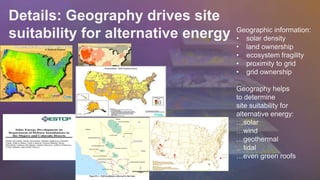
Details: Geography drives site 
suitability for alternative energy Geographic information: 
• solar density 
• land ownership 
• ecosystem fragility 
• proximity to grid 
• grid ownership 
Geography helps 
to determine 
site suitability for 
alternative energy: 
…solar 
…wind 
…geothermal 
…tidal 
…even green roofs
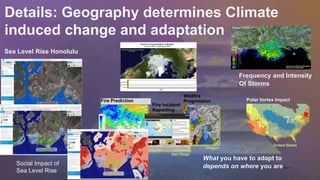
Details: Geography determines Climate 
induced change and adaptation 
Sea Level Rise Honolulu 
Frequency and Intensity 
Of Storms 
Polar Vortex Impact 
United States 
What you have to adapt to 
depends on where you are… 
Fire Prediction 
Amazon 
Wildfire 
Progression 
Oregon 
Fire Incident 
Reporting 
San Diego 
Social Impact of 
Sea Level Rise
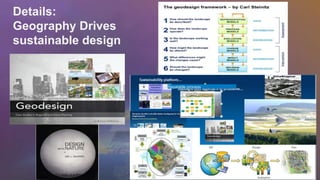
Details: 
Geography Drives 
sustainable design 
Repatable process
The Approach 
Geographically defined problems 
Geographic Approach
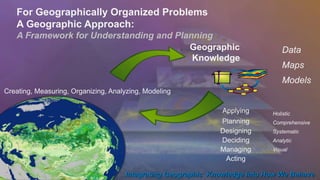
For Geographically Organized Problems 
A Geographic Approach: 
A Framework for Understanding and Planning 
Data 
Maps 
Models 
Holistic 
Comprehensive 
Systematic 
Analytic 
Visual 
Creating, Measuring, Organizing, Analyzing, Modeling 
Geographic 
Knowledge 
Applying 
Planning 
Designing 
Deciding 
Managing 
Acting 
Integrating Geographic Knowledge Into How We Behave
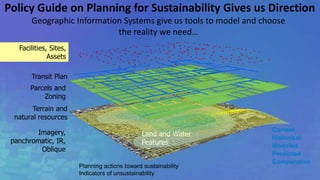
Policy Guide on Planning for Sustainability Gives us Direction 
Geographic Information Systems give us tools to model and choose 
Facilities, Sites, 
Assets 
the reality we need… 
Transit Plan 
Parcels and 
Zoning 
Imagery, 
panchromatic, IR, 
Oblique 
Land and Water 
Features 
Groundwater 
Terrain and 
natural resources 
Current 
Historical 
Modeled 
Predicted 
Comparative 
Planning actions toward sustainability 
Indicators of unsustainability
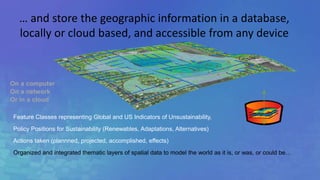
… and store the geographic information in a database, 
locally or cloud based, and accessible from any device 
On a computer 
On a network 
Or in a cloud 
Feature Classes representing Global and US Indicators of Unsustainability, 
Policy Positions for Sustainability (Renewables, Adaptations, Alternatives) 
Actions taken (plannned, projected, accomplished, effects) 
Organized and integrated thematic layers of spatial data to model the world as it is, or was, or could be…
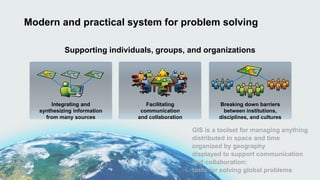
Modern and practical system for problem solving 
Supporting individuals, groups, and organizations 
Facilitating 
communication 
and collaboration 
Breaking down barriers 
between institutions, 
disciplines, and cultures 
Integrating and 
synthesizing information 
from many sources 
GIS is a toolset for managing anything 
distributed in space and time 
organized by geography 
displayed to support communication 
and collaboration: 
tools for solving global problems
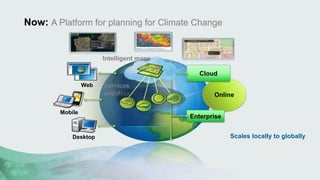
Now: A Platform for planning for Climate Change 
Cloud 
Online 
Enterprise 
Mobile 
Web 
Desktop 
Scales locally to globally 
Intelligent maps 
Services 
and data
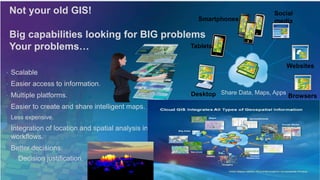
Not your old GIS! 
Smartphones 
Big capabilities looking for BIG problems 
Your problems… 
• Scalable 
• Easier access to information. 
• Multiple platforms. 
• Easier to create and share intelligent maps. 
• Less expensive. 
• Integration of location and spatial analysis into 
workflows. 
• Better decisions. 
- Decision justification. 
Tablets 
Desktop 
Social 
media 
Websites 
Browsers 
Share Data, Maps, Apps
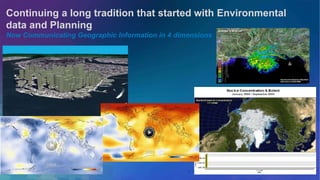
Continuing a long tradition that started with Environmental 
data and Planning 
Now Communicating Geographic Information in 4 dimensions 
. . . Creating Greater Understanding
Vision 
A Platform for Sustainability Planning 
Tools that didn’t Exist in 2000 
When you wrote the 
Policy Guide on Planning for Sustainability
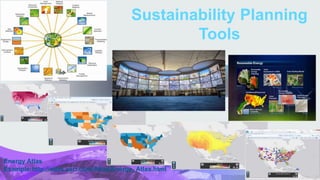
Sustainability Planning 
Tools 
... 
Energy Atlas 
Example:http://atlas.esri.com/Atlas/Energy_Atlas.html
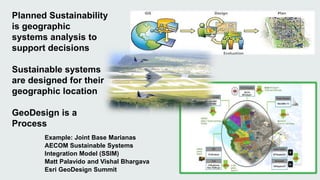
Planned Sustainability 
is geographic 
systems analysis to 
support decisions 
Sustainable systems 
are designed for their 
geographic location 
GeoDesign is a 
Process 
Example: Joint Base Marianas 
AECOM Sustainable Systems 
Integration Model (SSIM) 
Matt Palavido and Vishal Bhargava 
Esri GeoDesign Summit
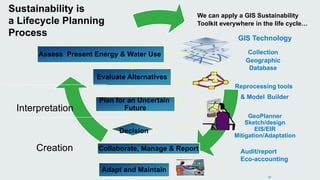
We can apply a GIS Sustainability 
Toolkit everywhere in the life cycle… 
Collection 
Geographic 
Database 
26 
Sustainability is 
a Lifecycle Planning 
Process 
Assess Present Energy & Water Use 
Interpretation 
Creation 
Evaluate Alternatives 
Plan for an Uncertain 
Future 
Decision 
Collaborate, Manage & Report 
Adapt and Maintain 
GIS Technology 
Reprocessing tools 
& Model Builder 
GeoPlanner 
Sketch/design 
EIS/EIR 
Mitigation/Adaptation 
Audit/report 
Eco-accounting
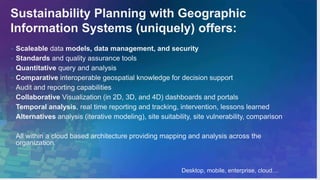
Sustainability Planning with Geographic 
Information Systems (uniquely) offers: 
• Scaleable data models, data management, and security 
• Standards and quality assurance tools 
• Quantitative query and analysis 
• Comparative interoperable geospatial knowledge for decision support 
• Audit and reporting capabilities 
• Collaborative Visualization (in 2D, 3D, and 4D) dashboards and portals 
• Temporal analysis, real time reporting and tracking, intervention, lessons learned 
• Alternatives analysis (iterative modeling), site suitability, site vulnerability, comparison 
• All within a cloud based architecture providing mapping and analysis across the 
organization. 
Desktop, mobile, enterprise, cloud…
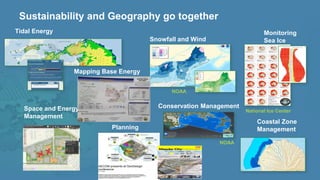
Sustainability and Geography go together 
Mapping Base Energy 
Monitoring 
Sea Ice 
Tidal Energy 
Planning 
Conservation Management 
Coastal Zone 
Management 
Snowfall and Wind 
NOAA 
NOAA 
Space and Energy National Ice Center 
Management
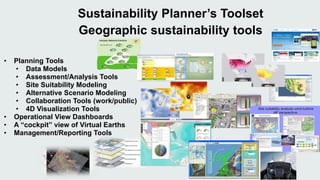
Sustainability Planner’s Toolset 
Geographic sustainability tools 
• Planning Tools 
• Data Models 
• Assessment/Analysis Tools 
• Site Suitability Modeling 
• Alternative Scenario Modeling 
• Collaboration Tools (work/public) 
• 4D Visualization Tools 
• Operational View Dashboards 
• A “cockpit” view of Virtual Earths 
• Management/Reporting Tools
Assessment Tools 
Core tools for planning
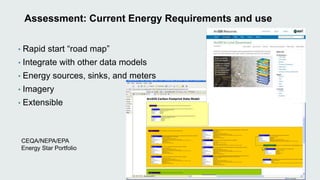
Assessment: Current Energy Requirements and use 
• Rapid start “road map” 
• Integrate with other data models 
• Energy sources, sinks, and meters 
• Imagery 
• Extensible 
CEQA/NEPA/EPA 
Energy Star Portfolio
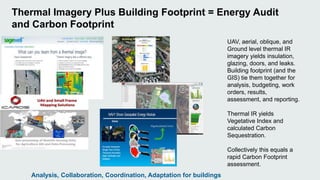
Thermal Imagery Plus Building Footprint = Energy Audit 
and Carbon Footprint 
UAV, aerial, oblique, and 
Ground level thermal IR 
imagery yields insulation, 
glazing, doors, and leaks. 
Building footprint (and the 
GIS) tie them together for 
analysis, budgeting, work 
orders, results, 
assessment, and reporting. 
Thermal IR yields 
Vegetative Index and 
calculated Carbon 
Sequestration. 
Collectively this equals a 
rapid Carbon Footprint 
assessment. 
Analysis, Collaboration, Coordination, Adaptation for buildings
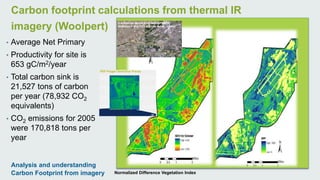
Carbon footprint calculations from thermal IR 
imagery (Woolpert) 
• Average Net Primary 
• Productivity for site is 
653 gC/m2/year 
• Total carbon sink is 
21,527 tons of carbon 
per year (78,932 CO2 
equivalents) 
• CO2 emissions for 2005 
were 170,818 tons per 
year 
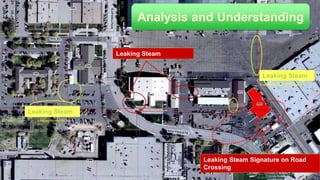
Analysis and understanding 
Carbon Footprint from imagery Normalized Difference Vegetation Index
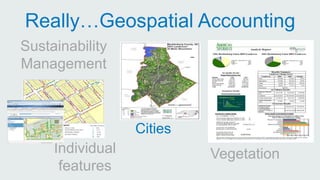
Really…Geospatial Accounting 
Sustainability 
Management 
Individual 
features 
Vegetation 
Cities
Analysis 
A Platform for Sustainability Planning
Leaking Steam 
Leaking Steam 
Leaking Steam Signature on Road 
Crossing 
Leaking Steam 
Analysis and Understanding
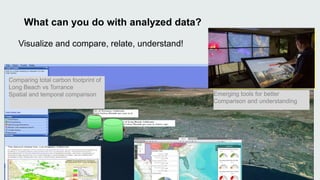
What can you do with analyzed data? 
Visualize and compare, relate, understand! 
Comparing total carbon footprint of 
Long Beach vs Torrance 
Spatial and temporal comparison Emerging tools for better 
Comparison and understanding
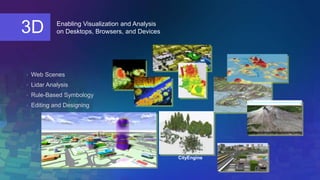
• Web Scenes 
• Lidar Analysis 
• Rule-Based Symbology 
• Editing and Designing 
CityEngine 
Enabling Visualization and Analysis 
on Desktops, Browsers, and Devices 3D
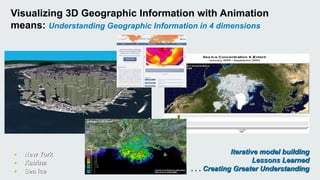
Visualizing 3D Geographic Information with Animation 
means: Understanding Geographic Information in 4 dimensions 
Iterative model building 
Lessons Learned 
. . . Creating Greater Understanding 
• New York 
• Katrina 
• Sea Ice
Alternatives 
Planning 
Platform for Sustainable Decisions
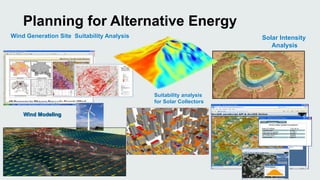
Planning for Alternative Energy 
Wind Generation Site Suitability Analysis 
Suitability analysis 
for Solar Collectors 
Solar Intensity 
Analysis 
Wind Modeling
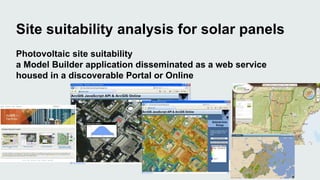
Site suitability analysis for solar panels 
Photovoltaic site suitability 
a Model Builder application disseminated as a web service 
housed in a discoverable Portal or Online
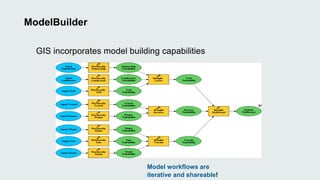
ModelBuilder 
GIS incorporates model building capabilities 
Model workflows are 
iterative and shareable!
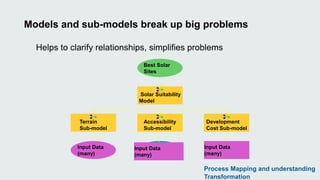
Models and sub-models break up big problems 
Helps to clarify relationships, simplifies problems 
Terrain 
Sub-model 
Input Data 
(many) 
Development 
Cost Sub-model 
Input Data 
(many) 
Best Solar 
Sites 
Solar Suitability 
Model 
Accessibility 
Sub-model 
Input Data 
(many) 
Process Mapping and understanding 
Transformation
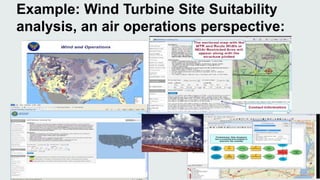
Example: Wind Turbine Site Suitability 
analysis, an air operations perspective:
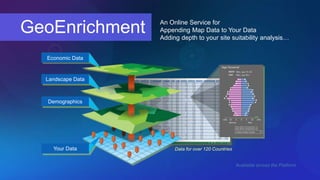
An Online Service for 
Appending Map Data to Your Data 
Adding depth to your site suitability analysis… 
Available across the Platform 
Data for over 120 Countries 
GeoEnrichment 
Economic Data 
Landscape Data 
Demographics 
Your Data
Adaptation and 
Resilience 
Planning 
Platform for Sustainable Decisions
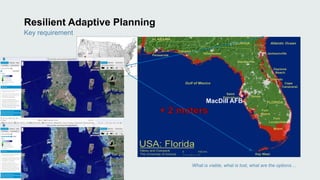
Resilient Adaptive Planning 
Key requirement 
MacDill AFB 
What is viable, what is lost, what are the options…
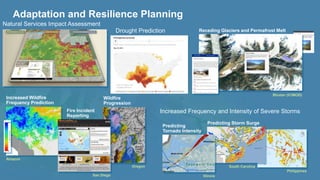
Adaptation and Resilience Planning 
Natural Services Impact Assessment 
Receding Glaciers and Permafrost Melt 
Bhutan (ICIMOD) 
Increased Wildfire 
Frequency Prediction 
Amazon 
Drought Prediction 
Wildfire 
Progression 
Oregon 
Fire Incident 
Reporting 
San Diego 
Increased Frequency and Intensity of Severe Storms 
Philippines 
Predicting Storm Surge 
South Carolina 
Illinois 
Predicting 
Tornado Intensity
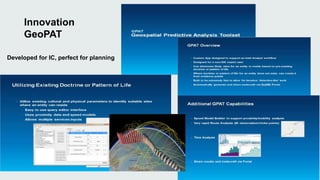
Innovation 
GeoPAT 
Developed for IC, perfect for planning
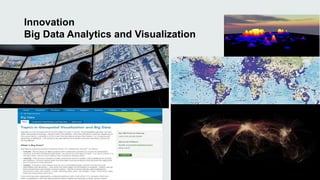
Innovation 
Big Data Analytics and Visualization
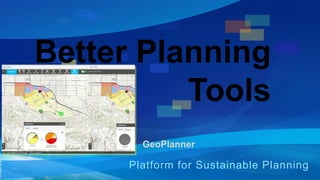
Better Planning 
Tools 
GeoPlanner 
Platform for Sustainable Planning
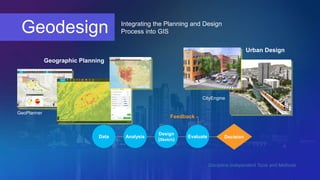
Integrating the Planning and Design 
Process into GIS Geodesign 
Feedback 
GeoPlanner 
Geographic Planning 
Data Analysis 
Design 
(Sketch) 
Evaluate Decision 
Urban Design 
CityEngine 
. . . Discipline-Independent Tools and Methods
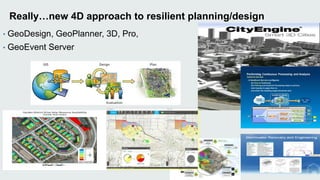
Really…new 4D approach to resilient planning/design 
• GeoDesign, GeoPlanner, 3D, Pro, 
• GeoEvent Server
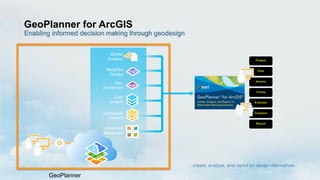
GeoPlanner for ArcGIS 
Enabling informed decision making through geodesign 
Project 
Data 
Assess 
Create 
Evaluate 
Compare 
Report 
…create, analyze, and report on design alternatives. 
Spatial 
Analysis 
Weighted 
Overlay 
Geo- 
Enrichment 
User 
Content 
Landscape 
Content 
Imagery & 
Basemaps 
GeoPlanner
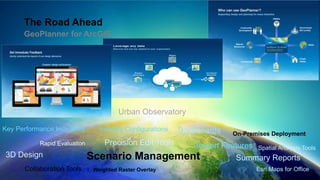
Urban Observatory 
Key Performance Indicators 
Rapid Evaluation 
On-Premises Deployment 
Import Features 
Industry Configurations 
3D Design Scenario Management Summary Reports 
Esri Maps for Office 
Precision Edit Tools 
Collaboration Tools Weighted Raster Overlay 
Spatial Analysis Tools 
Dashboards 
The Road Ahead 
GeoPlanner for ArcGIS
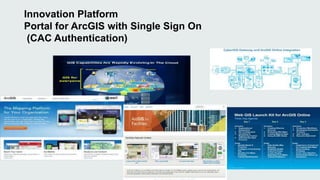
Innovation Platform 
Portal for ArcGIS with Single Sign On 
(CAC Authentication)
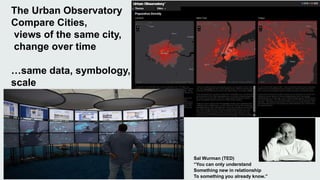
The Urban Observatory 
Compare Cities, 
views of the same city, 
change over time 
…same data, symbology, 
scale 
Sal Wurman (TED) 
“You can only understand 
Something new in relationship 
To something you already know.”
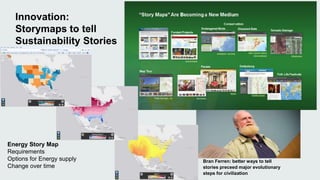
Innovation: 
Storymaps to tell 
Sustainability Stories 
Bran Ferren: better ways to tell 
stories preceed major evolutionary 
steps for civilization 
Energy Story Map 
Requirements 
Options for Energy supply 
Change over time
Situational 
Awareness and 
Reporting 
A Platform for Sustainability Planning
Innovation 
Full Motion Video and UAV platforms
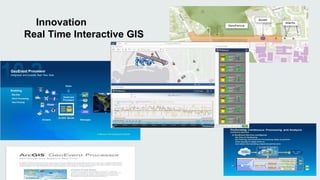
Innovation 
Real Time Interactive GIS
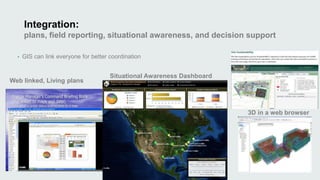
Integration: 
plans, field reporting, situational awareness, and decision support 
• GIS can link everyone for better coordination 
Web linked, Living plans 
Situational Awareness Dashboard 
3D in a web browser
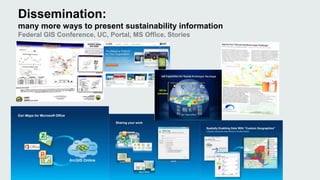
Dissemination: 
many more ways to present sustainability information 
Federal GIS Conference, UC, Portal, MS Office, Stories
Summary 
A Platform for Sustainability Planning
APA leadership is 
needed: 
New Policy Development 
Policy Guide on Planning for Sustainability 
Sustainable Communities Division of APA 
• The place to tackle deep sustainability 
challenges through planning by connecting 
with peers to discuss, organize, and 
collaborate 
• Only you can do this…but we can help. 
• You are the Architects of the Future. 
• Workshops? How can we help you?
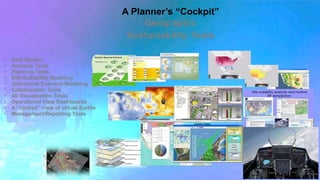
A Planner’s “Cockpit” 
Geographic 
Sustainability Tools 
• Data Models 
• Analysis Tools 
• Planning Tools 
• Site Suitability Modeling 
• Alternative Scenario Modeling 
• Collaboration Tools 
• 4D Visualization Tools 
• Operational View Dashboards 
• A “cockpit” view of virtual Earths 
• Management/Reporting Tools
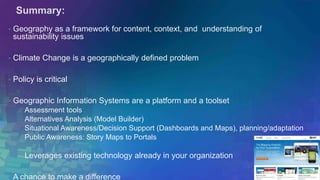
Summary: 
• Geography as a framework for content, context, and understanding of 
sustainability issues 
• Climate Change is a geographically defined problem 
• Policy is critical 
• Geographic Information Systems are a platform and a toolset 
Assessment tools 
Alternatives Analysis (Model Builder) 
Situational Awareness/Decision Support (Dashboards and Maps), planning/adaptation 
Public Awareness: Story Maps to Portals 
Leverages existing technology already in your organization 
• A chance to make a difference
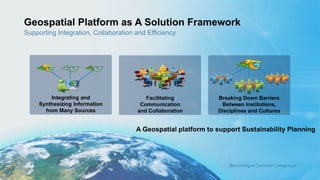
Geospatial Platform as A Solution Framework 
Supporting Integration, Collaboration and Efficiency 
. . . Becoming a Common Language 
Facilitating 
Communication 
and Collaboration 
Integrating and 
Synthesizing Information 
from Many Sources 
Breaking Down Barriers 
Between Institutions, 
Disciplines and Cultures 
A Geospatial platform to support Sustainability Planning
Thanks 
• Terry Martin 
• tmartin@esri.com 
• Esri Defense Team, Installations and Environment 
• Serving those who serve
Apa sustainability

Apa sustainability

  • 1.
    Sustainability: A GeographicPerspective Mr. Terrence D. Martin Esri Defense Team Urban Planning and Design Rochester, New York Urban Forestry Holland, Michigan
  • 2.
    Greetings From JackDangermond, Dawn Wright, Lawrie Jordan Thank you for your work! Flood Assessment Corporate Headquarters, President: Jack The Scientific Community, Chief Scientist, Director: Dawn And the Imagery Community, Director of Imagery: Lawrie Chris Thomas and Shannon McElvaney Natural Resources Assessment Alberta, Canada Land Use Management Singapore We at Esri are working hard to create the tools that you need to plan, design, And build the world of tomorrow. Your work is essential and indispensable if we are to plan a sustainable future for our communities, our states, our nation, and the planet Demographic Segmentation Predicting Storm Surge Web-Based Community Planning Norway Illinois
  • 3.
    In 2000 APAdefined Global Indicators of Unsustainability Dependence on non-renewable resources Population Growth Climate Disruption Sea Level Rise Inequities in Resource Distribution Socially Destructive Development Patterns Today Growing Instability We saw something else at the UC this summer… something’s changed… there is a sense of urgency, things need to happen
  • 4.
    APA is aleader: August 16, 2000 Policy Guide on Planning for Sustainability Sustainable Communities Division of APA • A place to tackle deep sustainability challenges through planning by connecting with peers to discuss, organize, and collaborate • Something is happening here… • Only you can do this. • You are the Architects of the Future.
  • 5.
    Policy Considerations Today(its not 2000) Standards (Data Models) Quantitative Reporting (Verifiable) Temporal Integration (3D and 4D) Comparable Plans (Compatible) Scalable (Community-Global) Collaborative (Cloud and Role Based) You couldn’t do this in 2000 Information is now available Tools you need are coming out now Collaboration is more important, and easier
  • 6.
    Geography Is Now More Important Than Ever Providing the Content and Context for Understanding Everything
  • 7.
    The Problem Planninga sustainable future
  • 8.
    Sustainability APA PolicyGuide on Planning for Sustainability Sustainability is the capability to equitably meet the vital human needs of the present without compromising the ability of future generations to meet their own needs by preserving and protecting the area’s ecosystems and natural resources. Creating Our Future
  • 9.
    Sustainability as aPolicy Problem • Compliance with Policy directives (Policy Guide on Planning For Sustainability) • Compliance w/Executive Orders (13423, 13514, EISA, and 13653), Sate and Local Guidance • General Requirements:  30% reduction in energy density by 2015  16% reduction in water consumption by 2015  Increased use of renewable energy  Net zero energy consumption by 2025  Design and operate sustainable buildings  GHG tracking  Develop Environmental Management Systems  Supply and Waste Stream analysis  Invest in Climate preparedness and resilience Assess Reduce GHG Increase Renewables Adapt Sustain
  • 10.
    Sustainability from ageographic perspective: Geography determines: • Energy Requirements • Energy Alternatives • Effects of Climate Change • Requirements for Adaptation • Patterns for persistence Geography organizes the content and provides context for understanding and action
  • 11.
    Details: Geography drivesenergy requirements and costs…everywhere… Cooling Heating Lighting Water Transportation 80% of facilities energy costs are in these areas
  • 12.
    Details: Geography drivessite suitability for alternative energy Geographic information: • solar density • land ownership • ecosystem fragility • proximity to grid • grid ownership Geography helps to determine site suitability for alternative energy: …solar …wind …geothermal …tidal …even green roofs
  • 13.
    Details: Geography determinesClimate induced change and adaptation Sea Level Rise Honolulu Frequency and Intensity Of Storms Polar Vortex Impact United States What you have to adapt to depends on where you are… Fire Prediction Amazon Wildfire Progression Oregon Fire Incident Reporting San Diego Social Impact of Sea Level Rise
  • 14.
    Details: Geography Drives sustainable design Repatable process
  • 15.
    The Approach Geographicallydefined problems Geographic Approach
  • 16.
    For Geographically OrganizedProblems A Geographic Approach: A Framework for Understanding and Planning Data Maps Models Holistic Comprehensive Systematic Analytic Visual Creating, Measuring, Organizing, Analyzing, Modeling Geographic Knowledge Applying Planning Designing Deciding Managing Acting Integrating Geographic Knowledge Into How We Behave
  • 17.
    Policy Guide onPlanning for Sustainability Gives us Direction Geographic Information Systems give us tools to model and choose Facilities, Sites, Assets the reality we need… Transit Plan Parcels and Zoning Imagery, panchromatic, IR, Oblique Land and Water Features Groundwater Terrain and natural resources Current Historical Modeled Predicted Comparative Planning actions toward sustainability Indicators of unsustainability
  • 18.
    … and storethe geographic information in a database, locally or cloud based, and accessible from any device On a computer On a network Or in a cloud Feature Classes representing Global and US Indicators of Unsustainability, Policy Positions for Sustainability (Renewables, Adaptations, Alternatives) Actions taken (plannned, projected, accomplished, effects) Organized and integrated thematic layers of spatial data to model the world as it is, or was, or could be…
  • 19.
    Modern and practicalsystem for problem solving Supporting individuals, groups, and organizations Facilitating communication and collaboration Breaking down barriers between institutions, disciplines, and cultures Integrating and synthesizing information from many sources GIS is a toolset for managing anything distributed in space and time organized by geography displayed to support communication and collaboration: tools for solving global problems
  • 20.
    Now: A Platformfor planning for Climate Change Cloud Online Enterprise Mobile Web Desktop Scales locally to globally Intelligent maps Services and data
  • 21.
    Not your oldGIS! Smartphones Big capabilities looking for BIG problems Your problems… • Scalable • Easier access to information. • Multiple platforms. • Easier to create and share intelligent maps. • Less expensive. • Integration of location and spatial analysis into workflows. • Better decisions. - Decision justification. Tablets Desktop Social media Websites Browsers Share Data, Maps, Apps
  • 22.
    Continuing a longtradition that started with Environmental data and Planning Now Communicating Geographic Information in 4 dimensions . . . Creating Greater Understanding
  • 23.
    Vision A Platformfor Sustainability Planning Tools that didn’t Exist in 2000 When you wrote the Policy Guide on Planning for Sustainability
  • 24.
    Sustainability Planning Tools ... Energy Atlas Example:http://atlas.esri.com/Atlas/Energy_Atlas.html
  • 25.
    Planned Sustainability isgeographic systems analysis to support decisions Sustainable systems are designed for their geographic location GeoDesign is a Process Example: Joint Base Marianas AECOM Sustainable Systems Integration Model (SSIM) Matt Palavido and Vishal Bhargava Esri GeoDesign Summit
  • 26.
    We can applya GIS Sustainability Toolkit everywhere in the life cycle… Collection Geographic Database 26 Sustainability is a Lifecycle Planning Process Assess Present Energy & Water Use Interpretation Creation Evaluate Alternatives Plan for an Uncertain Future Decision Collaborate, Manage & Report Adapt and Maintain GIS Technology Reprocessing tools & Model Builder GeoPlanner Sketch/design EIS/EIR Mitigation/Adaptation Audit/report Eco-accounting
  • 27.
    Sustainability Planning withGeographic Information Systems (uniquely) offers: • Scaleable data models, data management, and security • Standards and quality assurance tools • Quantitative query and analysis • Comparative interoperable geospatial knowledge for decision support • Audit and reporting capabilities • Collaborative Visualization (in 2D, 3D, and 4D) dashboards and portals • Temporal analysis, real time reporting and tracking, intervention, lessons learned • Alternatives analysis (iterative modeling), site suitability, site vulnerability, comparison • All within a cloud based architecture providing mapping and analysis across the organization. Desktop, mobile, enterprise, cloud…
  • 28.
    Sustainability and Geographygo together Mapping Base Energy Monitoring Sea Ice Tidal Energy Planning Conservation Management Coastal Zone Management Snowfall and Wind NOAA NOAA Space and Energy National Ice Center Management
  • 29.
    Sustainability Planner’s Toolset Geographic sustainability tools • Planning Tools • Data Models • Assessment/Analysis Tools • Site Suitability Modeling • Alternative Scenario Modeling • Collaboration Tools (work/public) • 4D Visualization Tools • Operational View Dashboards • A “cockpit” view of Virtual Earths • Management/Reporting Tools
  • 30.
    Assessment Tools Coretools for planning
  • 31.
    Assessment: Current EnergyRequirements and use • Rapid start “road map” • Integrate with other data models • Energy sources, sinks, and meters • Imagery • Extensible CEQA/NEPA/EPA Energy Star Portfolio
  • 32.
    Thermal Imagery PlusBuilding Footprint = Energy Audit and Carbon Footprint UAV, aerial, oblique, and Ground level thermal IR imagery yields insulation, glazing, doors, and leaks. Building footprint (and the GIS) tie them together for analysis, budgeting, work orders, results, assessment, and reporting. Thermal IR yields Vegetative Index and calculated Carbon Sequestration. Collectively this equals a rapid Carbon Footprint assessment. Analysis, Collaboration, Coordination, Adaptation for buildings
  • 33.
    Carbon footprint calculationsfrom thermal IR imagery (Woolpert) • Average Net Primary • Productivity for site is 653 gC/m2/year • Total carbon sink is 21,527 tons of carbon per year (78,932 CO2 equivalents) • CO2 emissions for 2005 were 170,818 tons per year Analysis and understanding Carbon Footprint from imagery Normalized Difference Vegetation Index
  • 34.
    Really…Geospatial Accounting Sustainability Management Individual features Vegetation Cities
  • 35.
    Analysis A Platformfor Sustainability Planning
  • 36.
    Leaking Steam LeakingSteam Leaking Steam Signature on Road Crossing Leaking Steam Analysis and Understanding
  • 37.
    What can youdo with analyzed data? Visualize and compare, relate, understand! Comparing total carbon footprint of Long Beach vs Torrance Spatial and temporal comparison Emerging tools for better Comparison and understanding
  • 38.
    • Web Scenes • Lidar Analysis • Rule-Based Symbology • Editing and Designing CityEngine Enabling Visualization and Analysis on Desktops, Browsers, and Devices 3D
  • 39.
    Visualizing 3D GeographicInformation with Animation means: Understanding Geographic Information in 4 dimensions Iterative model building Lessons Learned . . . Creating Greater Understanding • New York • Katrina • Sea Ice
  • 40.
    Alternatives Planning Platformfor Sustainable Decisions
  • 41.
    Planning for AlternativeEnergy Wind Generation Site Suitability Analysis Suitability analysis for Solar Collectors Solar Intensity Analysis Wind Modeling
  • 42.
    Site suitability analysisfor solar panels Photovoltaic site suitability a Model Builder application disseminated as a web service housed in a discoverable Portal or Online
  • 43.
    ModelBuilder GIS incorporatesmodel building capabilities Model workflows are iterative and shareable!
  • 44.
    Models and sub-modelsbreak up big problems Helps to clarify relationships, simplifies problems Terrain Sub-model Input Data (many) Development Cost Sub-model Input Data (many) Best Solar Sites Solar Suitability Model Accessibility Sub-model Input Data (many) Process Mapping and understanding Transformation
  • 45.
    Example: Wind TurbineSite Suitability analysis, an air operations perspective:
  • 46.
    An Online Servicefor Appending Map Data to Your Data Adding depth to your site suitability analysis… Available across the Platform Data for over 120 Countries GeoEnrichment Economic Data Landscape Data Demographics Your Data
  • 47.
    Adaptation and Resilience Planning Platform for Sustainable Decisions
  • 48.
    Resilient Adaptive Planning Key requirement MacDill AFB What is viable, what is lost, what are the options…
  • 49.
    Adaptation and ResiliencePlanning Natural Services Impact Assessment Receding Glaciers and Permafrost Melt Bhutan (ICIMOD) Increased Wildfire Frequency Prediction Amazon Drought Prediction Wildfire Progression Oregon Fire Incident Reporting San Diego Increased Frequency and Intensity of Severe Storms Philippines Predicting Storm Surge South Carolina Illinois Predicting Tornado Intensity
  • 50.
    Innovation GeoPAT Developedfor IC, perfect for planning
  • 51.
    Innovation Big DataAnalytics and Visualization
  • 52.
    Better Planning Tools GeoPlanner Platform for Sustainable Planning
  • 53.
    Integrating the Planningand Design Process into GIS Geodesign Feedback GeoPlanner Geographic Planning Data Analysis Design (Sketch) Evaluate Decision Urban Design CityEngine . . . Discipline-Independent Tools and Methods
  • 54.
    Really…new 4D approachto resilient planning/design • GeoDesign, GeoPlanner, 3D, Pro, • GeoEvent Server
  • 55.
    GeoPlanner for ArcGIS Enabling informed decision making through geodesign Project Data Assess Create Evaluate Compare Report …create, analyze, and report on design alternatives. Spatial Analysis Weighted Overlay Geo- Enrichment User Content Landscape Content Imagery & Basemaps GeoPlanner
  • 56.
    Urban Observatory KeyPerformance Indicators Rapid Evaluation On-Premises Deployment Import Features Industry Configurations 3D Design Scenario Management Summary Reports Esri Maps for Office Precision Edit Tools Collaboration Tools Weighted Raster Overlay Spatial Analysis Tools Dashboards The Road Ahead GeoPlanner for ArcGIS
  • 57.
    Innovation Platform Portalfor ArcGIS with Single Sign On (CAC Authentication)
  • 58.
    The Urban Observatory Compare Cities, views of the same city, change over time …same data, symbology, scale Sal Wurman (TED) “You can only understand Something new in relationship To something you already know.”
  • 59.
    Innovation: Storymaps totell Sustainability Stories Bran Ferren: better ways to tell stories preceed major evolutionary steps for civilization Energy Story Map Requirements Options for Energy supply Change over time
  • 60.
    Situational Awareness and Reporting A Platform for Sustainability Planning
  • 61.
    Innovation Full MotionVideo and UAV platforms
  • 62.
    Innovation Real TimeInteractive GIS
  • 63.
    Integration: plans, fieldreporting, situational awareness, and decision support • GIS can link everyone for better coordination Web linked, Living plans Situational Awareness Dashboard 3D in a web browser
  • 64.
    Dissemination: many moreways to present sustainability information Federal GIS Conference, UC, Portal, MS Office, Stories
  • 65.
    Summary A Platformfor Sustainability Planning
  • 66.
    APA leadership is needed: New Policy Development Policy Guide on Planning for Sustainability Sustainable Communities Division of APA • The place to tackle deep sustainability challenges through planning by connecting with peers to discuss, organize, and collaborate • Only you can do this…but we can help. • You are the Architects of the Future. • Workshops? How can we help you?
  • 67.
    A Planner’s “Cockpit” Geographic Sustainability Tools • Data Models • Analysis Tools • Planning Tools • Site Suitability Modeling • Alternative Scenario Modeling • Collaboration Tools • 4D Visualization Tools • Operational View Dashboards • A “cockpit” view of virtual Earths • Management/Reporting Tools
  • 68.
    Summary: • Geographyas a framework for content, context, and understanding of sustainability issues • Climate Change is a geographically defined problem • Policy is critical • Geographic Information Systems are a platform and a toolset Assessment tools Alternatives Analysis (Model Builder) Situational Awareness/Decision Support (Dashboards and Maps), planning/adaptation Public Awareness: Story Maps to Portals Leverages existing technology already in your organization • A chance to make a difference
  • 69.
    Geospatial Platform asA Solution Framework Supporting Integration, Collaboration and Efficiency . . . Becoming a Common Language Facilitating Communication and Collaboration Integrating and Synthesizing Information from Many Sources Breaking Down Barriers Between Institutions, Disciplines and Cultures A Geospatial platform to support Sustainability Planning
  • 70.
    Thanks • TerryMartin • tmartin@esri.com • Esri Defense Team, Installations and Environment • Serving those who serve