SEAFARER’S CENTER PEDESTRIAN BRIDGE
PRESENTATION
7/28/2016
OBJECTIVE
 Introduce the Seafarer’s Center Pedestrian
Bridge Project and review the project
process and results.
WHY BUILD A PEDESTRIAN BRIDGE?
 The seafarer’s center will have a restaurant open
soon and POHA employees will need a way to cross
the ditch to reach the Seafarer’s center
 It will provide access to a safe haven during fire drills
 It will provide recreation through a jogging trail
(coming up next year)
 It would provide support to not just executive building
inhabitants, but also parking for those who attend
large Seafarer’s Center Events
AGENDA
 Optimal Routes
 Bridge Design Considerations
 Painted Steel
 Aluminum
 Galvanized Steel
 Weathered Steel
 Bridge Fabrication and Erection Cost Estimates
 Bridge Material Recommendation
 Aluminum vs Steel Life Cycle Cost
 Recommended Material
 Deck Material Recommendation
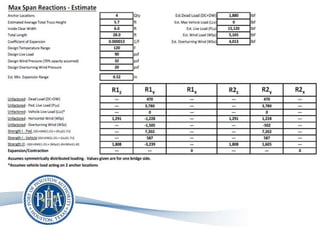
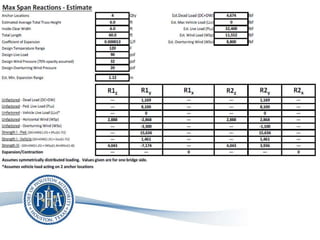
 Loadings
 Option Recommendation
 Foundation Design
 Anchorbolt Design
 Bridge and Foundation Drawings
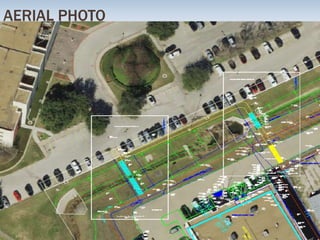
OPTIMAL ROUTES
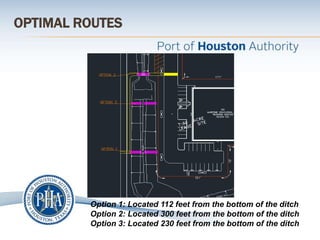
Option 1: Located 112 feet from the bottom of the ditch
Option 2: Located 300 feet from the bottom of the ditch
Option 3: Located 230 feet from the bottom of the ditch
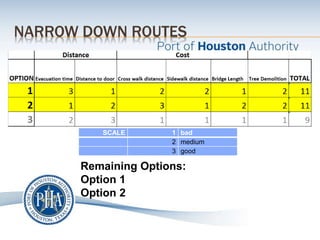
NARROW DOWN ROUTES
SCALE 1 bad
2 medium
3 good
Remaining Options:
Option 1
Option 2
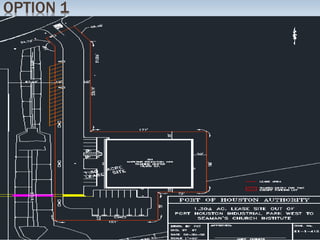
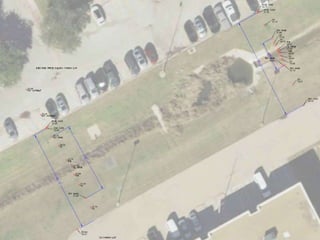
OPTION 1
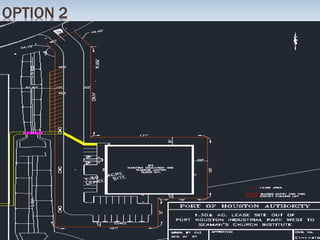
OPTION 2
AERIAL PHOTO
BRIDGE DESIGN CONSIDERATIONS
 Design consideration factors:
 Loading: Pedestrian Traffic
 Must not run into cable installed in the ground
 Width:
 The ADA compliant minimum inside clear width is 4 feet,
but the actual width of the bridge will be 5 to 6 feet
 Narrow Bridge Advantages
 more efficient load support
 less material
 minimizes the risk of unintended use (like vehicular traffic)
 Since a narrow bridge is advantageous, we will go with
the minimum:
 6 feet
 Potential length of bridge:
 Option 1: 60 feet
 Option 2: 28 feet
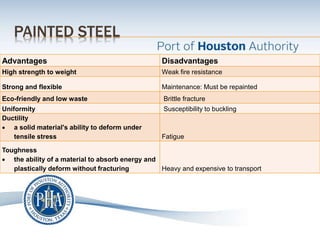
PAINTED STEEL
Advantages Disadvantages
High strength to weight Weak fire resistance
Strong and flexible Maintenance: Must be repainted
Eco-friendly and low waste Brittle fracture
Uniformity Susceptibility to buckling
Ductility
 a solid material's ability to deform under
tensile stress Fatigue
Toughness
 the ability of a material to absorb energy and
plastically deform without fracturing Heavy and expensive to transport
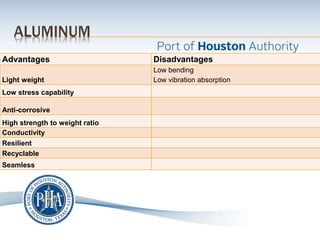
ALUMINUM
Advantages Disadvantages
Light weight
Low bending
Low vibration absorption
Low stress capability
Anti-corrosive
High strength to weight ratio
Conductivity
Resilient
Recyclable
Seamless
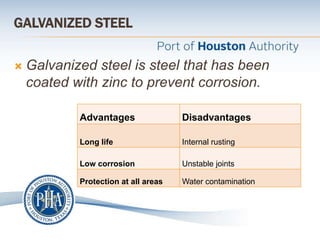
GALVANIZED STEEL
 Galvanized steel is steel that has been
coated with zinc to prevent corrosion.
Advantages Disadvantages
Long life Internal rusting
Low corrosion Unstable joints
Protection at all areas Water contamination
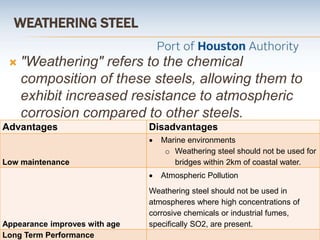
WEATHERING STEEL
 "Weathering" refers to the chemical
composition of these steels, allowing them to
exhibit increased resistance to atmospheric
corrosion compared to other steels.
Advantages Disadvantages
Low maintenance
 Marine environments
o Weathering steel should not be used for
bridges within 2km of coastal water.
Appearance improves with age
 Atmospheric Pollution
Weathering steel should not be used in
atmospheres where high concentrations of
corrosive chemicals or industrial fumes,
specifically SO2, are present.
Long Term Performance
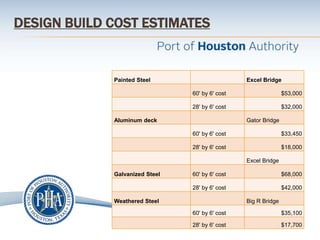
DESIGN BUILD COST ESTIMATES
Painted Steel Excel Bridge
60' by 6' cost $53,000
28' by 6' cost $32,000
Aluminum deck Gator Bridge
60' by 6' cost $33,450
28' by 6' cost $18,000
Excel Bridge
Galvanized Steel 60' by 6' cost $68,000
28' by 6' cost $42,000
Weathered Steel Big R Bridge
60' by 6' cost $35,100
28' by 6' cost $17,700
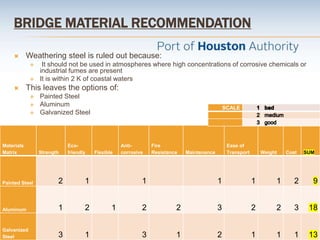
BRIDGE MATERIAL RECOMMENDATION
 Weathering steel is ruled out because:
 It should not be used in atmospheres where high concentrations of corrosive chemicals or
industrial fumes are present
 It is within 2 K of coastal waters
 This leaves the options of:
 Painted Steel
 Aluminum
 Galvanized Steel
Materials
Matrix Strength
Eco-
friendly Flexible
Anti-
corrosive
Fire
Resistance Maintenance
Ease of
Transport Weight Cost SUM
Painted Steel 2 1 1 1 1 1 2 9
Aluminum 1 2 1 2 2 3 2 2 3 18
Galvanized
Steel 3 1 3 1 2 1 1 1 13
SCALE
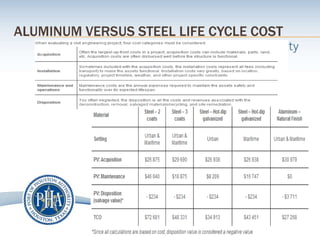
ALUMINUM VERSUS STEEL LIFE CYCLE COST
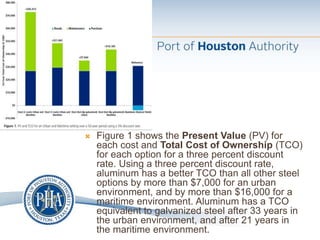
 Figure 1 shows the Present Value (PV) for
each cost and Total Cost of Ownership (TCO)
for each option for a three percent discount
rate. Using a three percent discount rate,
aluminum has a better TCO than all other steel
options by more than $7,000 for an urban
environment, and by more than $16,000 for a
maritime environment. Aluminum has a TCO
equivalent to galvanized steel after 33 years in
the urban environment, and after 21 years in
the maritime environment.
RECOMMENDED MATERIAL
 The recommended material to be
used for the bridge is aluminum.
 Cost:
 The material cost itself is the least
 It has the least total cost of ownership
 Materials Matrix
 It scored the highest amount of point in the
materials matrix, due to advantageous factors
that outweighed those of the other materials.
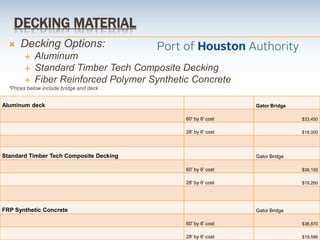
DECKING MATERIAL
 Decking Options:
 Aluminum
 Standard Timber Tech Composite Decking
 Fiber Reinforced Polymer Synthetic Concrete
*Prices below include bridge and deck
Aluminum deck Gator Bridge
60' by 6' cost $33,450
28' by 6' cost $18,000
Standard Timber Tech Composite Decking Gator Bridge
60' by 6' cost $36,150
28' by 6' cost $19,260
FRP Synthetic Concrete Gator Bridge
60' by 6' cost $36,870
28' by 6' cost $19,596
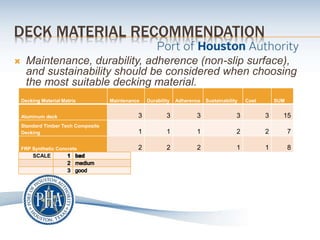
DECK MATERIAL RECOMMENDATION
 Maintenance, durability, adherence (non-slip surface),
and sustainability should be considered when choosing
the most suitable decking material.
Decking Material Matrix Maintenance Durability Adherence Sustainability Cost SUM
Aluminum deck 3 3 3 3 3 15
Standard Timber Tech Composite
Decking 1 1 1 2 2 7
FRP Synthetic Concrete 2 2 2 1 1 8
SCALE
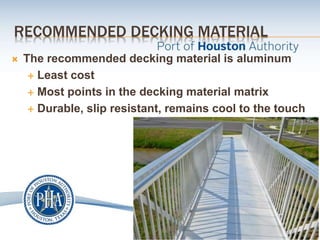
RECOMMENDED DECKING MATERIAL
 The recommended decking material is aluminum
 Least cost
 Most points in the decking material matrix
 Durable, slip resistant, remains cool to the touch
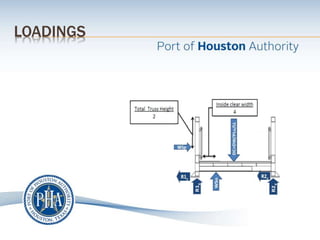
LOADINGS
OPTION RECOMMENDATION
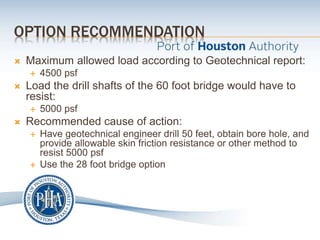
 Maximum allowed load according to Geotechnical report:
 4500 psf
 Load the drill shafts of the 60 foot bridge would have to
resist:
 5000 psf
 Recommended cause of action:
 Have geotechnical engineer drill 50 feet, obtain bore hole, and
provide allowable skin friction resistance or other method to
resist 5000 psf
 Use the 28 foot bridge option
DECISION:
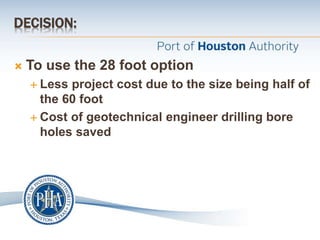
 To use the 28 foot option
 Less project cost due to the size being half of
the 60 foot
 Cost of geotechnical engineer drilling bore
holes saved
FOUNDATION DESIGN
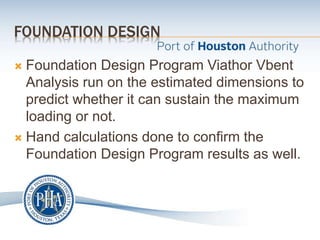
 Foundation Design Program Viathor Vbent
Analysis run on the estimated dimensions to
predict whether it can sustain the maximum
loading or not.
 Hand calculations done to confirm the
Foundation Design Program results as well.
FOUNDATION DESIGN
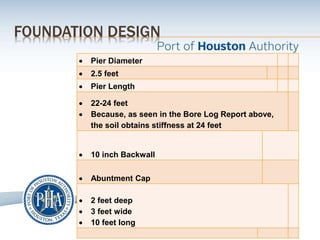
 Pier Diameter
 2.5 feet
 Pier Length
 22-24 feet
 Because, as seen in the Bore Log Report above,
the soil obtains stiffness at 24 feet
 10 inch Backwall
 Abuntment Cap
 2 feet deep
 3 feet wide
 10 feet long
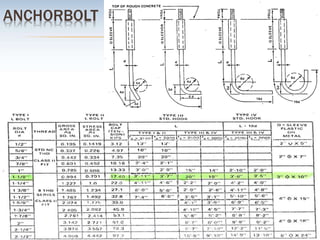
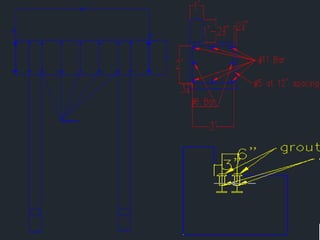
ANCHORBOLT
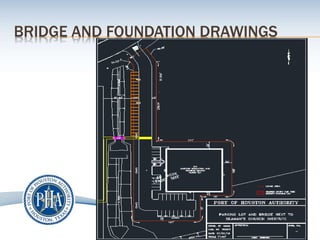
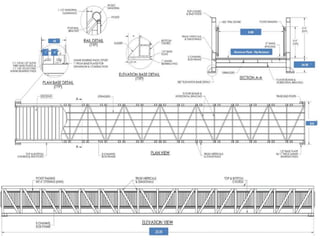
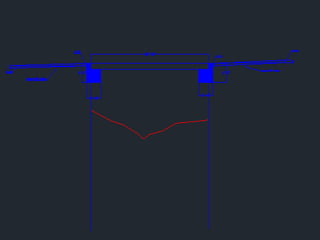
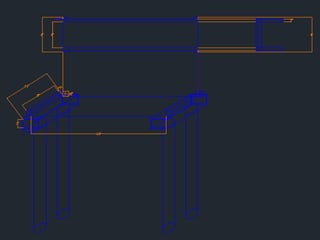
BRIDGE AND FOUNDATION DRAWINGS
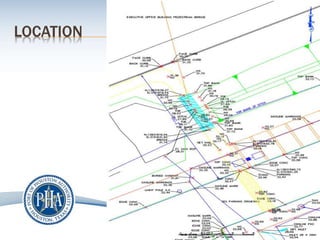
LOCATION
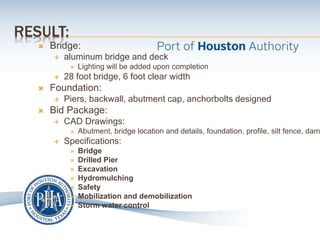
RESULT:
 Bridge:
 aluminum bridge and deck
 Lighting will be added upon completion
 28 foot bridge, 6 foot clear width
 Foundation:
 Piers, backwall, abutment cap, anchorbolts designed
 Bid Package:
 CAD Drawings:
 Abutment, bridge location and details, foundation, profile, silt fence, dam
 Specifications:
 Bridge
 Drilled Pier
 Excavation
 Hydromulching
 Safety
 Mobilization and demobilization
 Storm water control
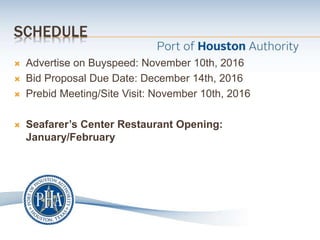
SCHEDULE
 Advertise on Buyspeed: November 10th, 2016
 Bid Proposal Due Date: December 14th, 2016
 Prebid Meeting/Site Visit: November 10th, 2016
 Seafarer’s Center Restaurant Opening:
January/February
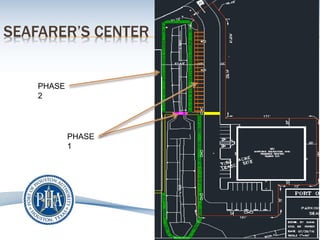
SEAFARER’S CENTER
PHASE
2
PHASE
1
Objective:
Introduce the Seafarer’s Center
Pedestrian Bridge Project and review
the project process and results.
Objective met?
Any questions?

SEAFARER’S CENTER PEDESTRIAN BRIDGE_PRESENTATION

  • 1.
    SEAFARER’S CENTER PEDESTRIANBRIDGE PRESENTATION 7/28/2016
  • 2.
    OBJECTIVE  Introduce theSeafarer’s Center Pedestrian Bridge Project and review the project process and results.
  • 3.
    WHY BUILD APEDESTRIAN BRIDGE?  The seafarer’s center will have a restaurant open soon and POHA employees will need a way to cross the ditch to reach the Seafarer’s center  It will provide access to a safe haven during fire drills  It will provide recreation through a jogging trail (coming up next year)  It would provide support to not just executive building inhabitants, but also parking for those who attend large Seafarer’s Center Events
  • 4.
    AGENDA  Optimal Routes Bridge Design Considerations  Painted Steel  Aluminum  Galvanized Steel  Weathered Steel  Bridge Fabrication and Erection Cost Estimates  Bridge Material Recommendation  Aluminum vs Steel Life Cycle Cost  Recommended Material  Deck Material Recommendation  Loadings  Option Recommendation  Foundation Design  Anchorbolt Design  Bridge and Foundation Drawings
  • 5.
    OPTIMAL ROUTES Option 1:Located 112 feet from the bottom of the ditch Option 2: Located 300 feet from the bottom of the ditch Option 3: Located 230 feet from the bottom of the ditch
  • 6.
    NARROW DOWN ROUTES SCALE1 bad 2 medium 3 good Remaining Options: Option 1 Option 2
  • 7.
  • 8.
  • 9.
  • 10.
    BRIDGE DESIGN CONSIDERATIONS Design consideration factors:  Loading: Pedestrian Traffic  Must not run into cable installed in the ground  Width:  The ADA compliant minimum inside clear width is 4 feet, but the actual width of the bridge will be 5 to 6 feet  Narrow Bridge Advantages  more efficient load support  less material  minimizes the risk of unintended use (like vehicular traffic)  Since a narrow bridge is advantageous, we will go with the minimum:  6 feet  Potential length of bridge:  Option 1: 60 feet  Option 2: 28 feet
  • 12.
    PAINTED STEEL Advantages Disadvantages Highstrength to weight Weak fire resistance Strong and flexible Maintenance: Must be repainted Eco-friendly and low waste Brittle fracture Uniformity Susceptibility to buckling Ductility  a solid material's ability to deform under tensile stress Fatigue Toughness  the ability of a material to absorb energy and plastically deform without fracturing Heavy and expensive to transport
  • 13.
    ALUMINUM Advantages Disadvantages Light weight Lowbending Low vibration absorption Low stress capability Anti-corrosive High strength to weight ratio Conductivity Resilient Recyclable Seamless
  • 14.
    GALVANIZED STEEL  Galvanizedsteel is steel that has been coated with zinc to prevent corrosion. Advantages Disadvantages Long life Internal rusting Low corrosion Unstable joints Protection at all areas Water contamination
  • 15.
    WEATHERING STEEL  "Weathering"refers to the chemical composition of these steels, allowing them to exhibit increased resistance to atmospheric corrosion compared to other steels. Advantages Disadvantages Low maintenance  Marine environments o Weathering steel should not be used for bridges within 2km of coastal water. Appearance improves with age  Atmospheric Pollution Weathering steel should not be used in atmospheres where high concentrations of corrosive chemicals or industrial fumes, specifically SO2, are present. Long Term Performance
  • 16.
    DESIGN BUILD COSTESTIMATES Painted Steel Excel Bridge 60' by 6' cost $53,000 28' by 6' cost $32,000 Aluminum deck Gator Bridge 60' by 6' cost $33,450 28' by 6' cost $18,000 Excel Bridge Galvanized Steel 60' by 6' cost $68,000 28' by 6' cost $42,000 Weathered Steel Big R Bridge 60' by 6' cost $35,100 28' by 6' cost $17,700
  • 17.
    BRIDGE MATERIAL RECOMMENDATION Weathering steel is ruled out because:  It should not be used in atmospheres where high concentrations of corrosive chemicals or industrial fumes are present  It is within 2 K of coastal waters  This leaves the options of:  Painted Steel  Aluminum  Galvanized Steel Materials Matrix Strength Eco- friendly Flexible Anti- corrosive Fire Resistance Maintenance Ease of Transport Weight Cost SUM Painted Steel 2 1 1 1 1 1 2 9 Aluminum 1 2 1 2 2 3 2 2 3 18 Galvanized Steel 3 1 3 1 2 1 1 1 13 SCALE
  • 18.
    ALUMINUM VERSUS STEELLIFE CYCLE COST
  • 19.
     Figure 1shows the Present Value (PV) for each cost and Total Cost of Ownership (TCO) for each option for a three percent discount rate. Using a three percent discount rate, aluminum has a better TCO than all other steel options by more than $7,000 for an urban environment, and by more than $16,000 for a maritime environment. Aluminum has a TCO equivalent to galvanized steel after 33 years in the urban environment, and after 21 years in the maritime environment.
  • 20.
    RECOMMENDED MATERIAL  Therecommended material to be used for the bridge is aluminum.  Cost:  The material cost itself is the least  It has the least total cost of ownership  Materials Matrix  It scored the highest amount of point in the materials matrix, due to advantageous factors that outweighed those of the other materials.
  • 21.
    DECKING MATERIAL  DeckingOptions:  Aluminum  Standard Timber Tech Composite Decking  Fiber Reinforced Polymer Synthetic Concrete *Prices below include bridge and deck Aluminum deck Gator Bridge 60' by 6' cost $33,450 28' by 6' cost $18,000 Standard Timber Tech Composite Decking Gator Bridge 60' by 6' cost $36,150 28' by 6' cost $19,260 FRP Synthetic Concrete Gator Bridge 60' by 6' cost $36,870 28' by 6' cost $19,596
  • 22.
    DECK MATERIAL RECOMMENDATION Maintenance, durability, adherence (non-slip surface), and sustainability should be considered when choosing the most suitable decking material. Decking Material Matrix Maintenance Durability Adherence Sustainability Cost SUM Aluminum deck 3 3 3 3 3 15 Standard Timber Tech Composite Decking 1 1 1 2 2 7 FRP Synthetic Concrete 2 2 2 1 1 8 SCALE
  • 23.
    RECOMMENDED DECKING MATERIAL The recommended decking material is aluminum  Least cost  Most points in the decking material matrix  Durable, slip resistant, remains cool to the touch
  • 24.
  • 27.
    OPTION RECOMMENDATION  Maximumallowed load according to Geotechnical report:  4500 psf  Load the drill shafts of the 60 foot bridge would have to resist:  5000 psf  Recommended cause of action:  Have geotechnical engineer drill 50 feet, obtain bore hole, and provide allowable skin friction resistance or other method to resist 5000 psf  Use the 28 foot bridge option
  • 28.
    DECISION:  To usethe 28 foot option  Less project cost due to the size being half of the 60 foot  Cost of geotechnical engineer drilling bore holes saved
  • 29.
    FOUNDATION DESIGN  FoundationDesign Program Viathor Vbent Analysis run on the estimated dimensions to predict whether it can sustain the maximum loading or not.  Hand calculations done to confirm the Foundation Design Program results as well.
  • 30.
    FOUNDATION DESIGN  PierDiameter  2.5 feet  Pier Length  22-24 feet  Because, as seen in the Bore Log Report above, the soil obtains stiffness at 24 feet  10 inch Backwall  Abuntment Cap  2 feet deep  3 feet wide  10 feet long
  • 31.
  • 32.
  • 33.
  • 38.
    RESULT:  Bridge:  aluminumbridge and deck  Lighting will be added upon completion  28 foot bridge, 6 foot clear width  Foundation:  Piers, backwall, abutment cap, anchorbolts designed  Bid Package:  CAD Drawings:  Abutment, bridge location and details, foundation, profile, silt fence, dam  Specifications:  Bridge  Drilled Pier  Excavation  Hydromulching  Safety  Mobilization and demobilization  Storm water control
  • 39.
    SCHEDULE  Advertise onBuyspeed: November 10th, 2016  Bid Proposal Due Date: December 14th, 2016  Prebid Meeting/Site Visit: November 10th, 2016  Seafarer’s Center Restaurant Opening: January/February
  • 40.
  • 41.
    Objective: Introduce the Seafarer’sCenter Pedestrian Bridge Project and review the project process and results. Objective met? Any questions?