CE 718 GRADUATE SEMINER
LIGHT GAUGE STEEL (LGS)
CONCEPT AND CONSTRUCTION METHODS
By
Ali Cabiroğlu
University of Gaziantep
May, 2015
CONTENTS
 Light gauge steel Concept
Meaning of LGS
 Manufacturing process
 In comparing with hot rolled steel
 Structural Behavior of LGS and section problems
Uses of LGS frames
Some terms in LGS frame construction
LGS framing with design principles
 Light gauge steel construction method
Wall system and erection
Roof system and erection
Finishing work in LGS construction.
Meaning of LGS
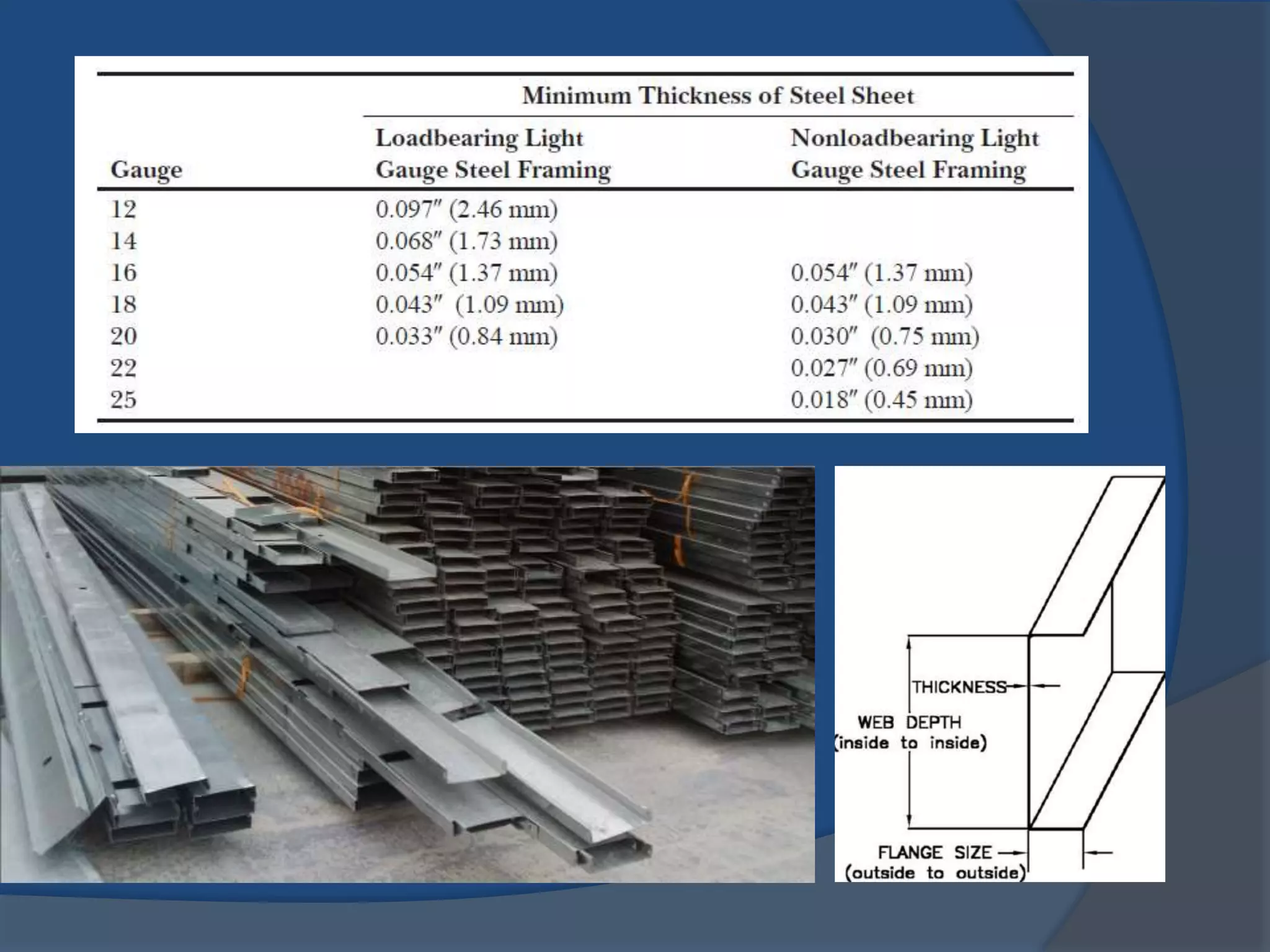
 Due to being light it is called light gauge steel (LGS)
 Is developed through a cold form process so it is also
called cold formed steel.
 Light weight but high tensile steel sheets
 The members steel is manufactured to ASTM
standards.
 And they are metal coated with zinc or al. -Zinc
 Very thin plate elements compared to their widths.
Ratio of width to thickness is important.
 The general thickness is ranging from 0.4mm to 2.40
mm. In some cases more..
Light Gauge Steel Concept
Meaning of LGS
Manufacturing process
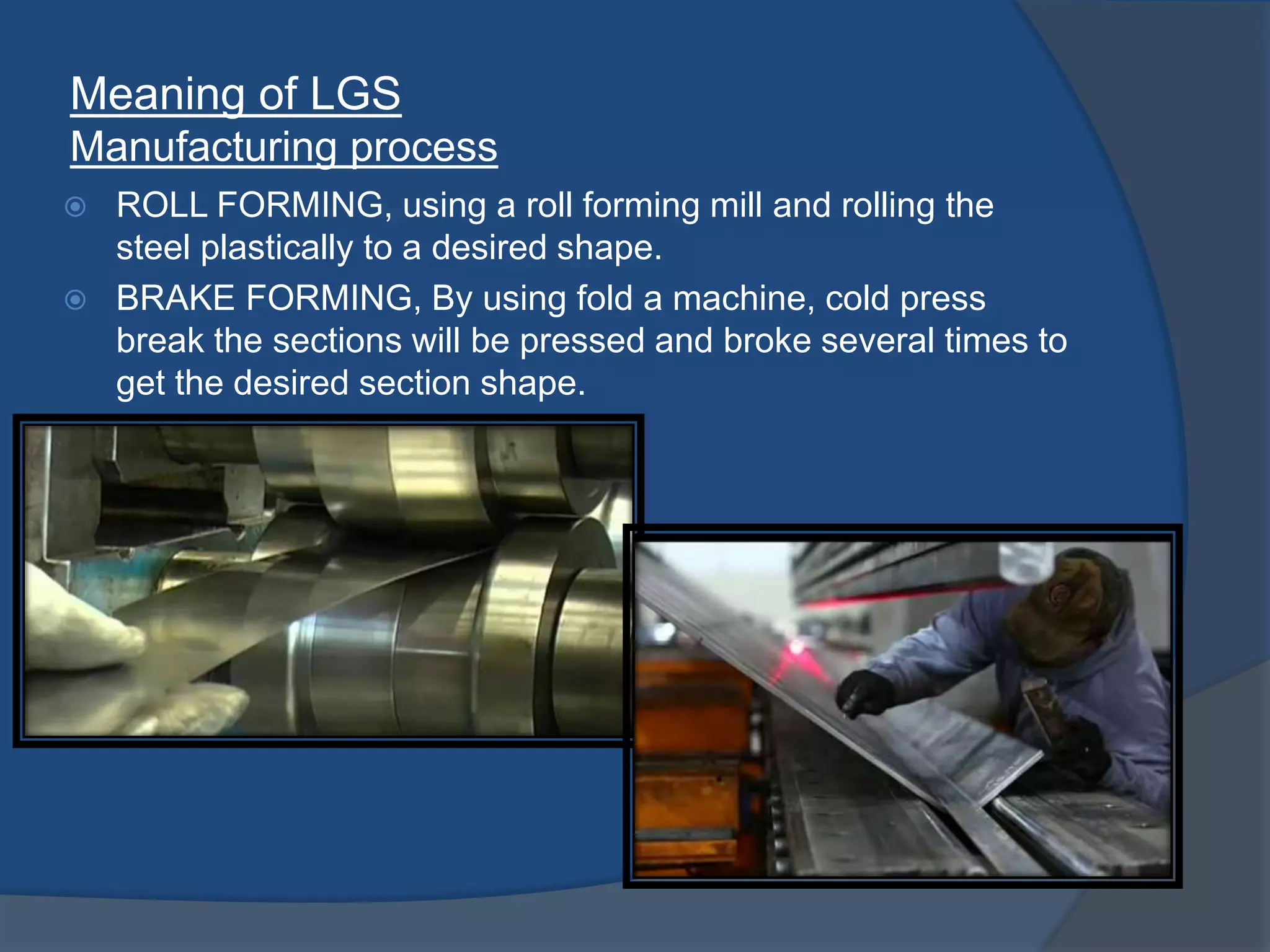
 ROLL FORMING, using a roll forming mill and rolling the
steel plastically to a desired shape.
 BRAKE FORMING, By using fold a machine, cold press
break the sections will be pressed and broke several times to
get the desired section shape.
Meaning of LGS
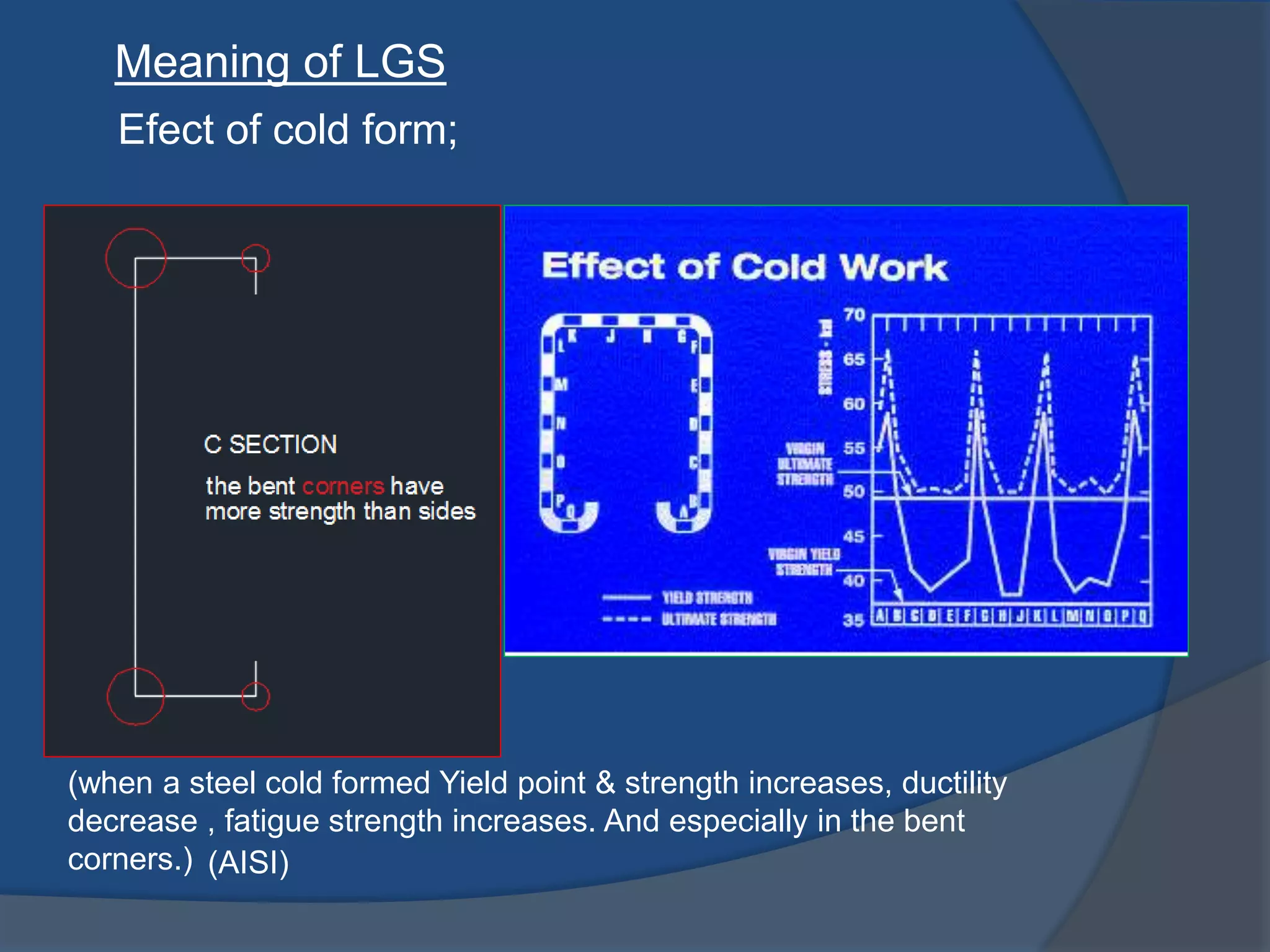
Efect of cold form;
(when a steel cold formed Yield point & strength increases, ductility
decrease , fatigue strength increases. And especially in the bent
corners.) (AISI)
 Thickness section is relatively small in comparison to its
width unlike in HR members. In that case in lgs frames
local buckling is the issue.
 Different behavior and different modes of failure.
 Properties are altered by the process of forming.
Depending on forming type, thickness and properties of
the steel.
 Fastening methods. Mostly used screws and bolts. In hot
rolled weld and bolts.
 Easier to construct.
 Designing the LGS structure is more complex than HR
structures due to its member section thinness and
unusual section types.
Meaning of LGS
In comparing with hot rolled steel (HR)
LGS WALLS JOISTS AND HR MEMBERS
LGS TRUSS HR COLUMN
 Section slenderness  buckling
 Since the width of the section is so thin in comparing to
its flat thickness, the local buckling may occur before
the section yielding.
 In addition, shear buckling and web crippling is also
considered in the design
 When the local buckling occurs, it is not necessary for
the element to reach its load capacity.
 If such element is stiffened by other elements on its
edges, it still processes great strength called post
buckling strength.
 There is in AISI a limitation for flat-width to thickness
ratio.
Meaning of LGS
Structural Behavior of LGS and section problems
Cold-formed steel sections used for
structural framing. (From Yu, W.W. 1991.
Cold- Formed Steel Design, John Wiley
& Sons, New York. With permission.
(AISI)
Common section types used for Hot
rolled steel members
 Due to the high width to thickness ratio, the member tends to
buckling elastically under even low compression loads. So
we use stiffened edge plate. Or for example, some different
sections we use lips. And that remains stable and it is still
effective in resisting more loads.(STIFFINING IN
SECTION=LIPS)
U SECTION C SECTION
Meaning of LGS
Structural Behavior of LGS and section problems
LGS Concept
Uses of LGS frames (benefits and disadvantages)
 Buildability; less waste material and improved quality.
 Short construction period; high speed builds.
 Strong and lightweight; highest strength to weight ratio.
 Safety; can be designed for highest wind and seismic loads.
 Durable and require less maintenance
 Easy to remove and reuse the material.
 Flexible design; we can have longer span distances
 Recyclable…
In case of fire the steel will lose its strength and huge collapse
will occur due to high heat. Not like in wood frames which
have the case of burning.
LGS Concept
General terms used in LGS framing
1- cold form & galvanized steel->corrosion resistance,
light weight high strength sheet metals;
2-bottom plate; which is at the end of wall stud. The upper
plate may not have lips and this is U profile.
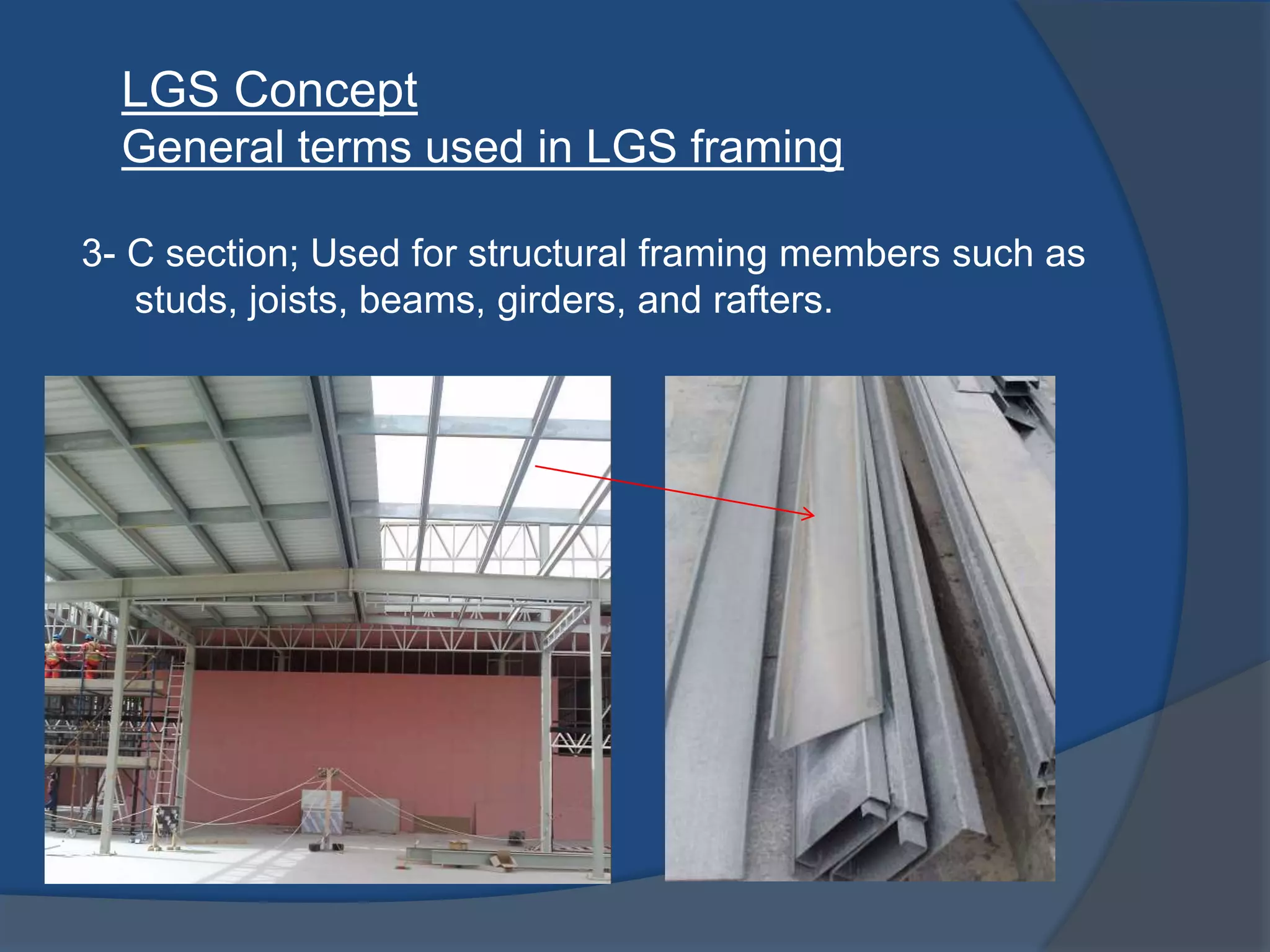
3- C section; Used for structural framing members such as
studs, joists, beams, girders, and rafters.
LGS Concept
General terms used in LGS framing
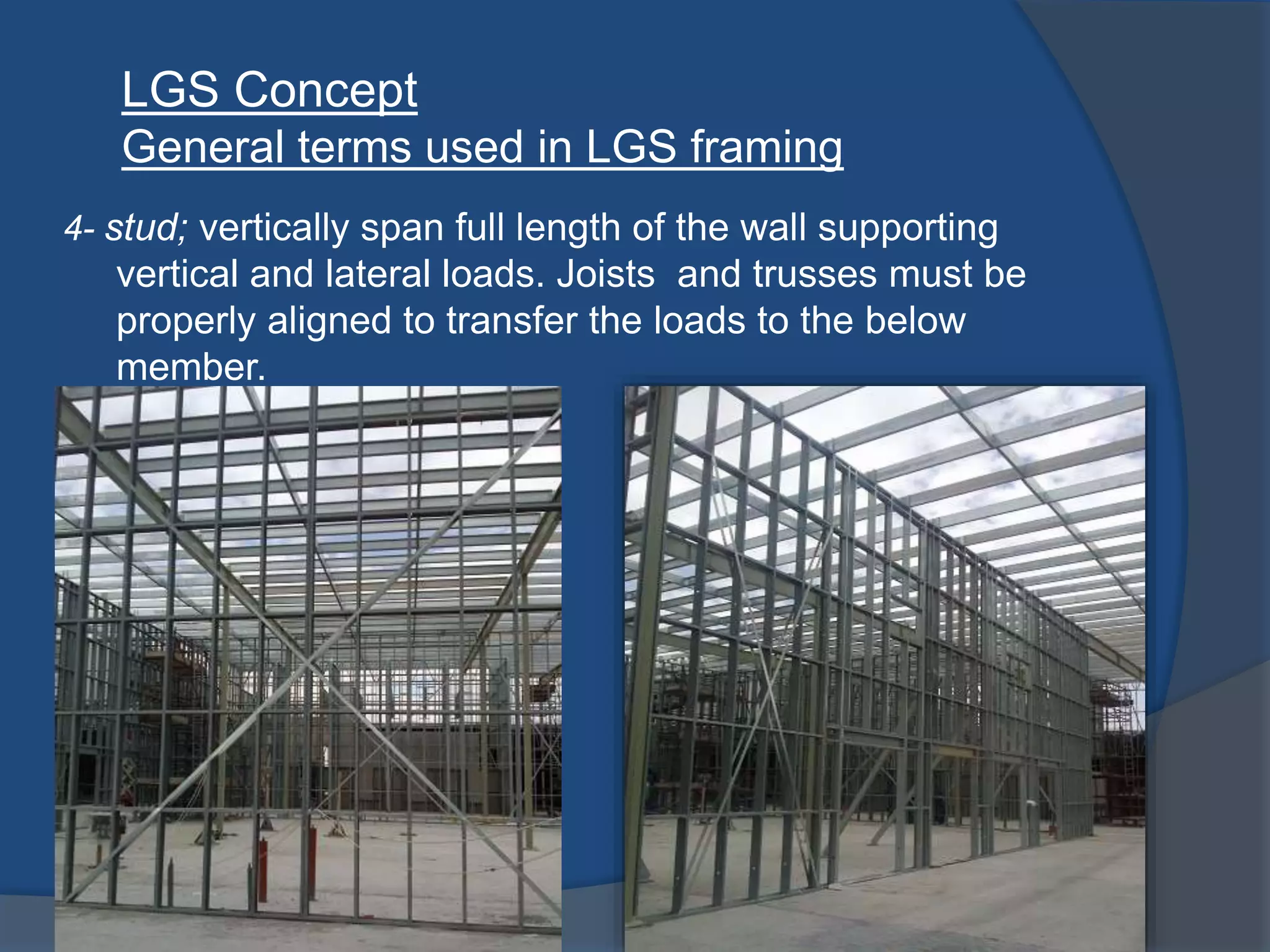
4- stud; vertically span full length of the wall supporting
vertical and lateral loads. Joists and trusses must be
properly aligned to transfer the loads to the below
member.
LGS Concept
General terms used in LGS framing
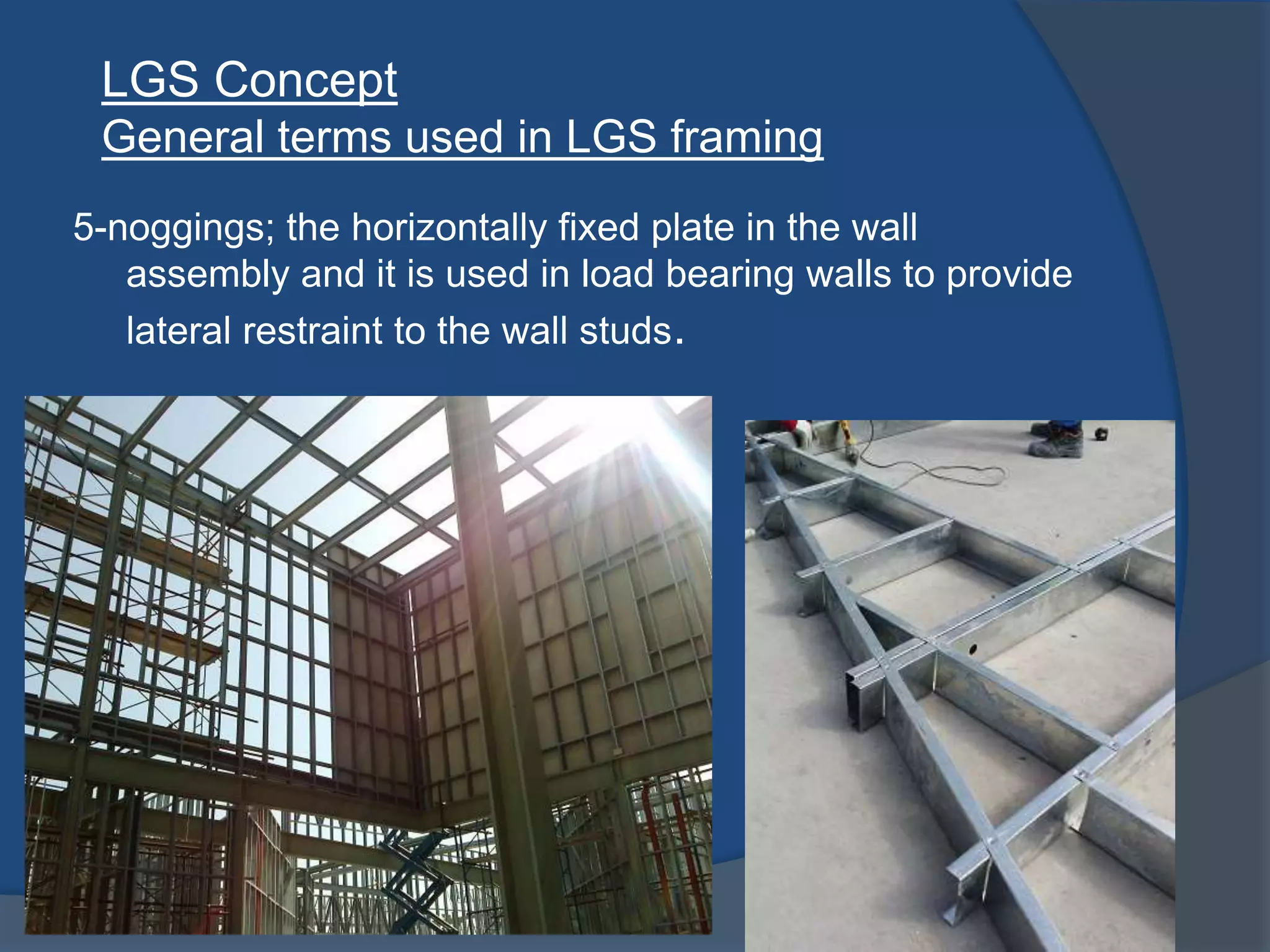
5-noggings; the horizontally fixed plate in the wall
assembly and it is used in load bearing walls to provide
lateral restraint to the wall studs.
LGS Concept
General terms used in LGS framing
6-floor joists; a horizontal member is designed to support
roof and roof service loads including wind and rain
dead loads. Depending on the design it can be single
or double joists (back to back)
LGS Concept
General terms used in LGS framing
Stiffener (against crippling)
U profile
Angle
7-blockings; are needed in designing distances between
taller joists in order to prevent any twisting problem in
the joists.
blocking
LGS Concept
General terms used in LGS framing
8- anchor bolt; because of uplift and shear forces when
attaching to the foundation we need to fix the walls
and the columns to the foundation.
LGS Concept
General terms used in LGS framing
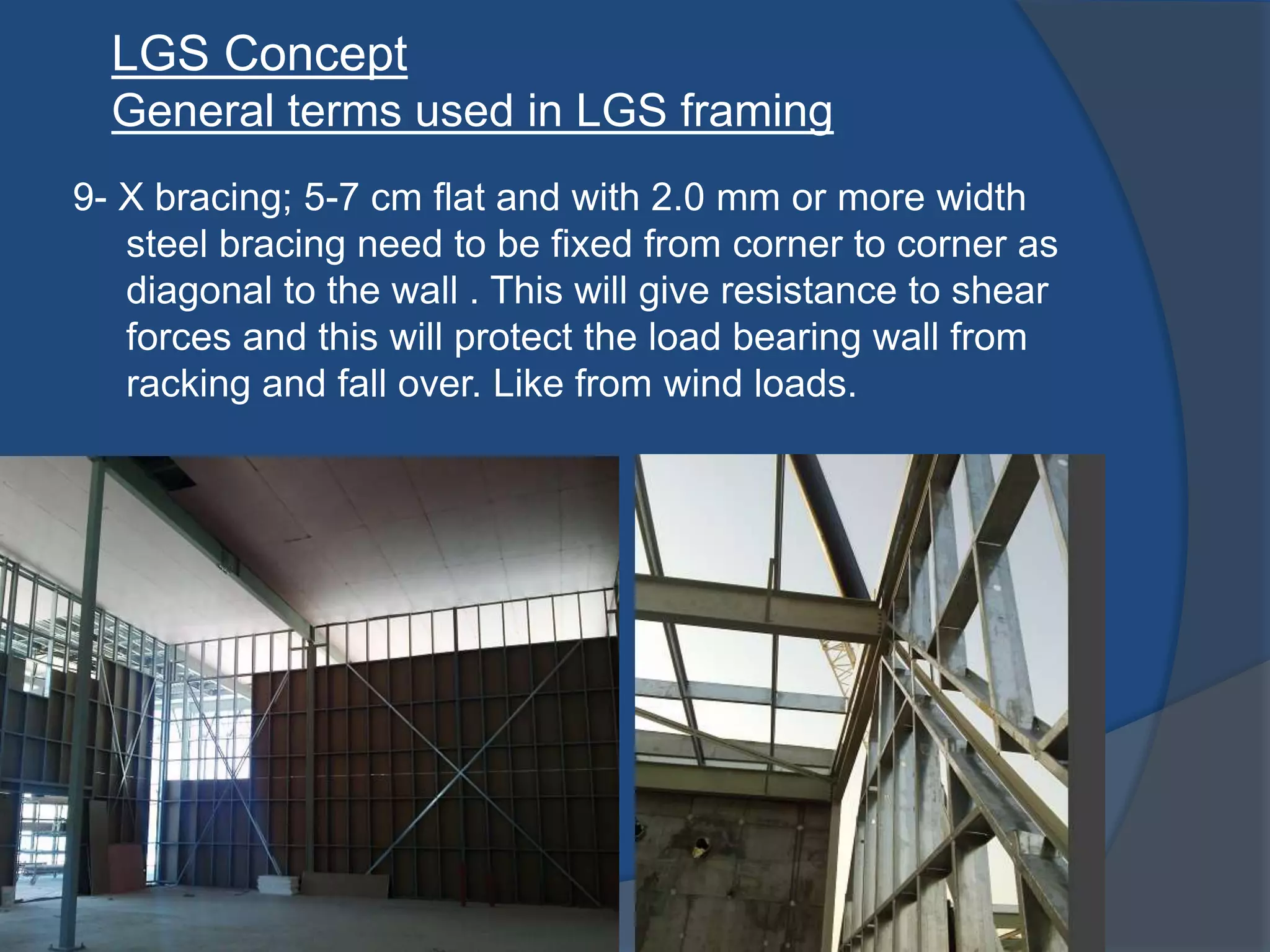
9- X bracing; 5-7 cm flat and with 2.0 mm or more width
steel bracing need to be fixed from corner to corner as
diagonal to the wall . This will give resistance to shear
forces and this will protect the load bearing wall from
racking and fall over. Like from wind loads.
LGS Concept
General terms used in LGS framing
LGS Concept
LGS framing with design principles
Our design consideration for LGS frames;
Strength combining with lightness
 (greater strength & thinner cross section)
Accuracy and design efficiency is important
Maintenance is ensured
Service condition.
General approach to design;
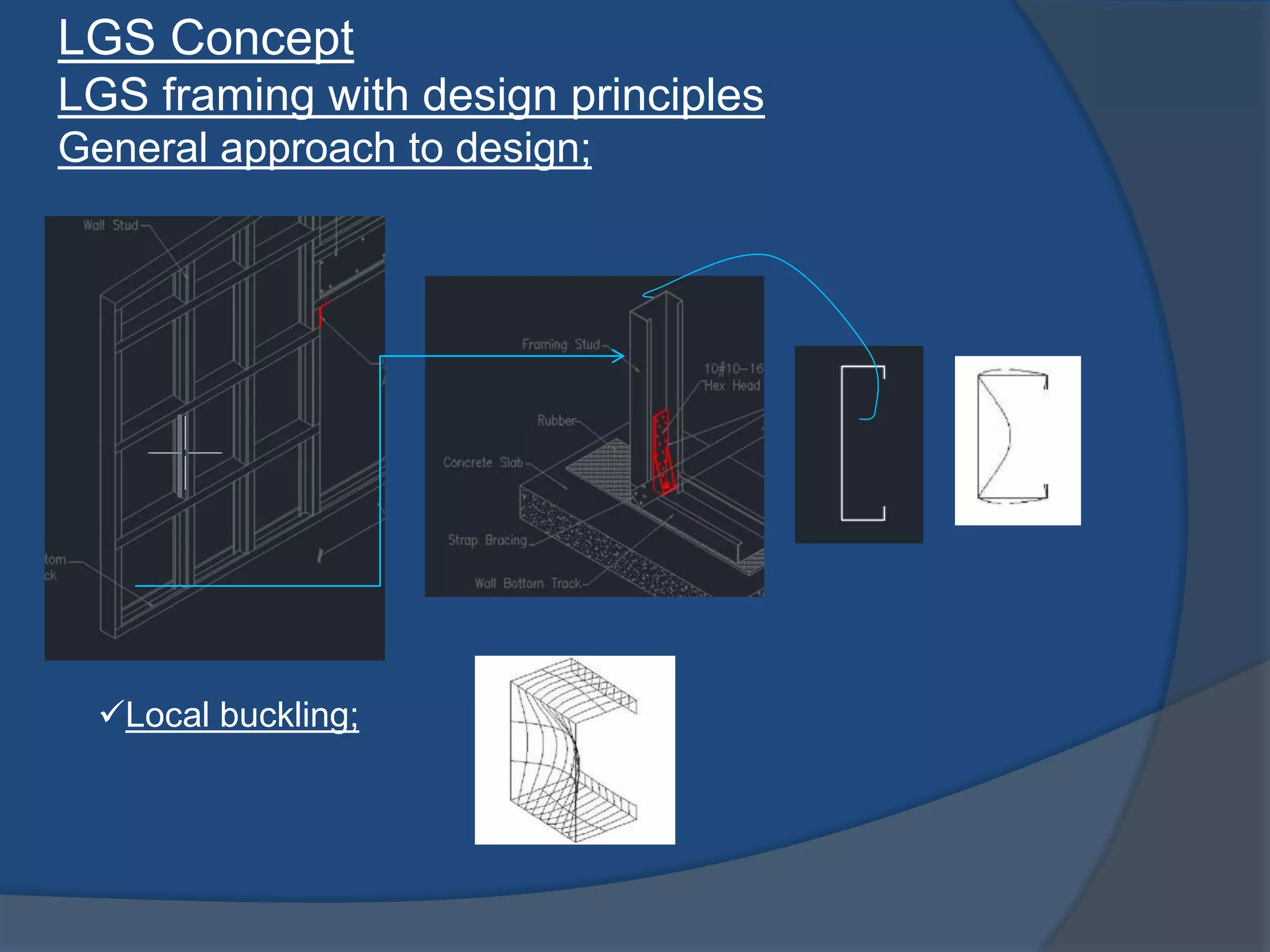
Local buckling
Post buckling
Distortional buckling (members under flexural loads)
Crippling
LGS Concept
LGS framing with design principles
General approach to design;
Local buckling and post buckling strength;
Because of the very small thickness of the member
comparing to their width, the member will show local
buckling elastically before the section yield. But if the
member will stiffened by other element, it still will resist to
more loads and will show more strength called post
buckling strength.
 Distortional buckling;
Since the small thickness the element also have low
torsional stiffness. Due to eccentricity coming from loads, the
beam will twist. And the beam will go under lateral or torsional
flexural buckling.
LGS Concept
LGS framing with design principles
General approach to design;
Local buckling;
Torsional deformation C web joists, shear load eccentrially.
(Cold Formed Steel Structures to AISI specifications, Gregory J Hancock).
Torsional deformation, Axially loaded column
(Cold Formed Steel Structures to AISI specifications, Gregory J Hancock).
LGS Concept
LGS framing with design principles
General approach to design;
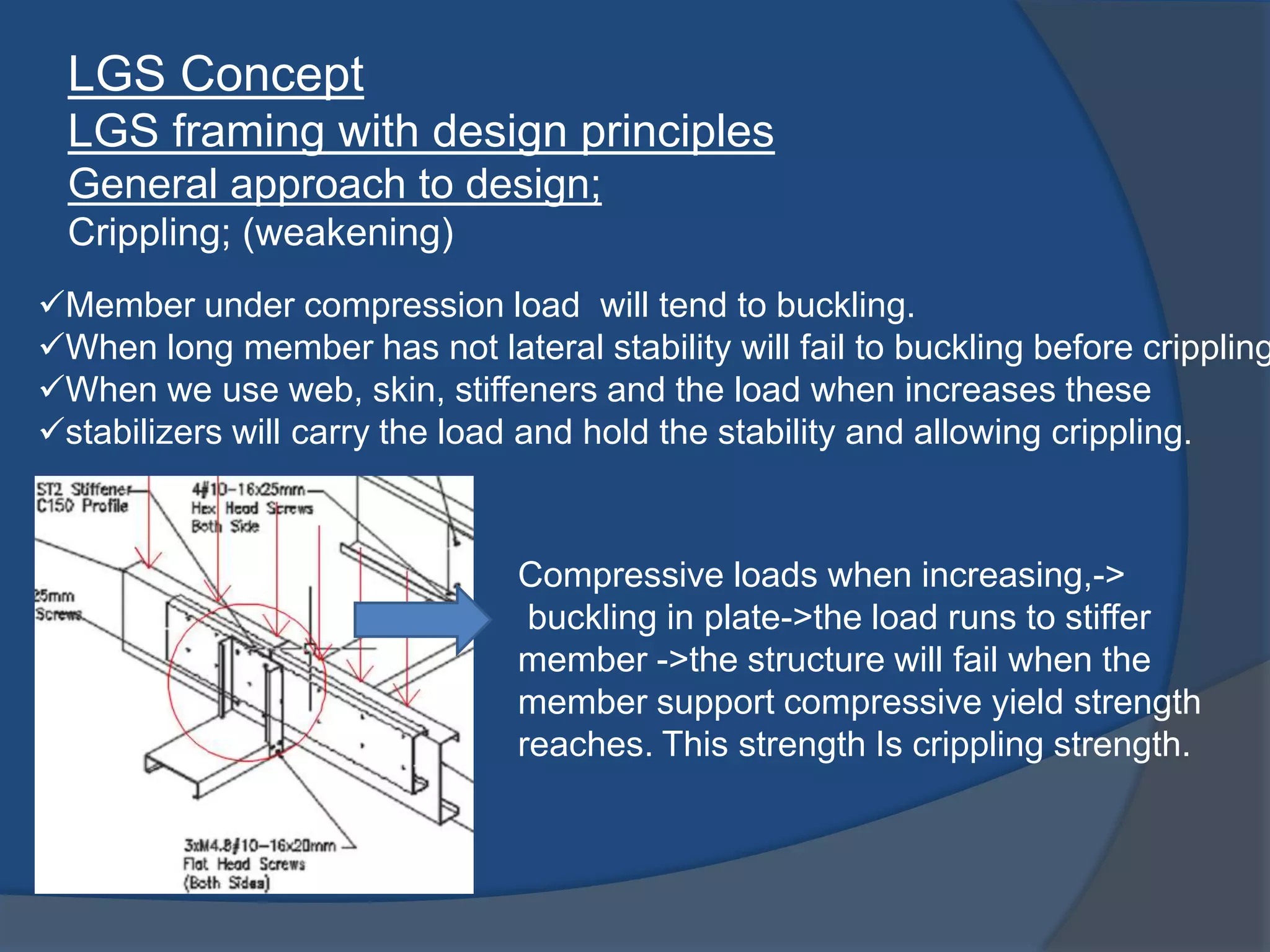
Crippling; (weakening)
Member under compression load will tend to buckling.
When long member has not lateral stability will fail to buckling before crippling
When we use web, skin, stiffeners and the load when increases these
stabilizers will carry the load and hold the stability and allowing crippling.
Compressive loads when increasing,->
buckling in plate->the load runs to stiffer
member ->the structure will fail when the
member support compressive yield strength
reaches. This strength Is crippling strength.
LGS Concept
LGS framing with design principles
General approach to design;
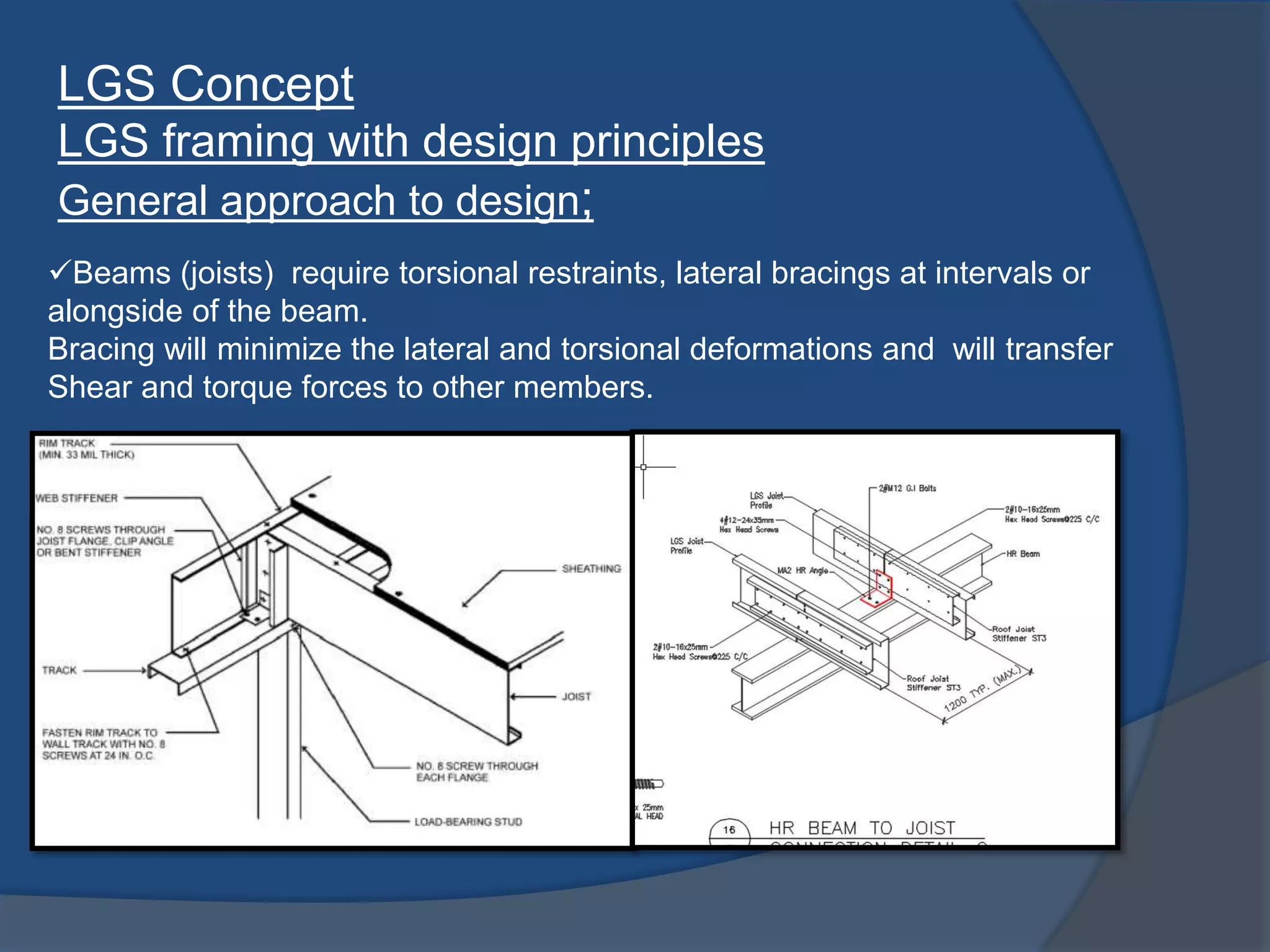
Beams (joists) require torsional restraints, lateral bracings at intervals or
alongside of the beam.
Bracing will minimize the lateral and torsional deformations and will transfer
Shear and torque forces to other members.
Design guides;
 AISI (It is mainly based on the current AISI combined
specification and load and resistance factor design
(LRFD).
LRFD  Required strength(load factor x loads)<=
design strength (resistance factor x nominal strength,)
 North American specifications.
 Eurocode 3 EN steel structures design; based design
criteria is for allowable stress design (ASD)
ASD Allowable design strentgh= nominal str./ safety
factor
LGS Concept
LGS framing with design principles
Design, manufacture and build principle;
 Designs for our CSI LGS system are carried-out using the
FrameCad ProDesign software package. The software
executes full structural analysis of a particular structure and
then displays the full structural report of panel loads and their
corresponding reactions to the load, hold-down or confined
locations and capacities, deflections and uplift loads.
 From the design stage, information provided by the design
software will then be loaded to the Roll Forming machines
wherein thin steel sheets will be cold rolled into profiles and
sections.
 These profiles will then be assembled for the actual design
and construction of the analyzed structure like mid rise
buildings, residential villas, labour camps and other
equivalent structures.
LGS Concept
LGS framing with design principles
The roof loads, wind loads, wall loads and floor loads will be transferred
all the way down to the foundation.
A steel framed structure would normally be built on a reinforced concrete
ground floor slab or raft foundation.
The ground floor wall panels would then be fastened and held down to the
ground floor slab.
The 1st floor bearers would then sit on top of the load bearing walls. These
bearers would connect and carry the floor joists. The floor joists would in turn carry
the floor boards and wall panels above. For roof deck, roof joists would then sit on
the wall panels to carry the roof system and other roof loads.
The sizes and spacing of the structural members would depend on the design
loads. Connections for steel framing can consist of self-drilling screws, bolts and
anchors. Welding is usually not required and mechanical fasteners would suffice
in most cases.
LGS Concept
LGS framing with design principles
Design, manufacture and build principle
Construction method for LGS steel frame
system;
wall erection,
 According to each per assembly drawing the LGS
members must be assembled by using screws in the
jobsite upon the material come to site.
 According to erection drawing the wall locations will be
surveyed and marked on the surface of the concrete
foundation properly.
 The 75 mm wide rubber stops must laid along the wall
line.
 Erection of the panels consist alignment, nailing and
anchoring the wall to the foundation.
 Recheck all the corners alignment
 Than the load bearing walls will be braced . This can
be after erection of the roof joists.
 Inspection will be carried out.
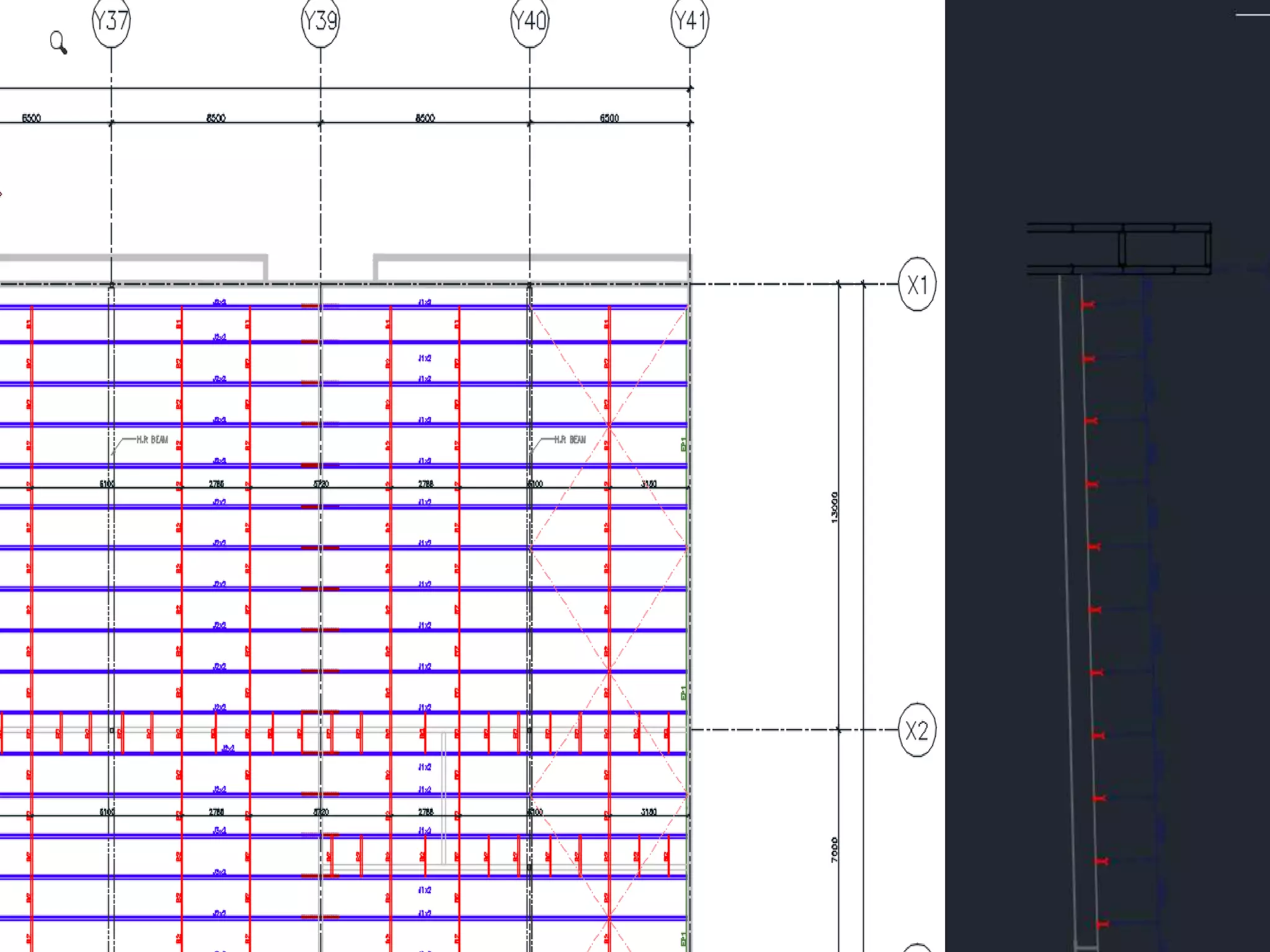
Floor plan
LGS WALLS HR BEAM
 Webs placed perpendicular to the wall surface.
 If there is fiber board, plywood or gypsum board
cladding on walls, this material will give lateral support
to the studs.
 According to the AISI specification the stud design
requires two concepts,
 The wall stud will be considered as a compression
member
 Sheating braced design, X bracing ( due to shear
rigidity and rotational restraint provided by sheating.)
Construction method for LGS steel frame
system;
wall erection,
Wall stud assembly and design criteria;
X bracing
Construction method for LGS steel frame system;
Assembly and Erection of Floor and Roof Deck,
 Joist track members are installed on top of walls as per
detail provided in the approved drawing.
 Joists are installed in the specified distance with
conduit holes positioned in one line.
 Blocking members are installed as per detail provided
in the approved drawing.
 Inspections are carried-out for all the members and
connection detail.
 On top of the joist, metal decking are laid and fixed to
the joist using screws.
 Same procedure will be repeated to the first and
second floor wherein panels will be fabricated below
and lifted up to the each floor using forklift or any
equivalent lifting equipment.
 EMP works will be conducted. And reqired service
holes will be drilled on the studs or nogings. This kind
of holes will be designed in the beginning in the
modeling according to the EMP given locations.
 Insulations will be installed according to given
drawings.
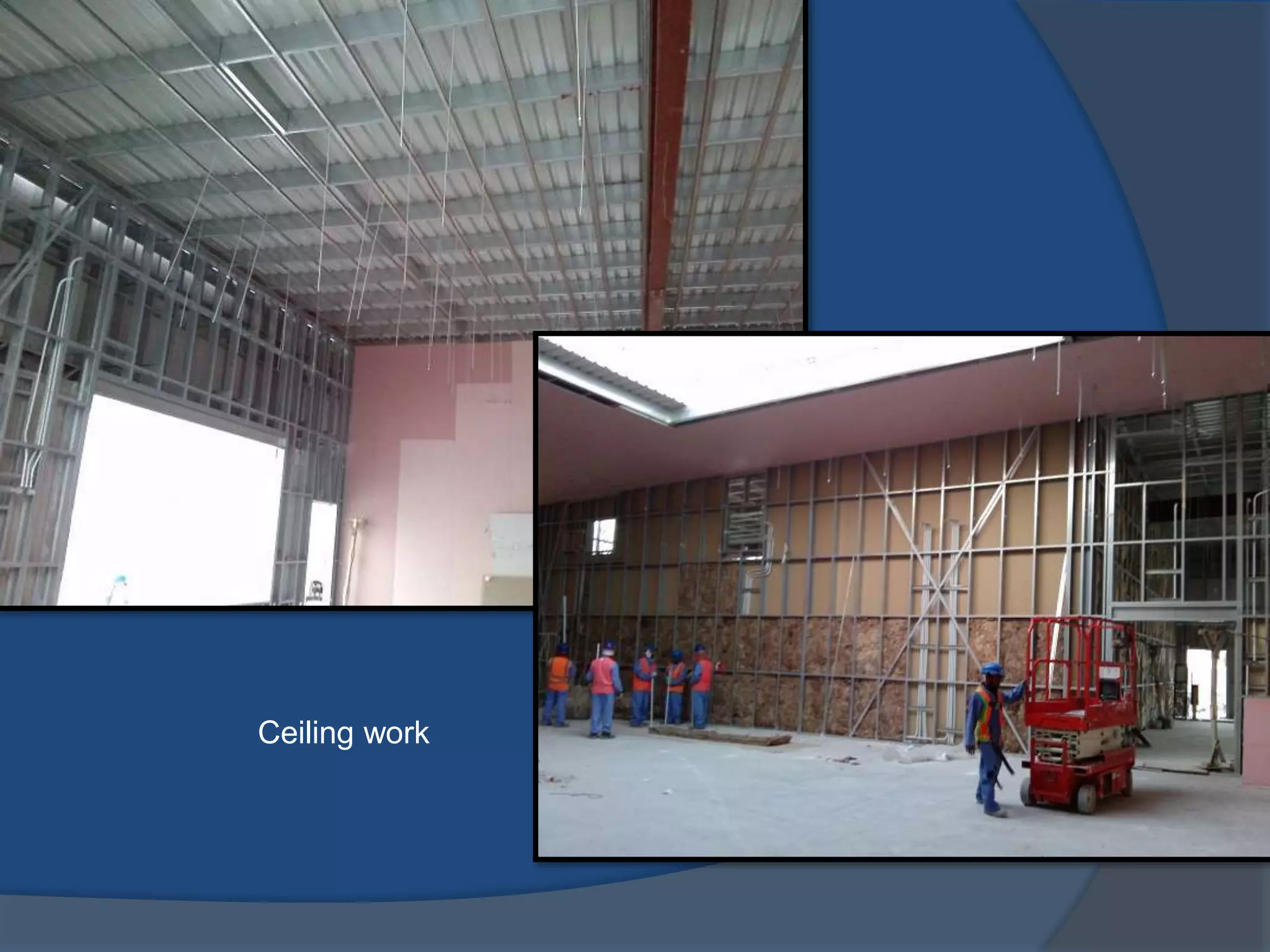
 Wall cladding and ceiling works will be done. LGS wall
panels and ceiling can be easily covered with either
fiber cement boards or gypsum boards by using self-
drilling screws.
Construction method for LGS steel frame
system;
Finishing of the work ;
Ceiling work
Insulation
Gypsum board cladding
Cladding the roof
Cladding and ceiling service works
External fiber cement board
cladding
Finishing plasterwork
REFERENCES;
1-http://structuregeek.blogspot.com.tr/2010/02/crippling failure.html
2-CSI (Comodore Steel Industry, UAE) company construction
method notes.
3-AISI, North American Specifications and Eurocode 3 En for LGS.
4- The-Behaviour-and-Design-of-Steel-Structures-to EC3-2008, N S
Thrahir, M A Bradford..
5- Wei-Wen Yu,CFS Design,4th_Edition(2010)
6-Cold-Formed Steel Structures to the AISI Specification –Gregory J.
Hancock, Thomas M Murray.
Thank you

LGS

  • 1.
    CE 718 GRADUATESEMINER LIGHT GAUGE STEEL (LGS) CONCEPT AND CONSTRUCTION METHODS By Ali Cabiroğlu University of Gaziantep May, 2015
  • 3.
    CONTENTS  Light gaugesteel Concept Meaning of LGS  Manufacturing process  In comparing with hot rolled steel  Structural Behavior of LGS and section problems Uses of LGS frames Some terms in LGS frame construction LGS framing with design principles  Light gauge steel construction method Wall system and erection Roof system and erection Finishing work in LGS construction.
  • 4.
    Meaning of LGS Due to being light it is called light gauge steel (LGS)  Is developed through a cold form process so it is also called cold formed steel.  Light weight but high tensile steel sheets  The members steel is manufactured to ASTM standards.  And they are metal coated with zinc or al. -Zinc  Very thin plate elements compared to their widths. Ratio of width to thickness is important.  The general thickness is ranging from 0.4mm to 2.40 mm. In some cases more.. Light Gauge Steel Concept
  • 6.
    Meaning of LGS Manufacturingprocess  ROLL FORMING, using a roll forming mill and rolling the steel plastically to a desired shape.  BRAKE FORMING, By using fold a machine, cold press break the sections will be pressed and broke several times to get the desired section shape.
  • 7.
    Meaning of LGS Efectof cold form; (when a steel cold formed Yield point & strength increases, ductility decrease , fatigue strength increases. And especially in the bent corners.) (AISI)
  • 8.
     Thickness sectionis relatively small in comparison to its width unlike in HR members. In that case in lgs frames local buckling is the issue.  Different behavior and different modes of failure.  Properties are altered by the process of forming. Depending on forming type, thickness and properties of the steel.  Fastening methods. Mostly used screws and bolts. In hot rolled weld and bolts.  Easier to construct.  Designing the LGS structure is more complex than HR structures due to its member section thinness and unusual section types. Meaning of LGS In comparing with hot rolled steel (HR)
  • 9.
    LGS WALLS JOISTSAND HR MEMBERS LGS TRUSS HR COLUMN
  • 10.
     Section slenderness buckling  Since the width of the section is so thin in comparing to its flat thickness, the local buckling may occur before the section yielding.  In addition, shear buckling and web crippling is also considered in the design  When the local buckling occurs, it is not necessary for the element to reach its load capacity.  If such element is stiffened by other elements on its edges, it still processes great strength called post buckling strength.  There is in AISI a limitation for flat-width to thickness ratio. Meaning of LGS Structural Behavior of LGS and section problems
  • 11.
    Cold-formed steel sectionsused for structural framing. (From Yu, W.W. 1991. Cold- Formed Steel Design, John Wiley & Sons, New York. With permission. (AISI) Common section types used for Hot rolled steel members
  • 12.
     Due tothe high width to thickness ratio, the member tends to buckling elastically under even low compression loads. So we use stiffened edge plate. Or for example, some different sections we use lips. And that remains stable and it is still effective in resisting more loads.(STIFFINING IN SECTION=LIPS) U SECTION C SECTION Meaning of LGS Structural Behavior of LGS and section problems
  • 13.
    LGS Concept Uses ofLGS frames (benefits and disadvantages)  Buildability; less waste material and improved quality.  Short construction period; high speed builds.  Strong and lightweight; highest strength to weight ratio.  Safety; can be designed for highest wind and seismic loads.  Durable and require less maintenance  Easy to remove and reuse the material.  Flexible design; we can have longer span distances  Recyclable… In case of fire the steel will lose its strength and huge collapse will occur due to high heat. Not like in wood frames which have the case of burning.
  • 14.
    LGS Concept General termsused in LGS framing 1- cold form & galvanized steel->corrosion resistance, light weight high strength sheet metals; 2-bottom plate; which is at the end of wall stud. The upper plate may not have lips and this is U profile.
  • 15.
    3- C section;Used for structural framing members such as studs, joists, beams, girders, and rafters. LGS Concept General terms used in LGS framing
  • 16.
    4- stud; verticallyspan full length of the wall supporting vertical and lateral loads. Joists and trusses must be properly aligned to transfer the loads to the below member. LGS Concept General terms used in LGS framing
  • 18.
    5-noggings; the horizontallyfixed plate in the wall assembly and it is used in load bearing walls to provide lateral restraint to the wall studs. LGS Concept General terms used in LGS framing
  • 19.
    6-floor joists; ahorizontal member is designed to support roof and roof service loads including wind and rain dead loads. Depending on the design it can be single or double joists (back to back) LGS Concept General terms used in LGS framing
  • 21.
  • 23.
    7-blockings; are neededin designing distances between taller joists in order to prevent any twisting problem in the joists. blocking LGS Concept General terms used in LGS framing
  • 25.
    8- anchor bolt;because of uplift and shear forces when attaching to the foundation we need to fix the walls and the columns to the foundation. LGS Concept General terms used in LGS framing
  • 26.
    9- X bracing;5-7 cm flat and with 2.0 mm or more width steel bracing need to be fixed from corner to corner as diagonal to the wall . This will give resistance to shear forces and this will protect the load bearing wall from racking and fall over. Like from wind loads. LGS Concept General terms used in LGS framing
  • 27.
    LGS Concept LGS framingwith design principles Our design consideration for LGS frames; Strength combining with lightness  (greater strength & thinner cross section) Accuracy and design efficiency is important Maintenance is ensured Service condition. General approach to design; Local buckling Post buckling Distortional buckling (members under flexural loads) Crippling
  • 28.
    LGS Concept LGS framingwith design principles General approach to design; Local buckling and post buckling strength; Because of the very small thickness of the member comparing to their width, the member will show local buckling elastically before the section yield. But if the member will stiffened by other element, it still will resist to more loads and will show more strength called post buckling strength.  Distortional buckling; Since the small thickness the element also have low torsional stiffness. Due to eccentricity coming from loads, the beam will twist. And the beam will go under lateral or torsional flexural buckling.
  • 29.
    LGS Concept LGS framingwith design principles General approach to design; Local buckling;
  • 30.
    Torsional deformation Cweb joists, shear load eccentrially. (Cold Formed Steel Structures to AISI specifications, Gregory J Hancock). Torsional deformation, Axially loaded column (Cold Formed Steel Structures to AISI specifications, Gregory J Hancock).
  • 31.
    LGS Concept LGS framingwith design principles General approach to design; Crippling; (weakening) Member under compression load will tend to buckling. When long member has not lateral stability will fail to buckling before crippling When we use web, skin, stiffeners and the load when increases these stabilizers will carry the load and hold the stability and allowing crippling. Compressive loads when increasing,-> buckling in plate->the load runs to stiffer member ->the structure will fail when the member support compressive yield strength reaches. This strength Is crippling strength.
  • 32.
    LGS Concept LGS framingwith design principles General approach to design; Beams (joists) require torsional restraints, lateral bracings at intervals or alongside of the beam. Bracing will minimize the lateral and torsional deformations and will transfer Shear and torque forces to other members.
  • 33.
    Design guides;  AISI(It is mainly based on the current AISI combined specification and load and resistance factor design (LRFD). LRFD  Required strength(load factor x loads)<= design strength (resistance factor x nominal strength,)  North American specifications.  Eurocode 3 EN steel structures design; based design criteria is for allowable stress design (ASD) ASD Allowable design strentgh= nominal str./ safety factor LGS Concept LGS framing with design principles
  • 34.
    Design, manufacture andbuild principle;  Designs for our CSI LGS system are carried-out using the FrameCad ProDesign software package. The software executes full structural analysis of a particular structure and then displays the full structural report of panel loads and their corresponding reactions to the load, hold-down or confined locations and capacities, deflections and uplift loads.  From the design stage, information provided by the design software will then be loaded to the Roll Forming machines wherein thin steel sheets will be cold rolled into profiles and sections.  These profiles will then be assembled for the actual design and construction of the analyzed structure like mid rise buildings, residential villas, labour camps and other equivalent structures. LGS Concept LGS framing with design principles
  • 35.
    The roof loads,wind loads, wall loads and floor loads will be transferred all the way down to the foundation. A steel framed structure would normally be built on a reinforced concrete ground floor slab or raft foundation. The ground floor wall panels would then be fastened and held down to the ground floor slab. The 1st floor bearers would then sit on top of the load bearing walls. These bearers would connect and carry the floor joists. The floor joists would in turn carry the floor boards and wall panels above. For roof deck, roof joists would then sit on the wall panels to carry the roof system and other roof loads. The sizes and spacing of the structural members would depend on the design loads. Connections for steel framing can consist of self-drilling screws, bolts and anchors. Welding is usually not required and mechanical fasteners would suffice in most cases. LGS Concept LGS framing with design principles Design, manufacture and build principle
  • 36.
    Construction method forLGS steel frame system; wall erection,  According to each per assembly drawing the LGS members must be assembled by using screws in the jobsite upon the material come to site.  According to erection drawing the wall locations will be surveyed and marked on the surface of the concrete foundation properly.  The 75 mm wide rubber stops must laid along the wall line.  Erection of the panels consist alignment, nailing and anchoring the wall to the foundation.  Recheck all the corners alignment  Than the load bearing walls will be braced . This can be after erection of the roof joists.  Inspection will be carried out.
  • 37.
  • 38.
     Webs placedperpendicular to the wall surface.  If there is fiber board, plywood or gypsum board cladding on walls, this material will give lateral support to the studs.  According to the AISI specification the stud design requires two concepts,  The wall stud will be considered as a compression member  Sheating braced design, X bracing ( due to shear rigidity and rotational restraint provided by sheating.) Construction method for LGS steel frame system; wall erection, Wall stud assembly and design criteria;
  • 39.
  • 41.
    Construction method forLGS steel frame system; Assembly and Erection of Floor and Roof Deck,  Joist track members are installed on top of walls as per detail provided in the approved drawing.  Joists are installed in the specified distance with conduit holes positioned in one line.  Blocking members are installed as per detail provided in the approved drawing.  Inspections are carried-out for all the members and connection detail.  On top of the joist, metal decking are laid and fixed to the joist using screws.  Same procedure will be repeated to the first and second floor wherein panels will be fabricated below and lifted up to the each floor using forklift or any equivalent lifting equipment.
  • 42.
     EMP workswill be conducted. And reqired service holes will be drilled on the studs or nogings. This kind of holes will be designed in the beginning in the modeling according to the EMP given locations.  Insulations will be installed according to given drawings.  Wall cladding and ceiling works will be done. LGS wall panels and ceiling can be easily covered with either fiber cement boards or gypsum boards by using self- drilling screws. Construction method for LGS steel frame system; Finishing of the work ;
  • 43.
  • 44.
    Insulation Gypsum board cladding Claddingthe roof Cladding and ceiling service works
  • 45.
    External fiber cementboard cladding Finishing plasterwork
  • 46.
    REFERENCES; 1-http://structuregeek.blogspot.com.tr/2010/02/crippling failure.html 2-CSI (ComodoreSteel Industry, UAE) company construction method notes. 3-AISI, North American Specifications and Eurocode 3 En for LGS. 4- The-Behaviour-and-Design-of-Steel-Structures-to EC3-2008, N S Thrahir, M A Bradford.. 5- Wei-Wen Yu,CFS Design,4th_Edition(2010) 6-Cold-Formed Steel Structures to the AISI Specification –Gregory J. Hancock, Thomas M Murray.
  • 47.

Editor's Notes

  • #3 Light Gauge Steel (LGS) is a term commonly used to refer to steel members with thicknesses Ranging from 0.40 to 2.00mm that are produced by roll forming machines. These members May be wall studs, floor joists, and roof rafters, bridging channels, furring channels or related Accessories. Also included would be the non load bearing (drywall) studs, which have a steel Thickness ranging from 0.46 to 0.90mm.