Multilayerity Within Multilayerity?
Assortative Mixing of
Multiple Partitions in
Mulilayer Networks
Moses A. Boudourides1 & Sergios T. Lenis2
Department of Mathematics
University of Patras, Greece
1Moses.Boudourides@gmail.com
2sergioslenis@gmail.com
8 June 2015
Examples and Python code:
http://mboudour.github.io/2015/06/09/Multilayerity-Within-Multilayerity%3F.html
M.A. Boudourides & S.T. Lenis Assortative Mixing of Multiple Partitions in Mulilayer Networks
Graph Partitions
Let
G = (V , E)
be a (simple undirected) graph with (finite) set of vectors V
and (finite) set of edges E.
The terms “graph” and “(social) network” are used here interchangeably.
If S1, S2, . . . , Ss ⊂ V (for a positive integer s) are s nonempty
(sub)sets of vertices of G, the (finite) family of subsets
S = S(G) = {S1, S2, . . . , Ss},
forms a partition (or s–partition) in G, when, for all
i, j = 1, 2, · · · , s, i = j,
Si ∩ Sj = ∅ and
V =
s
i=1
Si .
S1, S2, . . . , Ss are called groups (of vertices) of partition S.
M.A. Boudourides & S.T. Lenis Assortative Mixing of Multiple Partitions in Mulilayer Networks
For every graph, there exists (at least one) partition of its
vertices.
Two trivial graph partitions are:
the |V |–partition into singletons of vertices and
Spoint = Spoint(G) = {{v}: v ∈ V },
the 1–partition into the whole vertex set
Stotal = Stotal(G) = {V }.
If G is a bipartite graph with (vertex) parts U and V , the
bipartition of G is denoted as:
Sbipartition = Sbipartition(G) = {U, V }.
M.A. Boudourides & S.T. Lenis Assortative Mixing of Multiple Partitions in Mulilayer Networks
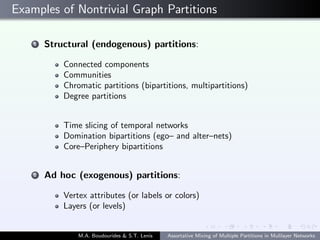
Examples of Nontrivial Graph Partitions
1 Structural (endogenous) partitions:
Connected components
Communities
Chromatic partitions (bipartitions, multipartitions)
Degree partitions
Time slicing of temporal networks
Domination bipartitions (ego– and alter–nets)
Core–Periphery bipartitions
2 Ad hoc (exogenous) partitions:
Vertex attributes (or labels or colors)
Layers (or levels)
M.A. Boudourides & S.T. Lenis Assortative Mixing of Multiple Partitions in Mulilayer Networks
Multilayer Partitions and Multilayer Graphs
A multilayer partition of a graph G is a partition
L = L(G) = {L1, L2, . . . , L }
into ≥ 2 groups of vertices L1, L2, . . . , L , which are called
layers.
A graph with a multilayer partition is called a multilayer
graph.
M.A. Boudourides & S.T. Lenis Assortative Mixing of Multiple Partitions in Mulilayer Networks
Ordering Partitions
Let P = {P1, P2, . . . , Pp} and Q = {Q1, Q2, . . . , Qq} be two
(different) partitions of vertices of graph G = (V , E).
Partition P is called thicker than partition Q (and Q is called
thinner than P), whenever, for every j = 1, 2, · · · , q, there
exists a i = 1, 2, · · · , p such that
Qj ⊂ Pi .
Partitions P and Q are called (enumeratively) equivalent,
whenever P is both thicker and thinner than partition Q.
Obviously, partitions P and Q are equivalent, whenever
|V | ≥ pq and,
for all i = 1, 2, · · · , p and j = 1, 2, · · · , q,
Pi ∩ Qj = ∅.
M.A. Boudourides & S.T. Lenis Assortative Mixing of Multiple Partitions in Mulilayer Networks
Self–Similarity of Partitions
A partition P of vertices of graph G (such that |V | ≥ p2) is
called (enumeratively) self–similar, whenever, for any
i = 1, 2, · · · , p, there is a p–(sub)partition
Pi
= {Pi
1, Pi
2, . . . , Pi
p}
of the (induced) subgraph Pi .
In this case, graph G is called (enumeratively) self–similar
with respect to partition P.
M.A. Boudourides & S.T. Lenis Assortative Mixing of Multiple Partitions in Mulilayer Networks
Graph Partitions as Enumerative Attribute Assignments
An assignment of enumerative attributes (or discrete
attribute assignment) to vertices of graph G is a mapping
A: V → {1, 2, · · · , α}, for some α ≤ |V |,
through which the vertices of G are classified according to the
values they take in the set {1, 2, · · · , α}.
Every p–partition P = {P1, P2, . . . , Pp} of vertices of G
corresponds to a p–assignment AP of enumerative attributes
to vertices of G distributing them in the groups of partition P.
Conversely, every assignment of enumerative attributes to
vertices of G taking values in the (finite) set {1, 2, · · · , α}
corresponds to a partition Pα = {Pα
1 , Pα
2 , . . . , Pα
p } of the
vertices of G such that, for any k = 1, 2, · · · , α,
Pα
k = {v ∈ V : A(v) = k} = A−1
(k).
Thus, vertex partitions and enumerative vertex attribute
assignments are coincident.
M.A. Boudourides & S.T. Lenis Assortative Mixing of Multiple Partitions in Mulilayer Networks
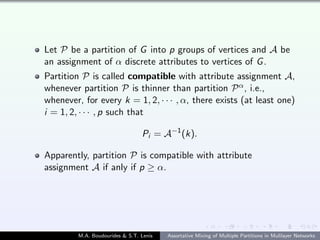
Let P be a partition of G into p groups of vertices and A be
an assignment of α discrete attributes to vertices of G.
Partition P is called compatible with attribute assignment A,
whenever partition P is thinner than partition Pα, i.e.,
whenever, for every k = 1, 2, · · · , α, there exists (at least one)
i = 1, 2, · · · , p such that
Pi = A−1
(k).
Apparently, partition P is compatible with attribute
assignment A if anly if p ≥ α.
M.A. Boudourides & S.T. Lenis Assortative Mixing of Multiple Partitions in Mulilayer Networks
Assortativity of a Partition
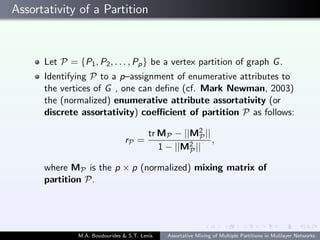
Let P = {P1, P2, . . . , Pp} be a vertex partition of graph G.
Identifying P to a p–assignment of enumerative attributes to
the vertices of G , one can define (cf. Mark Newman, 2003)
the (normalized) enumerative attribute assortativity (or
discrete assortativity) coefficient of partition P as follows:
rP =
tr MP − ||M2
P||
1 − ||M2
P||
,
where MP is the p × p (normalized) mixing matrix of
partition P.
M.A. Boudourides & S.T. Lenis Assortative Mixing of Multiple Partitions in Mulilayer Networks
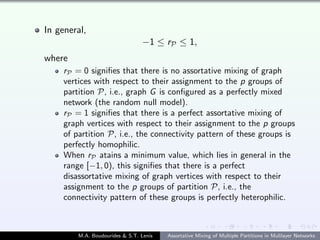
In general,
−1 ≤ rP ≤ 1,
where
rP = 0 signifies that there is no assortative mixing of graph
vertices with respect to their assignment to the p groups of
partition P, i.e., graph G is configured as a perfectly mixed
network (the random null model).
rP = 1 signifies that there is a perfect assortative mixing of
graph vertices with respect to their assignment to the p groups
of partition P, i.e., the connectivity pattern of these groups is
perfectly homophilic.
When rP atains a minimum value, which lies in general in the
range [−1, 0), this signifies that there is a perfect
disassortative mixing of graph vertices with respect to their
assignment to the p groups of partition P, i.e., the
connectivity pattern of these groups is perfectly heterophilic.
M.A. Boudourides & S.T. Lenis Assortative Mixing of Multiple Partitions in Mulilayer Networks
Assortative Mixing Among Partitions
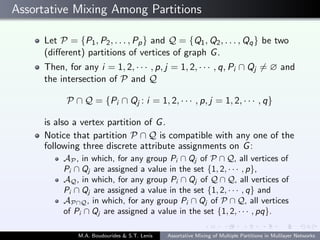
Let P = {P1, P2, . . . , Pp} and Q = {Q1, Q2, . . . , Qq} be two
(different) partitions of vertices of graph G.
Then, for any i = 1, 2, · · · , p, j = 1, 2, · · · , q, Pi ∩ Qj = ∅ and
the intersection of P and Q
P ∩ Q = {Pi ∩ Qj : i = 1, 2, · · · , p, j = 1, 2, · · · , q}
is also a vertex partition of G.
Notice that partition P ∩ Q is compatible with any one of the
following three discrete attribute assignments on G:
AP , in which, for any group Pi ∩ Qj of P ∩ Q, all vertices of
Pi ∩ Qj are assigned a value in the set {1, 2, · · · , p},
AQ, in which, for any group Pi ∩ Qj of Q ∩ Q, all vertices of
Pi ∩ Qj are assigned a value in the set {1, 2, · · · , q} and
AP∩Q, in which, for any group Pi ∩ Qj of P ∩ Q, all vertices
of Pi ∩ Qj are assigned a value in the set {1, 2, · · · , pq}.
M.A. Boudourides & S.T. Lenis Assortative Mixing of Multiple Partitions in Mulilayer Networks
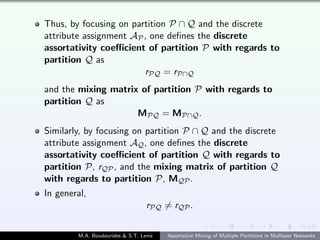
Thus, by focusing on partition P ∩ Q and the discrete
attribute assignment AP, one defines the discrete
assortativity coefficient of partition P with regards to
partition Q as
rPQ = rP∩Q
and the mixing matrix of partition P with regards to
partition Q as
MPQ = MP∩Q.
Similarly, by focusing on partition P ∩ Q and the discrete
attribute assignment AQ, one defines the discrete
assortativity coefficient of partition Q with regards to
partition P, rQP, and the mixing matrix of partition Q
with regards to partition P, MQP.
In general,
rPQ = rQP.
M.A. Boudourides & S.T. Lenis Assortative Mixing of Multiple Partitions in Mulilayer Networks
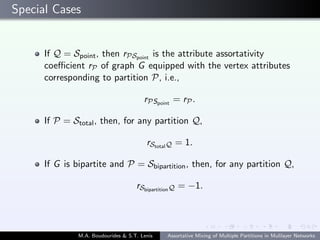
Special Cases
If Q = Spoint, then rPSpoint
is the attribute assortativity
coefficient rP of graph G equipped with the vertex attributes
corresponding to partition P, i.e.,
rPSpoint
= rP.
If P = Stotal, then, for any partition Q,
rStotalQ = 1.
If G is bipartite and P = Sbipartition, then, for any partition Q,
rSbipartitionQ = −1.
M.A. Boudourides & S.T. Lenis Assortative Mixing of Multiple Partitions in Mulilayer Networks

Multilayerity within multilayerity? On multilayer assortativity in social networks

  • 1.
    Multilayerity Within Multilayerity? AssortativeMixing of Multiple Partitions in Mulilayer Networks Moses A. Boudourides1 & Sergios T. Lenis2 Department of Mathematics University of Patras, Greece 1Moses.Boudourides@gmail.com 2sergioslenis@gmail.com 8 June 2015 Examples and Python code: http://mboudour.github.io/2015/06/09/Multilayerity-Within-Multilayerity%3F.html M.A. Boudourides & S.T. Lenis Assortative Mixing of Multiple Partitions in Mulilayer Networks
  • 2.
    Graph Partitions Let G =(V , E) be a (simple undirected) graph with (finite) set of vectors V and (finite) set of edges E. The terms “graph” and “(social) network” are used here interchangeably. If S1, S2, . . . , Ss ⊂ V (for a positive integer s) are s nonempty (sub)sets of vertices of G, the (finite) family of subsets S = S(G) = {S1, S2, . . . , Ss}, forms a partition (or s–partition) in G, when, for all i, j = 1, 2, · · · , s, i = j, Si ∩ Sj = ∅ and V = s i=1 Si . S1, S2, . . . , Ss are called groups (of vertices) of partition S. M.A. Boudourides & S.T. Lenis Assortative Mixing of Multiple Partitions in Mulilayer Networks
  • 3.
    For every graph,there exists (at least one) partition of its vertices. Two trivial graph partitions are: the |V |–partition into singletons of vertices and Spoint = Spoint(G) = {{v}: v ∈ V }, the 1–partition into the whole vertex set Stotal = Stotal(G) = {V }. If G is a bipartite graph with (vertex) parts U and V , the bipartition of G is denoted as: Sbipartition = Sbipartition(G) = {U, V }. M.A. Boudourides & S.T. Lenis Assortative Mixing of Multiple Partitions in Mulilayer Networks
  • 4.
    Examples of NontrivialGraph Partitions 1 Structural (endogenous) partitions: Connected components Communities Chromatic partitions (bipartitions, multipartitions) Degree partitions Time slicing of temporal networks Domination bipartitions (ego– and alter–nets) Core–Periphery bipartitions 2 Ad hoc (exogenous) partitions: Vertex attributes (or labels or colors) Layers (or levels) M.A. Boudourides & S.T. Lenis Assortative Mixing of Multiple Partitions in Mulilayer Networks
  • 5.
    Multilayer Partitions andMultilayer Graphs A multilayer partition of a graph G is a partition L = L(G) = {L1, L2, . . . , L } into ≥ 2 groups of vertices L1, L2, . . . , L , which are called layers. A graph with a multilayer partition is called a multilayer graph. M.A. Boudourides & S.T. Lenis Assortative Mixing of Multiple Partitions in Mulilayer Networks
  • 6.
    Ordering Partitions Let P= {P1, P2, . . . , Pp} and Q = {Q1, Q2, . . . , Qq} be two (different) partitions of vertices of graph G = (V , E). Partition P is called thicker than partition Q (and Q is called thinner than P), whenever, for every j = 1, 2, · · · , q, there exists a i = 1, 2, · · · , p such that Qj ⊂ Pi . Partitions P and Q are called (enumeratively) equivalent, whenever P is both thicker and thinner than partition Q. Obviously, partitions P and Q are equivalent, whenever |V | ≥ pq and, for all i = 1, 2, · · · , p and j = 1, 2, · · · , q, Pi ∩ Qj = ∅. M.A. Boudourides & S.T. Lenis Assortative Mixing of Multiple Partitions in Mulilayer Networks
  • 7.
    Self–Similarity of Partitions Apartition P of vertices of graph G (such that |V | ≥ p2) is called (enumeratively) self–similar, whenever, for any i = 1, 2, · · · , p, there is a p–(sub)partition Pi = {Pi 1, Pi 2, . . . , Pi p} of the (induced) subgraph Pi . In this case, graph G is called (enumeratively) self–similar with respect to partition P. M.A. Boudourides & S.T. Lenis Assortative Mixing of Multiple Partitions in Mulilayer Networks
  • 8.
    Graph Partitions asEnumerative Attribute Assignments An assignment of enumerative attributes (or discrete attribute assignment) to vertices of graph G is a mapping A: V → {1, 2, · · · , α}, for some α ≤ |V |, through which the vertices of G are classified according to the values they take in the set {1, 2, · · · , α}. Every p–partition P = {P1, P2, . . . , Pp} of vertices of G corresponds to a p–assignment AP of enumerative attributes to vertices of G distributing them in the groups of partition P. Conversely, every assignment of enumerative attributes to vertices of G taking values in the (finite) set {1, 2, · · · , α} corresponds to a partition Pα = {Pα 1 , Pα 2 , . . . , Pα p } of the vertices of G such that, for any k = 1, 2, · · · , α, Pα k = {v ∈ V : A(v) = k} = A−1 (k). Thus, vertex partitions and enumerative vertex attribute assignments are coincident. M.A. Boudourides & S.T. Lenis Assortative Mixing of Multiple Partitions in Mulilayer Networks
  • 9.
    Let P bea partition of G into p groups of vertices and A be an assignment of α discrete attributes to vertices of G. Partition P is called compatible with attribute assignment A, whenever partition P is thinner than partition Pα, i.e., whenever, for every k = 1, 2, · · · , α, there exists (at least one) i = 1, 2, · · · , p such that Pi = A−1 (k). Apparently, partition P is compatible with attribute assignment A if anly if p ≥ α. M.A. Boudourides & S.T. Lenis Assortative Mixing of Multiple Partitions in Mulilayer Networks
  • 10.
    Assortativity of aPartition Let P = {P1, P2, . . . , Pp} be a vertex partition of graph G. Identifying P to a p–assignment of enumerative attributes to the vertices of G , one can define (cf. Mark Newman, 2003) the (normalized) enumerative attribute assortativity (or discrete assortativity) coefficient of partition P as follows: rP = tr MP − ||M2 P|| 1 − ||M2 P|| , where MP is the p × p (normalized) mixing matrix of partition P. M.A. Boudourides & S.T. Lenis Assortative Mixing of Multiple Partitions in Mulilayer Networks
  • 11.
    In general, −1 ≤rP ≤ 1, where rP = 0 signifies that there is no assortative mixing of graph vertices with respect to their assignment to the p groups of partition P, i.e., graph G is configured as a perfectly mixed network (the random null model). rP = 1 signifies that there is a perfect assortative mixing of graph vertices with respect to their assignment to the p groups of partition P, i.e., the connectivity pattern of these groups is perfectly homophilic. When rP atains a minimum value, which lies in general in the range [−1, 0), this signifies that there is a perfect disassortative mixing of graph vertices with respect to their assignment to the p groups of partition P, i.e., the connectivity pattern of these groups is perfectly heterophilic. M.A. Boudourides & S.T. Lenis Assortative Mixing of Multiple Partitions in Mulilayer Networks
  • 12.
    Assortative Mixing AmongPartitions Let P = {P1, P2, . . . , Pp} and Q = {Q1, Q2, . . . , Qq} be two (different) partitions of vertices of graph G. Then, for any i = 1, 2, · · · , p, j = 1, 2, · · · , q, Pi ∩ Qj = ∅ and the intersection of P and Q P ∩ Q = {Pi ∩ Qj : i = 1, 2, · · · , p, j = 1, 2, · · · , q} is also a vertex partition of G. Notice that partition P ∩ Q is compatible with any one of the following three discrete attribute assignments on G: AP , in which, for any group Pi ∩ Qj of P ∩ Q, all vertices of Pi ∩ Qj are assigned a value in the set {1, 2, · · · , p}, AQ, in which, for any group Pi ∩ Qj of Q ∩ Q, all vertices of Pi ∩ Qj are assigned a value in the set {1, 2, · · · , q} and AP∩Q, in which, for any group Pi ∩ Qj of P ∩ Q, all vertices of Pi ∩ Qj are assigned a value in the set {1, 2, · · · , pq}. M.A. Boudourides & S.T. Lenis Assortative Mixing of Multiple Partitions in Mulilayer Networks
  • 13.
    Thus, by focusingon partition P ∩ Q and the discrete attribute assignment AP, one defines the discrete assortativity coefficient of partition P with regards to partition Q as rPQ = rP∩Q and the mixing matrix of partition P with regards to partition Q as MPQ = MP∩Q. Similarly, by focusing on partition P ∩ Q and the discrete attribute assignment AQ, one defines the discrete assortativity coefficient of partition Q with regards to partition P, rQP, and the mixing matrix of partition Q with regards to partition P, MQP. In general, rPQ = rQP. M.A. Boudourides & S.T. Lenis Assortative Mixing of Multiple Partitions in Mulilayer Networks
  • 14.
    Special Cases If Q= Spoint, then rPSpoint is the attribute assortativity coefficient rP of graph G equipped with the vertex attributes corresponding to partition P, i.e., rPSpoint = rP. If P = Stotal, then, for any partition Q, rStotalQ = 1. If G is bipartite and P = Sbipartition, then, for any partition Q, rSbipartitionQ = −1. M.A. Boudourides & S.T. Lenis Assortative Mixing of Multiple Partitions in Mulilayer Networks