1
February 28, 2014 CS21 Lecture 22 1
CS21
Decidability and Tractability
Lecture 22
February 28, 2014
Outline
• the class NP
– NP-complete problems: subset sum
– NP-complete problems: NAE-3-SAT, max-cut
• the class co-NP
• the class NP Å coNP
February 28, 2014 CS21 Lecture 22 2
February 28, 2014 CS21 Lecture 22 3
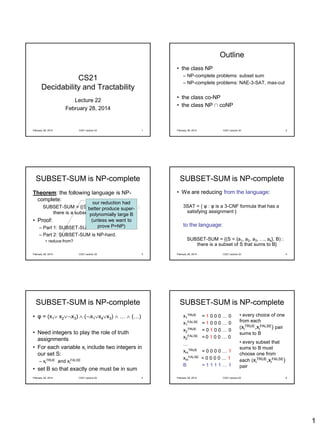
SUBSET-SUM is NP-complete
Theorem: the following language is NP-
complete:
SUBSET-SUM = {(S = {a1, a2, a3, …, ak}, B) :
there is a subset of S that sums to B}
• Proof:
– Part 1: SUBSET-SUM NP. Proof?
– Part 2: SUBSET-SUM is NP-hard.
• reduce from?
our reduction had
better produce super-
polynomially large B
(unless we want to
prove P=NP)
February 28, 2014 CS21 Lecture 22 4
SUBSET-SUM is NP-complete
• We are reducing from the language:
3SAT = { φ : φ is a 3-CNF formula that has a
satisfying assignment }
to the language:
SUBSET-SUM = {(S = {a1, a2, a3, …, ak}, B) :
there is a subset of S that sums to B}
February 28, 2014 CS21 Lecture 22 5
SUBSET-SUM is NP-complete
• φ = (x1 x2 x3) ( x1 x4 x3) … (…)
• Need integers to play the role of truth
assignments
• For each variable xi include two integers in
our set S:
– xi
TRUE and xi
FALSE
• set B so that exactly one must be in sum
February 28, 2014 CS21 Lecture 22 6
SUBSET-SUM is NP-complete
x1
TRUE = 1 0 0 0 … 0
x1
FALSE = 1 0 0 0 … 0
x2
TRUE = 0 1 0 0 … 0
x2
FALSE = 0 1 0 0 … 0
…
xm
TRUE = 0 0 0 0 … 1
xm
FALSE = 0 0 0 0 … 1
B = 1 1 1 1 … 1
• every choice of one
from each
(xi
TRUE,xi
FALSE) pair
sums to B
• every subset that
sums to B must
choose one from
each (xi
TRUE,xi
FALSE)
pair
2
February 28, 2014 CS21 Lecture 22 7
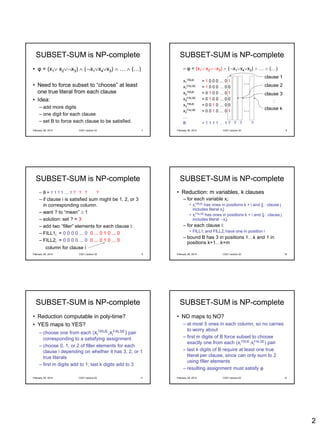
SUBSET-SUM is NP-complete
• φ = (x1 x2 x3) ( x1 x4 x3) … (…)
• Need to force subset to “choose” at least
one true literal from each clause
• Idea:
– add more digits
– one digit for each clause
– set B to force each clause to be satisfied.
February 28, 2014 CS21 Lecture 22 8
SUBSET-SUM is NP-complete
– φ = (x1 x2 x3) ( x1 x4 x3) … (…)
x1
TRUE = 1 0 0 0 … 0 1
x1
FALSE = 1 0 0 0 … 0 0
x2
TRUE = 0 1 0 0 … 0 1
x2
FALSE = 0 1 0 0 … 0 0
x3
TRUE = 0 0 1 0 … 0 0
x3
FALSE = 0 0 1 0 … 0 1
… :
B = 1 1 1 1 … 1 ? ? ? ?
…
…
clause 1
clause 2
clause 3
clause k
:
February 28, 2014 CS21 Lecture 22 9
SUBSET-SUM is NP-complete
– B = 1 1 1 1 … 1 ? ? ? ?
– if clause i is satisfied sum might be 1, 2, or 3
in corresponding column.
– want ? to “mean” 1
– solution: set ? = 3
– add two “filler” elements for each clause i:
– FILL1i = 0 0 0 0 ... 0 0 ... 0 1 0 ... 0
– FILL2i = 0 0 0 0 ... 0 0 ... 0 1 0 ... 0
column for clause i
February 28, 2014 CS21 Lecture 22 10
SUBSET-SUM is NP-complete
• Reduction: m variables, k clauses
– for each variable xi:
• xi
TRUE has ones in positions k + i and {j : clause j
includes literal xi}
• xi
FALSE has ones in positions k + i and {j : clause j
includes literal xi}
– for each clause i:
• FILL1i and FILL2i have one in position i
– bound B has 3 in positions 1…k and 1 in
positions k+1…k+m
February 28, 2014 CS21 Lecture 22 11
SUBSET-SUM is NP-complete
• Reduction computable in poly-time?
• YES maps to YES?
– choose one from each (xi
TRUE,xi
FALSE) pair
corresponding to a satisfying assignment
– choose 0, 1, or 2 of filler elements for each
clause i depending on whether it has 3, 2, or 1
true literals
– first m digits add to 1; last k digits add to 3
February 28, 2014 CS21 Lecture 22 12
SUBSET-SUM is NP-complete
• NO maps to NO?
– at most 5 ones in each column, so no carries
to worry about
– first m digits of B force subset to choose
exactly one from each (xi
TRUE,xi
FALSE) pair
– last k digits of B require at least one true
literal per clause, since can only sum to 2
using filler elements
– resulting assignment must satisfy φ
3
February 28, 2014 CS21 Lecture 22 13
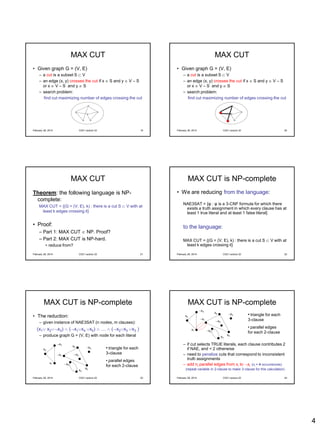
Not-All-Equal 3SAT
(x1 x2 x3) ( x1 x4 x3) … (…)
Theorem: the following language is NP-
complete:
NAE3SAT = {φ : φ is a 3-CNF formula for which there
exists a truth assignment in which every clause has at
least 1 true literal and at least 1 false literal}
• Proof:
– Part 1: NAE3SAT NP. Proof?
– Part 2: NAE3SAT is NP-hard. Reduce from?
February 28, 2014 CS21 Lecture 22 14
NAE3SAT is NP-complete
• We are reducing from the language:
CIRCUIT-SAT = {C : C is a Boolean circuit for
which there exists a satisfying truth assignment}
to the language:
NAE3SAT = {φ : φ is a 3-CNF formula for which there
exists a truth assignment in which every clause has at
least 1 true literal and at least 1 false literal}
February 28, 2014 CS21 Lecture 22 15
NAE3SAT is NP-complete
• Recall reduction to 3SAT
– variables x1, x2, …,xn, gates g1, g2, …, gm
– produce clauses:
gi
z
• (gi z)
• ( z gi)
gi
z1
• ( z1 gi)
• ( z2 gi)
• ( gi z1 z2)
z2
gi
z1
• ( gi z1)
• ( gi z2)
• ( z1 z2 gi)
z2
output gate gm:
• (gm)
not all true in a satisfying
assignment
not all true in a satisfying
assignment
February 28, 2014 CS21 Lecture 22 16
NAE3SAT is NP-complete
• modified reduction to NAE3SAT
– variables x1, x2, …,xn, gates g1, g2, …, gm
– produce clauses:
gi
z
• (gi z w)
• ( z gi w)
gi
z1
• ( z1 gi w)
• ( z2 gi w)
• ( gi z1 z2)
z2
gi
z1
• ( gi z1 w)
• ( gi z2 w)
• ( z1 z2 gi)
z2
output gate gm:
• (gm w)
February 28, 2014 CS21 Lecture 22 17
NAE3SAT is NP-complete
• Does the reduction run in
polynomial time?
• YES maps to YES
– already know how to get a
satisfying assignment to the
BLUE variables
– set w = FALSE
• ( z1 gi w)
• ( z2 gi w)
• ( gi z1 z2)
• ( gi z1 w)
• ( gi z2 w)
• ( z1 z2 gi)
• (gi z w)
• ( z gi w)
• (gm w)
February 28, 2014 CS21 Lecture 22 18
NAE3SAT is NP-complete
• NO maps to NO
– given NAE assignment A
– complement A’ is a NAE
assignment
– A or A’ has w = FALSE
– must have TRUE BLUE
variable in every clause
– we know this implies C
satisfiable
• ( z1 gi w)
• ( z2 gi w)
• ( gi z1 z2)
• ( gi z1 w)
• ( gi z2 w)
• ( z1 z2 gi)
• (gi z w)
• ( z gi w)
• (gm w)
4
February 28, 2014 CS21 Lecture 22 19
MAX CUT
• Given graph G = (V, E)
– a cut is a subset S V
– an edge (x, y) crosses the cut if x S and y V – S
or x V – S and y S
– search problem:
find cut maximizing number of edges crossing the cut
February 28, 2014 CS21 Lecture 22 20
MAX CUT
• Given graph G = (V, E)
– a cut is a subset S V
– an edge (x, y) crosses the cut if x S and y V – S
or x V – S and y S
– search problem:
find cut maximizing number of edges crossing the cut
February 28, 2014 CS21 Lecture 22 21
MAX CUT
Theorem: the following language is NP-
complete:
MAX CUT = {(G = (V, E), k) : there is a cut S V with at
least k edges crossing it}
• Proof:
– Part 1: MAX CUT NP. Proof?
– Part 2: MAX CUT is NP-hard.
• reduce from?
February 28, 2014 CS21 Lecture 22 22
MAX CUT is NP-complete
• We are reducing from the language:
NAE3SAT = {φ : φ is a 3-CNF formula for which there
exists a truth assignment in which every clause has at
least 1 true literal and at least 1 false literal}
to the language:
MAX CUT = {(G = (V, E), k) : there is a cut S V with at
least k edges crossing it}
February 28, 2014 CS21 Lecture 22 23
MAX CUT is NP-complete
• The reduction:
– given instance of NAE3SAT (n nodes, m clauses):
(x1 x2 x3) ( x1 x4 x5) … ( x2 x3 x3 )
– produce graph G = (V, E) with node for each literal
x2
x1
x4
x1
x5
x4
x3
x2
x5
x3
• triangle for each
3-clause
• parallel edges
for each 2-clause
February 28, 2014 CS21 Lecture 22 24
MAX CUT is NP-complete
– if cut selects TRUE literals, each clause contributes 2
if NAE, and < 2 otherwise
– need to penalize cuts that correspond to inconsistent
truth assignments
– add ni parallel edges from xi to xi (ni = # occurrences)
(repeat variable in 2-clause to make 3-clause for this calculation)
x2
x1
x4
x1
x5
x4
x3
x2
x5
x3
• triangle for each
3-clause
• parallel edges
for each 2-clause
5
February 28, 2014 CS21 Lecture 22 25
MAX CUT is NP-complete
• YES maps to YES
– take cut to be TRUE literals in a NAE truth
assignment
– contribution from clause gadgets: 2m
– contribution from (xi, xi) parallel edges: 3m
x2
x1
x4
x1
x5
x4
x3
x2
x5
x3 • triangle for each 3-clause
• parallel edges for each 2-
clause
• ni parallel edges from xi to xi
• set k = 5m
February 28, 2014 CS21 Lecture 22 26
MAX CUT is NP-complete
• NO maps to NO
– Claim: if cut has xi, xi on same side, then can move
one to opposite side without decreasing # edges
crossing cut
– contribution from (xi, xi) parallel edges: 3m
– contribution from clause gadgets must be 2m
– conclude: there is a NAE assignment
x2
x1
x4
x1
x5
x4
x3
x2
x5
x3
• triangle for each 3-clause
• parallel edges for each 2-
clause
• ni parallel edges from xi to xi
• set k = 5m
February 28, 2014 CS21 Lecture 22 27
MAX CUT is NP-complete
Claim: if cut has xi, xi on same side, then can
move one to opposite side without decreasing #
edges crossing cut
• Proof:
xi
...
xi
a edges
b edges
ni
edges
xi
...
xi
xi
...
xi
a+b ≤ 2ni
a + ni
b + ni
a + ni ≥ a + b or
b + ni ≥ a + b

Max cut

  • 1.
    1 February 28, 2014CS21 Lecture 22 1 CS21 Decidability and Tractability Lecture 22 February 28, 2014 Outline • the class NP – NP-complete problems: subset sum – NP-complete problems: NAE-3-SAT, max-cut • the class co-NP • the class NP Å coNP February 28, 2014 CS21 Lecture 22 2 February 28, 2014 CS21 Lecture 22 3 SUBSET-SUM is NP-complete Theorem: the following language is NP- complete: SUBSET-SUM = {(S = {a1, a2, a3, …, ak}, B) : there is a subset of S that sums to B} • Proof: – Part 1: SUBSET-SUM NP. Proof? – Part 2: SUBSET-SUM is NP-hard. • reduce from? our reduction had better produce super- polynomially large B (unless we want to prove P=NP) February 28, 2014 CS21 Lecture 22 4 SUBSET-SUM is NP-complete • We are reducing from the language: 3SAT = { φ : φ is a 3-CNF formula that has a satisfying assignment } to the language: SUBSET-SUM = {(S = {a1, a2, a3, …, ak}, B) : there is a subset of S that sums to B} February 28, 2014 CS21 Lecture 22 5 SUBSET-SUM is NP-complete • φ = (x1 x2 x3) ( x1 x4 x3) … (…) • Need integers to play the role of truth assignments • For each variable xi include two integers in our set S: – xi TRUE and xi FALSE • set B so that exactly one must be in sum February 28, 2014 CS21 Lecture 22 6 SUBSET-SUM is NP-complete x1 TRUE = 1 0 0 0 … 0 x1 FALSE = 1 0 0 0 … 0 x2 TRUE = 0 1 0 0 … 0 x2 FALSE = 0 1 0 0 … 0 … xm TRUE = 0 0 0 0 … 1 xm FALSE = 0 0 0 0 … 1 B = 1 1 1 1 … 1 • every choice of one from each (xi TRUE,xi FALSE) pair sums to B • every subset that sums to B must choose one from each (xi TRUE,xi FALSE) pair
  • 2.
    2 February 28, 2014CS21 Lecture 22 7 SUBSET-SUM is NP-complete • φ = (x1 x2 x3) ( x1 x4 x3) … (…) • Need to force subset to “choose” at least one true literal from each clause • Idea: – add more digits – one digit for each clause – set B to force each clause to be satisfied. February 28, 2014 CS21 Lecture 22 8 SUBSET-SUM is NP-complete – φ = (x1 x2 x3) ( x1 x4 x3) … (…) x1 TRUE = 1 0 0 0 … 0 1 x1 FALSE = 1 0 0 0 … 0 0 x2 TRUE = 0 1 0 0 … 0 1 x2 FALSE = 0 1 0 0 … 0 0 x3 TRUE = 0 0 1 0 … 0 0 x3 FALSE = 0 0 1 0 … 0 1 … : B = 1 1 1 1 … 1 ? ? ? ? … … clause 1 clause 2 clause 3 clause k : February 28, 2014 CS21 Lecture 22 9 SUBSET-SUM is NP-complete – B = 1 1 1 1 … 1 ? ? ? ? – if clause i is satisfied sum might be 1, 2, or 3 in corresponding column. – want ? to “mean” 1 – solution: set ? = 3 – add two “filler” elements for each clause i: – FILL1i = 0 0 0 0 ... 0 0 ... 0 1 0 ... 0 – FILL2i = 0 0 0 0 ... 0 0 ... 0 1 0 ... 0 column for clause i February 28, 2014 CS21 Lecture 22 10 SUBSET-SUM is NP-complete • Reduction: m variables, k clauses – for each variable xi: • xi TRUE has ones in positions k + i and {j : clause j includes literal xi} • xi FALSE has ones in positions k + i and {j : clause j includes literal xi} – for each clause i: • FILL1i and FILL2i have one in position i – bound B has 3 in positions 1…k and 1 in positions k+1…k+m February 28, 2014 CS21 Lecture 22 11 SUBSET-SUM is NP-complete • Reduction computable in poly-time? • YES maps to YES? – choose one from each (xi TRUE,xi FALSE) pair corresponding to a satisfying assignment – choose 0, 1, or 2 of filler elements for each clause i depending on whether it has 3, 2, or 1 true literals – first m digits add to 1; last k digits add to 3 February 28, 2014 CS21 Lecture 22 12 SUBSET-SUM is NP-complete • NO maps to NO? – at most 5 ones in each column, so no carries to worry about – first m digits of B force subset to choose exactly one from each (xi TRUE,xi FALSE) pair – last k digits of B require at least one true literal per clause, since can only sum to 2 using filler elements – resulting assignment must satisfy φ
  • 3.
    3 February 28, 2014CS21 Lecture 22 13 Not-All-Equal 3SAT (x1 x2 x3) ( x1 x4 x3) … (…) Theorem: the following language is NP- complete: NAE3SAT = {φ : φ is a 3-CNF formula for which there exists a truth assignment in which every clause has at least 1 true literal and at least 1 false literal} • Proof: – Part 1: NAE3SAT NP. Proof? – Part 2: NAE3SAT is NP-hard. Reduce from? February 28, 2014 CS21 Lecture 22 14 NAE3SAT is NP-complete • We are reducing from the language: CIRCUIT-SAT = {C : C is a Boolean circuit for which there exists a satisfying truth assignment} to the language: NAE3SAT = {φ : φ is a 3-CNF formula for which there exists a truth assignment in which every clause has at least 1 true literal and at least 1 false literal} February 28, 2014 CS21 Lecture 22 15 NAE3SAT is NP-complete • Recall reduction to 3SAT – variables x1, x2, …,xn, gates g1, g2, …, gm – produce clauses: gi z • (gi z) • ( z gi) gi z1 • ( z1 gi) • ( z2 gi) • ( gi z1 z2) z2 gi z1 • ( gi z1) • ( gi z2) • ( z1 z2 gi) z2 output gate gm: • (gm) not all true in a satisfying assignment not all true in a satisfying assignment February 28, 2014 CS21 Lecture 22 16 NAE3SAT is NP-complete • modified reduction to NAE3SAT – variables x1, x2, …,xn, gates g1, g2, …, gm – produce clauses: gi z • (gi z w) • ( z gi w) gi z1 • ( z1 gi w) • ( z2 gi w) • ( gi z1 z2) z2 gi z1 • ( gi z1 w) • ( gi z2 w) • ( z1 z2 gi) z2 output gate gm: • (gm w) February 28, 2014 CS21 Lecture 22 17 NAE3SAT is NP-complete • Does the reduction run in polynomial time? • YES maps to YES – already know how to get a satisfying assignment to the BLUE variables – set w = FALSE • ( z1 gi w) • ( z2 gi w) • ( gi z1 z2) • ( gi z1 w) • ( gi z2 w) • ( z1 z2 gi) • (gi z w) • ( z gi w) • (gm w) February 28, 2014 CS21 Lecture 22 18 NAE3SAT is NP-complete • NO maps to NO – given NAE assignment A – complement A’ is a NAE assignment – A or A’ has w = FALSE – must have TRUE BLUE variable in every clause – we know this implies C satisfiable • ( z1 gi w) • ( z2 gi w) • ( gi z1 z2) • ( gi z1 w) • ( gi z2 w) • ( z1 z2 gi) • (gi z w) • ( z gi w) • (gm w)
  • 4.
    4 February 28, 2014CS21 Lecture 22 19 MAX CUT • Given graph G = (V, E) – a cut is a subset S V – an edge (x, y) crosses the cut if x S and y V – S or x V – S and y S – search problem: find cut maximizing number of edges crossing the cut February 28, 2014 CS21 Lecture 22 20 MAX CUT • Given graph G = (V, E) – a cut is a subset S V – an edge (x, y) crosses the cut if x S and y V – S or x V – S and y S – search problem: find cut maximizing number of edges crossing the cut February 28, 2014 CS21 Lecture 22 21 MAX CUT Theorem: the following language is NP- complete: MAX CUT = {(G = (V, E), k) : there is a cut S V with at least k edges crossing it} • Proof: – Part 1: MAX CUT NP. Proof? – Part 2: MAX CUT is NP-hard. • reduce from? February 28, 2014 CS21 Lecture 22 22 MAX CUT is NP-complete • We are reducing from the language: NAE3SAT = {φ : φ is a 3-CNF formula for which there exists a truth assignment in which every clause has at least 1 true literal and at least 1 false literal} to the language: MAX CUT = {(G = (V, E), k) : there is a cut S V with at least k edges crossing it} February 28, 2014 CS21 Lecture 22 23 MAX CUT is NP-complete • The reduction: – given instance of NAE3SAT (n nodes, m clauses): (x1 x2 x3) ( x1 x4 x5) … ( x2 x3 x3 ) – produce graph G = (V, E) with node for each literal x2 x1 x4 x1 x5 x4 x3 x2 x5 x3 • triangle for each 3-clause • parallel edges for each 2-clause February 28, 2014 CS21 Lecture 22 24 MAX CUT is NP-complete – if cut selects TRUE literals, each clause contributes 2 if NAE, and < 2 otherwise – need to penalize cuts that correspond to inconsistent truth assignments – add ni parallel edges from xi to xi (ni = # occurrences) (repeat variable in 2-clause to make 3-clause for this calculation) x2 x1 x4 x1 x5 x4 x3 x2 x5 x3 • triangle for each 3-clause • parallel edges for each 2-clause
  • 5.
    5 February 28, 2014CS21 Lecture 22 25 MAX CUT is NP-complete • YES maps to YES – take cut to be TRUE literals in a NAE truth assignment – contribution from clause gadgets: 2m – contribution from (xi, xi) parallel edges: 3m x2 x1 x4 x1 x5 x4 x3 x2 x5 x3 • triangle for each 3-clause • parallel edges for each 2- clause • ni parallel edges from xi to xi • set k = 5m February 28, 2014 CS21 Lecture 22 26 MAX CUT is NP-complete • NO maps to NO – Claim: if cut has xi, xi on same side, then can move one to opposite side without decreasing # edges crossing cut – contribution from (xi, xi) parallel edges: 3m – contribution from clause gadgets must be 2m – conclude: there is a NAE assignment x2 x1 x4 x1 x5 x4 x3 x2 x5 x3 • triangle for each 3-clause • parallel edges for each 2- clause • ni parallel edges from xi to xi • set k = 5m February 28, 2014 CS21 Lecture 22 27 MAX CUT is NP-complete Claim: if cut has xi, xi on same side, then can move one to opposite side without decreasing # edges crossing cut • Proof: xi ... xi a edges b edges ni edges xi ... xi xi ... xi a+b ≤ 2ni a + ni b + ni a + ni ≥ a + b or b + ni ≥ a + b