Compressive Sensing as a tool for Video Analysis
Rhian Davies
Idris Eckley, Lyudmila Mihaylova, Nicos Pavlidis
August 4, 2013
Motivation
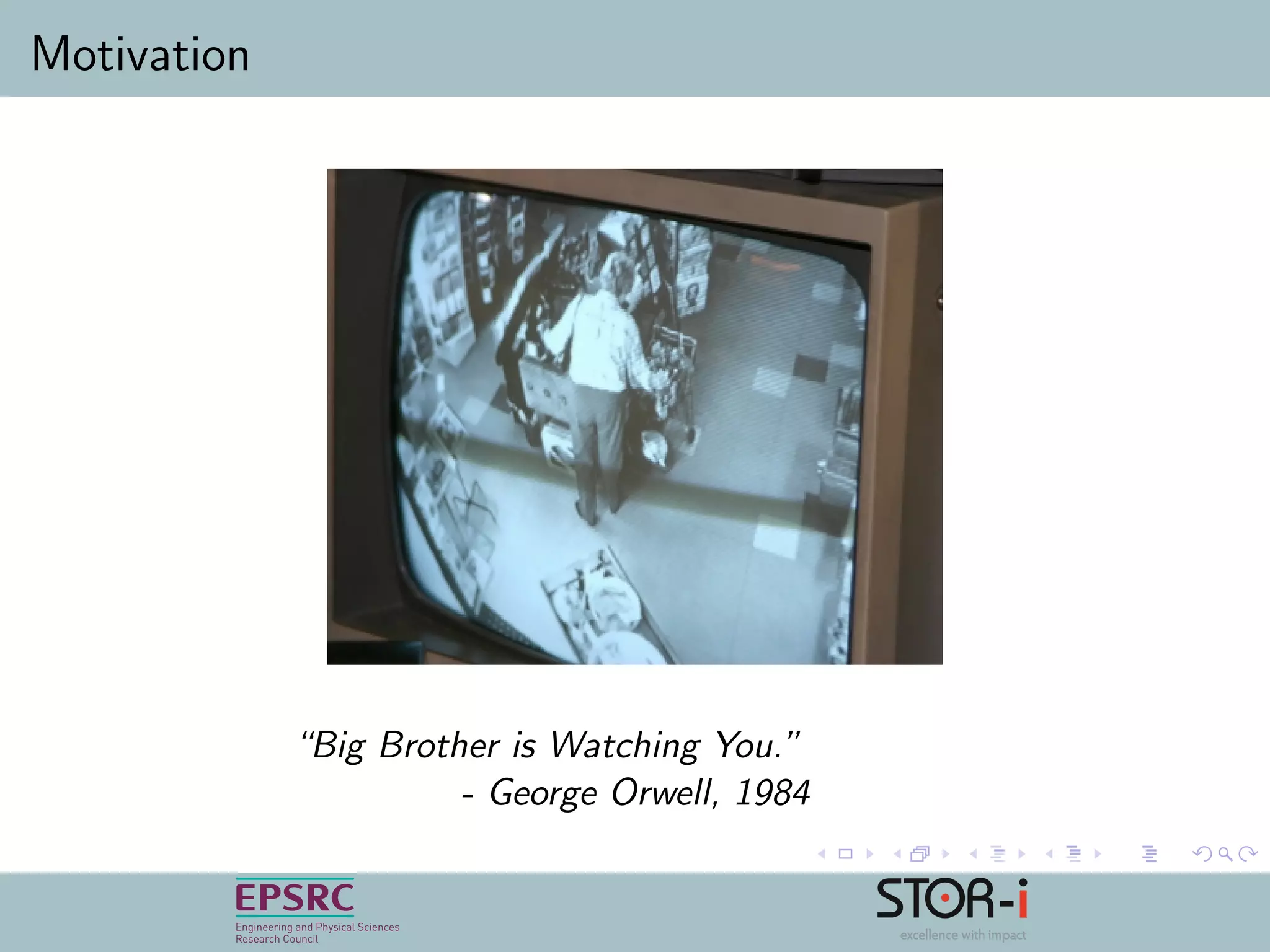
“Big Brother is Watching You.”
- George Orwell, 1984
What is compressive sensing?
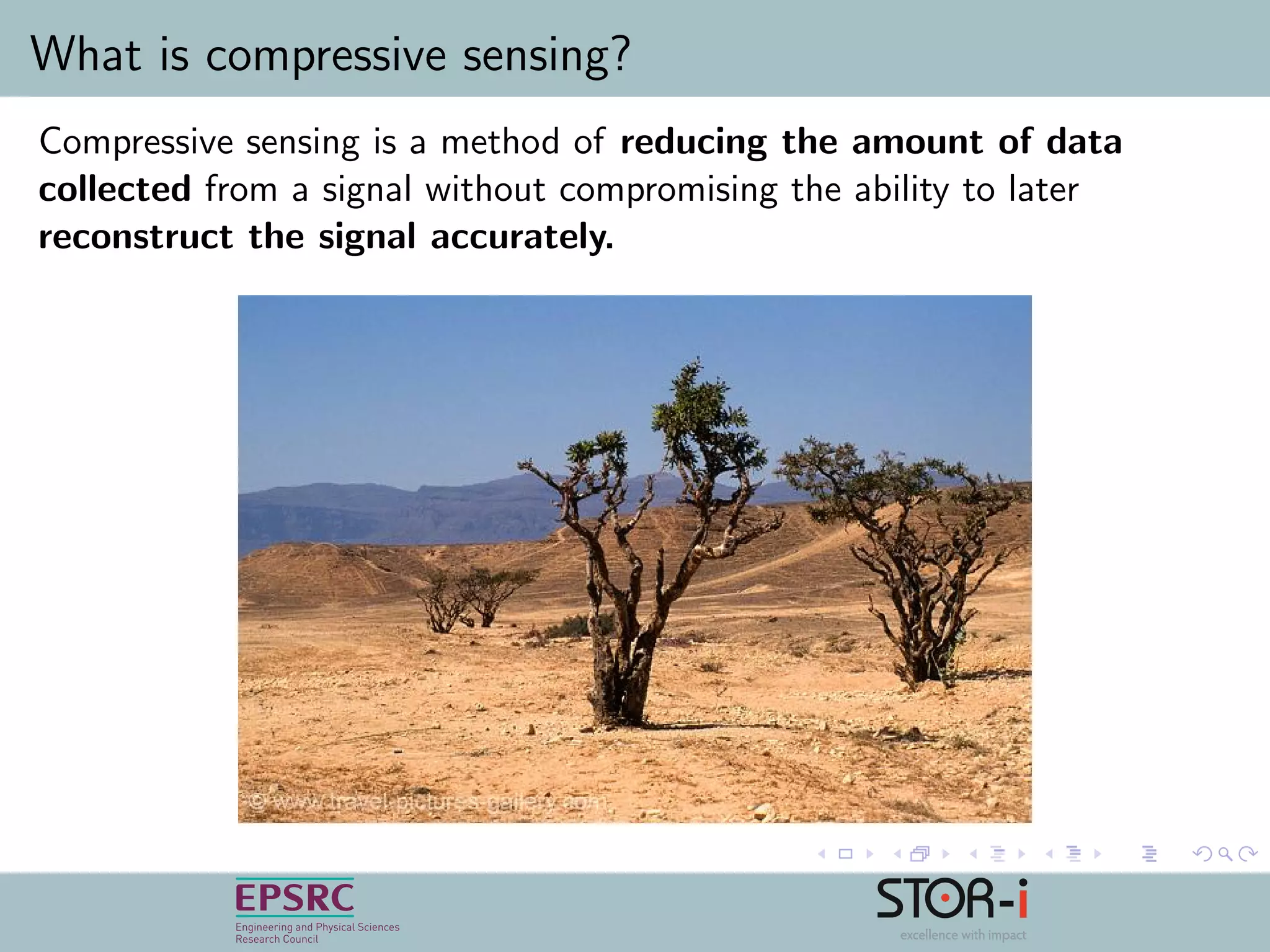
Compressive sensing is a method of reducing the amount of data
collected from a signal without compromising the ability to later
reconstruct the signal accurately.
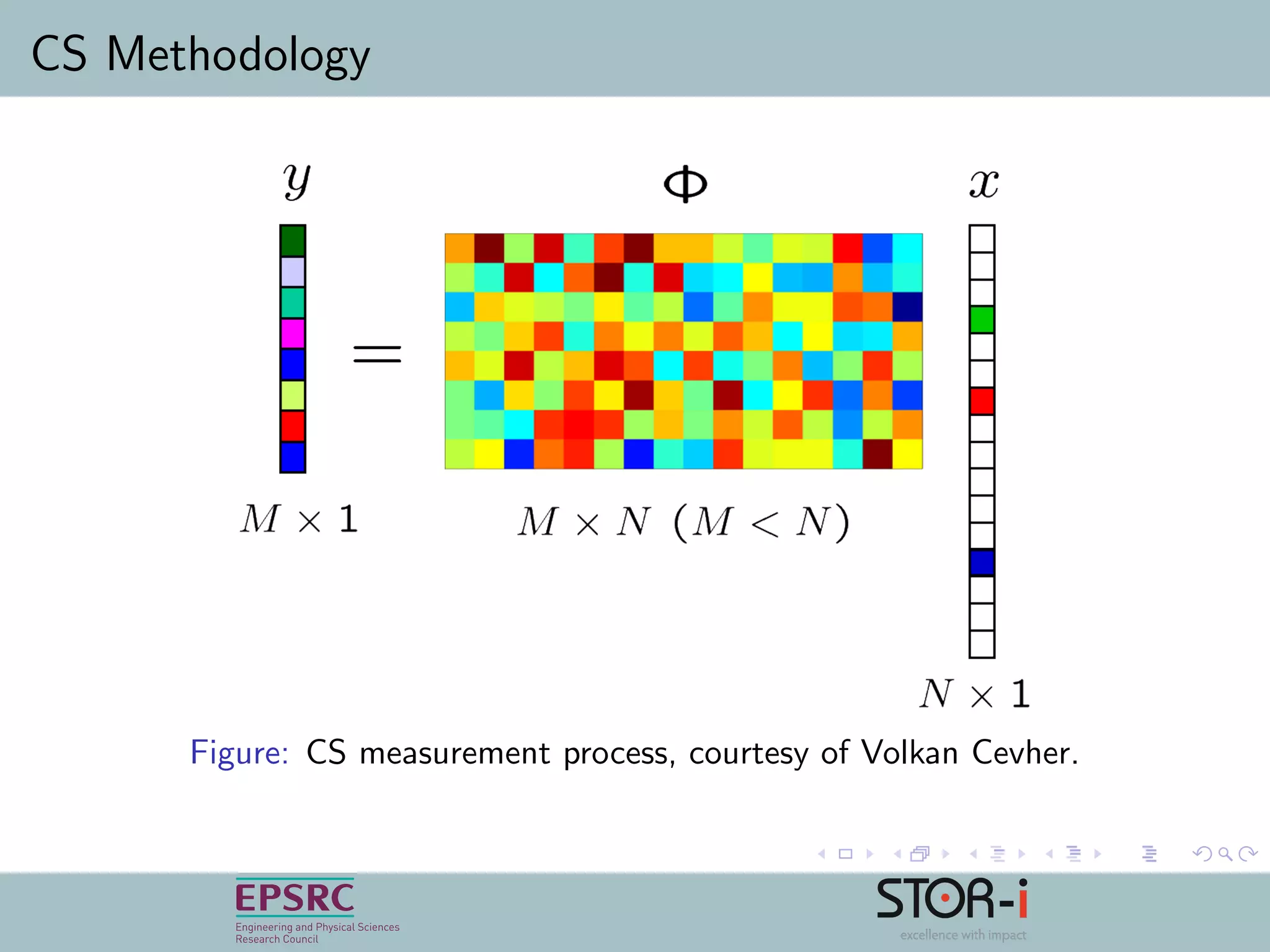
CS Methodology
Figure: CS measurement process, courtesy of Volkan Cevher.
Restricted Isometry Property (RIP)
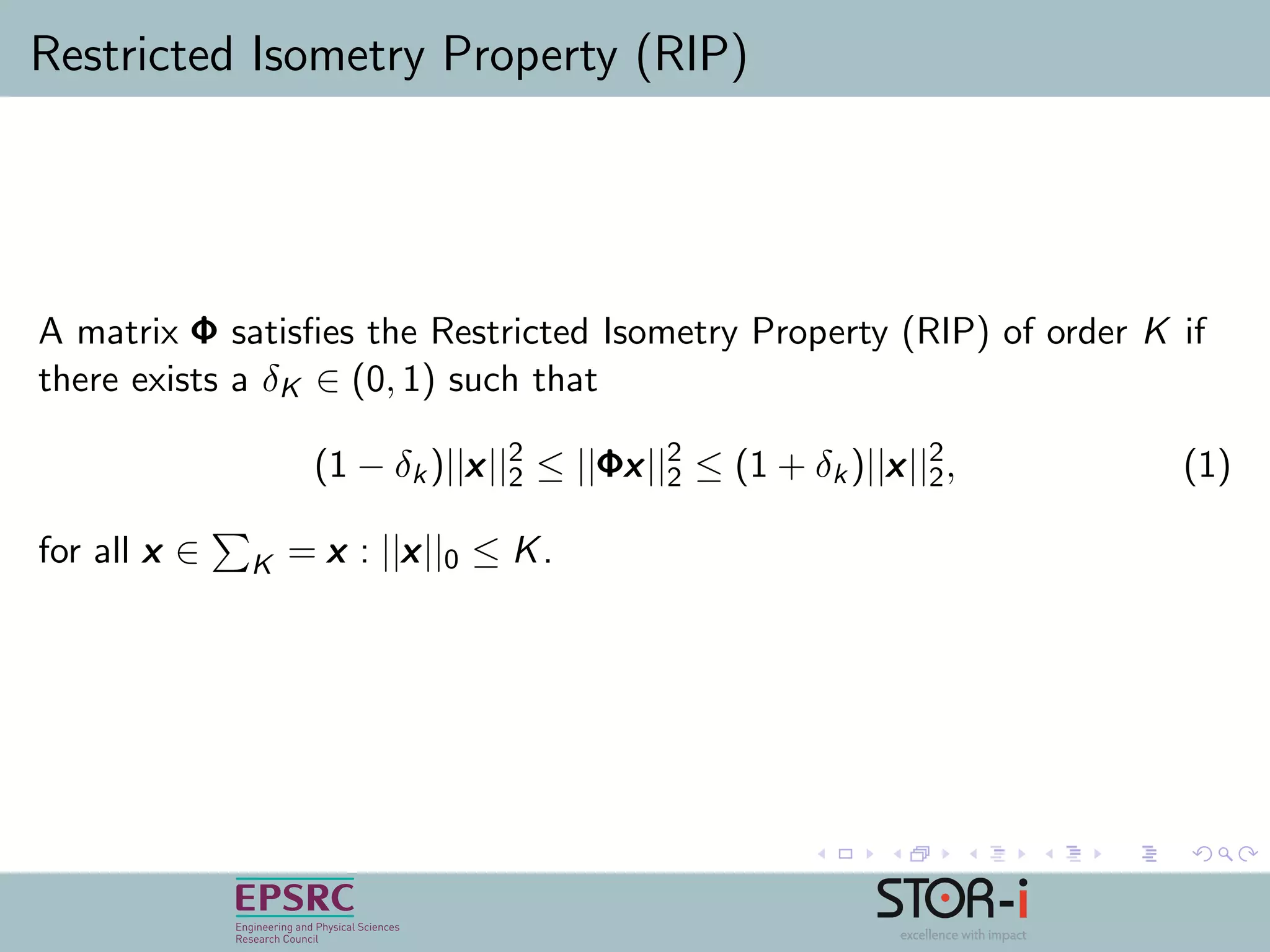
A matrix ΦΦΦ satisfies the Restricted Isometry Property (RIP) of order K if
there exists a δK ∈ (0, 1) such that
(1 − δk)||xxx||2
2 ≤ ||ΦΦΦxxx||2
2 ≤ (1 + δk)||xxx||2
2, (1)
for all xxx ∈ K = xxx : ||xxx||0 ≤ K.
Recovery of sparse transforms
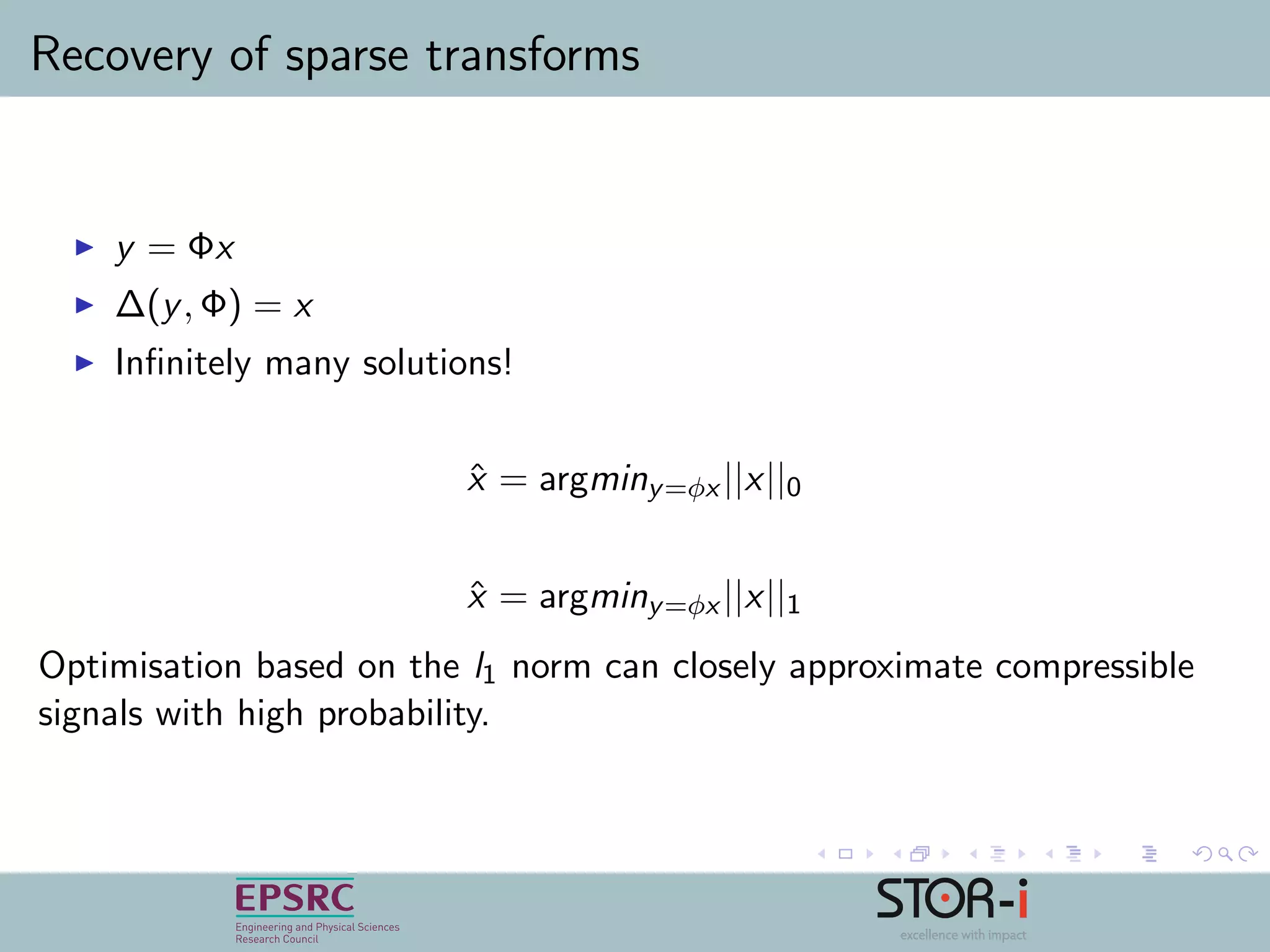
y = Φx
∆(y, Φ) = x
Infinitely many solutions!
ˆx = argminy=φx ||x||0
ˆx = argminy=φx ||x||1
Optimisation based on the l1 norm can closely approximate compressible
signals with high probability.
Orthogonal Matching Pursuit
We shall define the columns of Φ to be ϕ1, ϕ2, . . . , ϕN each of length M.
Step 1: Find the index for the column of Φ which satisfies
λt = argmax j=1,...,N| < rt−1, ϕj > |
Step 2: Keeps track of the columns used. Λt = Λt−1 ∪ λt,
Φt = [Φt−1, ψλt ]
Step 3: Update the estimate of the signal. xt = argminx ||v − Φtx||2 .
Step 4: Update the measurement residual. rt = y − Φtxt.
Output: Estimated sparse vector ˆx
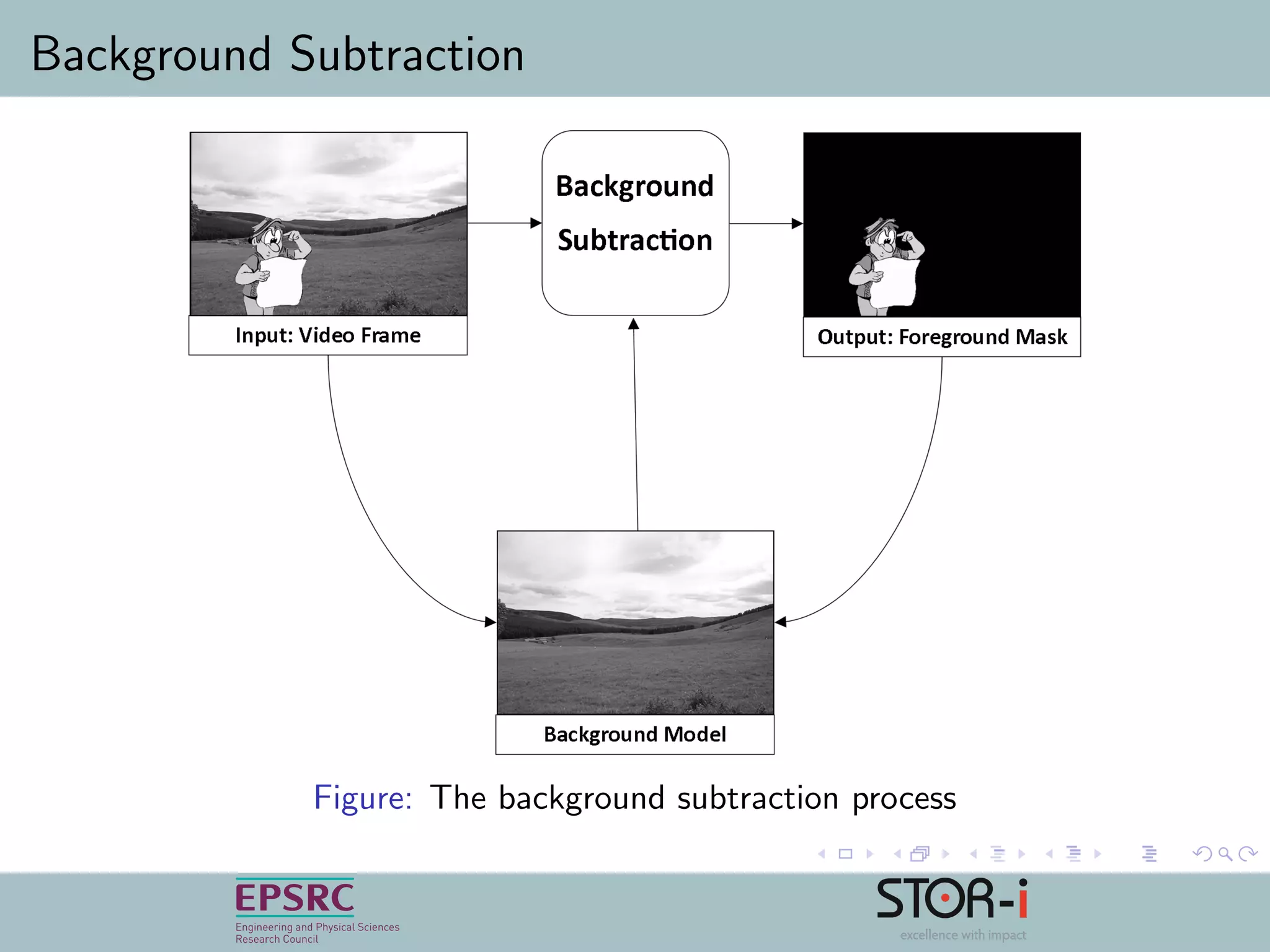
Background Subtraction
Figure: The background subtraction process
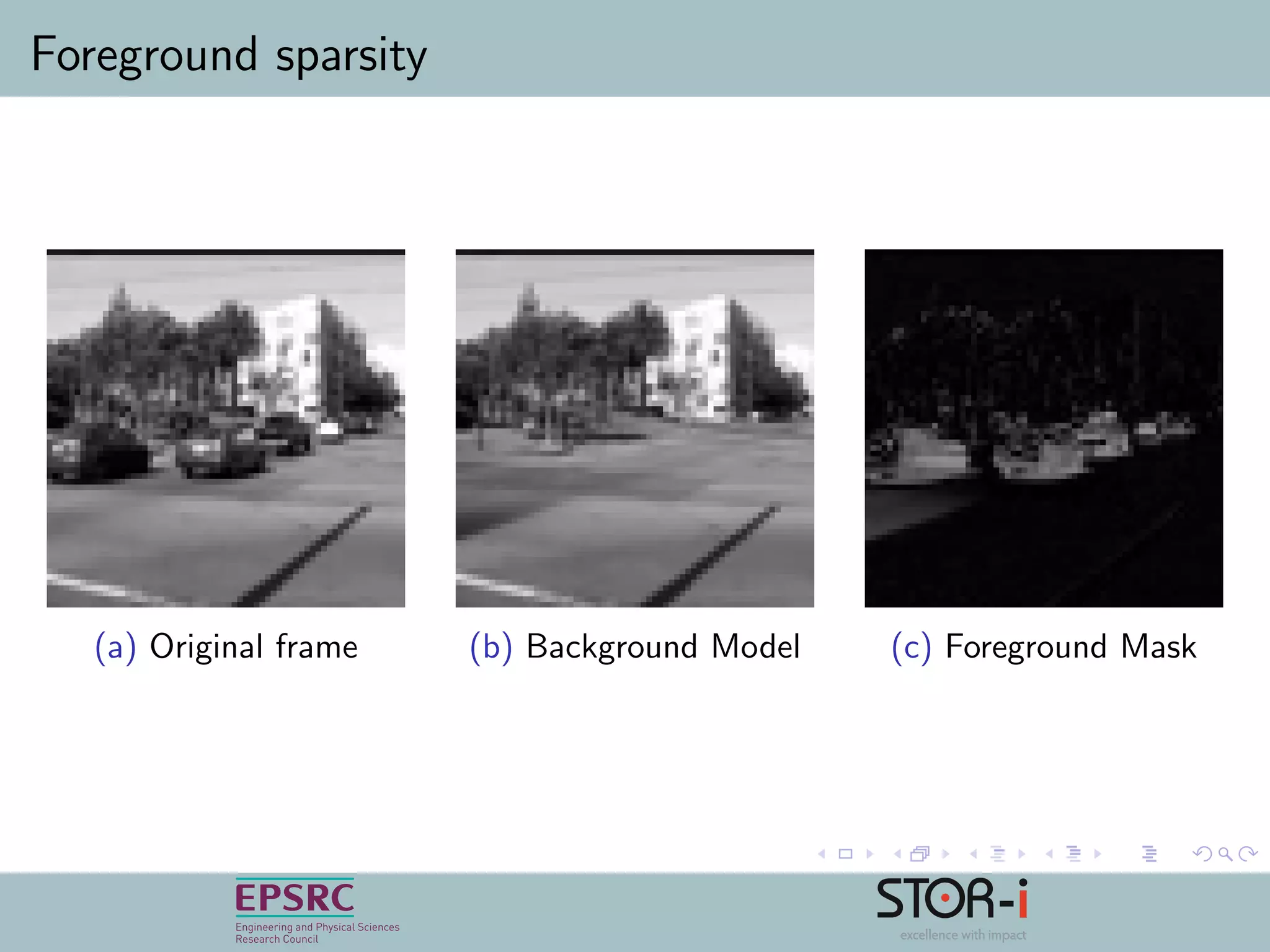
Foreground sparsity
(a) Original frame (b) Background Model (c) Foreground Mask
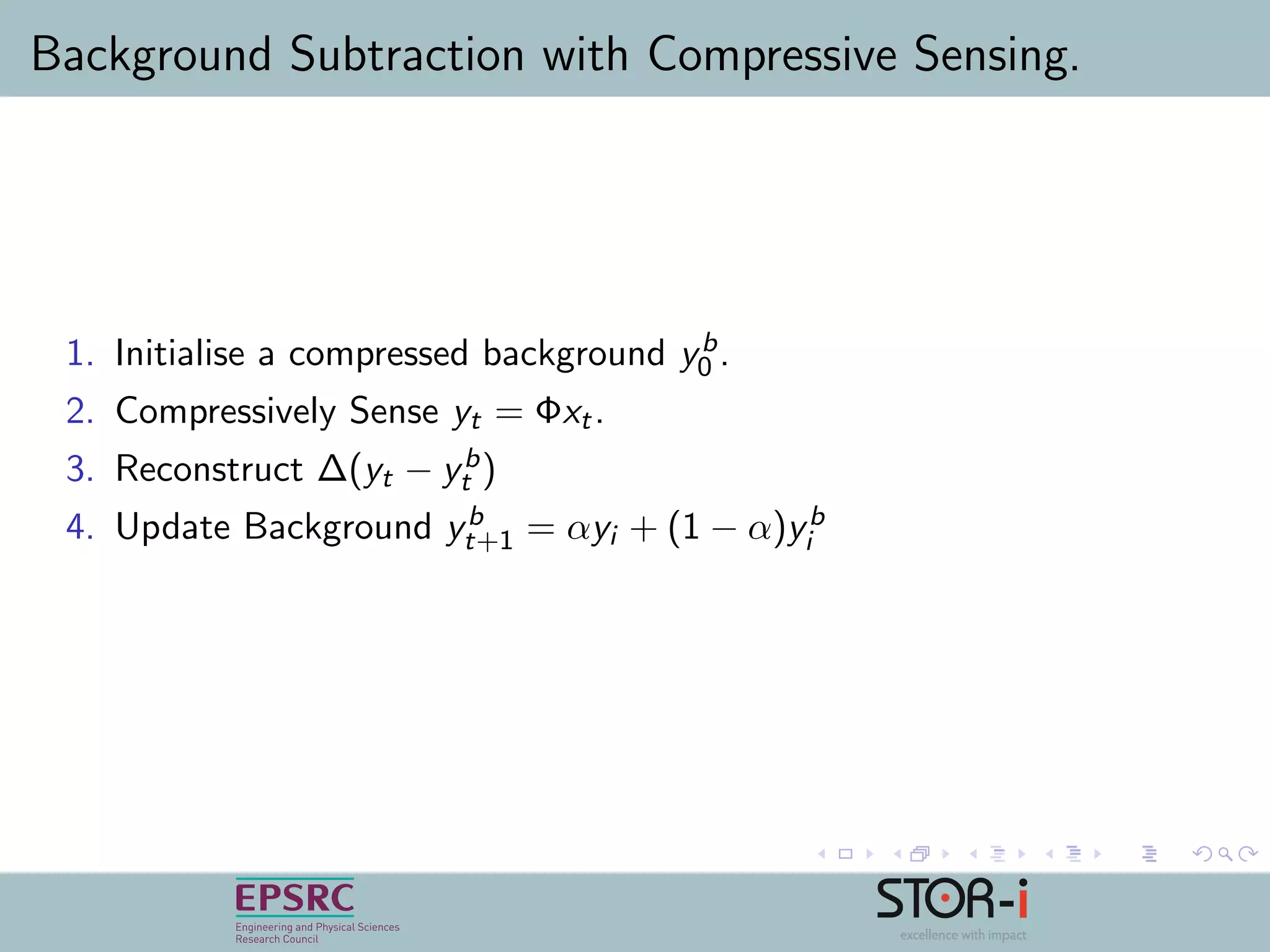
Background Subtraction with Compressive Sensing.
1. Initialise a compressed background yb
0 .
2. Compressively Sense yt = Φxt.
3. Reconstruct ∆(yt − yb
t )
4. Update Background yb
t+1 = αyi + (1 − α)yb
i
Experimentation
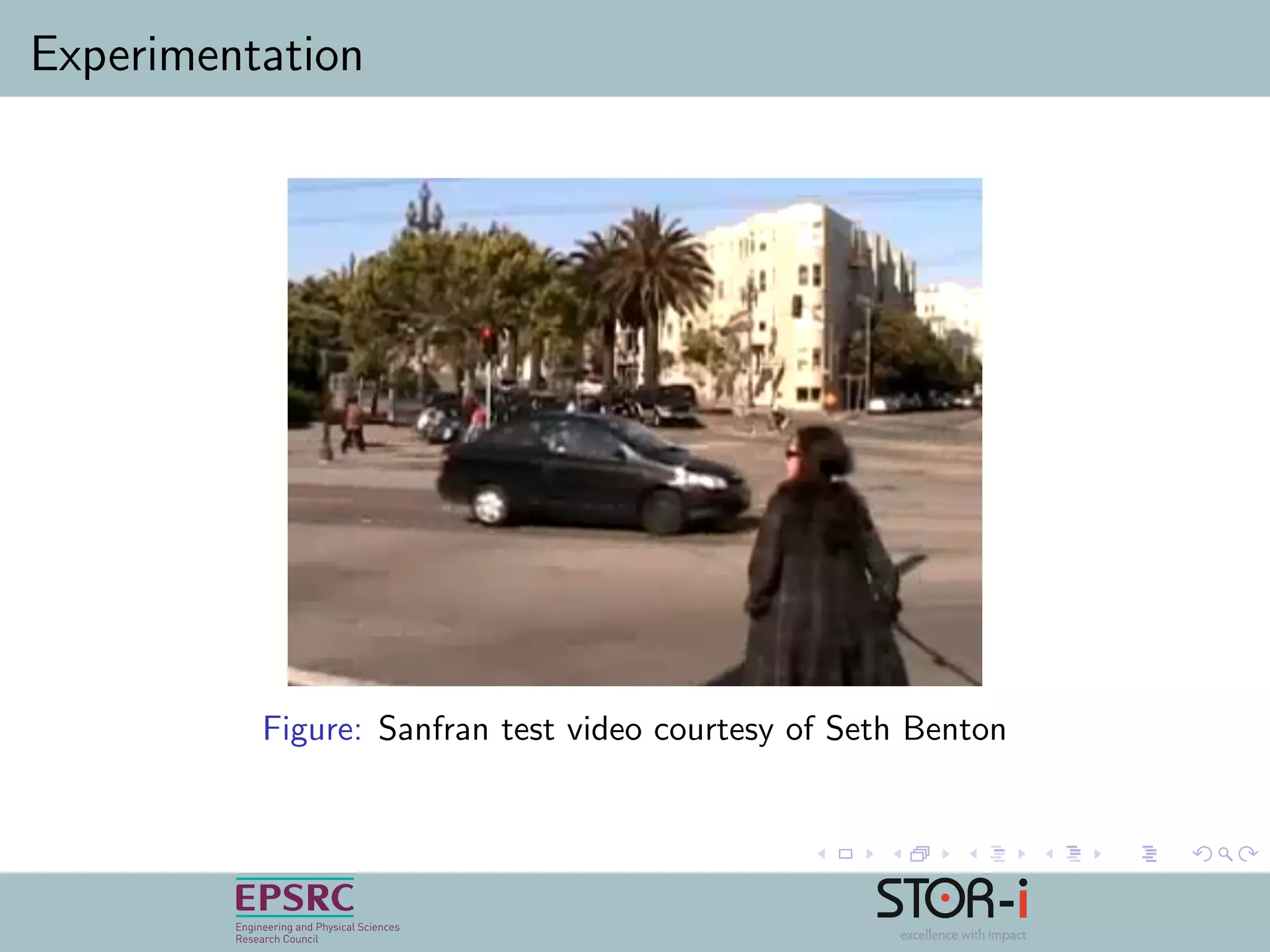
Figure: Sanfran test video courtesy of Seth Benton
Further Work
Choice of Φ and ∆?
More advanced methods of background subtraction.
Adapting with varying sparsity.
Knowing when to reconstruct.
Exploiting the properties of natural images.
Any Questions?

upgrade2013

  • 1.
    Compressive Sensing asa tool for Video Analysis Rhian Davies Idris Eckley, Lyudmila Mihaylova, Nicos Pavlidis August 4, 2013
  • 2.
    Motivation “Big Brother isWatching You.” - George Orwell, 1984
  • 3.
    What is compressivesensing? Compressive sensing is a method of reducing the amount of data collected from a signal without compromising the ability to later reconstruct the signal accurately.
  • 4.
    CS Methodology Figure: CSmeasurement process, courtesy of Volkan Cevher.
  • 5.
    Restricted Isometry Property(RIP) A matrix ΦΦΦ satisfies the Restricted Isometry Property (RIP) of order K if there exists a δK ∈ (0, 1) such that (1 − δk)||xxx||2 2 ≤ ||ΦΦΦxxx||2 2 ≤ (1 + δk)||xxx||2 2, (1) for all xxx ∈ K = xxx : ||xxx||0 ≤ K.
  • 6.
    Recovery of sparsetransforms y = Φx ∆(y, Φ) = x Infinitely many solutions! ˆx = argminy=φx ||x||0 ˆx = argminy=φx ||x||1 Optimisation based on the l1 norm can closely approximate compressible signals with high probability.
  • 7.
    Orthogonal Matching Pursuit Weshall define the columns of Φ to be ϕ1, ϕ2, . . . , ϕN each of length M. Step 1: Find the index for the column of Φ which satisfies λt = argmax j=1,...,N| < rt−1, ϕj > | Step 2: Keeps track of the columns used. Λt = Λt−1 ∪ λt, Φt = [Φt−1, ψλt ] Step 3: Update the estimate of the signal. xt = argminx ||v − Φtx||2 . Step 4: Update the measurement residual. rt = y − Φtxt. Output: Estimated sparse vector ˆx
  • 8.
    Background Subtraction Figure: Thebackground subtraction process
  • 9.
    Foreground sparsity (a) Originalframe (b) Background Model (c) Foreground Mask
  • 10.
    Background Subtraction withCompressive Sensing. 1. Initialise a compressed background yb 0 . 2. Compressively Sense yt = Φxt. 3. Reconstruct ∆(yt − yb t ) 4. Update Background yb t+1 = αyi + (1 − α)yb i
  • 11.
    Experimentation Figure: Sanfran testvideo courtesy of Seth Benton
  • 12.
    Further Work Choice ofΦ and ∆? More advanced methods of background subtraction. Adapting with varying sparsity. Knowing when to reconstruct. Exploiting the properties of natural images.
  • 13.