Kif Scheuer 
Climate Change Program Director 
Local Government Commission 
CAP & TRADE 
Local Government Commission www.lgc.org
Local Government Commission 
www.lgc.org 
We are a nonprofit 
organization that 
fosters innovation in 
local environmental 
sustainability, economic 
prosperity and social 
equity.
In 10 minutes I Hope to…. 
• Offer a quick Cap and Trade 101 
• Talk about current status and allocations 
• Review specific program status 
• Focus on water programs a bit 
• Outline what LGs can do to get ready 
Local Government Commission www.lgc.org
Cap and Trade 101 
• A strategy in the AB 32 
Scoping Plan 
• Sets a firm limit or “cap” 
that declines over time 
• Trading spurs 
innovation to reduce 
GHGs below allowable 
levels 
• Revenues are targeted 
to GHG reducing 
programs 
http://www.realsolutionstoclimatechange.com/ 
Local Government Commission www.lgc.org
Allocations of Revenues 
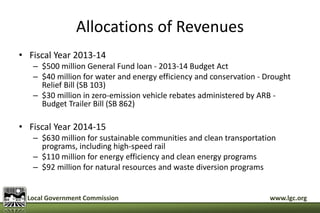
• Fiscal Year 2013-14 
– $500 million General Fund loan - 2013-14 Budget Act 
– $40 million for water and energy efficiency and conservation - Drought 
Relief Bill (SB 103) 
– $30 million in zero-emission vehicle rebates administered by ARB - 
Budget Trailer Bill (SB 862) 
• Fiscal Year 2014-15 
– $630 million for sustainable communities and clean transportation 
programs, including high-speed rail 
– $110 million for energy efficiency and clean energy programs 
– $92 million for natural resources and waste diversion programs 
Local Government Commission www.lgc.org
Transportation and 
Sustainable Communities 
Agency / Dept Program and Potential Investment Types Funding 
14-15 % 
high need 
15-15 % 
share 
Upcoming Events 
High Speed 
Rail Authority 
High Speed Rail 
• Planning, design, and right-of-way acquisition of 
the initial operating segment 
• Construction of the initial operating segment 
$250 
million 
0-25% 25% 
California State 
Transportation 
Agency 
Transit and Intercity Rail Capital Program 
• Expansion, enhancement and improvement of 
existing rail systems, including new rail cars and 
locomotives, to increase ridership and service 
levels, and improve reliability 
• Improved connectivity of existing and future rail 
systems 
• Increased integration of rail and transit services, 
including integrated ticketing 
• Bus transit investments that increase ridership 
and reduce GHG emissions 
$25 
million 
25% 10% 
Department of 
Transportation 
(Caltrans) 
Low Carbon Transit Operations Program 
• New/expanded bus, rail services, or expanded 
intermodal transit facilities 
• Service or facility improvements, e.g. equipment, 
fueling, and maintenance 
$25 
million 
50% 5% 
• Guidelines review and 
public comment, Fall 
2014 
• Guidelines adoption, 
Early 2015 
Local Government Commission www.lgc.org
Transportation and 
Sustainable Communities 
Agency / Dept Program and Potential Investment Types Funding 
14-15 % 
high need 
15-16 % share Upcoming Events 
Strategic Growth 
Council 
Affordable Housing and Sustainable 
Communities(AHSC) Program 
• Transit-oriented development 
• Intermodal affordable housing 
• Transit capital projects 
• Active transportation/complete streets 
• Local planning and implementation 
Sustainable Agriculture Land Conservation(SALC) 
Program 
• Agricultural land preservation 
$130 
million 
50% 20% 
• AHSC Workshops: All 
completed 
• SALC Workshops: All 
completed 
• Comments were due 
10/31 
Air Resources 
Board 
Low Carbon Transportation 
• Zero and near-zero emission passenger vehicle 
rebates 
• Heavy duty hybrid/ZEV trucks and buses 
• Freight demonstration projects 
• Pilot programs (car sharing, financing, etc.) in 
disadvantaged communities 
$230 
million 
50% 
~ 
• Low Carbon 
Transportation 
Work Group 
meetings: All 
Completed 
Local Government Commission www.lgc.org
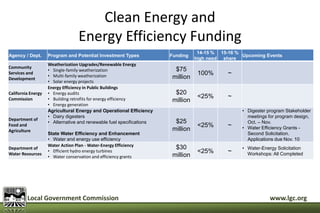
Clean Energy and 
Energy Efficiency Funding 
Agency / Dept. Program and Potential Investment Types Funding 
14-15 % 
high need 
15-16 % 
share 
Upcoming Events 
Community 
Services and 
Development 
Weatherization Upgrades/Renewable Energy 
• Single-family weatherization 
• Multi-family weatherization 
• Solar energy projects 
$75 
million 
100% ~ 
California Energy 
Commission 
Energy Efficiency in Public Buildings 
• Energy audits 
• Building retrofits for energy efficiency 
• Energy generation 
$20 
million 
<25% ~ 
Department of 
Food and 
Agriculture 
Agricultural Energy and Operational Efficiency 
• Dairy digesters 
• Alternative and renewable fuel specifications 
State Water Efficiency and Enhancement 
• Water and energy use efficiency 
$25 
million 
<25% ~ 
• Digester program Stakeholder 
meetings for program design, 
Oct. – Nov. 
• Water Efficiency Grants - 
Second Solicitation. 
Applications due Nov. 10 
Department of 
Water Resources 
Water Action Plan - Water-Energy Efficiency 
• Efficient hydro energy turbines 
• Water conservation and efficiency grants 
$30 
million 
<25% ~ 
• Water-Energy Solicitation 
Workshops: All Completed 
Local Government Commission www.lgc.org
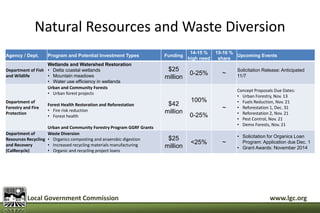
Natural Resources and Waste Diversion 
Agency / Dept. Program and Potential Investment Types Funding 
14-15 % 
high need 
15-16 % 
share 
Upcoming Events 
Department of Fish 
and Wildlife 
Wetlands and Watershed Restoration 
• Delta coastal wetlands 
• Mountain meadows 
• Water use efficiency in wetlands 
$25 
million 
0-25% ~ 
Solicitation Release: Anticipated 
11/7 
Department of 
Forestry and Fire 
Protection 
Urban and Community Forests 
• Urban forest projects 
Forest Health Restoration and Reforestation 
• Fire risk reduction 
• Forest health 
Urban and Community Forestry Program GGRF Grants 
$42 
million 
100% 
0-25% 
~ 
Concept Proposals Due Dates: 
• Urban Forestry, Nov. 13 
• Fuels Reduction, Nov. 21 
• Reforestation 1, Dec. 31 
• Reforestation 2, Nov. 21 
• Pest Control, Nov. 21 
• Demo Forests, Nov. 21 
Department of 
Resources Recycling 
and Recovery 
(CalRecycle) 
Waste Diversion 
• Organics composting and anaerobic digestion 
• Increased recycling materials manufacturing 
• Organic and recycling project loans 
$25 
million 
<25% ~ 
• Solicitation for Organics Loan 
Program: Application due Dec. 1 
• Grant Awards: November 2014 
Local Government Commission www.lgc.org
DWR: Water-Energy Grant Program 
• Provides funds ($19m) to implement projects & 
programs that: 
1. Reduce GHG emissions 
2. Reduce water use 
3. Reduce energy use 
• Eligible Applicants: 
– Local agencies (any “subdivision of the state”) 
– Joint Powers Authorities (JPAs) 
– Nonprofit Organizations 
• Timeline: 
– December 12, 2014, Proposals Due 
– March 2015, Draft Awards 
– April/May 2015, Final Awards 
http://cdn7.triplepundit.com 
Local Government Commission www.lgc.org
DWR Water-Energy: Potential Projects 
• Eligible Programs/Projects 
– Residential, commercial, or institutional Programs. 
– MUST reduce greenhouse gas, water, and energy use. 
– MUST quantify GHG, energy, and water reductions. 
• Preferences: 
– Regional Projects & Partnerships 
– Serving DACs, based on 
CalEnviroScan 2.0 
– Low-cost, high 
water-saving 
Local Government Commission www.lgc.org
DFW: Wetlands and Watershed Restoration 
Program 
• Provides funds ($25m) to Implement projects that 
provide carbon sequestration benefits 
• Eligible Applicants 
– Likely to include public agencies, recognized tribes, 
and qualified non-profit organizations 
• Eligible Project Types 
– Restoration of wetlands (including those in the 
Delta) in coastal watersheds and mountain 
meadows. 
– Projects that lead to water use efficiency in wetlands 
• Timing 
– Solicitation release: Anticipated by 11/7 
– Proposals due: Unknown 
– Awards: Unknown 
http://forcechangecom.c.presscdn.com 
Local Government Commission www.lgc.org
What can LGs do to get ready? 
• Review program guidelines to understand process, scopes and 
timing 
– http://www.arb.ca.gov/cc/capandtrade/auctionproceeds/budgetap 
propriations.htm 
• Look at existing programs or projects you already have you 
that might be eligible to expand or replicate 
• Identify “disadvantaged communities” within your 
jurisdictions and compare opportunities to needs. 
• Talk with likely partners and participants and assess needs in 
your region for specific areas 
• Ask your neighbors what they are thinking to identify ways to 
combine efforts 
Local Government Commission www.lgc.org
Kif Scheuer 
kscheuer@lgc.org 
415-717-4809 
THANK YOU! 
Local Government Commission www.lgc.org

Scheuer Climate Change

  • 1.
    Kif Scheuer ClimateChange Program Director Local Government Commission CAP & TRADE Local Government Commission www.lgc.org
  • 2.
    Local Government Commission www.lgc.org We are a nonprofit organization that fosters innovation in local environmental sustainability, economic prosperity and social equity.
  • 3.
    In 10 minutesI Hope to…. • Offer a quick Cap and Trade 101 • Talk about current status and allocations • Review specific program status • Focus on water programs a bit • Outline what LGs can do to get ready Local Government Commission www.lgc.org
  • 4.
    Cap and Trade101 • A strategy in the AB 32 Scoping Plan • Sets a firm limit or “cap” that declines over time • Trading spurs innovation to reduce GHGs below allowable levels • Revenues are targeted to GHG reducing programs http://www.realsolutionstoclimatechange.com/ Local Government Commission www.lgc.org
  • 5.
    Allocations of Revenues • Fiscal Year 2013-14 – $500 million General Fund loan - 2013-14 Budget Act – $40 million for water and energy efficiency and conservation - Drought Relief Bill (SB 103) – $30 million in zero-emission vehicle rebates administered by ARB - Budget Trailer Bill (SB 862) • Fiscal Year 2014-15 – $630 million for sustainable communities and clean transportation programs, including high-speed rail – $110 million for energy efficiency and clean energy programs – $92 million for natural resources and waste diversion programs Local Government Commission www.lgc.org
  • 6.
    Transportation and SustainableCommunities Agency / Dept Program and Potential Investment Types Funding 14-15 % high need 15-15 % share Upcoming Events High Speed Rail Authority High Speed Rail • Planning, design, and right-of-way acquisition of the initial operating segment • Construction of the initial operating segment $250 million 0-25% 25% California State Transportation Agency Transit and Intercity Rail Capital Program • Expansion, enhancement and improvement of existing rail systems, including new rail cars and locomotives, to increase ridership and service levels, and improve reliability • Improved connectivity of existing and future rail systems • Increased integration of rail and transit services, including integrated ticketing • Bus transit investments that increase ridership and reduce GHG emissions $25 million 25% 10% Department of Transportation (Caltrans) Low Carbon Transit Operations Program • New/expanded bus, rail services, or expanded intermodal transit facilities • Service or facility improvements, e.g. equipment, fueling, and maintenance $25 million 50% 5% • Guidelines review and public comment, Fall 2014 • Guidelines adoption, Early 2015 Local Government Commission www.lgc.org
  • 7.
    Transportation and SustainableCommunities Agency / Dept Program and Potential Investment Types Funding 14-15 % high need 15-16 % share Upcoming Events Strategic Growth Council Affordable Housing and Sustainable Communities(AHSC) Program • Transit-oriented development • Intermodal affordable housing • Transit capital projects • Active transportation/complete streets • Local planning and implementation Sustainable Agriculture Land Conservation(SALC) Program • Agricultural land preservation $130 million 50% 20% • AHSC Workshops: All completed • SALC Workshops: All completed • Comments were due 10/31 Air Resources Board Low Carbon Transportation • Zero and near-zero emission passenger vehicle rebates • Heavy duty hybrid/ZEV trucks and buses • Freight demonstration projects • Pilot programs (car sharing, financing, etc.) in disadvantaged communities $230 million 50% ~ • Low Carbon Transportation Work Group meetings: All Completed Local Government Commission www.lgc.org
  • 8.
    Clean Energy and Energy Efficiency Funding Agency / Dept. Program and Potential Investment Types Funding 14-15 % high need 15-16 % share Upcoming Events Community Services and Development Weatherization Upgrades/Renewable Energy • Single-family weatherization • Multi-family weatherization • Solar energy projects $75 million 100% ~ California Energy Commission Energy Efficiency in Public Buildings • Energy audits • Building retrofits for energy efficiency • Energy generation $20 million <25% ~ Department of Food and Agriculture Agricultural Energy and Operational Efficiency • Dairy digesters • Alternative and renewable fuel specifications State Water Efficiency and Enhancement • Water and energy use efficiency $25 million <25% ~ • Digester program Stakeholder meetings for program design, Oct. – Nov. • Water Efficiency Grants - Second Solicitation. Applications due Nov. 10 Department of Water Resources Water Action Plan - Water-Energy Efficiency • Efficient hydro energy turbines • Water conservation and efficiency grants $30 million <25% ~ • Water-Energy Solicitation Workshops: All Completed Local Government Commission www.lgc.org
  • 9.
    Natural Resources andWaste Diversion Agency / Dept. Program and Potential Investment Types Funding 14-15 % high need 15-16 % share Upcoming Events Department of Fish and Wildlife Wetlands and Watershed Restoration • Delta coastal wetlands • Mountain meadows • Water use efficiency in wetlands $25 million 0-25% ~ Solicitation Release: Anticipated 11/7 Department of Forestry and Fire Protection Urban and Community Forests • Urban forest projects Forest Health Restoration and Reforestation • Fire risk reduction • Forest health Urban and Community Forestry Program GGRF Grants $42 million 100% 0-25% ~ Concept Proposals Due Dates: • Urban Forestry, Nov. 13 • Fuels Reduction, Nov. 21 • Reforestation 1, Dec. 31 • Reforestation 2, Nov. 21 • Pest Control, Nov. 21 • Demo Forests, Nov. 21 Department of Resources Recycling and Recovery (CalRecycle) Waste Diversion • Organics composting and anaerobic digestion • Increased recycling materials manufacturing • Organic and recycling project loans $25 million <25% ~ • Solicitation for Organics Loan Program: Application due Dec. 1 • Grant Awards: November 2014 Local Government Commission www.lgc.org
  • 10.
    DWR: Water-Energy GrantProgram • Provides funds ($19m) to implement projects & programs that: 1. Reduce GHG emissions 2. Reduce water use 3. Reduce energy use • Eligible Applicants: – Local agencies (any “subdivision of the state”) – Joint Powers Authorities (JPAs) – Nonprofit Organizations • Timeline: – December 12, 2014, Proposals Due – March 2015, Draft Awards – April/May 2015, Final Awards http://cdn7.triplepundit.com Local Government Commission www.lgc.org
  • 11.
    DWR Water-Energy: PotentialProjects • Eligible Programs/Projects – Residential, commercial, or institutional Programs. – MUST reduce greenhouse gas, water, and energy use. – MUST quantify GHG, energy, and water reductions. • Preferences: – Regional Projects & Partnerships – Serving DACs, based on CalEnviroScan 2.0 – Low-cost, high water-saving Local Government Commission www.lgc.org
  • 12.
    DFW: Wetlands andWatershed Restoration Program • Provides funds ($25m) to Implement projects that provide carbon sequestration benefits • Eligible Applicants – Likely to include public agencies, recognized tribes, and qualified non-profit organizations • Eligible Project Types – Restoration of wetlands (including those in the Delta) in coastal watersheds and mountain meadows. – Projects that lead to water use efficiency in wetlands • Timing – Solicitation release: Anticipated by 11/7 – Proposals due: Unknown – Awards: Unknown http://forcechangecom.c.presscdn.com Local Government Commission www.lgc.org
  • 13.
    What can LGsdo to get ready? • Review program guidelines to understand process, scopes and timing – http://www.arb.ca.gov/cc/capandtrade/auctionproceeds/budgetap propriations.htm • Look at existing programs or projects you already have you that might be eligible to expand or replicate • Identify “disadvantaged communities” within your jurisdictions and compare opportunities to needs. • Talk with likely partners and participants and assess needs in your region for specific areas • Ask your neighbors what they are thinking to identify ways to combine efforts Local Government Commission www.lgc.org
  • 14.
    Kif Scheuer kscheuer@lgc.org 415-717-4809 THANK YOU! Local Government Commission www.lgc.org

Editor's Notes

  • #3 Thank you for inviting me here. My name is Kif Scheuer I am the climate change program director at the LGC We are a 34 year old nonprofit that fosters innovation In local environmental sustainability, economic prosperity and social equity.
  • #4  We all know that there are a lot of environmental policies shaping mandates on local governments There are also a number of regulations promulgated by relatively new regulatory agencies. Some of this has arisen because California is at the forefront of dealing with climate change, which is upending what we know and how we plan for our communities’ futures. But that also means for local governments there are a lot of new rules to learn about and in some cases new tools. Cap and trade is part of AB32 which has created a lot of new rules, but this piece in particular is offering you all a new tool in the form of structured funding. Your ability to tap into this tool depends on your ability to track that. So in the hope of offering a bit of assistance in this effort, In the next 10 I’d like to Offer a quick Cap and Trade 101 Talk about current status and allocations Review specific program status Focus on water programs a bit Outline what LGs can do to get ready
  • #5 The AB 32 Scoping Plan identifies a cap-and-trade program as one of the strategies California will employ to reduce the greenhouse gas (GHG) emissions that cause climate change. This program will help put California on the path to meet its goal of reducing GHG emissions to 1990 levels by the year 2020, and ultimately achieving an 80% reduction from 1990 levels by 2050. The California Air Resources Board (ARB) has designed the California cap-and-trade program that is enforceable and meets the requirements of AB 32. The development of this program included a multi-year stakeholder process and consideration of potential impacts on disproportionately impacted communities. The program started on January 1, 2012, with an enforceable compliance obligation beginning with the 2013 GHG emissions. Cap-and-trade is a market based regulation that is designed to reduce greenhouse gases (GHGs) from multiple sources. Under cap-and-trade, an overall limit on GHG emissions from capped sectors will be established by the cap-and-trade program and facilities subject to the cap will be able to trade permits (allowances) to emit GHGs. Cap-and-trade sets a firm limit or cap on GHGs and minimize the compliance costs of achieving AB 32 goals. The cap will decline approximately 3 percent each year beginning in 2013. Trading creates incentives to reduce GHGs below allowable levels through investments in clean technologies. With a carbon market, a price on carbon is established for GHGs. Market forces spur technological innovation and investments in clean energy. Cap-and-trade is an environmentally effective and economically efficient response to climate change. Revenues from allowance auctions are added to a “greenhouse gas reduction fund” Funds are directed to ghg reducing initiatives There is a special emphasis on disadvanted communities that was defined in SB 535, that requires that the state invest at least 10 percent of the auction proceeds within the most disadvantaged communities and at least 25 percent of the proceeds be invested to benefit these communities. The California Environmental Protection Agency, directed by SB 535, will determine the list of disadvantaged communities using CalEnviroScreen, a tool developed by the Office of Environmental Health Hazard Assessment, in collaboration with stakeholders and an advisory group Guidelines are currently being worked on for this determination.
  • #6 Fiscal Year 2013-14 For the 2013-14 Budget Act, the Legislature and Governor authorized a one-time loan of auction proceeds to the General Fund. In March 2014, the Legislature and the Governor amended the 2013-14 Budget to provide funding to the California Department of Water Resources (DWR) and the California Department of Food and Agriculture (CDFA) for projects that reduce water and energy use. The 2013-14 Budget was also amended to provide additional funding to ARB for zero-emission vehicles. $500 million General Fund loan - 2013-14 Budget Act $40 million for water and energy efficiency and conservation - Drought Relief Bill (SB 103) $30 million in zero-emission vehicle rebates administered by ARB - Budget Trailer Bill (SB 862) Fiscal Year 2014-15 The enacted State Budget for FY 2014-15 appropriates $832 million in auction proceeds to 11 state agencies to begin funding programs that will reduce GHG emissions, provide direct investments and benefits in disadvantaged communities, and provide additional environmental and economic co-benefits. The Legislature and the Governor also enacted Senate Bill 862, which provides for continuous appropriations of future year's GGRF monies for transportation, transit, land-use, housing, and agricultural land preservation programs. $630 million for sustainable communities and clean transportation programs, including high-speed rail $110 million for energy efficiency and clean energy programs $92 million for natural resources and waste diversion programs
  • #7 This and the next few slides outline the total program and also identify the % allocation going forward and the % targeted to disadvantaged communities. This is taken from ARB who is providing the best “one-stop-shop” for program details across the board. I have a link later on to this site. I won’t go into detail, but I did want to outline the major pieces. Go through slide briefly.
  • #8 Go through slide briefly.
  • #9 Go through slide briefly.
  • #10 Go through slide briefly.
  • #11 The funding for this program was approved by the Governor on March 1, 2014 through Senate Bill 103, Section 11, Appropriated funds from the Greenhouse Gas Reduction Fund to the California Department of Water Resources to establish a grant program. The Water-Energy Grant Program provides funds to implement water efficiency programs or projects that reduce greenhouse gas emissions, and reduce water and energy use. Funding & Eligibility Greenhouse Gas Reduction Fund; $19 million total $2.5 million max per proposal; NO funding match required Eligible Applicants local agencies joint powers authorities, and nonprofit organizations Eligible Programs/Projects Residential Water Efficiency, Commercial Water Efficiency, Institutional Water Efficiency Programs, or Projects that reduce greenhouse gas, reduce water and reduce energy use "CIty or County provides rebates to homewoners who replace lawns with drought-tolerant landscaping Schedule Final PSP released Oct 2014 Applicant Workshops mid-late Oct 2014 Proposals due Dec (12?) 2014 Awards March 2015 Max 3-year implementation; MUST complete all work by June 30 2018 Of related interest: *Public Utility Commission is working on rule-making to document energy savings of investing in water efficiency *SB 1096, calling DWR to standardize water supplier reports of energy intensity
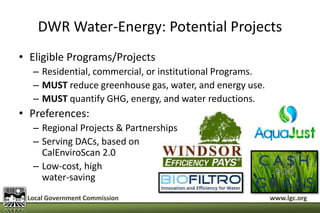
  • #12  Project Specs Residential, commercial, or institutional water efficiency programs or projects Must reduce greenhouse gas emissions, and also reduce water and energy use. MUST QUANTIFY: volume water /kWh energy; GHG energy intensity factor, emission factor Strong preference for DACs (at least 50% of funding, 75% of projects, to benefit) Regional projects encouraged Emphasis on water supply systems “System Boundary” defined as water service area boundary low-cost, high water saving projects preferred Highest Priority Rank will: benefit DAC, high water savings, high energy savings, sufficiently meets “agreement components” Examples "AquaJust™ lets families and firms track and trade the water they save. As a trusted broker, AquaJust integrates our sharing software with any utility hardware for a few cents per meter, and earns a modest commission on transactions by guaranteeing the secure, transparent, accurate, smooth, and certified transfer of valuable savings down to the exact gallon. ” "Biofiltro technology produces water suitable for irrigation from waste water sources contaminated with organic solids and nutrients. PAYS Efficiency upgrades are installed, bill is paid back by resident, via their water bill. Efficiency measures are chosen that result in combined savings on energy and water bill that is more then the monthly cost of the upgrade Cash for Grass
  • #13 In addition to furthering the goals of AB 32, these types of projects are integral to developing a more sustainable water management system statewide. Provides funds ($25m) to Implement projects that provide carbon sequestration benefits Eligible Applicants Likely to include public agencies, recognized tribes, and qualified non-profit organizations Eligible Project Types Restoration of wetlands (including those in the Delta) in coastal watersheds and mountain meadows. Projects that lead to water use efficiency in wetlands Timing Solicitation release: Anticipated by 11/7 Proposals due: Unknown Awards: Unknown
  • #14 Review program guidelines to understand process, scopes and timing Look at existing programs or projects you already have you that might be eligible to expand or replicate Talk with likely partners and participants to identify Assess needs in your region for specific areas Ask your neighbors what they are thinking to identify ways to combine efforts Identify “disadvantaged communities” within your jurisdictions and compare opportunities to needs.