Scriptwriting
for Radio
Introduction ….
• The purpose of scripted material is to make sure that all the
content that needs to be covered is on the script. The
variety of dialogue that is pre-scripted is ,
underestimated, particularly in music sequence
production where music track introductions and backannouncements are sometime scripted and distributed
via the internet daily to radio stations, leaving often only
a small amount of time in the middle of a link available
for the presenter to ad-lib.
Linguistic Conventions
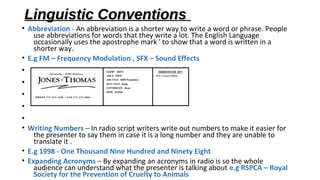
• Abbreviation - An abbreviation is a shorter way to write a word or phrase. People
use abbreviations for words that they write a lot. The English Language
occasionally uses the apostrophe mark ' to show that a word is written in a
shorter way.
• E.g FM – Frequency Modulation , SFX – Sound Effects
•
•
•
•
•
• Writing Numbers – In radio script writers write out numbers to make it easier for
the presenter to say them in case it is a long number and they are unable to
translate it .
• E.g 1998 - One Thousand Nine Hundred and Ninety Eight
• Expanding Acronyms – By expanding an acronyms in radio is so the whole
audience can understand what the presenter is talking about e.g RSPCA – Royal
Society for the Prevention of Cruelty to Animals
More Linguistic Conventions……..
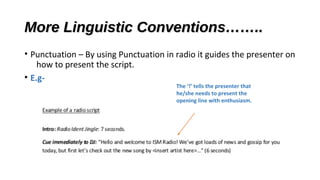
• Punctuation – By using Punctuation in radio it guides the presenter on
how to present the script.
• E.gThe ‘!’ tells the presenter that
he/she needs to present the
opening line with enthusiasm.
• Formal and Colloquial Language - Colloquial English is English as it is
spoken, as compared to formal English which follows all of the rules
of grammar - written English tends to be more formal than spoken.
E.g - "My old man's wheels are fully sick" which would translate to
"My Dad's car is great".
• Jargon – Jargon is like a type of shorthand between members of a
particular group of people, often words that are meaningless
outside of a certain context.
• E.g – Milatary Jargon - TD - Temporary duty , AWOL - Absent
without leave
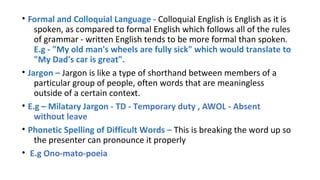
• Phonetic Spelling of Difficult Words – This is breaking the word up so
the presenter can pronounce it properly
• E.g Ono-mato-poeia
Style
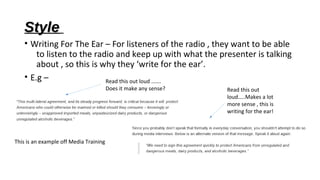
• Writing For The Ear – For listeners of the radio , they want to be able
to listen to the radio and keep up with what the presenter is talking
about , so this is why they ‘write for the ear’.
• E.g –
Read this out loud …….
Does it make any sense?

This is an example off Media Training

Read this out
loud…..Makes a lot
more sense , this is
writing for the ear!
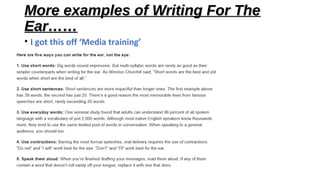
More examples of Writing For The
Ear……
• I got this off ‘Media training’
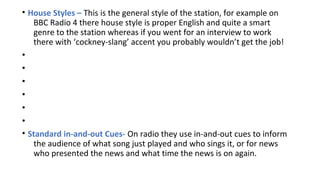
• House Styles – This is the general style of the station, for example on
BBC Radio 4 there house style is proper English and quite a smart
genre to the station whereas if you went for an interview to work
there with ‘cockney-slang’ accent you probably wouldn’t get the job!
•
•
•
•
•
•
• Standard in-and-out Cues- On radio they use in-and-out cues to inform
the audience of what song just played and who sings it, or for news
who presented the news and what time the news is on again.
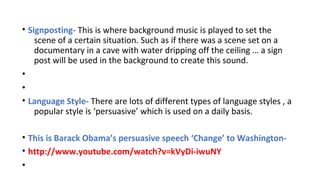
• Signposting- This is where background music is played to set the
scene of a certain situation. Such as if there was a scene set on a
documentary in a cave with water dripping off the ceiling … a sign
post will be used in the background to create this sound.
•
•
• Language Style- There are lots of different types of language styles , a
popular style is ‘persuasive’ which is used on a daily basis.
• This is Barack Obama’s persuasive speech ‘Change’ to Washington• http://www.youtube.com/watch?v=kVyDi-iwuNY
•
Recognised Genres….

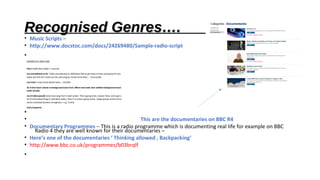
• Music Scripts –
• http://www.docstoc.com/docs/24269480/Sample-radio-script
•
•
•
•
•
•
•
•
This are the documentaries on BBC R4
• Documentary Programmes – This is a radio programme which is documenting real life for example on BBC
Radio 4 they are well known for their documentaries –
• Here’s one of the documentaries ‘ Thinking allowed , Backpacking’
• http://www.bbc.co.uk/programmes/b03brqlf
•
• Speech Packages –
•
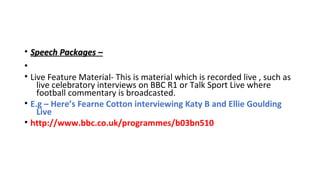
• Live Feature Material- This is material which is recorded live , such as
live celebratory interviews on BBC R1 or Talk Sport Live where
football commentary is broadcasted.
• E.g – Here’s Fearne Cotton interviewing Katy B and Ellie Goulding
Live
• http://www.bbc.co.uk/programmes/b03bn510

Scriptwriting for radio

  • 1.
  • 2.
    Introduction …. • Thepurpose of scripted material is to make sure that all the content that needs to be covered is on the script. The variety of dialogue that is pre-scripted is , underestimated, particularly in music sequence production where music track introductions and backannouncements are sometime scripted and distributed via the internet daily to radio stations, leaving often only a small amount of time in the middle of a link available for the presenter to ad-lib.
  • 3.
    Linguistic Conventions • Abbreviation- An abbreviation is a shorter way to write a word or phrase. People use abbreviations for words that they write a lot. The English Language occasionally uses the apostrophe mark ' to show that a word is written in a shorter way. • E.g FM – Frequency Modulation , SFX – Sound Effects • • • • • • Writing Numbers – In radio script writers write out numbers to make it easier for the presenter to say them in case it is a long number and they are unable to translate it . • E.g 1998 - One Thousand Nine Hundred and Ninety Eight • Expanding Acronyms – By expanding an acronyms in radio is so the whole audience can understand what the presenter is talking about e.g RSPCA – Royal Society for the Prevention of Cruelty to Animals
  • 4.
    More Linguistic Conventions…….. •Punctuation – By using Punctuation in radio it guides the presenter on how to present the script. • E.gThe ‘!’ tells the presenter that he/she needs to present the opening line with enthusiasm.
  • 5.
    • Formal andColloquial Language - Colloquial English is English as it is spoken, as compared to formal English which follows all of the rules of grammar - written English tends to be more formal than spoken. E.g - "My old man's wheels are fully sick" which would translate to "My Dad's car is great". • Jargon – Jargon is like a type of shorthand between members of a particular group of people, often words that are meaningless outside of a certain context. • E.g – Milatary Jargon - TD - Temporary duty , AWOL - Absent without leave • Phonetic Spelling of Difficult Words – This is breaking the word up so the presenter can pronounce it properly • E.g Ono-mato-poeia
  • 6.
    Style • Writing ForThe Ear – For listeners of the radio , they want to be able to listen to the radio and keep up with what the presenter is talking about , so this is why they ‘write for the ear’. • E.g – Read this out loud ……. Does it make any sense? This is an example off Media Training Read this out loud…..Makes a lot more sense , this is writing for the ear!
  • 7.
    More examples ofWriting For The Ear…… • I got this off ‘Media training’
  • 8.
    • House Styles– This is the general style of the station, for example on BBC Radio 4 there house style is proper English and quite a smart genre to the station whereas if you went for an interview to work there with ‘cockney-slang’ accent you probably wouldn’t get the job! • • • • • • • Standard in-and-out Cues- On radio they use in-and-out cues to inform the audience of what song just played and who sings it, or for news who presented the news and what time the news is on again.
  • 9.
    • Signposting- Thisis where background music is played to set the scene of a certain situation. Such as if there was a scene set on a documentary in a cave with water dripping off the ceiling … a sign post will be used in the background to create this sound. • • • Language Style- There are lots of different types of language styles , a popular style is ‘persuasive’ which is used on a daily basis. • This is Barack Obama’s persuasive speech ‘Change’ to Washington• http://www.youtube.com/watch?v=kVyDi-iwuNY •
  • 10.
    Recognised Genres…. • MusicScripts – • http://www.docstoc.com/docs/24269480/Sample-radio-script • • • • • • • • This are the documentaries on BBC R4 • Documentary Programmes – This is a radio programme which is documenting real life for example on BBC Radio 4 they are well known for their documentaries – • Here’s one of the documentaries ‘ Thinking allowed , Backpacking’ • http://www.bbc.co.uk/programmes/b03brqlf •
  • 11.
    • Speech Packages– • • Live Feature Material- This is material which is recorded live , such as live celebratory interviews on BBC R1 or Talk Sport Live where football commentary is broadcasted. • E.g – Here’s Fearne Cotton interviewing Katy B and Ellie Goulding Live • http://www.bbc.co.uk/programmes/b03bn510