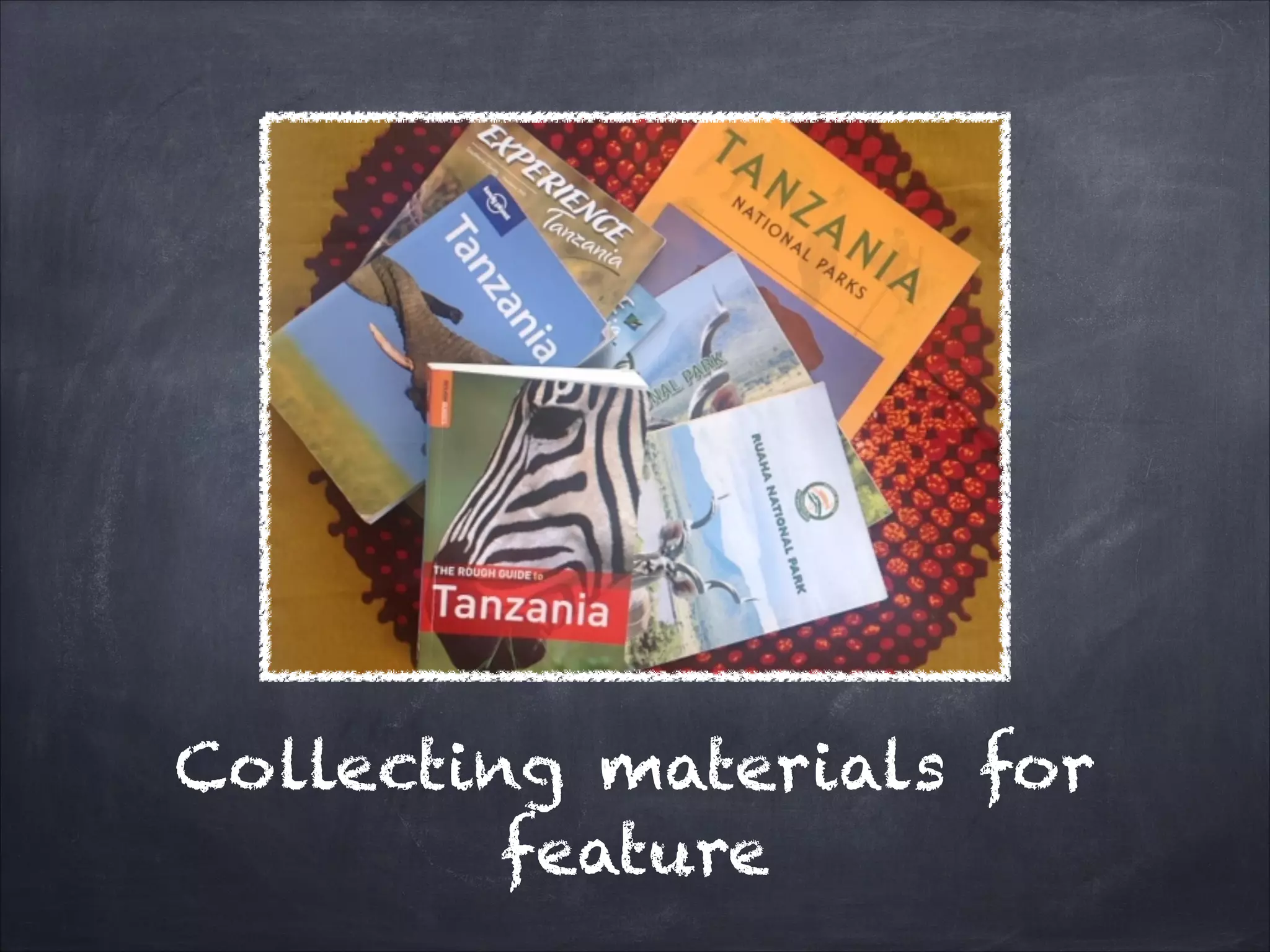
Collecting materials for
feature
Sources for feature...
People sources
Your own experiences, observations, perceptions, emotions
Someone elses experiences and action
Interviews and discussions with people
Printed sources (crf. published sources in Garrison 2004)
Various documents and publications in archives, libraries etc.
Online sources (crf. computer-based sources in Garrison 2004)
Electronic databases and journals (e.g. EBSCO in Tumaini's library!!!)
Open online journals, reports and research publications
Social media
Websites of organizations etc.
...and how to use
them as material
Describing your observations and perseption, reactions and
emotions
Describing reactions by "general public" or a specific group (e.g.
in social media)
Direct quatations from interviews/discussions
Parafrasing thoughts expressed by interviewee
Pieces of dialogue between characters
Describing action by characters: what does someone do
Integrating facts, fugures, statistics etc. into your storyline
(usually without identifyng the document source)
You first need to know enough of the
topic to know who to interview and to
be able to ask meaningful questions
from your interviewees!

BACKGROUND
RESEARCH
"I regularly use library and online
services to flesh out my background
knowledge before I call anybody - I've
found most sources are exponentially
more forthcoming when you indicate
that you have at least a rudimentary
knowledge of what you are asking them.
They also are more likely to think you'll
know if they are lying, so they don't try
it so often." (Feature writer Steve
Perlstein in Garrison 2004, 58)
INTERVIEW
Who to interview: experts, eyewitnesses, users/
consumers, "people in the street"...?
Focus on persons who have personal experiences of
the issue in question! Experts of their own life and
situation!
Choose one main character for story, if possible.
Don't give main role to authorities/"formal experts"
BUT they may provide useful background
information and facts.
INTERVIEW
Prepare, prepare, prepare!!!
Use a digital recorded, if possible. Otherwise
make very careful notes, especially of pieces
you might consider using as direct quotes.
Choose the place for the interview carefully
- not too much background noice;
somewhere were the interviewee is in his/her
"natural environment".
INTERVIEW
Create trust, be descrete and trustworthy:
Let the interviewee know exactly for what you
are planning to use her/his interview.
If interviewee wants to read the article before
publishing, arrange that.
If the topic is sensitive, discuss with
interviewee, whether you should use only the
first name ot an alias instead of the real name.
INTERVIEW
During the interview, make
observations and notes also on the
interviewee and the location - his/
her voice, tone, expressions; what he
does; the surroundings - of all the
little details that make the scene
alive for readers.
OBSERVATIONS
Use all of your senses: don't just see,
but also smell, listen and touch/feel.
Make DETAILED observations.
Write down detailed notes on your
observations and perceptions; and of the
emotions they arouse in you.
"A Field diary".
FACT CHECKING
Just as important as in news!
Different sources than when
collecting personal experiences,
observations, opinions etc....
Remember critical evaluation of your
sources, especially of online sources!
FACT CHECKING
Critical questions:
Expertise: who is the author of the text?
Motivation: does the author/publisher have
their own agenda/vested interests in issue?
Timeliness: When was the text/publication
written/published? Has it been updated
since?
FACT CHECKING
Who is a reliable source then?
Research institutes
University researchers
Established international organizations (UN, Unisef,
Unesco, UNDP etc.; ILO, WHO, WFP, Red Cross etc.)
Merited professionals in the field
Many national or regional NGOs/CSOs
FACT CHECKING
Do not take your facts from
Discussion forums
Individual bloggers
Facebook or Twitter
Press relieses, websites and publications of
organizations or individuals you don't know
well and/or who clearly have their own agenda
to advocate.
FACT CHECKING
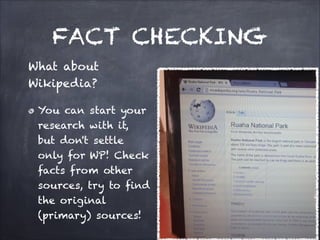
What about
Wikipedia?
You can start your
research with it,
but don't settle
only for WP! Check
facts from other
sources, try to find
the original
(primary) sources!

Sources and Materials in Feature

  • 1.
  • 2.
    Sources for feature... Peoplesources Your own experiences, observations, perceptions, emotions Someone elses experiences and action Interviews and discussions with people Printed sources (crf. published sources in Garrison 2004) Various documents and publications in archives, libraries etc. Online sources (crf. computer-based sources in Garrison 2004) Electronic databases and journals (e.g. EBSCO in Tumaini's library!!!) Open online journals, reports and research publications Social media Websites of organizations etc.
  • 3.
    ...and how touse them as material Describing your observations and perseption, reactions and emotions Describing reactions by "general public" or a specific group (e.g. in social media) Direct quatations from interviews/discussions Parafrasing thoughts expressed by interviewee Pieces of dialogue between characters Describing action by characters: what does someone do Integrating facts, fugures, statistics etc. into your storyline (usually without identifyng the document source)
  • 4.
    You first needto know enough of the topic to know who to interview and to be able to ask meaningful questions from your interviewees! BACKGROUND RESEARCH
  • 5.
    "I regularly uselibrary and online services to flesh out my background knowledge before I call anybody - I've found most sources are exponentially more forthcoming when you indicate that you have at least a rudimentary knowledge of what you are asking them. They also are more likely to think you'll know if they are lying, so they don't try it so often." (Feature writer Steve Perlstein in Garrison 2004, 58)
  • 6.
    INTERVIEW Who to interview:experts, eyewitnesses, users/ consumers, "people in the street"...? Focus on persons who have personal experiences of the issue in question! Experts of their own life and situation! Choose one main character for story, if possible. Don't give main role to authorities/"formal experts" BUT they may provide useful background information and facts.
  • 7.
    INTERVIEW Prepare, prepare, prepare!!! Usea digital recorded, if possible. Otherwise make very careful notes, especially of pieces you might consider using as direct quotes. Choose the place for the interview carefully - not too much background noice; somewhere were the interviewee is in his/her "natural environment".
  • 8.
    INTERVIEW Create trust, bedescrete and trustworthy: Let the interviewee know exactly for what you are planning to use her/his interview. If interviewee wants to read the article before publishing, arrange that. If the topic is sensitive, discuss with interviewee, whether you should use only the first name ot an alias instead of the real name.
  • 9.
    INTERVIEW During the interview,make observations and notes also on the interviewee and the location - his/ her voice, tone, expressions; what he does; the surroundings - of all the little details that make the scene alive for readers.
  • 10.
    OBSERVATIONS Use all ofyour senses: don't just see, but also smell, listen and touch/feel. Make DETAILED observations. Write down detailed notes on your observations and perceptions; and of the emotions they arouse in you. "A Field diary".
  • 11.
    FACT CHECKING Just asimportant as in news! Different sources than when collecting personal experiences, observations, opinions etc.... Remember critical evaluation of your sources, especially of online sources!
  • 12.
    FACT CHECKING Critical questions: Expertise:who is the author of the text? Motivation: does the author/publisher have their own agenda/vested interests in issue? Timeliness: When was the text/publication written/published? Has it been updated since?
  • 13.
    FACT CHECKING Who isa reliable source then? Research institutes University researchers Established international organizations (UN, Unisef, Unesco, UNDP etc.; ILO, WHO, WFP, Red Cross etc.) Merited professionals in the field Many national or regional NGOs/CSOs
  • 14.
    FACT CHECKING Do nottake your facts from Discussion forums Individual bloggers Facebook or Twitter Press relieses, websites and publications of organizations or individuals you don't know well and/or who clearly have their own agenda to advocate.
  • 15.
    FACT CHECKING What about Wikipedia? Youcan start your research with it, but don't settle only for WP! Check facts from other sources, try to find the original (primary) sources!