G. Pourmand MD.  Tehran University of Medical Sciences May- June 2008 Point counterpoint: Prostate cancer in the elderly man: Should we screen men after age 65 years?
Yes   No Is prostate cancer a health care problem?
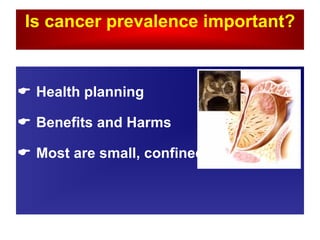
Is cancer prevalence important?    Health planning     Benefits and Harms     Most are small, confined
Cancer Incidence Rates * for Men US, 1973-1999
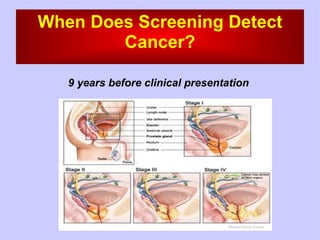
When Does Screening Detect Cancer? 9 years before clinical presentation
What about the prognosis?    Screen- Detected Prostate Cancer  Conventionally Presenting Localized Disease  P.W. Nicholson, BJU International  2002,90,686-693
To Screen or Not !  •  Serious Public Problem. •  Asymp. Localized Phase  Sensitivity, Specificity  and Predictive Values  •  The Potential for Cure  •  Improved Outcomes Relation to  Screen
   Cost- effectiveness     Avoid detecting biologically unimportant cancers     Detect and treat tumors  Progress, Produce Symptoms and  Reduce Life Expectancy
American Cancer Society Modification  (Men who eligible for Pca Screening) PSA and DRE  Annually Should or Offer?
American Academy of Family     Physician And US Preventive Services  Task Force     Do not Recommend Routine Screening in Low- Risk Patients
National Screening  1996 Counseling  Potential  Harms    Benefits  Scientific Uncertainties
Patient- Clinician Process ( Joint Decision Making) and  (Agree on a Course of Action)
PSA and DRE from 50 years  Life expectancy of at least 10 years  Discussion
PSA < 2 mg/ml  Biannually  PSA ≥ 2 mg/ml  Annually
PSA  (1980) Most useful tumor marker  1- Detection  2- Monitoring   Radiation  Radical prostatectomy  Systemic therapy
PSA  Glycoprotein  Almost Exclusively in Prostate Epithelial Cells
BPH  Prostatitis Prostatic Infarction  Is PSA Ideal Tumor Marker?
PSA thershold = 4 ng/mL: 65% F. Positive rate  20% F. Negative rate PSA: 3 ng/mL  Sensitivity  Positive Predictive Value
PSA Density  PSA Velocity  Age Specific Reference  May Increase Sensitivity and specificity
Age Specific PSA,  Reference Range Age, yr Reference Range, ng/ml 40-49 …………………….. 0.0-2.5 50-59 …………………….. 0.0-3.5 60-69 …………………….. 0.0-4.5 70-79 …………………….. 0.0-6.5
Use of PSA and PSA density to detect prostate cancer in men with normal DRE   PSA density (Threshold) Sensitivity % Specificity % Positive Predictive Value % 0.10 …………… 95 24 29 0.15 …………… 79 50 34 0.30 ……………. 45 85 50 0.50 ……………. 29 95 65
Correlation Between PSA and Prostate Cancer
Total PSA (ng/mL) PSA Density= Total prostate volume (mL)
PSA Velocity  PSA ≥ 0.75 ng/mL
Digital Rectal Examination • Detect missed Pca by PSA Screening  •  Able to detect asymptomatic patient  •  Abnormal DRE (3.2%-10%) •  Pca (0.2%-1.7%) in original group
ACS    DRE + Occult Blood >40 yrs     The (+ve) Predictive Value 17.8%    Sensitivity of DRE: 53.2%    Specificity of DRE: 83.6%
Trans Rectal UltraSonography   Expensive     Not available for family physicians     Suffers from lack of specificity
Biopsy 1- Elevated PSA + Benign DRE  TRUS  Visible abnormal lesions 2- Abnormal DRE + TRUS  Regardless of PSA
Charecteristics of Screening Tests   Test Sensitivity % Specificity % Positive Predictive Value % DRE 45-58 96-97 24-58 TRUS 71-91 89-94 15-43 PSA > 4 ng/ml 67-89 59-97 33-47
 
1 Andorra 83.53 2 Macau 82.35 … . 47 United States 78.14 … 130 Iran 70.86 … 222 Angola 37.92 223 Swaziland 31.99 World’s Life expectancy report
Population Pyramid for USA
Population Pyramid for Iran
1384: 2722
Points Age-specific Incidence Rate of Prostate cancer  per 100,000 Population in Iran (2005-2006)
Prostate cancer screening remains widespread, despite recommendations against routine screening by the United States Preventive Services Task Force and the ACP, and recommendations by the AAFP for counseling about the known risks and uncertain benefits of screening for prostate cancer.  Recent evidence shows that men older than 75 years are frequently screened for prostate cancer, despite current guidelines suggesting they are unlikely to benefit from treatment as the disease develops slowly in this age group.  Counterpoints
Table shavad In a national surveys of physician-reported information carried out from 1999 to 2002 by Duke University Medical Center researchers: Counterpoints (Cont.)
Counterpoints (Cont.) They concluded that  Urologists were more likely to initiate the tests than non-urologists.  Excessive PSA testing has direct and indirect costs, and reflects an inefficient allocation of resources.
In another National Ambulatory Medical Care Surveys performed in 1995-6: Counterpoints (Cont.)
High incidence of Pca in Iranian elderly men - Ethical & moral values Short life following the detection  considering the life expectancy  Slow growing tumor Death due to other complications Shall we screen elderly?
 

Prostate cancer (screening)

  • 1.
  • 2.
    G. Pourmand MD. Tehran University of Medical Sciences May- June 2008 Point counterpoint: Prostate cancer in the elderly man: Should we screen men after age 65 years?
  • 3.
    Yes No Is prostate cancer a health care problem?
  • 4.
    Is cancer prevalenceimportant?  Health planning  Benefits and Harms  Most are small, confined
  • 5.
    Cancer Incidence Rates* for Men US, 1973-1999
  • 6.
    When Does ScreeningDetect Cancer? 9 years before clinical presentation
  • 7.
    What about theprognosis?  Screen- Detected Prostate Cancer Conventionally Presenting Localized Disease P.W. Nicholson, BJU International 2002,90,686-693
  • 8.
    To Screen orNot ! • Serious Public Problem. • Asymp. Localized Phase Sensitivity, Specificity and Predictive Values • The Potential for Cure • Improved Outcomes Relation to Screen
  • 9.
    Cost- effectiveness  Avoid detecting biologically unimportant cancers  Detect and treat tumors Progress, Produce Symptoms and Reduce Life Expectancy
  • 10.
    American Cancer SocietyModification (Men who eligible for Pca Screening) PSA and DRE Annually Should or Offer?
  • 11.
    American Academy ofFamily  Physician And US Preventive Services Task Force  Do not Recommend Routine Screening in Low- Risk Patients
  • 12.
    National Screening 1996 Counseling Potential Harms  Benefits Scientific Uncertainties
  • 13.
    Patient- Clinician Process( Joint Decision Making) and (Agree on a Course of Action)
  • 14.
    PSA and DREfrom 50 years Life expectancy of at least 10 years Discussion
  • 15.
    PSA < 2mg/ml Biannually PSA ≥ 2 mg/ml Annually
  • 16.
    PSA (1980)Most useful tumor marker 1- Detection 2- Monitoring Radiation Radical prostatectomy Systemic therapy
  • 17.
    PSA  Glycoprotein Almost Exclusively in Prostate Epithelial Cells
  • 18.
    BPH ProstatitisProstatic Infarction Is PSA Ideal Tumor Marker?
  • 19.
    PSA thershold =4 ng/mL: 65% F. Positive rate 20% F. Negative rate PSA: 3 ng/mL Sensitivity Positive Predictive Value
  • 20.
    PSA Density PSA Velocity Age Specific Reference May Increase Sensitivity and specificity
  • 21.
    Age Specific PSA, Reference Range Age, yr Reference Range, ng/ml 40-49 …………………….. 0.0-2.5 50-59 …………………….. 0.0-3.5 60-69 …………………….. 0.0-4.5 70-79 …………………….. 0.0-6.5
  • 22.
    Use of PSAand PSA density to detect prostate cancer in men with normal DRE PSA density (Threshold) Sensitivity % Specificity % Positive Predictive Value % 0.10 …………… 95 24 29 0.15 …………… 79 50 34 0.30 ……………. 45 85 50 0.50 ……………. 29 95 65
  • 23.
    Correlation Between PSAand Prostate Cancer
  • 24.
    Total PSA (ng/mL)PSA Density= Total prostate volume (mL)
  • 25.
    PSA Velocity PSA ≥ 0.75 ng/mL
  • 26.
    Digital Rectal Examination• Detect missed Pca by PSA Screening • Able to detect asymptomatic patient • Abnormal DRE (3.2%-10%) • Pca (0.2%-1.7%) in original group
  • 27.
    ACS  DRE + Occult Blood >40 yrs  The (+ve) Predictive Value 17.8%  Sensitivity of DRE: 53.2%  Specificity of DRE: 83.6%
  • 28.
    Trans Rectal UltraSonography  Expensive  Not available for family physicians  Suffers from lack of specificity
  • 29.
    Biopsy 1- ElevatedPSA + Benign DRE TRUS Visible abnormal lesions 2- Abnormal DRE + TRUS Regardless of PSA
  • 30.
    Charecteristics of ScreeningTests Test Sensitivity % Specificity % Positive Predictive Value % DRE 45-58 96-97 24-58 TRUS 71-91 89-94 15-43 PSA > 4 ng/ml 67-89 59-97 33-47
  • 31.
  • 32.
    1 Andorra 83.532 Macau 82.35 … . 47 United States 78.14 … 130 Iran 70.86 … 222 Angola 37.92 223 Swaziland 31.99 World’s Life expectancy report
  • 33.
  • 34.
  • 35.
  • 36.
    Points Age-specific IncidenceRate of Prostate cancer per 100,000 Population in Iran (2005-2006)
  • 37.
    Prostate cancer screeningremains widespread, despite recommendations against routine screening by the United States Preventive Services Task Force and the ACP, and recommendations by the AAFP for counseling about the known risks and uncertain benefits of screening for prostate cancer. Recent evidence shows that men older than 75 years are frequently screened for prostate cancer, despite current guidelines suggesting they are unlikely to benefit from treatment as the disease develops slowly in this age group. Counterpoints
  • 38.
    Table shavad Ina national surveys of physician-reported information carried out from 1999 to 2002 by Duke University Medical Center researchers: Counterpoints (Cont.)
  • 39.
    Counterpoints (Cont.) Theyconcluded that Urologists were more likely to initiate the tests than non-urologists. Excessive PSA testing has direct and indirect costs, and reflects an inefficient allocation of resources.
  • 40.
    In another NationalAmbulatory Medical Care Surveys performed in 1995-6: Counterpoints (Cont.)
  • 41.
    High incidence ofPca in Iranian elderly men - Ethical & moral values Short life following the detection considering the life expectancy Slow growing tumor Death due to other complications Shall we screen elderly?
  • 42.