Scientific Method
What is the Scientific Method? It is a  process  that is used to find  answers  to questions about the world around us.
Is there only one “scientific method”? NO!    there are several versions Some versions have more  steps  while others may have only a few. All begin with the identification of a  problem  or a  question  to be answered based on observations around us and provide an  organized  method for conducting and analyzing an experiment.
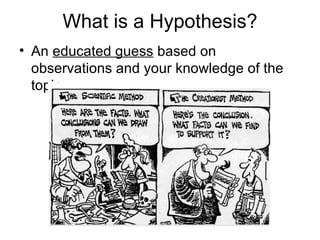
What is a Hypothesis? An  educated guess  based on observations and your knowledge of the topic.
What is Data? Information  gathered during an experiment.
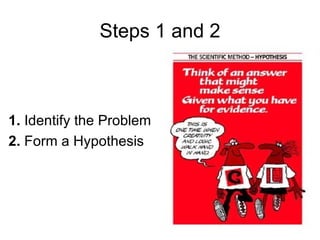
Steps 1 and 2 1.  Identify the Problem 2.  Form a Hypothesis
Steps 3 and 4 3.  Create an Experiment 4.  Perform an Experiment Parts of an Experiment : independent variable The variable changed dependent variable The variable that reacts because of the change Control Used as a standard of comparison Trials (minimum is 3) Repeated experiments
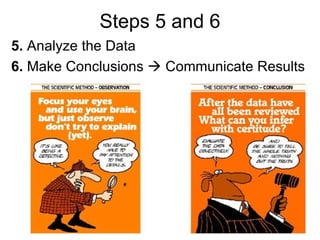
Steps 5 and 6 5.  Analyze the Data 6.  Make Conclusions    Communicate Results
Modify the Experiment (when data is inaccurate or experiment is flawed)
Hypothesis vs. Theory vs. Law Hypothesis :  possible answer to a question Theory :  a hypothesis that has been tested and supported many times. They serve as a basis for describing patterns that we observe in nature. Example : The Big Bang Theory Law :  a general statement that describes some pattern in nature. The statement must hold under the specified conditions without exception. Example : The Law of Gravity


Scientific Method

  • 1.
  • 2.
    What is theScientific Method? It is a process that is used to find answers to questions about the world around us.
  • 3.
    Is there onlyone “scientific method”? NO!  there are several versions Some versions have more steps while others may have only a few. All begin with the identification of a problem or a question to be answered based on observations around us and provide an organized method for conducting and analyzing an experiment.
  • 4.
    What is aHypothesis? An educated guess based on observations and your knowledge of the topic.
  • 5.
    What is Data?Information gathered during an experiment.
  • 6.
    Steps 1 and2 1. Identify the Problem 2. Form a Hypothesis
  • 7.
    Steps 3 and4 3. Create an Experiment 4. Perform an Experiment Parts of an Experiment : independent variable The variable changed dependent variable The variable that reacts because of the change Control Used as a standard of comparison Trials (minimum is 3) Repeated experiments
  • 8.
    Steps 5 and6 5. Analyze the Data 6. Make Conclusions  Communicate Results
  • 9.
    Modify the Experiment(when data is inaccurate or experiment is flawed)
  • 10.
    Hypothesis vs. Theoryvs. Law Hypothesis : possible answer to a question Theory : a hypothesis that has been tested and supported many times. They serve as a basis for describing patterns that we observe in nature. Example : The Big Bang Theory Law : a general statement that describes some pattern in nature. The statement must hold under the specified conditions without exception. Example : The Law of Gravity
  • 11.
  • 12.