Science
4
1st
Quarter
Week 1 Day 1
Content: Science Inventions
School-based Training of teachers on the
matatag Curriculum
Prepared by:
Dinalyn Rose C. Villamangca
Grade 4 Science Teacher
Activating Prior Knowledge
Activity 1: Inventions and
Scientists
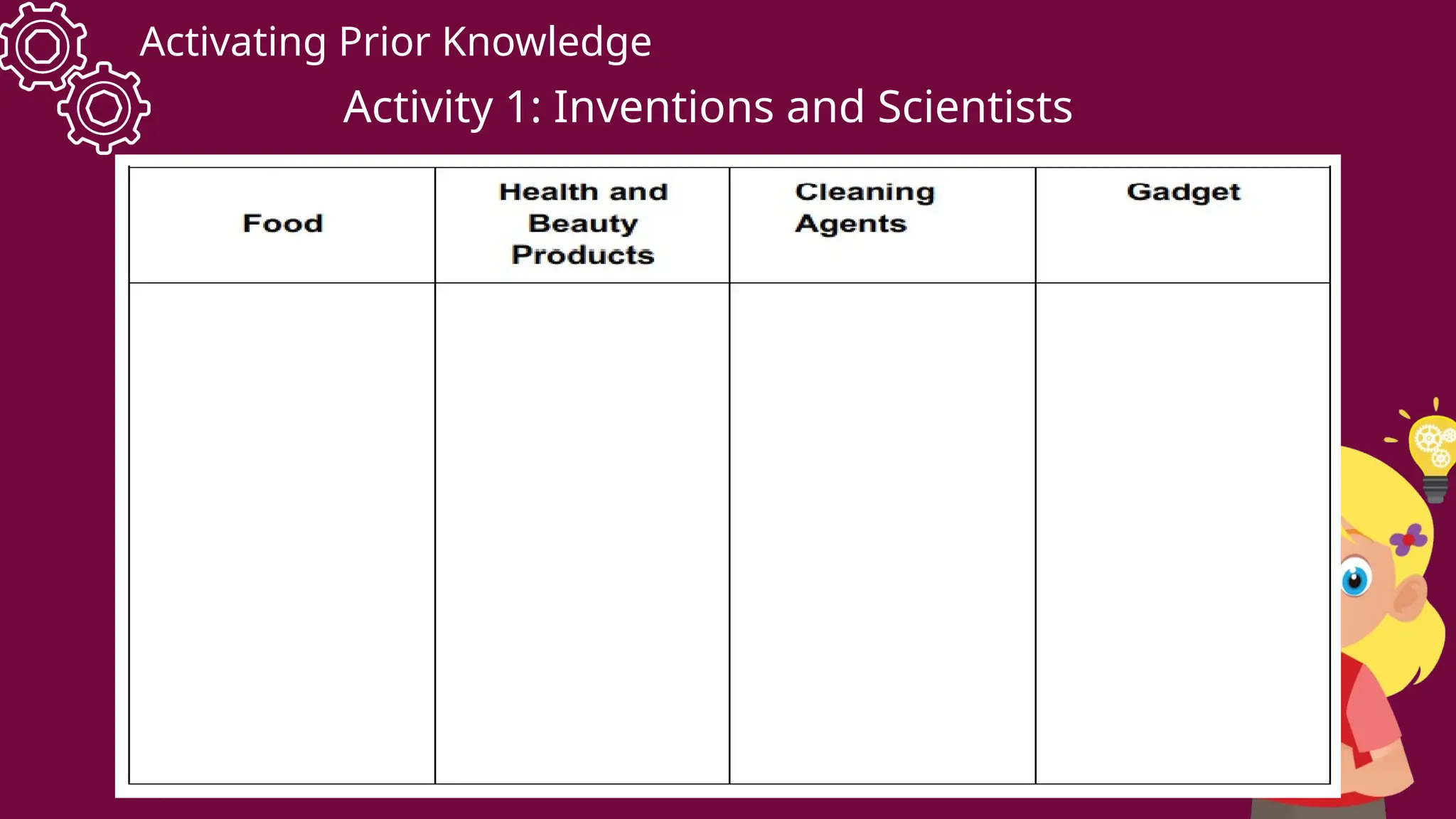
DIRECTION: In my bag, there are various
pictures of materials we use at home, school,
and in our community. What you will do is
choose one and classify it whether it is used
for food, health, cleaning agents, or gadgets
Activating Prior Knowledge
Activity 1: Inventions and Scientists
Lesson Purpose/Intention
All the materials you saw and answered
earlier are products of the hard work of our
scientists.
So today, the aim of this lesson is to study
their inventions and understand how we can
appreciate them and their inventions.
Lesson Language Practice
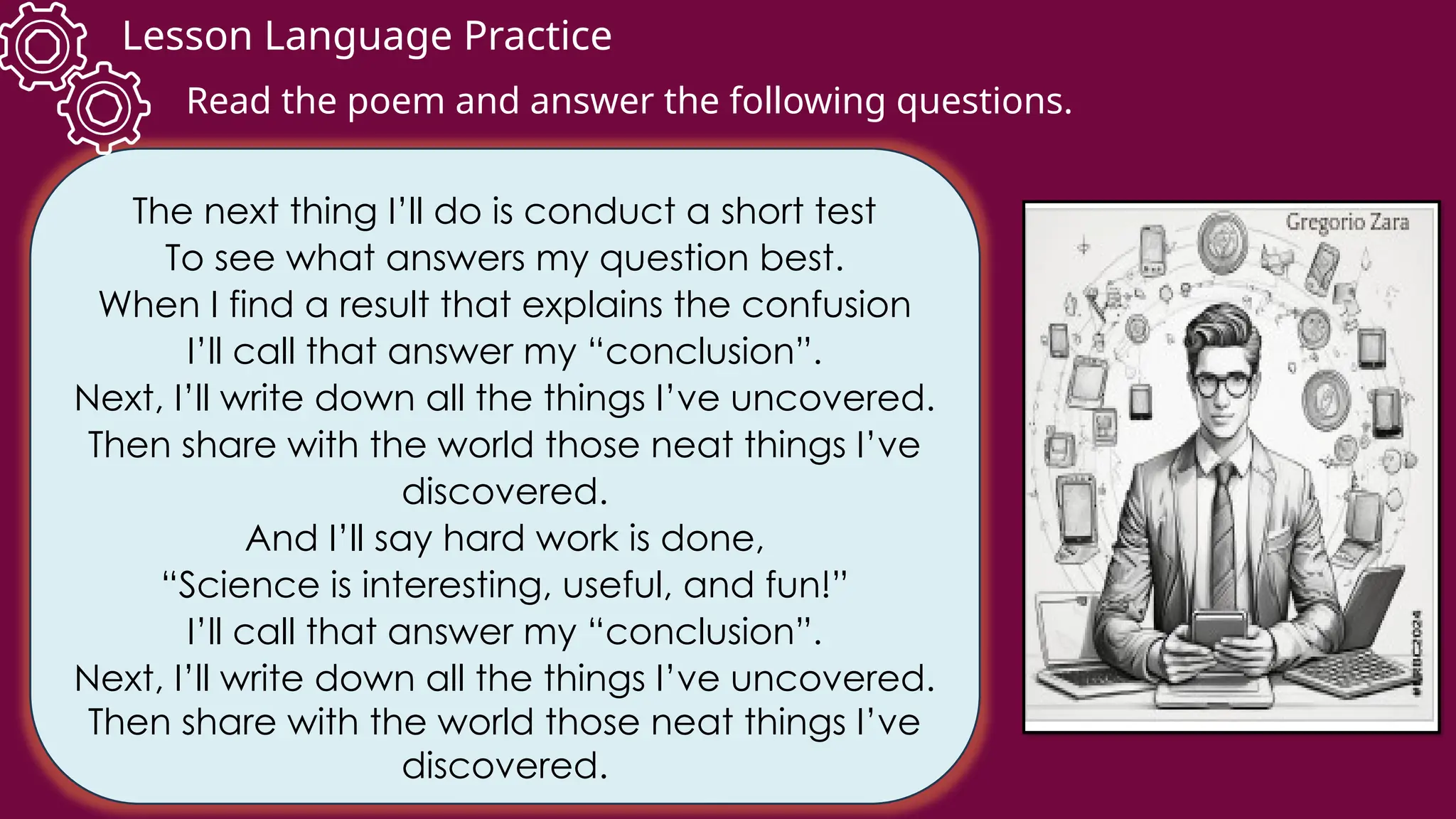
I Am a Scientist
by Brian Crawford
Illustrated by Lovely Rollaine B. Cruz
I am a scientist. What do I do?
I study the nature of things, old and new.
I take a close look at the things that I see.
And make guesses about all the ways they might
be.
When I find something neat, sometimes I will
ponder,
“Why does that thing behave like that, I wonder?
” I’ll come up with ideas – I’ll take a good guess,
And I’ll call my guess a “hypothesis”.
Read the poem and answer the following questions.
Lesson Language Practice
The next thing I’ll do is conduct a short test
To see what answers my question best.
When I find a result that explains the confusion
I’ll call that answer my “conclusion”.
Next, I’ll write down all the things I’ve uncovered.
Then share with the world those neat things I’ve
discovered.
And I’ll say hard work is done,
“Science is interesting, useful, and fun!”
I’ll call that answer my “conclusion”.
Next, I’ll write down all the things I’ve uncovered.
Then share with the world those neat things I’ve
discovered.
Read the poem and answer the following questions.
Lesson Language Practice
GUIDE QUESTIONS:
1.What should be the attitude of a
scientist?
Possible Answer: A scientist should be curious, ask
questions, make guesses, test those guesses, and
share what they learn. They should also find science
fun and interesting.
Lesson Language Practice
GUIDE QUESTIONS:
2.What are the scientific processes that
scientists do before discovering something?
Lesson Language Practice
GUIDE QUESTIONS:
Possible Answers:
1.Observe things closely: "I take a close look at the things that I see."
2.Make guesses, called hypotheses: "And I'll call my guess a 'hypothesis'."
3.Conduct tests to check their guesses: "The next thing I'll do is conduct a
short test."
4.Find results and make conclusions: "I'll call that answer my 'conclusion'."
5.Write down their findings: "Next, I'll write down all the things I've
uncovered."
6.Share their discoveries with others: "Then share with the world those
neat things I've discovered."
Lesson Language Practice
GUIDE QUESTIONS:
3. Based on the poem, how do you describe
the work of a scientist?
Possible Answer: Based on the poem "I Am a Scientist" by
Brian Crawford, the work of a scientist is described as a
process of curiosity, exploration, and discovery.
Reading the Key Idea/Stem
Read the important passages and answer the questions that follow.
Great Inventors, Inspiring
Inventions
Reading the Key Idea/Stem
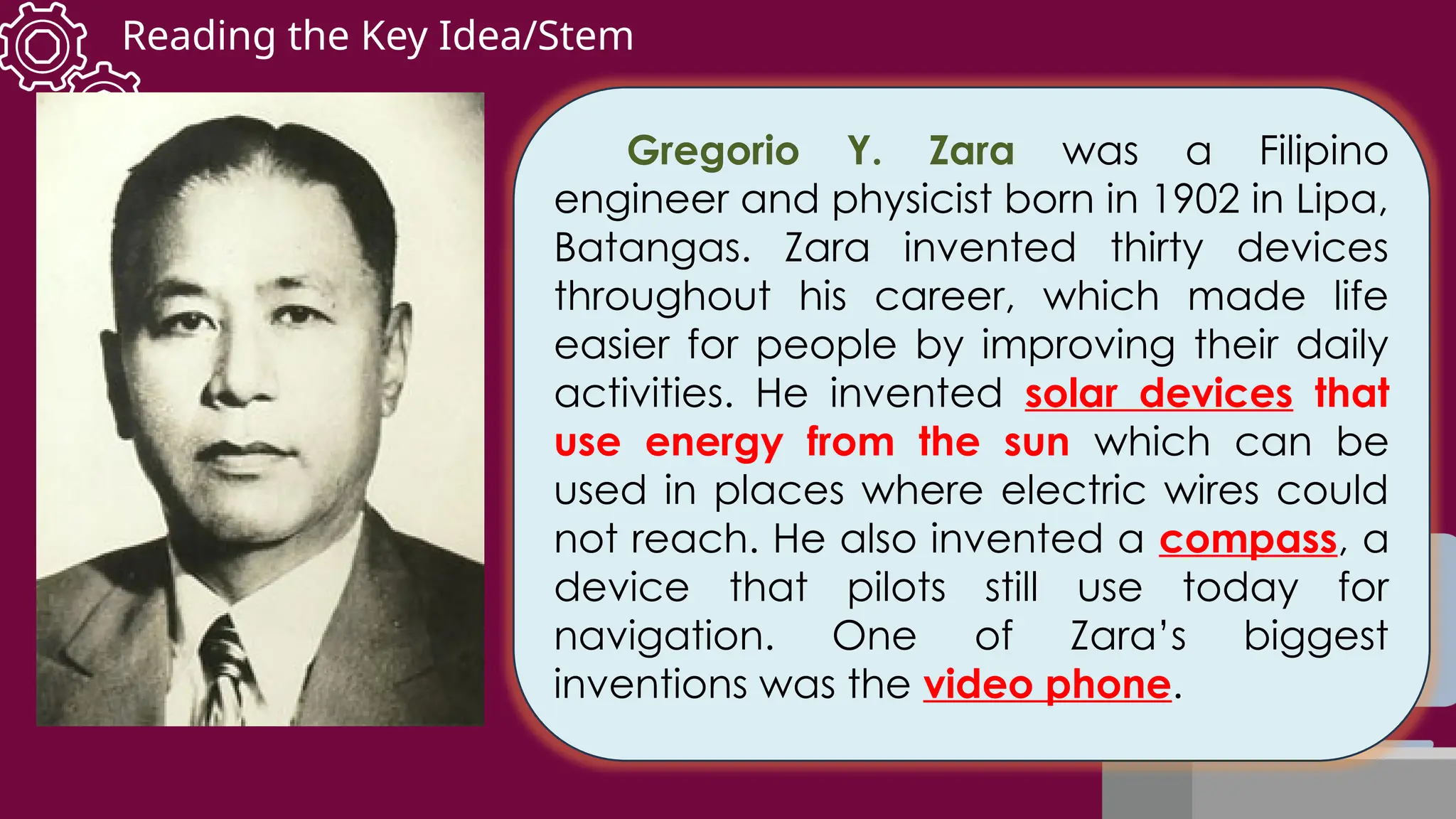
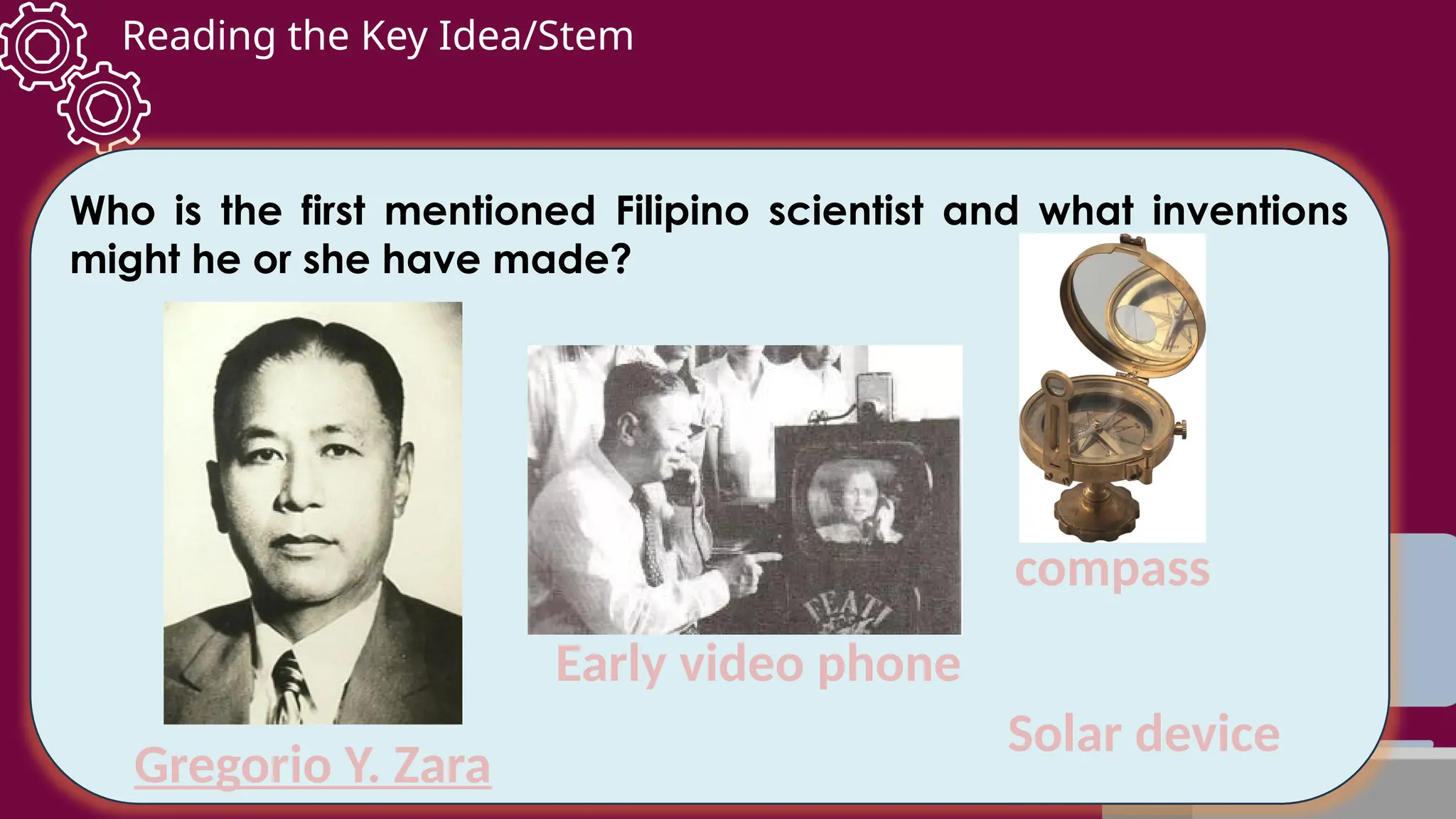
Gregorio Y. Zara was a Filipino
engineer and physicist born in 1902 in Lipa,
Batangas. Zara invented thirty devices
throughout his career, which made life
easier for people by improving their daily
activities. He invented solar devices that
use energy from the sun which can be
used in places where electric wires could
not reach. He also invented a compass, a
device that pilots still use today for
navigation. One of Zara’s biggest
inventions was the video phone.
Reading the Key Idea/Stem
Who is the first mentioned Filipino scientist and what inventions
might he or she have made?
Gregorio Y. Zara
Early video phone
compass
Solar device
Reading the Key Idea/Stem
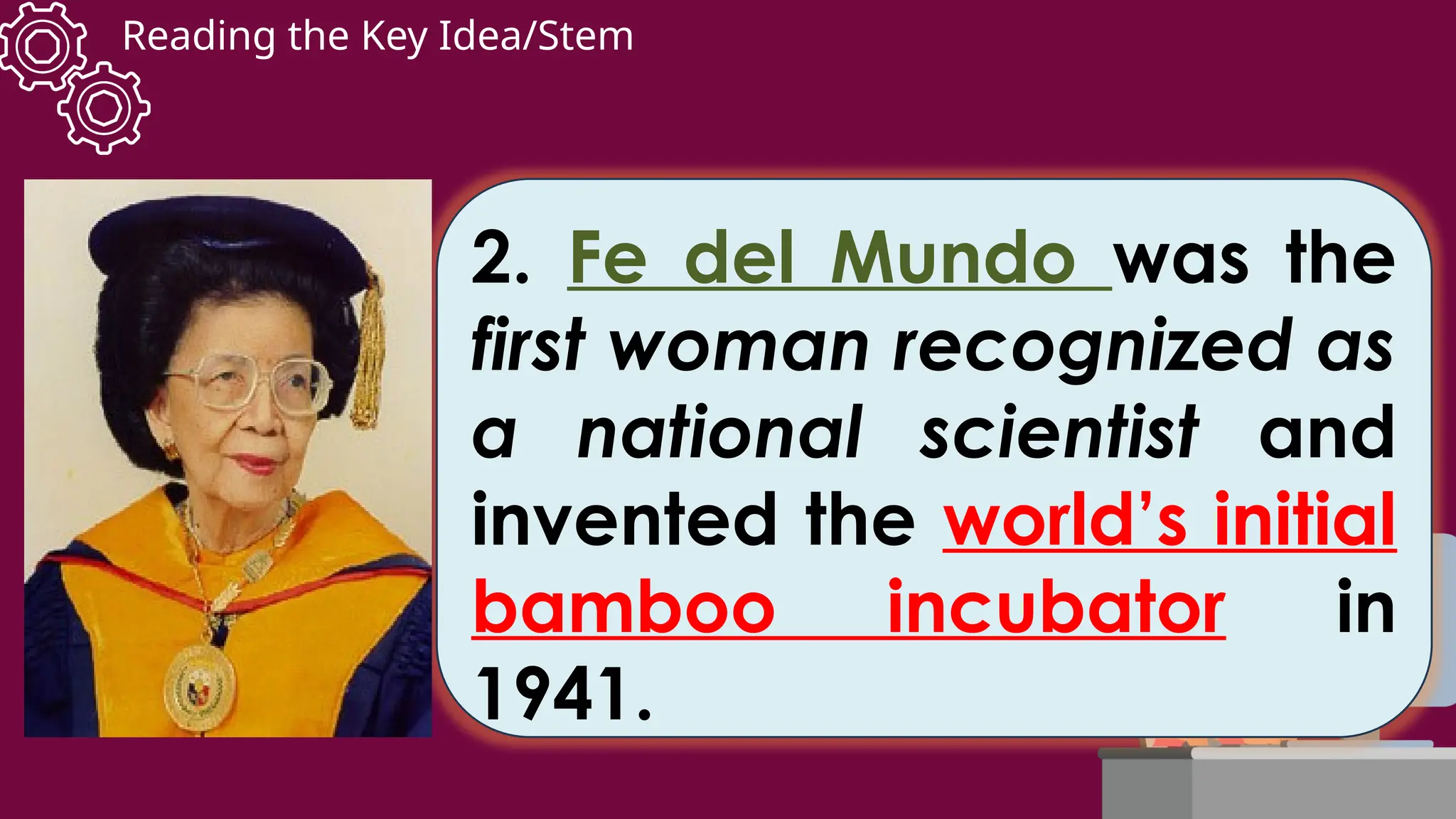
2. Fe del Mundo was the
first woman recognized as
a national scientist and
invented the world’s initial
bamboo incubator in
1941.
Reading the Key Idea/Stem
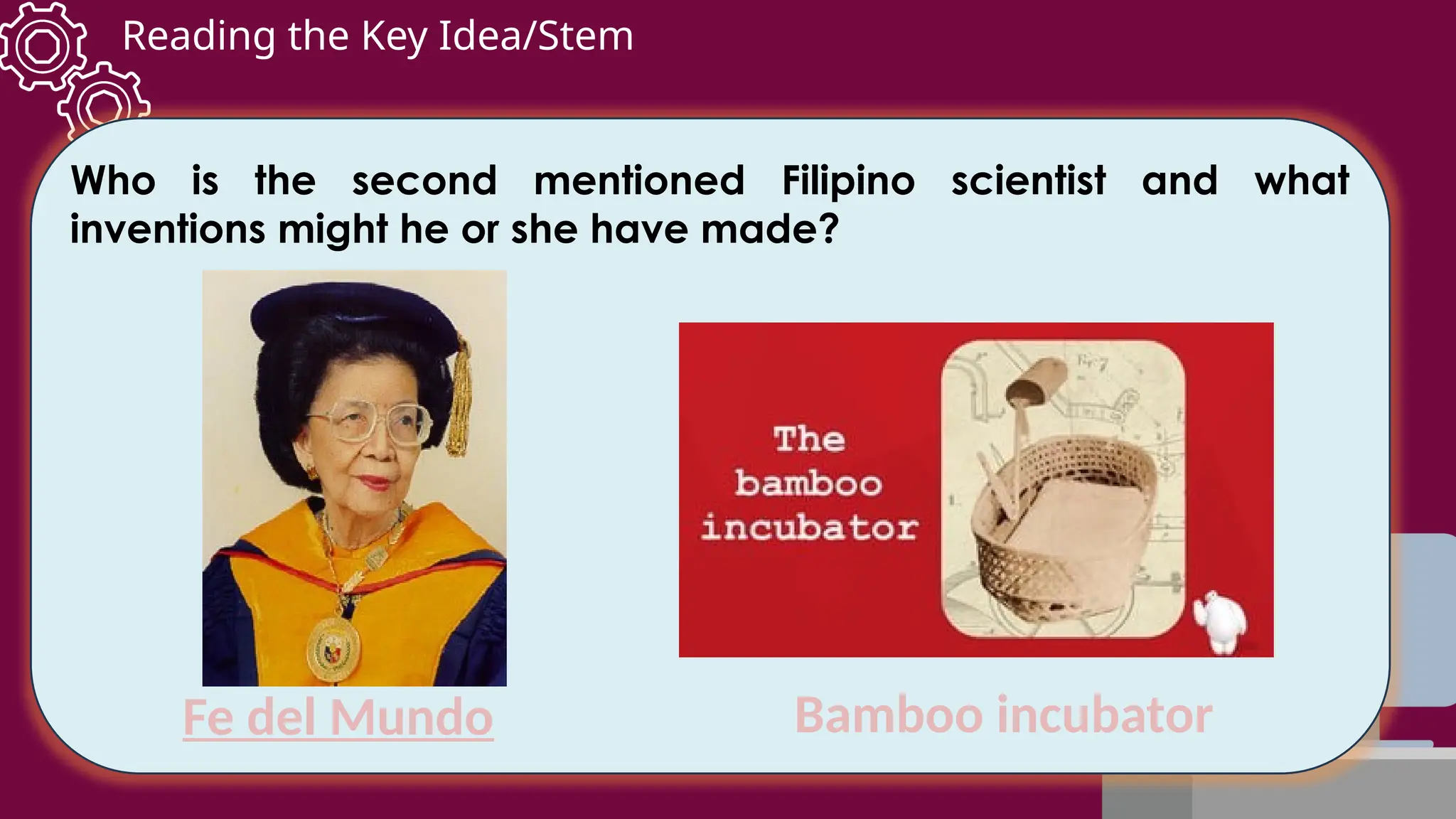
Who is the second mentioned Filipino scientist and what
inventions might he or she have made?
Fe del Mundo Bamboo incubator
Reading the Key Idea/Stem
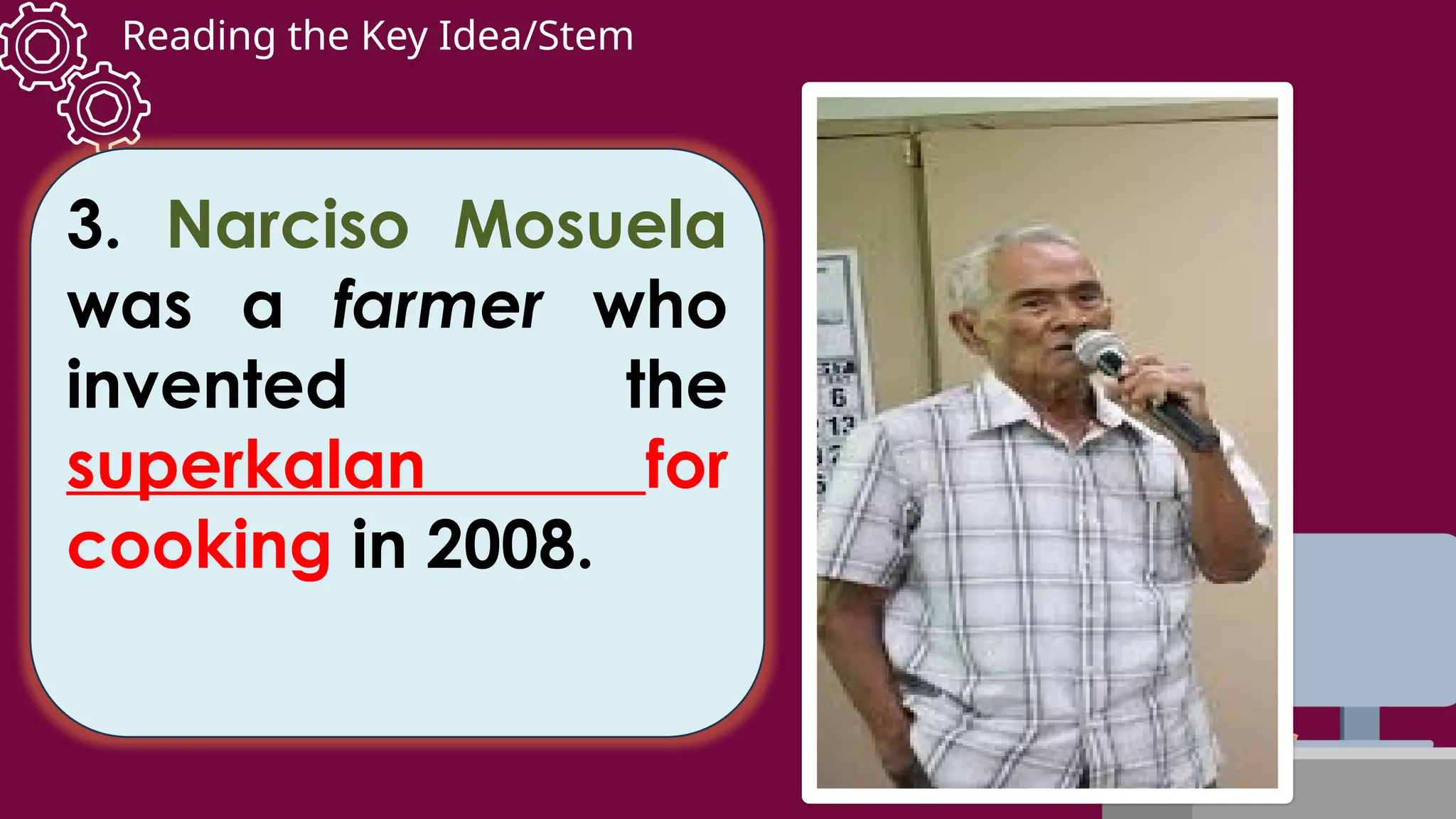
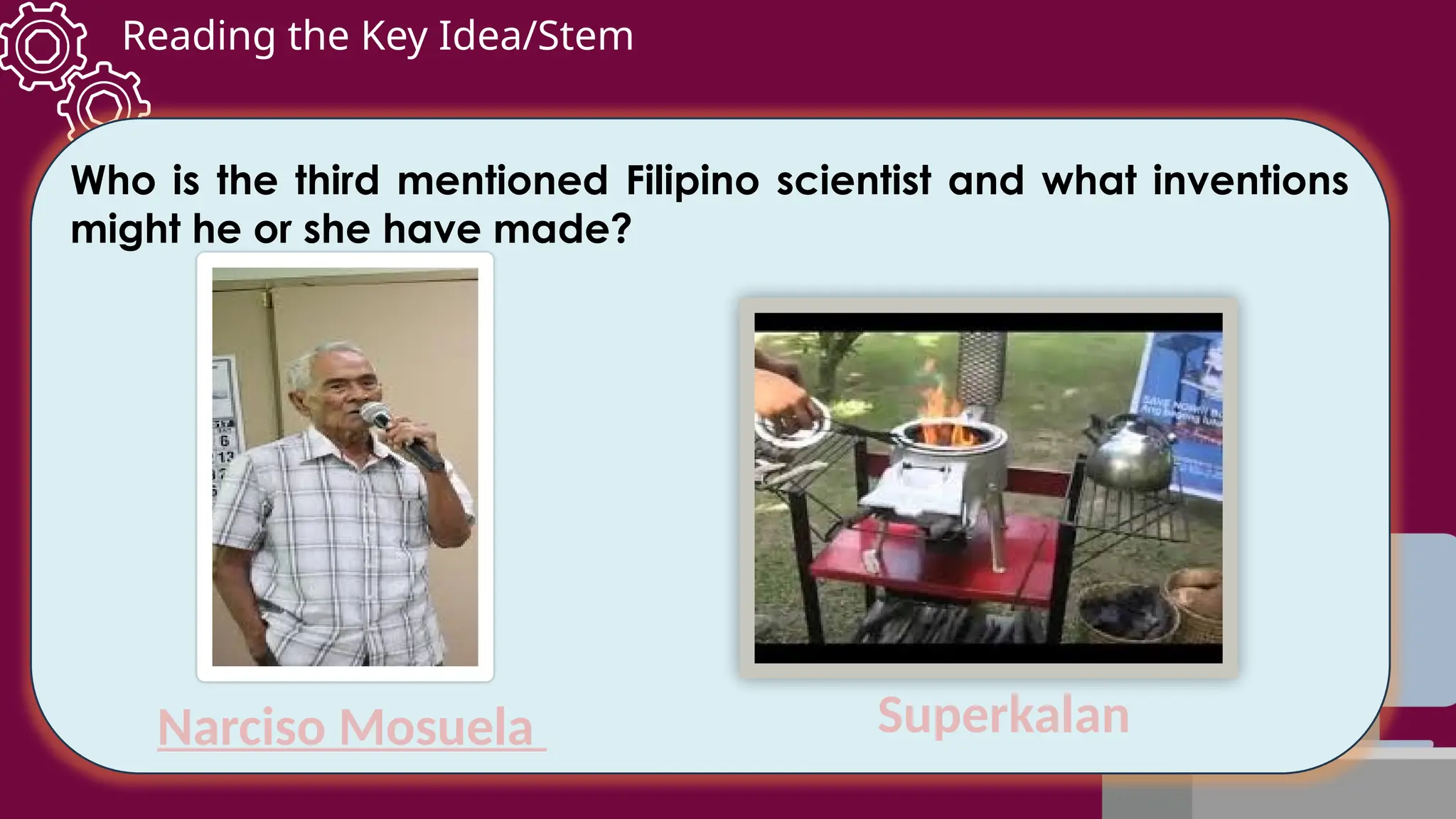
3. Narciso Mosuela
was a farmer who
invented the
superkalan for
cooking in 2008.
Reading the Key Idea/Stem
Who is the third mentioned Filipino scientist and what inventions
might he or she have made?
Narciso Mosuela Superkalan
Reading the Key Idea/Stem
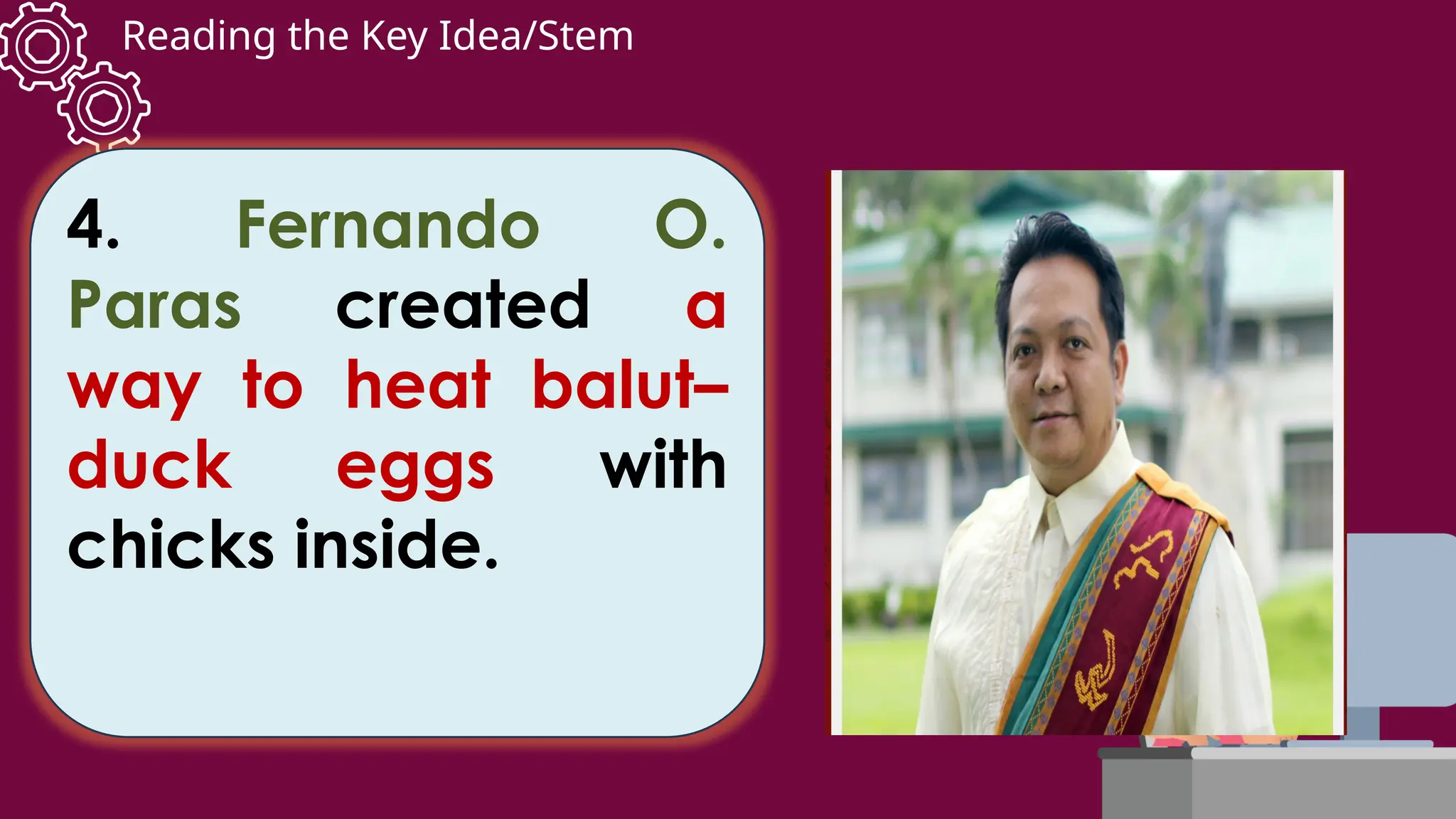
4. Fernando O.
Paras created a
way to heat balut–
duck eggs with
chicks inside.
Reading the Key Idea/Stem
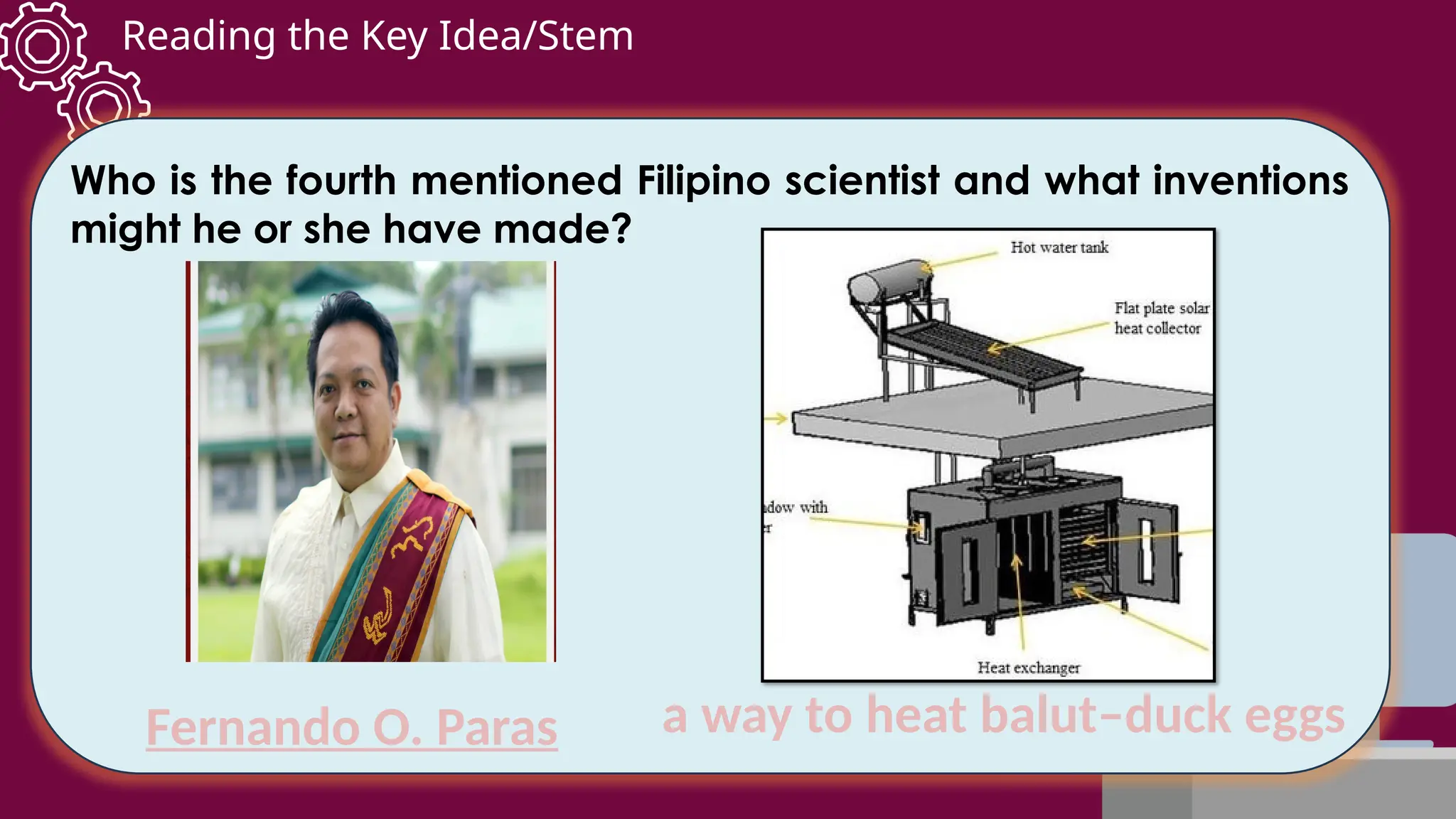
Who is the fourth mentioned Filipino scientist and what inventions
might he or she have made?
Fernando O. Paras a way to heat balut–duck eggs
Reading the Key Idea/Stem
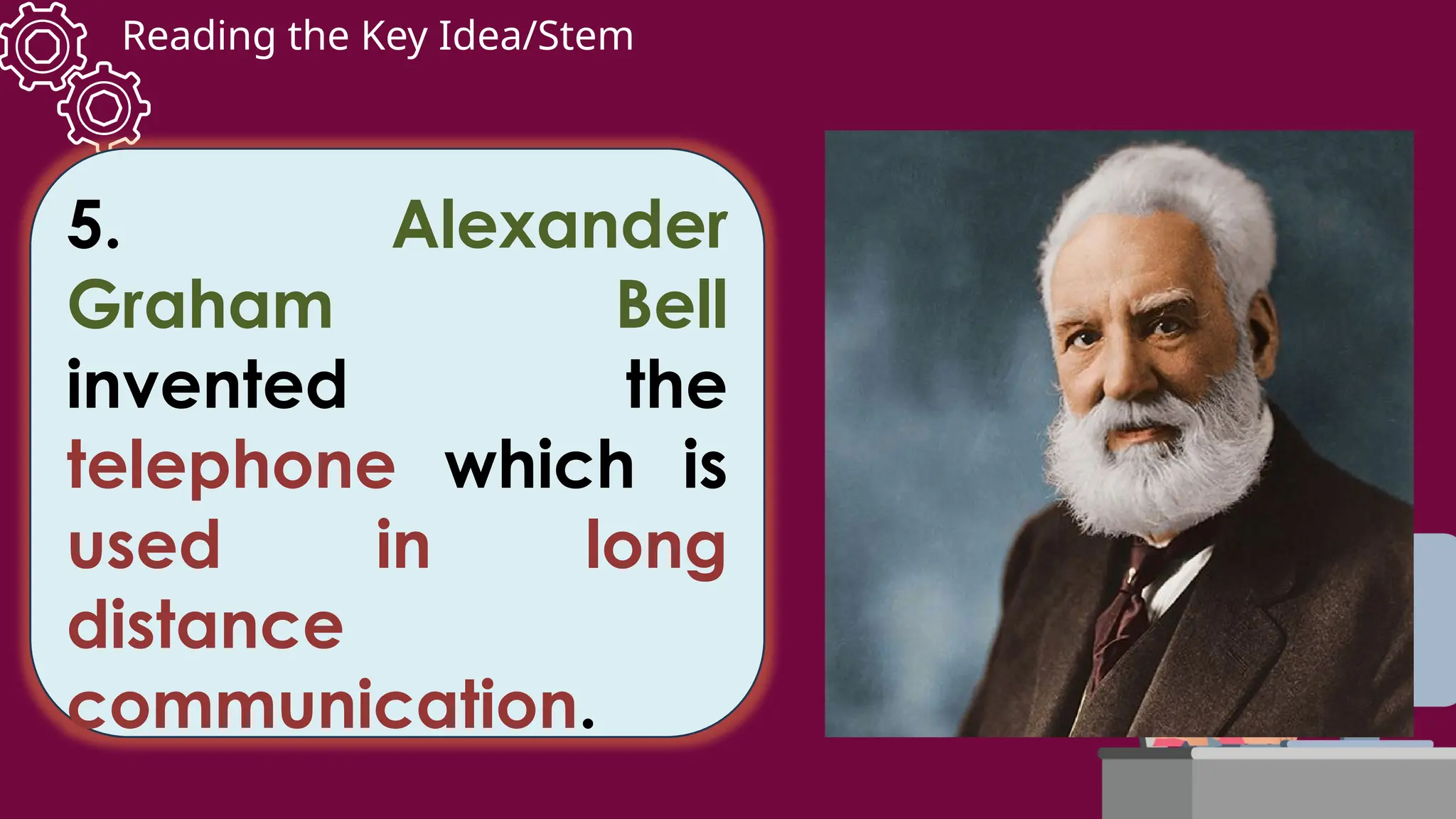
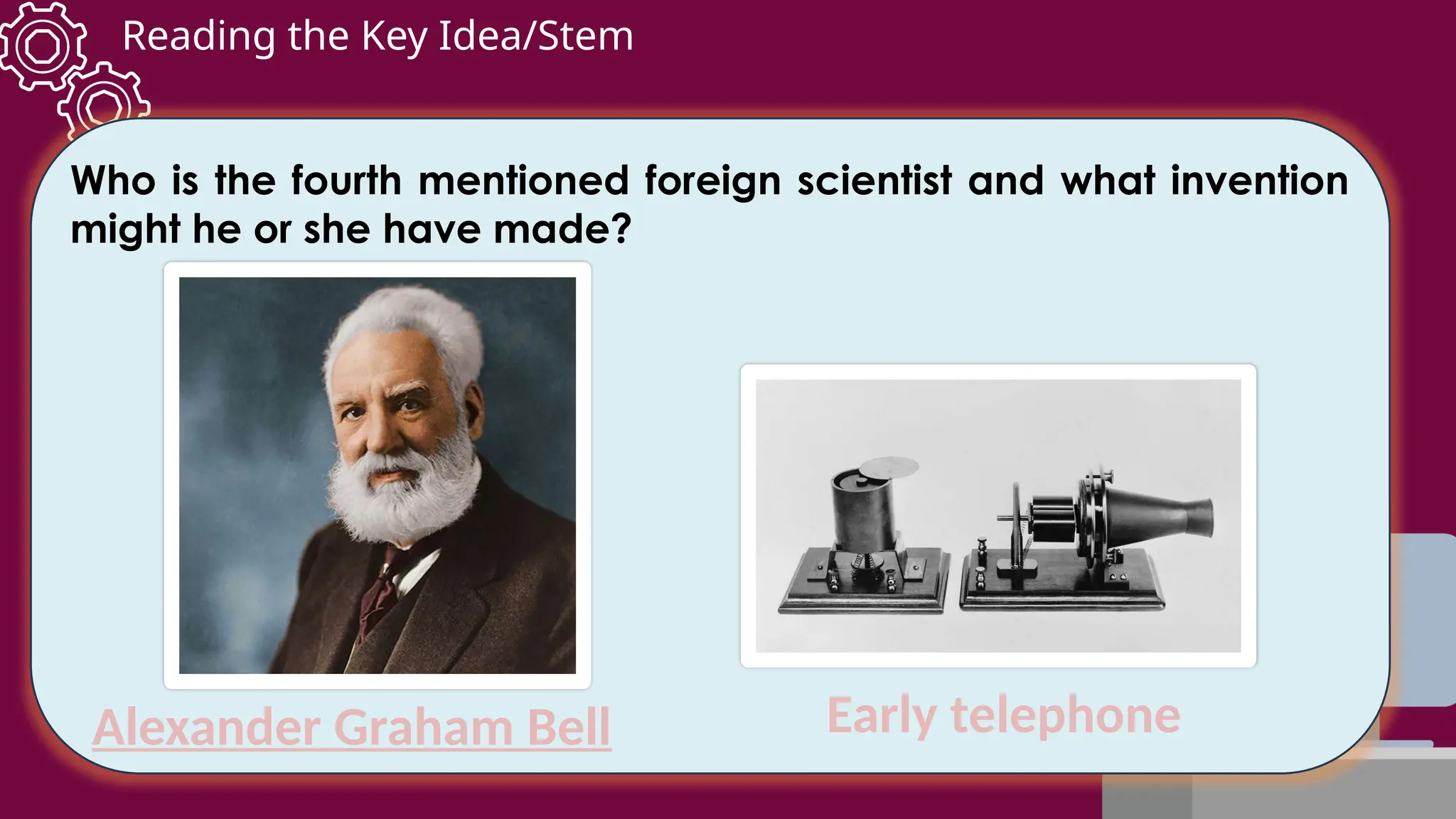
5. Alexander
Graham Bell
invented the
telephone which is
used in long
distance
communication.
Reading the Key Idea/Stem
Who is the fourth mentioned foreign scientist and what invention
might he or she have made?
Alexander Graham Bell Early telephone
Reading the Key Idea/Stem
Other suggested scientists with
contribution to chemistry and Natural
Products of the Philippines:
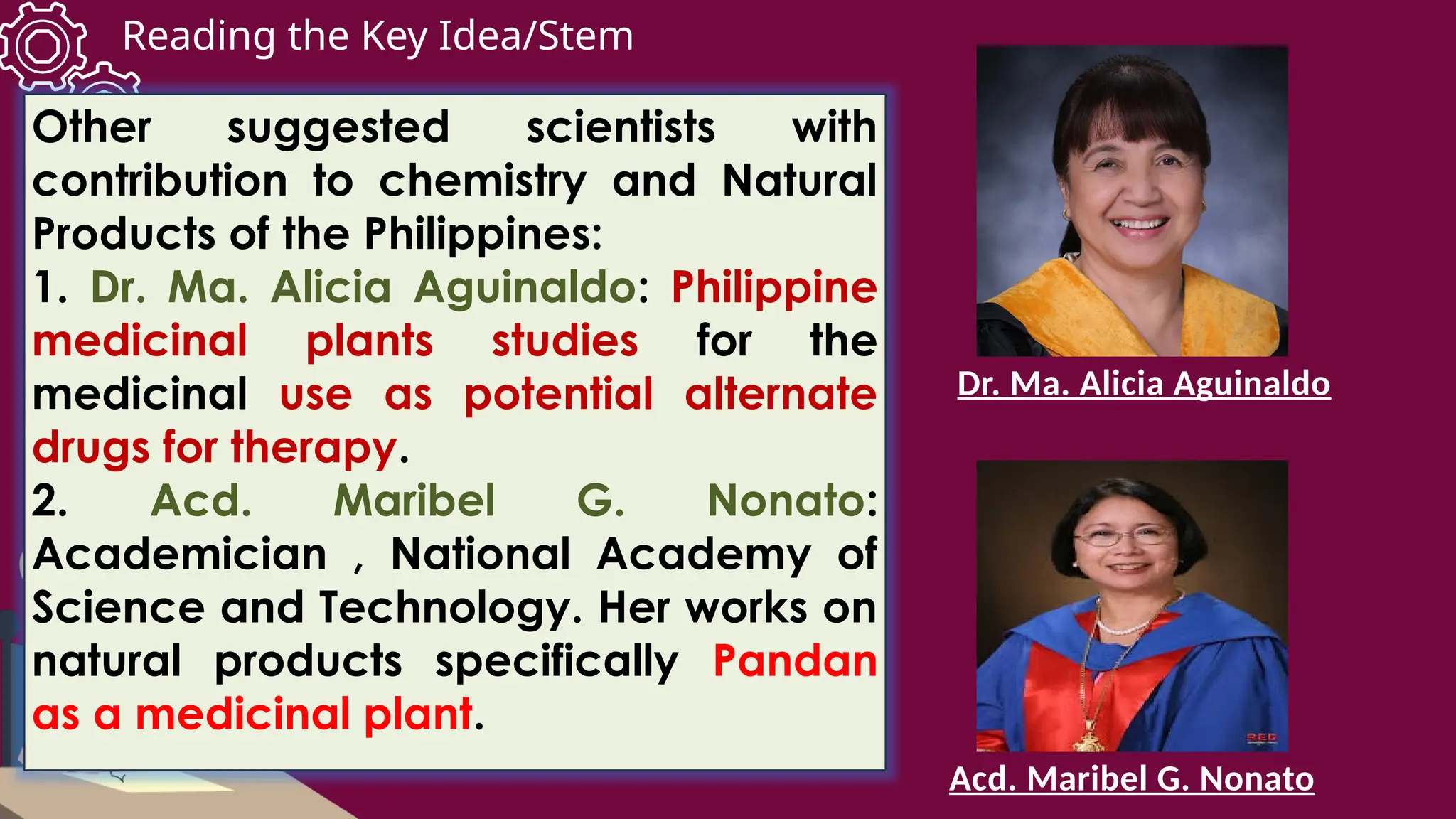
1. Dr. Ma. Alicia Aguinaldo: Philippine
medicinal plants studies for the
medicinal use as potential alternate
drugs for therapy.
2. Acd. Maribel G. Nonato:
Academician , National Academy of
Science and Technology. Her works on
natural products specifically Pandan
as a medicinal plant.
Dr. Ma. Alicia Aguinaldo
Acd. Maribel G. Nonato
Developing Understanding of the Key Idea/Stem
1. In the story you read earlier, where and
when do we often use science inventions
materials?
Answer: The science inventions
made by the scientist are often use
in our home, school, and
community
Developing Understanding of the Key Idea/Stem
2. Can you name one material you use at
home, school, or in your community and
explain how scientists might have been
involved in inventing it?
Example Answer: Pencils are used at school. Scientists
invented pencils by discovering how to combine graphite
and wood to create a writing tool.
Developing Understanding of the Key Idea/Stem
3. Why do you think it's important for us to
learn about the contributions of both foreign
and Filipino scientists to the things we use
every day?
Developing Understanding of the Key Idea/Stem
Understanding the contributions of
scientists helps us appreciate how their
discoveries and inventions have improved
our daily lives. It also inspires us to learn
more about science and maybe become
scientists ourselves one day.
Deepening Understanding of the Key Idea/Stem
GROUP WORK
Activity 3: My Favorite
Scientist!
Deepening Understanding of the Key Idea/Stem
Direction: Choose a picture of a Filipino/foreign inventor and
their inventions that you like, with a minimum of 2 inventions.
Explain why you liked their inventions.
Gregorio Y. Zara Fe del Mundo Narciso Mosuela Alexander Graham Bell
Making Generalizations and Abstractions
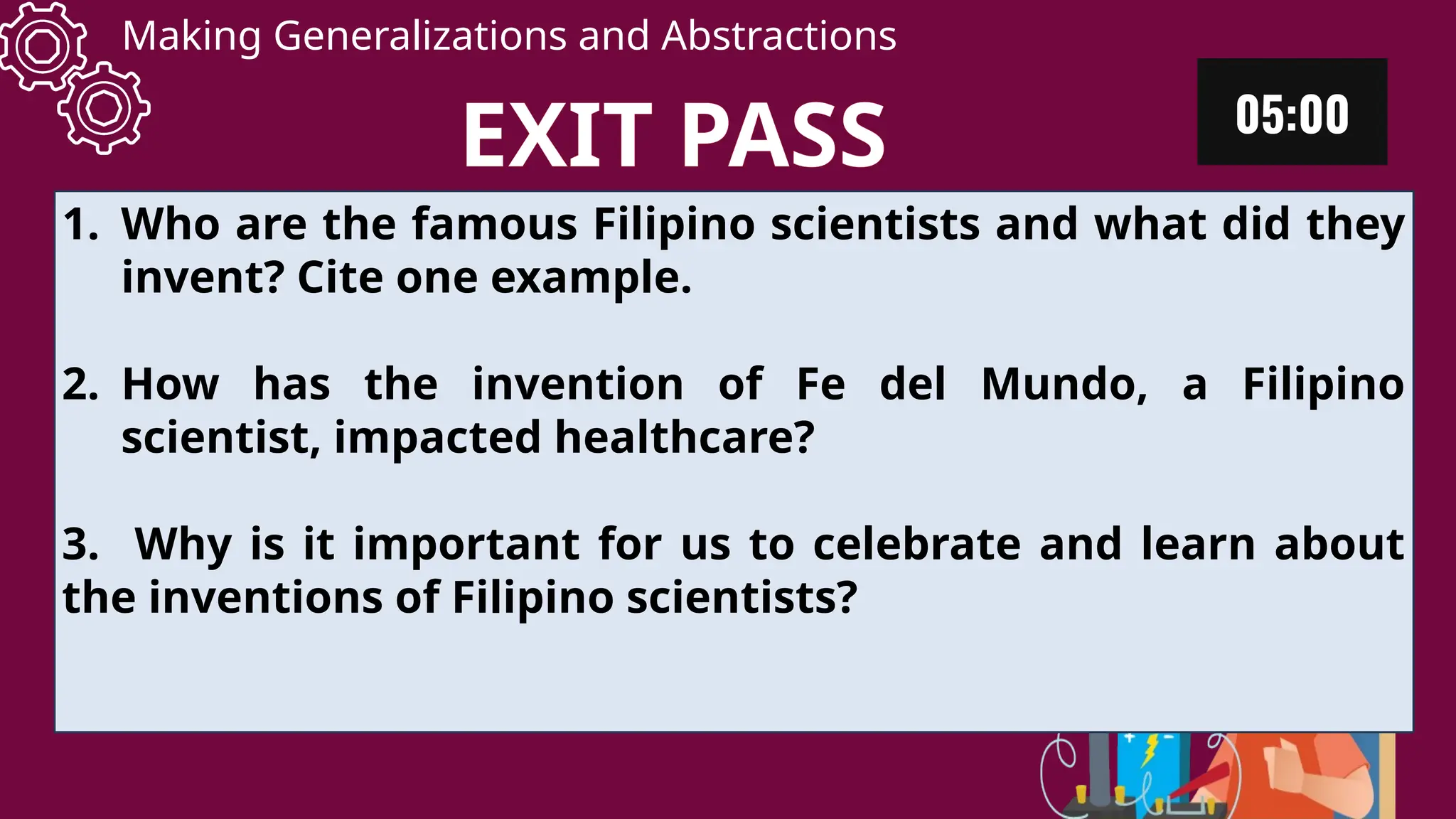
1. Who are the famous Filipino scientists and what did they
invent? Cite one example.
2. How has the invention of Fe del Mundo, a Filipino
scientist, impacted healthcare?
3. Why is it important for us to celebrate and learn about
the inventions of Filipino scientists?
EXIT PASS
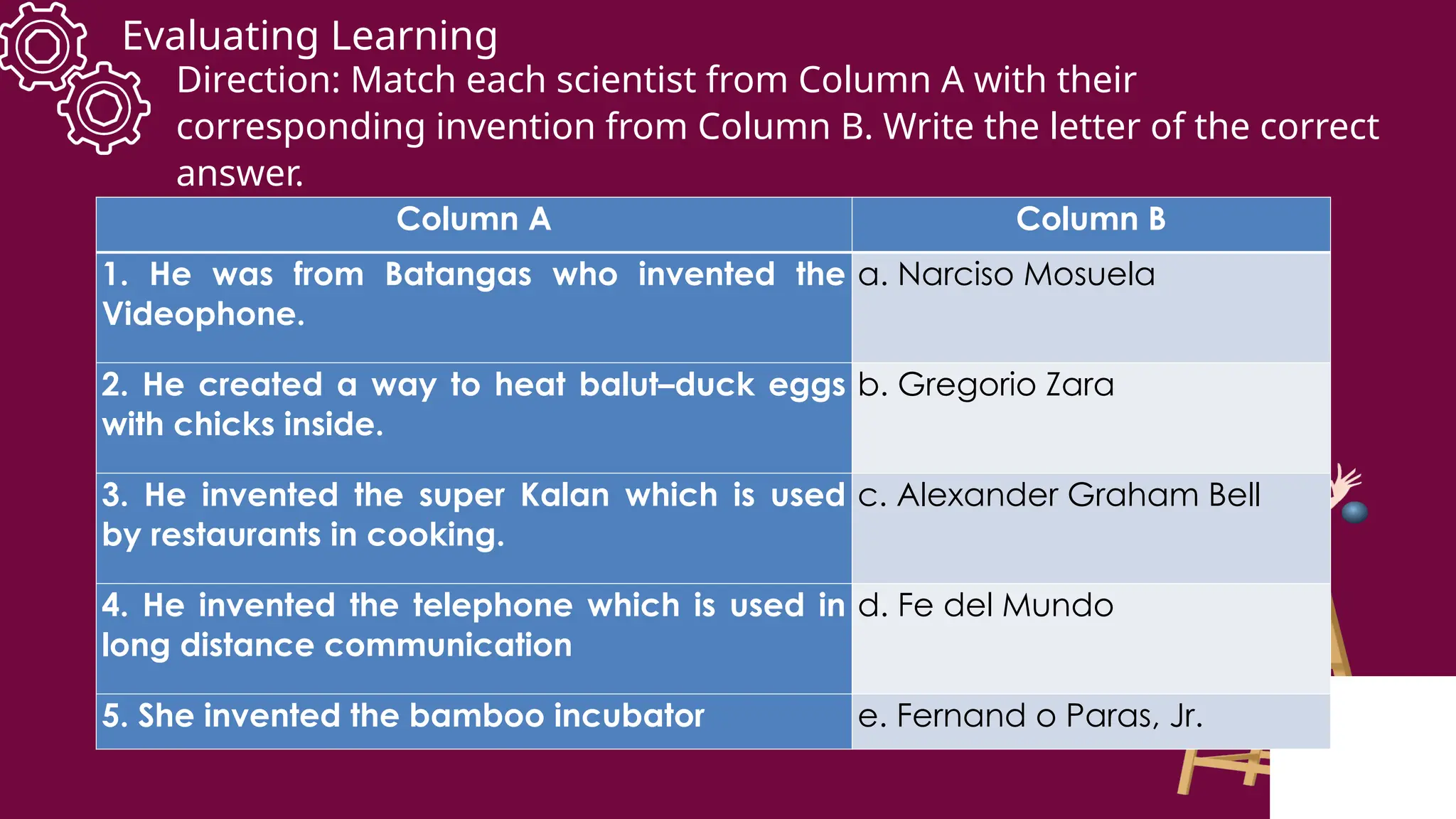
Evaluating Learning
Column A Column B
1. He was from Batangas who invented the
Videophone.
a. Narciso Mosuela
2. He created a way to heat balut–duck eggs
with chicks inside.
b. Gregorio Zara
3. He invented the super Kalan which is used
by restaurants in cooking.
c. Alexander Graham Bell
4. He invented the telephone which is used in
long distance communication
d. Fe del Mundo
5. She invented the bamboo incubator e. Fernand o Paras, Jr.
Direction: Match each scientist from Column A with their
corresponding invention from Column B. Write the letter of the correct
answer.

SCIENCE-4-DEMO-TEACHING Week 1 Day 1 Science Inventions.pptx

  • 1.
    Science 4 1st Quarter Week 1 Day1 Content: Science Inventions School-based Training of teachers on the matatag Curriculum Prepared by: Dinalyn Rose C. Villamangca Grade 4 Science Teacher
  • 2.
    Activating Prior Knowledge Activity1: Inventions and Scientists DIRECTION: In my bag, there are various pictures of materials we use at home, school, and in our community. What you will do is choose one and classify it whether it is used for food, health, cleaning agents, or gadgets
  • 3.
    Activating Prior Knowledge Activity1: Inventions and Scientists
  • 4.
    Lesson Purpose/Intention All thematerials you saw and answered earlier are products of the hard work of our scientists. So today, the aim of this lesson is to study their inventions and understand how we can appreciate them and their inventions.
  • 5.
    Lesson Language Practice IAm a Scientist by Brian Crawford Illustrated by Lovely Rollaine B. Cruz I am a scientist. What do I do? I study the nature of things, old and new. I take a close look at the things that I see. And make guesses about all the ways they might be. When I find something neat, sometimes I will ponder, “Why does that thing behave like that, I wonder? ” I’ll come up with ideas – I’ll take a good guess, And I’ll call my guess a “hypothesis”. Read the poem and answer the following questions.
  • 6.
    Lesson Language Practice Thenext thing I’ll do is conduct a short test To see what answers my question best. When I find a result that explains the confusion I’ll call that answer my “conclusion”. Next, I’ll write down all the things I’ve uncovered. Then share with the world those neat things I’ve discovered. And I’ll say hard work is done, “Science is interesting, useful, and fun!” I’ll call that answer my “conclusion”. Next, I’ll write down all the things I’ve uncovered. Then share with the world those neat things I’ve discovered. Read the poem and answer the following questions.
  • 7.
    Lesson Language Practice GUIDEQUESTIONS: 1.What should be the attitude of a scientist? Possible Answer: A scientist should be curious, ask questions, make guesses, test those guesses, and share what they learn. They should also find science fun and interesting.
  • 8.
    Lesson Language Practice GUIDEQUESTIONS: 2.What are the scientific processes that scientists do before discovering something?
  • 9.
    Lesson Language Practice GUIDEQUESTIONS: Possible Answers: 1.Observe things closely: "I take a close look at the things that I see." 2.Make guesses, called hypotheses: "And I'll call my guess a 'hypothesis'." 3.Conduct tests to check their guesses: "The next thing I'll do is conduct a short test." 4.Find results and make conclusions: "I'll call that answer my 'conclusion'." 5.Write down their findings: "Next, I'll write down all the things I've uncovered." 6.Share their discoveries with others: "Then share with the world those neat things I've discovered."
  • 10.
    Lesson Language Practice GUIDEQUESTIONS: 3. Based on the poem, how do you describe the work of a scientist? Possible Answer: Based on the poem "I Am a Scientist" by Brian Crawford, the work of a scientist is described as a process of curiosity, exploration, and discovery.
  • 11.
    Reading the KeyIdea/Stem Read the important passages and answer the questions that follow. Great Inventors, Inspiring Inventions
  • 12.
    Reading the KeyIdea/Stem Gregorio Y. Zara was a Filipino engineer and physicist born in 1902 in Lipa, Batangas. Zara invented thirty devices throughout his career, which made life easier for people by improving their daily activities. He invented solar devices that use energy from the sun which can be used in places where electric wires could not reach. He also invented a compass, a device that pilots still use today for navigation. One of Zara’s biggest inventions was the video phone.
  • 13.
    Reading the KeyIdea/Stem Who is the first mentioned Filipino scientist and what inventions might he or she have made? Gregorio Y. Zara Early video phone compass Solar device
  • 14.
    Reading the KeyIdea/Stem 2. Fe del Mundo was the first woman recognized as a national scientist and invented the world’s initial bamboo incubator in 1941.
  • 15.
    Reading the KeyIdea/Stem Who is the second mentioned Filipino scientist and what inventions might he or she have made? Fe del Mundo Bamboo incubator
  • 16.
    Reading the KeyIdea/Stem 3. Narciso Mosuela was a farmer who invented the superkalan for cooking in 2008.
  • 17.
    Reading the KeyIdea/Stem Who is the third mentioned Filipino scientist and what inventions might he or she have made? Narciso Mosuela Superkalan
  • 18.
    Reading the KeyIdea/Stem 4. Fernando O. Paras created a way to heat balut– duck eggs with chicks inside.
  • 19.
    Reading the KeyIdea/Stem Who is the fourth mentioned Filipino scientist and what inventions might he or she have made? Fernando O. Paras a way to heat balut–duck eggs
  • 20.
    Reading the KeyIdea/Stem 5. Alexander Graham Bell invented the telephone which is used in long distance communication.
  • 21.
    Reading the KeyIdea/Stem Who is the fourth mentioned foreign scientist and what invention might he or she have made? Alexander Graham Bell Early telephone
  • 22.
    Reading the KeyIdea/Stem Other suggested scientists with contribution to chemistry and Natural Products of the Philippines: 1. Dr. Ma. Alicia Aguinaldo: Philippine medicinal plants studies for the medicinal use as potential alternate drugs for therapy. 2. Acd. Maribel G. Nonato: Academician , National Academy of Science and Technology. Her works on natural products specifically Pandan as a medicinal plant. Dr. Ma. Alicia Aguinaldo Acd. Maribel G. Nonato
  • 23.
    Developing Understanding ofthe Key Idea/Stem
  • 24.
    Developing Understanding ofthe Key Idea/Stem
  • 25.
    Developing Understanding ofthe Key Idea/Stem 1. In the story you read earlier, where and when do we often use science inventions materials? Answer: The science inventions made by the scientist are often use in our home, school, and community
  • 26.
    Developing Understanding ofthe Key Idea/Stem 2. Can you name one material you use at home, school, or in your community and explain how scientists might have been involved in inventing it? Example Answer: Pencils are used at school. Scientists invented pencils by discovering how to combine graphite and wood to create a writing tool.
  • 27.
    Developing Understanding ofthe Key Idea/Stem 3. Why do you think it's important for us to learn about the contributions of both foreign and Filipino scientists to the things we use every day?
  • 28.
    Developing Understanding ofthe Key Idea/Stem Understanding the contributions of scientists helps us appreciate how their discoveries and inventions have improved our daily lives. It also inspires us to learn more about science and maybe become scientists ourselves one day.
  • 29.
    Deepening Understanding ofthe Key Idea/Stem GROUP WORK Activity 3: My Favorite Scientist!
  • 30.
    Deepening Understanding ofthe Key Idea/Stem Direction: Choose a picture of a Filipino/foreign inventor and their inventions that you like, with a minimum of 2 inventions. Explain why you liked their inventions. Gregorio Y. Zara Fe del Mundo Narciso Mosuela Alexander Graham Bell
  • 31.
    Making Generalizations andAbstractions 1. Who are the famous Filipino scientists and what did they invent? Cite one example. 2. How has the invention of Fe del Mundo, a Filipino scientist, impacted healthcare? 3. Why is it important for us to celebrate and learn about the inventions of Filipino scientists? EXIT PASS
  • 32.
    Evaluating Learning Column AColumn B 1. He was from Batangas who invented the Videophone. a. Narciso Mosuela 2. He created a way to heat balut–duck eggs with chicks inside. b. Gregorio Zara 3. He invented the super Kalan which is used by restaurants in cooking. c. Alexander Graham Bell 4. He invented the telephone which is used in long distance communication d. Fe del Mundo 5. She invented the bamboo incubator e. Fernand o Paras, Jr. Direction: Match each scientist from Column A with their corresponding invention from Column B. Write the letter of the correct answer.

Editor's Notes

  • #1 Hello children! How are you? Did you have a happy vacation? Very good! I'm glad to hear that everyone is doing well. Even though it's our first day seeing each, we will start our lesson right away for Science 4. Take a look at the things in our classroom. Which of those make teaching and listening to your teacher easier? What do you think would happen to you if, little by little, these tools were to disappear or be replaced with older ones? Nowadays, people use sophisticated materials to make work easier and faster. Materials we use at home, school and in our community are invented and created by scientists.
  • #3 Did you enjoy the activity or group game? How did you feel after finishing the task assigned to your group?
  • #4 Who loves reading? Good! So the next part of our lesson, you are going to read silently a poem. For every slide I’ll give you 1 minute, after the 1 minute will move it to the next slide. After reading the poem, that I will pick a name in the roulette to answer question, this to check whether you really understood the poem that you read.
  • #23 Who among you still wants to play and have a chance to win a prize?