Guess What?
Who inventedthe following based from our past
lesson.
A. Soyalac and Darak
B. Incubator and jaundice-relieving device
C. Erythromycin
D. single chip 16-bit microprocessor
E. inducing flowering of mangoes ) using potassium
nitrate
Review
3.
Guess What?
Who inventedthe following based from our past
lesson.
F. telephone
G. diesel engine
H. calculator
I. penicillin
J. magnetic tape
K. insulin
Drill
4.
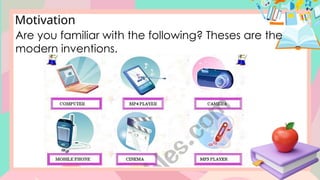
Motivation
Watch this videoon a song about inventors and
inventions by global inventors.
https://youtu.be/VhbCqZbuwiY
5.
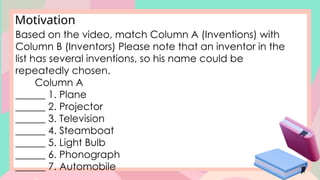
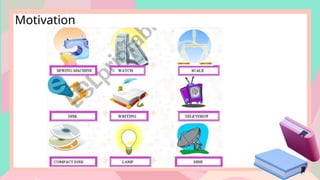
Motivation
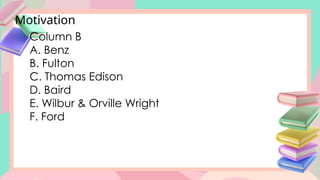
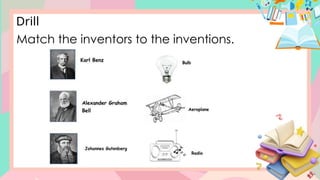
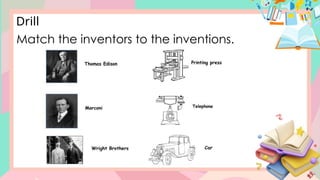
Based on thevideo, match Column A (Inventions) with
Column B (Inventors) Please note that an inventor in the
list has several inventions, so his name could be
repeatedly chosen.
Column A
______ 1. Plane
______ 2. Projector
______ 3. Television
______ 4. Steamboat
______ 5. Light Bulb
______ 6. Phonograph
______ 7. Automobile
Presentation
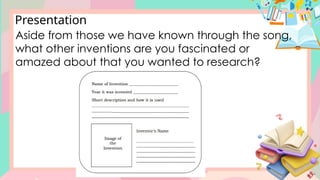
Aside from thosewe have known through the song,
what other inventions are you fascinated or
amazed about that you wanted to research?
8.
Presentation
If you hada chance to meet the inventor in
person, what question would you ask him/her?
If there is something you would like to invent, what
will it be and why?
9.
Activity 1
Make alist of 5 inventions you want to research
about. These are the 5 inventions I am very
interested in researching about:
1. _____________________________________
2. _____________________________________
3. _____________________________________
4. _____________________________________
5. _____________________________________
10.
Activity 2
Do theactivity.
1. With a partner, choose an inventor to research
and you are given 5 minutes to do this.
2. You can use your cellphone to research online.
3. You may also watch the given links to the Video
about them.
https://youtu.be/A3sgm1fbftk?t=89
https://youtu.be/ev5N4v9nTuI?t=44
4. Once you are done, you may raise your flaglets
to indicate that you are ready.
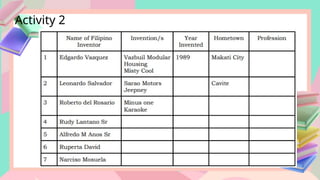
Activity 2
Guide Questions:
1.In terms of gender, what have you noticed
about the inventors?
2. When we consider their hometown, where do
most of them come from?
3. What can you say about their profession? Are all
of them professionals?
4. If you become one of them, what will your
invention be?
13.
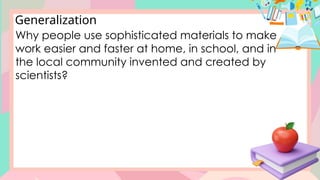
Generalization
Why people usesophisticated materials to make
work easier and faster at home, in school, and in
the local community invented and created by
scientists?
14.
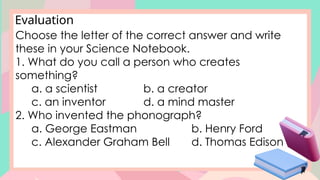
Evaluation
Choose the letterof the correct answer and write
these in your Science Notebook.
1. What do you call a person who creates
something?
a. a scientist b. a creator
c. an inventor d. a mind master
2. Who invented the phonograph?
a. George Eastman b. Henry Ford
c. Alexander Graham Bell d. Thomas Edison
15.
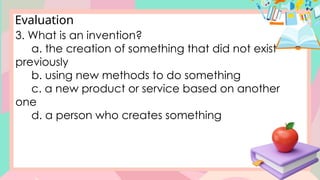
Evaluation
3. What isan invention?
a. the creation of something that did not exist
previously
b. using new methods to do something
c. a new product or service based on another
one
d. a person who creates something
16.
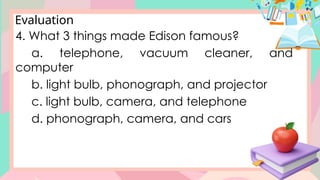
Evaluation
4. What 3things made Edison famous?
a. telephone, vacuum cleaner, and
computer
b. light bulb, phonograph, and projector
c. light bulb, camera, and telephone
d. phonograph, camera, and cars
17.
Evaluation
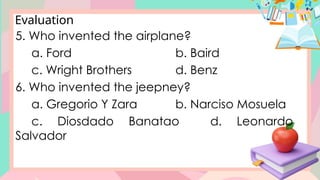
5. Who inventedthe airplane?
a. Ford b. Baird
c. Wright Brothers d. Benz
6. Who invented the jeepney?
a. Gregorio Y Zara b. Narciso Mosuela
c. Diosdado Banatao d. Leonardo
Salvador
18.
Evaluation
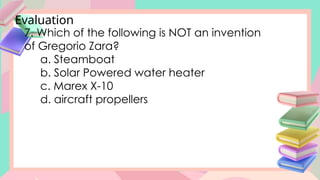
7. Which ofthe following is NOT an invention
of Gregorio Zara?
a. Steamboat
b. Solar Powered water heater
c. Marex X-10
d. aircraft propellers
19.
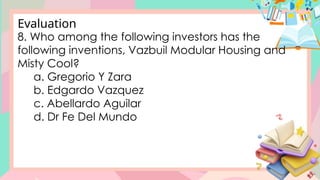
8. Who amongthe following investors has the
following inventions, Vazbuil Modular Housing and
Misty Cool?
a. Gregorio Y Zara
b. Edgardo Vazquez
c. Abellardo Aguilar
d. Dr Fe Del Mundo
Evaluation
20.
Evaluation
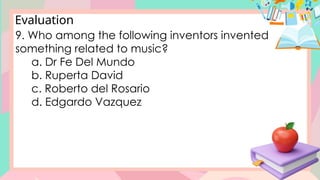
9. Who amongthe following inventors invented
something related to music?
a. Dr Fe Del Mundo
b. Ruperta David
c. Roberto del Rosario
d. Edgardo Vazquez
21.
Evaluation
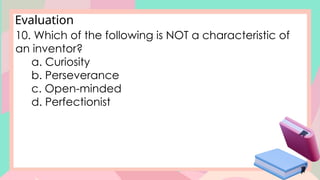
10. Which ofthe following is NOT a characteristic of
an inventor?
a. Curiosity
b. Perseverance
c. Open-minded
d. Perfectionist
Motivation
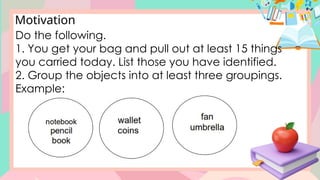
Do the following.
1.You get your bag and pull out at least 15 things
you carried today. List those you have identified.
2. Group the objects into at least three groupings.
Example:
25.
Motivation
3. When youare done, share it with your seatmate
and make a drawing.
4. Explain why you grouped the things you have in
your bags that way. Each of you will have different
ways and reasons for doing it.
Presentation
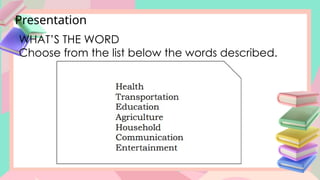
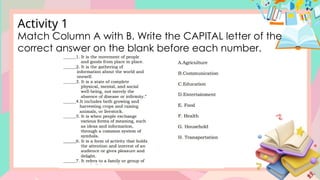
1. It isthe movement of people and goods from
place to place.
2. It is the gathering of information about the world
and oneself.
3. It is a state of complete physical, mental, and
social well-being, not merely the absence of
disease or infirmity.”
28.
Presentation
4. It includesboth growing and harvesting crops
and raising animals or livestock.
5. It is when people exchange various forms of
meaning, such as ideas and information, through a
common system of symbols.
6. It is a form of activity that holds the attention and
interest of an audience or gives pleasure and
delight.
7. It refers to a family or group of people living
together.
29.
Discussion
Importance and impactof inventions on everyday
life:
Inventions, such as new tools, devices, processes,
and medicines, have provided significant benefits
to society. Inventions help people around the world
live longer, healthier, and more productive lives
and provide new ways to build, move,
communicate, heal, learn, and play.
30.
Discussion
Inventions can leadto new technologies, create
new jobs, and improve quality of life.
Useful, and unbelievable inventions that have
transformed how we live. The ones that have the
most profound impact on our day-to-day life are
connected to some of the basic ones in our
hierarchy of needs:
31.
Discussion
1) The moderntoilet. We use it everyday and take
for granted that cultures and methods that have
come before weren’t always the most hygienic or
have adequate and safe plumbing.
32.
Discussion
2) The refrigeratorand freezer. The ability to store
our food for use in the future for days or years is
quite remarkable. Opening the fridge and staring
at what to eat next hasn’t been a thing for that
long in human history.
33.
Discussion
3) The microwave.Your grandparents didn’t have
one growing up most likely. The ability to instantly
heat up and cook food in seconds or minutes is
amazing and doing so without dying from
radiation.
34.
Match Column Awith B. Write the CAPITAL letter of the
correct answer on the blank before each number.
Activity 1
35.
Activity 1
Guide Question:
1.Which of the terms in Column B do you need
more explanation with, tell your teacher.
2. Give at least 5 examples of each category.
How do weclassify/group the different
inventions and into what area of human life?
Generalization
38.
Evaluation
Choose the letterof the correct answer from the
given options and write your choice in CAPITAL
letters.
1. Which of the following inventions has greatly
changed the way people communicate with each
other?
a. laptop b. television
c. cell phone d. projector
39.
Evaluation
2. Which ofthe following contributed to the
improvement of health?
a. electronic mosquito repellant
b. electronic door opener
c. jeepney
d. steamboat
40.
Evaluation
3. Identify fromthe list below, which DOES NOT
belong.
a. patis
b. b. video phone
c. soyalac
d. banana ketchup
41.
Evaluation
4. The followingare examples of inventions in
agriculture EXCEPT one, which is it?
a. soyalac
b. b. banana ketchup
c. tractor
d. jeepney
42.
Evaluation
5. Which ofthe following refers to the exchange of
various forms of meaning, such as ideas and
information, through a common system of symbols?
a. Health
b. Agriculture
c. Education
d. Communication
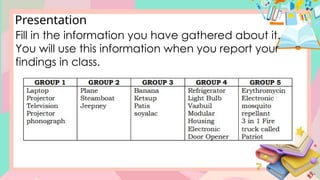
Presentation
Fill in theinformation you have gathered about it.
You will use this information when you report your
findings in class.
48.
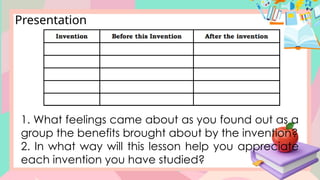
Presentation
1. What feelingscame about as you found out as a
group the benefits brought about by the invention?
2. In what way will this lesson help you appreciate
each invention you have studied?
49.
Discussion
There are systemsof inventions that I would
categorize as having influenced our day-to-day:
1) Harnessing and managing electricity. Wrangling
this power changed how work is done; it changed
how much can be done and by how many
people. Go through an average day at home
without using electricity and see how much we
underestimate this convenience.
50.
Discussion
2) Methods andspeed of communication. This
is a giant category from wired telegraph and
phone connections to satellite and cell
technology, what tools and how fast we
communicate has changed everything. Just
think about how easy and fast you can
connect with a friend in a video chat and know
what’s going on in another country at this very
moment.
51.
Discussion
3) Methods oftransportation. Another huge
category, getting to and from work, the store,
friends’ houses, and exploring through vacations is
just the tip of the iceberg. Maybe the invention of
the wheel or the combustion engine should be in
this category, but then you have items like
airplanes and other powered forms of travel that
make living further away from where you want to
go not a big deal anymore.
52.
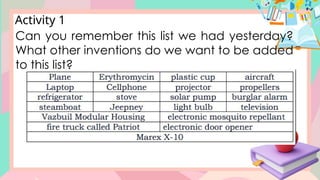
Activity 1
Can youremember this list we had yesterday?
What other inventions do we want to be added
to this list?
53.
Activity 2
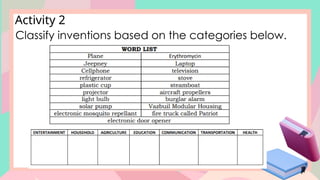
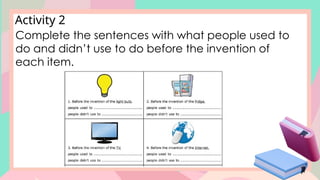
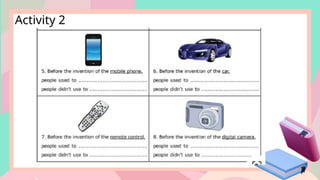
Complete thesentences with what people used to
do and didn’t use to do before the invention of
each item.
Evaluation
Choose the letterof the correct answer.
1. Which of the following refers to complete
physical, mental, and social wellbeing, not merely
the absence of disease or infirmity?
A. Health
B. Agriculture
C. Education
D. Communication
57.
Evaluation
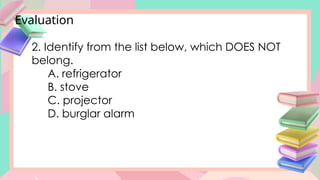
2. Identify fromthe list below, which DOES NOT
belong.
A. refrigerator
B. stove
C. projector
D. burglar alarm
58.
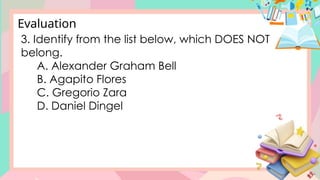
3. Identify fromthe list below, which DOES NOT
belong.
A. Alexander Graham Bell
B. Agapito Flores
C. Gregorio Zara
D. Daniel Dingel
Evaluation
59.
Evaluation
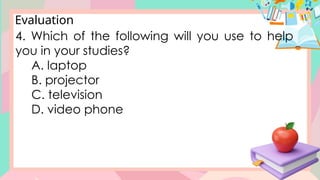
4. Which ofthe following will you use to help
you in your studies?
A. laptop
B. projector
C. television
D. video phone
60.
Evaluation
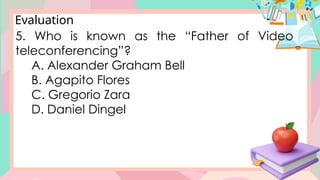
5. Who isknown as the “Father of Video
teleconferencing”?
A. Alexander Graham Bell
B. Agapito Flores
C. Gregorio Zara
D. Daniel Dingel
61.
Search the internetfor documentation of an
invention and inventor you think you will also
be doing if you are given a chance. You will
share this in class.
Additional Activity
Let’s Try
Choose oneof the following accidental inventions
and how this has benefited you.
1. Matches – John Walker
2. Teflon – Roy J. Plunkett
3. Potato Chips – George Crum
4. Ice cream cones – St. Louis
5. Coca Cola- John Pemberton
6. Post-it Notes – Dr. Spencer Silver
67.
Let’s Try
7. SafetyGlass – Edouard Benedictus
8. Vulcanized Rubber – Charles Goodyear
9. Plastic – Leo Hendrik Baekeland
10. Antidepressant
11. Implantable pacemaker – Wilson Greatbatch
12. Antibiotics – Alexander Flemming
13. X-ray –
14. Superglue – Harry Coverr
15. Microwave Oven – Percy Spencer
68.
Discussion
Science invention andits impact on everyday life:
What is the importance of Science in our daily life?
Science plays a vital role in our everyday lives as it
helps us grasp the way things operate in the world.
It enables us to create fresh gadgets, medicines,
and other advances that enhance our well-being.
Additionally, science aids us in comprehending the
environment around us and finding ways to
safeguard it.
69.
Discussion
How is scienceused in my everyday life?
Science plays a role in many aspects of our
lives, like cooking, eating, breathing, driving,
and playing. The clothes we wear, the
toothbrush and toothpaste we use, shampoo,
talcum powder, and even the oil we apply are
all the result of scientific progress.
70.
Discussion
What science doyou use everyday?
In our everyday routines, we rely on various
machines that follow the fundamental
principles of science. Computers, satellites, X-
rays, radium, cosmetic procedures, mobile
phones, electricity, the internet, cameras, and
other scientific innovations have demonstrated
their immense practicality.
71.
Activity 1
My FutureInvention
Use your creativity and imagination to design a
future invention that you think might exist someday.
Draw ang label a picture of your invention and
write a short description to explain what it does and
how it might make our lives better.
72.
Tasks and Thoughts
Answerthe following:
Share at least 3 of the 15 accidental inventions with
your family members. Take note of their reactions
to your sharing.
If you were to invent something, which issue, or
problem would you try to address?
What invention will that be? Share your idea.
Evaluation
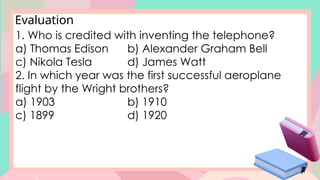
1. Who iscredited with inventing the telephone?
a) Thomas Edison b) Alexander Graham Bell
c) Nikola Tesla d) James Watt
2. In which year was the first successful aeroplane
flight by the Wright brothers?
a) 1903 b) 1910
c) 1899 d) 1920
75.
Evaluation
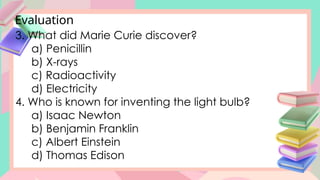
3. What didMarie Curie discover?
a) Penicillin
b) X-rays
c) Radioactivity
d) Electricity
4. Who is known for inventing the light bulb?
a) Isaac Newton
b) Benjamin Franklin
c) Albert Einstein
d) Thomas Edison
76.
Evaluation
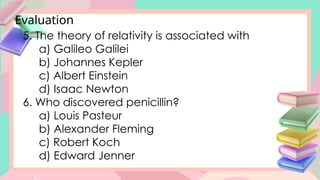
5. The theoryof relativity is associated with
a) Galileo Galilei
b) Johannes Kepler
c) Albert Einstein
d) Isaac Newton
6. Who discovered penicillin?
a) Louis Pasteur
b) Alexander Fleming
c) Robert Koch
d) Edward Jenner
77.
7. Who isresponsible for developing the World Wide
Web (WWW)?
a) Tim Berners-Lee
b) Steve Jobs
c) Bill Gates
d) Mark Zuckerberg
8. What did Galileo Galilei invent?
a) Telescope
b) Microscope
c) Telephone
d) Clock
Evaluation