

Science & Technology Communication
Gensei Ishimura
Associate Professor
Communication in Science & Technology Education & Research Program,
Hokkaido University (CoSTEP)
ishimura@costep.hucc.hokudai.ac.jp
2013.7.8
Outline
1. Self Introduction
2. What is Science & Technology Communication?
3. Why and How Is It Necessary in Today’s
Context?
4. Definition of S&T Communication
5. Cases of Practices at CoSTEP
6. Evaluation of Practices
7. Education of S&T Communicators at CoSTEP
8. Sustainability and S&T Communication
9. Discussion
1. Self Introduction
Biography
• 2005-
– Practitioner, teacher, and researcher in the field of
science and technology communication
– Work at CoSTEP(Communication in Science &
Technology Research & Education Program, Hokkaido
University)
• 1999-
– Planning director of exhibits for science museums
• 1996-
– Researcher in the field of psychology and neuroscience
My Works: Exhibit Zone for Science of the Sun
(SANYO Electric Co., Ltd. Solar Energy Museum “SOLAR LAB”)
My Works: Tables for Science Communication
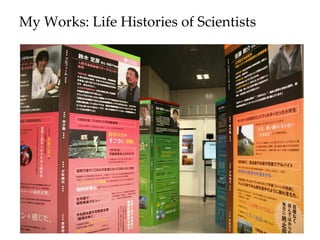
My Works: Life Histories of Scientists
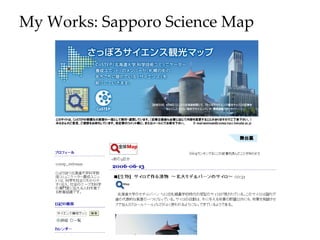
My Works: Sapporo Science Map
• It is a website
1. made by students
2. where various places in the city Sapporo
are introduced
3. in terms of related scientific stories.
• URL http://d.hatena.ne.jp/costep_webteam/
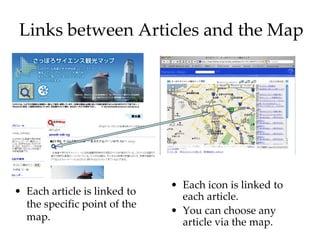
Links between Articles and the Map
• Each article is linked to
the specific point of the
map.
• Each icon is linked to
each article.
• You can choose any
article via the map.
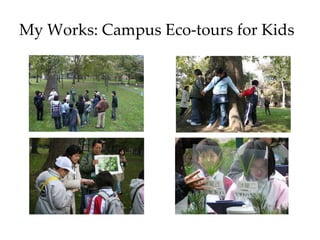
My Works: Campus Eco-tours for Kids
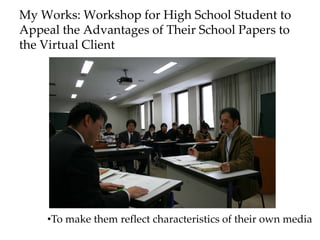
My Works: Workshop for High School Student to
Appeal the Advantages of Their School Papers to
the Virtual Client
•To make them reflect characteristics of their own media
2. What is Science & Technology
Communication?
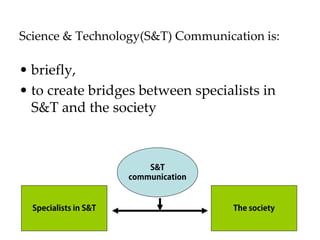
Science & Technology(S&T) Communication is:
• briefly,
• to create bridges between specialists in
S&T and the society
Specialists in S&T The society
S&T
communication
Early History of Science
Communication in United Kingdom
• The Christmas Lectures of the Royal Institution
of Great Britain
– Demonstration-packed, fun-filled science events for
young people.
– Started by Michael Faraday in 1825.
• C.P. Snow (1959): The Two Cultures
– The intellectual life of the whole of western society
was split into the two cultures — namely
the sciences and the humanities — and that this was
a major obstacle to solving the world's problems.
Royal Society (1985): The Public
Understanding of Science (Bodmer Report)
• Weighed much importance on:
– facilitation and improvement of public
understanding of science
• Led to:
– Committee on the Public Understanding of
Science : COPUS (1985)
– cultural change in the attitude of scientists
to outreach activities
– Media Fellowship, Westminster Fellowship
3. Why and How Is It Necessary in
Today’s Context?
Why and How Is It Necessary in
Today’s Context?
• Impact of S&T increased enormously during
this 100 years.
• S&T have carried out many negative effect in
our society (ex. environmental problem,
technological risk)
• S&T have largely changed our lifestyle and
essentially affect our ethics and value systems.
• S&T are supported by huge budget provided
by our government.
Why and How Is It Necessary in
Today’s Context?
• Relation among S&T and the society has
become extremely complicated and they are
hardly separable.
• The number of questions which can be asked
of science and yet cannot be answered by
science (= trans-science issues) has increased.
• To deal with such issues, novel initiatives
become needed in the society.
Case: BSE (Bovine Spongiform
Encephalopathy) Issue
• Occurred at first in UK around 1990.
• In 1989, the committee chaired by the Oxford zoologist
Richard Southwood, had given its opinion that there
was very little danger to humans from BSE.
• The government and statesmen ignored the warning of
the committee that pointed the limitation of the report
and the necessity of further investigation.
• In 1996, the government admitted that 10 clients
of vCJD (variant Creutzfeld Jacob Disease) had been
infected because of having taken beef from BSE infected
cows.
• The public came to strongly distrust the government
and scientists belong to it.
The recommendation “Science and Society”
• In 2000, the recommendation “Science and Society”
pointed that the public had strong distrust of scientists
related to the government and industries, and that they
expressed feeling of rejection against science and
technology such as genetically modified foods and
cloning technology.
• Besides, it suggested that the government should
respond to the public’s need for ‘dialogue’.
• The recommendation adopted STS (Science and
Technology Studies) researchers discussion.
STS (Science and Technology Studies)
researchers discussion
• They insisted that the ‘deficit model’ was no
more successful.
What is “Deficit model”?
• The government and scientists thought that
people cannot think, discuss, nor behave
logically because they lack sufficient
knowledge of science.
• So, they thought that they must convey more
and more scientific knowledge to the
uneducated public in order to enlighten them.
• That’s why they had thought PUS (Public
Understanding of Science) was important.
STS (Science and Technology Studies)
researchers discussion
• They insisted that the ‘deficit model’ was no
more successful.
• They revealed that the theory “the more
scientific knowledge the public acquire, the
more positively they perceive science” is not
always true.
– For some research fields which are related to ethical
issues, the more scientific knowledge the public have,
the more negatively they think of the fields.
– The better they understand science, the more
indifferent they are to science.
STS (Science and Technology Studies)
researchers discussion
• Even among scientists, clear consensus doesn’t
exist about “what is science” or “what is
scientific knowledge”.
Beyond “Deficit Model”
1. Contextual model
– The public have situation-specific, contextualized
knowledge.
• closely related to their political and social knowledge.
– Post normal science
• high uncertainty of the system, but highly related to their
interests
2. Lay-expertise model
– The public have, so called, local knowledge, or
indigenous knowledge.
Beyond “Deficit Model”
3. Participation model
– From enlightenment to empowerment
– pTA (participatory technology assessment)
• Consensus conference
– Started in Denmark
• Deliberative polling (DP)
– Mutuality, and communication
• Science café
4. Definition of S&T Communication
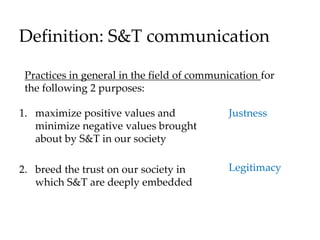
Definition: S&T communication
1. maximize positive values and
minimize negative values brought
about by S&T in our society
2. breed the trust on our society in
which S&T are deeply embedded
Justness
Legitimacy
Practices in general in the field of communication for
the following 2 purposes:
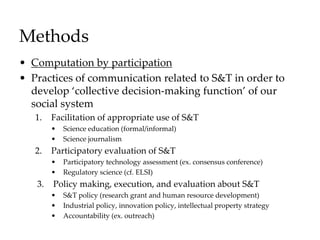
Methods
• Computation by participation
• Practices of communication related to S&T in order to
develop ‘collective decision-making function’ of our
social system
1. Facilitation of appropriate use of S&T
• Science education (formal/informal)
• Science journalism
2. Participatory evaluation of S&T
• Participatory technology assessment (ex. consensus conference)
• Regulatory science (cf. ELSI)
3. Policy making, execution, and evaluation about S&T
• S&T policy (research grant and human resource development)
• Industrial policy, innovation policy, intellectual property strategy
• Accountability (ex. outreach)
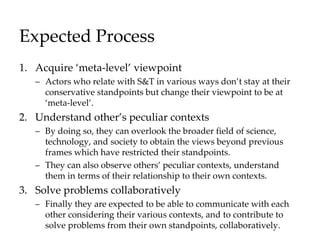
Expected Process
1. Acquire ‘meta-level’ viewpoint
– Actors who relate with S&T in various ways don’t stay at their
conservative standpoints but change their viewpoint to be at
‘meta-level’.
2. Understand other’s peculiar contexts
– By doing so, they can overlook the broader field of science,
technology, and society to obtain the views beyond previous
frames which have restricted their standpoints.
– They can also observe others’ peculiar contexts, understand
them in terms of their relationship to their own contexts.
3. Solve problems collaboratively
– Finally they are expected to be able to communicate with each
other considering their various contexts, and to contribute to
solve problems from their own standpoints, collaboratively.
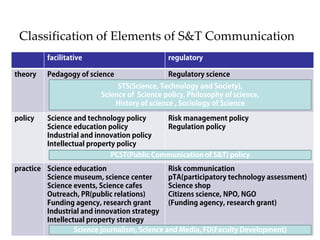
Classification of Elements of S&T Communication
facilitative regulatory
theory Pedagogy of science Regulatory science
policy Science and technology policy
Science education policy
Industrial and innovation policy
Intellectual property policy
Risk management policy
Regulation policy
practice Science education
Science museum, science center
Science events, Science cafes
Outreach, PR(public relations)
Funding agency, research grant
Industrial and innovation strategy
Intellectual property strategy
Risk communication
pTA(participatory technology assessment)
Science shop
Citizens science, NPO, NGO
(Funding agency, research grant)
STS(Science, Technology and Society),
Science of Science policy, Philosophy of science,
History of science , Sociology of Science
Science journalism, Science and Media, FD(Faculty Development)
PCST(Public Communication of S&T) policy
5. Cases of Practices at CoSTEP
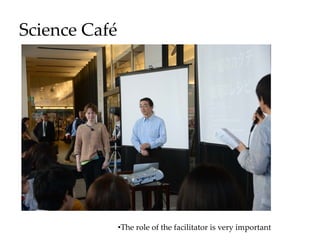
Science Café
•The role of the facilitator is very important
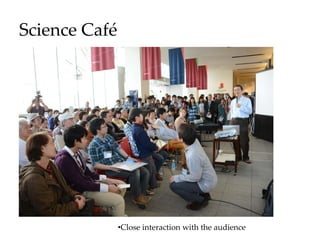
Science Café
•Close interaction with the audience
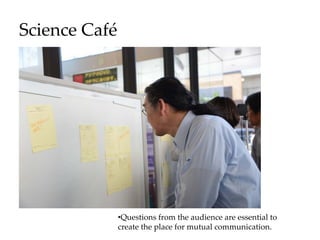
Science Café
•Questions from the audience are essential to
create the place for mutual communication.
Consensus Conference on GM crops
• Case
– GM consensus conference in Hokkaido, in 2006-2007
– Held by the prefectural government of Hokkaido
– pTA about GM(genetically modified) crops
– The first pTA event in practical use that has a close linkage to
actual policy-making.
• Method
– 15 citizens participated in 5 days’ program.
– Basic information was given to participants.
– Participants made key questions to specialists and they
answered.
– Based on the answer, participants discussed and made the
proposal for the policy about GM crops.
Nano TRI
• On food nanotechnologies held in Hokkaido in
2008
• The method “upstream public engagement” in
emerging technologies was employed, because
the method was caught attention, with
reflection from the failure on handling GM
food and crops issues.
• Consisted of three types of deliberative
methods: consensus conference, group
interview, and science café.
WWViews on Global Warming
• Held all around the world in 2009.
• To establish a model for the future inclusion of
the world’s citizens in global policy making.
• Involved around 4,000 citizens in 38 countries
in deliberations in Japan.
• The participants voted on 12 multiple-choice
questions and produced a large number of
recommendations phrased in their own
wording.
DP(Deliberative Poll) on BSE issues
• On BSE issues held in Hokkaido in 2011.
• The 1st questionnaire was sent to randomly chosen 3000 citizens
and 1616 answered.
• 170 were randomly chosen and information material about BSE
issues was sent to them.
• 151 people participated and the 2nd questionnaire was given them.
• Additional information was given by the video.
• The 1st group discussion and the 1st Q&A with specialists were
held .
• The 2nd group discussion and the 2nd Q&A with specialists were
held.
• The 3rd questionnaire was given.
• The results of 3 questionnaire were compared and analyzed.
6. Evaluation of Practices
Present Condition
• In Japan, cases of practices in S&T
communication have been accumulated since
2004.
• However, the followings are necessary to
continue practices with higher quality.
– Conduct of evaluation which is more acceptable and
useful for stakeholders and interested parties
– Systematization of evaluation methodology
What kind of problems are brought by lack of
systematization in evaluation of practices?
1. We can’t share any platform to compare
various practices with each other.
2. It is difficult to develop good theories based on
practices.
3. It is difficult for S&T communicators to achieve
accountability to citizens.
4. It is difficult for S&T communicators to acquire
stable evaluation.
Why is it difficult to evaluate
practices of S&T communication?
• Problems to be solved are not well defined.
– Definitions of “S&T communication” or “practices” are
diverse, in reality.
– Purposes of practices are also diverse.
– Multiple purposes are included even in a single
practice, and combination of the purposes are diverse
among practices.
Reasons of Diversity
1. Diversity of actors
– Diverse actors are involved, such as science teachers,
curators of science museums or science centers,
scientists, science journalists, science writers, PR
persons for research institutes, science policy makers,
industries, scholars in STS(science and technology
studies), citizens, and so on.
2. Complexity of objects
– Objects for practices of S&T communication
themselves are complicated from the viewpoint of
trans-science.
My Standpoint
• These diversities should not be “eliminated” but
should be “accepted as an essential property” for
S&T communication.
• Suppose that there is diversity in purposes of
practices, in order to acquire “common language”
for evaluation in spite of the diversity, it is
necessary and effective to try to systematize
evaluation methodology for practices.
• We are trying now….
7. Education of S&T
Communicators at CoSTEP
In Japan,
• Three education programs were founded in 2005
in Hokkaido University, Waseda University, and
University of Tokyo, funded by JST(Japan S&T
agency).
• CoSTEP(Communicators in Science and
Technology Education Program, Hokkaido
University) was one of them.
• Around the same time, several education
program began which were run by universities
or science museums.
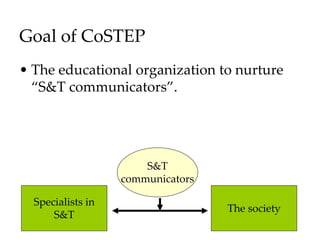
Goal of CoSTEP
• The educational organization to nurture
“S&T communicators”.
Specialists in
S&T
The society
S&T
communicators
History
• Founded in 2005 at Hokkaido University
as a 5-year project funded by the national
government.
• At April, 2010, Hokkaido University
decided to continue the program by its
own budget.
• Now the 9th yearly program is running.
Mission
1. To educate S&T communicators
2. To do practice variety of science
communications
3. Research and development of
educational methods
To realize better relationship between
science, technology, and the society
Principles
• Mutual communication
• Community based
• Learning by practice
• Science communicator as a “role” (not
restricted to ,so-called, “profession”)
• Generalist-oriented (not to exclude
specialists but to focus on collaborating
with them)
How the Curriculum Should be
Designed?
• What kind of knowledge, skills, mindsets and
experiences are needed for science
communicators?
• They depend on
– purpose of communication,
– with whom they will work,
– what the society expects,
– students career design,
– students background,
– time and other resources available for education
– etc.
Conditions
• There’s no top-down answer.
• It must be dynamically constructed in the
mutual relationship among education,
practice, and conceptualization.
Education, Practice, and
Conceptualization
• Education
– lectures and seminars in the classroom
• Practice
– activities in the real society with diverse actors
(clients, audience, visitors, etc.)
• Conceptualization
– Description, abstraction, and systematization of
education and practice
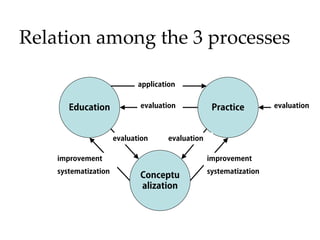
Relation among the 3 processes
Education Practice
Conceptu
alization
improvement
systematization
evaluation
evaluation
application
improvement
systematization
evaluation
evaluation
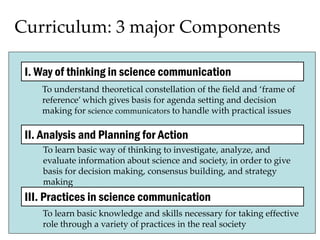
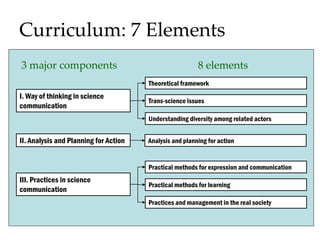
Curriculum: 3 major Components
I. Way of thinking in science communication
II. Analysis and Planning for Action
III. Practices in science communication
To understand theoretical constellation of the field and ‘frame of
reference’ which gives basis for agenda setting and decision
making for science communicators to handle with practical issues
To learn basic way of thinking to investigate, analyze, and
evaluate information about science and society, in order to give
basis for decision making, consensus building, and strategy
making
To learn basic knowledge and skills necessary for taking effective
role through a variety of practices in the real society
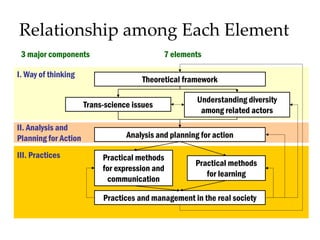
Curriculum: 7 Elements
Theoretical framework
Trans-science issues
Understanding diversity among related actors
Analysis and planning for action
Practical methods for learning
Practices and management in the real society
I. Way of thinking in science
communication
II. Analysis and Planning for Action
III. Practices in science
communication
3 major components 8 elements
Practical methods for expression and communication
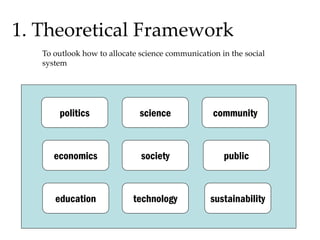
1. Theoretical Framework
To outlook how to allocate science communication in the social
system
society
science
public
technology
communitypolitics
education sustainability
economics
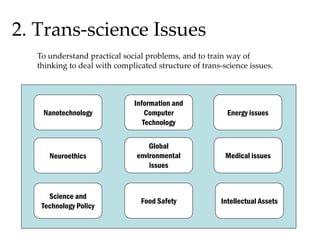
2. Trans-science Issues
To understand practical social problems, and to train way of
thinking to deal with complicated structure of trans-science issues.
Global
environmental
issues
Information and
Computer
Technology
Medical issues
Food Safety
Energy issuesNanotechnology
Science and
Technology Policy
Intellectual Assets
Neuroethics
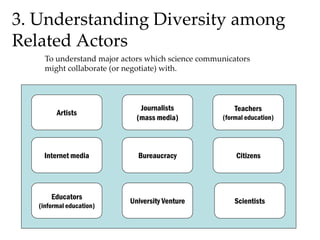
3. Understanding Diversity among
Related Actors
To understand major actors which science communicators
might collaborate (or negotiate) with.
Internet media Bureaucracy
Journalists
(mass media)
Citizens
University Venture
Teachers
(formal education)
Artists
Educators
(informal education)
Scientists
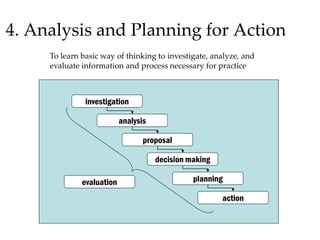
4. Analysis and Planning for Action
To learn basic way of thinking to investigate, analyze, and
evaluate information and process necessary for practice
investigation
decision making
analysis
evaluation
action
planning
proposal
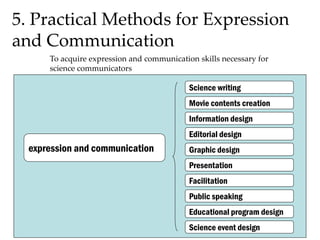
5. Practical Methods for Expression
and Communication
To acquire expression and communication skills necessary for
science communicators
Graphic design
Presentation
Facilitation
expression and communication
Science writing
Movie contents creation
Information design
Science event design
Public speaking
Editorial design
Educational program design
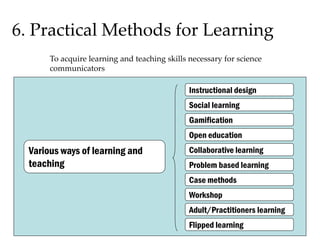
6. Practical Methods for Learning
To acquire learning and teaching skills necessary for science
communicators
Collaborative learning
Problem based learning
Case methods
Various ways of learning and
teaching
Instructional design
Social learning
Gamification
Adult/Practitioners learning
Workshop
Open education
Flipped learning
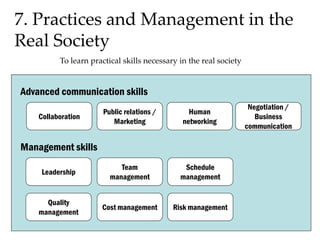
7. Practices and Management in the
Real Society
To learn practical skills necessary in the real society
Schedule
management
Team
management
Negotiation /
Business
communication
Public relations /
Marketing
Cost management
Human
networking
Leadership
Quality
management
Risk management
Advanced communication skills
Management skills
Collaboration
Relationship among Each Element
Theoretical framework
Trans-science issues
Understanding diversity
among related actors
Analysis and planning for action
Practical methods
for expression and
communication
Practices and management in the real society
I. Way of thinking
II. Analysis and
Planning for Action
III. Practices
3 major components 7 elements
Practical methods
for learning
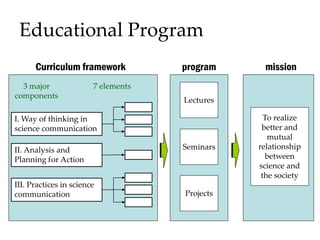
Educational Program
I. Way of thinking in
science communication
II. Analysis and
Planning for Action
III. Practices in science
communication
3 major
components
7 elements
Lectures
Seminars
Projects
Curriculum framework program
To realize
better and
mutual
relationship
between
science and
the society
mission
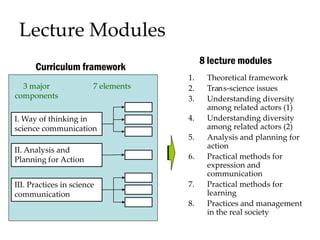
Lecture Modules
8 lecture modules
1. Theoretical framework
2. Trans-science issues
3. Understanding diversity
among related actors (1)
4. Understanding diversity
among related actors (2)
5. Analysis and planning for
action
6. Practical methods for
expression and
communication
7. Practical methods for
learning
8. Practices and management
in the real society
I. Way of thinking in
science communication
II. Analysis and
Planning for Action
III. Practices in science
communication
3 major
components
7 elements
Curriculum framework
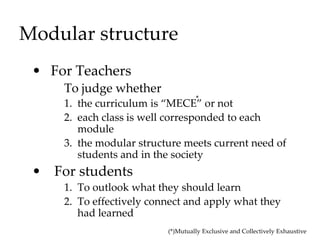
Modular structure
• For Teachers
To judge whether
1. the curriculum is “MECE” or not
2. each class is well corresponded to each
module
3. the modular structure meets current need of
students and in the society
• For students
1. To outlook what they should learn
2. To effectively connect and apply what they
had learned
(*)Mutually Exclusive and Collectively Exhaustive
*
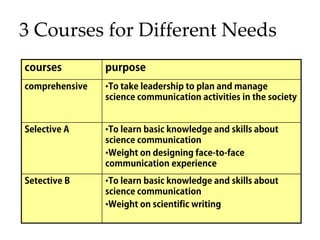
3 Courses for Different Needs
courses purpose
comprehensive •To take leadership to plan and manage
science communication activities in the society
Selective A •To learn basic knowledge and skills about
science communication
•Weight on designing face-to-face
communication experience
Setective B •To learn basic knowledge and skills about
science communication
•Weight on scientific writing
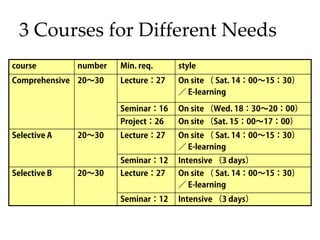
3 Courses for Different Needs
course number Min. req. style
Comprehensive 20~30 Lecture:27 On site ( Sat. 14:00~15:30)
/ E-learning
Seminar:16 On site (Wed. 18:30~20:00)
Project:26 On site (Sat. 15:00~17:00)
Selective A 20~30 Lecture:27 On site ( Sat. 14:00~15:30)
/ E-learning
Seminar:12 Intensive (3 days)
Selective B 20~30 Lecture:27 On site ( Sat. 14:00~15:30)
/ E-learning
Seminar:12 Intensive (3 days)
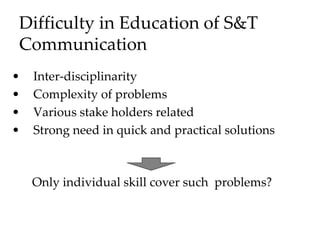
Difficulty in Education of S&T
Communication
• Inter-disciplinarity
• Complexity of problems
• Various stake holders related
• Strong need in quick and practical solutions
Only individual skill cover such problems?
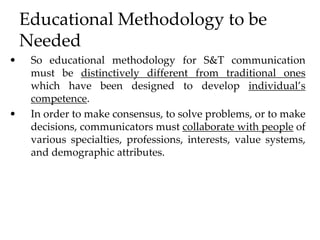
Educational Methodology to be
Needed
• So educational methodology for S&T communication
must be distinctively different from traditional ones
which have been designed to develop individual’s
competence.
• In order to make consensus, to solve problems, or to make
decisions, communicators must collaborate with people of
various specialties, professions, interests, value systems,
and demographic attributes.
Educational Methodology to be
Needed
• We focus on educating S&T communicators
who can have leadership to plan and manage
activities in the real society,
– by collaborating with others.
8. Sustainability and S&T
Communication
Sustainability and S&T Communication
• S&T is indispensable for the modern society.
• However it might make us face with tremendous “man-
made” risks.
• Such risks are sometimes so destructive as to harm
sustainability of the earth’s ecological system and our
society.
• In short, S&T is too important to submit it to only
specialists.
• We must participate in decision-making process on S&T
researches, applications, and policies for sustainable
future.
9. Discussion
Discussion
1. Do you think that the purpose and the methods
of S&T communication are valid?
2. In your research field, what kind of S&T
communication is:
– Most effective? For what purpose and why effective?
– Least paid attention to in spite of its necessity? What
do you think the reason? How can you change the
situation?
– Most attractive for you when you do by yourself?
Why?

Science & Technology Communication

  • 1.
    Science & TechnologyCommunication Gensei Ishimura Associate Professor Communication in Science & Technology Education & Research Program, Hokkaido University (CoSTEP) ishimura@costep.hucc.hokudai.ac.jp 2013.7.8
  • 2.
    Outline 1. Self Introduction 2.What is Science & Technology Communication? 3. Why and How Is It Necessary in Today’s Context? 4. Definition of S&T Communication 5. Cases of Practices at CoSTEP 6. Evaluation of Practices 7. Education of S&T Communicators at CoSTEP 8. Sustainability and S&T Communication 9. Discussion
  • 3.
  • 4.
    Biography • 2005- – Practitioner,teacher, and researcher in the field of science and technology communication – Work at CoSTEP(Communication in Science & Technology Research & Education Program, Hokkaido University) • 1999- – Planning director of exhibits for science museums • 1996- – Researcher in the field of psychology and neuroscience
  • 5.
    My Works: ExhibitZone for Science of the Sun (SANYO Electric Co., Ltd. Solar Energy Museum “SOLAR LAB”)
  • 6.
    (SANYO Electric Co.,Ltd. Solar Energy Museum “SOLAR LAB”) My Works: Tables for Science Communication
  • 7.
    My Works: LifeHistories of Scientists
  • 8.
    My Works: SapporoScience Map
  • 9.
    My Works: SapporoScience Map • It is a website 1. made by students 2. where various places in the city Sapporo are introduced 3. in terms of related scientific stories. • URL http://d.hatena.ne.jp/costep_webteam/
  • 10.
    Links between Articlesand the Map • Each article is linked to the specific point of the map. • Each icon is linked to each article. • You can choose any article via the map.
  • 11.
    My Works: CampusEco-tours for Kids
  • 12.
    My Works: Workshopfor High School Student to Appeal the Advantages of Their School Papers to the Virtual Client •To make them reflect characteristics of their own media
  • 13.
    2. What isScience & Technology Communication?
  • 14.
    Science & Technology(S&T)Communication is: • briefly, • to create bridges between specialists in S&T and the society Specialists in S&T The society S&T communication
  • 15.
    Early History ofScience Communication in United Kingdom • The Christmas Lectures of the Royal Institution of Great Britain – Demonstration-packed, fun-filled science events for young people. – Started by Michael Faraday in 1825. • C.P. Snow (1959): The Two Cultures – The intellectual life of the whole of western society was split into the two cultures — namely the sciences and the humanities — and that this was a major obstacle to solving the world's problems.
  • 16.
    Royal Society (1985):The Public Understanding of Science (Bodmer Report) • Weighed much importance on: – facilitation and improvement of public understanding of science • Led to: – Committee on the Public Understanding of Science : COPUS (1985) – cultural change in the attitude of scientists to outreach activities – Media Fellowship, Westminster Fellowship
  • 17.
    3. Why andHow Is It Necessary in Today’s Context?
  • 18.
    Why and HowIs It Necessary in Today’s Context? • Impact of S&T increased enormously during this 100 years. • S&T have carried out many negative effect in our society (ex. environmental problem, technological risk) • S&T have largely changed our lifestyle and essentially affect our ethics and value systems. • S&T are supported by huge budget provided by our government.
  • 19.
    Why and HowIs It Necessary in Today’s Context? • Relation among S&T and the society has become extremely complicated and they are hardly separable. • The number of questions which can be asked of science and yet cannot be answered by science (= trans-science issues) has increased. • To deal with such issues, novel initiatives become needed in the society.
  • 20.
    Case: BSE (BovineSpongiform Encephalopathy) Issue • Occurred at first in UK around 1990. • In 1989, the committee chaired by the Oxford zoologist Richard Southwood, had given its opinion that there was very little danger to humans from BSE. • The government and statesmen ignored the warning of the committee that pointed the limitation of the report and the necessity of further investigation. • In 1996, the government admitted that 10 clients of vCJD (variant Creutzfeld Jacob Disease) had been infected because of having taken beef from BSE infected cows. • The public came to strongly distrust the government and scientists belong to it.
  • 21.
    The recommendation “Scienceand Society” • In 2000, the recommendation “Science and Society” pointed that the public had strong distrust of scientists related to the government and industries, and that they expressed feeling of rejection against science and technology such as genetically modified foods and cloning technology. • Besides, it suggested that the government should respond to the public’s need for ‘dialogue’. • The recommendation adopted STS (Science and Technology Studies) researchers discussion.
  • 22.
    STS (Science andTechnology Studies) researchers discussion • They insisted that the ‘deficit model’ was no more successful.
  • 23.
    What is “Deficitmodel”? • The government and scientists thought that people cannot think, discuss, nor behave logically because they lack sufficient knowledge of science. • So, they thought that they must convey more and more scientific knowledge to the uneducated public in order to enlighten them. • That’s why they had thought PUS (Public Understanding of Science) was important.
  • 24.
    STS (Science andTechnology Studies) researchers discussion • They insisted that the ‘deficit model’ was no more successful. • They revealed that the theory “the more scientific knowledge the public acquire, the more positively they perceive science” is not always true. – For some research fields which are related to ethical issues, the more scientific knowledge the public have, the more negatively they think of the fields. – The better they understand science, the more indifferent they are to science.
  • 25.
    STS (Science andTechnology Studies) researchers discussion • Even among scientists, clear consensus doesn’t exist about “what is science” or “what is scientific knowledge”.
  • 26.
    Beyond “Deficit Model” 1.Contextual model – The public have situation-specific, contextualized knowledge. • closely related to their political and social knowledge. – Post normal science • high uncertainty of the system, but highly related to their interests 2. Lay-expertise model – The public have, so called, local knowledge, or indigenous knowledge.
  • 27.
    Beyond “Deficit Model” 3.Participation model – From enlightenment to empowerment – pTA (participatory technology assessment) • Consensus conference – Started in Denmark • Deliberative polling (DP) – Mutuality, and communication • Science café
  • 28.
    4. Definition ofS&T Communication
  • 29.
    Definition: S&T communication 1.maximize positive values and minimize negative values brought about by S&T in our society 2. breed the trust on our society in which S&T are deeply embedded Justness Legitimacy Practices in general in the field of communication for the following 2 purposes:
  • 30.
    Methods • Computation byparticipation • Practices of communication related to S&T in order to develop ‘collective decision-making function’ of our social system 1. Facilitation of appropriate use of S&T • Science education (formal/informal) • Science journalism 2. Participatory evaluation of S&T • Participatory technology assessment (ex. consensus conference) • Regulatory science (cf. ELSI) 3. Policy making, execution, and evaluation about S&T • S&T policy (research grant and human resource development) • Industrial policy, innovation policy, intellectual property strategy • Accountability (ex. outreach)
  • 31.
    Expected Process 1. Acquire‘meta-level’ viewpoint – Actors who relate with S&T in various ways don’t stay at their conservative standpoints but change their viewpoint to be at ‘meta-level’. 2. Understand other’s peculiar contexts – By doing so, they can overlook the broader field of science, technology, and society to obtain the views beyond previous frames which have restricted their standpoints. – They can also observe others’ peculiar contexts, understand them in terms of their relationship to their own contexts. 3. Solve problems collaboratively – Finally they are expected to be able to communicate with each other considering their various contexts, and to contribute to solve problems from their own standpoints, collaboratively.
  • 32.
    Classification of Elementsof S&T Communication facilitative regulatory theory Pedagogy of science Regulatory science policy Science and technology policy Science education policy Industrial and innovation policy Intellectual property policy Risk management policy Regulation policy practice Science education Science museum, science center Science events, Science cafes Outreach, PR(public relations) Funding agency, research grant Industrial and innovation strategy Intellectual property strategy Risk communication pTA(participatory technology assessment) Science shop Citizens science, NPO, NGO (Funding agency, research grant) STS(Science, Technology and Society), Science of Science policy, Philosophy of science, History of science , Sociology of Science Science journalism, Science and Media, FD(Faculty Development) PCST(Public Communication of S&T) policy
  • 33.
    5. Cases ofPractices at CoSTEP
  • 34.
    Science Café •The roleof the facilitator is very important
  • 35.
  • 36.
    Science Café •Questions fromthe audience are essential to create the place for mutual communication.
  • 37.
    Consensus Conference onGM crops • Case – GM consensus conference in Hokkaido, in 2006-2007 – Held by the prefectural government of Hokkaido – pTA about GM(genetically modified) crops – The first pTA event in practical use that has a close linkage to actual policy-making. • Method – 15 citizens participated in 5 days’ program. – Basic information was given to participants. – Participants made key questions to specialists and they answered. – Based on the answer, participants discussed and made the proposal for the policy about GM crops.
  • 38.
    Nano TRI • Onfood nanotechnologies held in Hokkaido in 2008 • The method “upstream public engagement” in emerging technologies was employed, because the method was caught attention, with reflection from the failure on handling GM food and crops issues. • Consisted of three types of deliberative methods: consensus conference, group interview, and science café.
  • 39.
    WWViews on GlobalWarming • Held all around the world in 2009. • To establish a model for the future inclusion of the world’s citizens in global policy making. • Involved around 4,000 citizens in 38 countries in deliberations in Japan. • The participants voted on 12 multiple-choice questions and produced a large number of recommendations phrased in their own wording.
  • 40.
    DP(Deliberative Poll) onBSE issues • On BSE issues held in Hokkaido in 2011. • The 1st questionnaire was sent to randomly chosen 3000 citizens and 1616 answered. • 170 were randomly chosen and information material about BSE issues was sent to them. • 151 people participated and the 2nd questionnaire was given them. • Additional information was given by the video. • The 1st group discussion and the 1st Q&A with specialists were held . • The 2nd group discussion and the 2nd Q&A with specialists were held. • The 3rd questionnaire was given. • The results of 3 questionnaire were compared and analyzed.
  • 41.
  • 42.
    Present Condition • InJapan, cases of practices in S&T communication have been accumulated since 2004. • However, the followings are necessary to continue practices with higher quality. – Conduct of evaluation which is more acceptable and useful for stakeholders and interested parties – Systematization of evaluation methodology
  • 43.
    What kind ofproblems are brought by lack of systematization in evaluation of practices? 1. We can’t share any platform to compare various practices with each other. 2. It is difficult to develop good theories based on practices. 3. It is difficult for S&T communicators to achieve accountability to citizens. 4. It is difficult for S&T communicators to acquire stable evaluation.
  • 44.
    Why is itdifficult to evaluate practices of S&T communication? • Problems to be solved are not well defined. – Definitions of “S&T communication” or “practices” are diverse, in reality. – Purposes of practices are also diverse. – Multiple purposes are included even in a single practice, and combination of the purposes are diverse among practices.
  • 45.
    Reasons of Diversity 1.Diversity of actors – Diverse actors are involved, such as science teachers, curators of science museums or science centers, scientists, science journalists, science writers, PR persons for research institutes, science policy makers, industries, scholars in STS(science and technology studies), citizens, and so on. 2. Complexity of objects – Objects for practices of S&T communication themselves are complicated from the viewpoint of trans-science.
  • 46.
    My Standpoint • Thesediversities should not be “eliminated” but should be “accepted as an essential property” for S&T communication. • Suppose that there is diversity in purposes of practices, in order to acquire “common language” for evaluation in spite of the diversity, it is necessary and effective to try to systematize evaluation methodology for practices. • We are trying now….
  • 47.
    7. Education ofS&T Communicators at CoSTEP
  • 48.
    In Japan, • Threeeducation programs were founded in 2005 in Hokkaido University, Waseda University, and University of Tokyo, funded by JST(Japan S&T agency). • CoSTEP(Communicators in Science and Technology Education Program, Hokkaido University) was one of them. • Around the same time, several education program began which were run by universities or science museums.
  • 49.
    Goal of CoSTEP •The educational organization to nurture “S&T communicators”. Specialists in S&T The society S&T communicators
  • 50.
    History • Founded in2005 at Hokkaido University as a 5-year project funded by the national government. • At April, 2010, Hokkaido University decided to continue the program by its own budget. • Now the 9th yearly program is running.
  • 51.
    Mission 1. To educateS&T communicators 2. To do practice variety of science communications 3. Research and development of educational methods To realize better relationship between science, technology, and the society
  • 52.
    Principles • Mutual communication •Community based • Learning by practice • Science communicator as a “role” (not restricted to ,so-called, “profession”) • Generalist-oriented (not to exclude specialists but to focus on collaborating with them)
  • 53.
    How the CurriculumShould be Designed? • What kind of knowledge, skills, mindsets and experiences are needed for science communicators? • They depend on – purpose of communication, – with whom they will work, – what the society expects, – students career design, – students background, – time and other resources available for education – etc.
  • 54.
    Conditions • There’s notop-down answer. • It must be dynamically constructed in the mutual relationship among education, practice, and conceptualization.
  • 55.
    Education, Practice, and Conceptualization •Education – lectures and seminars in the classroom • Practice – activities in the real society with diverse actors (clients, audience, visitors, etc.) • Conceptualization – Description, abstraction, and systematization of education and practice
  • 56.
    Relation among the3 processes Education Practice Conceptu alization improvement systematization evaluation evaluation application improvement systematization evaluation evaluation
  • 57.
    Curriculum: 3 majorComponents I. Way of thinking in science communication II. Analysis and Planning for Action III. Practices in science communication To understand theoretical constellation of the field and ‘frame of reference’ which gives basis for agenda setting and decision making for science communicators to handle with practical issues To learn basic way of thinking to investigate, analyze, and evaluate information about science and society, in order to give basis for decision making, consensus building, and strategy making To learn basic knowledge and skills necessary for taking effective role through a variety of practices in the real society
  • 58.
    Curriculum: 7 Elements Theoreticalframework Trans-science issues Understanding diversity among related actors Analysis and planning for action Practical methods for learning Practices and management in the real society I. Way of thinking in science communication II. Analysis and Planning for Action III. Practices in science communication 3 major components 8 elements Practical methods for expression and communication
  • 59.
    1. Theoretical Framework Tooutlook how to allocate science communication in the social system society science public technology communitypolitics education sustainability economics
  • 60.
    2. Trans-science Issues Tounderstand practical social problems, and to train way of thinking to deal with complicated structure of trans-science issues. Global environmental issues Information and Computer Technology Medical issues Food Safety Energy issuesNanotechnology Science and Technology Policy Intellectual Assets Neuroethics
  • 61.
    3. Understanding Diversityamong Related Actors To understand major actors which science communicators might collaborate (or negotiate) with. Internet media Bureaucracy Journalists (mass media) Citizens University Venture Teachers (formal education) Artists Educators (informal education) Scientists
  • 62.
    4. Analysis andPlanning for Action To learn basic way of thinking to investigate, analyze, and evaluate information and process necessary for practice investigation decision making analysis evaluation action planning proposal
  • 63.
    5. Practical Methodsfor Expression and Communication To acquire expression and communication skills necessary for science communicators Graphic design Presentation Facilitation expression and communication Science writing Movie contents creation Information design Science event design Public speaking Editorial design Educational program design
  • 64.
    6. Practical Methodsfor Learning To acquire learning and teaching skills necessary for science communicators Collaborative learning Problem based learning Case methods Various ways of learning and teaching Instructional design Social learning Gamification Adult/Practitioners learning Workshop Open education Flipped learning
  • 65.
    7. Practices andManagement in the Real Society To learn practical skills necessary in the real society Schedule management Team management Negotiation / Business communication Public relations / Marketing Cost management Human networking Leadership Quality management Risk management Advanced communication skills Management skills Collaboration
  • 66.
    Relationship among EachElement Theoretical framework Trans-science issues Understanding diversity among related actors Analysis and planning for action Practical methods for expression and communication Practices and management in the real society I. Way of thinking II. Analysis and Planning for Action III. Practices 3 major components 7 elements Practical methods for learning
  • 67.
    Educational Program I. Wayof thinking in science communication II. Analysis and Planning for Action III. Practices in science communication 3 major components 7 elements Lectures Seminars Projects Curriculum framework program To realize better and mutual relationship between science and the society mission
  • 68.
    Lecture Modules 8 lecturemodules 1. Theoretical framework 2. Trans-science issues 3. Understanding diversity among related actors (1) 4. Understanding diversity among related actors (2) 5. Analysis and planning for action 6. Practical methods for expression and communication 7. Practical methods for learning 8. Practices and management in the real society I. Way of thinking in science communication II. Analysis and Planning for Action III. Practices in science communication 3 major components 7 elements Curriculum framework
  • 69.
    Modular structure • ForTeachers To judge whether 1. the curriculum is “MECE” or not 2. each class is well corresponded to each module 3. the modular structure meets current need of students and in the society • For students 1. To outlook what they should learn 2. To effectively connect and apply what they had learned (*)Mutually Exclusive and Collectively Exhaustive *
  • 70.
    3 Courses forDifferent Needs courses purpose comprehensive •To take leadership to plan and manage science communication activities in the society Selective A •To learn basic knowledge and skills about science communication •Weight on designing face-to-face communication experience Setective B •To learn basic knowledge and skills about science communication •Weight on scientific writing
  • 71.
    3 Courses forDifferent Needs course number Min. req. style Comprehensive 20~30 Lecture:27 On site ( Sat. 14:00~15:30) / E-learning Seminar:16 On site (Wed. 18:30~20:00) Project:26 On site (Sat. 15:00~17:00) Selective A 20~30 Lecture:27 On site ( Sat. 14:00~15:30) / E-learning Seminar:12 Intensive (3 days) Selective B 20~30 Lecture:27 On site ( Sat. 14:00~15:30) / E-learning Seminar:12 Intensive (3 days)
  • 72.
    Difficulty in Educationof S&T Communication • Inter-disciplinarity • Complexity of problems • Various stake holders related • Strong need in quick and practical solutions Only individual skill cover such problems?
  • 73.
    Educational Methodology tobe Needed • So educational methodology for S&T communication must be distinctively different from traditional ones which have been designed to develop individual’s competence. • In order to make consensus, to solve problems, or to make decisions, communicators must collaborate with people of various specialties, professions, interests, value systems, and demographic attributes.
  • 74.
    Educational Methodology tobe Needed • We focus on educating S&T communicators who can have leadership to plan and manage activities in the real society, – by collaborating with others.
  • 75.
    8. Sustainability andS&T Communication
  • 76.
    Sustainability and S&TCommunication • S&T is indispensable for the modern society. • However it might make us face with tremendous “man- made” risks. • Such risks are sometimes so destructive as to harm sustainability of the earth’s ecological system and our society. • In short, S&T is too important to submit it to only specialists. • We must participate in decision-making process on S&T researches, applications, and policies for sustainable future.
  • 77.
  • 78.
    Discussion 1. Do youthink that the purpose and the methods of S&T communication are valid? 2. In your research field, what kind of S&T communication is: – Most effective? For what purpose and why effective? – Least paid attention to in spite of its necessity? What do you think the reason? How can you change the situation? – Most attractive for you when you do by yourself? Why?