MUNTINLUPA CITY EARTHQUAKE
PREPAREDNESS
WHAT IS EARTHQUAKE
An earthquake is the shaking of the surface of the Earth,
resulting from the sudden release of energy in the Earth’s
lithosphere that creates seismic waves. Earthquakes can
range in size from those that are so weak that they cannot be
felt to those violent enough to toss people around and
destroy whole cities. The seismicity or seismic activity of an
area refers to the frequency, type and size of earthquakes
experienced over a period of time.
EFFECTS OF EARTHQUAKE
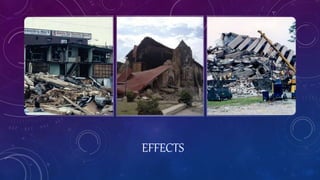
• The primary effects of earthquakes are ground
shaking, ground rupture, landslide, tsunamis,
and liquification. Fires are probably the single most
important secondary effect of earthquakes.
• When two massive plates meet at a convergent boundary, the
impact buckles one or both edges of the plates, shifting them
upwards to create mountains and sometimes volcanoes – or it
can bend one of the plates to create a deep marine trench on the
seabed. In divergent boundaries, the plates move away from each
other on the ocean’s floor, often forming deep trenches that allow
magma fissures to open and spew lava.
EFFECTS
HOW SHOULD WE PREPARE FOR
AN EARTHQUAKE
THING TO DO BEFORE AN EARTHQUAKE
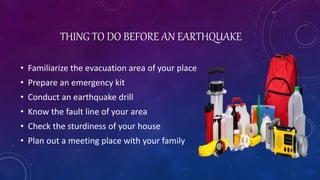
• Familiarize the evacuation area of your place
• Prepare an emergency kit
• Conduct an earthquake drill
• Know the fault line of your area
• Check the sturdiness of your house
• Plan out a meeting place with your family
THINGS TO DO DURING AN EARTHQUAKE
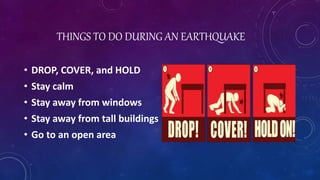
• DROP, COVER, and HOLD
• Stay calm
• Stay away from windows
• Stay away from tall buildings
• Go to an open area
THINGS TO DO AFTER AN EARTHQUAKE
• Be alert and cautious
• Expect an aftershocks
• Check your self and your family for injuries
• Stay out of damage areas
THANK YOU

Science power point

  • 1.
  • 2.
    WHAT IS EARTHQUAKE Anearthquake is the shaking of the surface of the Earth, resulting from the sudden release of energy in the Earth’s lithosphere that creates seismic waves. Earthquakes can range in size from those that are so weak that they cannot be felt to those violent enough to toss people around and destroy whole cities. The seismicity or seismic activity of an area refers to the frequency, type and size of earthquakes experienced over a period of time.
  • 3.
    EFFECTS OF EARTHQUAKE •The primary effects of earthquakes are ground shaking, ground rupture, landslide, tsunamis, and liquification. Fires are probably the single most important secondary effect of earthquakes. • When two massive plates meet at a convergent boundary, the impact buckles one or both edges of the plates, shifting them upwards to create mountains and sometimes volcanoes – or it can bend one of the plates to create a deep marine trench on the seabed. In divergent boundaries, the plates move away from each other on the ocean’s floor, often forming deep trenches that allow magma fissures to open and spew lava.
  • 4.
  • 5.
    HOW SHOULD WEPREPARE FOR AN EARTHQUAKE
  • 6.
    THING TO DOBEFORE AN EARTHQUAKE • Familiarize the evacuation area of your place • Prepare an emergency kit • Conduct an earthquake drill • Know the fault line of your area • Check the sturdiness of your house • Plan out a meeting place with your family
  • 7.
    THINGS TO DODURING AN EARTHQUAKE • DROP, COVER, and HOLD • Stay calm • Stay away from windows • Stay away from tall buildings • Go to an open area
  • 8.
    THINGS TO DOAFTER AN EARTHQUAKE • Be alert and cautious • Expect an aftershocks • Check your self and your family for injuries • Stay out of damage areas
  • 9.