Chapter 2
 Nina Bartell 8-3
2.1
Pure Substance

Matter that always has exactly the same
composition is classified as a pure substance

*every sample of a given substance has the
same properties because a substance has a
fixed, uniform composition

can be classified into two categories-elements
and compounds
Elements and Atoms

a substance that cannot be broken down into simpler
substances

an atom is the smallest particle of an element

*an element has a fixed composition because it
contains only one type of atom

no two elements contain the same type of atom
Compounds


 a substance that is made from two or more
simpler substances and can be broken down
into those simpler substances

The simpler substances are either elements or
other compounds
Mixture


*the properties of a mixture can vary because
the composition of a mixture is not fixed

mixtures can be classified by how well the
parts of the mixture are distributed throughout
the mixture
Heterogeneous and homogenous
          mixtures


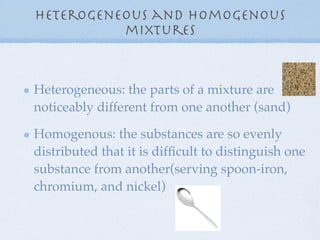
Heterogeneous: the parts of a mixture are
noticeably different from one another (sand)

Homogenous: the substances are so evenly
distributed that it is difficult to distinguish one
substance from another(serving spoon-iron,
chromium, and nickel)
Solutions/Suspensions/Colloids


 *Based on the size of its largest particles, a mixture can
 be classified as a solution, suspension, or colloid

 Solution: when substances dissolve and form a
 homogenous mixture

 Able to see through solutions that are liquids because
 light passes through them without going in all different
 directions

 Suspension: heterogeneous mixture that separates into
 layers over time
2.2
Physical Properties

Any characteristic of a material that can be observed
or measured without changing the composition of the
substances in the material

Used to identify a material, to choose a material for a
specific purpose, or to separate the substances in a
mixture

viscosity, conductivity, malleability, hardness, melting
point, boiling point, and density are all
Viscosity

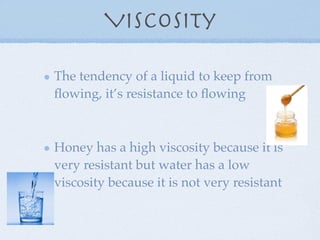
The tendency of a liquid to keep from
flowing, it’s resistance to flowing


Honey has a high viscosity because it is
very resistant but water has a low
viscosity because it is not very resistant
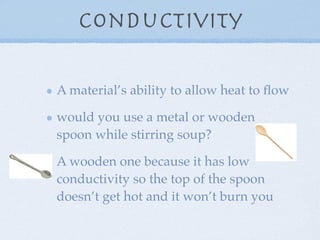
Conductivity

A material’s ability to allow heat to flow

would you use a metal or wooden
spoon while stirring soup?

A wooden one because it has low
conductivity so the top of the spoon
doesn’t get hot and it won’t burn you
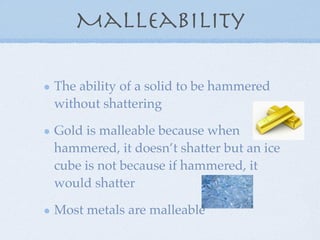
Malleability

The ability of a solid to be hammered
without shattering

Gold is malleable because when
hammered, it doesn’t shatter but an ice
cube is not because if hammered, it
would shatter

Most metals are malleable
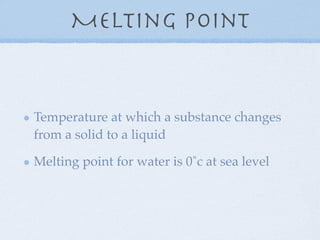
Melting point


Temperature at which a substance changes
from a solid to a liquid

Melting point for water is 0˚c at sea level
Boiling Point


Temperature at which a substance boils

Boiling point for water is 100˚c at sea level
Density


Used to test the purity of a substance

Ratio of the mass of a substance to its volume
Identifying a Material


1. Decide which properties to test

2. Do tests on the sample of the unknown

3. Compare the results with the data reported
for known materials
What are Properties?


They determine which materials are chosen for
what uses
Filtration and Distillation


These two terms are common separation
methods

Filtration: a process that separates materials
based on the size of their particles

Distillation: a process that separates the
substances in a solution based on their boiling
points
What is physical change?


The change of water from a liquid to a gas
during boiling

This occurs when some of the properties of the
material change but the substances in the
material stay the same
Ways of Separating a
        Mixture


Distillation

Filtration

Evaporation
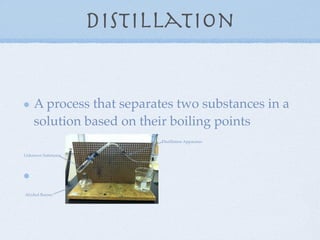
Distillation


    A process that separates two substances in a
    solution based on their boiling points
                          Distillation Apparatus


Unknown Substance


Alcohol Burner
Filtration

A process that separates materials based on the
size of particles +/or solubility

filter paper goes inside filter

the mixture is poured into filter paper

the element left in the filter paper is the
substance and the liquid at the bottom is to
purified water (liquid)
Evaporation

A process used to isolate a solid dissolved in a
liquid

ex: NaCl+water

Disclaimer: water(liquid) will evaporate+you
won’t be able to isolate a sample of it

mixture is poured into an evaporating dish
which is heated and all that is left is the
dissolved element that is now not dissolved
2.3
Chemical Property

Any ability to produce a change in
composition of matter

Changes the composition of the substance

*Chemical properties can only be observed
when the substances in a sample of matter are
changing into different substances
Flammability

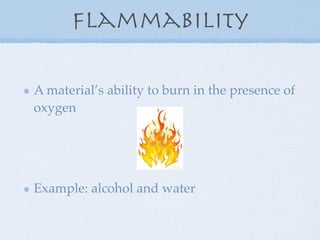
A material’s ability to burn in the presence of
oxygen


Example: alcohol and water
Reactivity


A property that describes how readily a
substance combines with other substances.

Example: Oxygen/Potassium
Chemical Change


Occurs when a substance reacts and forms one
or more new substances

*Three common types of of a chemical change:
-change in color -the production of gas -the
formation of a precipitate
Precipitate


Any solid that forms and separates from a
liquid mixture
REVIEW
QUESTIONS
#1 QUESTION


HOW MANY CATEGORIES ARE PURE
SUBSTANCES CLASSIFIED INTO? AND
WHAT ARE THOSE CATEGORIES?
#2 QUESTION


WHAT TYPE OF CHANGE DO YOU USE
WHEN YOU WANT THE COMPOSITION OF
THE SUBSTANCES TO STAY THE SAME?
#3 QUESTION


WHAT TECHNIQUE WOULD YOU USE TO
ISOLATE A SOLUTION OF SALT AND
WATER?
#4 QUESTION


IF BLUE DYE WAS SPILLED ON A SHIRT,
WOULD IT BE A CHEMICAL OR PHYSICAL
CHANGE? WHY?
ANSWERS:

#1- Pure substances are classified into two categories,
elements and compounds.

#2-You would use a physical change if you wanted the
composition of the substances to stay the same.

#3-The technique used to isolate a solution of salt and
water would be evaporation.

#4-It would be a chemical change if blue dye was
spilled on a shirt because it changes the color, but also,
it can never come out therefore it adds to the object.

Chapter two powerpoint

  • 1.
    Chapter 2 NinaBartell 8-3
  • 2.
  • 3.
    Pure Substance Matter thatalways has exactly the same composition is classified as a pure substance *every sample of a given substance has the same properties because a substance has a fixed, uniform composition can be classified into two categories-elements and compounds
  • 4.
    Elements and Atoms asubstance that cannot be broken down into simpler substances an atom is the smallest particle of an element *an element has a fixed composition because it contains only one type of atom no two elements contain the same type of atom
  • 5.
    Compounds a substancethat is made from two or more simpler substances and can be broken down into those simpler substances The simpler substances are either elements or other compounds
  • 6.
    Mixture *the properties ofa mixture can vary because the composition of a mixture is not fixed mixtures can be classified by how well the parts of the mixture are distributed throughout the mixture
  • 7.
    Heterogeneous and homogenous mixtures Heterogeneous: the parts of a mixture are noticeably different from one another (sand) Homogenous: the substances are so evenly distributed that it is difficult to distinguish one substance from another(serving spoon-iron, chromium, and nickel)
  • 8.
    Solutions/Suspensions/Colloids *Based onthe size of its largest particles, a mixture can be classified as a solution, suspension, or colloid Solution: when substances dissolve and form a homogenous mixture Able to see through solutions that are liquids because light passes through them without going in all different directions Suspension: heterogeneous mixture that separates into layers over time
  • 9.
  • 10.
    Physical Properties Any characteristicof a material that can be observed or measured without changing the composition of the substances in the material Used to identify a material, to choose a material for a specific purpose, or to separate the substances in a mixture viscosity, conductivity, malleability, hardness, melting point, boiling point, and density are all
  • 11.
    Viscosity The tendency ofa liquid to keep from flowing, it’s resistance to flowing Honey has a high viscosity because it is very resistant but water has a low viscosity because it is not very resistant
  • 12.
    Conductivity A material’s abilityto allow heat to flow would you use a metal or wooden spoon while stirring soup? A wooden one because it has low conductivity so the top of the spoon doesn’t get hot and it won’t burn you
  • 13.
    Malleability The ability ofa solid to be hammered without shattering Gold is malleable because when hammered, it doesn’t shatter but an ice cube is not because if hammered, it would shatter Most metals are malleable
  • 14.
    Melting point Temperature atwhich a substance changes from a solid to a liquid Melting point for water is 0˚c at sea level
  • 15.
    Boiling Point Temperature atwhich a substance boils Boiling point for water is 100˚c at sea level
  • 16.
    Density Used to testthe purity of a substance Ratio of the mass of a substance to its volume
  • 17.
    Identifying a Material 1.Decide which properties to test 2. Do tests on the sample of the unknown 3. Compare the results with the data reported for known materials
  • 18.
    What are Properties? Theydetermine which materials are chosen for what uses
  • 19.
    Filtration and Distillation Thesetwo terms are common separation methods Filtration: a process that separates materials based on the size of their particles Distillation: a process that separates the substances in a solution based on their boiling points
  • 20.
    What is physicalchange? The change of water from a liquid to a gas during boiling This occurs when some of the properties of the material change but the substances in the material stay the same
  • 21.
    Ways of Separatinga Mixture Distillation Filtration Evaporation
  • 22.
    Distillation A process that separates two substances in a solution based on their boiling points Distillation Apparatus Unknown Substance Alcohol Burner
  • 23.
    Filtration A process thatseparates materials based on the size of particles +/or solubility filter paper goes inside filter the mixture is poured into filter paper the element left in the filter paper is the substance and the liquid at the bottom is to purified water (liquid)
  • 24.
    Evaporation A process usedto isolate a solid dissolved in a liquid ex: NaCl+water Disclaimer: water(liquid) will evaporate+you won’t be able to isolate a sample of it mixture is poured into an evaporating dish which is heated and all that is left is the dissolved element that is now not dissolved
  • 25.
  • 26.
    Chemical Property Any abilityto produce a change in composition of matter Changes the composition of the substance *Chemical properties can only be observed when the substances in a sample of matter are changing into different substances
  • 27.
    Flammability A material’s abilityto burn in the presence of oxygen Example: alcohol and water
  • 28.
    Reactivity A property thatdescribes how readily a substance combines with other substances. Example: Oxygen/Potassium
  • 29.
    Chemical Change Occurs whena substance reacts and forms one or more new substances *Three common types of of a chemical change: -change in color -the production of gas -the formation of a precipitate
  • 30.
    Precipitate Any solid thatforms and separates from a liquid mixture
  • 31.
  • 32.
    #1 QUESTION HOW MANYCATEGORIES ARE PURE SUBSTANCES CLASSIFIED INTO? AND WHAT ARE THOSE CATEGORIES?
  • 33.
    #2 QUESTION WHAT TYPEOF CHANGE DO YOU USE WHEN YOU WANT THE COMPOSITION OF THE SUBSTANCES TO STAY THE SAME?
  • 34.
    #3 QUESTION WHAT TECHNIQUEWOULD YOU USE TO ISOLATE A SOLUTION OF SALT AND WATER?
  • 35.
    #4 QUESTION IF BLUEDYE WAS SPILLED ON A SHIRT, WOULD IT BE A CHEMICAL OR PHYSICAL CHANGE? WHY?
  • 36.
    ANSWERS: #1- Pure substancesare classified into two categories, elements and compounds. #2-You would use a physical change if you wanted the composition of the substances to stay the same. #3-The technique used to isolate a solution of salt and water would be evaporation. #4-It would be a chemical change if blue dye was spilled on a shirt because it changes the color, but also, it can never come out therefore it adds to the object.