Sharin’ Ain’t “Social”
The Science of Social Learning
Greg Bybee
VP, Learning Solutions, NovoEd
greg@novoed.com
March 17, 2016
Introduction
Principles of Andragogy
Quick NovoEd Introduction
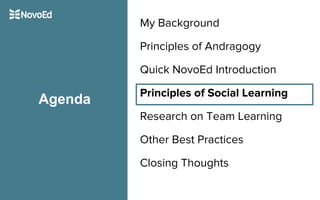
Principles of Social Learning
Research on Team Learning
Other Best Practices
Closing Thoughts
Agenda
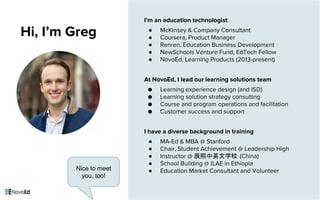
I’m an education technologist
● McKinsey & Company Consultant
● Coursera, Product Manager
● Renren, Education Business Development
● NewSchools Venture Fund, EdTech Fellow
● NovoEd, Learning Products (2013-present)
At NovoEd, I lead our learning solutions team
● Learning experience design (and ISD)
● Learning solution strategy consulting
● Course and program operations and facilitation
● Customer success and support
I have a diverse background in training
● MA-Ed & MBA @ Stanford
● Chair, Student Achievement @ Leadership High
● Instructor @ 辰熙中英文学校 (China)
● School Building @ ILAE in Ethiopia
● Education Market Consultant and Volunteer
Hi, I’m Greg
Nice to meet
you, too!
Introduction
Principles of Andragogy
Quick NovoEd Introduction
Principles of Social Learning
Research on Team Learning
Other Best Practices
Closing Thoughts
Agenda
Group Activity!!
● Form groups of 4-8.
● Answer the question: “what
makes for an effective adult
learning experience”
○ Focus not on outcomes of the
learning, but the definition of
the learning process
○ You’ll have 8 minutes.
● Add your ideas as text here:
http://padlet.com/novoed/ls16
Weren’t you
supposed to
tell us that?
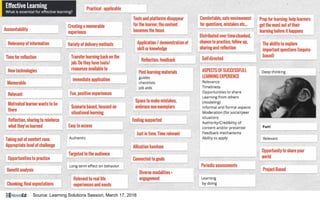
Source: Learning Solutions Session, March 17, 2016
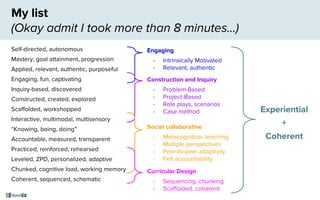
Social collaborative
- Metacognition, teaching
- Multiple perspectives
- Peer-to-peer adaptivity
- Felt accountability
Construction and Inquiry
- Problem-Based
- Project-Based
- Role plays, scenarios
- Case method
Engaging
- Intrinsically Motivated
- Relevant, authentic
My list
(Okay admit I took more than 8 minutes...)
Experiential
+
Coherent
Self-directed, autonomous
Mastery, goal attainment, progression
Applied, relevant, authentic, purposeful
Engaging, fun, captivating
Inquiry-based, discovered
Constructed, created, explored
Scaffolded, workshopped
Interactive, multimodal, multisensory
“Knowing, being, doing”
Accountable, measured, transparent
Practiced, reinforced, rehearsed
Leveled, ZPD, personalized, adaptive
Chunked, cognitive load, working memory
Coherent, sequenced, schematic
Curricular Design
- Sequencing, chunking
- Scaffolded, coherent
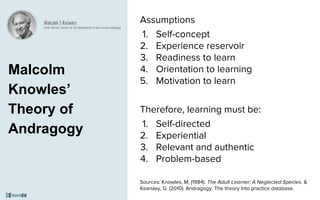
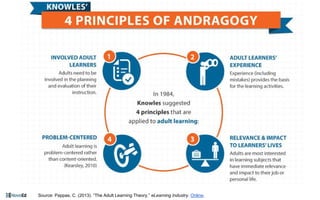
Malcolm
Knowles’
Theory of
Andragogy
Assumptions
1. Self-concept
2. Experience reservoir
3. Readiness to learn
4. Orientation to learning
5. Motivation to learn
Therefore, learning must be:
1. Self-directed
2. Experiential
3. Relevant and authentic
4. Problem-based
Sources: Knowles, M. (1984). The Adult Learner: A Neglected Species. &
Kearsley, G. (2010). Andragogy: The theory Into practice database.
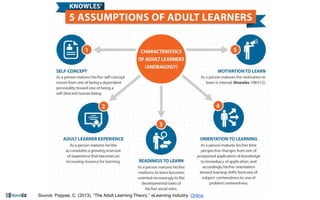
Source: Pappas, C. (2013). “The Adult Learning Theory.” eLearning Industry. Online.
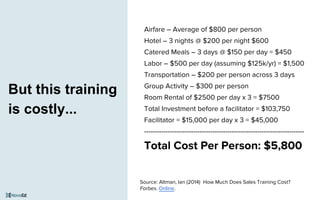
But this training
is costly...
Airfare – Average of $800 per person
Hotel – 3 nights @ $200 per night $600
Catered Meals – 3 days @ $150 per day = $450
Labor – $500 per day (assuming $125k/yr) = $1,500
Transportation – $200 per person across 3 days
Group Activity – $300 per person
Room Rental of $2500 per day x 3 = $7500
Total Investment before a facilitator = $103,750
Facilitator = $15,000 per day x 3 = $45,000
---------------------------------------------------------------------------
Total Cost Per Person: $5,800
Source: Altman, Ian (2014) How Much Does Sales Training Cost?
Forbes. Online.
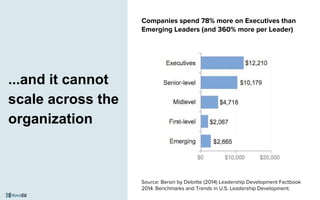
...and it cannot
scale across the
organization
Companies spend 78% more on Executives than
Emerging Leaders (and 360% more per Leader)
Source: Bersin by Deloitte (2014) Leadership Development Factbook
2014: Benchmarks and Trends in U.S. Leadership Development.
Online learning offered a solution, but didn’t deliver
My Background
Principles of Andragogy
Shameless Plug
Principles of Social Learning
Research on Team Learning
Other Best Practices
Closing Thoughts
Agenda
Solutions for learning
experience design
and implementation
Online platform for
experiential learning
NovoEd
develops talent
online.
We power the best talent development programs
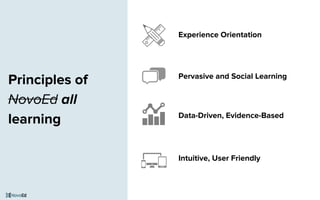
Principles of
NovoEd all
learning
Intuitive, User Friendly
Experience Orientation
Pervasive and Social Learning
Data-Driven, Evidence-Based
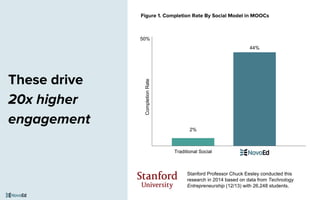
These drive
20x higher
engagement
CompletionRate
2%
44%
Traditional Social
Stanford Professor Chuck Eesley conducted this
research in 2014 based on data from Technology
Entrepreneurship (12/13) with 26,248 students.
50%
Figure 1. Completion Rate By Social Model in MOOCs
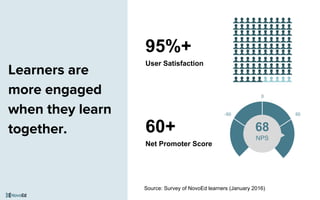
Learners are
more engaged
when they learn
together. 68
NPS
50-50
0
95%+
User Satisfaction
60+
Net Promoter Score
Source: Survey of NovoEd learners (January 2016)
My Background
Principles of Andragogy
Quick NovoEd Introduction
Principles of Social Learning
Research on Team Learning
Other Best Practices
Closing Thoughts
Agenda
What is social
learning?
The use of peer-to-peer (social) interaction
as a pedagogical technique to drive
learning.
Examples:
● 1:1 tutoring
● Reciprocal Teaching
● Think-Pair-share
● Jigsaw
● Group work
● Collaborative brainstorming
Source: I made this up last night after talking to another speaker.
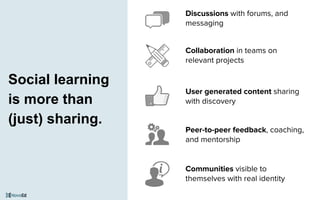
Social learning
is more than
(just) sharing.
Communities visible to
themselves with real identity
Peer-to-peer feedback, coaching,
and mentorship
Collaboration in teams on
relevant projects
Discussions with forums, and
messaging
User generated content sharing
with discovery
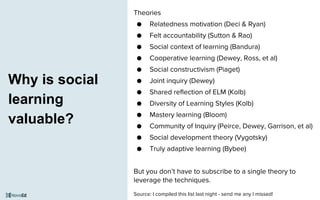
Why is social
learning
valuable?
Theories
● Relatedness motivation (Deci & Ryan)
● Felt accountability (Sutton & Rao)
● Social context of learning (Bandura)
● Cooperative learning (Dewey, Ross, et al)
● Social constructivism (Piaget)
● Joint inquiry (Dewey)
● Shared reflection of ELM (Kolb)
● Diversity of Learning Styles (Kolb)
● Mastery learning (Bloom)
● Community of Inquiry (Peirce, Dewey, Garrison, et al)
● Social development theory (Vygotsky)
● Truly adaptive learning (Bybee)
But you don’t have to subscribe to a single theory to
leverage the techniques.
Source: I compiled this list last night - send me any I missed!
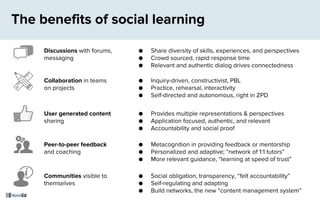
The benefits of social learning
Communities visible to
themselves
Peer-to-peer feedback
and coaching
Collaboration in teams
on projects
Discussions with forums,
messaging
User generated content
sharing
● Social obligation, transparency, “felt accountability”
● Self-regulating and adapting
● Build networks, the new “content management system”
● Metacognition in providing feedback or mentorship
● Personalized and adaptive; “network of 1:1 tutors”
● More relevant guidance, “learning at speed of trust”
● Inquiry-driven, constructivist, PBL
● Practice, rehearsal, interactivity
● Self-directed and autonomous, right in ZPD
● Share diversity of skills, experiences, and perspectives
● Crowd sourced, rapid response time
● Relevant and authentic dialog drives connectedness
● Provides multiple representations & perspectives
● Application focused, authentic, and relevant
● Accountability and social proof
My Background
Principles of Andragogy
Quick NovoEd Introduction
Principles of Social Learning
Research on Team Learning
Other Best Practices
Closing Thoughts
Agenda
Agenda
My Background
Principles of Andragogy
NovoEd Introduction
Social Learning
Team Learning
Best Practices
Closing Thoughts
Impact of Teams
Felt Accountability
Team Size
Team Selection
Team Heterogeneity
Scaffolding Teamwork
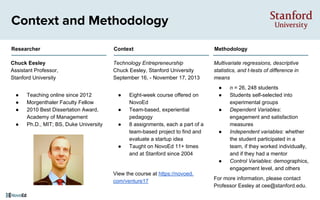
Context and Methodology
Chuck Eesley
Assistant Professor,
Stanford University
● Teaching online since 2012
● Morgenthaler Faculty Fellow
● 2010 Best Dissertation Award,
Academy of Management
● Ph.D., MIT; BS, Duke University
Technology Entrepreneurship
Chuck Eesley, Stanford University
September 16, - November 17, 2013
● Eight-week course offered on
NovoEd
● Team-based, experiential
pedagogy
● 8 assignments, each a part of a
team-based project to find and
evaluate a startup idea
● Taught on NovoEd 11+ times
and at Stanford since 2004
View the course at https://novoed.
com/venture17
Multivariate regressions, descriptive
statistics, and t-tests of difference in
means
● n = 26, 248 students
● Students self-selected into
experimental groups
● Dependent Variables:
engagement and satisfaction
measures
● Independent variables: whether
the student participated in a
team, if they worked individually,
and if they had a mentor
● Control Variables: demographics,
engagement level, and others
For more information, please contact
Professor Eesley at cee@stanford.edu.
Researcher Context Methodology
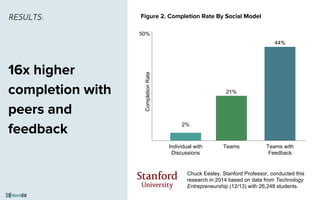
16x higher
completion with
peers and
feedback
CompletionRate
21%
2%
44%
293
Individual with
Discussions
Teams Teams with
Feedback
Chuck Eesley, Stanford Professor, conducted this
research in 2014 based on data from Technology
Entrepreneurship (12/13) with 26,248 students.
50%
Figure 2. Completion Rate By Social ModelRESULTS:
5x more sign-ins
by individuals in
teams
AverageSign-InsPerCourse
39
8
44
293
Individual with
Discussions
Teams Teams with
Feedback
Chuck Eesley, Stanford Professor, conducted this
research in 2014 based on data from Technology
Entrepreneurship (12/13) with 26,248 students.
50
Figure 3. Sign-Ins Per User, By CohortRESULTS:
Agenda
My Background
Principles of Andragogy
NovoEd Introduction
Social Learning
Research on Teams
Best Practices
Closing Thoughts
Impact of Teams
Felt Accountability
Team Size
Team Selection
Team Heterogeneity
Scaffolding Teamwork
Rao & Sutton (2013) suggest felt accountability
drives intrinsic motivation and engagement
Sutton and Rao discuss NovoEd
and the value of felt accountability
in Scaling Up Excellence
"[NovoEd] built in numerous clever
and easy-to-use social features to
create a peer-powered network
that would link, organize,
evaluate, and mentor students."
Huggy Rao Robert Sutton
Agenda
My Background
Principles of Andragogy
NovoEd Introduction
Social Learning
Research on Teams
Best Practices
Closing Thoughts
Impact of Teams
Felt Accountability (Stanford)
Team Size (NovoEd)
Team Selection (NovoEd)
Team Heterogeneity (NovoEd)
Scaffolding Teamwork (Presidio)
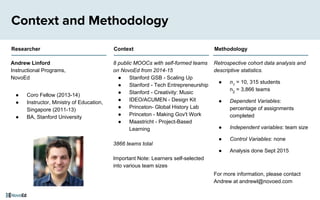
8 public MOOCs with self-formed teams
on NovoEd from 2014-15
● Stanford GSB - Scaling Up
● Stanford - Tech Entrepreneurship
● Stanford - Creativity: Music
● IDEO/ACUMEN - Design Kit
● Princeton- Global History Lab
● Princeton - Making Gov't Work
● Maastricht - Project-Based
Learning
3866 teams total
Important Note: Learners self-selected
into various team sizes
Context and Methodology
Andrew Linford
Instructional Programs,
NovoEd
● Coro Fellow (2013-14)
● Instructor, Ministry of Education,
Singapore (2011-13)
● BA, Stanford University
Retrospective cohort data analysis and
descriptive statistics.
● n1
= 10, 315 students
n2
= 3,866 teams
● Dependent Variables:
percentage of assignments
completed
● Independent variables: team size
● Control Variables: none
● Analysis done Sept 2015
For more information, please contact
Andrew at andrewl@novoed.com
Researcher Context Methodology
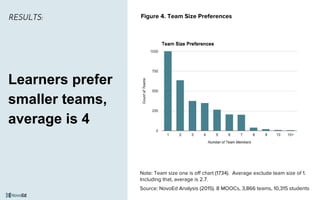
Note: Team size one is off chart (1734). Average exclude team size of 1.
Including that, average is 2.7.
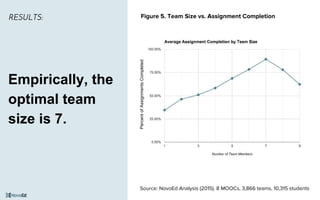
Source: NovoEd Analysis (2015). 8 MOOCs, 3,866 teams, 10,315 students
Learners prefer
smaller teams,
average is 4
Figure 4. Team Size PreferencesRESULTS:
Source: NovoEd Analysis (2015). 8 MOOCs, 3,866 teams, 10,315 students
Empirically, the
optimal team
size is 7.
Figure 5. Team Size vs. Assignment Completion
PercentofAssignmentsCompleted
RESULTS:
Agenda
My Background
Principles of Andragogy
NovoEd Introduction
Social Learning
Research on Teams
Best Practices
Closing Thoughts
Impact of Teams (Stanford)
Felt Accountability (Stanford)
Team Size (NovoEd)
Team Selection (NovoEd)
Team Heterogeneity (NovoEd)
Scaffolding Teamwork (Presidio)
3 private offerings of Presidio Institute’s
Introduction to Cross Sector
Leadership: Building Teams
420 learners total
Important Note: In two of the courses,
learners self-selected into teams (220
learners). In the other course (200
learners), learners were assigned teams
by the teaching team based on meeting
availability times.
Context and Methodology
Retrospective cohort data analysis and
descriptive statistics.
● n1
= 420 learners
● Dependent Variables:
○ Learners engaging in
course-wide discussions
○ Learners chatting with
team in private work
space
○ Learners messaging other
learners
○ Learners commenting on
assignment submissions
● Control Variables: course size
● Analysis done Feb 2016
For more information, please contact
Andrew at andrewl@novoed.com
Researcher Context Methodology
Andrew Linford
Manager, Support and Technical Ops
NovoEd
Alison Gold
Manager of Leadership Education
Course Instructor
Presidio Institute
AndrewAlison
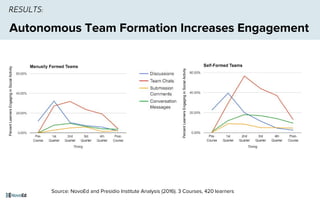
Autonomous Team Formation Increases Engagement
RESULTS:
Source: NovoEd and Presidio Institute Analysis (2016). 3 Courses, 420 learners
PercentLearnersEngaginginSocialActivity
Agenda
My Background
Principles of Andragogy
NovoEd Introduction
Social Learning
Research on Teams
Best Practices
Closing Thoughts
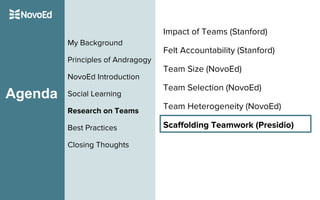
Impact of Teams (Stanford)
Felt Accountability (Stanford)
Team Size (NovoEd)
Team Selection (NovoEd)
Team Heterogeneity (NovoEd)
Scaffolding Teamwork (Presidio)
● Focused on organic teams
formed by the students and
analyze preferences of students
when selecting a team.
● Analyzed the differences
between randomly-assigned and
self-selected teams.
● Analyzed signals to discern
which activities had the greatest
correlation with course
completion.
● n1
= 11 courses
● n2
= 24,000 active learners
For more information, please contact
Milad at m.eftekhar@gmail.com.
Context and Methodology
Milad Eftekhar
Data Science Intern, NovoEd
Co-authored with Amin Saberi and
Farnaz Ronaghi
● Former data researcher at
Microsoft and Stanford
● Ph.D., University of Toronto
● BS & MS, Computer
Engineering, Sharif University of
Technology
● Analysis conducted on 11 public
MOOCs with teams offered
summer 2014.
● Courses were four to eight weeks
long focusing on various
business topics.
● Enrollments ranged from 200 to
more than 25,000.
● Demographic data comes from
self-completed student profiles.
Data includes age, education,
gender, and location.
Working Paper: “Team Formation
Dynamics: A Study Using Online
Learning Data.”
Researcher Context Methodology
Learners
preferred teams
with similarly
aged members.
Figure 6. Homogeneity by age in team selection
Source: Eftekhar, et al (2015) Team Formation Dynamics: A Study Using
Online Learning Data.
RESULTS:
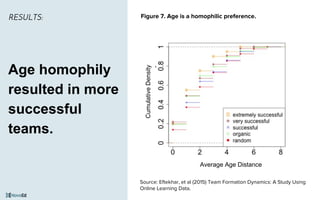
Figure 7. Age is a homophilic preference.
Source: Eftekhar, et al (2015) Team Formation Dynamics: A Study Using
Online Learning Data.
Age homophily
resulted in more
successful
teams.
CumulativeDensity
Average Age Distance
RESULTS:
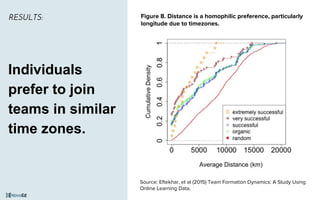
Figure 8. Distance is a homophilic preference, particularly
longitude due to timezones.
Source: Eftekhar, et al (2015) Team Formation Dynamics: A Study Using
Online Learning Data.
Individuals
prefer to join
teams in similar
time zones.
CumulativeDensity
Average Distance (km)
RESULTS:
Figure 9. Education Level is a homogenous preference
Source: Eftekhar, et al (2015) Team Formation Dynamics: A Study Using
Online Learning Data.
Teams preferred
and worked best
with similar
education levels
CumulativeDensity
Average Education Distance
RESULTS:
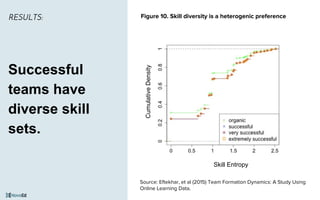
Figure 10. Skill diversity is a heterogenic preference
Source: Eftekhar, et al (2015) Team Formation Dynamics: A Study Using
Online Learning Data.
Successful
teams have
diverse skill
sets.
CumulativeDensity
Skill Entropy
RESULTS:
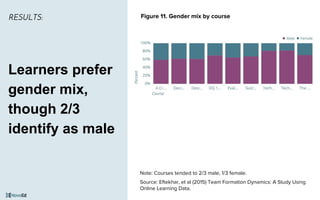
Note: Courses tended to 2/3 male, 1/3 female.
Source: Eftekhar, et al (2015) Team Formation Dynamics: A Study Using
Online Learning Data.
Learners prefer
gender mix,
though 2/3
identify as male
RESULTS: Figure 11. Gender mix by course
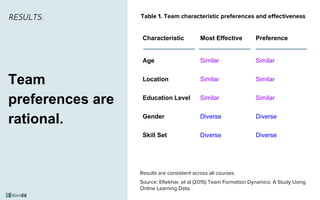
Results are consistent across all courses.
Source: Eftekhar, et al (2015) Team Formation Dynamics: A Study Using
Online Learning Data.
Team
preferences are
rational.
Characteristic Most Effective
SimilarAge
SimilarLocation
SimilarEducation Level
DiverseGender
DiverseSkill Set
Preference
Similar
Similar
Similar
Diverse
Diverse
RESULTS: Table 1. Team characteristic preferences and effectiveness
Agenda
My Background
Principles of Andragogy
NovoEd Introduction
Social Learning
Research on Teams
Best Practices
Closing Thoughts
Impact of Teams (Stanford)
Felt Accountability (Stanford)
Team Size (NovoEd)
Team Selection (NovoEd)
Team Heterogeneity (NovoEd)
Scaffolding Teamwork (Presidio)
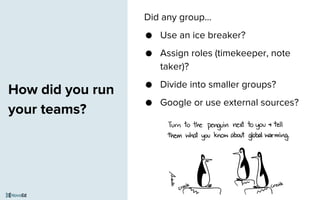
How did you run
your teams?
Did any group...
● Use an ice breaker?
● Assign roles (timekeeper, note
taker)?
● Divide into smaller groups?
● Google or use external sources?
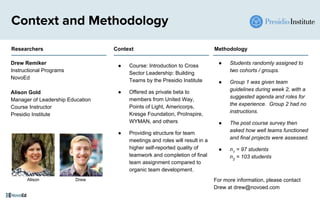
● Students randomly assigned to
two cohorts / groups.
● Group 1 was given team
guidelines during week 2, with a
suggested agenda and roles for
the experience. Group 2 had no
instructions.
● The post course survey then
asked how well teams functioned
and final projects were assessed.
● n1
= 97 students
n2
= 103 students
For more information, please contact
Drew at drew@novoed.com
Drew Remiker
Instructional Programs
NovoEd
Alison Gold
Manager of Leadership Education
Course Instructor
Presidio Institute
Context and Methodology
● Course: Introduction to Cross
Sector Leadership: Building
Teams by the Presidio Institute
● Offered as private beta to
members from United Way,
Points of Light, Americorps,
Kresge Foundation, ProInspire,
WYMAN, and others
● Providing structure for team
meetings and roles will result in a
higher self-reported quality of
teamwork and completion of final
team assignment compared to
organic team development.
Researchers Context Methodology
Alison Drew
Source: Presidio Institute (2015) Introduction to Cross Sector Leadership:
Building Teams, Team Scaffolding Study. “Guidelines for First Team
Meeting”
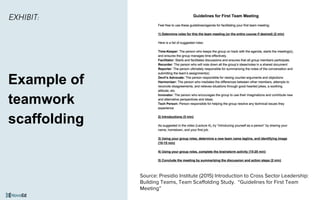
Example of
teamwork
scaffolding
EXHIBIT:
Source: Presidio Institute (2015) Introduction to Cross Sector Leadership:
Building Teams, Team Scaffolding Study.
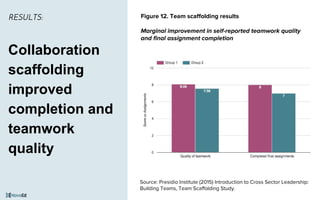
Collaboration
scaffolding
improved
completion and
teamwork
quality
Characteristic Group 1 Group 2
Quality of teamwork 4.03 / 5.0 3.79 / 5.0
Completed final
assignments
8 / 10 7 / 9
Figure 12. Team scaffolding results
Marginal improvement in self-reported teamwork quality
and final assignment completion
RESULTS:
My Background
Principles of Andragogy
Quick NovoEd Introduction
Principles of Social Learning
Research on Team Learning
Other Best Practices
Closing Thoughts
Agenda
Agenda
My Background
Principles of Andragogy
NovoEd Introduction
Social Learning
Research on Teams
Best Practices
Closing Thoughts
Notifications
Course Champions
6 public MOOCs offerings before and
after new notifications offering was
released.
● Stanford GSB - Scaling Up
Without Screwing Up
● Stanford - Tech Entrepreneurship
Part 2
● Agder - Success Unleashed
41,657 teams total
Important Note: Almost nothing
changed within the courses when
offered a second time with the
notifications feature available, although
were slightly smaller. Learners self-
selected teams in all courses.
Context and Methodology
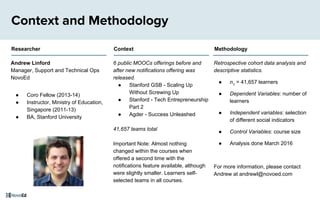
Andrew Linford
Manager, Support and Technical Ops
NovoEd
● Coro Fellow (2013-14)
● Instructor, Ministry of Education,
Singapore (2011-13)
● BA, Stanford University
Retrospective cohort data analysis and
descriptive statistics.
● n1
= 41,657 learners
● Dependent Variables: number of
learners
● Independent variables: selection
of different social indicators
● Control Variables: course size
● Analysis done March 2016
For more information, please contact
Andrew at andrewl@novoed.com
Researcher Context Methodology
Notifications
● Personal alerts about ongoing social activity
(including responses in discussion forums),
assignment reminders, and more
● Daily Course Digests with assignment reminders
and an overview of course activity
● Easy reminders about and access to teaching team
communication
Huge Impact on
Submissions;
Positive Impact
on Other Social
Activities
RESULTS:
Source: NovoEd Analysis (2016). 6 Free Public MOOCs, 41,657 learners
Figure 13. Social Activities Pre/Post Notifications
Agenda
My Background
Principles of Andragogy
NovoEd Introduction
Social Learning
Research on Teams
Best Practices
Notifications
Course Champions
● Program: Philanthropy University
● September - December, 2015
● Course champions chosen from
active learners in the middle of
the program (beginning of
November)
● 7 courses, 200,291 unique
learners
Context and Methodology
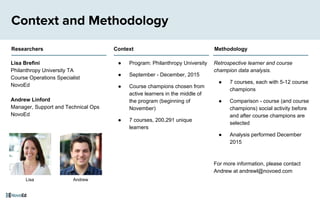
Lisa Brefini
Philanthropy University TA
Course Operations Specialist
NovoEd
Andrew Linford
Manager, Support and Technical Ops
NovoEd
Retrospective learner and course
champion data analysis.
● 7 courses, each with 5-12 course
champions
● Comparison - course (and course
champions) social activity before
and after course champions are
selected
● Analysis performed December
2015
For more information, please contact
Andrew at andrewl@novoed.com
Researchers Context Methodology
Lisa Andrew
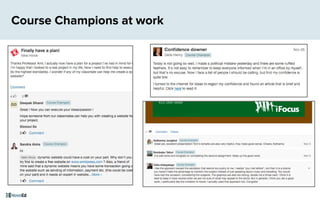
Course Champions at work
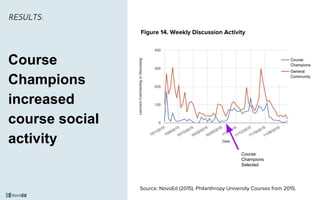
Course
Champions
increased
course social
activity
RESULTS:
Source: NovoEd (2015). Philanthropy University Courses from 2015.
Course
Champions
Selected
Figure 14. Weekly Discussion Activity
My Background
Principles of Andragogy
Quick NovoEd Introduction
Principles of Social Learning
Research on Team Learning
Other Best Practices
Closing Thoughts
Agenda
● That experience must be engaging, driven by
inquiry, social, and coherent.
● Adults require self-discovery and (extra)
practice to overcome preexisting schema
● Knowledge acquisition < skill development <
behavior change. Increasingly experiential.
● Online learning is no different. Scale the best
of offline learning, not the worst (lectures).
● Social techniques include discussions,
collaboration, sharing, feedback, community.
● Peer learning enables personalization,
metacognition, and motivation.
● Teams and group work is the most critical.
CLOSING THOUGHTS
Learning must
be experiential.
Learn Together.
http://novoed.com
Thank you! Please feel free to contact me!
Greg Bybee
Vice President, Learning
NovoEd
greg@novoed.com
@gregbybee
http://linkedin.com/in/gregbybee
Email me for slides or the
research briefs. I’d also love to
help you implement in your org.

Science of Social Learning (Learning Solutions 2016)

  • 1.
    Sharin’ Ain’t “Social” TheScience of Social Learning Greg Bybee VP, Learning Solutions, NovoEd greg@novoed.com March 17, 2016
  • 2.
    Introduction Principles of Andragogy QuickNovoEd Introduction Principles of Social Learning Research on Team Learning Other Best Practices Closing Thoughts Agenda
  • 3.
    I’m an educationtechnologist ● McKinsey & Company Consultant ● Coursera, Product Manager ● Renren, Education Business Development ● NewSchools Venture Fund, EdTech Fellow ● NovoEd, Learning Products (2013-present) At NovoEd, I lead our learning solutions team ● Learning experience design (and ISD) ● Learning solution strategy consulting ● Course and program operations and facilitation ● Customer success and support I have a diverse background in training ● MA-Ed & MBA @ Stanford ● Chair, Student Achievement @ Leadership High ● Instructor @ 辰熙中英文学校 (China) ● School Building @ ILAE in Ethiopia ● Education Market Consultant and Volunteer Hi, I’m Greg Nice to meet you, too!
  • 4.
    Introduction Principles of Andragogy QuickNovoEd Introduction Principles of Social Learning Research on Team Learning Other Best Practices Closing Thoughts Agenda
  • 5.
    Group Activity!! ● Formgroups of 4-8. ● Answer the question: “what makes for an effective adult learning experience” ○ Focus not on outcomes of the learning, but the definition of the learning process ○ You’ll have 8 minutes. ● Add your ideas as text here: http://padlet.com/novoed/ls16 Weren’t you supposed to tell us that?
  • 6.
    Source: Learning SolutionsSession, March 17, 2016
  • 8.
    Social collaborative - Metacognition,teaching - Multiple perspectives - Peer-to-peer adaptivity - Felt accountability Construction and Inquiry - Problem-Based - Project-Based - Role plays, scenarios - Case method Engaging - Intrinsically Motivated - Relevant, authentic My list (Okay admit I took more than 8 minutes...) Experiential + Coherent Self-directed, autonomous Mastery, goal attainment, progression Applied, relevant, authentic, purposeful Engaging, fun, captivating Inquiry-based, discovered Constructed, created, explored Scaffolded, workshopped Interactive, multimodal, multisensory “Knowing, being, doing” Accountable, measured, transparent Practiced, reinforced, rehearsed Leveled, ZPD, personalized, adaptive Chunked, cognitive load, working memory Coherent, sequenced, schematic Curricular Design - Sequencing, chunking - Scaffolded, coherent
  • 9.
    Malcolm Knowles’ Theory of Andragogy Assumptions 1. Self-concept 2.Experience reservoir 3. Readiness to learn 4. Orientation to learning 5. Motivation to learn Therefore, learning must be: 1. Self-directed 2. Experiential 3. Relevant and authentic 4. Problem-based Sources: Knowles, M. (1984). The Adult Learner: A Neglected Species. & Kearsley, G. (2010). Andragogy: The theory Into practice database.
  • 10.
    Source: Pappas, C.(2013). “The Adult Learning Theory.” eLearning Industry. Online.
  • 11.
    Source: Pappas, C.(2013). “The Adult Learning Theory.” eLearning Industry. Online.
  • 13.
    But this training iscostly... Airfare – Average of $800 per person Hotel – 3 nights @ $200 per night $600 Catered Meals – 3 days @ $150 per day = $450 Labor – $500 per day (assuming $125k/yr) = $1,500 Transportation – $200 per person across 3 days Group Activity – $300 per person Room Rental of $2500 per day x 3 = $7500 Total Investment before a facilitator = $103,750 Facilitator = $15,000 per day x 3 = $45,000 --------------------------------------------------------------------------- Total Cost Per Person: $5,800 Source: Altman, Ian (2014) How Much Does Sales Training Cost? Forbes. Online.
  • 14.
    ...and it cannot scaleacross the organization Companies spend 78% more on Executives than Emerging Leaders (and 360% more per Leader) Source: Bersin by Deloitte (2014) Leadership Development Factbook 2014: Benchmarks and Trends in U.S. Leadership Development.
  • 15.
    Online learning offereda solution, but didn’t deliver
  • 16.
    My Background Principles ofAndragogy Shameless Plug Principles of Social Learning Research on Team Learning Other Best Practices Closing Thoughts Agenda
  • 19.
    Solutions for learning experiencedesign and implementation Online platform for experiential learning NovoEd develops talent online.
  • 20.
    We power thebest talent development programs
  • 21.
    Principles of NovoEd all learning Intuitive,User Friendly Experience Orientation Pervasive and Social Learning Data-Driven, Evidence-Based
  • 22.
    These drive 20x higher engagement CompletionRate 2% 44% TraditionalSocial Stanford Professor Chuck Eesley conducted this research in 2014 based on data from Technology Entrepreneurship (12/13) with 26,248 students. 50% Figure 1. Completion Rate By Social Model in MOOCs
  • 23.
    Learners are more engaged whenthey learn together. 68 NPS 50-50 0 95%+ User Satisfaction 60+ Net Promoter Score Source: Survey of NovoEd learners (January 2016)
  • 24.
    My Background Principles ofAndragogy Quick NovoEd Introduction Principles of Social Learning Research on Team Learning Other Best Practices Closing Thoughts Agenda
  • 25.
    What is social learning? Theuse of peer-to-peer (social) interaction as a pedagogical technique to drive learning. Examples: ● 1:1 tutoring ● Reciprocal Teaching ● Think-Pair-share ● Jigsaw ● Group work ● Collaborative brainstorming Source: I made this up last night after talking to another speaker.
  • 26.
    Social learning is morethan (just) sharing. Communities visible to themselves with real identity Peer-to-peer feedback, coaching, and mentorship Collaboration in teams on relevant projects Discussions with forums, and messaging User generated content sharing with discovery
  • 27.
    Why is social learning valuable? Theories ●Relatedness motivation (Deci & Ryan) ● Felt accountability (Sutton & Rao) ● Social context of learning (Bandura) ● Cooperative learning (Dewey, Ross, et al) ● Social constructivism (Piaget) ● Joint inquiry (Dewey) ● Shared reflection of ELM (Kolb) ● Diversity of Learning Styles (Kolb) ● Mastery learning (Bloom) ● Community of Inquiry (Peirce, Dewey, Garrison, et al) ● Social development theory (Vygotsky) ● Truly adaptive learning (Bybee) But you don’t have to subscribe to a single theory to leverage the techniques. Source: I compiled this list last night - send me any I missed!
  • 28.
    The benefits ofsocial learning Communities visible to themselves Peer-to-peer feedback and coaching Collaboration in teams on projects Discussions with forums, messaging User generated content sharing ● Social obligation, transparency, “felt accountability” ● Self-regulating and adapting ● Build networks, the new “content management system” ● Metacognition in providing feedback or mentorship ● Personalized and adaptive; “network of 1:1 tutors” ● More relevant guidance, “learning at speed of trust” ● Inquiry-driven, constructivist, PBL ● Practice, rehearsal, interactivity ● Self-directed and autonomous, right in ZPD ● Share diversity of skills, experiences, and perspectives ● Crowd sourced, rapid response time ● Relevant and authentic dialog drives connectedness ● Provides multiple representations & perspectives ● Application focused, authentic, and relevant ● Accountability and social proof
  • 29.
    My Background Principles ofAndragogy Quick NovoEd Introduction Principles of Social Learning Research on Team Learning Other Best Practices Closing Thoughts Agenda
  • 30.
    Agenda My Background Principles ofAndragogy NovoEd Introduction Social Learning Team Learning Best Practices Closing Thoughts Impact of Teams Felt Accountability Team Size Team Selection Team Heterogeneity Scaffolding Teamwork
  • 31.
    Context and Methodology ChuckEesley Assistant Professor, Stanford University ● Teaching online since 2012 ● Morgenthaler Faculty Fellow ● 2010 Best Dissertation Award, Academy of Management ● Ph.D., MIT; BS, Duke University Technology Entrepreneurship Chuck Eesley, Stanford University September 16, - November 17, 2013 ● Eight-week course offered on NovoEd ● Team-based, experiential pedagogy ● 8 assignments, each a part of a team-based project to find and evaluate a startup idea ● Taught on NovoEd 11+ times and at Stanford since 2004 View the course at https://novoed. com/venture17 Multivariate regressions, descriptive statistics, and t-tests of difference in means ● n = 26, 248 students ● Students self-selected into experimental groups ● Dependent Variables: engagement and satisfaction measures ● Independent variables: whether the student participated in a team, if they worked individually, and if they had a mentor ● Control Variables: demographics, engagement level, and others For more information, please contact Professor Eesley at cee@stanford.edu. Researcher Context Methodology
  • 32.
    16x higher completion with peersand feedback CompletionRate 21% 2% 44% 293 Individual with Discussions Teams Teams with Feedback Chuck Eesley, Stanford Professor, conducted this research in 2014 based on data from Technology Entrepreneurship (12/13) with 26,248 students. 50% Figure 2. Completion Rate By Social ModelRESULTS:
  • 33.
    5x more sign-ins byindividuals in teams AverageSign-InsPerCourse 39 8 44 293 Individual with Discussions Teams Teams with Feedback Chuck Eesley, Stanford Professor, conducted this research in 2014 based on data from Technology Entrepreneurship (12/13) with 26,248 students. 50 Figure 3. Sign-Ins Per User, By CohortRESULTS:
  • 34.
    Agenda My Background Principles ofAndragogy NovoEd Introduction Social Learning Research on Teams Best Practices Closing Thoughts Impact of Teams Felt Accountability Team Size Team Selection Team Heterogeneity Scaffolding Teamwork
  • 36.
    Rao & Sutton(2013) suggest felt accountability drives intrinsic motivation and engagement Sutton and Rao discuss NovoEd and the value of felt accountability in Scaling Up Excellence "[NovoEd] built in numerous clever and easy-to-use social features to create a peer-powered network that would link, organize, evaluate, and mentor students." Huggy Rao Robert Sutton
  • 37.
    Agenda My Background Principles ofAndragogy NovoEd Introduction Social Learning Research on Teams Best Practices Closing Thoughts Impact of Teams Felt Accountability (Stanford) Team Size (NovoEd) Team Selection (NovoEd) Team Heterogeneity (NovoEd) Scaffolding Teamwork (Presidio)
  • 38.
    8 public MOOCswith self-formed teams on NovoEd from 2014-15 ● Stanford GSB - Scaling Up ● Stanford - Tech Entrepreneurship ● Stanford - Creativity: Music ● IDEO/ACUMEN - Design Kit ● Princeton- Global History Lab ● Princeton - Making Gov't Work ● Maastricht - Project-Based Learning 3866 teams total Important Note: Learners self-selected into various team sizes Context and Methodology Andrew Linford Instructional Programs, NovoEd ● Coro Fellow (2013-14) ● Instructor, Ministry of Education, Singapore (2011-13) ● BA, Stanford University Retrospective cohort data analysis and descriptive statistics. ● n1 = 10, 315 students n2 = 3,866 teams ● Dependent Variables: percentage of assignments completed ● Independent variables: team size ● Control Variables: none ● Analysis done Sept 2015 For more information, please contact Andrew at andrewl@novoed.com Researcher Context Methodology
  • 39.
    Note: Team sizeone is off chart (1734). Average exclude team size of 1. Including that, average is 2.7. Source: NovoEd Analysis (2015). 8 MOOCs, 3,866 teams, 10,315 students Learners prefer smaller teams, average is 4 Figure 4. Team Size PreferencesRESULTS:
  • 40.
    Source: NovoEd Analysis(2015). 8 MOOCs, 3,866 teams, 10,315 students Empirically, the optimal team size is 7. Figure 5. Team Size vs. Assignment Completion PercentofAssignmentsCompleted RESULTS:
  • 41.
    Agenda My Background Principles ofAndragogy NovoEd Introduction Social Learning Research on Teams Best Practices Closing Thoughts Impact of Teams (Stanford) Felt Accountability (Stanford) Team Size (NovoEd) Team Selection (NovoEd) Team Heterogeneity (NovoEd) Scaffolding Teamwork (Presidio)
  • 42.
    3 private offeringsof Presidio Institute’s Introduction to Cross Sector Leadership: Building Teams 420 learners total Important Note: In two of the courses, learners self-selected into teams (220 learners). In the other course (200 learners), learners were assigned teams by the teaching team based on meeting availability times. Context and Methodology Retrospective cohort data analysis and descriptive statistics. ● n1 = 420 learners ● Dependent Variables: ○ Learners engaging in course-wide discussions ○ Learners chatting with team in private work space ○ Learners messaging other learners ○ Learners commenting on assignment submissions ● Control Variables: course size ● Analysis done Feb 2016 For more information, please contact Andrew at andrewl@novoed.com Researcher Context Methodology Andrew Linford Manager, Support and Technical Ops NovoEd Alison Gold Manager of Leadership Education Course Instructor Presidio Institute AndrewAlison
  • 43.
    Autonomous Team FormationIncreases Engagement RESULTS: Source: NovoEd and Presidio Institute Analysis (2016). 3 Courses, 420 learners PercentLearnersEngaginginSocialActivity PercentLearnersEngaginginSocialActivity
  • 44.
    Agenda My Background Principles ofAndragogy NovoEd Introduction Social Learning Research on Teams Best Practices Closing Thoughts Impact of Teams (Stanford) Felt Accountability (Stanford) Team Size (NovoEd) Team Selection (NovoEd) Team Heterogeneity (NovoEd) Scaffolding Teamwork (Presidio)
  • 45.
    ● Focused onorganic teams formed by the students and analyze preferences of students when selecting a team. ● Analyzed the differences between randomly-assigned and self-selected teams. ● Analyzed signals to discern which activities had the greatest correlation with course completion. ● n1 = 11 courses ● n2 = 24,000 active learners For more information, please contact Milad at m.eftekhar@gmail.com. Context and Methodology Milad Eftekhar Data Science Intern, NovoEd Co-authored with Amin Saberi and Farnaz Ronaghi ● Former data researcher at Microsoft and Stanford ● Ph.D., University of Toronto ● BS & MS, Computer Engineering, Sharif University of Technology ● Analysis conducted on 11 public MOOCs with teams offered summer 2014. ● Courses were four to eight weeks long focusing on various business topics. ● Enrollments ranged from 200 to more than 25,000. ● Demographic data comes from self-completed student profiles. Data includes age, education, gender, and location. Working Paper: “Team Formation Dynamics: A Study Using Online Learning Data.” Researcher Context Methodology
  • 46.
    Learners preferred teams with similarly agedmembers. Figure 6. Homogeneity by age in team selection Source: Eftekhar, et al (2015) Team Formation Dynamics: A Study Using Online Learning Data. RESULTS:
  • 47.
    Figure 7. Ageis a homophilic preference. Source: Eftekhar, et al (2015) Team Formation Dynamics: A Study Using Online Learning Data. Age homophily resulted in more successful teams. CumulativeDensity Average Age Distance RESULTS:
  • 48.
    Figure 8. Distanceis a homophilic preference, particularly longitude due to timezones. Source: Eftekhar, et al (2015) Team Formation Dynamics: A Study Using Online Learning Data. Individuals prefer to join teams in similar time zones. CumulativeDensity Average Distance (km) RESULTS:
  • 49.
    Figure 9. EducationLevel is a homogenous preference Source: Eftekhar, et al (2015) Team Formation Dynamics: A Study Using Online Learning Data. Teams preferred and worked best with similar education levels CumulativeDensity Average Education Distance RESULTS:
  • 50.
    Figure 10. Skilldiversity is a heterogenic preference Source: Eftekhar, et al (2015) Team Formation Dynamics: A Study Using Online Learning Data. Successful teams have diverse skill sets. CumulativeDensity Skill Entropy RESULTS:
  • 51.
    Note: Courses tendedto 2/3 male, 1/3 female. Source: Eftekhar, et al (2015) Team Formation Dynamics: A Study Using Online Learning Data. Learners prefer gender mix, though 2/3 identify as male RESULTS: Figure 11. Gender mix by course
  • 52.
    Results are consistentacross all courses. Source: Eftekhar, et al (2015) Team Formation Dynamics: A Study Using Online Learning Data. Team preferences are rational. Characteristic Most Effective SimilarAge SimilarLocation SimilarEducation Level DiverseGender DiverseSkill Set Preference Similar Similar Similar Diverse Diverse RESULTS: Table 1. Team characteristic preferences and effectiveness
  • 53.
    Agenda My Background Principles ofAndragogy NovoEd Introduction Social Learning Research on Teams Best Practices Closing Thoughts Impact of Teams (Stanford) Felt Accountability (Stanford) Team Size (NovoEd) Team Selection (NovoEd) Team Heterogeneity (NovoEd) Scaffolding Teamwork (Presidio)
  • 54.
    How did yourun your teams? Did any group... ● Use an ice breaker? ● Assign roles (timekeeper, note taker)? ● Divide into smaller groups? ● Google or use external sources?
  • 55.
    ● Students randomlyassigned to two cohorts / groups. ● Group 1 was given team guidelines during week 2, with a suggested agenda and roles for the experience. Group 2 had no instructions. ● The post course survey then asked how well teams functioned and final projects were assessed. ● n1 = 97 students n2 = 103 students For more information, please contact Drew at drew@novoed.com Drew Remiker Instructional Programs NovoEd Alison Gold Manager of Leadership Education Course Instructor Presidio Institute Context and Methodology ● Course: Introduction to Cross Sector Leadership: Building Teams by the Presidio Institute ● Offered as private beta to members from United Way, Points of Light, Americorps, Kresge Foundation, ProInspire, WYMAN, and others ● Providing structure for team meetings and roles will result in a higher self-reported quality of teamwork and completion of final team assignment compared to organic team development. Researchers Context Methodology Alison Drew
  • 56.
    Source: Presidio Institute(2015) Introduction to Cross Sector Leadership: Building Teams, Team Scaffolding Study. “Guidelines for First Team Meeting” Example of teamwork scaffolding EXHIBIT:
  • 57.
    Source: Presidio Institute(2015) Introduction to Cross Sector Leadership: Building Teams, Team Scaffolding Study. Collaboration scaffolding improved completion and teamwork quality Characteristic Group 1 Group 2 Quality of teamwork 4.03 / 5.0 3.79 / 5.0 Completed final assignments 8 / 10 7 / 9 Figure 12. Team scaffolding results Marginal improvement in self-reported teamwork quality and final assignment completion RESULTS:
  • 58.
    My Background Principles ofAndragogy Quick NovoEd Introduction Principles of Social Learning Research on Team Learning Other Best Practices Closing Thoughts Agenda
  • 59.
    Agenda My Background Principles ofAndragogy NovoEd Introduction Social Learning Research on Teams Best Practices Closing Thoughts Notifications Course Champions
  • 60.
    6 public MOOCsofferings before and after new notifications offering was released. ● Stanford GSB - Scaling Up Without Screwing Up ● Stanford - Tech Entrepreneurship Part 2 ● Agder - Success Unleashed 41,657 teams total Important Note: Almost nothing changed within the courses when offered a second time with the notifications feature available, although were slightly smaller. Learners self- selected teams in all courses. Context and Methodology Andrew Linford Manager, Support and Technical Ops NovoEd ● Coro Fellow (2013-14) ● Instructor, Ministry of Education, Singapore (2011-13) ● BA, Stanford University Retrospective cohort data analysis and descriptive statistics. ● n1 = 41,657 learners ● Dependent Variables: number of learners ● Independent variables: selection of different social indicators ● Control Variables: course size ● Analysis done March 2016 For more information, please contact Andrew at andrewl@novoed.com Researcher Context Methodology
  • 61.
    Notifications ● Personal alertsabout ongoing social activity (including responses in discussion forums), assignment reminders, and more ● Daily Course Digests with assignment reminders and an overview of course activity ● Easy reminders about and access to teaching team communication
  • 62.
    Huge Impact on Submissions; PositiveImpact on Other Social Activities RESULTS: Source: NovoEd Analysis (2016). 6 Free Public MOOCs, 41,657 learners Figure 13. Social Activities Pre/Post Notifications
  • 63.
    Agenda My Background Principles ofAndragogy NovoEd Introduction Social Learning Research on Teams Best Practices Notifications Course Champions
  • 64.
    ● Program: PhilanthropyUniversity ● September - December, 2015 ● Course champions chosen from active learners in the middle of the program (beginning of November) ● 7 courses, 200,291 unique learners Context and Methodology Lisa Brefini Philanthropy University TA Course Operations Specialist NovoEd Andrew Linford Manager, Support and Technical Ops NovoEd Retrospective learner and course champion data analysis. ● 7 courses, each with 5-12 course champions ● Comparison - course (and course champions) social activity before and after course champions are selected ● Analysis performed December 2015 For more information, please contact Andrew at andrewl@novoed.com Researchers Context Methodology Lisa Andrew
  • 65.
  • 66.
    Course Champions increased course social activity RESULTS: Source: NovoEd(2015). Philanthropy University Courses from 2015. Course Champions Selected Figure 14. Weekly Discussion Activity
  • 67.
    My Background Principles ofAndragogy Quick NovoEd Introduction Principles of Social Learning Research on Team Learning Other Best Practices Closing Thoughts Agenda
  • 68.
    ● That experiencemust be engaging, driven by inquiry, social, and coherent. ● Adults require self-discovery and (extra) practice to overcome preexisting schema ● Knowledge acquisition < skill development < behavior change. Increasingly experiential. ● Online learning is no different. Scale the best of offline learning, not the worst (lectures). ● Social techniques include discussions, collaboration, sharing, feedback, community. ● Peer learning enables personalization, metacognition, and motivation. ● Teams and group work is the most critical. CLOSING THOUGHTS Learning must be experiential.
  • 69.
  • 70.
    Thank you! Pleasefeel free to contact me! Greg Bybee Vice President, Learning NovoEd greg@novoed.com @gregbybee http://linkedin.com/in/gregbybee Email me for slides or the research briefs. I’d also love to help you implement in your org.