Social Constructivist approach of Motivation
Recommendation of diverse peer messages on Social Networking Services
Sébastien Louvigné
Ueno laboratory
Graduate School of Information Systems
The University of Electro-Communications
April 22, 2016
Sébastien Louvigné (Ueno lab. UEC) Doctorate Course 1 / 59
Outline
1 Introduction
Research Objective
Social Constructivism
Goal & Purpose for Motivation
Proposed Research
2 Goal-based data from SNS
SNS Data
Systemic Functional Linguistics
Transitivity Model
Goal-based messages from
peers
Summary
3 Recommending peers messages
LDA model
Topic distribution
Goal & Purpose
Recommendation
Experimentation
Self-evaluation results
4 Learning communities
Learning Activity reports
Evaluations
5 Conclusion
Discussion
Future works
Sébastien Louvigné (Ueno lab. UEC) Doctorate Course 2 / 59
Introduction
Outline

1 Introduction
Research Objective
Social Constructivism
Goal & Purpose for Motivation
Proposed Research
2 Goal-based data from SNS
SNS Data
Systemic Functional Linguistics
Transitivity Model
Goal-based messages from
peers
Summary
3 Recommending peers messages
LDA model
Topic distribution
Goal & Purpose
Recommendation
Experimentation
Self-evaluation results
4 Learning communities
Learning Activity reports
Evaluations
5 Conclusion
Discussion
Future works
Sébastien Louvigné (Ueno lab. UEC) Doctorate Course 3 / 59
Introduction Research Objective
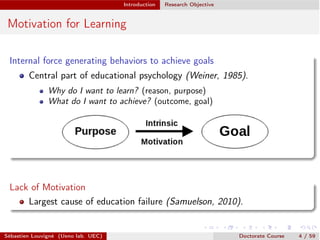
Motivation for Learning
Internal force generating behaviors to achieve goals
Central part of educational psychology (Weiner, 1985).
Why do I want to learn? (reason, purpose)
What do I want to achieve? (outcome, goal)
Lack of Motivation
Largest cause of education failure (Samuelson, 2010).
Sébastien Louvigné (Ueno lab. UEC) Doctorate Course 4 / 59
Introduction Research Objective
Learning in social environments
Collaborative Learning
People interact to learn together (Dillenbourg, 1999).
Contemporary pedagogical approaches
Increasingly integrate collaboration for learning
Make learning more meaningful
Need to include psychological functions
Research Objective
Enhance learning motivation using social learning environments
Sébastien Louvigné (Ueno lab. UEC) Doctorate Course 5 / 59
Introduction Social Constructivism
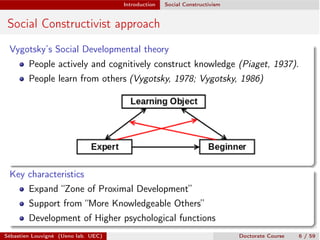
Social Constructivist approach
Vygotsky’s Social Developmental theory
People actively and cognitively construct knowledge (Piaget, 1937).
People learn from others (Vygotsky, 1978; Vygotsky, 1986)
Key characteristics
Expand “Zone of Proximal Development”
Support from “More Knowledgeable Others”

Development of Higher psychological functions
Sébastien Louvigné (Ueno lab. UEC) Doctorate Course 6 / 59
Introduction Social Constructivism
Social Constructivism in Learning
Contemporary learning
Increasingly integrates social constructivism
Promote & Facilitate the construction of knowledge
Pedagogical approaches: “Scaffolding” (Wood et al, 1976)
Cognitive apprenticeship (Collins et al, 1991)
Communities of Practice (Lave & Wenger, 1991)
Learning Communities (Scardamalia & Bereiter, 1994)
Computer-Supported Collaborative Learning (Scardamalia &
Bereiter, 1989)
Sébastien Louvigné (Ueno lab. UEC) Doctorate Course 7 / 59
Introduction Social Constructivism
Need for more psychological aspects
Contemporary collaborative approaches
How to learn psychological functions from others?
Important role of intrinsic motivation in CSCL (Rientes et al, 2009)
Limited diversity (learners with similar characteristics)
Increasing social presence
Proposed research
1 Collaborative learning environment to Enhance / Generate new
intrinsic motivation
2 More diverse social environment -> Social Network Services (SNS)
Sébastien Louvigné (Ueno lab. UEC) Doctorate Course 8 / 59
Introduction Goal & Purpose for Motivation
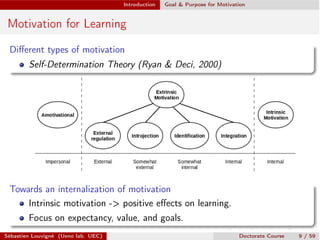
Motivation for Learning
Different types of motivation
Self-Determination Theory (Ryan & Deci, 2000)
Towards an internalization of motivation
Intrinsic motivation -> positive effects on learning.
Focus on expectancy, value, and goals.
Sébastien Louvigné (Ueno lab. UEC) Doctorate Course 9 / 59
Introduction Goal & Purpose for Motivation
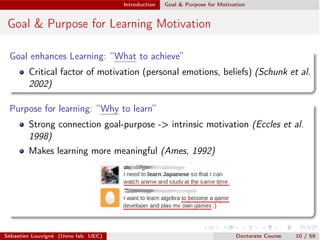
Goal & Purpose for Learning Motivation
Goal enhances Learning: “What to achieve”
Critical factor of motivation (personal emotions, beliefs) (Schunk et al.
2002)
Purpose for learning: “Why to learn”
Strong connection goal-purpose -> intrinsic motivation (Eccles et al.
1998)
Makes learning more meaningful (Ames, 1992)
Sébastien Louvigné (Ueno lab. UEC) Doctorate Course 10 / 59
Introduction Goal & Purpose for Motivation
Problem Statement
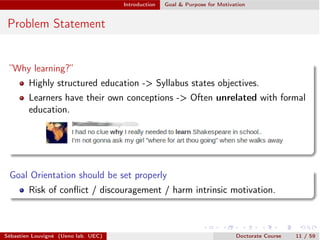
”Why learning?”
Highly structured education -> Syllabus states objectives.
Learners have their own conceptions -> Often unrelated with formal
education.
Goal Orientation should be set properly
Risk of conflict / discouragement / harm intrinsic motivation.
Sébastien Louvigné (Ueno lab. UEC) Doctorate Course 11 / 59
Introduction Goal & Purpose for Motivation
Goal & Purpose
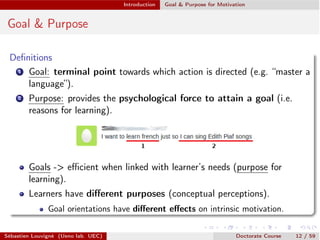
Definitions
1 Goal: terminal point towards which action is directed (e.g. “master a
language”).
2 Purpose: provides the psychological force to attain a goal (i.e.
reasons for learning).
Goals -> efficient when linked with learner’s needs (purpose for
learning).
Learners have different purposes (conceptual perceptions).
Goal orientations have different effects on intrinsic motivation.
Sébastien Louvigné (Ueno lab. UEC) Doctorate Course 12 / 59
Introduction Goal & Purpose for Motivation
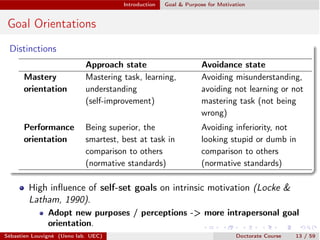
Goal Orientations
Distinctions
Approach state Avoidance state
Mastery
orientation
Mastering task, learning,
understanding
(self-improvement)
Avoiding misunderstanding,
avoiding not learning or not
mastering task (not being
wrong)
Performance
orientation
Being superior, the
smartest, best at task in
comparison to others
(normative standards)
Avoiding inferiority, not
looking stupid or dumb in
comparison to others
(normative standards)
High influence of self-set goals on intrinsic motivation (Locke &
Latham, 1990).
Adopt new purposes / perceptions -> more intrapersonal goal
orientation.
Sébastien Louvigné (Ueno lab. UEC) Doctorate Course 13 / 59
Introduction Proposed Research
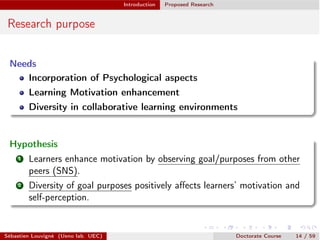
Research purpose
Needs
Incorporation of Psychological aspects
Learning Motivation enhancement
Diversity in collaborative learning environments
Hypothesis
1 Learners enhance motivation by observing goal/purposes from other
peers (SNS).
2 Diversity of goal purposes positively affects learners’ motivation and
self-perception.
Sébastien Louvigné (Ueno lab. UEC) Doctorate Course 14 / 59
Introduction Proposed Research
Social Networking Services
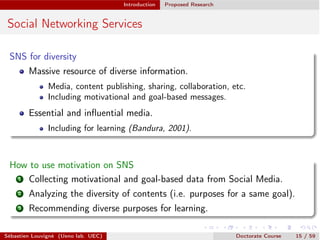
SNS for diversity
Massive resource of diverse information.
Media, content publishing, sharing, collaboration, etc.
Including motivational and goal-based messages.
Essential and influential media.
Including for learning (Bandura, 2001).
How to use motivation on SNS
1 Collecting motivational and goal-based data from Social Media.
2 Analyzing the diversity of contents (i.e. purposes for a same goal).
3 Recommending diverse purposes for learning.
Sébastien Louvigné (Ueno lab. UEC) Doctorate Course 15 / 59
Introduction Proposed Research
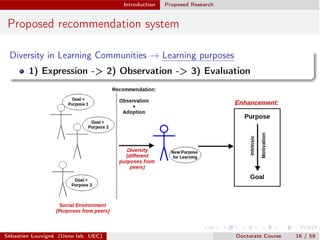
Proposed recommendation system
Diversity in Learning Communities → Learning purposes
1) Expression -> 2) Observation -> 3) Evaluation
Sébastien Louvigné (Ueno lab. UEC) Doctorate Course 16 / 59
Introduction Proposed Research
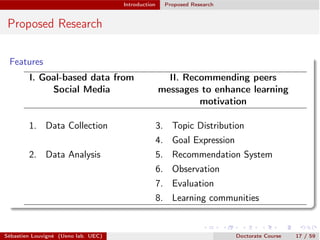
Proposed Research
Features
I. Goal-based data from
Social Media
II. Recommending peers
messages to enhance learning
motivation
1. Data Collection 3. Topic Distribution
4. Goal Expression
2. Data Analysis 5. Recommendation System
6. Observation
7. Evaluation
8. Learning communities
Sébastien Louvigné (Ueno lab. UEC) Doctorate Course 17 / 59
Goal-based data from SNS
Outline
1 Introduction
Research Objective
Social Constructivism
Goal & Purpose for Motivation
Proposed Research
2 Goal-based data from SNS
SNS Data
Systemic Functional Linguistics
Transitivity Model
Goal-based messages from
peers
Summary
3 Recommending peers messages
LDA model
Topic distribution
Goal & Purpose
Recommendation
Experimentation
Self-evaluation results
4 Learning communities
Learning Activity reports
Evaluations
5 Conclusion
Discussion
Future works
Sébastien Louvigné (Ueno lab. UEC) Doctorate Course 18 / 59
Goal-based data from SNS SNS Data
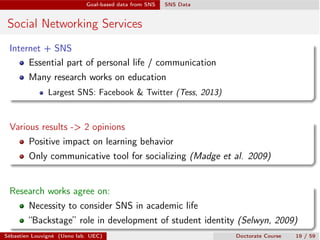
Social Networking Services
Internet + SNS
Essential part of personal life / communication
Many research works on education
Largest SNS: Facebook & Twitter (Tess, 2013)
Various results -> 2 opinions
Positive impact on learning behavior
Only communicative tool for socializing (Madge et al. 2009)
Research works agree on:
Necessity to consider SNS in academic life
“Backstage” role in development of student identity (Selwyn, 2009)
Sébastien Louvigné (Ueno lab. UEC) Doctorate Course 19 / 59
Goal-based data from SNS SNS Data
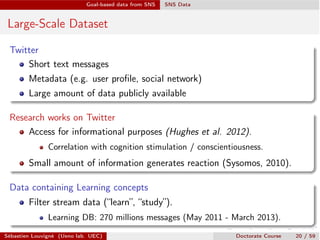
Large-Scale Dataset
Twitter
Short text messages
Metadata (e.g. user profile, social network)
Large amount of data publicly available
Research works on Twitter
Access for informational purposes (Hughes et al. 2012).
Correlation with cognition stimulation / conscientiousness.
Small amount of information generates reaction (Sysomos, 2010).
Data containing Learning concepts
Filter stream data (“learn”, “study”).
Learning DB: 270 millions messages (May 2011 - March 2013).
Sébastien Louvigné (Ueno lab. UEC) Doctorate Course 20 / 59
Goal-based data from SNS Systemic Functional Linguistics
Systemic Functional Grammar (SFG)
Form of language description (Halliday, 1994)
1 “Systemic” -> Language: network of systems, interrelated sets of
options for making meaning.
2 “Functional” -> Language: multidimensional architecture reflecting
“the multidimensional nature of human experience and interpersonal
relations."
Sébastien Louvigné (Ueno lab. UEC) Doctorate Course 21 / 59
Goal-based data from SNS Systemic Functional Linguistics
Systemic Functional Grammar (SFG)
Functional semantic perspective
Linking linguistic elements and functions to create meaning.
Metafunctions of language:
Ideational (creating meaning),
Interpersonal (interactivity, mood),
Textual (internal organization).
Multidimensional architecture of language (Halliday, 2003).
Sébastien Louvigné (Ueno lab. UEC) Doctorate Course 22 / 59
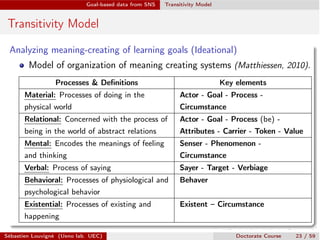
Goal-based data from SNS Transitivity Model
Transitivity Model
Analyzing meaning-creating of learning goals (Ideational)
Model of organization of meaning creating systems (Matthiessen, 2010).
Processes & Definitions Key elements
Material: Processes of doing in the
physical world
Actor - Goal - Process -
Circumstance
Relational: Concerned with the process of
being in the world of abstract relations
Actor - Goal - Process (be) -
Attributes - Carrier - Token - Value
Mental: Encodes the meanings of feeling
and thinking
Senser - Phenomenon -
Circumstance
Verbal: Process of saying Sayer - Target - Verbiage
Behavioral: Processes of physiological and
psychological behavior
Behaver
Existential: Processes of existing and
happening
Existent – Circumstance
Sébastien Louvigné (Ueno lab. UEC) Doctorate Course 23 / 59
Goal-based data from SNS Transitivity Model
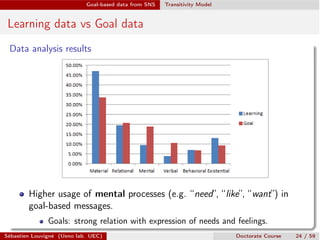
Learning data vs Goal data
Data analysis results
Higher usage of mental processes (e.g. “need”, “like”, “want”) in
goal-based messages.
Goals: strong relation with expression of needs and feelings.
Sébastien Louvigné (Ueno lab. UEC) Doctorate Course 24 / 59
Goal-based data from SNS Goal-based messages from peers
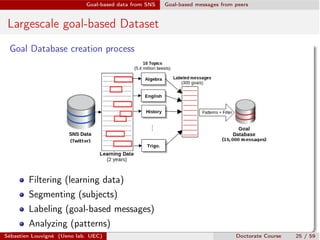
Largescale goal-based Dataset
Goal Database creation process
Filtering (learning data)
Segmenting (subjects)
Labeling (goal-based messages)
Analyzing (patterns)
Sébastien Louvigné (Ueno lab. UEC) Doctorate Course 25 / 59
Goal-based data from SNS Summary
Discussion
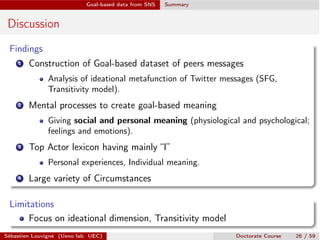
Findings
1 Construction of Goal-based dataset of peers messages
Analysis of ideational metafunction of Twitter messages (SFG,
Transitivity model).
2 Mental processes to create goal-based meaning
Giving social and personal meaning (physiological and psychological;
feelings and emotions).
3 Top Actor lexicon having mainly “I”
Personal experiences, Individual meaning.
4 Large variety of Circumstances
Limitations
Focus on ideational dimension, Transitivity model
Sébastien Louvigné (Ueno lab. UEC) Doctorate Course 26 / 59
Recommending peers messages
Outline
1 Introduction
Research Objective
Social Constructivism
Goal & Purpose for Motivation
Proposed Research
2 Goal-based data from SNS
SNS Data
Systemic Functional Linguistics
Transitivity Model
Goal-based messages from
peers
Summary
3 Recommending peers messages
LDA model
Topic distribution
Goal & Purpose
Recommendation
Experimentation
Self-evaluation results
4 Learning communities
Learning Activity reports
Evaluations
5 Conclusion
Discussion
Future works
Sébastien Louvigné (Ueno lab. UEC) Doctorate Course 27 / 59
Recommending peers messages
Context
Needs
Learning motivation enhancement
Integration in collaborative learning environments
more diverse social presence,
intrinsic motivational contents from other peers.
Objective
1 Recommendation system
Goal-based messages from other peers.
Diverse purposes (reasons) for a shared goal (desired outcome).
2 Motivation evaluation
Influence of observing peers’ messages.
Sébastien Louvigné (Ueno lab. UEC) Doctorate Course 28 / 59
Recommending peers messages
Recommender Systems
Technology Enhanced Learning systems (Manouselis et al. 2012)
Recommending personalized contents
Similarity of item contents / user profiles / other info
Need to consider diversity (Erdt et al. 2015)
Recommend outcomes different from learners’ expectations
Sébastien Louvigné (Ueno lab. UEC) Doctorate Course 29 / 59
Recommending peers messages LDA model
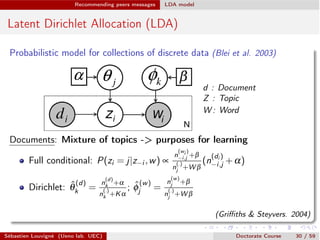
Latent Dirichlet Allocation (LDA)
Probabilistic model for collections of discrete data (Blei et al. 2003)
d : Document
Z : Topic
W : Word
Documents: Mixture of topics -> purposes for learning
Full conditional: P(zi = j|z i ,w) µ
n
(wi )
i,j +b
n
(.)
j +W b
(n
(di )
i,j +a)
Dirichlet: ˆq
(d)
k =
n
(d)
k +a
n
(.)
k +Ka
; ˆf
(w)
j =
n
(w)
j +b
n
(.)
j +W b
(Griffiths & Steyvers. 2004)
Sébastien Louvigné (Ueno lab. UEC) Doctorate Course 30 / 59
Recommending peers messages Topic distribution
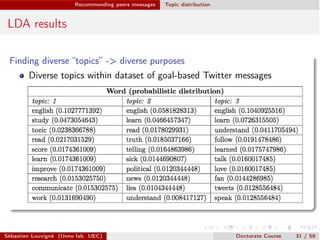
LDA results
Finding diverse “topics” -> diverse purposes
Diverse topics within dataset of goal-based Twitter messages
Sébastien Louvigné (Ueno lab. UEC) Doctorate Course 31 / 59
Recommending peers messages Topic distribution
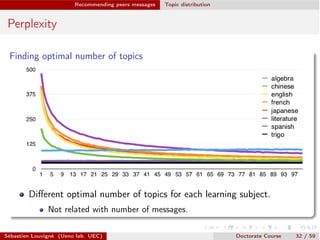
Perplexity
Finding optimal number of topics
Different optimal number of topics for each learning subject.
Not related with number of messages.
Sébastien Louvigné (Ueno lab. UEC) Doctorate Course 32 / 59
Recommending peers messages Goal & Purpose Recommendation
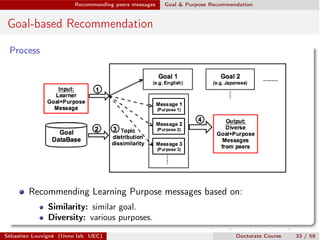
Goal-based Recommendation
Process
Recommending Learning Purpose messages based on:
Similarity: similar goal.
Diversity: various purposes.
Sébastien Louvigné (Ueno lab. UEC) Doctorate Course 33 / 59
Recommending peers messages Goal & Purpose Recommendation
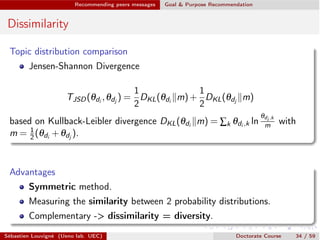
Dissimilarity
Topic distribution comparison
Jensen-Shannon Divergence
TJSD(qdi
,qdj
) =
1
2
DKL(qdi
km)+
1
2
DKL(qdj
km)
based on Kullback-Leibler divergence DKL(qdi
km) = Âk qdi ,k ln
qdi ,k
m with
m = 1
2 (qdi
+qdj
).
Advantages
Symmetric method.
Measuring the similarity between 2 probability distributions.
Complementary -> dissimilarity = diversity.
Sébastien Louvigné (Ueno lab. UEC) Doctorate Course 34 / 59
Recommending peers messages Goal & Purpose Recommendation
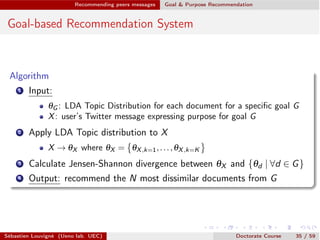
Goal-based Recommendation System
Algorithm
1 Input:
qG : LDA Topic Distribution for each document for a specific goal G
X: user’s Twitter message expressing purpose for goal G
2 Apply LDA Topic distribution to X
X ! qX where qX = qX,k=1,...,qX,k=K
3 Calculate Jensen-Shannon divergence between qX and {qd | 8d 2 G}
4 Output: recommend the N most dissimilar documents from G
Sébastien Louvigné (Ueno lab. UEC) Doctorate Course 35 / 59
Recommending peers messages Experimentation
User Interface
Sébastien Louvigné (Ueno lab. UEC) Doctorate Course 36 / 59
Recommending peers messages Experimentation
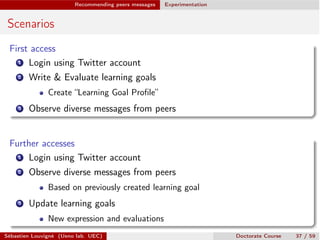
Scenarios
First access
1 Login using Twitter account
2 Write & Evaluate learning goals
Create “Learning Goal Profile”
3 Observe diverse messages from peers
Further accesses
1 Login using Twitter account
2 Observe diverse messages from peers
Based on previously created learning goal
3 Update learning goals
New expression and evaluations
Sébastien Louvigné (Ueno lab. UEC) Doctorate Course 37 / 59
Recommending peers messages Experimentation
Learning Goal Profile
Sébastien Louvigné (Ueno lab. UEC) Doctorate Course 38 / 59
Recommending peers messages Self-evaluation results
Evaluating Motivation
Measurement methods
Self-Report (auto-evaluation questionnaire)
Precise analysis / Personal characteristics / Learner profile
Subjectivity / Non-synchronism / Learning sequencing
Free Choice (Time spent on activities / continuing tasks)
Appropriate for Intrinsic motivation
Difficult to measure in open environment
Peer-review (rating by others)
More objective / Behaviors
Difficult to judge
Sébastien Louvigné (Ueno lab. UEC) Doctorate Course 39 / 59
Recommending peers messages Self-evaluation results
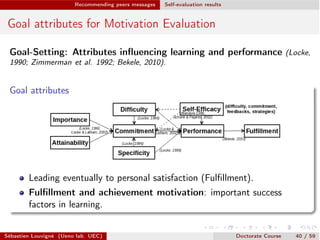
Goal attributes for Motivation Evaluation
Goal-Setting: Attributes influencing learning and performance (Locke,
1990; Zimmerman et al. 1992; Bekele, 2010).
Goal attributes
Leading eventually to personal satisfaction (Fulfillment).
Fulfillment and achievement motivation: important success
factors in learning.
Sébastien Louvigné (Ueno lab. UEC) Doctorate Course 40 / 59
Recommending peers messages Self-evaluation results
Questionnaire
Sébastien Louvigné (Ueno lab. UEC) Doctorate Course 41 / 59
Recommending peers messages Self-evaluation results
Experiment
Participants
77 Undergraduate students in University of Electro-Communications
(Tokyo)
English classes
Scenario
1 Create a “Learning Goal Profile”
2 Observe messages from peers (similar / diverse)
3 Repeat previous steps over time
Sébastien Louvigné (Ueno lab. UEC) Doctorate Course 42 / 59
Recommending peers messages Self-evaluation results
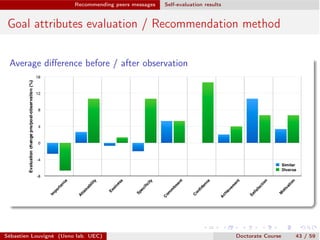
Goal attributes evaluation / Recommendation method
Average difference before / after observation
Sébastien Louvigné (Ueno lab. UEC) Doctorate Course 43 / 59
Recommending peers messages Self-evaluation results
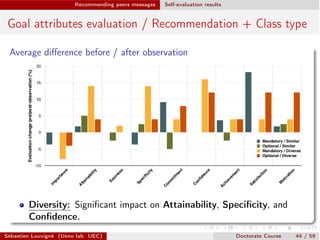
Goal attributes evaluation / Recommendation + Class type
Average difference before / after observation
Diversity: Significant impact on Attainability, Specificity, and
Confidence.
Sébastien Louvigné (Ueno lab. UEC) Doctorate Course 44 / 59
Recommending peers messages Self-evaluation results
T-test (pre-observation / post-observation)
Average difference (P[T<=t] one-tail)
Mandatory classes Optional classes
Attributes Similar Diverse Similar Diverse
Importance -3.63 (0.28) -8.00 (0.13) 0.00 (0.00) -4.00 (0.27)
Attainability 1.81 (0.38) 14.00 (0.04) 5.00 (0.34) 4.00 (0.38)
Easiness 0.00 (0.50) 2.00 (0.42) -2.50 (0.45) 0.00 (0.50)
Specificity -3.63 (0.30) 14.00 (0.04) 2.50 (0.36) 4.00 (0.33)
Commitment 9.09 (0.13) 4.00 (0.32) -5.00 (0.27) 8.00 (0.27)
Confidence 0.00 (0.50) 16.00 (0.05) 0.00 (0.50) 12.00 (0.23)
Achievement 3.63 (0.32) 4.00 (0.33) -2.50 (0.40) 4.00 (0.27)
Satisfaction 18.18 (0.01) 4.00 (0.37) 0.00 (0.20) 12.00 (0.14)
Motivation 1.81 (0.39) 4.00 (0.32) 7.50 (0.15) 12.00 (0.15)
Sébastien Louvigné (Ueno lab. UEC) Doctorate Course 45 / 59
Recommending peers messages Self-evaluation results
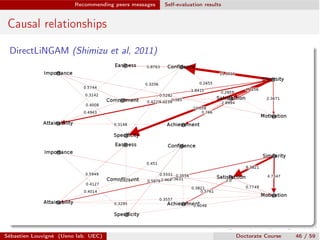
Causal relationships
DirectLiNGAM (Shimizu et al, 2011)
Sébastien Louvigné (Ueno lab. UEC) Doctorate Course 46 / 59
Recommending peers messages Self-evaluation results
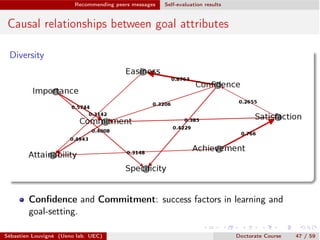
Causal relationships between goal attributes
Diversity
Confidence and Commitment: success factors in learning and
goal-setting.
Sébastien Louvigné (Ueno lab. UEC) Doctorate Course 47 / 59
Recommending peers messages Self-evaluation results
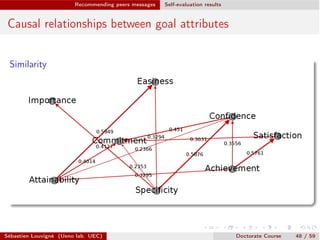
Causal relationships between goal attributes
Similarity
Sébastien Louvigné (Ueno lab. UEC) Doctorate Course 48 / 59
Learning communities
Outline
1 Introduction
Research Objective
Social Constructivism
Goal & Purpose for Motivation
Proposed Research
2 Goal-based data from SNS
SNS Data
Systemic Functional Linguistics
Transitivity Model
Goal-based messages from
peers
Summary
3 Recommending peers messages
LDA model
Topic distribution
Goal & Purpose
Recommendation
Experimentation
Self-evaluation results
4 Learning communities
Learning Activity reports
Evaluations
5 Conclusion
Discussion
Future works
Sébastien Louvigné (Ueno lab. UEC) Doctorate Course 49 / 59
Learning communities Learning Activity reports
Learning Communities
Key characteristics (Bielaczyc et al. 1999)
1 Diversity of expertise.
2 Shared objective.
3 Focus on learning “how to learn”.
4 Mechanisms to share what has been learned.
Implementing Learning Communities
Need for more diverse message types.
“Learning Activity” reports: detailing “what” students learned, and
“how” they learned.
Sébastien Louvigné (Ueno lab. UEC) Doctorate Course 50 / 59
Learning communities Learning Activity reports
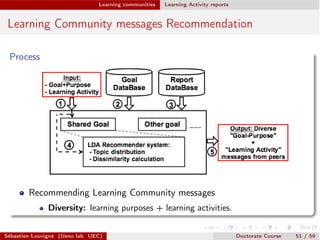
Learning Community messages Recommendation
Process
Recommending Learning Community messages
Diversity: learning purposes + learning activities.
Sébastien Louvigné (Ueno lab. UEC) Doctorate Course 51 / 59
Learning communities Evaluations
T-test (pre-observation / post-observation)
Variations (P[T  t])
Attributes Learning activity
messages
Only learning
purposes
Commitment 14.29 (0.03) 5.33 (0.09)
Confidence 8.57 (0.11) 14.67 (0.24)
Achievement 12.86 (0.06) 4.00 (0.18)
Fulfillment 7.14 (0.22) 6.67 (0.03)
Motivation 12.86 (0.08) 6.67 (0.40)
- Extrinsic 12.86 (0.06) N/A
- Intrinsic 14.29 (0.02) N/A
Hours 1.10 (0.10) 0.10 (0.50)
Significant impact on Commitment, and Motivation (extrinsic /
intrinsic).
Sébastien Louvigné (Ueno lab. UEC) Doctorate Course 52 / 59
Conclusion
Outline
1 Introduction
Research Objective
Social Constructivism
Goal & Purpose for Motivation
Proposed Research
2 Goal-based data from SNS
SNS Data
Systemic Functional Linguistics
Transitivity Model
Goal-based messages from
peers
Summary
3 Recommending peers messages
LDA model
Topic distribution
Goal & Purpose
Recommendation
Experimentation
Self-evaluation results
4 Learning communities
Learning Activity reports
Evaluations
5 Conclusion
Discussion
Future works
Sébastien Louvigné (Ueno lab. UEC) Doctorate Course 53 / 59
Conclusion
Conclusion
Using Social Context to enhance Learning Motivation
1 Focusing on psychological functions.
2 Diversity of messages from peers for learning.
3 Recommendation of diverse purposes from peers.
4 Implementation of learning communities characteristics.
Results
Observing diverse SNS messages from peers
Positive impact on Motivation.
Diversity: positive impact on Attainability, Specificity, and
Confidence.
Confidence and Commitment appear as measure of success in
goal-setting.
Motivation and Commitment enhancement with Learning
Communities implementation.
Sébastien Louvigné (Ueno lab. UEC) Doctorate Course 54 / 59
Conclusion Discussion
Contributions
Enhancing motivation with a more diverse social environment
Integrated Motivational contents in:
Collaborative learning environment
Recommendation System
Importance of Diversity
Observing diverse purposes from peers enhanced self-perceptions
Recommendation factor
LDA
3-level distinction: document-topic-word
Recommendation based on topic dissimilarity
Learning Communities
More dynamic implementation of motivation
Better enhancement of motivation
Sébastien Louvigné (Ueno lab. UEC) Doctorate Course 55 / 59
Conclusion Future works
Future works
Learning Environment
Integration of motivation in Learning Management Systems.
Motivation evaluation
Develop “Free choice” method
Time of study
Behavior and decision making (e.g. joining optional class)
Other learning subjects
LDA
e.g. Short text analysis, Including grammatical features
Sébastien Louvigné (Ueno lab. UEC) Doctorate Course 56 / 59
Conclusion Future works
List of Publications
S. Louvigné, and N. Rubens (2016), “Meaning-Making Analysis and Topic Classification of
SNS Goal-based messages”. Behaviormetrika 43(1).
S. Louvigné, Y. Kato, N. Rubens, and M. Ueno (2015), “SNS messages Recommendation
for Learning Motivation”. Artificial Intelligence in Education (International Conference).
S. Louvigné, Y. Kato, N. Rubens, and M. Ueno (2015), “Goal-based messages
Recommendation utilizing Latent Dirichlet Allocation”. The 14th IEEE International
Conference on Advanced Learning Technologies (ICALT).
J. Shi, and S. Louvigné (2014), “Goal-Setting and Meaning-Making in Mined Dataset of
Tweets Using SFG Approach”. Journal of Electrical Engineering.
S. Louvigné, N. Rubens, F. Anma, and T. Okamoto (2012), “Utilizing Social Media for
Goal Setting based on Observational Learning”. 2012 IEEE 12th International Conference
on Advanced Learning Technologies (ICALT).
S. Louvigné, N. Rubens, F. Anma, and T. Okamoto (2012), “Utilizing Social Media for
Observational Goal Setting”. Computers and Advanced Technology in Education
(International Conference).
Sébastien Louvigné (Ueno lab. UEC) Doctorate Course 57 / 59
Conclusion Future works
Bibliography
L. Vygotsky (1978), “Mind in Society: The Development of Higher Psychological
Processes”. Harvard University Press.
J. S. Eccles, and A. Wigfield (2002), “Motivational Beliefs, Values, and Goals”. Annual
review of psychology.
D. H. Schunk, J. L. Meece, and P. R. Pintrich (2002), “Goals and Goal Orientations”.
Motivation in Education: Theory, Research, and Applications.
P. R. Pintrich (2003), “A Motivational Science Perspective on the Role of Student
Motivation in Learning and Teaching Contexts”. Journal of Educational Psychology.
C. Ames (1992), “Classrooms: Goals, Structures, and Student Motivation”. Journal of
Educational Psychology.
E. A. Locke, and G. P. Latham (2002), “Building a practically useful theory of goal setting
and task motivation: A 35-year odyssey”. American Psychologist.
D. M. Blei, A. Y. Ng, and M. I. Jordan (2003), “Latent Dirichlet Allocation”. Journal of
Machine Learning Research.
T. L. Griffiths, and M. Steyvers (2004), “Finding scientific topics”. National academy of
Sciences of the United States of America.
Sébastien Louvigné (Ueno lab. UEC) Doctorate Course 58 / 59
Conclusion Future works
Thank you
Sébastien Louvigné (Ueno lab. UEC) Doctorate Course 59 / 59

Social Constructivist Approach of Learning Motivation

  • 1.
    Social Constructivist approachof Motivation Recommendation of diverse peer messages on Social Networking Services Sébastien Louvigné Ueno laboratory Graduate School of Information Systems The University of Electro-Communications April 22, 2016 Sébastien Louvigné (Ueno lab. UEC) Doctorate Course 1 / 59
  • 2.
    Outline 1 Introduction Research Objective SocialConstructivism Goal & Purpose for Motivation Proposed Research 2 Goal-based data from SNS SNS Data Systemic Functional Linguistics Transitivity Model Goal-based messages from peers Summary 3 Recommending peers messages LDA model Topic distribution Goal & Purpose Recommendation Experimentation Self-evaluation results 4 Learning communities Learning Activity reports Evaluations 5 Conclusion Discussion Future works Sébastien Louvigné (Ueno lab. UEC) Doctorate Course 2 / 59
  • 3.
    Introduction Outline 1 Introduction Research Objective SocialConstructivism Goal & Purpose for Motivation Proposed Research 2 Goal-based data from SNS SNS Data Systemic Functional Linguistics Transitivity Model Goal-based messages from peers Summary 3 Recommending peers messages LDA model Topic distribution Goal & Purpose Recommendation Experimentation Self-evaluation results 4 Learning communities Learning Activity reports Evaluations 5 Conclusion Discussion Future works Sébastien Louvigné (Ueno lab. UEC) Doctorate Course 3 / 59
  • 4.
    Introduction Research Objective Motivationfor Learning Internal force generating behaviors to achieve goals Central part of educational psychology (Weiner, 1985). Why do I want to learn? (reason, purpose) What do I want to achieve? (outcome, goal) Lack of Motivation Largest cause of education failure (Samuelson, 2010). Sébastien Louvigné (Ueno lab. UEC) Doctorate Course 4 / 59
  • 5.
    Introduction Research Objective Learningin social environments Collaborative Learning People interact to learn together (Dillenbourg, 1999). Contemporary pedagogical approaches Increasingly integrate collaboration for learning Make learning more meaningful Need to include psychological functions Research Objective Enhance learning motivation using social learning environments Sébastien Louvigné (Ueno lab. UEC) Doctorate Course 5 / 59
  • 6.
    Introduction Social Constructivism SocialConstructivist approach Vygotsky’s Social Developmental theory People actively and cognitively construct knowledge (Piaget, 1937). People learn from others (Vygotsky, 1978; Vygotsky, 1986) Key characteristics Expand “Zone of Proximal Development” Support from “More Knowledgeable Others” Development of Higher psychological functions Sébastien Louvigné (Ueno lab. UEC) Doctorate Course 6 / 59
  • 7.
    Introduction Social Constructivism SocialConstructivism in Learning Contemporary learning Increasingly integrates social constructivism Promote & Facilitate the construction of knowledge Pedagogical approaches: “Scaffolding” (Wood et al, 1976) Cognitive apprenticeship (Collins et al, 1991) Communities of Practice (Lave & Wenger, 1991) Learning Communities (Scardamalia & Bereiter, 1994) Computer-Supported Collaborative Learning (Scardamalia & Bereiter, 1989) Sébastien Louvigné (Ueno lab. UEC) Doctorate Course 7 / 59
  • 8.
    Introduction Social Constructivism Needfor more psychological aspects Contemporary collaborative approaches How to learn psychological functions from others? Important role of intrinsic motivation in CSCL (Rientes et al, 2009) Limited diversity (learners with similar characteristics) Increasing social presence Proposed research 1 Collaborative learning environment to Enhance / Generate new intrinsic motivation 2 More diverse social environment -> Social Network Services (SNS) Sébastien Louvigné (Ueno lab. UEC) Doctorate Course 8 / 59
  • 9.
    Introduction Goal &Purpose for Motivation Motivation for Learning Different types of motivation Self-Determination Theory (Ryan & Deci, 2000) Towards an internalization of motivation Intrinsic motivation -> positive effects on learning. Focus on expectancy, value, and goals. Sébastien Louvigné (Ueno lab. UEC) Doctorate Course 9 / 59
  • 10.
    Introduction Goal &Purpose for Motivation Goal & Purpose for Learning Motivation Goal enhances Learning: “What to achieve” Critical factor of motivation (personal emotions, beliefs) (Schunk et al. 2002) Purpose for learning: “Why to learn” Strong connection goal-purpose -> intrinsic motivation (Eccles et al. 1998) Makes learning more meaningful (Ames, 1992) Sébastien Louvigné (Ueno lab. UEC) Doctorate Course 10 / 59
  • 11.
    Introduction Goal &Purpose for Motivation Problem Statement ”Why learning?” Highly structured education -> Syllabus states objectives. Learners have their own conceptions -> Often unrelated with formal education. Goal Orientation should be set properly Risk of conflict / discouragement / harm intrinsic motivation. Sébastien Louvigné (Ueno lab. UEC) Doctorate Course 11 / 59
  • 12.
    Introduction Goal &Purpose for Motivation Goal & Purpose Definitions 1 Goal: terminal point towards which action is directed (e.g. “master a language”). 2 Purpose: provides the psychological force to attain a goal (i.e. reasons for learning). Goals -> efficient when linked with learner’s needs (purpose for learning). Learners have different purposes (conceptual perceptions). Goal orientations have different effects on intrinsic motivation. Sébastien Louvigné (Ueno lab. UEC) Doctorate Course 12 / 59
  • 13.
    Introduction Goal &Purpose for Motivation Goal Orientations Distinctions Approach state Avoidance state Mastery orientation Mastering task, learning, understanding (self-improvement) Avoiding misunderstanding, avoiding not learning or not mastering task (not being wrong) Performance orientation Being superior, the smartest, best at task in comparison to others (normative standards) Avoiding inferiority, not looking stupid or dumb in comparison to others (normative standards) High influence of self-set goals on intrinsic motivation (Locke & Latham, 1990). Adopt new purposes / perceptions -> more intrapersonal goal orientation. Sébastien Louvigné (Ueno lab. UEC) Doctorate Course 13 / 59
  • 14.
    Introduction Proposed Research Researchpurpose Needs Incorporation of Psychological aspects Learning Motivation enhancement Diversity in collaborative learning environments Hypothesis 1 Learners enhance motivation by observing goal/purposes from other peers (SNS). 2 Diversity of goal purposes positively affects learners’ motivation and self-perception. Sébastien Louvigné (Ueno lab. UEC) Doctorate Course 14 / 59
  • 15.
    Introduction Proposed Research SocialNetworking Services SNS for diversity Massive resource of diverse information. Media, content publishing, sharing, collaboration, etc. Including motivational and goal-based messages. Essential and influential media. Including for learning (Bandura, 2001). How to use motivation on SNS 1 Collecting motivational and goal-based data from Social Media. 2 Analyzing the diversity of contents (i.e. purposes for a same goal). 3 Recommending diverse purposes for learning. Sébastien Louvigné (Ueno lab. UEC) Doctorate Course 15 / 59
  • 16.
    Introduction Proposed Research Proposedrecommendation system Diversity in Learning Communities → Learning purposes 1) Expression -> 2) Observation -> 3) Evaluation Sébastien Louvigné (Ueno lab. UEC) Doctorate Course 16 / 59
  • 17.
    Introduction Proposed Research ProposedResearch Features I. Goal-based data from Social Media II. Recommending peers messages to enhance learning motivation 1. Data Collection 3. Topic Distribution 4. Goal Expression 2. Data Analysis 5. Recommendation System 6. Observation 7. Evaluation 8. Learning communities Sébastien Louvigné (Ueno lab. UEC) Doctorate Course 17 / 59
  • 18.
    Goal-based data fromSNS Outline 1 Introduction Research Objective Social Constructivism Goal & Purpose for Motivation Proposed Research 2 Goal-based data from SNS SNS Data Systemic Functional Linguistics Transitivity Model Goal-based messages from peers Summary 3 Recommending peers messages LDA model Topic distribution Goal & Purpose Recommendation Experimentation Self-evaluation results 4 Learning communities Learning Activity reports Evaluations 5 Conclusion Discussion Future works Sébastien Louvigné (Ueno lab. UEC) Doctorate Course 18 / 59
  • 19.
    Goal-based data fromSNS SNS Data Social Networking Services Internet + SNS Essential part of personal life / communication Many research works on education Largest SNS: Facebook & Twitter (Tess, 2013) Various results -> 2 opinions Positive impact on learning behavior Only communicative tool for socializing (Madge et al. 2009) Research works agree on: Necessity to consider SNS in academic life “Backstage” role in development of student identity (Selwyn, 2009) Sébastien Louvigné (Ueno lab. UEC) Doctorate Course 19 / 59
  • 20.
    Goal-based data fromSNS SNS Data Large-Scale Dataset Twitter Short text messages Metadata (e.g. user profile, social network) Large amount of data publicly available Research works on Twitter Access for informational purposes (Hughes et al. 2012). Correlation with cognition stimulation / conscientiousness. Small amount of information generates reaction (Sysomos, 2010). Data containing Learning concepts Filter stream data (“learn”, “study”). Learning DB: 270 millions messages (May 2011 - March 2013). Sébastien Louvigné (Ueno lab. UEC) Doctorate Course 20 / 59
  • 21.
    Goal-based data fromSNS Systemic Functional Linguistics Systemic Functional Grammar (SFG) Form of language description (Halliday, 1994) 1 “Systemic” -> Language: network of systems, interrelated sets of options for making meaning. 2 “Functional” -> Language: multidimensional architecture reflecting “the multidimensional nature of human experience and interpersonal relations." Sébastien Louvigné (Ueno lab. UEC) Doctorate Course 21 / 59
  • 22.
    Goal-based data fromSNS Systemic Functional Linguistics Systemic Functional Grammar (SFG) Functional semantic perspective Linking linguistic elements and functions to create meaning. Metafunctions of language: Ideational (creating meaning), Interpersonal (interactivity, mood), Textual (internal organization). Multidimensional architecture of language (Halliday, 2003). Sébastien Louvigné (Ueno lab. UEC) Doctorate Course 22 / 59
  • 23.
    Goal-based data fromSNS Transitivity Model Transitivity Model Analyzing meaning-creating of learning goals (Ideational) Model of organization of meaning creating systems (Matthiessen, 2010). Processes & Definitions Key elements Material: Processes of doing in the physical world Actor - Goal - Process - Circumstance Relational: Concerned with the process of being in the world of abstract relations Actor - Goal - Process (be) - Attributes - Carrier - Token - Value Mental: Encodes the meanings of feeling and thinking Senser - Phenomenon - Circumstance Verbal: Process of saying Sayer - Target - Verbiage Behavioral: Processes of physiological and psychological behavior Behaver Existential: Processes of existing and happening Existent – Circumstance Sébastien Louvigné (Ueno lab. UEC) Doctorate Course 23 / 59
  • 24.
    Goal-based data fromSNS Transitivity Model Learning data vs Goal data Data analysis results Higher usage of mental processes (e.g. “need”, “like”, “want”) in goal-based messages. Goals: strong relation with expression of needs and feelings. Sébastien Louvigné (Ueno lab. UEC) Doctorate Course 24 / 59
  • 25.
    Goal-based data fromSNS Goal-based messages from peers Largescale goal-based Dataset Goal Database creation process Filtering (learning data) Segmenting (subjects) Labeling (goal-based messages) Analyzing (patterns) Sébastien Louvigné (Ueno lab. UEC) Doctorate Course 25 / 59
  • 26.
    Goal-based data fromSNS Summary Discussion Findings 1 Construction of Goal-based dataset of peers messages Analysis of ideational metafunction of Twitter messages (SFG, Transitivity model). 2 Mental processes to create goal-based meaning Giving social and personal meaning (physiological and psychological; feelings and emotions). 3 Top Actor lexicon having mainly “I” Personal experiences, Individual meaning. 4 Large variety of Circumstances Limitations Focus on ideational dimension, Transitivity model Sébastien Louvigné (Ueno lab. UEC) Doctorate Course 26 / 59
  • 27.
    Recommending peers messages Outline 1Introduction Research Objective Social Constructivism Goal & Purpose for Motivation Proposed Research 2 Goal-based data from SNS SNS Data Systemic Functional Linguistics Transitivity Model Goal-based messages from peers Summary 3 Recommending peers messages LDA model Topic distribution Goal & Purpose Recommendation Experimentation Self-evaluation results 4 Learning communities Learning Activity reports Evaluations 5 Conclusion Discussion Future works Sébastien Louvigné (Ueno lab. UEC) Doctorate Course 27 / 59
  • 28.
    Recommending peers messages Context Needs Learningmotivation enhancement Integration in collaborative learning environments more diverse social presence, intrinsic motivational contents from other peers. Objective 1 Recommendation system Goal-based messages from other peers. Diverse purposes (reasons) for a shared goal (desired outcome). 2 Motivation evaluation Influence of observing peers’ messages. Sébastien Louvigné (Ueno lab. UEC) Doctorate Course 28 / 59
  • 29.
    Recommending peers messages RecommenderSystems Technology Enhanced Learning systems (Manouselis et al. 2012) Recommending personalized contents Similarity of item contents / user profiles / other info Need to consider diversity (Erdt et al. 2015) Recommend outcomes different from learners’ expectations Sébastien Louvigné (Ueno lab. UEC) Doctorate Course 29 / 59
  • 30.
    Recommending peers messagesLDA model Latent Dirichlet Allocation (LDA) Probabilistic model for collections of discrete data (Blei et al. 2003) d : Document Z : Topic W : Word Documents: Mixture of topics -> purposes for learning Full conditional: P(zi = j|z i ,w) µ n (wi ) i,j +b n (.) j +W b (n (di ) i,j +a) Dirichlet: ˆq (d) k = n (d) k +a n (.) k +Ka ; ˆf (w) j = n (w) j +b n (.) j +W b (Griffiths & Steyvers. 2004) Sébastien Louvigné (Ueno lab. UEC) Doctorate Course 30 / 59
  • 31.
    Recommending peers messagesTopic distribution LDA results Finding diverse “topics” -> diverse purposes Diverse topics within dataset of goal-based Twitter messages Sébastien Louvigné (Ueno lab. UEC) Doctorate Course 31 / 59
  • 32.
    Recommending peers messagesTopic distribution Perplexity Finding optimal number of topics Different optimal number of topics for each learning subject. Not related with number of messages. Sébastien Louvigné (Ueno lab. UEC) Doctorate Course 32 / 59
  • 33.
    Recommending peers messagesGoal & Purpose Recommendation Goal-based Recommendation Process Recommending Learning Purpose messages based on: Similarity: similar goal. Diversity: various purposes. Sébastien Louvigné (Ueno lab. UEC) Doctorate Course 33 / 59
  • 34.
    Recommending peers messagesGoal & Purpose Recommendation Dissimilarity Topic distribution comparison Jensen-Shannon Divergence TJSD(qdi ,qdj ) = 1 2 DKL(qdi km)+ 1 2 DKL(qdj km) based on Kullback-Leibler divergence DKL(qdi km) = Âk qdi ,k ln qdi ,k m with m = 1 2 (qdi +qdj ). Advantages Symmetric method. Measuring the similarity between 2 probability distributions. Complementary -> dissimilarity = diversity. Sébastien Louvigné (Ueno lab. UEC) Doctorate Course 34 / 59
  • 35.
    Recommending peers messagesGoal & Purpose Recommendation Goal-based Recommendation System Algorithm 1 Input: qG : LDA Topic Distribution for each document for a specific goal G X: user’s Twitter message expressing purpose for goal G 2 Apply LDA Topic distribution to X X ! qX where qX = qX,k=1,...,qX,k=K 3 Calculate Jensen-Shannon divergence between qX and {qd | 8d 2 G} 4 Output: recommend the N most dissimilar documents from G Sébastien Louvigné (Ueno lab. UEC) Doctorate Course 35 / 59
  • 36.
    Recommending peers messagesExperimentation User Interface Sébastien Louvigné (Ueno lab. UEC) Doctorate Course 36 / 59
  • 37.
    Recommending peers messagesExperimentation Scenarios First access 1 Login using Twitter account 2 Write & Evaluate learning goals Create “Learning Goal Profile” 3 Observe diverse messages from peers Further accesses 1 Login using Twitter account 2 Observe diverse messages from peers Based on previously created learning goal 3 Update learning goals New expression and evaluations Sébastien Louvigné (Ueno lab. UEC) Doctorate Course 37 / 59
  • 38.
    Recommending peers messagesExperimentation Learning Goal Profile Sébastien Louvigné (Ueno lab. UEC) Doctorate Course 38 / 59
  • 39.
    Recommending peers messagesSelf-evaluation results Evaluating Motivation Measurement methods Self-Report (auto-evaluation questionnaire) Precise analysis / Personal characteristics / Learner profile Subjectivity / Non-synchronism / Learning sequencing Free Choice (Time spent on activities / continuing tasks) Appropriate for Intrinsic motivation Difficult to measure in open environment Peer-review (rating by others) More objective / Behaviors Difficult to judge Sébastien Louvigné (Ueno lab. UEC) Doctorate Course 39 / 59
  • 40.
    Recommending peers messagesSelf-evaluation results Goal attributes for Motivation Evaluation Goal-Setting: Attributes influencing learning and performance (Locke, 1990; Zimmerman et al. 1992; Bekele, 2010). Goal attributes Leading eventually to personal satisfaction (Fulfillment). Fulfillment and achievement motivation: important success factors in learning. Sébastien Louvigné (Ueno lab. UEC) Doctorate Course 40 / 59
  • 41.
    Recommending peers messagesSelf-evaluation results Questionnaire Sébastien Louvigné (Ueno lab. UEC) Doctorate Course 41 / 59
  • 42.
    Recommending peers messagesSelf-evaluation results Experiment Participants 77 Undergraduate students in University of Electro-Communications (Tokyo) English classes Scenario 1 Create a “Learning Goal Profile” 2 Observe messages from peers (similar / diverse) 3 Repeat previous steps over time Sébastien Louvigné (Ueno lab. UEC) Doctorate Course 42 / 59
  • 43.
    Recommending peers messagesSelf-evaluation results Goal attributes evaluation / Recommendation method Average difference before / after observation Sébastien Louvigné (Ueno lab. UEC) Doctorate Course 43 / 59
  • 44.
    Recommending peers messagesSelf-evaluation results Goal attributes evaluation / Recommendation + Class type Average difference before / after observation Diversity: Significant impact on Attainability, Specificity, and Confidence. Sébastien Louvigné (Ueno lab. UEC) Doctorate Course 44 / 59
  • 45.
    Recommending peers messagesSelf-evaluation results T-test (pre-observation / post-observation) Average difference (P[T<=t] one-tail) Mandatory classes Optional classes Attributes Similar Diverse Similar Diverse Importance -3.63 (0.28) -8.00 (0.13) 0.00 (0.00) -4.00 (0.27) Attainability 1.81 (0.38) 14.00 (0.04) 5.00 (0.34) 4.00 (0.38) Easiness 0.00 (0.50) 2.00 (0.42) -2.50 (0.45) 0.00 (0.50) Specificity -3.63 (0.30) 14.00 (0.04) 2.50 (0.36) 4.00 (0.33) Commitment 9.09 (0.13) 4.00 (0.32) -5.00 (0.27) 8.00 (0.27) Confidence 0.00 (0.50) 16.00 (0.05) 0.00 (0.50) 12.00 (0.23) Achievement 3.63 (0.32) 4.00 (0.33) -2.50 (0.40) 4.00 (0.27) Satisfaction 18.18 (0.01) 4.00 (0.37) 0.00 (0.20) 12.00 (0.14) Motivation 1.81 (0.39) 4.00 (0.32) 7.50 (0.15) 12.00 (0.15) Sébastien Louvigné (Ueno lab. UEC) Doctorate Course 45 / 59
  • 46.
    Recommending peers messagesSelf-evaluation results Causal relationships DirectLiNGAM (Shimizu et al, 2011) Sébastien Louvigné (Ueno lab. UEC) Doctorate Course 46 / 59
  • 47.
    Recommending peers messagesSelf-evaluation results Causal relationships between goal attributes Diversity Confidence and Commitment: success factors in learning and goal-setting. Sébastien Louvigné (Ueno lab. UEC) Doctorate Course 47 / 59
  • 48.
    Recommending peers messagesSelf-evaluation results Causal relationships between goal attributes Similarity Sébastien Louvigné (Ueno lab. UEC) Doctorate Course 48 / 59
  • 49.
    Learning communities Outline 1 Introduction ResearchObjective Social Constructivism Goal & Purpose for Motivation Proposed Research 2 Goal-based data from SNS SNS Data Systemic Functional Linguistics Transitivity Model Goal-based messages from peers Summary 3 Recommending peers messages LDA model Topic distribution Goal & Purpose Recommendation Experimentation Self-evaluation results 4 Learning communities Learning Activity reports Evaluations 5 Conclusion Discussion Future works Sébastien Louvigné (Ueno lab. UEC) Doctorate Course 49 / 59
  • 50.
    Learning communities LearningActivity reports Learning Communities Key characteristics (Bielaczyc et al. 1999) 1 Diversity of expertise. 2 Shared objective. 3 Focus on learning “how to learn”. 4 Mechanisms to share what has been learned. Implementing Learning Communities Need for more diverse message types. “Learning Activity” reports: detailing “what” students learned, and “how” they learned. Sébastien Louvigné (Ueno lab. UEC) Doctorate Course 50 / 59
  • 51.
    Learning communities LearningActivity reports Learning Community messages Recommendation Process Recommending Learning Community messages Diversity: learning purposes + learning activities. Sébastien Louvigné (Ueno lab. UEC) Doctorate Course 51 / 59
  • 52.
    Learning communities Evaluations T-test(pre-observation / post-observation) Variations (P[T  t]) Attributes Learning activity messages Only learning purposes Commitment 14.29 (0.03) 5.33 (0.09) Confidence 8.57 (0.11) 14.67 (0.24) Achievement 12.86 (0.06) 4.00 (0.18) Fulfillment 7.14 (0.22) 6.67 (0.03) Motivation 12.86 (0.08) 6.67 (0.40) - Extrinsic 12.86 (0.06) N/A - Intrinsic 14.29 (0.02) N/A Hours 1.10 (0.10) 0.10 (0.50) Significant impact on Commitment, and Motivation (extrinsic / intrinsic). Sébastien Louvigné (Ueno lab. UEC) Doctorate Course 52 / 59
  • 53.
    Conclusion Outline 1 Introduction Research Objective SocialConstructivism Goal & Purpose for Motivation Proposed Research 2 Goal-based data from SNS SNS Data Systemic Functional Linguistics Transitivity Model Goal-based messages from peers Summary 3 Recommending peers messages LDA model Topic distribution Goal & Purpose Recommendation Experimentation Self-evaluation results 4 Learning communities Learning Activity reports Evaluations 5 Conclusion Discussion Future works Sébastien Louvigné (Ueno lab. UEC) Doctorate Course 53 / 59
  • 54.
    Conclusion Conclusion Using Social Contextto enhance Learning Motivation 1 Focusing on psychological functions. 2 Diversity of messages from peers for learning. 3 Recommendation of diverse purposes from peers. 4 Implementation of learning communities characteristics. Results Observing diverse SNS messages from peers Positive impact on Motivation. Diversity: positive impact on Attainability, Specificity, and Confidence. Confidence and Commitment appear as measure of success in goal-setting. Motivation and Commitment enhancement with Learning Communities implementation. Sébastien Louvigné (Ueno lab. UEC) Doctorate Course 54 / 59
  • 55.
    Conclusion Discussion Contributions Enhancing motivationwith a more diverse social environment Integrated Motivational contents in: Collaborative learning environment Recommendation System Importance of Diversity Observing diverse purposes from peers enhanced self-perceptions Recommendation factor LDA 3-level distinction: document-topic-word Recommendation based on topic dissimilarity Learning Communities More dynamic implementation of motivation Better enhancement of motivation Sébastien Louvigné (Ueno lab. UEC) Doctorate Course 55 / 59
  • 56.
    Conclusion Future works Futureworks Learning Environment Integration of motivation in Learning Management Systems. Motivation evaluation Develop “Free choice” method Time of study Behavior and decision making (e.g. joining optional class) Other learning subjects LDA e.g. Short text analysis, Including grammatical features Sébastien Louvigné (Ueno lab. UEC) Doctorate Course 56 / 59
  • 57.
    Conclusion Future works Listof Publications S. Louvigné, and N. Rubens (2016), “Meaning-Making Analysis and Topic Classification of SNS Goal-based messages”. Behaviormetrika 43(1). S. Louvigné, Y. Kato, N. Rubens, and M. Ueno (2015), “SNS messages Recommendation for Learning Motivation”. Artificial Intelligence in Education (International Conference). S. Louvigné, Y. Kato, N. Rubens, and M. Ueno (2015), “Goal-based messages Recommendation utilizing Latent Dirichlet Allocation”. The 14th IEEE International Conference on Advanced Learning Technologies (ICALT). J. Shi, and S. Louvigné (2014), “Goal-Setting and Meaning-Making in Mined Dataset of Tweets Using SFG Approach”. Journal of Electrical Engineering. S. Louvigné, N. Rubens, F. Anma, and T. Okamoto (2012), “Utilizing Social Media for Goal Setting based on Observational Learning”. 2012 IEEE 12th International Conference on Advanced Learning Technologies (ICALT). S. Louvigné, N. Rubens, F. Anma, and T. Okamoto (2012), “Utilizing Social Media for Observational Goal Setting”. Computers and Advanced Technology in Education (International Conference). Sébastien Louvigné (Ueno lab. UEC) Doctorate Course 57 / 59
  • 58.
    Conclusion Future works Bibliography L.Vygotsky (1978), “Mind in Society: The Development of Higher Psychological Processes”. Harvard University Press. J. S. Eccles, and A. Wigfield (2002), “Motivational Beliefs, Values, and Goals”. Annual review of psychology. D. H. Schunk, J. L. Meece, and P. R. Pintrich (2002), “Goals and Goal Orientations”. Motivation in Education: Theory, Research, and Applications. P. R. Pintrich (2003), “A Motivational Science Perspective on the Role of Student Motivation in Learning and Teaching Contexts”. Journal of Educational Psychology. C. Ames (1992), “Classrooms: Goals, Structures, and Student Motivation”. Journal of Educational Psychology. E. A. Locke, and G. P. Latham (2002), “Building a practically useful theory of goal setting and task motivation: A 35-year odyssey”. American Psychologist. D. M. Blei, A. Y. Ng, and M. I. Jordan (2003), “Latent Dirichlet Allocation”. Journal of Machine Learning Research. T. L. Griffiths, and M. Steyvers (2004), “Finding scientific topics”. National academy of Sciences of the United States of America. Sébastien Louvigné (Ueno lab. UEC) Doctorate Course 58 / 59
  • 59.
    Conclusion Future works Thankyou Sébastien Louvigné (Ueno lab. UEC) Doctorate Course 59 / 59