Science education in Iceland:
Status, challenges and projects
Birgir U. Ásgeirsson, Ester Ýr Jónsdóttir & Svava Pétursdóttir
Scientix meeting in Reykjavík, September 26 2015
#scientix #scientix_rvk
Structure
• Icelandic educational system
• Teachers education
• STEM education/curriculum
• Challenges in STEM
• What are we doing?
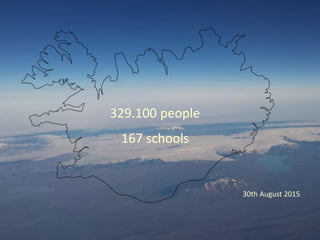
329.100 people
167 schools
30th August 2015
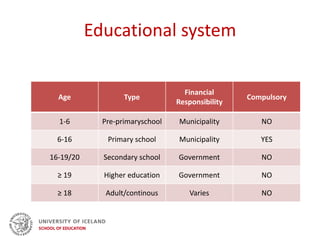
Educational system
Age Type
Financial
Responsibility
Compulsory
1-6 Pre-primaryschool Municipality NO
6-16 Primary school Municipality YES
16-19/20 Secondary school Government NO
≥ 19 Higher education Government NO
≥ 18 Adult/continous Varies NO
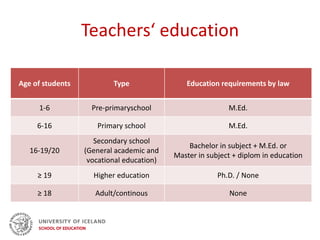
Teachers‘ education
Age of students Type Education requirements by law
1-6 Pre-primaryschool M.Ed.
6-16 Primary school M.Ed.
16-19/20
Secondary school
(General academic and
vocational education)
Bachelor in subject + M.Ed. or
Master in subject + diplom in education
≥ 19 Higher education Ph.D. / None
≥ 18 Adult/continous None
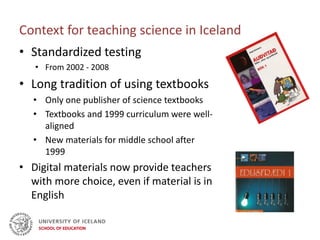
Context for teaching science in Iceland
• Standardized testing
• From 2002 - 2008
• Long tradition of using textbooks
• Only one publisher of science textbooks
• Textbooks and 1999 curriculum were well-
aligned
• New materials for middle school after
1999
• Digital materials now provide teachers
with more choice, even if material is in
English
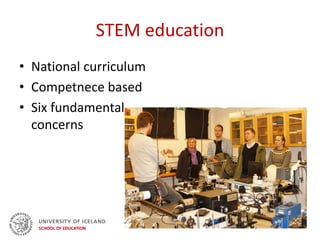
STEM education
• National curriculum
• Competnece based
• Six fundamental
concerns
Challenges in STEM
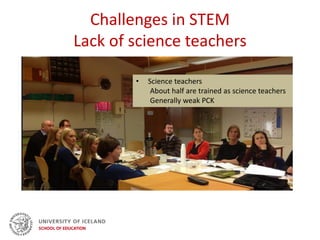
Lack of science teachers
• Science teachers
About half are trained as science teachers
Generally weak PCK
Challenges in STEM
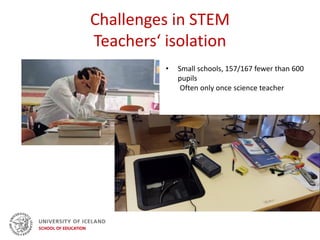
Teachers‘ isolation
• Small schools, 157/167 fewer than 600
pupils
Often only once science teacher
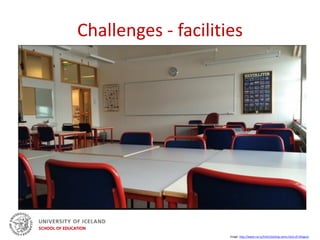
Challenges - facilities
Image: http://www.ruv.is/frett/stytting-nams-hluti-af-tillogum
Challenges in STEM
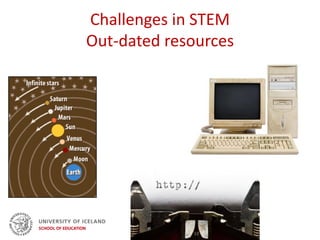
Out-dated resources
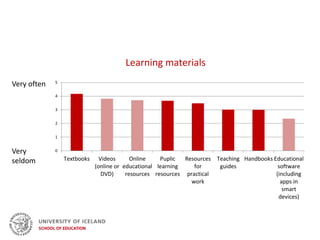
Learning materials
0
1
2
3
4
5
Textbooks Videos
(online or
DVD)
Online
educational
resources
Puplic
learning
resources
Resources
for
practical
work
Teaching
guides
Handbooks Educational
software
(including
apps in
smart
devices)
Very often
Very
seldom
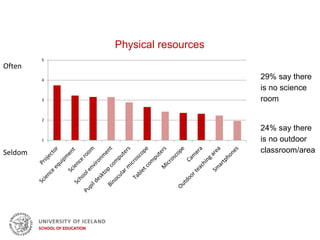
Physical resources
29% say there
is no science
room
24% say there
is no outdoor
classroom/area
1
2
3
4
5
Often
Seldom
Challenges in STEM
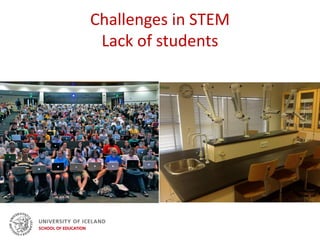
Lack of students
NaNO-project
• The NaNO-project focuses on upper and
lower secondary level science education in
Iceland.
– It is funded by the 2011 Birthday Fund, University
of Iceland and other funds.
• Project managers NaNO work with other
specialists on
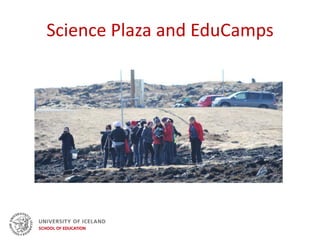
– developing courses, a resource bank, Science
Plaza (Náttúrutorg) and EduCamps.
Science Plaza and EduCamps
Perceived needs
• I am the only science teacher in this
school and have nobody to talk to
• I learn most from talking to other teachers
• It is ridiculous that we are each working in
our own corner
• This subject is difficult to teach, my
knowledge is not strong enough
Aims of the Plaza – to strengthen
science education
• To increase cooperation between science
teachers.
• To establish a collection of teaching resources.
• To facilitate increased professional development
opportunities.
• To support the use of ICT in science education.
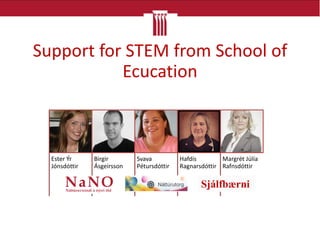
Ester Ýr
Jónsdóttir
Birgir
Ásgeirsson
Svava
Pétursdóttir
Hafdís
Ragnarsdóttir
Margrét Júlía
Rafnsdóttir
Support for STEM from School of
Ecucation
Sjálfbærni
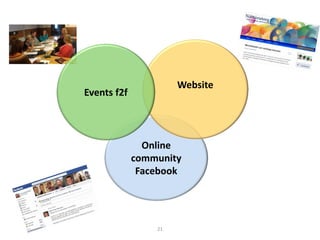
Online
community
Facebook
21
Website
Events f2f
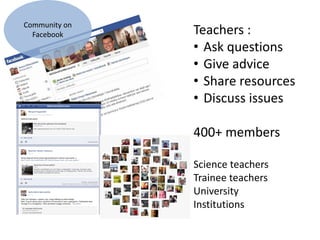
Teachers :
• Ask questions
• Give advice
• Share resources
• Discuss issues
400+ members
Science teachers
Trainee teachers
University
Institutions
Community on
Facebook
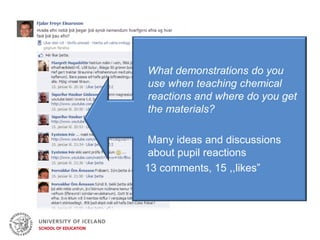
What demonstrations do you
use when teaching chemical
reactions and where do you get
the materials?
Many ideas and discussions
about pupil reactions
13 comments, 15 ,,likes”
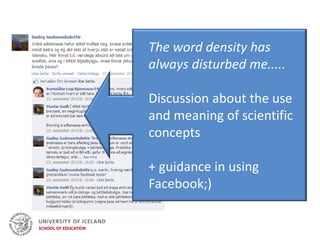
The word density has
always disturbed me.....
Discussion about the use
and meaning of scientific
concepts
+ guidance in using
Facebook;)
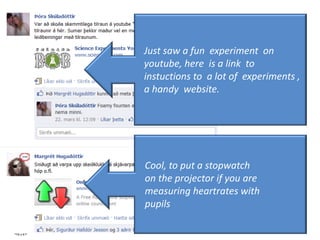
Just saw a fun experiment on
youtube, here is a link to
instuctions to a lot of experiments ,
a handy website.
Cool, to put a stopwatch
on the projector if you are
measuring heartrates with
pupils
Menntakvika 2011
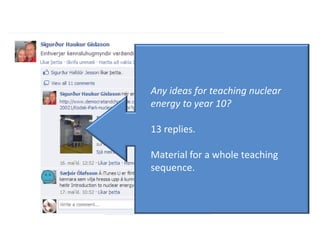
Any ideas for teaching nuclear
energy to year 10?
13 replies.
Material for a whole teaching
sequence.
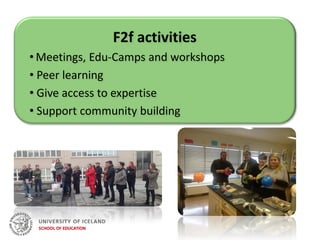
F2f activities
• Meetings, Edu-Camps and workshops
• Peer learning
• Give access to expertise
• Support community building
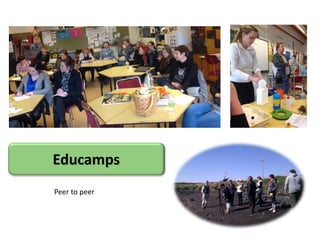
Educamps
Peer to peer
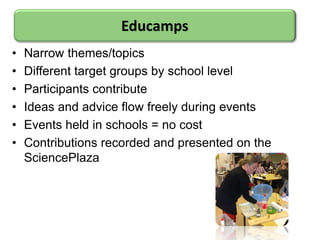
• Narrow themes/topics
• Different target groups by school level
• Participants contribute
• Ideas and advice flow freely during events
• Events held in schools = no cost
• Contributions recorded and presented on the
SciencePlaza
Educamps
Impact from Edu-Camps
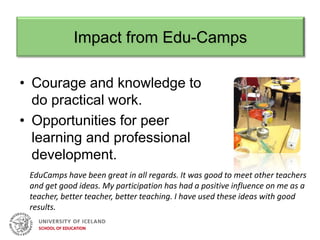
• Courage and knowledge to
do practical work.
• Opportunities for peer
learning and professional
development.
EduCamps have been great in all regards. It was good to meet other teachers
and get good ideas. My participation has had a positive influence on me as a
teacher, better teacher, better teaching. I have used these ideas with good
results.
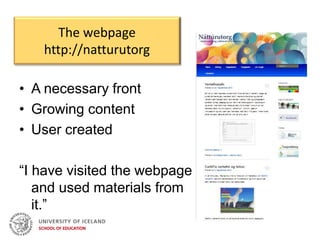
The webpage
http://natturutorg
• A necessary front
• Growing content
• User created
“I have visited the webpage
and used materials from
it.”
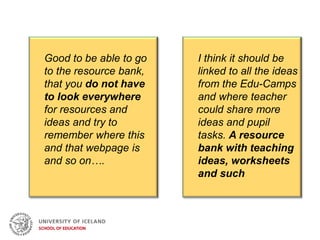
Good to be able to go
to the resource bank,
that you do not have
to look everywhere
for resources and
ideas and try to
remember where this
and that webpage is
and so on….
I think it should be
linked to all the ideas
from the Edu-Camps
and where teacher
could share more
ideas and pupil
tasks. A resource
bank with teaching
ideas, worksheets
and such
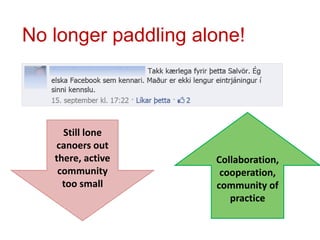
No longer paddling alone!
Still lone
canoers out
there, active
community
too small
Collaboration,
cooperation,
community of
practice
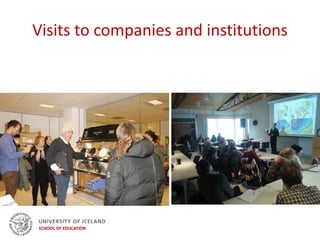
Visits to companies and institutions
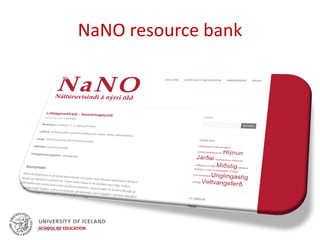
NaNO resource bank
07.11.2014
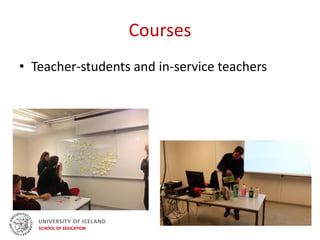
Courses
• Teacher-students and in-service teachers
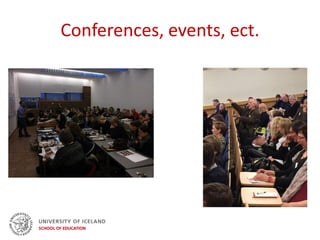
Conferences, events, ect.
Other Icelandic activities
Takk!
birgira@hi.is
esteryj@hi.is
svavap@hi.is
@svavap
@birgirua
@Ester_Yr
#scientix
#scientix_rvkhttp://slideshare.net/svavap/
@svavap

Science education in iceland