2010 Secondary Education Curriculum
                                                                                                             Integrated Science


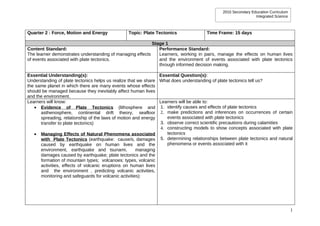
Quarter 2 : Force, Motion and Energy           Topic: Plate Tectonics               Time Frame: 15 days

                                                           Stage 1
Content Standard:                                             Performance Standard:
The learner demonstrates understanding of managing effects    Learners, working in pairs, manage the effects on human lives
of events associated with plate tectonics.                    and the environment of events associated with plate tectonics
                                                              through informed decision making.

Essential Understanding(s):                                     Essential Question(s):
Understanding of plate tectonics helps us realize that we share What does understanding of plate tectonics tell us?
the same planet in which there are many events whose effects
should be managed because they inevitably affect human lives
and the environment.
Learners will know:                                             Learners will be able to:
   • Evidence of Plate Tectonics (lithosphere and 1. identify causes and effects of plate tectonics
      asthenosphere, continental drift theory, seafloor 2. make predictions and inferences on occurrences of certain
      spreading, relationship of the laws of motion and energy     events associated with plate tectonics
      transfer to plate tectonics)                              3. observe correct scientific precautions during calamities
                                                                4. constructing models to show concepts associated with plate
   • Managing Effects of Natural Phenomena associated              tectonics
      with Plate Tectonics (earthquake: cause/s, damages 5. determining relationships between plate tectonics and natural
      caused by earthquake on human lives and the                  phenomena or events associated with it
      environment, earthquake and tsunami,            managing
      damages caused by earthquake; plate tectonics and the
      formation of mountain types; volcanoes: types, volcanic
      activities, effects of volcanic eruptions on human lives
      and the environment , predicting volcanic activities,
      monitoring and safeguards for volcanic activities)


                                                                                                                                  1
2010 Secondary Education Curriculum
                                                                                                        Integrated Science


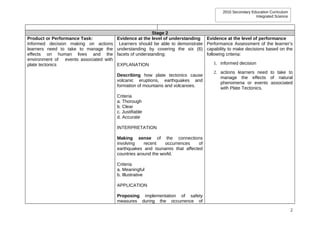
                                                      Stage 2
Product or Performance Task:          Evidence at the level of understanding    Evidence at the level of performance
Informed decision making on actions Learners should be able to demonstrate      Performance Assessment of the learner’s
learners need to take to manage the understanding by covering the six (6)       capability to make decisions based on the
effects on human lives and the facets of understanding:                         following criteria:
environment of events associated with
plate tectonics                       EXPLANATION                                  1. informed decision
                                                                                   2. actions learners need to take to
                                      Describing how plate tectonics cause
                                                                                      manage the effects of natural
                                      volcanic eruptions, earthquakes and
                                                                                      phenomena or events associated
                                      formation of mountains and volcanoes.
                                                                                      with Plate Tectonics.
                                      Criteria
                                      a. Thorough
                                      b. Clear
                                      c. Justifiable
                                      d. Accurate

                                      INTERPRETATION

                                      Making sense of the connections
                                      involving    recent    occurrences   of
                                      earthquakes and tsunamis that affected
                                      countries around the world.

                                      Criteria
                                      a. Meaningful
                                      b. Illustrative

                                      APPLICATION

                                      Proposing implementation of safety
                                      measures during the occurrence of
                                                                                                                             2
2010 Secondary Education Curriculum
                                                                 Integrated Science


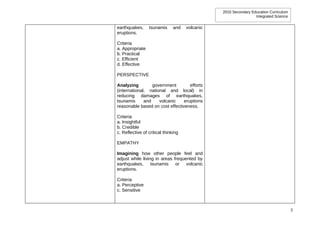
earthquakes,     tsunamis      and   volcanic
eruptions.

Criteria
a. Appropriate
b. Practical
c. Efficient
d. Effective

PERSPECTIVE

Analyzing         government        efforts
(international, national and local) in
reducing damages of earthquakes,
tsunamis      and    volcanic    eruptions
reasonable based on cost effectiveness.

Criteria
a. Insightful
b. Credible
c. Reflective of critical thinking

EMPATHY

Imagining how other people feel and
adjust while living in areas frequented by
earthquakes,      tsunamis    or   volcanic
eruptions.

Criteria
a. Perceptive
c. Sensitive


                                                                                      3
2010 Secondary Education Curriculum
                                                                                                                      Integrated Science


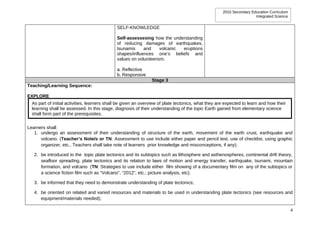
                                              SELF-KNOWLEDGE

                                              Self-assessesing how the understanding
                                              of reducing damages of earthquakes,
                                              tsunamis     and     volcanic eruptions
                                              shapes/influences one’s beliefs and
                                              values on volunteerism.

                                              a. Reflective
                                              b. Responsive
                                                                Stage 3
Teaching/Learning Sequence:

EXPLORE
  As part of initial activities, learners shall be given an overview of plate tectonics, what they are expected to learn and how their
  learning shall be assessed. In this stage, diagnosis of their understanding of the topic Earth gained from elementary science
  shall form part of the prerequisites.


Learners shall:
   1. undergo an assessment of their understanding of structure of the earth, movement of the earth crust, earthquake and
      volcano. (Teacher’s Note/s or TN: Assessment to use include either paper and pencil test, use of checklist, using graphic
      organizer, etc.. Teachers shall take note of learners prior knowledge and misconceptions, if any);

   2. be introduced to the topic plate tectonics and its subtopics such as lithosphere and asthenospheres, continental drift theory,
      seafloor spreading, plate tectonics and its relation to laws of motion and energy transfer, earthquake, tsunami, mountain
      formation, and volcano (TN: Strategies to use include either film showing of a documentary film on any of the subtopics or
      a science fiction film such as “Volcano”, “2012”, etc.; picture analysis, etc);

   3. be informed that they need to demonstrate understanding of plate tectonics;

   4. be oriented on related and varied resources and materials to be used in understanding plate tectonics (see resources and
      equipment/materials needed);

                                                                                                                                           4
2010 Secondary Education Curriculum
                                                                                                                     Integrated Science


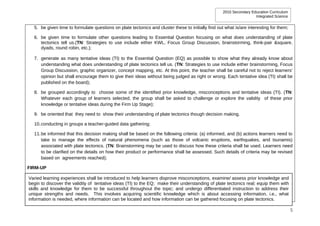
  5. be given time to formulate questions on plate tectonics and cluster these to initially find out what is/are interesting for them;

  6. be given time to formulate other questions leading to Essential Question focusing on what does understanding of plate
     tectonics tell us.(TN: Strategies to use include either KWL, Focus Group Discussion, brainstorming, think-pair &square,
     dyads, round robin, etc.);

  7. generate as many tentative ideas (TI) to the Essential Question (EQ) as possible to show what they already know about
     understanding what does understanding of plate tectonics tell us. (TN: Strategies to use include either brainstorming, Focus
     Group Discussion, graphic organizer, concept mapping, etc. At this point, the teacher shall be careful not to reject learners’
     opinion but shall encourage them to give their ideas without being judged as right or wrong. Each tentative idea (TI) shall be
     published on the board);

  8. be grouped accordingly to choose some of the identified prior knowledge, misconceptions and tentative ideas (TI). (TN:
     Whatever each group of learners selected, the group shall be asked to challenge or explore the validity of these prior
     knowledge or tentative ideas during the Firm Up Stage);

  9. be oriented that they need to show their understanding of plate tectonics though decision making.

  10. conducting in groups a teacher-guided data gathering;

  11. be informed that this decision making shall be based on the following criteria: (a) informed, and (b) actions learners need to
      take to manage the effects of natural phenomena (such as those of volcanic eruptions, earthquakes, and tsunamis)
      associated with plate tectonics. (TN: Brainstorming may be used to discuss how these criteria shall be used. Learners need
      to be clarified on the details on how their product or performance shall be assessed. Such details of criteria may be revised
      based on agreements reached);

FIRM-UP

Varied learning experiences shall be introduced to help learners disprove misconceptions, examine/ assess prior knowledge and
begin to discover the validity of tentative ideas (TI) to the EQ; make their understanding of plate tectonics real; equip them with
skills and knowledge for them to be successful throughout the topic; and undergo differentiated instruction to address their
unique strengths and needs. This involves acquiring scientific knowledge which is about accessing information, i.e., what
information is needed, where information can be located and how information can be gathered focusing on plate tectonics.

                                                                                                                                          5
2010 Secondary Education Curriculum
                                                                                                                  Integrated Science


Evidence of Plate Tectonics

Using the chosen prior knowledge, misconceptions and/or tentative ideas (TI) to the EQ as starting/focal points of investigation,
learners shall:

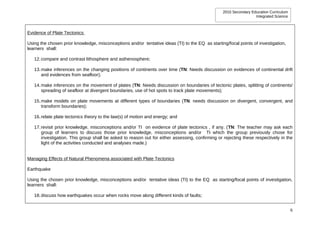
   12. compare and contrast lithosphere and asthenosphere;

   13. make inferences on the changing positions of continents over time (TN: Needs discussion on evidences of continental drift
       and evidences from seafloor);

   14. make inferences on the movement of plates (TN: Needs discussion on boundaries of tectonic plates, splitting of continents/
       spreading of seafloor at divergent boundaries, use of hot spots to track plate movements);

   15. make models on plate movements at different types of boundaries (TN: needs discussion on divergent, convergent, and
       transform boundaries);

   16. relate plate tectonics theory to the law(s) of motion and energy; and

   17. revisit prior knowledge, misconceptions and/or TI on evidence of plate tectonics , if any. (TN: The teacher may ask each
       group of learners to discuss those prior knowledge, misconceptions and/or TI which the group previously chose for
       investigation. This group shall be asked to reason out for either assessing, confirming or rejecting these respectively in the
       light of the activities conducted and analyses made.)


Managing Effects of Natural Phenomena associated with Plate Tectonics

Earthquake

Using the chosen prior knowledge, misconceptions and/or tentative ideas (TI) to the EQ as starting/focal points of investigation,
learners shall:

   18. discuss how earthquakes occur when rocks move along different kinds of faults;


                                                                                                                                       6
2010 Secondary Education Curriculum
                                                                                                                 Integrated Science


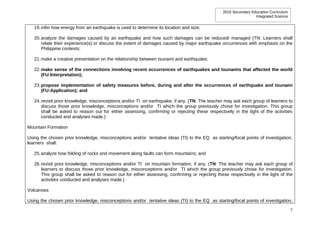
   19. infer how energy from an earthquake is used to determine its location and size;

   20. analyze the damages caused by an earthquake and how such damages can be reduced/ managed (TN: Learners shall
       relate their experience(s) or discuss the extent of damages caused by major earthquake occurrences with emphasis on the
       Philippine contexts;

   21. make a creative presentation on the relationship between tsunami and earthquake;

   22. make sense of the connections involving recent occurrences of earthquakes and tsunamis that affected the world
       (FU:Interpretation);

   23. propose implementation of safety measures before, during and after the occurrences of earthquake and tsunami
       (FU:Application); and

   24. revisit prior knowledge, misconceptions and/or TI on earthquake, if any. (TN: The teacher may ask each group of learners to
       discuss those prior knowledge, misconceptions and/or TI which the group previously chose for investigation. This group
       shall be asked to reason out for either assessing, confirming or rejecting these respectively in the light of the activities
       conducted and analyses made.)

Mountain Formation

Using the chosen prior knowledge, misconceptions and/or tentative ideas (TI) to the EQ as starting/focal points of investigation,
learners shall:

   25. analyze how folding of rocks and movement along faults can form mountains; and

   26. revisit prior knowledge, misconceptions and/or TI on mountain formation, if any. (TN: The teacher may ask each group of
       learners to discuss those prior knowledge, misconceptions and/or TI which the group previously chose for investigation.
       This group shall be asked to reason out for either assessing, confirming or rejecting these respectively in the light of the
       activities conducted and analyses made.)

Volcanoes

Using the chosen prior knowledge, misconceptions and/or tentative ideas (TI) to the EQ as starting/focal points of investigation,

                                                                                                                                      7
2010 Secondary Education Curriculum
                                                                                                                     Integrated Science


learners shall:

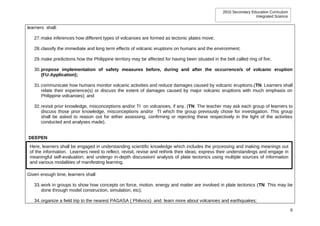
   27. make inferences how different types of volcanoes are formed as tectonic plates move;

   28. classify the immediate and long term effects of volcanic eruptions on humans and the environment;

   29. make predictions how the Philippine territory may be affected for having been situated in the belt called ring of fire;

   30. propose implementation of safety measures before, during and after the occurrence/s of volcanic eruption
       (FU:Application);

   31. communicate how humans monitor volcanic activities and reduce damages caused by volcanic eruptions.(TN: Learners shall
       relate their experience(s) or discuss the extent of damages caused by major volcanic eruptions with much emphasis on
       Philippine volcanoes); and

   32. revisit prior knowledge, misconceptions and/or TI on volcanoes, if any. (TN: The teacher may ask each group of learners to
       discuss those prior knowledge, misconceptions and/or TI which the group previously chose for investigation. This group
       shall be asked to reason out for either assessing, confirming or rejecting these respectively in the light of the activities
       conducted and analyses made).


DEEPEN
 Here, learners shall be engaged in understanding scientific knowledge which includes the processing and making meanings out
 of the information. Learners need to reflect, revisit, revise and rethink their ideas; express their understandings and engage in
 meaningful self-evaluation; and undergo in-depth discussion/ analysis of plate tectonics using multiple sources of information
 and various modalities of manifesting learning.

Given enough time, learners shall:

   33. work in groups to show how concepts on force, motion, energy and matter are involved in plate tectonics (TN: This may be
       done through model construction, simulation, etc);

   34. organize a field trip to the nearest PAGASA ( Philvocs) and learn more about volcanoes and earthquakes;

                                                                                                                                          8
2010 Secondary Education Curriculum
                                                                                                                   Integrated Science


   35. conduct an interview with experts (volcanologist, seismologist, etc.) to understand further those concepts in plate tectonics
       found to be difficult ;

   36. make a background investigation (through literature search, interview or survey) on how safe one’s immediate community
       from the occurrences of earthquake, tsunami and/or volcanic eruption; and

   37. make account of their self-interest in future career and occupation/profession by attending career orientation in the school or
       career counseling;

At the level of understanding, learners shall:

   38. describe how plate tectonics cause earthquakes, tsunami, mountain formation and volcanic eruptions (FU: Explanation);

   39. analyze government efforts (international, national and local) in reducing damages of earthquakes, tsunami and volcanic
       eruptions based on cost effectiveness (FU: Perspective);

   40. imagine what other people feel and how they adjust while living in areas frequented/ visited by earthquake(s), tsunami(s),
       and/or volcanic eruption (FU: Empathy); and

   41. self-assess how the understanding of reducing damages of earthquake, tsunami, volcanic eruption shape/influence one’s
       beliefs and values on volunteerism (FU: Self-knowledge).

To draw out the Essential Understanding, learners shall:

   42. contemplate on the Essential Question;
                -What does understanding of plate tectonics tell us?

   43. reexamine their revised tentative idea (TI); and

   44. justify the TI based on the understanding (s) gained.


                                                                                                                                        9
2010 Secondary Education Curriculum
                                                                                                                 Integrated Science


TRANSFER ++
 There is a need to encourage learners to organize their learning experiences so that they can move from teacher-guided and
 concrete activities to independent applications where they may create or produce new knowledge in science. This is to
 challenge learners to transfer their learning in new settings and use this creatively to generate new ideas or view things
 differently. Learners shall be involved in planning which manifest informed decision making relevant to reducing effects of some
 plate tectonics-related events.

Learners shall:

   45. prepare a tangible output (eg. Decision Matrix, Action Plan, Advocacy Material, Flow Chart, Earthquake drill, etc) showing
      informed decisions made on actions learners need to take to manage the effects of natural phenomena or events (such as
      those of volcanic eruptions, earthquakes, and tsunamis) associated with plate tectonics; and

   46. evaluate their product/performance.


       Resources (Books, Interview, Science Magazines, etc.)
        1. Glencoe Science Level Blue, Chapter 7
        2. Pictures, Illustrations, Articles from Internet, Video Clips
        3. PAGASA, Philvocs materials
        4. Weblinks
   •    http://www.deped.gov.ph/iSchool Web Board/Science Web Board
   •    http://www.deped.gov.ph/skoool.ph
   •    http://www.deped.gov.ph/e-turo
   •    http://www.deped.gov.ph/BSE/iDEP
   •    http://www.pjoedu.wordpress/Philippine Studies/FREE TEXTBOOKS
   •    http://www.teacherplanet.com
   •    http://www.pil.ph
   •    http://www.alcob.com/ICT Model School Network
   •    http://www.APEC Cyber Academy.com

                                                                                                                                      10
2010 Secondary Education Curriculum
                                                                              Integrated Science


   •   http://www.globalclassroom.net
   •   http://www.think.com
   •   http://www.wordiq.com
   •   http://www.csmres.jmu.edu/geollab/Fichter/PlateTect


Materials/ Equipment
      1.Seismograph Model
      2.Maps
      3. Other needed laboratory apparatus


                                                                                                   11

Tg science q2 plate tectonics

  • 1.
    2010 Secondary EducationCurriculum Integrated Science Quarter 2 : Force, Motion and Energy Topic: Plate Tectonics Time Frame: 15 days Stage 1 Content Standard: Performance Standard: The learner demonstrates understanding of managing effects Learners, working in pairs, manage the effects on human lives of events associated with plate tectonics. and the environment of events associated with plate tectonics through informed decision making. Essential Understanding(s): Essential Question(s): Understanding of plate tectonics helps us realize that we share What does understanding of plate tectonics tell us? the same planet in which there are many events whose effects should be managed because they inevitably affect human lives and the environment. Learners will know: Learners will be able to: • Evidence of Plate Tectonics (lithosphere and 1. identify causes and effects of plate tectonics asthenosphere, continental drift theory, seafloor 2. make predictions and inferences on occurrences of certain spreading, relationship of the laws of motion and energy events associated with plate tectonics transfer to plate tectonics) 3. observe correct scientific precautions during calamities 4. constructing models to show concepts associated with plate • Managing Effects of Natural Phenomena associated tectonics with Plate Tectonics (earthquake: cause/s, damages 5. determining relationships between plate tectonics and natural caused by earthquake on human lives and the phenomena or events associated with it environment, earthquake and tsunami, managing damages caused by earthquake; plate tectonics and the formation of mountain types; volcanoes: types, volcanic activities, effects of volcanic eruptions on human lives and the environment , predicting volcanic activities, monitoring and safeguards for volcanic activities) 1
  • 2.
    2010 Secondary EducationCurriculum Integrated Science Stage 2 Product or Performance Task: Evidence at the level of understanding Evidence at the level of performance Informed decision making on actions Learners should be able to demonstrate Performance Assessment of the learner’s learners need to take to manage the understanding by covering the six (6) capability to make decisions based on the effects on human lives and the facets of understanding: following criteria: environment of events associated with plate tectonics EXPLANATION 1. informed decision 2. actions learners need to take to Describing how plate tectonics cause manage the effects of natural volcanic eruptions, earthquakes and phenomena or events associated formation of mountains and volcanoes. with Plate Tectonics. Criteria a. Thorough b. Clear c. Justifiable d. Accurate INTERPRETATION Making sense of the connections involving recent occurrences of earthquakes and tsunamis that affected countries around the world. Criteria a. Meaningful b. Illustrative APPLICATION Proposing implementation of safety measures during the occurrence of 2
  • 3.
    2010 Secondary EducationCurriculum Integrated Science earthquakes, tsunamis and volcanic eruptions. Criteria a. Appropriate b. Practical c. Efficient d. Effective PERSPECTIVE Analyzing government efforts (international, national and local) in reducing damages of earthquakes, tsunamis and volcanic eruptions reasonable based on cost effectiveness. Criteria a. Insightful b. Credible c. Reflective of critical thinking EMPATHY Imagining how other people feel and adjust while living in areas frequented by earthquakes, tsunamis or volcanic eruptions. Criteria a. Perceptive c. Sensitive 3
  • 4.
    2010 Secondary EducationCurriculum Integrated Science SELF-KNOWLEDGE Self-assessesing how the understanding of reducing damages of earthquakes, tsunamis and volcanic eruptions shapes/influences one’s beliefs and values on volunteerism. a. Reflective b. Responsive Stage 3 Teaching/Learning Sequence: EXPLORE As part of initial activities, learners shall be given an overview of plate tectonics, what they are expected to learn and how their learning shall be assessed. In this stage, diagnosis of their understanding of the topic Earth gained from elementary science shall form part of the prerequisites. Learners shall: 1. undergo an assessment of their understanding of structure of the earth, movement of the earth crust, earthquake and volcano. (Teacher’s Note/s or TN: Assessment to use include either paper and pencil test, use of checklist, using graphic organizer, etc.. Teachers shall take note of learners prior knowledge and misconceptions, if any); 2. be introduced to the topic plate tectonics and its subtopics such as lithosphere and asthenospheres, continental drift theory, seafloor spreading, plate tectonics and its relation to laws of motion and energy transfer, earthquake, tsunami, mountain formation, and volcano (TN: Strategies to use include either film showing of a documentary film on any of the subtopics or a science fiction film such as “Volcano”, “2012”, etc.; picture analysis, etc); 3. be informed that they need to demonstrate understanding of plate tectonics; 4. be oriented on related and varied resources and materials to be used in understanding plate tectonics (see resources and equipment/materials needed); 4
  • 5.
    2010 Secondary EducationCurriculum Integrated Science 5. be given time to formulate questions on plate tectonics and cluster these to initially find out what is/are interesting for them; 6. be given time to formulate other questions leading to Essential Question focusing on what does understanding of plate tectonics tell us.(TN: Strategies to use include either KWL, Focus Group Discussion, brainstorming, think-pair &square, dyads, round robin, etc.); 7. generate as many tentative ideas (TI) to the Essential Question (EQ) as possible to show what they already know about understanding what does understanding of plate tectonics tell us. (TN: Strategies to use include either brainstorming, Focus Group Discussion, graphic organizer, concept mapping, etc. At this point, the teacher shall be careful not to reject learners’ opinion but shall encourage them to give their ideas without being judged as right or wrong. Each tentative idea (TI) shall be published on the board); 8. be grouped accordingly to choose some of the identified prior knowledge, misconceptions and tentative ideas (TI). (TN: Whatever each group of learners selected, the group shall be asked to challenge or explore the validity of these prior knowledge or tentative ideas during the Firm Up Stage); 9. be oriented that they need to show their understanding of plate tectonics though decision making. 10. conducting in groups a teacher-guided data gathering; 11. be informed that this decision making shall be based on the following criteria: (a) informed, and (b) actions learners need to take to manage the effects of natural phenomena (such as those of volcanic eruptions, earthquakes, and tsunamis) associated with plate tectonics. (TN: Brainstorming may be used to discuss how these criteria shall be used. Learners need to be clarified on the details on how their product or performance shall be assessed. Such details of criteria may be revised based on agreements reached); FIRM-UP Varied learning experiences shall be introduced to help learners disprove misconceptions, examine/ assess prior knowledge and begin to discover the validity of tentative ideas (TI) to the EQ; make their understanding of plate tectonics real; equip them with skills and knowledge for them to be successful throughout the topic; and undergo differentiated instruction to address their unique strengths and needs. This involves acquiring scientific knowledge which is about accessing information, i.e., what information is needed, where information can be located and how information can be gathered focusing on plate tectonics. 5
  • 6.
    2010 Secondary EducationCurriculum Integrated Science Evidence of Plate Tectonics Using the chosen prior knowledge, misconceptions and/or tentative ideas (TI) to the EQ as starting/focal points of investigation, learners shall: 12. compare and contrast lithosphere and asthenosphere; 13. make inferences on the changing positions of continents over time (TN: Needs discussion on evidences of continental drift and evidences from seafloor); 14. make inferences on the movement of plates (TN: Needs discussion on boundaries of tectonic plates, splitting of continents/ spreading of seafloor at divergent boundaries, use of hot spots to track plate movements); 15. make models on plate movements at different types of boundaries (TN: needs discussion on divergent, convergent, and transform boundaries); 16. relate plate tectonics theory to the law(s) of motion and energy; and 17. revisit prior knowledge, misconceptions and/or TI on evidence of plate tectonics , if any. (TN: The teacher may ask each group of learners to discuss those prior knowledge, misconceptions and/or TI which the group previously chose for investigation. This group shall be asked to reason out for either assessing, confirming or rejecting these respectively in the light of the activities conducted and analyses made.) Managing Effects of Natural Phenomena associated with Plate Tectonics Earthquake Using the chosen prior knowledge, misconceptions and/or tentative ideas (TI) to the EQ as starting/focal points of investigation, learners shall: 18. discuss how earthquakes occur when rocks move along different kinds of faults; 6
  • 7.
    2010 Secondary EducationCurriculum Integrated Science 19. infer how energy from an earthquake is used to determine its location and size; 20. analyze the damages caused by an earthquake and how such damages can be reduced/ managed (TN: Learners shall relate their experience(s) or discuss the extent of damages caused by major earthquake occurrences with emphasis on the Philippine contexts; 21. make a creative presentation on the relationship between tsunami and earthquake; 22. make sense of the connections involving recent occurrences of earthquakes and tsunamis that affected the world (FU:Interpretation); 23. propose implementation of safety measures before, during and after the occurrences of earthquake and tsunami (FU:Application); and 24. revisit prior knowledge, misconceptions and/or TI on earthquake, if any. (TN: The teacher may ask each group of learners to discuss those prior knowledge, misconceptions and/or TI which the group previously chose for investigation. This group shall be asked to reason out for either assessing, confirming or rejecting these respectively in the light of the activities conducted and analyses made.) Mountain Formation Using the chosen prior knowledge, misconceptions and/or tentative ideas (TI) to the EQ as starting/focal points of investigation, learners shall: 25. analyze how folding of rocks and movement along faults can form mountains; and 26. revisit prior knowledge, misconceptions and/or TI on mountain formation, if any. (TN: The teacher may ask each group of learners to discuss those prior knowledge, misconceptions and/or TI which the group previously chose for investigation. This group shall be asked to reason out for either assessing, confirming or rejecting these respectively in the light of the activities conducted and analyses made.) Volcanoes Using the chosen prior knowledge, misconceptions and/or tentative ideas (TI) to the EQ as starting/focal points of investigation, 7
  • 8.
    2010 Secondary EducationCurriculum Integrated Science learners shall: 27. make inferences how different types of volcanoes are formed as tectonic plates move; 28. classify the immediate and long term effects of volcanic eruptions on humans and the environment; 29. make predictions how the Philippine territory may be affected for having been situated in the belt called ring of fire; 30. propose implementation of safety measures before, during and after the occurrence/s of volcanic eruption (FU:Application); 31. communicate how humans monitor volcanic activities and reduce damages caused by volcanic eruptions.(TN: Learners shall relate their experience(s) or discuss the extent of damages caused by major volcanic eruptions with much emphasis on Philippine volcanoes); and 32. revisit prior knowledge, misconceptions and/or TI on volcanoes, if any. (TN: The teacher may ask each group of learners to discuss those prior knowledge, misconceptions and/or TI which the group previously chose for investigation. This group shall be asked to reason out for either assessing, confirming or rejecting these respectively in the light of the activities conducted and analyses made). DEEPEN Here, learners shall be engaged in understanding scientific knowledge which includes the processing and making meanings out of the information. Learners need to reflect, revisit, revise and rethink their ideas; express their understandings and engage in meaningful self-evaluation; and undergo in-depth discussion/ analysis of plate tectonics using multiple sources of information and various modalities of manifesting learning. Given enough time, learners shall: 33. work in groups to show how concepts on force, motion, energy and matter are involved in plate tectonics (TN: This may be done through model construction, simulation, etc); 34. organize a field trip to the nearest PAGASA ( Philvocs) and learn more about volcanoes and earthquakes; 8
  • 9.
    2010 Secondary EducationCurriculum Integrated Science 35. conduct an interview with experts (volcanologist, seismologist, etc.) to understand further those concepts in plate tectonics found to be difficult ; 36. make a background investigation (through literature search, interview or survey) on how safe one’s immediate community from the occurrences of earthquake, tsunami and/or volcanic eruption; and 37. make account of their self-interest in future career and occupation/profession by attending career orientation in the school or career counseling; At the level of understanding, learners shall: 38. describe how plate tectonics cause earthquakes, tsunami, mountain formation and volcanic eruptions (FU: Explanation); 39. analyze government efforts (international, national and local) in reducing damages of earthquakes, tsunami and volcanic eruptions based on cost effectiveness (FU: Perspective); 40. imagine what other people feel and how they adjust while living in areas frequented/ visited by earthquake(s), tsunami(s), and/or volcanic eruption (FU: Empathy); and 41. self-assess how the understanding of reducing damages of earthquake, tsunami, volcanic eruption shape/influence one’s beliefs and values on volunteerism (FU: Self-knowledge). To draw out the Essential Understanding, learners shall: 42. contemplate on the Essential Question; -What does understanding of plate tectonics tell us? 43. reexamine their revised tentative idea (TI); and 44. justify the TI based on the understanding (s) gained. 9
  • 10.
    2010 Secondary EducationCurriculum Integrated Science TRANSFER ++ There is a need to encourage learners to organize their learning experiences so that they can move from teacher-guided and concrete activities to independent applications where they may create or produce new knowledge in science. This is to challenge learners to transfer their learning in new settings and use this creatively to generate new ideas or view things differently. Learners shall be involved in planning which manifest informed decision making relevant to reducing effects of some plate tectonics-related events. Learners shall: 45. prepare a tangible output (eg. Decision Matrix, Action Plan, Advocacy Material, Flow Chart, Earthquake drill, etc) showing informed decisions made on actions learners need to take to manage the effects of natural phenomena or events (such as those of volcanic eruptions, earthquakes, and tsunamis) associated with plate tectonics; and 46. evaluate their product/performance. Resources (Books, Interview, Science Magazines, etc.) 1. Glencoe Science Level Blue, Chapter 7 2. Pictures, Illustrations, Articles from Internet, Video Clips 3. PAGASA, Philvocs materials 4. Weblinks • http://www.deped.gov.ph/iSchool Web Board/Science Web Board • http://www.deped.gov.ph/skoool.ph • http://www.deped.gov.ph/e-turo • http://www.deped.gov.ph/BSE/iDEP • http://www.pjoedu.wordpress/Philippine Studies/FREE TEXTBOOKS • http://www.teacherplanet.com • http://www.pil.ph • http://www.alcob.com/ICT Model School Network • http://www.APEC Cyber Academy.com 10
  • 11.
    2010 Secondary EducationCurriculum Integrated Science • http://www.globalclassroom.net • http://www.think.com • http://www.wordiq.com • http://www.csmres.jmu.edu/geollab/Fichter/PlateTect Materials/ Equipment 1.Seismograph Model 2.Maps 3. Other needed laboratory apparatus 11