
An Introduction to Science  and Innovation PolicyKathryn Clay, Ph.D.Adjunct ProfessorProgram on Science and the Public InterestGeorgetown University1
Science Policy is different than science itself.Science is ideally value free and objective.Science policy is concerned with “the incentives and the environment for discovery and innovation…with the effect of science and technology on society and considers how they can best serve the public.”The purpose of science policy is to advance societal aims – hence there are always value judgments embedded in the discussions.2Source:  Griffiths, P., Science in the Public Interest, The Bridge, 1993.
Funding Levels for ScienceFederal funding for science competes with all other areas of expenditure – many other public goods, including:National DefenseSocial SecurityEnvironmental clean-up programsInfrastructure –roadways, bridges, portsMany others – examples?3
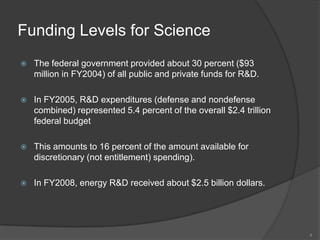
Funding Levels for ScienceThe federal government provided about 30 percent ($93 million in FY2004) of all public and private funds for R&D.In FY2005, R&D expenditures (defense and nondefense combined) represented 5.4 percent of the overall $2.4 trillion federal budgetThis amounts to 16 percent of the amount available for discretionary (not entitlement) spending). In FY2008, energy R&D received about $2.5 billion dollars.4
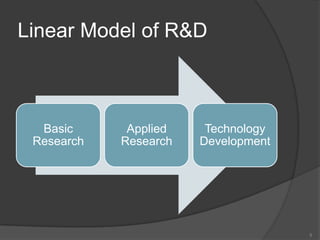
Linear Model of R&D 5
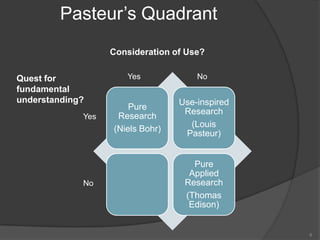
Pasteur’s Quadrant6Consideration of Use?YesNoQuest for fundamental understanding?YesNo
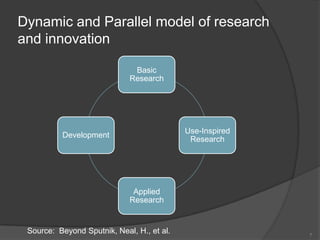
Dynamic and Parallel model of research and innovation7Source:  Beyond Sputnik, Neal, H., et al.
Why invest in energy R&D?Public goods of energy security and environmental protection (including climate change mitigation)Creating new “green tech” industries to boost U.S. competitivenessPresident Obama’s commitment to “green jobs,” echoed by the Congress in the Stimulus funding last spring8
Tough Choices…where to invest?How do we ensure a balance along the spectrum of research, development, and beyond to commercialization?Who are the most appropriate actors – national laboratories, universities, industry, consortia?Does the urgency of the challenge change the answer?9
Questions/Discussion?10

Science And Innovation Policy

  • 1.
    An Introduction toScience and Innovation PolicyKathryn Clay, Ph.D.Adjunct ProfessorProgram on Science and the Public InterestGeorgetown University1
  • 2.
    Science Policy isdifferent than science itself.Science is ideally value free and objective.Science policy is concerned with “the incentives and the environment for discovery and innovation…with the effect of science and technology on society and considers how they can best serve the public.”The purpose of science policy is to advance societal aims – hence there are always value judgments embedded in the discussions.2Source: Griffiths, P., Science in the Public Interest, The Bridge, 1993.
  • 3.
    Funding Levels forScienceFederal funding for science competes with all other areas of expenditure – many other public goods, including:National DefenseSocial SecurityEnvironmental clean-up programsInfrastructure –roadways, bridges, portsMany others – examples?3
  • 4.
    Funding Levels forScienceThe federal government provided about 30 percent ($93 million in FY2004) of all public and private funds for R&D.In FY2005, R&D expenditures (defense and nondefense combined) represented 5.4 percent of the overall $2.4 trillion federal budgetThis amounts to 16 percent of the amount available for discretionary (not entitlement) spending). In FY2008, energy R&D received about $2.5 billion dollars.4
  • 5.
  • 6.
    Pasteur’s Quadrant6Consideration ofUse?YesNoQuest for fundamental understanding?YesNo
  • 7.
    Dynamic and Parallelmodel of research and innovation7Source: Beyond Sputnik, Neal, H., et al.
  • 8.
    Why invest inenergy R&D?Public goods of energy security and environmental protection (including climate change mitigation)Creating new “green tech” industries to boost U.S. competitivenessPresident Obama’s commitment to “green jobs,” echoed by the Congress in the Stimulus funding last spring8
  • 9.
    Tough Choices…where toinvest?How do we ensure a balance along the spectrum of research, development, and beyond to commercialization?Who are the most appropriate actors – national laboratories, universities, industry, consortia?Does the urgency of the challenge change the answer?9
  • 10.