Honours presentation
Christopher George Humphries
Supervisor: Prof. Danny Simatele
The Role of Institutions and Policy
Frameworks in Sustainable Renewable
Energy Development in South Africa
Title:
Introduction
• What is the project about?
o Renewable energy
o South African renewable energy policy , legislation and institutional
frameworks
o Sustainable development
o Barriers and opportunities in the South African renewable energy sector
Rationale
o Energy is the critical infrastructural backbone on which an economy exists and
develops
o Need to transform the energy sector globally
• Move away from emission intense electricity production
o South African electricity undersupply (demand doubling – 2030)
• How is government and private sector going to fill this gap?
• (Deichmann, U., Meisner, C., Murray, S., & Wheeler, D., 2011)
o Policy and institutions either create barriers or opportunities to
sustainable renewable development (Pegels, A., 2010)
o South Africa’s energy crisis perpetuated by institutional frameworks
• (Menyah, K., & Wolde-Rufael, Y., 2010)
Research question:
In what ways do institutions, energy legislation/regulation and
energy policy effect the implementation of sustainable renewable
energy infrastructure in South Africa?
Sub-questions:
In what ways are renewable energies incorporated in policy frameworks in SA?
What barriers and opportunities exist in the pursuit for renewable energy in
SA?
What are the implications of these findings on further studies and
environmental policy design?
Academic aim
To investigate policy and legal framework influencing the
implementation of renewable energy technologies in South Africa
Strategic aim:
Present opportunity for ‘policy entrepreneurs’ to create further
opportunity in policies for renewable energy technologies to transform
the South African energy sector
Objectives
• To determine what influence energy policy has on both public and private
investment as well as RE implementation.
• To determine what policies and legislation are currently in place.
• To understand the benefits of setting up renewable energies as opposed to
traditional unsustainable energy infrastructure.
• To propose new areas in policy design that will encourage investment
mechanisms in renewable energies in South Africa.
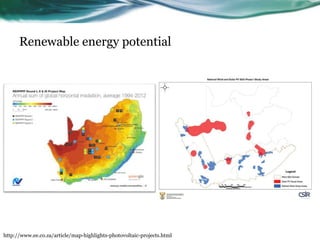
Renewable energy potential
http://www.ee.co.za/article/map-highlights-photovoltaic-projects.html
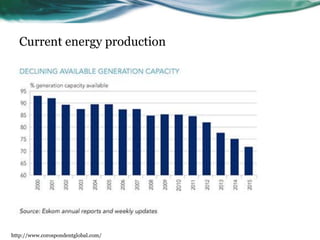
Current energy production
http://www.corospondentglobal.com/
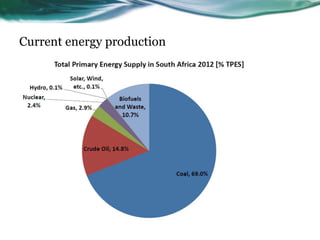
Current energy production
Theoretical framework/research philosophy
• Economic liberalism
• Association with free markets and private ownership of capital assets.
• Sustainability (job creation; investment; wealth creation; technological
development – Foucault – political technocracy).
• Usage – significant opportunity for growth and development associated
with economic liberalism.
Methodology
• Qualitative research
Reasons, opinions and motivations behind the construction of energy
policy
Sourcing of literature
• Secondary data
• Appropriate legal and policy framework from respective institutions
mandated to produce, distribute and manage energy
• Internet search engines
• Scholarly articles
• White papers
• Library sources
• Policies
Data analysis
3 strategies
1. Rapid appraisal (Beebe, 1995)
• Quick review and investigation into the policy
• Flexible framework
• Investigate aims and objectives the relevant policies
• Look for key works and context
2. Thematic analysis
3. Meta analysis
1. Contrasting of findings from different energy specific literature
2. Identification of patterns
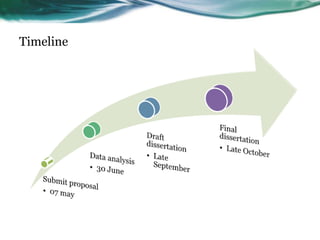
Timeline
For your information
• Supplementary documents (sent on request)
• Contact information
o C: 060 946 2390
o E: chris-humphries@outlook.com
o T: @CancerMustFall
References
http://www.ee.co.za/article/map-highlights-photovoltaic-projects.html
http://www.corospondentglobal.com
Deichmann, U., Meisner, C., Murray, S., & Wheeler, D. (2011). The economics of renewable energy
expansion in rural Sub-Saharan Africa. Energy Policy, 39(1), 215-227.
Menyah, K., & Wolde-Rufael, Y. (2010). Energy consumption, pollutant emissions and economic
growth in South Africa. Energy Economics, 32(6), 1374-1382.
Pegels, A. 2010. Renewable energy in South Africa: Potentials, barriers and options for support. Energy
policy, 38(9), 4945-4954.
Beebe, J. (1995). Basic concepts and techniques of rapid appraisal. Human organization, 54(1), 42-51.
Thank you

Honours presentation chris humphries

  • 1.
    Honours presentation Christopher GeorgeHumphries Supervisor: Prof. Danny Simatele
  • 2.
    The Role ofInstitutions and Policy Frameworks in Sustainable Renewable Energy Development in South Africa Title:
  • 3.
    Introduction • What isthe project about? o Renewable energy o South African renewable energy policy , legislation and institutional frameworks o Sustainable development o Barriers and opportunities in the South African renewable energy sector
  • 4.
    Rationale o Energy isthe critical infrastructural backbone on which an economy exists and develops o Need to transform the energy sector globally • Move away from emission intense electricity production o South African electricity undersupply (demand doubling – 2030) • How is government and private sector going to fill this gap? • (Deichmann, U., Meisner, C., Murray, S., & Wheeler, D., 2011) o Policy and institutions either create barriers or opportunities to sustainable renewable development (Pegels, A., 2010) o South Africa’s energy crisis perpetuated by institutional frameworks • (Menyah, K., & Wolde-Rufael, Y., 2010)
  • 5.
    Research question: In whatways do institutions, energy legislation/regulation and energy policy effect the implementation of sustainable renewable energy infrastructure in South Africa? Sub-questions: In what ways are renewable energies incorporated in policy frameworks in SA? What barriers and opportunities exist in the pursuit for renewable energy in SA? What are the implications of these findings on further studies and environmental policy design?
  • 6.
    Academic aim To investigatepolicy and legal framework influencing the implementation of renewable energy technologies in South Africa Strategic aim: Present opportunity for ‘policy entrepreneurs’ to create further opportunity in policies for renewable energy technologies to transform the South African energy sector
  • 7.
    Objectives • To determinewhat influence energy policy has on both public and private investment as well as RE implementation. • To determine what policies and legislation are currently in place. • To understand the benefits of setting up renewable energies as opposed to traditional unsustainable energy infrastructure. • To propose new areas in policy design that will encourage investment mechanisms in renewable energies in South Africa.
  • 8.
  • 9.
  • 10.
  • 11.
    Theoretical framework/research philosophy •Economic liberalism • Association with free markets and private ownership of capital assets. • Sustainability (job creation; investment; wealth creation; technological development – Foucault – political technocracy). • Usage – significant opportunity for growth and development associated with economic liberalism.
  • 12.
    Methodology • Qualitative research Reasons,opinions and motivations behind the construction of energy policy Sourcing of literature • Secondary data • Appropriate legal and policy framework from respective institutions mandated to produce, distribute and manage energy • Internet search engines • Scholarly articles • White papers • Library sources • Policies
  • 13.
    Data analysis 3 strategies 1.Rapid appraisal (Beebe, 1995) • Quick review and investigation into the policy • Flexible framework • Investigate aims and objectives the relevant policies • Look for key works and context 2. Thematic analysis 3. Meta analysis 1. Contrasting of findings from different energy specific literature 2. Identification of patterns
  • 14.
  • 15.
    For your information •Supplementary documents (sent on request) • Contact information o C: 060 946 2390 o E: chris-humphries@outlook.com o T: @CancerMustFall
  • 16.
    References http://www.ee.co.za/article/map-highlights-photovoltaic-projects.html http://www.corospondentglobal.com Deichmann, U., Meisner,C., Murray, S., & Wheeler, D. (2011). The economics of renewable energy expansion in rural Sub-Saharan Africa. Energy Policy, 39(1), 215-227. Menyah, K., & Wolde-Rufael, Y. (2010). Energy consumption, pollutant emissions and economic growth in South Africa. Energy Economics, 32(6), 1374-1382. Pegels, A. 2010. Renewable energy in South Africa: Potentials, barriers and options for support. Energy policy, 38(9), 4945-4954. Beebe, J. (1995). Basic concepts and techniques of rapid appraisal. Human organization, 54(1), 42-51.
  • 17.

Editor's Notes

  • #2 This template can be used as a starter file to give updates for project milestones. Sections Sections can help to organize your slides or facilitate collaboration between multiple authors. On the Home tab, under Slides, click Section, and then click Add Section. Notes Use the Notes pane for delivery notes or to provide additional details for the audience. You can see these notes in Presenter View during your presentation. Keep in mind the font size (important for accessibility, visibility, videotaping, and online production) Coordinated colors Pay particular attention to the graphs, charts, and text boxes. Consider that attendees will print in black and white or grayscale. Run a test print to make sure your colors work when printed in pure black and white and grayscale. Graphics, tables, and graphs Keep it simple: If possible, use consistent, non-distracting styles and colors. Label all graphs and tables.
  • #4 What is the project about? Define the goal of this project Is it similar to projects in the past or is it a new effort? Define the scope of this project Is it an independent project or is it related to other projects? * Note that this slide is not necessary for weekly status meetings
  • #5 Duplicate this slide as necessary if there is more than one issue. This and related slides can be moved to the appendix or hidden if necessary.
  • #7 * If any of these issues caused a schedule delay or need to be discussed further, include details in next slide.
  • #15 The following slides show several examples of timelines using SmartArt graphics. Include a timeline for the project, clearly marking milestones, important dates, and highlight where the project is now.