
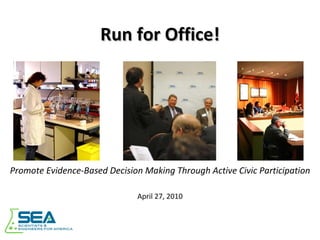
Run for Office! Promote Evidence-Based Decision Making Through Active Civic Participation April 27, 2010
Overview About SEA A Brief Biography Common Excuses for Not Entering Politics The Need for Scientists & Engineers to Serve as Policy Makers Political Strength of the Science & Engineering Community How to Run for Office SEA Can Help…sort of Conclusion
About SEA SEA’s mission is to promote evidence-based decision making at all levels of government. Key Programs: Campaign Training & Education SHARP Redistricting Student Programs Led by an accomplished Board of Directors & Advisors
About Camron Gorguinpour B.A. Physics & Astrophysics, UC Berkeley PhD Bioengineering, UC Berkeley  [as of May 2010] Created and managed one nonprofit and two public charter schools prior to joining SEA Designed & taught  Introduction to Bioastronautics  course at UC Berkeley Worked on political campaigns in six states, including as a Campaign Manager for a House of Delegates race in Virginia
Common Excuses for Not Entering Politics 3 Top Excuses for Not Entering Politics: It won’t make a difference. Other people will do it. I don’t have the knowledge base. Other Reasons: Politics is “dirty”. I don’t have time/support from my work. It takes too much money.
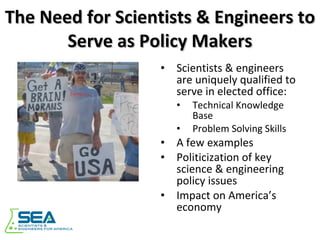
The Need for Scientists & Engineers to Serve as Policy Makers Scientists & engineers are uniquely qualified to serve in elected office: Technical Knowledge Base Problem Solving Skills A few examples Politicization of key science & engineering policy issues Impact on America’s economy
Political Strength of the Science & Engineering Community In general, scientists and engineers make ideal political candidates. Strong Public Trust The Public Values Scientists & Engineers Strong organizational skills and rational decision making
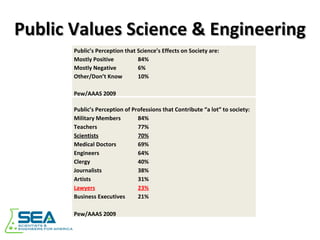
Public Values Science & Engineering Public’s Perception that Science’s Effects on Society are: Mostly Positive 84% Mostly Negative 6% Other/Don’t Know 10%   Pew/AAAS 2009 Public’s Perception of Professions that Contribute “a lot” to society: Military Members 84% Teachers 77% Scientists 70% Medical Doctors 69% Engineers 64% Clergy 40% Journalists 38% Artists 31% Lawyers 23% Business Executives 21%   Pew/AAAS 2009
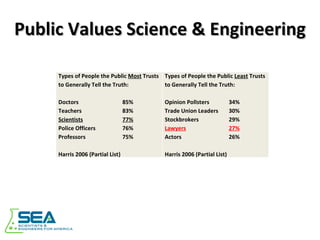
Public Values Science & Engineering Types of People the Public  Most  Trusts to Generally Tell the Truth: Doctors 85% Teachers 83% Scientists 77% Police Officers 76% Professors 75%   Harris 2006 (Partial List) Types of People the Public  Least  Trusts to Generally Tell the Truth: Opinion Pollsters 34% Trade Union Leaders 30% Stockbrokers 29% Lawyers 27% Actors 26%   Harris 2006 (Partial List)
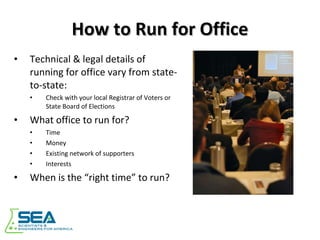
How to Run for Office Technical & legal details of running for office vary from state-to-state: Check with your local Registrar of Voters or State Board of Elections What office to run for? Time Money Existing network of supporters Interests When is the “right time” to run?
Elements of a Political Campaign Research Who are you running against? What are the key issues facing your district? Data Analysis How many votes do you need to win? Who is most likely to vote? Policy Platform What is your position on issues that  voters  are concerned about?
Elements of a Political Campaign Messaging How do we present your platform in a clear and concise manner? What can we say about your opponent’s policies and perspectives? Direct Voter Contact Knock on doors and make phone calls Paid, Earned, and “New” Media Where do people in your district get their information? How can we get your message out to the press?
Elements of a Political Campaign Fundraising Create a budget Make a lot of phone calls Staff, Consultants, and Volunteers If you need a staff, get a  good  campaign manager. Many people will find good ways to use your hard earned money. Volunteers are essential for most campaigns.
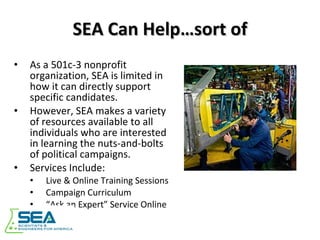
SEA Can Help…sort of As a 501c-3 nonprofit organization, SEA is limited in how it can directly support specific candidates. However, SEA makes a variety of resources available to all individuals who are interested in learning the nuts-and-bolts of political campaigns. Services Include: Live & Online Training Sessions Campaign Curriculum “ Ask an Expert” Service Online
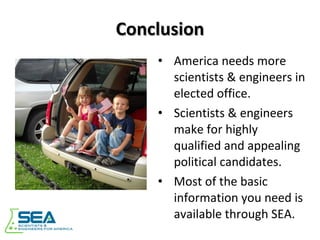
Conclusion America needs more scientists & engineers in elected office. Scientists & engineers make for highly qualified and appealing political candidates. Most of the basic information you need is available through SEA.
Contact Information Camron Gorguinpour Executive Director Scientists & Engineers for America (SEA) Phone: 510.381.3998 Email:  [email_address]

Run for Office

  • 1.
  • 2.
    Run for Office!Promote Evidence-Based Decision Making Through Active Civic Participation April 27, 2010
  • 3.
    Overview About SEAA Brief Biography Common Excuses for Not Entering Politics The Need for Scientists & Engineers to Serve as Policy Makers Political Strength of the Science & Engineering Community How to Run for Office SEA Can Help…sort of Conclusion
  • 4.
    About SEA SEA’smission is to promote evidence-based decision making at all levels of government. Key Programs: Campaign Training & Education SHARP Redistricting Student Programs Led by an accomplished Board of Directors & Advisors
  • 5.
    About Camron GorguinpourB.A. Physics & Astrophysics, UC Berkeley PhD Bioengineering, UC Berkeley [as of May 2010] Created and managed one nonprofit and two public charter schools prior to joining SEA Designed & taught Introduction to Bioastronautics course at UC Berkeley Worked on political campaigns in six states, including as a Campaign Manager for a House of Delegates race in Virginia
  • 6.
    Common Excuses forNot Entering Politics 3 Top Excuses for Not Entering Politics: It won’t make a difference. Other people will do it. I don’t have the knowledge base. Other Reasons: Politics is “dirty”. I don’t have time/support from my work. It takes too much money.
  • 7.
    The Need forScientists & Engineers to Serve as Policy Makers Scientists & engineers are uniquely qualified to serve in elected office: Technical Knowledge Base Problem Solving Skills A few examples Politicization of key science & engineering policy issues Impact on America’s economy
  • 8.
    Political Strength ofthe Science & Engineering Community In general, scientists and engineers make ideal political candidates. Strong Public Trust The Public Values Scientists & Engineers Strong organizational skills and rational decision making
  • 9.
    Public Values Science& Engineering Public’s Perception that Science’s Effects on Society are: Mostly Positive 84% Mostly Negative 6% Other/Don’t Know 10%   Pew/AAAS 2009 Public’s Perception of Professions that Contribute “a lot” to society: Military Members 84% Teachers 77% Scientists 70% Medical Doctors 69% Engineers 64% Clergy 40% Journalists 38% Artists 31% Lawyers 23% Business Executives 21%   Pew/AAAS 2009
  • 10.
    Public Values Science& Engineering Types of People the Public Most Trusts to Generally Tell the Truth: Doctors 85% Teachers 83% Scientists 77% Police Officers 76% Professors 75%   Harris 2006 (Partial List) Types of People the Public Least Trusts to Generally Tell the Truth: Opinion Pollsters 34% Trade Union Leaders 30% Stockbrokers 29% Lawyers 27% Actors 26%   Harris 2006 (Partial List)
  • 11.
    How to Runfor Office Technical & legal details of running for office vary from state-to-state: Check with your local Registrar of Voters or State Board of Elections What office to run for? Time Money Existing network of supporters Interests When is the “right time” to run?
  • 12.
    Elements of aPolitical Campaign Research Who are you running against? What are the key issues facing your district? Data Analysis How many votes do you need to win? Who is most likely to vote? Policy Platform What is your position on issues that voters are concerned about?
  • 13.
    Elements of aPolitical Campaign Messaging How do we present your platform in a clear and concise manner? What can we say about your opponent’s policies and perspectives? Direct Voter Contact Knock on doors and make phone calls Paid, Earned, and “New” Media Where do people in your district get their information? How can we get your message out to the press?
  • 14.
    Elements of aPolitical Campaign Fundraising Create a budget Make a lot of phone calls Staff, Consultants, and Volunteers If you need a staff, get a good campaign manager. Many people will find good ways to use your hard earned money. Volunteers are essential for most campaigns.
  • 15.
    SEA Can Help…sortof As a 501c-3 nonprofit organization, SEA is limited in how it can directly support specific candidates. However, SEA makes a variety of resources available to all individuals who are interested in learning the nuts-and-bolts of political campaigns. Services Include: Live & Online Training Sessions Campaign Curriculum “ Ask an Expert” Service Online
  • 16.
    Conclusion America needsmore scientists & engineers in elected office. Scientists & engineers make for highly qualified and appealing political candidates. Most of the basic information you need is available through SEA.
  • 17.
    Contact Information CamronGorguinpour Executive Director Scientists & Engineers for America (SEA) Phone: 510.381.3998 Email: [email_address]