





Repowering American Innovation Strategies for U.S. Economic Leadership Presentation by Teryn Norris  for Scientists & Engineers for America March 9 th , 2010
Our Global Leadership
 
 
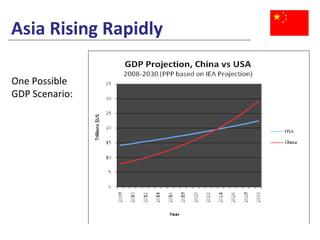
Asia Rising Rapidly One Possible GDP Scenario:
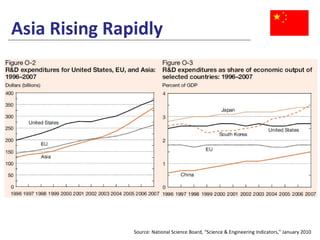
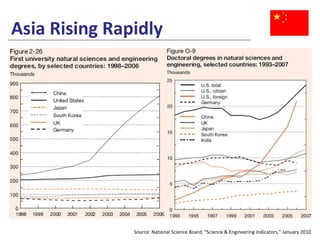
Asia Rising Rapidly Source: National Science Board, “Science & Engineering Indicators,” January 2010
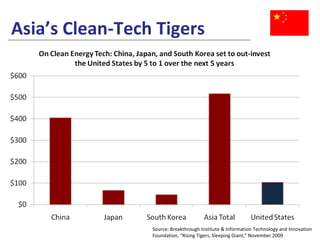
Asia’s Clean-Tech Tigers Source: Breakthrough Institute & Information Technology and Innovation Foundation, “Rising Tigers, Sleeping Giant,” November 2009
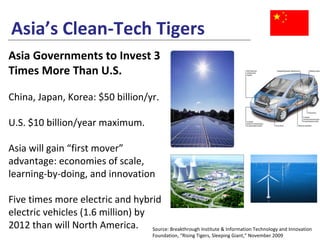
Asia’s Clean-Tech Tigers Source: Breakthrough Institute & Information Technology and Innovation Foundation, “Rising Tigers, Sleeping Giant,” November 2009 Asia Governments to Invest 3 Times More Than U.S. China, Japan, Korea: $50 billion/yr. U.S. $10 billion/year maximum. Asia will gain “first mover” advantage: economies of scale, learning-by-doing, and innovation Five times more electric and hybrid electric vehicles (1.6 million) by 2012 than will North America. Asian government investments are direct and coordinated. U.S. and Europe indirect and uncoordinated.
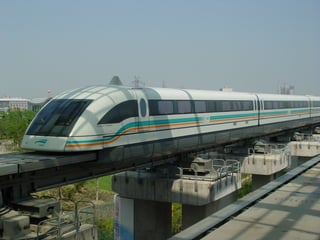
High Speed Rail (HSR) Policy
"These nations aren't playing for second place... They're making serious investments in clean energy because they want those jobs... The nation that leads the clean-energy economy will be the nation that leads the global economy. And America must be that nation.”   -President Obama State of the Union, Jan. 2010  A New Strategy for  American Leadership
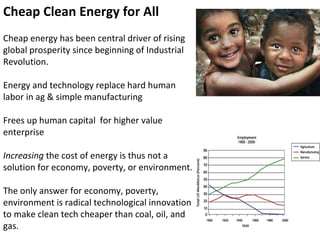
Cheap Clean Energy for All Cheap energy has been central driver of rising global prosperity since beginning of Industrial Revolution. Energy and technology replace hard human labor in ag & simple manufacturing Frees up human capital  for higher value enterprise Increasing  the cost of energy is thus not a solution for economy, poverty, or environment. The only answer for economy, poverty, environment is radical technological innovation to make clean tech cheaper than coal, oil, and gas.
 
We can’t make  dirty energy expensive. Let’s   make clean  energy cheap.
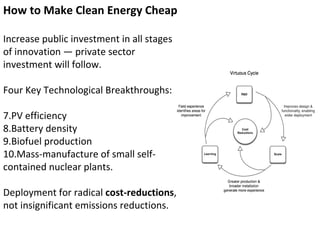
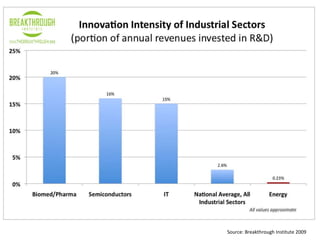
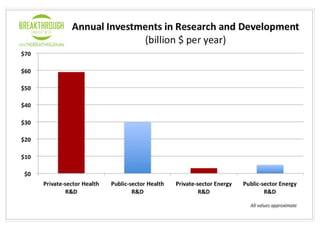
How to Make Clean Energy Cheap Increase public investment in all stages of innovation — private sector investment will follow. Four Key Technological Breakthroughs:  PV efficiency Battery density Biofuel production Mass-manufacture of small self-contained nuclear plants. Deployment for radical  cost-reductions , not insignificant emissions reductions.
Source: Breakthrough Institute 2009
 
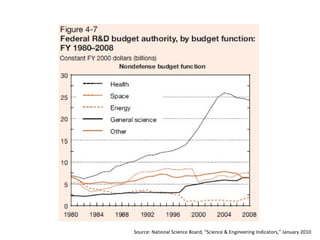
Source: National Science Board, “Science & Engineering Indicators,” January 2010
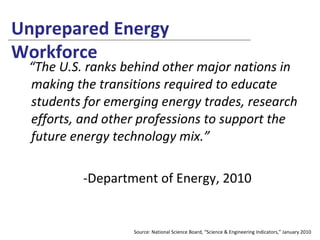
“ The U.S. ranks behind other major nations in making the transitions required to educate students for emerging energy trades, research efforts, and other professions to support the future energy technology mix.” -Department of Energy, 2010 Unprepared Energy Workforce Source: National Science Board, “Science & Engineering Indicators,” January 2010
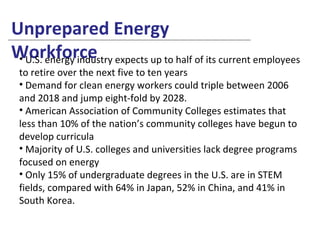
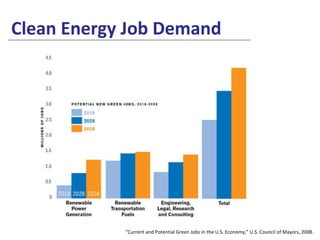
Unprepared Energy Workforce U.S. energy industry expects up to half of its current employees to retire over the next five to ten years Demand for clean energy workers could triple between 2006 and 2018 and jump eight-fold by 2028. American Association of Community Colleges estimates that less than 10% of the nation’s community colleges have begun to develop curricula Majority of U.S. colleges and universities lack degree programs focused on energy Only 15% of undergraduate degrees in the U.S. are in STEM  fields, compared with 64% in Japan, 52% in China, and 41% in South Korea.
Clean Energy Job Demand “ Current and Potential Green Jobs in the U.S. Economy,” U.S. Council of Mayors, 2008.
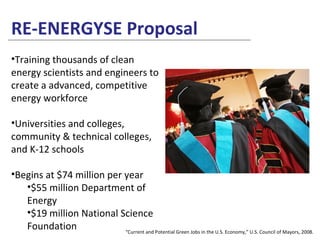
RE-ENERGYSE Proposal “ Current and Potential Green Jobs in the U.S. Economy,” U.S. Council of Mayors, 2008. Training thousands of clean energy scientists and engineers to create a advanced, competitive energy workforce  Universities and colleges, community & technical colleges, and K-12 schools Begins at $74 million per year $55 million Department of Energy $19 million National Science Foundation
ReEnergyse Campaign “ Current and Potential Green Jobs in the U.S. Economy,” U.S. Council of Mayors, 2008. Student presidents letter Youth organization letter Strategic districts outreach DC briefing and lobby day Op-eds and articles Campus events Secretary Chu


Thank You! Teryn Norris [email_address] www.leadenergy.org

Repowering American Innovation

  • 1.
    Repowering American InnovationStrategies for U.S. Economic Leadership Presentation by Teryn Norris for Scientists & Engineers for America March 9 th , 2010
  • 2.
  • 3.
  • 4.
  • 5.
    Asia Rising RapidlyOne Possible GDP Scenario:
  • 6.
    Asia Rising RapidlySource: National Science Board, “Science & Engineering Indicators,” January 2010
  • 7.
    Asia Rising RapidlySource: National Science Board, “Science & Engineering Indicators,” January 2010
  • 8.
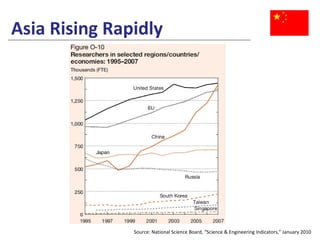
    Asia Rising RapidlySource: National Science Board, “Science & Engineering Indicators,” January 2010
  • 9.
    Asia’s Clean-Tech TigersSource: Breakthrough Institute & Information Technology and Innovation Foundation, “Rising Tigers, Sleeping Giant,” November 2009
  • 10.
    Asia’s Clean-Tech TigersSource: Breakthrough Institute & Information Technology and Innovation Foundation, “Rising Tigers, Sleeping Giant,” November 2009 Asia Governments to Invest 3 Times More Than U.S. China, Japan, Korea: $50 billion/yr. U.S. $10 billion/year maximum. Asia will gain “first mover” advantage: economies of scale, learning-by-doing, and innovation Five times more electric and hybrid electric vehicles (1.6 million) by 2012 than will North America. Asian government investments are direct and coordinated. U.S. and Europe indirect and uncoordinated.
  • 11.
    High Speed Rail(HSR) Policy
  • 12.
    "These nations aren'tplaying for second place... They're making serious investments in clean energy because they want those jobs... The nation that leads the clean-energy economy will be the nation that leads the global economy. And America must be that nation.” -President Obama State of the Union, Jan. 2010 A New Strategy for American Leadership
  • 13.
    Cheap Clean Energyfor All Cheap energy has been central driver of rising global prosperity since beginning of Industrial Revolution. Energy and technology replace hard human labor in ag & simple manufacturing Frees up human capital for higher value enterprise Increasing the cost of energy is thus not a solution for economy, poverty, or environment. The only answer for economy, poverty, environment is radical technological innovation to make clean tech cheaper than coal, oil, and gas.
  • 14.
  • 15.
    We can’t make dirty energy expensive. Let’s make clean energy cheap.
  • 16.
    How to MakeClean Energy Cheap Increase public investment in all stages of innovation — private sector investment will follow. Four Key Technological Breakthroughs: PV efficiency Battery density Biofuel production Mass-manufacture of small self-contained nuclear plants. Deployment for radical cost-reductions , not insignificant emissions reductions.
  • 17.
  • 18.
  • 19.
    Source: National ScienceBoard, “Science & Engineering Indicators,” January 2010
  • 20.
    “ The U.S.ranks behind other major nations in making the transitions required to educate students for emerging energy trades, research efforts, and other professions to support the future energy technology mix.” -Department of Energy, 2010 Unprepared Energy Workforce Source: National Science Board, “Science & Engineering Indicators,” January 2010
  • 21.
    Unprepared Energy WorkforceU.S. energy industry expects up to half of its current employees to retire over the next five to ten years Demand for clean energy workers could triple between 2006 and 2018 and jump eight-fold by 2028. American Association of Community Colleges estimates that less than 10% of the nation’s community colleges have begun to develop curricula Majority of U.S. colleges and universities lack degree programs focused on energy Only 15% of undergraduate degrees in the U.S. are in STEM fields, compared with 64% in Japan, 52% in China, and 41% in South Korea.
  • 22.
    Clean Energy JobDemand “ Current and Potential Green Jobs in the U.S. Economy,” U.S. Council of Mayors, 2008.
  • 23.
    RE-ENERGYSE Proposal “Current and Potential Green Jobs in the U.S. Economy,” U.S. Council of Mayors, 2008. Training thousands of clean energy scientists and engineers to create a advanced, competitive energy workforce Universities and colleges, community & technical colleges, and K-12 schools Begins at $74 million per year $55 million Department of Energy $19 million National Science Foundation
  • 24.
    ReEnergyse Campaign “Current and Potential Green Jobs in the U.S. Economy,” U.S. Council of Mayors, 2008. Student presidents letter Youth organization letter Strategic districts outreach DC briefing and lobby day Op-eds and articles Campus events Secretary Chu
  • 25.
  • 26.
  • 27.
  • 28.
    Thank You! TerynNorris [email_address] www.leadenergy.org

Editor's Notes

  • #3 Industry also helped by stimulus package
  • #6 Industry also helped by stimulus package
  • #7 Industry also helped by stimulus package
  • #12 Industry also helped by stimulus package
  • #14 BW
  • #17 BW
  • #18 Invest in: Innovation and RD&D. Massive innovation gap in energy sector.
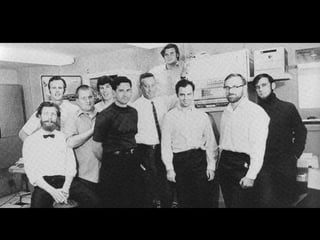
  • #28 Inventors of the internet