SCIENCE 7
First QUARTER- lc 7.1
Matatag curriculum
LESSON 1: Standard Units
of Physical Quantities
The learners shall learn different standard units
of measurement, organize collected data and
identify the components of a solution.
CONTENT
There are specific processes for
planning, conducting, and recording
scientific investigations.
LEARNING
STANDARD
The learners shall make accurate
measurements using standard units for
physical quantity, and organize the collected
data when carrying out a scientific
investigation and be able to identify the role of
the solute and solvent in a solution.
LEARNING
COMPETENCY
By the end of the lesson, the 80 percent of
the learners will be able to:
1. Identify the base units in the International
System of Units (SI) and their definitions.
2. Provide step-by-step examples of converting
between various SI units.
3. Appreciate the global standardization of
measurement units and the role they play in
scientific communication and collaboration.
OBJECTIVES
I. Activating Prior Knowledge
"Can you share some
examples of different
physical quantities that
we measure in our
everyday lives or in
science? What are some of
the common units used to
measure those
I. Activating Prior Knowledge
 Length (meters, centimeters, inches, feet)
 Mass (grams, kilograms, pounds)
 Volume (liters, milliliters, cubic
centimeters)
 Time (seconds, minutes, hours)
 Temperature (degrees Celsius, Fahrenheit)
 Force (newtons)
 Energy (joules, calories)
 Power (watts)
I. Activating Prior Knowledge
"Now, let's talk about your
experiences with collecting and
recording data, whether it's
been during science
experiments or in your
everyday life. Can you share
some examples of times when
you've had to measure and
record different physical
quantities?"
I. Activating Prior Knowledge
 Length (e.g. measuring the height of a
plant, the width of a table)
 Mass (e.g. weighing ingredients for a
recipe, measuring their own weight)
 Volume (e.g. measuring the amount of
liquid in a container, calculating the
volume of a box)
 Time (e.g. timing how long it takes to run a
lap, recording the duration of an
I. Activating Prior Knowledge
"How did you decide
which units to use
when measuring that
quantity? Why did
you choose those
particular units?"
 Today's lesson will focus on developing skills for
accurately measuring physical quantities,
organizing data, and understanding the
components of a solution.
 Explain to the learners that the lesson is about
making accurate measurements using standard
units for physical quantities.
B. Establishing Purpose of the Lesson
1. LESSON PURPOSE
B. Establishing Purpose of the Lesson
2. Unlocking Content Vocabulary: Match Type Activity
Kilogram (kg)
Second (s)
Kelvin (K)
-The base unit of mass in the SI system
- The base unit of time in the SI system
-The base unit of thermodynamic
temperature in the SI system
Meter (m) -The base unit of length in the SI system
C. Developing and Deepening Understanding
 The International System of Units,
commonly referred to as the SI, is
the standardized system of
measurement used around the
world.
 It was developed to provide a
consistent and precise way of
quantifying different physical
quantities.
Introduction to the
International System of Units (SI)
C. Developing and Deepening Understanding
 Using standard units is crucial in the field
of science, as it allows for consistent and
reliable measurements. When scientists
and researchers use the same
standardized units, it enables them to
accurately compare data, replicate
experiments, and build upon each other's
work. This consistency and precision is
essential for the advancement of scientific
knowledge.
Importance of using standard units for
consistency and precision in science.
C. Developing and Deepening Understanding
 Meter (m): The base unit of length in the SI system. It
is defined as the distance traveled by light in a
vacuum over a time interval of 1/299,792,458 of a
second.
7 base SI units and brief definition and description
 Kilogram (kg): The base unit of mass in the SI
system. It is defined by the international prototype of
the kilogram, a platinum-iridium cylinder kept at the
International Bureau of Weights and Measures.
C. Developing and Deepening Understanding
 Second (s): The base unit of time in the SI system. It
is defined as the duration of 9,192,631,770 periods of
the radiation corresponding to the transition between
the two hyperfine levels of the ground state of the
cesium-133 atom.
7 base SI units and brief definition and description
 Ampere (A): The base unit of electric current in the
SI system. It is defined as the constant flow of one
coulomb of electrical charge per second.
C. Developing and Deepening Understanding
 Kelvin (K): The base unit of thermodynamic
temperature in the SI system. It is defined as the
fraction 1/273.16 of the thermodynamic temperature of
the triple point of water.
7 base SI units and brief definition and description
 Mole (mol): The base unit of amount of substance in
the SI system. It is defined as the amount of
substance that contains exactly 6.022 × 10^23
elementary entities, which can be atoms, molecules,
ions, or electrons.
C. Developing and Deepening Understanding
Derived SI Units
 In addition to the 7 base SI units, there are many other
units that can be derived by combining the base units
in specific ways. These derived units allow us to
measure and quantify a wide range of physical
quantities beyond just the fundamental ones.
Derived SI Units
C. Developing and Deepening Understanding
 Newton (N): The unit of force, derived from the
base units of mass (kg), length (m), and time (s).
1 N = 1 kg·m/s^2
Common derived SI units and how they are defined:
 Pascal (Pa): The unit of pressure or stress,
derived from the base units of mass (kg), length
(m), and time (s). 1 Pa = 1 N/m^2
C. Developing and Deepening Understanding
 Watt (W): The unit of power, derived from the
base units of mass (kg), length (m), and time (s).
1 W = 1 J/s
Common derived SI units and how they are defined:
 Joule (J): The unit of energy or work, derived
from the base units of mass (kg), length (m), and
time (s). 1 J = 1 N·m
C. Developing and Deepening Understanding
 Hertz (Hz): The unit of frequency, derived
from the base unit of time (s). 1 Hz = 1
cycle/s
Common derived SI units and how they are defined:
 Volt (V): The unit of electric potential, derived
from the base units of mass (kg), length (m),
time (s), and electric current (A). 1 V = 1 W/A
C. Developing and Deepening Understanding
 SI system uses a series of prefixes to
indicate the magnitude of a unit.
 These prefixes allow us to express very
large or very small quantities using the
base units.
Prefixes and Unit Conversions
C. Developing and Deepening Understanding
Prefixes and Meaning
C. Developing and Deepening Understanding
Example 1: Converting meters to centimeters
 1 meter (m) = 100 centimeters (cm)
 To convert 5 meters to centimeters:
 5 m × (100 cm/1 m) = 500 cm
Prefixes and Unit Conversions
C. Developing and Deepening Understanding
Example 2: Converting kilograms to grams
1 kilogram (kg) = 1000 grams (g)
To convert 2.5 kilograms to grams:
2.5 kg × (1000 g/1 kg) = 2500 g
Prefixes and Unit Conversions
C. Developing and Deepening Understanding
Example 3: Converting seconds to
milliseconds
1 second (s) = 1000 milliseconds (ms)
To convert 7.2 seconds to milliseconds:
7.2 s × (1000 ms/1 s) = 7200 ms
Prefixes and Unit Conversions
C. Developing and Deepening Understanding
1. Advantages of Using Standard Units
o Consistency: The SI system provides a standardized,
globally recognized set of units.
o Precision: Standard units allow for accurate and
reproducible measurements.
o Comparability: Using the same units enables
scientists and researchers to compare data and
findings.
Importance and Applications of SI Units
C. Developing and Deepening Understanding
2. Real-World Applications of SI Units
o Science and Research
 Measuring length, mass, time, temperature, and other
physical quantities in experiments.
 Reporting scientific data and findings using SI units.
Importance and Applications of SI Units
C. Developing and Deepening Understanding
2. Real-World Applications of SI Units
o Engineering and Technology
 Designing and manufacturing products with precise
dimensions and specifications.
 Calculating and reporting energy usage, power output,
and other engineering metrics.
Importance and Applications of SI Units
C. Developing and Deepening Understanding
2. Real-World Applications of SI Units
o Everyday Life
 Measuring and reporting weight, volume, and distance
in daily activities.
 Tracking time, temperature, and other quantities in our
personal lives.
Importance and Applications of SI Units
C. Developing and Deepening Understanding
Worked Example
Learners will be asked to read out and answer the
following questions:
1. What is needed to show the accurate measurement of
a given quantity?
2. What is the SI unit of mass? Temperature? Time?
3. What is the official system of units used in our country?
D. MAKING GENERALIZATION
Reflection on Learning
 Learners will be asked if the
lesson today has helped
them make accurate
measurements. If so, why? If
not, what can be made
better?
E. EVALUATING LEARNING
__________1. Which of the following is NOT
one of the 7 base units in the International
System of Units (SI)?
a) Meter
b) Kilogram
c) Hertz
d) Candela
E. EVALUATING LEARNING
__________2. The base unit of time in the SI
system is the:
a) Second
b) Minute
c) Hour
d) Day
E. EVALUATING LEARNING
__________3. Which SI prefix represents a
factor of 1,000,000?
a) Milli
b) Centi
c) Kilo
d) Mega
E. EVALUATING LEARNING
__________4. If an object has a mass of 5
kilograms, what is its mass in grams?
a) 0.005 g
b) 5 g
c) 500 g
d) 5,000 g
E. EVALUATING LEARNING
__________5. Which of the following is a
derived SI unit?
a) Meter
b) Kelvin
c) Newton
d) Mole
E. EVALUATING LEARNING
__________6. The base unit of length in the
SI system is the:
a) Inch
b) Foot
c) Meter
d) Centimeter
E. EVALUATING LEARNING
__________7. Which SI prefix represents a
factor of 0.001?
a) Centi
b) Milli
c) Kilo
d) Mega
E. EVALUATING LEARNING
__________8. If an object has a volume of
2.5 liters, what is its volume in milliliters?
a) 2.5 mL
b) 25 mL
c) 250 mL
d) 2,500 mL
E. EVALUATING LEARNING
__________9. The base unit of electric
current in the SI system is the:
a) Volt
b) Ohm
c) Watt
d) Ampere
E. EVALUATING LEARNING
__________10. Which of the following is a
derived SI unit for force?
a) Kilogram
b) Second
c) Newton
d) Kelvin
E. EVALUATING LEARNING
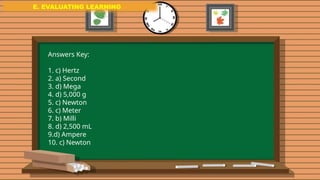
Answers Key:
1. c) Hertz
2. a) Second
3. d) Mega
4. d) 5,000 g
5. c) Newton
6. c) Meter
7. b) Milli
8. d) 2,500 mL
9.d) Ampere
10. c) Newton
References:
•SCIENCE 7 LESSON EXEMPLAR
•Textbooks:
•"Physics" by David Halliday, Robert Resnick, and Jearl Walker
•"Chemistry" by Nivaldo J. Tro
•"Physical Science" by Bill W. Tillery, Eldon Embree, and Dorothy Byrd
•Scientific Organization Websites:
•National Institute of Standards and Technology (NIST) - nist.gov
•International Bureau of Weights and Measures (BIPM) - bipm.org
•International System of Units (SI) - www.bipm.org/en/measurement-units/
•Educational Resource Websites:
•Khan Academy - khanacademy.org
•PhET Interactive Simulations - phet.colorado.edu
•Science Learning Hub - sciencelearn.org.nz
Grade 7 Science Physical Quantities.pptx

Grade 7 Science Physical Quantities.pptx

  • 2.
    SCIENCE 7 First QUARTER-lc 7.1 Matatag curriculum LESSON 1: Standard Units of Physical Quantities
  • 3.
    The learners shalllearn different standard units of measurement, organize collected data and identify the components of a solution. CONTENT There are specific processes for planning, conducting, and recording scientific investigations. LEARNING STANDARD The learners shall make accurate measurements using standard units for physical quantity, and organize the collected data when carrying out a scientific investigation and be able to identify the role of the solute and solvent in a solution. LEARNING COMPETENCY
  • 4.
    By the endof the lesson, the 80 percent of the learners will be able to: 1. Identify the base units in the International System of Units (SI) and their definitions. 2. Provide step-by-step examples of converting between various SI units. 3. Appreciate the global standardization of measurement units and the role they play in scientific communication and collaboration. OBJECTIVES
  • 5.
    I. Activating PriorKnowledge "Can you share some examples of different physical quantities that we measure in our everyday lives or in science? What are some of the common units used to measure those
  • 6.
    I. Activating PriorKnowledge  Length (meters, centimeters, inches, feet)  Mass (grams, kilograms, pounds)  Volume (liters, milliliters, cubic centimeters)  Time (seconds, minutes, hours)  Temperature (degrees Celsius, Fahrenheit)  Force (newtons)  Energy (joules, calories)  Power (watts)
  • 7.
    I. Activating PriorKnowledge "Now, let's talk about your experiences with collecting and recording data, whether it's been during science experiments or in your everyday life. Can you share some examples of times when you've had to measure and record different physical quantities?"
  • 8.
    I. Activating PriorKnowledge  Length (e.g. measuring the height of a plant, the width of a table)  Mass (e.g. weighing ingredients for a recipe, measuring their own weight)  Volume (e.g. measuring the amount of liquid in a container, calculating the volume of a box)  Time (e.g. timing how long it takes to run a lap, recording the duration of an
  • 9.
    I. Activating PriorKnowledge "How did you decide which units to use when measuring that quantity? Why did you choose those particular units?"
  • 10.
     Today's lessonwill focus on developing skills for accurately measuring physical quantities, organizing data, and understanding the components of a solution.  Explain to the learners that the lesson is about making accurate measurements using standard units for physical quantities. B. Establishing Purpose of the Lesson 1. LESSON PURPOSE
  • 11.
    B. Establishing Purposeof the Lesson 2. Unlocking Content Vocabulary: Match Type Activity Kilogram (kg) Second (s) Kelvin (K) -The base unit of mass in the SI system - The base unit of time in the SI system -The base unit of thermodynamic temperature in the SI system Meter (m) -The base unit of length in the SI system
  • 12.
    C. Developing andDeepening Understanding  The International System of Units, commonly referred to as the SI, is the standardized system of measurement used around the world.  It was developed to provide a consistent and precise way of quantifying different physical quantities. Introduction to the International System of Units (SI)
  • 13.
    C. Developing andDeepening Understanding  Using standard units is crucial in the field of science, as it allows for consistent and reliable measurements. When scientists and researchers use the same standardized units, it enables them to accurately compare data, replicate experiments, and build upon each other's work. This consistency and precision is essential for the advancement of scientific knowledge. Importance of using standard units for consistency and precision in science.
  • 14.
    C. Developing andDeepening Understanding  Meter (m): The base unit of length in the SI system. It is defined as the distance traveled by light in a vacuum over a time interval of 1/299,792,458 of a second. 7 base SI units and brief definition and description  Kilogram (kg): The base unit of mass in the SI system. It is defined by the international prototype of the kilogram, a platinum-iridium cylinder kept at the International Bureau of Weights and Measures.
  • 15.
    C. Developing andDeepening Understanding  Second (s): The base unit of time in the SI system. It is defined as the duration of 9,192,631,770 periods of the radiation corresponding to the transition between the two hyperfine levels of the ground state of the cesium-133 atom. 7 base SI units and brief definition and description  Ampere (A): The base unit of electric current in the SI system. It is defined as the constant flow of one coulomb of electrical charge per second.
  • 16.
    C. Developing andDeepening Understanding  Kelvin (K): The base unit of thermodynamic temperature in the SI system. It is defined as the fraction 1/273.16 of the thermodynamic temperature of the triple point of water. 7 base SI units and brief definition and description  Mole (mol): The base unit of amount of substance in the SI system. It is defined as the amount of substance that contains exactly 6.022 × 10^23 elementary entities, which can be atoms, molecules, ions, or electrons.
  • 17.
    C. Developing andDeepening Understanding Derived SI Units  In addition to the 7 base SI units, there are many other units that can be derived by combining the base units in specific ways. These derived units allow us to measure and quantify a wide range of physical quantities beyond just the fundamental ones. Derived SI Units
  • 18.
    C. Developing andDeepening Understanding  Newton (N): The unit of force, derived from the base units of mass (kg), length (m), and time (s). 1 N = 1 kg·m/s^2 Common derived SI units and how they are defined:  Pascal (Pa): The unit of pressure or stress, derived from the base units of mass (kg), length (m), and time (s). 1 Pa = 1 N/m^2
  • 19.
    C. Developing andDeepening Understanding  Watt (W): The unit of power, derived from the base units of mass (kg), length (m), and time (s). 1 W = 1 J/s Common derived SI units and how they are defined:  Joule (J): The unit of energy or work, derived from the base units of mass (kg), length (m), and time (s). 1 J = 1 N·m
  • 20.
    C. Developing andDeepening Understanding  Hertz (Hz): The unit of frequency, derived from the base unit of time (s). 1 Hz = 1 cycle/s Common derived SI units and how they are defined:  Volt (V): The unit of electric potential, derived from the base units of mass (kg), length (m), time (s), and electric current (A). 1 V = 1 W/A
  • 21.
    C. Developing andDeepening Understanding  SI system uses a series of prefixes to indicate the magnitude of a unit.  These prefixes allow us to express very large or very small quantities using the base units. Prefixes and Unit Conversions
  • 22.
    C. Developing andDeepening Understanding Prefixes and Meaning
  • 23.
    C. Developing andDeepening Understanding Example 1: Converting meters to centimeters  1 meter (m) = 100 centimeters (cm)  To convert 5 meters to centimeters:  5 m × (100 cm/1 m) = 500 cm Prefixes and Unit Conversions
  • 24.
    C. Developing andDeepening Understanding Example 2: Converting kilograms to grams 1 kilogram (kg) = 1000 grams (g) To convert 2.5 kilograms to grams: 2.5 kg × (1000 g/1 kg) = 2500 g Prefixes and Unit Conversions
  • 25.
    C. Developing andDeepening Understanding Example 3: Converting seconds to milliseconds 1 second (s) = 1000 milliseconds (ms) To convert 7.2 seconds to milliseconds: 7.2 s × (1000 ms/1 s) = 7200 ms Prefixes and Unit Conversions
  • 26.
    C. Developing andDeepening Understanding 1. Advantages of Using Standard Units o Consistency: The SI system provides a standardized, globally recognized set of units. o Precision: Standard units allow for accurate and reproducible measurements. o Comparability: Using the same units enables scientists and researchers to compare data and findings. Importance and Applications of SI Units
  • 27.
    C. Developing andDeepening Understanding 2. Real-World Applications of SI Units o Science and Research  Measuring length, mass, time, temperature, and other physical quantities in experiments.  Reporting scientific data and findings using SI units. Importance and Applications of SI Units
  • 28.
    C. Developing andDeepening Understanding 2. Real-World Applications of SI Units o Engineering and Technology  Designing and manufacturing products with precise dimensions and specifications.  Calculating and reporting energy usage, power output, and other engineering metrics. Importance and Applications of SI Units
  • 29.
    C. Developing andDeepening Understanding 2. Real-World Applications of SI Units o Everyday Life  Measuring and reporting weight, volume, and distance in daily activities.  Tracking time, temperature, and other quantities in our personal lives. Importance and Applications of SI Units
  • 30.
    C. Developing andDeepening Understanding Worked Example Learners will be asked to read out and answer the following questions: 1. What is needed to show the accurate measurement of a given quantity? 2. What is the SI unit of mass? Temperature? Time? 3. What is the official system of units used in our country?
  • 31.
    D. MAKING GENERALIZATION D.MAKING GENERALIZATION Reflection on Learning  Learners will be asked if the lesson today has helped them make accurate measurements. If so, why? If not, what can be made better?
  • 32.
    E. EVALUATING LEARNING E.EVALUATING LEARNING E. EVALUATING LEARNING __________1. Which of the following is NOT one of the 7 base units in the International System of Units (SI)? a) Meter b) Kilogram c) Hertz d) Candela
  • 33.
    E. EVALUATING LEARNING E.EVALUATING LEARNING E. EVALUATING LEARNING __________2. The base unit of time in the SI system is the: a) Second b) Minute c) Hour d) Day
  • 34.
    E. EVALUATING LEARNING E.EVALUATING LEARNING E. EVALUATING LEARNING __________3. Which SI prefix represents a factor of 1,000,000? a) Milli b) Centi c) Kilo d) Mega
  • 35.
    E. EVALUATING LEARNING E.EVALUATING LEARNING E. EVALUATING LEARNING __________4. If an object has a mass of 5 kilograms, what is its mass in grams? a) 0.005 g b) 5 g c) 500 g d) 5,000 g
  • 36.
    E. EVALUATING LEARNING E.EVALUATING LEARNING E. EVALUATING LEARNING __________5. Which of the following is a derived SI unit? a) Meter b) Kelvin c) Newton d) Mole
  • 37.
    E. EVALUATING LEARNING E.EVALUATING LEARNING E. EVALUATING LEARNING __________6. The base unit of length in the SI system is the: a) Inch b) Foot c) Meter d) Centimeter
  • 38.
    E. EVALUATING LEARNING E.EVALUATING LEARNING E. EVALUATING LEARNING __________7. Which SI prefix represents a factor of 0.001? a) Centi b) Milli c) Kilo d) Mega
  • 39.
    E. EVALUATING LEARNING E.EVALUATING LEARNING E. EVALUATING LEARNING __________8. If an object has a volume of 2.5 liters, what is its volume in milliliters? a) 2.5 mL b) 25 mL c) 250 mL d) 2,500 mL
  • 40.
    E. EVALUATING LEARNING E.EVALUATING LEARNING E. EVALUATING LEARNING __________9. The base unit of electric current in the SI system is the: a) Volt b) Ohm c) Watt d) Ampere
  • 41.
    E. EVALUATING LEARNING E.EVALUATING LEARNING E. EVALUATING LEARNING __________10. Which of the following is a derived SI unit for force? a) Kilogram b) Second c) Newton d) Kelvin
  • 42.
    E. EVALUATING LEARNING E.EVALUATING LEARNING E. EVALUATING LEARNING Answers Key: 1. c) Hertz 2. a) Second 3. d) Mega 4. d) 5,000 g 5. c) Newton 6. c) Meter 7. b) Milli 8. d) 2,500 mL 9.d) Ampere 10. c) Newton
  • 43.
    References: •SCIENCE 7 LESSONEXEMPLAR •Textbooks: •"Physics" by David Halliday, Robert Resnick, and Jearl Walker •"Chemistry" by Nivaldo J. Tro •"Physical Science" by Bill W. Tillery, Eldon Embree, and Dorothy Byrd •Scientific Organization Websites: •National Institute of Standards and Technology (NIST) - nist.gov •International Bureau of Weights and Measures (BIPM) - bipm.org •International System of Units (SI) - www.bipm.org/en/measurement-units/ •Educational Resource Websites: •Khan Academy - khanacademy.org •PhET Interactive Simulations - phet.colorado.edu •Science Learning Hub - sciencelearn.org.nz