So You Want To Do A Science Fair Project? 2010-2011 John Adams Elementary Individual or group projects (No more than 3) Individual, group or class projects K-5
Scientific Method Question – stating a problem Research – find out all you can that relates to the problem Hypothesis –  after research , make an educated guess about what the answer to the problem will be Materials – complete list of what needed for the investigation
Scientific Method, cont. Procedure – a step-by-step description of how to do the investigation Investigation – do the tests to find out if your hypothesis is correct, record data, take pictures, write in your journal, keep a timeline, measure anything needed Data – organize the observations into graphs, charts and/or tables
Scientific Method, cont. Results – put the data into words, explain what actually happened, use your notes and the timeline Conclusion – analyze the results and write a conclusion explaining what happened and why.
Starting off: What are you interested in? Think of a question Your teacher can help Research – make sure to take notes books The Internet encyclopedias
Hypothesis Based on information you get from research Clear and brief You can test it, do an experiment You are not doing a demonstration of something you already know or asking people what they like or do not like (a survey)
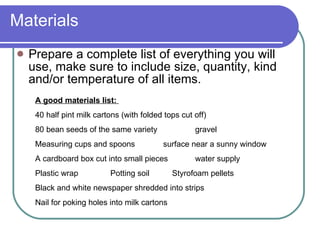
Materials Prepare a complete list of everything you will use, make sure to include size, quantity, kind and/or temperature of all items. A good materials list:  40 half pint milk cartons (with folded tops cut off) 80 bean seeds of the same variety gravel Measuring cups and spoons  surface near a sunny window A cardboard box cut into small pieces water supply Plastic wrap   Potting soil    Styrofoam pellets Black and white newspaper shredded into strips Nail for poking holes into milk cartons
Design the Investigation What is being tested? (the subject) What condition are you changing?  (the variable) This is the part that is different with each subject of the experiment.  What conditions is NOT changed?  (the control) These have to be the same for all subjects in your experiment
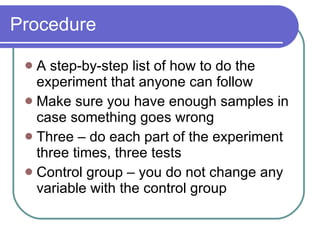
Procedure A step-by-step list of how to do the experiment that anyone can follow Make sure you have enough samples in case something goes wrong Three – do each part of the experiment three times, three tests Control group – you do not change any variable with the control group
Procedure Page for Experiment Estimate the time needed for each step to help your planning. You may even make a schedule with dates. What? When? Done( )
Create a Log Sheet Precise record keeping is essential for accurate results. Create a log sheet before you begin the investigation. Sample #1  Change In Temperature  6° Log sheet to record temperature over a 10 min period. 1 min 2 min 3 min 4 min 5 min 6 min 7 min 8 min 9 min 10   min 90° c 91  ° c 93  ° c 94  ° c 95  ° c 95  ° c 96  ° c 96  ° c 96  ° c 96  ° c
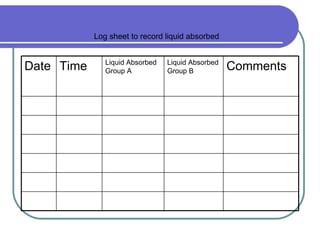
Log sheet to record liquid absorbed Date Time Liquid Absorbed Group A Liquid Absorbed Group B Comments
Doing Your Experiment Follow the procedure you have written Gather data, record it in log sheet or chart Keep a timeline of what you do each day Be accurate in your measurements and careful in recording the results. Record and write at the time you make your observation, not later. Photographs help, too. If you need to change your procedure, note the changes and  tell why they were made. Sometime nothing happens! That is a result!
Organize Data and Write Results When your experiment is complete, you need to look at the written observations and put them in order.  You may want to create bar graphs or line graphs to show your data. At the bottom of each chart, table or graph, write a brief explanation to explain what happened.  Title and label each chart, table or graph carefully. When you have completed your graphs, write a summary of your observations and measurements. This should be short and simple.
Conclusion This is the analysis of what happened Tell what you learned from the trials and tests Compare your results with the original hypothesis. Your hypothesis may be true OR false. It may also be inconclusive. Your data may not be enough to prove or disprove your hypothesis. Look for patterns! End your conclusion with how your learning can connect to the real world.
Presenting Your Project You are now ready to present the project! You will need two (2) things- A notebook/Journal that should include your: Background research Table of Contents Bibliography Copies of each of the steps in your project A timeline of what you did for your project each day Data sheets (charts, tables and graphs) Each student is required to complete a journal.
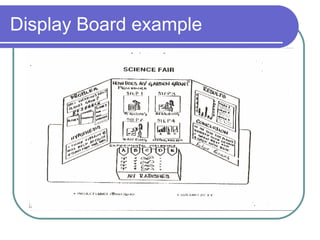
Presenting Your Project, cont. A display board A good display will attract attention and help others learn from what you have done. Your display MUST include summaries of the problem, hypothesis, procedures, results, and conclusions. You may also include graphs and photos.  The display should be neatly and carefully done and may be colorful.  A clever title will make it more interesting, too.
Display Board example
Taking it all to the Science Fair Make sure all of these items get turned in and come to the science fair: Display board Journal, complete with all required pages Put your name and room number on the BACK of the display board and on the cover of the journal Turn it in on time: Tuesday, Feb.,1st, 2011 for judging
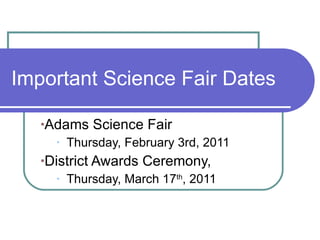
Important Science Fair Dates Adams Science Fair Thursday, February 3rd, 2011 District Awards Ceremony, Thursday, March 17 th , 2011

Science Fair Power Point

  • 1.
    So You WantTo Do A Science Fair Project? 2010-2011 John Adams Elementary Individual or group projects (No more than 3) Individual, group or class projects K-5
  • 2.
    Scientific Method Question– stating a problem Research – find out all you can that relates to the problem Hypothesis – after research , make an educated guess about what the answer to the problem will be Materials – complete list of what needed for the investigation
  • 3.
    Scientific Method, cont.Procedure – a step-by-step description of how to do the investigation Investigation – do the tests to find out if your hypothesis is correct, record data, take pictures, write in your journal, keep a timeline, measure anything needed Data – organize the observations into graphs, charts and/or tables
  • 4.
    Scientific Method, cont.Results – put the data into words, explain what actually happened, use your notes and the timeline Conclusion – analyze the results and write a conclusion explaining what happened and why.
  • 5.
    Starting off: Whatare you interested in? Think of a question Your teacher can help Research – make sure to take notes books The Internet encyclopedias
  • 6.
    Hypothesis Based oninformation you get from research Clear and brief You can test it, do an experiment You are not doing a demonstration of something you already know or asking people what they like or do not like (a survey)
  • 7.
    Materials Prepare acomplete list of everything you will use, make sure to include size, quantity, kind and/or temperature of all items. A good materials list: 40 half pint milk cartons (with folded tops cut off) 80 bean seeds of the same variety gravel Measuring cups and spoons surface near a sunny window A cardboard box cut into small pieces water supply Plastic wrap Potting soil Styrofoam pellets Black and white newspaper shredded into strips Nail for poking holes into milk cartons
  • 8.
    Design the InvestigationWhat is being tested? (the subject) What condition are you changing? (the variable) This is the part that is different with each subject of the experiment. What conditions is NOT changed? (the control) These have to be the same for all subjects in your experiment
  • 9.
    Procedure A step-by-steplist of how to do the experiment that anyone can follow Make sure you have enough samples in case something goes wrong Three – do each part of the experiment three times, three tests Control group – you do not change any variable with the control group
  • 10.
    Procedure Page forExperiment Estimate the time needed for each step to help your planning. You may even make a schedule with dates. What? When? Done( )
  • 11.
    Create a LogSheet Precise record keeping is essential for accurate results. Create a log sheet before you begin the investigation. Sample #1 Change In Temperature 6° Log sheet to record temperature over a 10 min period. 1 min 2 min 3 min 4 min 5 min 6 min 7 min 8 min 9 min 10 min 90° c 91 ° c 93 ° c 94 ° c 95 ° c 95 ° c 96 ° c 96 ° c 96 ° c 96 ° c
  • 12.
    Log sheet torecord liquid absorbed Date Time Liquid Absorbed Group A Liquid Absorbed Group B Comments
  • 13.
    Doing Your ExperimentFollow the procedure you have written Gather data, record it in log sheet or chart Keep a timeline of what you do each day Be accurate in your measurements and careful in recording the results. Record and write at the time you make your observation, not later. Photographs help, too. If you need to change your procedure, note the changes and tell why they were made. Sometime nothing happens! That is a result!
  • 14.
    Organize Data andWrite Results When your experiment is complete, you need to look at the written observations and put them in order. You may want to create bar graphs or line graphs to show your data. At the bottom of each chart, table or graph, write a brief explanation to explain what happened. Title and label each chart, table or graph carefully. When you have completed your graphs, write a summary of your observations and measurements. This should be short and simple.
  • 15.
    Conclusion This isthe analysis of what happened Tell what you learned from the trials and tests Compare your results with the original hypothesis. Your hypothesis may be true OR false. It may also be inconclusive. Your data may not be enough to prove or disprove your hypothesis. Look for patterns! End your conclusion with how your learning can connect to the real world.
  • 16.
    Presenting Your ProjectYou are now ready to present the project! You will need two (2) things- A notebook/Journal that should include your: Background research Table of Contents Bibliography Copies of each of the steps in your project A timeline of what you did for your project each day Data sheets (charts, tables and graphs) Each student is required to complete a journal.
  • 17.
    Presenting Your Project,cont. A display board A good display will attract attention and help others learn from what you have done. Your display MUST include summaries of the problem, hypothesis, procedures, results, and conclusions. You may also include graphs and photos. The display should be neatly and carefully done and may be colorful. A clever title will make it more interesting, too.
  • 18.
  • 19.
    Taking it allto the Science Fair Make sure all of these items get turned in and come to the science fair: Display board Journal, complete with all required pages Put your name and room number on the BACK of the display board and on the cover of the journal Turn it in on time: Tuesday, Feb.,1st, 2011 for judging
  • 20.
    Important Science FairDates Adams Science Fair Thursday, February 3rd, 2011 District Awards Ceremony, Thursday, March 17 th , 2011