Schrödinger
equation
Agenda
Physical meaning of Ψ
Basic postulates of quantum mechanics
The Hamiltonian Operator
Solutions of Schrodinger equation for particle move in
free space
Physical meaning of Ψ:
• No meaning can be assigned to wave function ψ as it is because it complex function
• Schrodinger define as amplitude of wave that associated with particle but this is
wrong
• According to Max Born’s interpretation of the wave function, the only quantity that
has some meaning is
• is the propability density for finding the particle at a given
location in space(imaginary number is squared to get a real number solution )
Basic postulates of quantum
mechanics:
1- Ψ is known as the wave function, it is usually complex quantity containing an imaginary
part beside a real part, so it is not observable and its physical
meaning is unknown
2- |Ψ|2
has a definite physical meaning (it gives the probability of finding
the electron)
3- Hence, the probability of finding the particle in an infinitesimal volume
dv=dx dy dz
is dv
If we integrate over the entire space, the total probability must be equal to one:
This ensures that the particle must exist somewhere in space. If the integral value equals 0,
the electron is certainly absent there.
conditions for an acceptable wave
function
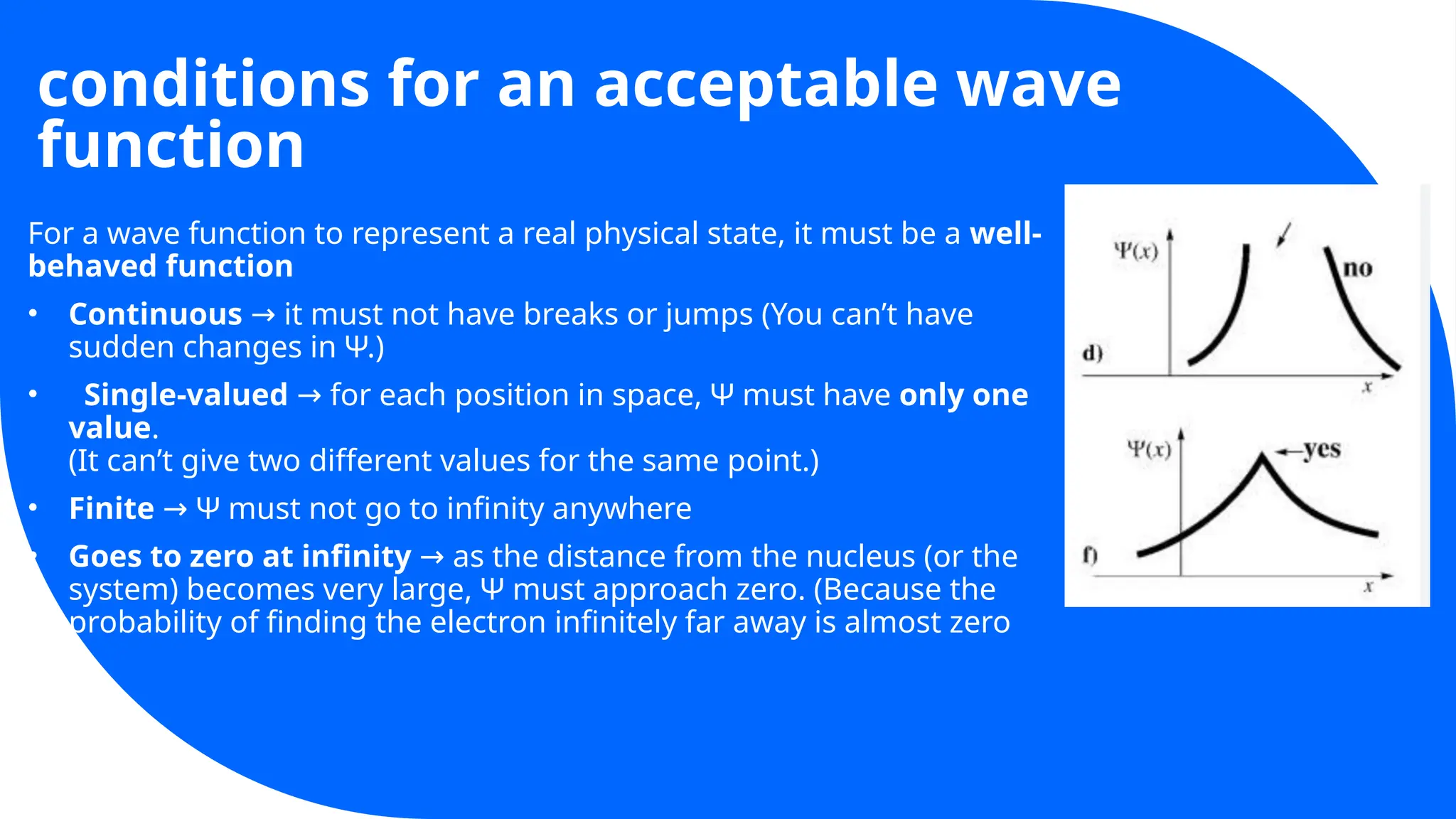
For a wave function to represent a real physical state, it must be a well-
behaved function
• Continuous it must not have breaks or jumps (You can’t have
→
sudden changes in Ψ.)
• Single-valued for each position in space, Ψ must have
→ only one
value.
(It can’t give two different values for the same point.)
• Finite Ψ must not go to infinity anywhere
→
• Goes to zero at infinity as the distance from the nucleus (or the
→
system) becomes very large, Ψ must approach zero. (Because the
probability of finding the electron infinitely far away is almost zero
The Hamiltonian
Operator
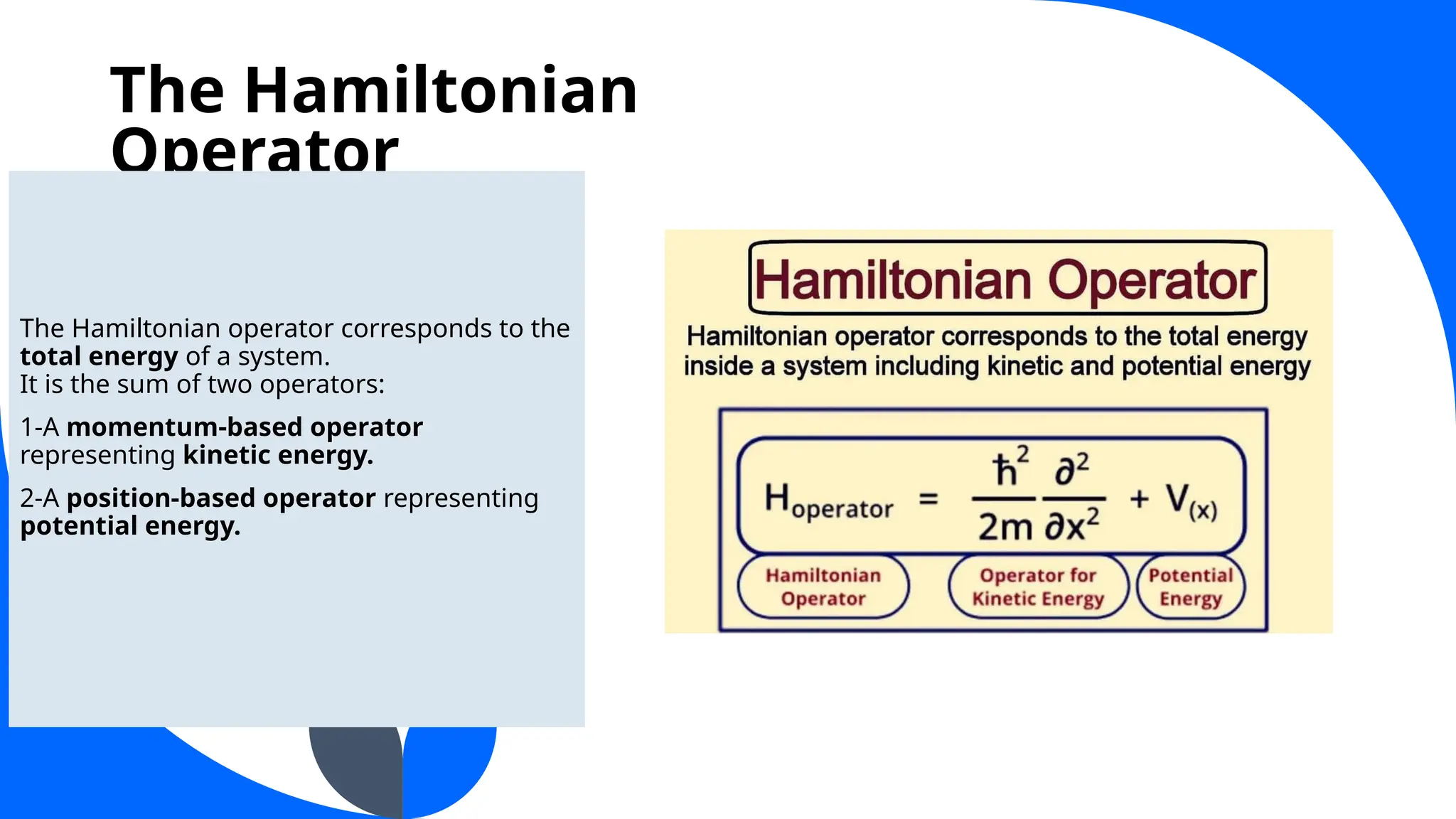
The Hamiltonian operator corresponds to the
total energy of a system.
It is the sum of two operators:
1-A momentum-based operator
representing kinetic energy.
2-A position-based operator representing
potential energy.
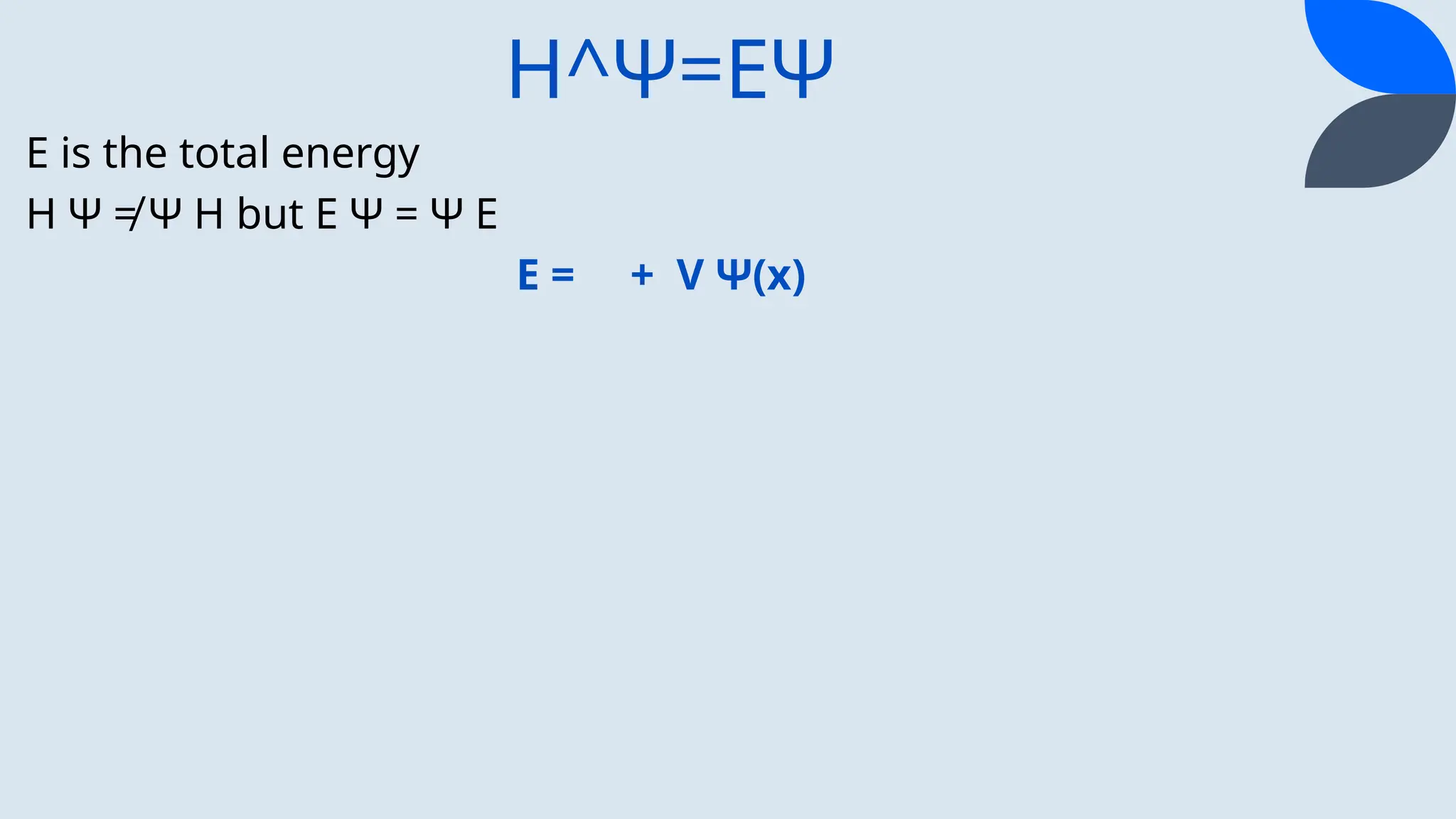
H^Ψ=EΨ
E is the total energy
H Ψ ≠ Ψ H but E Ψ = Ψ E
E = + V Ψ(x)
Solutions of Schrodinger equation for
particle move in free space
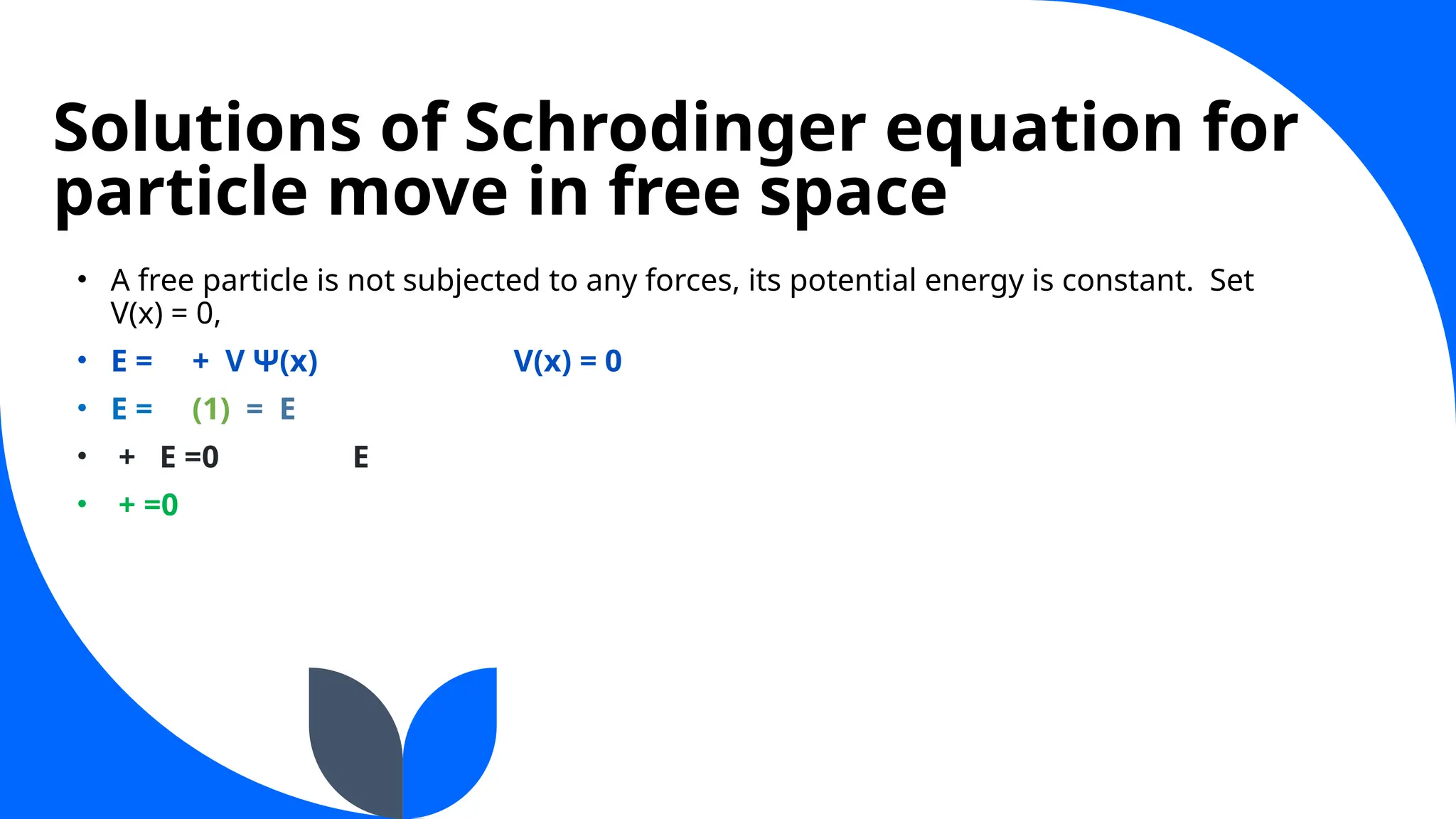
• A free particle is not subjected to any forces, its potential energy is constant. Set
V(x) = 0,
• E = + V Ψ(x) V(x) = 0
• E = (1) = E
• + E =0 E
• + =0
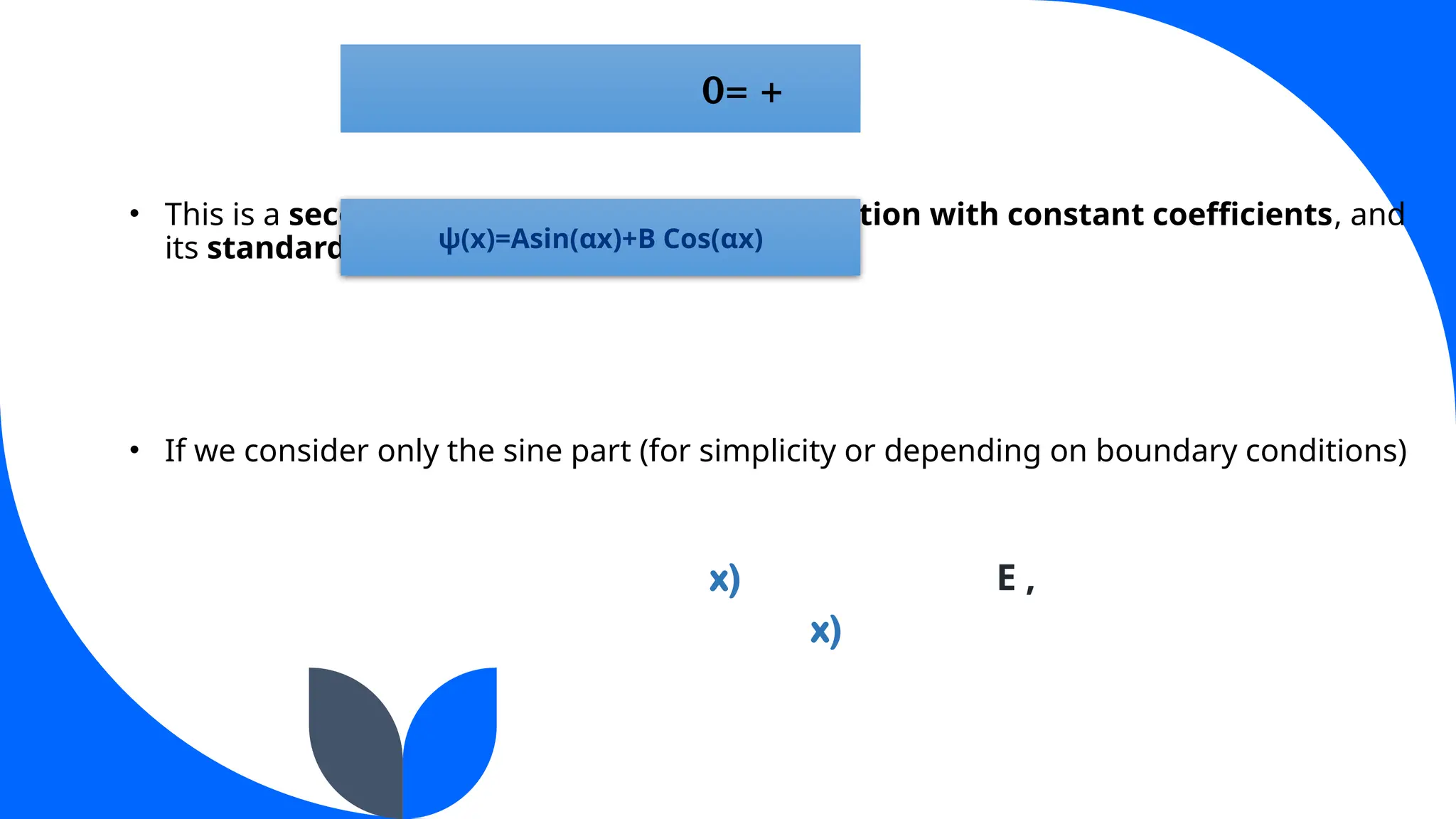
• This is a second-order linear differential equation with constant coefficients, and
its standard general solution is always:
• If we consider only the sine part (for simplicity or depending on boundary conditions)
x) E ,
x)
= +
0
ψ(x)=Asin(αx)+B Cos(αx)
the wave function for a free
particle in three dimensions:
x)
)
)
ψfree​= x) ) )
Thank you
Brita Tamm
502-555-0152
brita@firstupconsultants.com
www.firstupconsultants.com

شردنجر.....................................pptx

  • 1.
  • 2.
    Agenda Physical meaning ofΨ Basic postulates of quantum mechanics The Hamiltonian Operator Solutions of Schrodinger equation for particle move in free space
  • 3.
    Physical meaning ofΨ: • No meaning can be assigned to wave function ψ as it is because it complex function • Schrodinger define as amplitude of wave that associated with particle but this is wrong • According to Max Born’s interpretation of the wave function, the only quantity that has some meaning is • is the propability density for finding the particle at a given location in space(imaginary number is squared to get a real number solution )
  • 4.
    Basic postulates ofquantum mechanics: 1- Ψ is known as the wave function, it is usually complex quantity containing an imaginary part beside a real part, so it is not observable and its physical meaning is unknown 2- |Ψ|2 has a definite physical meaning (it gives the probability of finding the electron) 3- Hence, the probability of finding the particle in an infinitesimal volume dv=dx dy dz is dv If we integrate over the entire space, the total probability must be equal to one: This ensures that the particle must exist somewhere in space. If the integral value equals 0, the electron is certainly absent there.
  • 5.
    conditions for anacceptable wave function For a wave function to represent a real physical state, it must be a well- behaved function • Continuous it must not have breaks or jumps (You can’t have → sudden changes in Ψ.) • Single-valued for each position in space, Ψ must have → only one value. (It can’t give two different values for the same point.) • Finite Ψ must not go to infinity anywhere → • Goes to zero at infinity as the distance from the nucleus (or the → system) becomes very large, Ψ must approach zero. (Because the probability of finding the electron infinitely far away is almost zero
  • 6.
    The Hamiltonian Operator The Hamiltonianoperator corresponds to the total energy of a system. It is the sum of two operators: 1-A momentum-based operator representing kinetic energy. 2-A position-based operator representing potential energy.
  • 7.
    H^Ψ=EΨ E is thetotal energy H Ψ ≠ Ψ H but E Ψ = Ψ E E = + V Ψ(x)
  • 8.
    Solutions of Schrodingerequation for particle move in free space • A free particle is not subjected to any forces, its potential energy is constant. Set V(x) = 0, • E = + V Ψ(x) V(x) = 0 • E = (1) = E • + E =0 E • + =0
  • 9.
    • This isa second-order linear differential equation with constant coefficients, and its standard general solution is always: • If we consider only the sine part (for simplicity or depending on boundary conditions) x) E , x) = + 0 ψ(x)=Asin(αx)+B Cos(αx)
  • 10.
    the wave functionfor a free particle in three dimensions: x) ) ) ψfree​= x) ) )
  • 11.