The History
of
Periodic Table
1. Johann Wolfgang Dobereiner
2.John Newlands
3.Dmitri Ivanovich Mendeleev
4. Henry Mosely
Döbereiner's
Triads
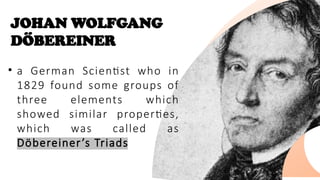
JOHAN WOLFGANG
DÖBEREINER
• a German Scientist who in
1829 found some groups of
three elements which
showed similar properties,
which was called as
Döbereiner’s Triads
2
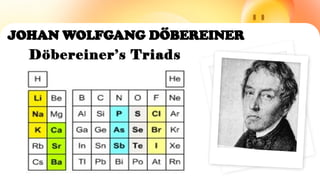
JOHAN WOLFGANG DÖBEREINER
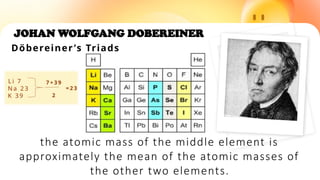
Döbereiner’s Triads
2
JOHAN WOLFGANG DOBEREINER
the atomic mass of the middle element is
approximately the mean of the atomic masses of
the other two elements.
L i 7
N a 2 3
K 3 9
7 + 3 9
2
= 2 3
Döbereiner’s Triads
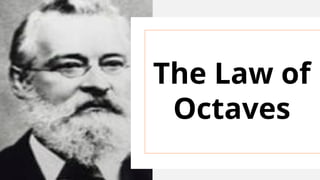
The Law of
Octaves
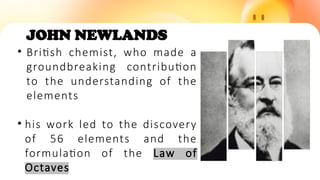
JOHN NEWLANDS
• British chemist, who made a
groundbreaking contribution
to the understanding of the
elements
• his work led to the discovery
of 56 elements and the
formulation of the Law of
Octaves
Newland’s Octave
The Law of Octaves,
was a significant step
towards
understanding the
periodic nature of
elements.
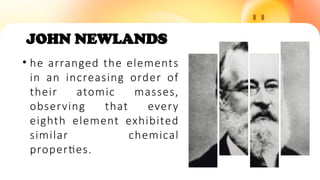
JOHN NEWLANDS
• he arranged the elements
in an increasing order of
their atomic masses,
observing that every
eighth element exhibited
similar chemical
properties.
JOHN NEWLANDS
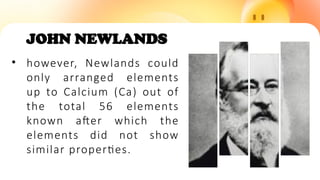
• however, Newlands could
only arranged elements
up to Calcium (Ca) out of
the total 56 elements
known after which the
elements did not show
similar properties.
JOHN NEWLANDS
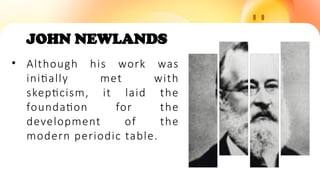
• Although his work was
initially met with
skepticism, it laid the
foundation for the
development of the
modern periodic table.
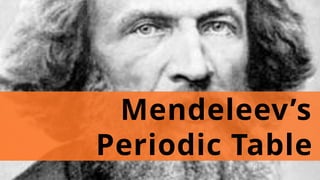
Mendeleev’s
Periodic Table
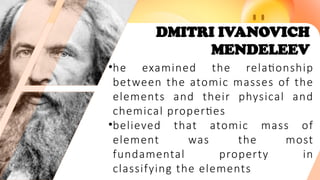
DMITRI IVANOVICH
MENDELEEV
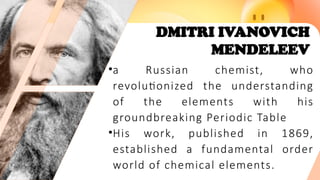
•a Russian chemist, who
revolutionized the understanding
of the elements with his
groundbreaking Periodic Table
•His work, published in 1869,
established a fundamental order
world of chemical elements.
DMITRI IVANOVICH
MENDELEEV
•he examined the relationship
between the atomic masses of the
elements and their physical and
chemical properties
•believed that atomic mass of
element was the most
fundamental property in
classifying the elements
DMITRI IVANOVICH
MENDELEEV
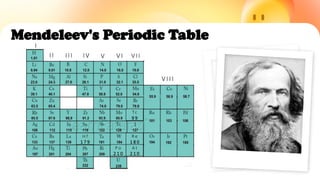
•he arranged the known elements in
the increasing order of their
atomic masses and their properties
and thus created the first periodic
table containing 63 elements till
then known as Mendeleev’s
periodic table
Mendeleev's Periodic Table
Tc
9 9
R e
1 8 0
A t
2 1 0
P o
2 1 0
H f
1 7 9
I
II III IV V VI V I I
VIII
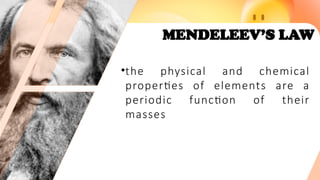
MENDELEEV’S LAW
•the physical and chemical
properties of elements are a
periodic function of their
masses
Mendeleev's Periodic Table
T c
9 9
R e
1 8 0
A t
2 1 0
P o
2 1 0
H f
1 7 9
I
I I I I I I V V V I V I I
V I I I
PERIODS
GROUPS
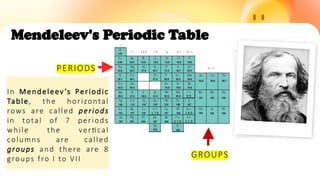
In Mendeleev ’s Periodic
Table, the horizontal
rows are called periods
in total of 7 periods
while the vertical
columns are called
groups and there are 8
groups fro I to VII
DMITRI IVANOVICH
MENDELEEV
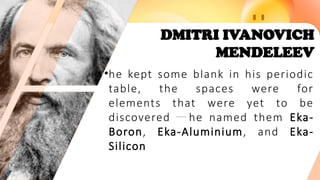
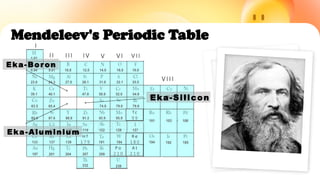
•he kept some blank in his periodic
table, the spaces were for
elements that were yet to be
discovered he named them Eka-
Boron, Eka-Aluminium, and Eka-
Silicon
Mendeleev's Periodic Table
Tc
9 9
R e
1 8 0
A t
2 1 0
P o
2 1 0
H f
1 7 9
I
II III IV V VI V I I
VIII
Eka-Bor on
Eka-Aluminium
Eka-Silicon
Mendeleev's Periodic Table
Tc
9 9
R e
1 8 0
A t
2 1 0
P o
2 1 0
H f
1 7 9
I
II III IV V VI V I I
VIII
S c
4 5 . 0
G a
6 9 . 7
G e
7 2 . 6
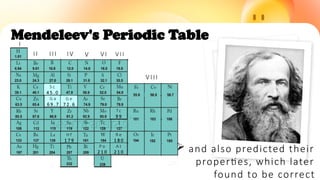
 and also predicted their
properties, which later
found to be correct
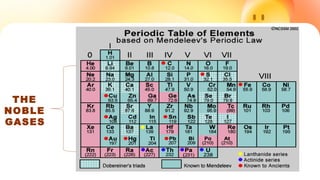
• then the noble gases
where discovered and they
were placed in
Mendeleev’s table without
disturbing the position of
other elements
THE
NOBLE
GASES
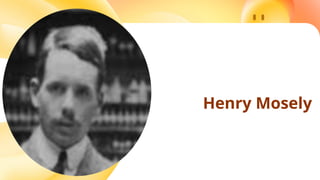
Henry Mosely
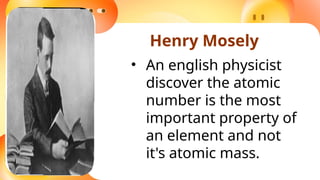
Henry Mosely
• An english physicist
discover the atomic
number is the most
important property of
an element and not
it's atomic mass.
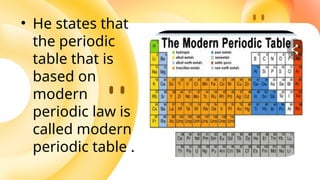
• He states that
the periodic
table that is
based on
modern
periodic law is
called modern
periodic table .
Thank
You
LIMUTAN, GERAH LIZA
RUBIO, MARRY GRACE
MOMAR, ROMILYN
SERINO, MEREIEL
MAKITID, JANCHINE
PARRENO, RAMIL
MANO, JOANAH
PREPARED BY:
MAGLASANG, JONARD
MISPEROS, KENJIE
MASICAMPO, DAN IVAN
NAQUILA, EUGENE
HABAGAT, KENT
MEDEL, ALJIERIVEN
MAHAWAN, TJ