Everyday digital scholarship
Using web-based tools for research
Francesca Di Donato
University of Pisa, COST A32
In Our End are Fresh Beginnings
Perspectives for Open Scholarly Communities on the Web
München, 2 Oct. 2010
didonato@sp.unipi.it
Topics
• Searching the Web or: How to make a smart use
of search engines
• Storing, organizing, sharing sources
• Disseminate your results
The research
community had used links
between paper
documents for ages:
Table of contents, indexes,
bibliographies, and
reference sections are
hypertext links....
On the Web, however, [...]
scientists could escape from
the sequential organization of
each paper and bibliography,
to pick and choose a path of
references that served their
own interests. [1]
The Web is our library:
How to search inside it?
A paradox as a premise
Plato Meno, XIV 80d–e/81a
I know,
Meno, what you
mean; but just see what a
tiresome dispute you are
introducing. You argue that man
cannot enquire either about that
which he knows, or about that
which he does not know; for if he
knows, he has no need to enquire;
and if not, he cannot; for he
does not know the very
subject about which he is to
enquire.
And how
will you enquire,
Socrates, into that
which you do not
know? What will you put
forth as the subject of
enquiry? And if you find
what you want, how will
you ever know that this
is the thing which
you did not know?
Topology of the Web
The web is a graph: an abstract representation of a set of
objects where some pairs of the objects (vertices)
are connected by links (edges).
(Koenigsberg bridges, 1736)
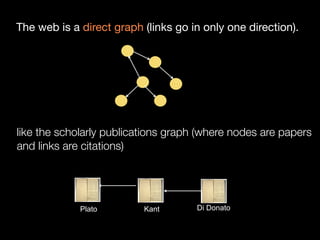
The web is a direct graph (links go in only one direction).
like the scholarly publications graph (where nodes are papers
and links are citations)
Plato Kant Di Donato
The web is a direct graph (links go in only one direction).
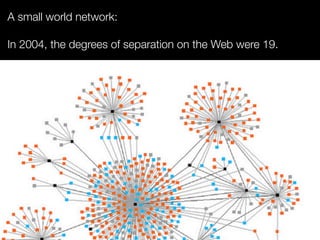
A small world network:
In 2004, the degrees of separation on the Web were 19.
On the Web, not all the nodes are equal: there are hubs
and authorities
The biggest nodes are in contact with most part of nodes
http://thenextweb.org/wp-content/uploads/2008/06/fragmented.jpg
Which is then the Web form?
It has 4 continents.. but we can explore only two of them
[Witt et al, p. 93]
Exploring the Web surface:
on the use of SES
Though hundreds of search engines are freely and publicly available,
a very few capture the overwhelming majority of the audience.
According to the well-known 80/20 rule, 80 percent of users are
concentrated on 20 percent of applications.
Users trust their own ability as web searchers
More than 90 percent of people who use search engines say they
are confident in the answers; half are very confident. Users also
judge their research activities as successful in most cases.
The less Internet experience people have, the more successful
they regard their own searches.
[I.H. Witten, M. Gori, T. Numerico, Web Dragons, pp. 23-4].
Surveys have revealed that more than two-thirds of users believe
that search engines are a fair and unbiased source of
information.
In SES we trust
A smart use of
search engines is
essential for a good
researcher
Search engines
are many and
different
Rule n. 1
many!!!
http://www.searchlores.org/main.htm
Fravia’s map
Best s.e.:
CUIL
MSNsearch
Google - GOOGLE dedicated page
Ask
Yahoo! - YAHOO dedicated page
Fast
Altavista
Useful s.e.
Wayback (past)
Lycos
Gigablast
Swicki ("vertical")
IceRocket (webarchive)
Rollyo ("vertical")
Graph s.e.
Touch (graph)
Dicy (cluster)
Mooter (cluster)
Second Tier
Alexa
Exalead (date & regexp)
A 9 (google's )
Baidu
"Visual" s.e.
lyGO ("visual" search)
yaouba ("visual" & anon)
searchme ("visual" search)
Other
Entireweb
Excite (not † but very ill)
Factbite (encycl)
dmoz (directory)
Furl (webarchive)
[FTPSEARCH]
searching techniques and
tips @ fravia's
Golden rules
Long term
Short term
Deep web
Files repos
Targets
Local
Regional
Compound
Usenet
Accmail
Live searches
Combing
Klebing
Guessing
Databases
Allinones
Images
Books
Laws
Files
Filez
Passwords
Cadavers
Teoma († 07)
Wisenut († 07)
Ouverture († 07)
Northernlight († 02)
Webtop († 01)
and the web is plenty of websites and
books on this subject
http://www.searchlores.org/main.htm
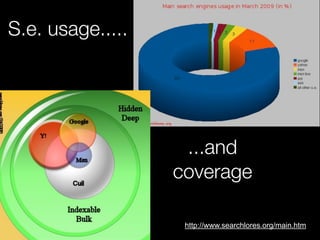
S.e. usage.....
...and
coverage
http://www.langreiter.com/exec/yahoo-vs-google.html?q=searchlores
Rule 2.
Learn
how to formulate
your queries
Rule 3.
Use operators
http://www.searchlores.org/operators.htm
Ex: Google operators
site:
allintitle: (all of the query words in the title)
intitle: (that word in the title)
allinURL: (all of the query words in the URL)
inURL: (that word in the URL)
cache:
link:
related: (pages that are "similar" to a specified web page)
info: (google's info)
other practical advices
1. use small letters
other practical advices
1. use small letters
2. use inverted commas [“”]
other practical advices
1. use small letters
2. use inverted commas [“”]
3. Insert errors
other practical advices
1. use small letters
2. use inverted commas [“”]
3. Insert errors
4. Use booleans
other practical advices
1. use small letters
2. use inverted commas [“”]
3. Insert errors
4. Use booleans
5. Use asterisk [*]
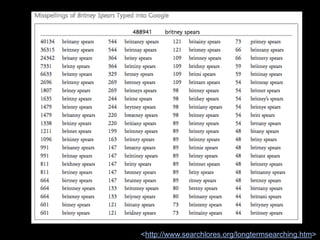
<http://www.searchlores.org/longtermsearching.htm>
Long term searching
(ex. a PhD thesis, a book)<http://www.searchlores.org/longtermsearching.htm>
see also: http://www.searchlores.org/effective_searching.htm
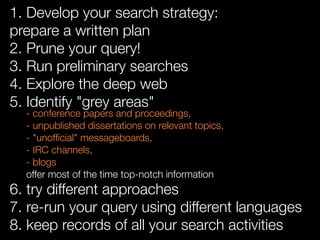
1. Develop your search strategy:
prepare a written plan
2. Prune your query!
3. Run preliminary searches
4. Explore the deep web
5. Identify "grey areas"
- conference papers and proceedings,
- unpublished dissertations on relevant topics,
- "unofficial" messageboards,
- IRC channels,
- blogs
offer most of the time top-notch information
6. try different approaches
7. re-run your query using different languages
8. keep records of all your search activities
Organizing your searches:
results and paths
Web 2.0 or Social Web
1) The Web as a platform
Ex. Google account http://www.google.it
2) Software as a service (not as a product)
3) Decentralization: every client is a server
(P2P)
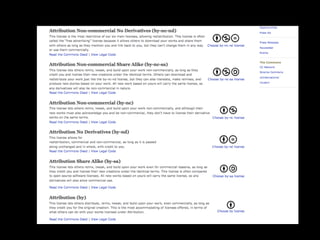
4) Some rights reserved
Ex. Napster, Emule, etc..
Ex. Creative Commons
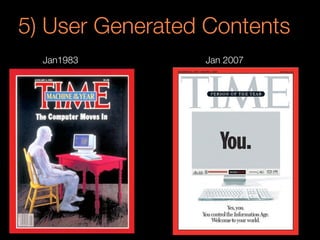
Jan 2007
5) User Generated Contents
Jan1983
Web 2.0: a video
<http://www.youtube.com/watch?v=6gmP4nk0EOE>
The Machine is Us/ing Us
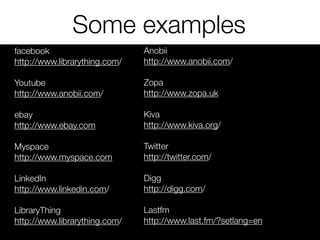
Some examples
facebook
http://www.librarything.com/
Youtube
http://www.anobii.com/
ebay
http://www.ebay.com
Myspace
http://www.myspace.com
LinkedIn
http://www.linkedin.com/
LibraryThing
http://www.librarything.com/
Anobii
http://www.anobii.com/
Zopa
http://www.zopa.uk
Kiva
http://www.kiva.org/
Twitter
http://twitter.com/
Digg
http://digg.com/
Lastfm
http://www.last.fm/?setlang=en
Social networks
for scholarly research
delicious
http://delicious.com/
Connotea
http://www.connotea.org/
CiteULike
http://citeulike.org/
Zotero
http://www.zotero.org
MediaCommons
http://mediacommons.futureofthebook.org
Academia.edu
http://www.academia.edu
PanMind
http://www.panmind.org/
Other?
Sign In
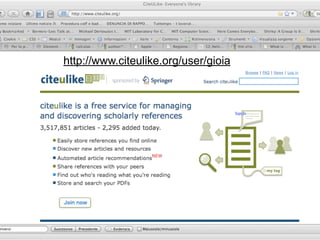
http://www.citeulike.org/user/gioia
Disseminate your results
Two Scholarly Publishing systems:
2nd. The "Web age"
1st. The "Printing Era"
To publish means to make intellectual productions
accessible for the public of readers.
In the Academia
dissemination means publishing
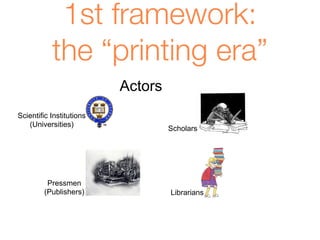
Librarians
Scientific Institutions
(Universities)
Pressmen
(Publishers)
1st framework:
the “printing era”
Scholars
Actors
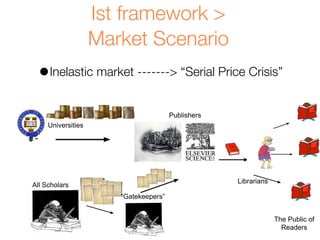
•Inelastic market -------> “Serial Price Crisis”
Ist framework >
Market Scenario
All Scholars
Universities
Publishers
Librarians
The Public of
Readers
“Gatekeepers”
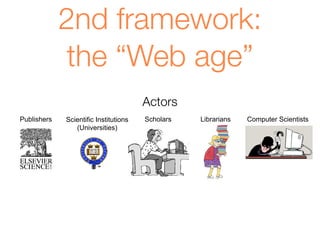
2nd framework:
the “Web age”
Actors
LibrariansScientific Institutions
(Universities)
Publishers Scholars Computer Scientists
A new scenario
Public Repositories
Open Journals
Traditional
printed Journals
Print on
demand
Blogs
Other channels
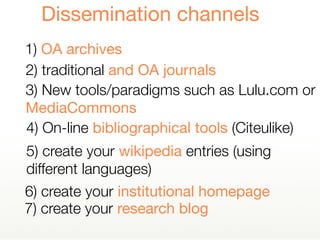
Dissemination channels
1) OA archives
Dissemination channels
1) OA archives
Dissemination channels
2) traditional and OA journals
1) OA archives
Dissemination channels
2) traditional and OA journals
3) New tools/paradigms such as Lulu.com or
MediaCommons
1) OA archives
Dissemination channels
2) traditional and OA journals
4) On-line bibliographical tools (Citeulike)
3) New tools/paradigms such as Lulu.com or
MediaCommons
5) create your wikipedia entries (using
different languages)
1) OA archives
Dissemination channels
2) traditional and OA journals
4) On-line bibliographical tools (Citeulike)
3) New tools/paradigms such as Lulu.com or
MediaCommons
5) create your wikipedia entries (using
different languages)
1) OA archives
Dissemination channels
2) traditional and OA journals
4) On-line bibliographical tools (Citeulike)
6) create your institutional homepage
3) New tools/paradigms such as Lulu.com or
MediaCommons
5) create your wikipedia entries (using
different languages)
1) OA archives
Dissemination channels
2) traditional and OA journals
4) On-line bibliographical tools (Citeulike)
7) create your research blog
6) create your institutional homepage
3) New tools/paradigms such as Lulu.com or
MediaCommons
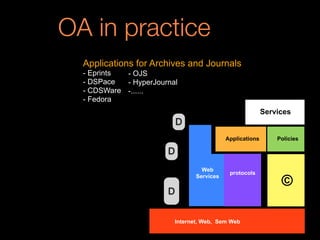
OA in practice
Applications for Archives and Journals
- Eprints
- DSPace
- CDSWare
- Fedora
- OJS
- HyperJournal
-......
D
D
D
©
protocols
Applications Policies
Web
Services
Services
Internet, Web, Sem Web
OA in practice
Applications for Archives and Journals
- Eprints
- DSPace
- CDSWare
- Fedora
- OJS
- HyperJournal
-......
D
D
D
©
protocols
Applications Policies
Web
Services
Services
Internet, Web, Sem WebInfrastructure
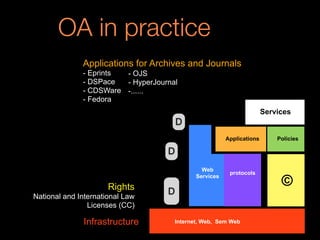
OA in practice
Applications for Archives and Journals
- Eprints
- DSPace
- CDSWare
- Fedora
- OJS
- HyperJournal
-......
D
D
D
©
protocols
Applications Policies
Web
Services
Services
Internet, Web, Sem WebInfrastructure
Rights
National and International Law
Licenses (CC)
OA in practice
Protocols, standard
OAI-PMH, RSS, Dublin Core, ...
Applications for Archives and Journals
- Eprints
- DSPace
- CDSWare
- Fedora
- OJS
- HyperJournal
-......
D
D
D
©
protocols
Applications Policies
Web
Services
Services
Internet, Web, Sem WebInfrastructure
Rights
National and International Law
Licenses (CC)
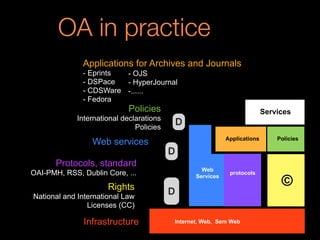
OA in practice
Protocols, standard
OAI-PMH, RSS, Dublin Core, ...
Applications for Archives and Journals
- Eprints
- DSPace
- CDSWare
- Fedora
- OJS
- HyperJournal
-......
D
D
D
©
protocols
Applications Policies
Web
Services
Services
Internet, Web, Sem WebInfrastructure
Rights
National and International Law
Licenses (CC)
Web services
OA in practice
Protocols, standard
OAI-PMH, RSS, Dublin Core, ...
Applications for Archives and Journals
- Eprints
- DSPace
- CDSWare
- Fedora
- OJS
- HyperJournal
-......
D
D
D
©
protocols
Applications Policies
Web
Services
Services
Internet, Web, Sem WebInfrastructure
Rights
National and International Law
Licenses (CC)
Policies
International declarations
Policies
Web services
OA in practice
Protocols, standard
OAI-PMH, RSS, Dublin Core, ...
Applications for Archives and Journals
- Eprints
- DSPace
- CDSWare
- Fedora
- OJS
- HyperJournal
-......
D
D
D
©
protocols
Applications Policies
Web
Services
Services
Internet, Web, Sem WebInfrastructure
Rights
National and International Law
Licenses (CC)
Policies
International declarations
Policies
Web services
?
MediaCommons
Kathleen Fitzpatrick, Scholarly Publishing in the Age of the
Internet, <http://mediacommons.futureofthebook.org/mcpress/scholarlypublishing/>
The traditional publishing system is broken.
“What exactly do we in the humanities want the future of
scholarship to look like, and what do we have to do in
order to persuade ourselves, our senior colleagues, our
departments, and our institutions — all of which tend, if
unconsciously, toward an obstinate luddism — that such a
future is not only acceptable but necessary?”
<http://mediacommons.futureofthebook.org/mcpress/scholarlypublishing/2-mla-task-force-recommendations/>
From “born-digital” to “consumed digital”
A publication should be evaluated without any
mediabased bias
Scholarly monograph in the digital context. How does it
change?
Scholarly monograph
must move online
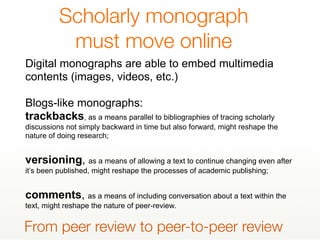
Digital monographs are able to embed multimedia
contents (images, videos, etc.)
Blogs-like monographs:
trackbacks, as a means parallel to bibliographies of tracing scholarly
discussions not simply backward in time but also forward, might reshape the
nature of doing research;
versioning, as a means of allowing a text to continue changing even after
it’s been published, might reshape the processes of academic publishing;
comments, as a means of including conversation about a text within the
text, might reshape the nature of peer-review.
From peer review to peer-to-peer review
A democratic knowledge
exchange system
Whitworth B., Friedman R., Reinventing Academic Publishing online. PART II. A Socio-Technical Vision,
«First Monday», 14, 9, 2009,<http://&rstmonday.org/htbin/cgiwrap/bin/ojs/index.php/fm/article/view/2642/2287>.
How to calculate/
quantify your
impact
OA and evaluation
Plurality
of sources and criteria
(not only indexes: peer-to-peer review!)
Trasparence
of processes
Access
to documents and data
OA and evaluation
In practice it’s possible
1. to calculate different indexes on OAI-compliant archives
and journal networks
2. to use download metrics
3. to use social network analysis-based metrics, such as:
Degree Centrality:
“The sum of the number of relationships pointing to and from an actor, i.e., their in- and out-degree,
normalized by the total number of relationships in the social network”
Closeness Centrality:
“The average shortest path distance of an actor to all other actors in the network”.
Betweenness Centrality:
“The frequency by which an actor is part of the shortest path between any pair of agents in the
network”.
questions?
References
[1] T. Berners-Lee, Weaving the Web, p. 38.
Photos:
slide 1: http://www.flickr.com/photos/batigolix/2367456992/
slides 3,4: http://www.flickr.com/photos/marinos/4040243418/
slide 6: http://files.splinder.com/07e2282cca381de636ce4f27d9413431.jpeg
http://it-it.abctribe.com/Disegni/Guide/Generiche/Maestro-scheda%281%29.jpg
slide 7: http://physics.weber.edu/carroll/honors_images/BarbasiBridges.jpg
slides 9,10: http://www.flickr.com/photos/ajc1/2553555562/
slide 11: http://m.blog.hu/ne/nemlinearis/image/erdosgraph.jpg
slide 14: http://www.flickr.com/photos/osvaldo_zoom/3506973686/
slide 15: http://media.ly/images/search_engines.jpg
A-L. Barabàsi, Linked: The New Science of Networks
(Perseus, Cambridge, MA, 2002).
I.H. Witten, M. Gori, T. Numerico, Web Dragons.
Inside the Myths of Search Engine Technology,
Morgan Kaufmann Publishers-Elsevier, San Francisco
2007.
Fravia, Searchlores. Advanced Internet searching
strategies & advice. Resources for basic, advanced &
deep web seekers, http://www.searchlores.org.
On-line resources
Deep web searching.
The lore of searching: how to exploit the shallow deep_web
http://www.searchlores.org/deepweb_searching.htm
How to find books and texts
http://www.searchlores.org/books.htm
Combing
http://www.searchlores.org/combing.htm
Regional search engines
http://www.searchlores.org/regional.htm
Blog
http://www.searchlores.org/blog.htm
Essays
http://www.searchlores.org/essays.htm
Classrooms
http://www.searchlores.org/c_intro.htm
Conferences and workshops
http://www.searchlores.org/mines.htm
The lore of (dinosauria) researching (An "how to" for young web seekers)
How to research, evaluate and collate web material
by A+heist (heavily edited by fravia+), February 2008
http://www.searchlores.org/how_to_research.htm
http://www.gutenberg.org: Project Gutenberg
http://gutenberg.net.au/: Gutenberg australia
(As the oz law is just 50 years max...)
http://gallica.bnf.fr/: Gallica
http://about.eserver.org/: Eserver
http://books.google.com/books?: Google books
http://scholar.google.com/: Google scholar
http://en.scientificcommons.org/: Index of OAI-compliant papers
http://www.archive.org/search.php?query=subject%3A%22search%22: Internet Archive
http://vlib.org.uk/: The WWW Virtual Library
http://digital.library.upenn.edu/books/search.html: The University of Pensylvania Online
Books Page
http://abu.cnam.fr/index.html: ABU: la Bibliothèque Universelle
http://www.opencontentalliance.org/: Open Content Alliance
http://www.readprint.com/: Our website offers thousands of free books for students,
teachers, and the classic enthusiast.
http://www.gutenberg.org/: There are 17,000 free books in the Project Gutenberg
Online Book Catalog.
http://www.bibliomania.com/: Free Online Literature with more than 2000 Classic Texts
http://digital.library.upenn.edu/books/: Upenn.edu, Listing over 25,000 free books on
the Web
http://www.ipl.org/div/subject/browse/hum60.60.00/: The Internet Public Library,
Literature Online Texts
Texts for SSH
http://www.literature.org/: An Online Library of Literature. Read. Learn. Think.
http://www.loc.gov/: The Library of Congress serves as the research arm of the US-
Congress.
http://ota.ahds.ac.uk/: The Oxford Text Archive hosts AHDS Literature, Languages and
Linguistics.
http://bcdlib.tc.ca/links-subjects.html: British Columbia digital library: The focus of this
set of links is on collections of electronic texts (not individual titles) preserved through
libraries, archives, museums and corporate or private initiatives.
http://un2sg4.unige.ch/athena/html/fran_fr.html: Textes d'auteurs d'expression
française
http://www.intratext.com/: Full-text Digital Library committed to accuracy,
accessibility and usability, offering texts and corpora as lexical hypertexts
http://www.fordham.edu/halsall/sbook2.html: Internet Medieval Sourcebook
http://pomoerium.com/links.htm: classics resources
http://un2sg4.unige.ch/athena/html/fran_fr.html: Textes d'auteurs d'expression
française
http://www.intratext.com/: Full-text Digital Library committed to accuracy,
accessibility and usability, offering texts and corpora as lexical hypertexts
http://www.fordham.edu/halsall/sbook2.html: Internet Medieval Sourcebook
http://pomoerium.com/links.htm: classics resources
http://germazope.uni-trier.de/Projects/DWB: Das Deutsche Wörterbuch von
Jacob und Wilhelm Grimm auf CD-ROM und im Internet
http://www.ikp.uni-bonn.de/kant/: Das Bonner Kant-Korpus. Elektronische
Edition der Gesammelten Werke Immanuel Kants
http://dewey.library.upenn.edu/sceti: SCETI. Virtual facsimiles of rare books and
manuscripts.
http://dsal.uchicago.edu/index.html: Digital South Asia Library
http://www.fiu.edu/~mirandas/cardinals.htm: The Cardinals of the Holy Roman Church
http://www.1911encyclopedia.org/: (Britannica, eleventh edition)
http://www.newadvent.org/cathen/: The Catholic Encyclopedia
http://plato.stanford.edu/: Stanford Encyclopedia of Philosophy
http://ourworld.compuserve.com/homepages/cornwall_business_systems/index.htm:
A Smaller Classical Dictionary of Biography, Mythology and Geography
http://lexicorient.com/e.o/index.htm: The Encyclopaedia of the Orient.
http://astronomy.nju.edu.cn/twkp/astrobook/Oth_Historical.html: Astronomical Books
Online
http://www.biblegateway.com/: "Enter the Bible passage (e.g. John 3:16),
keyword (e.g. Jesus, prophet, etc.) or topic (e.g. salvation) you want to find"
http://www.questia.com/Index.jsp: Questia, Your Online Library for Research.
Search over 60,000 Scholarly Books and 1,000,000 Journals.
Finding laws, UE and UN documents
http://www.searchlores.org/laws.htm
http://www.searchlores.org/frav_eu2.htm
http://www.searchlores.org/eurosearch.htm
http://www.searchlores.org/frav_eu1.htm
Others
http://avaxhome.ws/
http://gigapedia.com/
See also: http://www.searchlores.org/books.htm
Universal library: http://www.searchlores.org/universallibrary.htm
Classicalia
http://www.thelatinlibrary.com/index.html: the latin library, latin
http://www.thelatinlibrary.com/neo.html: the latin library, neo-latin
http://www.forumromanum.org/literature/authors_a.html: Corpus scriptorum latinorum
http://www.fh-augsburg.de/~harsch/a_chron.html#latmed: BIBLIOTHECA AUGUSTANA
(Bibliotheca Latina scriptorum latinorum collectio)
http://www.corpusthomisticum.org/iopera.html: CORPUS THOMISTICUM S. THOMAE DE
AQUINO OPERA OMNIA
http://www.textkit.com/: Textkit is the Internet's largest provider of free and fully
downloadable Greek and Latin grammars and readers. With currently 146 free books to
choose from.
http://www.molfettanet.com/tradizioni/pesi_e_misure.htm: Pesi e misure nell'antichità
(Italian)
http://www.ancientlibrary.com/wcd/: The wiki classical dictionary at ancientlibrary (currently
down :-(
http://www.perseus.tufts.edu/hopper/: Perseus Digital Library
De re orientalia
http://omphaloskepsis.com/collection/index.html: Omphaloskepsis
Omphaloskepsis provides free access to important works of eastern literature in
digital format.
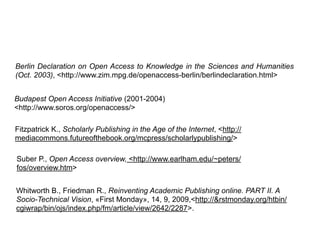
Whitworth B., Friedman R., Reinventing Academic Publishing online. PART II. A
Socio-Technical Vision, «First Monday», 14, 9, 2009,<http://&rstmonday.org/htbin/
cgiwrap/bin/ojs/index.php/fm/article/view/2642/2287>.
Fitzpatrick K., Scholarly Publishing in the Age of the Internet, <http://
mediacommons.futureofthebook.org/mcpress/scholarlypublishing/>
Berlin Declaration on Open Access to Knowledge in the Sciences and Humanities
(Oct. 2003), <http://www.zim.mpg.de/openaccess-berlin/berlindeclaration.html>
Budapest Open Access Initiative (2001-2004)
<http://www.soros.org/openaccess/>
Suber P., Open Access overview, <http://www.earlham.edu/~peters/
fos/overview.htm>

Everyday digital scholarship: Using web-based tools for research

  • 1.
    Everyday digital scholarship Usingweb-based tools for research Francesca Di Donato University of Pisa, COST A32 In Our End are Fresh Beginnings Perspectives for Open Scholarly Communities on the Web München, 2 Oct. 2010 didonato@sp.unipi.it
  • 2.
    Topics • Searching theWeb or: How to make a smart use of search engines • Storing, organizing, sharing sources • Disseminate your results
  • 3.
    The research community hadused links between paper documents for ages: Table of contents, indexes, bibliographies, and reference sections are hypertext links....
  • 4.
    On the Web,however, [...] scientists could escape from the sequential organization of each paper and bibliography, to pick and choose a path of references that served their own interests. [1]
  • 5.
    The Web isour library:
  • 6.
    The Web isour library: How to search inside it?
  • 7.
    A paradox asa premise Plato Meno, XIV 80d–e/81a I know, Meno, what you mean; but just see what a tiresome dispute you are introducing. You argue that man cannot enquire either about that which he knows, or about that which he does not know; for if he knows, he has no need to enquire; and if not, he cannot; for he does not know the very subject about which he is to enquire. And how will you enquire, Socrates, into that which you do not know? What will you put forth as the subject of enquiry? And if you find what you want, how will you ever know that this is the thing which you did not know?
  • 8.
    Topology of theWeb The web is a graph: an abstract representation of a set of objects where some pairs of the objects (vertices) are connected by links (edges). (Koenigsberg bridges, 1736)
  • 9.
    The web isa direct graph (links go in only one direction).
  • 10.
    like the scholarlypublications graph (where nodes are papers and links are citations) Plato Kant Di Donato The web is a direct graph (links go in only one direction).
  • 11.
    A small worldnetwork: In 2004, the degrees of separation on the Web were 19.
  • 12.
    On the Web,not all the nodes are equal: there are hubs and authorities The biggest nodes are in contact with most part of nodes
  • 14.
    http://thenextweb.org/wp-content/uploads/2008/06/fragmented.jpg Which is thenthe Web form? It has 4 continents.. but we can explore only two of them
  • 15.
  • 16.
    Exploring the Websurface: on the use of SES Though hundreds of search engines are freely and publicly available, a very few capture the overwhelming majority of the audience. According to the well-known 80/20 rule, 80 percent of users are concentrated on 20 percent of applications.
  • 17.
    Users trust theirown ability as web searchers More than 90 percent of people who use search engines say they are confident in the answers; half are very confident. Users also judge their research activities as successful in most cases. The less Internet experience people have, the more successful they regard their own searches. [I.H. Witten, M. Gori, T. Numerico, Web Dragons, pp. 23-4]. Surveys have revealed that more than two-thirds of users believe that search engines are a fair and unbiased source of information. In SES we trust
  • 18.
    A smart useof search engines is essential for a good researcher
  • 19.
    Search engines are manyand different Rule n. 1
  • 20.
  • 21.
    Fravia’s map Best s.e.: CUIL MSNsearch Google- GOOGLE dedicated page Ask Yahoo! - YAHOO dedicated page Fast Altavista Useful s.e. Wayback (past) Lycos Gigablast Swicki ("vertical") IceRocket (webarchive) Rollyo ("vertical") Graph s.e. Touch (graph) Dicy (cluster) Mooter (cluster) Second Tier Alexa Exalead (date & regexp) A 9 (google's ) Baidu "Visual" s.e. lyGO ("visual" search) yaouba ("visual" & anon) searchme ("visual" search) Other Entireweb Excite (not † but very ill) Factbite (encycl) dmoz (directory) Furl (webarchive) [FTPSEARCH] searching techniques and tips @ fravia's Golden rules Long term Short term Deep web Files repos Targets Local Regional Compound Usenet Accmail Live searches Combing Klebing Guessing Databases Allinones Images Books Laws Files Filez Passwords Cadavers Teoma († 07) Wisenut († 07) Ouverture († 07) Northernlight († 02) Webtop († 01)
  • 22.
    and the webis plenty of websites and books on this subject
  • 23.
  • 24.
  • 25.
    Rule 2. Learn how toformulate your queries
  • 26.
    Rule 3. Use operators http://www.searchlores.org/operators.htm Ex:Google operators site: allintitle: (all of the query words in the title) intitle: (that word in the title) allinURL: (all of the query words in the URL) inURL: (that word in the URL) cache: link: related: (pages that are "similar" to a specified web page) info: (google's info)
  • 27.
  • 28.
    other practical advices 1.use small letters
  • 29.
    other practical advices 1.use small letters 2. use inverted commas [“”]
  • 30.
    other practical advices 1.use small letters 2. use inverted commas [“”] 3. Insert errors
  • 31.
    other practical advices 1.use small letters 2. use inverted commas [“”] 3. Insert errors 4. Use booleans
  • 32.
    other practical advices 1.use small letters 2. use inverted commas [“”] 3. Insert errors 4. Use booleans 5. Use asterisk [*]
  • 33.
  • 34.
    Long term searching (ex.a PhD thesis, a book)<http://www.searchlores.org/longtermsearching.htm> see also: http://www.searchlores.org/effective_searching.htm
  • 35.
    1. Develop yoursearch strategy: prepare a written plan 2. Prune your query! 3. Run preliminary searches 4. Explore the deep web 5. Identify "grey areas" - conference papers and proceedings, - unpublished dissertations on relevant topics, - "unofficial" messageboards, - IRC channels, - blogs offer most of the time top-notch information 6. try different approaches 7. re-run your query using different languages 8. keep records of all your search activities
  • 36.
  • 37.
    Web 2.0 orSocial Web 1) The Web as a platform Ex. Google account http://www.google.it 2) Software as a service (not as a product) 3) Decentralization: every client is a server (P2P) 4) Some rights reserved Ex. Napster, Emule, etc.. Ex. Creative Commons
  • 39.
    Jan 2007 5) UserGenerated Contents Jan1983
  • 40.
    Web 2.0: avideo <http://www.youtube.com/watch?v=6gmP4nk0EOE> The Machine is Us/ing Us
  • 41.
  • 42.
    Social networks for scholarlyresearch delicious http://delicious.com/ Connotea http://www.connotea.org/ CiteULike http://citeulike.org/ Zotero http://www.zotero.org MediaCommons http://mediacommons.futureofthebook.org Academia.edu http://www.academia.edu PanMind http://www.panmind.org/ Other?
  • 43.
  • 44.
  • 45.
    Two Scholarly Publishingsystems: 2nd. The "Web age" 1st. The "Printing Era" To publish means to make intellectual productions accessible for the public of readers. In the Academia dissemination means publishing
  • 46.
  • 47.
    •Inelastic market ------->“Serial Price Crisis” Ist framework > Market Scenario All Scholars Universities Publishers Librarians The Public of Readers “Gatekeepers”
  • 48.
    2nd framework: the “Webage” Actors LibrariansScientific Institutions (Universities) Publishers Scholars Computer Scientists
  • 49.
    A new scenario PublicRepositories Open Journals Traditional printed Journals Print on demand Blogs Other channels
  • 50.
  • 51.
  • 52.
    1) OA archives Disseminationchannels 2) traditional and OA journals
  • 53.
    1) OA archives Disseminationchannels 2) traditional and OA journals 3) New tools/paradigms such as Lulu.com or MediaCommons
  • 54.
    1) OA archives Disseminationchannels 2) traditional and OA journals 4) On-line bibliographical tools (Citeulike) 3) New tools/paradigms such as Lulu.com or MediaCommons
  • 55.
    5) create yourwikipedia entries (using different languages) 1) OA archives Dissemination channels 2) traditional and OA journals 4) On-line bibliographical tools (Citeulike) 3) New tools/paradigms such as Lulu.com or MediaCommons
  • 56.
    5) create yourwikipedia entries (using different languages) 1) OA archives Dissemination channels 2) traditional and OA journals 4) On-line bibliographical tools (Citeulike) 6) create your institutional homepage 3) New tools/paradigms such as Lulu.com or MediaCommons
  • 57.
    5) create yourwikipedia entries (using different languages) 1) OA archives Dissemination channels 2) traditional and OA journals 4) On-line bibliographical tools (Citeulike) 7) create your research blog 6) create your institutional homepage 3) New tools/paradigms such as Lulu.com or MediaCommons
  • 58.
    OA in practice Applicationsfor Archives and Journals - Eprints - DSPace - CDSWare - Fedora - OJS - HyperJournal -...... D D D © protocols Applications Policies Web Services Services Internet, Web, Sem Web
  • 59.
    OA in practice Applicationsfor Archives and Journals - Eprints - DSPace - CDSWare - Fedora - OJS - HyperJournal -...... D D D © protocols Applications Policies Web Services Services Internet, Web, Sem WebInfrastructure
  • 60.
    OA in practice Applicationsfor Archives and Journals - Eprints - DSPace - CDSWare - Fedora - OJS - HyperJournal -...... D D D © protocols Applications Policies Web Services Services Internet, Web, Sem WebInfrastructure Rights National and International Law Licenses (CC)
  • 61.
    OA in practice Protocols,standard OAI-PMH, RSS, Dublin Core, ... Applications for Archives and Journals - Eprints - DSPace - CDSWare - Fedora - OJS - HyperJournal -...... D D D © protocols Applications Policies Web Services Services Internet, Web, Sem WebInfrastructure Rights National and International Law Licenses (CC)
  • 62.
    OA in practice Protocols,standard OAI-PMH, RSS, Dublin Core, ... Applications for Archives and Journals - Eprints - DSPace - CDSWare - Fedora - OJS - HyperJournal -...... D D D © protocols Applications Policies Web Services Services Internet, Web, Sem WebInfrastructure Rights National and International Law Licenses (CC) Web services
  • 63.
    OA in practice Protocols,standard OAI-PMH, RSS, Dublin Core, ... Applications for Archives and Journals - Eprints - DSPace - CDSWare - Fedora - OJS - HyperJournal -...... D D D © protocols Applications Policies Web Services Services Internet, Web, Sem WebInfrastructure Rights National and International Law Licenses (CC) Policies International declarations Policies Web services
  • 64.
    OA in practice Protocols,standard OAI-PMH, RSS, Dublin Core, ... Applications for Archives and Journals - Eprints - DSPace - CDSWare - Fedora - OJS - HyperJournal -...... D D D © protocols Applications Policies Web Services Services Internet, Web, Sem WebInfrastructure Rights National and International Law Licenses (CC) Policies International declarations Policies Web services ?
  • 65.
    MediaCommons Kathleen Fitzpatrick, ScholarlyPublishing in the Age of the Internet, <http://mediacommons.futureofthebook.org/mcpress/scholarlypublishing/> The traditional publishing system is broken. “What exactly do we in the humanities want the future of scholarship to look like, and what do we have to do in order to persuade ourselves, our senior colleagues, our departments, and our institutions — all of which tend, if unconsciously, toward an obstinate luddism — that such a future is not only acceptable but necessary?” <http://mediacommons.futureofthebook.org/mcpress/scholarlypublishing/2-mla-task-force-recommendations/>
  • 66.
    From “born-digital” to“consumed digital” A publication should be evaluated without any mediabased bias Scholarly monograph in the digital context. How does it change?
  • 67.
    Scholarly monograph must moveonline Digital monographs are able to embed multimedia contents (images, videos, etc.) Blogs-like monographs: trackbacks, as a means parallel to bibliographies of tracing scholarly discussions not simply backward in time but also forward, might reshape the nature of doing research; versioning, as a means of allowing a text to continue changing even after it’s been published, might reshape the processes of academic publishing; comments, as a means of including conversation about a text within the text, might reshape the nature of peer-review. From peer review to peer-to-peer review
  • 68.
    A democratic knowledge exchangesystem Whitworth B., Friedman R., Reinventing Academic Publishing online. PART II. A Socio-Technical Vision, «First Monday», 14, 9, 2009,<http://&rstmonday.org/htbin/cgiwrap/bin/ojs/index.php/fm/article/view/2642/2287>.
  • 69.
  • 70.
    OA and evaluation Plurality ofsources and criteria (not only indexes: peer-to-peer review!) Trasparence of processes Access to documents and data
  • 71.
    OA and evaluation Inpractice it’s possible 1. to calculate different indexes on OAI-compliant archives and journal networks 2. to use download metrics 3. to use social network analysis-based metrics, such as: Degree Centrality: “The sum of the number of relationships pointing to and from an actor, i.e., their in- and out-degree, normalized by the total number of relationships in the social network” Closeness Centrality: “The average shortest path distance of an actor to all other actors in the network”. Betweenness Centrality: “The frequency by which an actor is part of the shortest path between any pair of agents in the network”.
  • 72.
  • 73.
    References [1] T. Berners-Lee,Weaving the Web, p. 38. Photos: slide 1: http://www.flickr.com/photos/batigolix/2367456992/ slides 3,4: http://www.flickr.com/photos/marinos/4040243418/ slide 6: http://files.splinder.com/07e2282cca381de636ce4f27d9413431.jpeg http://it-it.abctribe.com/Disegni/Guide/Generiche/Maestro-scheda%281%29.jpg slide 7: http://physics.weber.edu/carroll/honors_images/BarbasiBridges.jpg slides 9,10: http://www.flickr.com/photos/ajc1/2553555562/ slide 11: http://m.blog.hu/ne/nemlinearis/image/erdosgraph.jpg slide 14: http://www.flickr.com/photos/osvaldo_zoom/3506973686/ slide 15: http://media.ly/images/search_engines.jpg
  • 74.
    A-L. Barabàsi, Linked:The New Science of Networks (Perseus, Cambridge, MA, 2002). I.H. Witten, M. Gori, T. Numerico, Web Dragons. Inside the Myths of Search Engine Technology, Morgan Kaufmann Publishers-Elsevier, San Francisco 2007. Fravia, Searchlores. Advanced Internet searching strategies & advice. Resources for basic, advanced & deep web seekers, http://www.searchlores.org.
  • 76.
  • 77.
    Deep web searching. Thelore of searching: how to exploit the shallow deep_web http://www.searchlores.org/deepweb_searching.htm How to find books and texts http://www.searchlores.org/books.htm Combing http://www.searchlores.org/combing.htm Regional search engines http://www.searchlores.org/regional.htm Blog http://www.searchlores.org/blog.htm Essays http://www.searchlores.org/essays.htm Classrooms http://www.searchlores.org/c_intro.htm Conferences and workshops http://www.searchlores.org/mines.htm The lore of (dinosauria) researching (An "how to" for young web seekers) How to research, evaluate and collate web material by A+heist (heavily edited by fravia+), February 2008 http://www.searchlores.org/how_to_research.htm
  • 78.
    http://www.gutenberg.org: Project Gutenberg http://gutenberg.net.au/:Gutenberg australia (As the oz law is just 50 years max...) http://gallica.bnf.fr/: Gallica http://about.eserver.org/: Eserver http://books.google.com/books?: Google books http://scholar.google.com/: Google scholar http://en.scientificcommons.org/: Index of OAI-compliant papers http://www.archive.org/search.php?query=subject%3A%22search%22: Internet Archive http://vlib.org.uk/: The WWW Virtual Library http://digital.library.upenn.edu/books/search.html: The University of Pensylvania Online Books Page http://abu.cnam.fr/index.html: ABU: la Bibliothèque Universelle http://www.opencontentalliance.org/: Open Content Alliance http://www.readprint.com/: Our website offers thousands of free books for students, teachers, and the classic enthusiast. http://www.gutenberg.org/: There are 17,000 free books in the Project Gutenberg Online Book Catalog. http://www.bibliomania.com/: Free Online Literature with more than 2000 Classic Texts http://digital.library.upenn.edu/books/: Upenn.edu, Listing over 25,000 free books on the Web http://www.ipl.org/div/subject/browse/hum60.60.00/: The Internet Public Library, Literature Online Texts Texts for SSH
  • 79.
    http://www.literature.org/: An OnlineLibrary of Literature. Read. Learn. Think. http://www.loc.gov/: The Library of Congress serves as the research arm of the US- Congress. http://ota.ahds.ac.uk/: The Oxford Text Archive hosts AHDS Literature, Languages and Linguistics. http://bcdlib.tc.ca/links-subjects.html: British Columbia digital library: The focus of this set of links is on collections of electronic texts (not individual titles) preserved through libraries, archives, museums and corporate or private initiatives. http://un2sg4.unige.ch/athena/html/fran_fr.html: Textes d'auteurs d'expression française http://www.intratext.com/: Full-text Digital Library committed to accuracy, accessibility and usability, offering texts and corpora as lexical hypertexts http://www.fordham.edu/halsall/sbook2.html: Internet Medieval Sourcebook http://pomoerium.com/links.htm: classics resources http://un2sg4.unige.ch/athena/html/fran_fr.html: Textes d'auteurs d'expression française http://www.intratext.com/: Full-text Digital Library committed to accuracy, accessibility and usability, offering texts and corpora as lexical hypertexts http://www.fordham.edu/halsall/sbook2.html: Internet Medieval Sourcebook http://pomoerium.com/links.htm: classics resources http://germazope.uni-trier.de/Projects/DWB: Das Deutsche Wörterbuch von Jacob und Wilhelm Grimm auf CD-ROM und im Internet http://www.ikp.uni-bonn.de/kant/: Das Bonner Kant-Korpus. Elektronische Edition der Gesammelten Werke Immanuel Kants http://dewey.library.upenn.edu/sceti: SCETI. Virtual facsimiles of rare books and manuscripts.
  • 80.
    http://dsal.uchicago.edu/index.html: Digital SouthAsia Library http://www.fiu.edu/~mirandas/cardinals.htm: The Cardinals of the Holy Roman Church http://www.1911encyclopedia.org/: (Britannica, eleventh edition) http://www.newadvent.org/cathen/: The Catholic Encyclopedia http://plato.stanford.edu/: Stanford Encyclopedia of Philosophy http://ourworld.compuserve.com/homepages/cornwall_business_systems/index.htm: A Smaller Classical Dictionary of Biography, Mythology and Geography http://lexicorient.com/e.o/index.htm: The Encyclopaedia of the Orient. http://astronomy.nju.edu.cn/twkp/astrobook/Oth_Historical.html: Astronomical Books Online http://www.biblegateway.com/: "Enter the Bible passage (e.g. John 3:16), keyword (e.g. Jesus, prophet, etc.) or topic (e.g. salvation) you want to find" http://www.questia.com/Index.jsp: Questia, Your Online Library for Research. Search over 60,000 Scholarly Books and 1,000,000 Journals. Finding laws, UE and UN documents http://www.searchlores.org/laws.htm http://www.searchlores.org/frav_eu2.htm http://www.searchlores.org/eurosearch.htm http://www.searchlores.org/frav_eu1.htm Others http://avaxhome.ws/ http://gigapedia.com/ See also: http://www.searchlores.org/books.htm Universal library: http://www.searchlores.org/universallibrary.htm
  • 81.
    Classicalia http://www.thelatinlibrary.com/index.html: the latinlibrary, latin http://www.thelatinlibrary.com/neo.html: the latin library, neo-latin http://www.forumromanum.org/literature/authors_a.html: Corpus scriptorum latinorum http://www.fh-augsburg.de/~harsch/a_chron.html#latmed: BIBLIOTHECA AUGUSTANA (Bibliotheca Latina scriptorum latinorum collectio) http://www.corpusthomisticum.org/iopera.html: CORPUS THOMISTICUM S. THOMAE DE AQUINO OPERA OMNIA http://www.textkit.com/: Textkit is the Internet's largest provider of free and fully downloadable Greek and Latin grammars and readers. With currently 146 free books to choose from. http://www.molfettanet.com/tradizioni/pesi_e_misure.htm: Pesi e misure nell'antichità (Italian) http://www.ancientlibrary.com/wcd/: The wiki classical dictionary at ancientlibrary (currently down :-( http://www.perseus.tufts.edu/hopper/: Perseus Digital Library De re orientalia http://omphaloskepsis.com/collection/index.html: Omphaloskepsis Omphaloskepsis provides free access to important works of eastern literature in digital format.
  • 82.
    Whitworth B., FriedmanR., Reinventing Academic Publishing online. PART II. A Socio-Technical Vision, «First Monday», 14, 9, 2009,<http://&rstmonday.org/htbin/ cgiwrap/bin/ojs/index.php/fm/article/view/2642/2287>. Fitzpatrick K., Scholarly Publishing in the Age of the Internet, <http:// mediacommons.futureofthebook.org/mcpress/scholarlypublishing/> Berlin Declaration on Open Access to Knowledge in the Sciences and Humanities (Oct. 2003), <http://www.zim.mpg.de/openaccess-berlin/berlindeclaration.html> Budapest Open Access Initiative (2001-2004) <http://www.soros.org/openaccess/> Suber P., Open Access overview, <http://www.earlham.edu/~peters/ fos/overview.htm>