Tips for Critical Thinking
Source: “It’s Critical” Reading Selection in Section 2.4
Americans Have Access to…
•1 million new books each year
•5,500 magazines
•10,500 radio stations
•65,000 iPhone apps
•1,000,000,000,000 Web pages[1]
Critical thinking is the ability to discover the value of an idea, a
set of beliefs, a claim, or an argument. It requires you to use
logic and reasoning to evaluate evidence or information to make
a decision or reach a conclusion.
Critical thinking is
• a foundation for effective communication,
• the principal skill used in effective decision making,
• at the core of creating new knowledge,
• a way to uncover bias and prejudices.
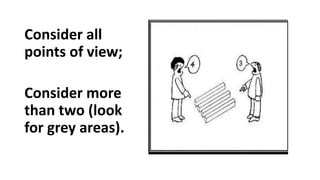
Consider all
points of view;
Consider more
than two (look
for grey areas).
Keep an open
mind.
Answer three questions about your supporting data:
• Is it enough support?
• Is it the right support?
• Is it credible?
Look for evidence that contradicts your point of view.
Pretend to disagree with the position you are
supporting.
What parts of your argument are weak?
Do you have the supporting facts to overcome that
evidence?
Create a set of criteria you will use to evaluate the strength of
information you want to use to support your argument. Ask questions
like these:
What is the source of this information?
Is the author well respected in the field?
When was this information developed? Is that important? Why?
Does the author or publisher have an agenda for publishing the
information? How does that agenda affect the credibility of the
information?
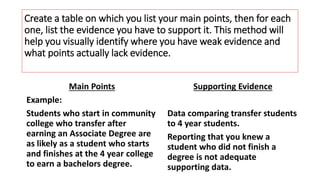
Create a table on which you list your main points, then for each
one, list the evidence you have to support it. This method will
help you visually identify where you have weak evidence and
what points actually lack evidence.
Main Points
Example:
Students who start in community
college who transfer after
earning an Associate Degree are
as likely as a student who starts
and finishes at the 4 year college
to earn a bachelors degree.
Supporting Evidence
Data comparing transfer students
to 4 year students.
Reporting that you knew a
student who did not finish a
degree is not adequate
supporting data.
Be willing to admit that you lack information to
support a point of view or make a decision.
Ask questions or do some focused research to get
what you still need.
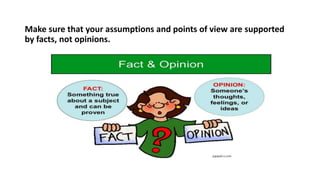
Make sure that your assumptions and points of view are supported
by facts, not opinions.
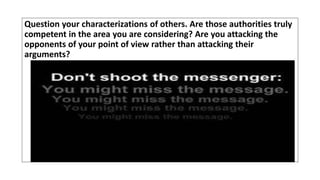
Question your characterizations of others. Are those authorities truly
competent in the area you are considering? Are you attacking the
opponents of your point of view rather than attacking their
arguments?
Be careful of broad generalizations.
Claims that use absolute words like “all,” “none,” “always,” “never,” “no
one,” and “everyone” require much more proof than claims that use
words like “most,” “some,” “often,” “rarely,” “sometimes,” and so on.
*****Watch for this one in True False Questions on tests!
Critical thinking rg

Critical thinking rg

  • 1.
    Tips for CriticalThinking Source: “It’s Critical” Reading Selection in Section 2.4
  • 2.
    Americans Have Accessto… •1 million new books each year •5,500 magazines •10,500 radio stations •65,000 iPhone apps •1,000,000,000,000 Web pages[1]
  • 3.
    Critical thinking isthe ability to discover the value of an idea, a set of beliefs, a claim, or an argument. It requires you to use logic and reasoning to evaluate evidence or information to make a decision or reach a conclusion. Critical thinking is • a foundation for effective communication, • the principal skill used in effective decision making, • at the core of creating new knowledge, • a way to uncover bias and prejudices.
  • 5.
    Consider all points ofview; Consider more than two (look for grey areas).
  • 6.
  • 7.
    Answer three questionsabout your supporting data: • Is it enough support? • Is it the right support? • Is it credible?
  • 8.
    Look for evidencethat contradicts your point of view. Pretend to disagree with the position you are supporting. What parts of your argument are weak? Do you have the supporting facts to overcome that evidence?
  • 9.
    Create a setof criteria you will use to evaluate the strength of information you want to use to support your argument. Ask questions like these: What is the source of this information? Is the author well respected in the field? When was this information developed? Is that important? Why? Does the author or publisher have an agenda for publishing the information? How does that agenda affect the credibility of the information?
  • 10.
    Create a tableon which you list your main points, then for each one, list the evidence you have to support it. This method will help you visually identify where you have weak evidence and what points actually lack evidence. Main Points Example: Students who start in community college who transfer after earning an Associate Degree are as likely as a student who starts and finishes at the 4 year college to earn a bachelors degree. Supporting Evidence Data comparing transfer students to 4 year students. Reporting that you knew a student who did not finish a degree is not adequate supporting data.
  • 11.
    Be willing toadmit that you lack information to support a point of view or make a decision. Ask questions or do some focused research to get what you still need.
  • 12.
    Make sure thatyour assumptions and points of view are supported by facts, not opinions.
  • 14.
    Question your characterizationsof others. Are those authorities truly competent in the area you are considering? Are you attacking the opponents of your point of view rather than attacking their arguments?
  • 15.
    Be careful ofbroad generalizations. Claims that use absolute words like “all,” “none,” “always,” “never,” “no one,” and “everyone” require much more proof than claims that use words like “most,” “some,” “often,” “rarely,” “sometimes,” and so on. *****Watch for this one in True False Questions on tests!