




SCHIZOPHRENIA
Created by :- Lulun Guite. Psy-III.
WHAT IS SCHIZOPHRENIA?
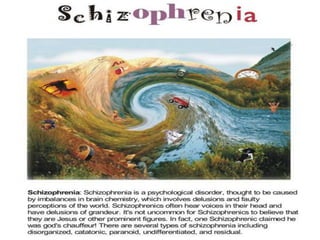
• Schizophrenia is a psychological disorder.
• It is classified separately from other disorder because it
is not easily categorized as an anxiety or mood
disorder.
• Schizophrenia is characterized by the inability to
separate reality from non-reality or fantasy.
• Schizophrenic patients often experience non-existent
stimuli that create perceptions of things that do not
exist, such as voices.
• Symptoms may include: flat effect (exhibiting no
emotion), delusions, hallucinations, or disorganized
thinking.
INTRODUCTION
Schizophrenic disorder is a complex mental disorder that makes it difficult to –
o Tell the difference between real and unreal experience.
o Think logically.
o Have normal emotional responses.
o Behave normally in social situation.
Although these common symptoms are found in most of us, every
individual cannot be called a schizophrenic person. This symptoms
varies in degrees and in nature. Some scholars like Saundrak Carson
states that; “this disorder is characterized by an array of diverse
symptoms, including- extreme oddities in perception, thinking,
action, sense of self and behaviour relating to others.”
Although the hallmark of schizophrenia is a significant loss of
contact with realty, it doesn’t refer to Psychosis.
CAUSES OF SCHIZOPHRENIA
• No one knows the exact cause of schizophrenia, but
multiple possible factors have been discovered.
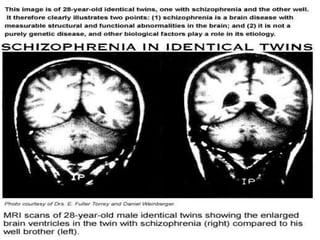
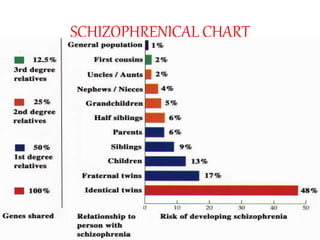
• Genetics appear to play a part; someone is more likely
to develop schizophrenia if they have an identical twin
with schizophrenia than if they have a fraternal twin
with schizophrenia.
• Women infected with the influenza virus during their
pregnancy are more likely to give birth to children who
will develop the disorder.
• Schizophrenic’s brains also contain larger fluid-filled
areas than their healthy brain counterparts.
CLINICAL PICTURE OF SCHIZOPHRENIA
According to DSM IV TR- two or more of the following
symptoms are present for a significant portion of time during
a month period.
I) Delusions
II) Hallucination
III) Disorganized Speech
IV) Catatonic behaviour
V) Negative symptoms
VI) Dysfunction in work
VII) Sign of disturbance for atleast six months .
SYMPTOMS OF SCHIZOPHRENIA
The three main symptoms of schizophrenia:
i)Positive symptoms: - Includes unusual thoughts or
perception that include hallucinations, delusions,
thought disorder and disorders of movement.
ii)Negative symptoms: – Represent a lose or
decrease in the ability to start plans, speak,
express emotion, or find any pleasure in life.
iii)Cognitive symptoms: – Problems with attention
and certain memory, and the function that allow
people to plan and organize.
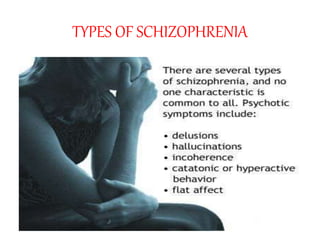
TYPES OF SCHIZOPHRENIA
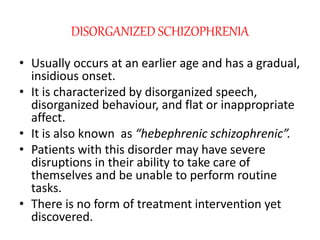
DISORGANIZED SCHIZOPHRENIA
• Usually occurs at an earlier age and has a gradual,
insidious onset.
• It is characterized by disorganized speech,
disorganized behaviour, and flat or inappropriate
affect.
• It is also known as “hebephrenic schizophrenic”.
• Patients with this disorder may have severe
disruptions in their ability to take care of
themselves and be unable to perform routine
tasks.
• There is no form of treatment intervention yet
discovered.
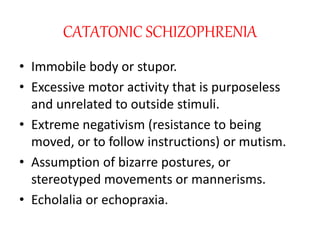
CATATONIC SCHIZOPHRENIA
• Immobile body or stupor.
• Excessive motor activity that is purposeless
and unrelated to outside stimuli.
• Extreme negativism (resistance to being
moved, or to follow instructions) or mutism.
• Assumption of bizarre postures, or
stereotyped movements or mannerisms.
• Echolalia or echopraxia.
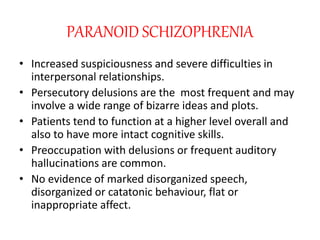
PARANOID SCHIZOPHRENIA
• Increased suspiciousness and severe difficulties in
interpersonal relationships.
• Persecutory delusions are the most frequent and may
involve a wide range of bizarre ideas and plots.
• Patients tend to function at a higher level overall and
also to have more intact cognitive skills.
• Preoccupation with delusions or frequent auditory
hallucinations are common.
• No evidence of marked disorganized speech,
disorganized or catatonic behaviour, flat or
inappropriate affect.
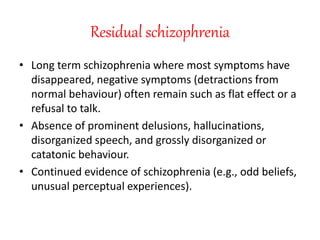
Residual schizophrenia
• Long term schizophrenia where most symptoms have
disappeared, negative symptoms (detractions from
normal behaviour) often remain such as flat effect or a
refusal to talk.
• Absence of prominent delusions, hallucinations,
disorganized speech, and grossly disorganized or
catatonic behaviour.
• Continued evidence of schizophrenia (e.g., odd beliefs,
unusual perceptual experiences).
Undifferentiated schizophrenia
• Symptoms of schizophrenia that do not meet
criteria for the Paranoid, Disorganized, or
Catatonic types.
• People in the acute, early phases of a
schizophrenic breakdown frequently exhibit
undifferentiated symptoms.
SCHIZOPHRENIC DELUSIONS
• A delusion is a false belief.
• Some common schizophrenic delusions include:
- Being cheated
- Being harassed
- Being poisoned
- Being spied upon
- Being plotted against
• Most delusions are very grandiose and involve
the patient at the center of some large plot or
scheme.
SCHIZOPHRENIC HALLUCINATION
• A hallucination is a non-existent stimulus that is
perceived as real.
• The most common Schizophrenic hallucination is
hearing voices, however the patient may also have
visual hallucinations where they see a person or object
that does not exist.
• Hallucinated voices often interact with the patient:
- By commenting on their behaviour
- By ordering them to do things
- By warning of impending dangers
- By talking to other voices about the patient.
TREATING SCHIZOPHRENIA
• Anti-psychotic drugs have been effective in treating symptoms of
schizophrenia.
• Unfortunately, these drugs can also have some mild side effects
including drowsiness, weight gain, jitters, movement problems, and
muscle contractions.
• A possible long-term side effect of anti-psychotic drugs is a
condition called tardive dyskinesia where patients will develop
uncontrollable movements.
• Another treatment is a typical anti-psychotic drugs which have less
side effects and can better treat patients not treated effectively by
the normal drugs.
• Therapy and counseling are also effective in improving behaviour as
well as creating a system of support for the patients.
Anti-psychotic drugs
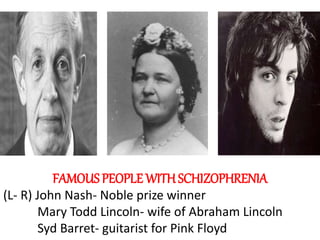
FAMOUS PEOPLE WITHSCHIZOPHRENIA
(L- R) John Nash- Noble prize winner
Mary Todd Lincoln- wife of Abraham Lincoln
Syd Barret- guitarist for Pink Floyd
SCHIZOPHRENICAL CHART
CONCLUSION
• Schizophrenia, along with depression, is one of
the only disorders known to exist in every culture
and society around the world.
• Schizophrenia effects men and women equally,
but it is usually diagnosed earlier in men.
• Schizophrenia has received a significant stigma in
history and in modern society, further facilitating
social withdrawal among schizophrenics.
• Although seemingly primitive, electroconvulsive
therapy has proven to be safe and effective in
treating several cases of schizophrenia.

Schizophrenia

  • 1.
    SCHIZOPHRENIA Created by :-Lulun Guite. Psy-III.
  • 2.
    WHAT IS SCHIZOPHRENIA? •Schizophrenia is a psychological disorder. • It is classified separately from other disorder because it is not easily categorized as an anxiety or mood disorder. • Schizophrenia is characterized by the inability to separate reality from non-reality or fantasy. • Schizophrenic patients often experience non-existent stimuli that create perceptions of things that do not exist, such as voices. • Symptoms may include: flat effect (exhibiting no emotion), delusions, hallucinations, or disorganized thinking.
  • 4.
    INTRODUCTION Schizophrenic disorder isa complex mental disorder that makes it difficult to – o Tell the difference between real and unreal experience. o Think logically. o Have normal emotional responses. o Behave normally in social situation. Although these common symptoms are found in most of us, every individual cannot be called a schizophrenic person. This symptoms varies in degrees and in nature. Some scholars like Saundrak Carson states that; “this disorder is characterized by an array of diverse symptoms, including- extreme oddities in perception, thinking, action, sense of self and behaviour relating to others.” Although the hallmark of schizophrenia is a significant loss of contact with realty, it doesn’t refer to Psychosis.
  • 5.
    CAUSES OF SCHIZOPHRENIA •No one knows the exact cause of schizophrenia, but multiple possible factors have been discovered. • Genetics appear to play a part; someone is more likely to develop schizophrenia if they have an identical twin with schizophrenia than if they have a fraternal twin with schizophrenia. • Women infected with the influenza virus during their pregnancy are more likely to give birth to children who will develop the disorder. • Schizophrenic’s brains also contain larger fluid-filled areas than their healthy brain counterparts.
  • 7.
    CLINICAL PICTURE OFSCHIZOPHRENIA According to DSM IV TR- two or more of the following symptoms are present for a significant portion of time during a month period. I) Delusions II) Hallucination III) Disorganized Speech IV) Catatonic behaviour V) Negative symptoms VI) Dysfunction in work VII) Sign of disturbance for atleast six months .
  • 8.
    SYMPTOMS OF SCHIZOPHRENIA Thethree main symptoms of schizophrenia: i)Positive symptoms: - Includes unusual thoughts or perception that include hallucinations, delusions, thought disorder and disorders of movement. ii)Negative symptoms: – Represent a lose or decrease in the ability to start plans, speak, express emotion, or find any pleasure in life. iii)Cognitive symptoms: – Problems with attention and certain memory, and the function that allow people to plan and organize.
  • 9.
  • 11.
    DISORGANIZED SCHIZOPHRENIA • Usuallyoccurs at an earlier age and has a gradual, insidious onset. • It is characterized by disorganized speech, disorganized behaviour, and flat or inappropriate affect. • It is also known as “hebephrenic schizophrenic”. • Patients with this disorder may have severe disruptions in their ability to take care of themselves and be unable to perform routine tasks. • There is no form of treatment intervention yet discovered.
  • 12.
    CATATONIC SCHIZOPHRENIA • Immobilebody or stupor. • Excessive motor activity that is purposeless and unrelated to outside stimuli. • Extreme negativism (resistance to being moved, or to follow instructions) or mutism. • Assumption of bizarre postures, or stereotyped movements or mannerisms. • Echolalia or echopraxia.
  • 13.
    PARANOID SCHIZOPHRENIA • Increasedsuspiciousness and severe difficulties in interpersonal relationships. • Persecutory delusions are the most frequent and may involve a wide range of bizarre ideas and plots. • Patients tend to function at a higher level overall and also to have more intact cognitive skills. • Preoccupation with delusions or frequent auditory hallucinations are common. • No evidence of marked disorganized speech, disorganized or catatonic behaviour, flat or inappropriate affect.
  • 14.
    Residual schizophrenia • Longterm schizophrenia where most symptoms have disappeared, negative symptoms (detractions from normal behaviour) often remain such as flat effect or a refusal to talk. • Absence of prominent delusions, hallucinations, disorganized speech, and grossly disorganized or catatonic behaviour. • Continued evidence of schizophrenia (e.g., odd beliefs, unusual perceptual experiences).
  • 15.
    Undifferentiated schizophrenia • Symptomsof schizophrenia that do not meet criteria for the Paranoid, Disorganized, or Catatonic types. • People in the acute, early phases of a schizophrenic breakdown frequently exhibit undifferentiated symptoms.
  • 16.
    SCHIZOPHRENIC DELUSIONS • Adelusion is a false belief. • Some common schizophrenic delusions include: - Being cheated - Being harassed - Being poisoned - Being spied upon - Being plotted against • Most delusions are very grandiose and involve the patient at the center of some large plot or scheme.
  • 17.
    SCHIZOPHRENIC HALLUCINATION • Ahallucination is a non-existent stimulus that is perceived as real. • The most common Schizophrenic hallucination is hearing voices, however the patient may also have visual hallucinations where they see a person or object that does not exist. • Hallucinated voices often interact with the patient: - By commenting on their behaviour - By ordering them to do things - By warning of impending dangers - By talking to other voices about the patient.
  • 19.
    TREATING SCHIZOPHRENIA • Anti-psychoticdrugs have been effective in treating symptoms of schizophrenia. • Unfortunately, these drugs can also have some mild side effects including drowsiness, weight gain, jitters, movement problems, and muscle contractions. • A possible long-term side effect of anti-psychotic drugs is a condition called tardive dyskinesia where patients will develop uncontrollable movements. • Another treatment is a typical anti-psychotic drugs which have less side effects and can better treat patients not treated effectively by the normal drugs. • Therapy and counseling are also effective in improving behaviour as well as creating a system of support for the patients.
  • 20.
  • 21.
    FAMOUS PEOPLE WITHSCHIZOPHRENIA (L-R) John Nash- Noble prize winner Mary Todd Lincoln- wife of Abraham Lincoln Syd Barret- guitarist for Pink Floyd
  • 22.
  • 23.
    CONCLUSION • Schizophrenia, alongwith depression, is one of the only disorders known to exist in every culture and society around the world. • Schizophrenia effects men and women equally, but it is usually diagnosed earlier in men. • Schizophrenia has received a significant stigma in history and in modern society, further facilitating social withdrawal among schizophrenics. • Although seemingly primitive, electroconvulsive therapy has proven to be safe and effective in treating several cases of schizophrenia.