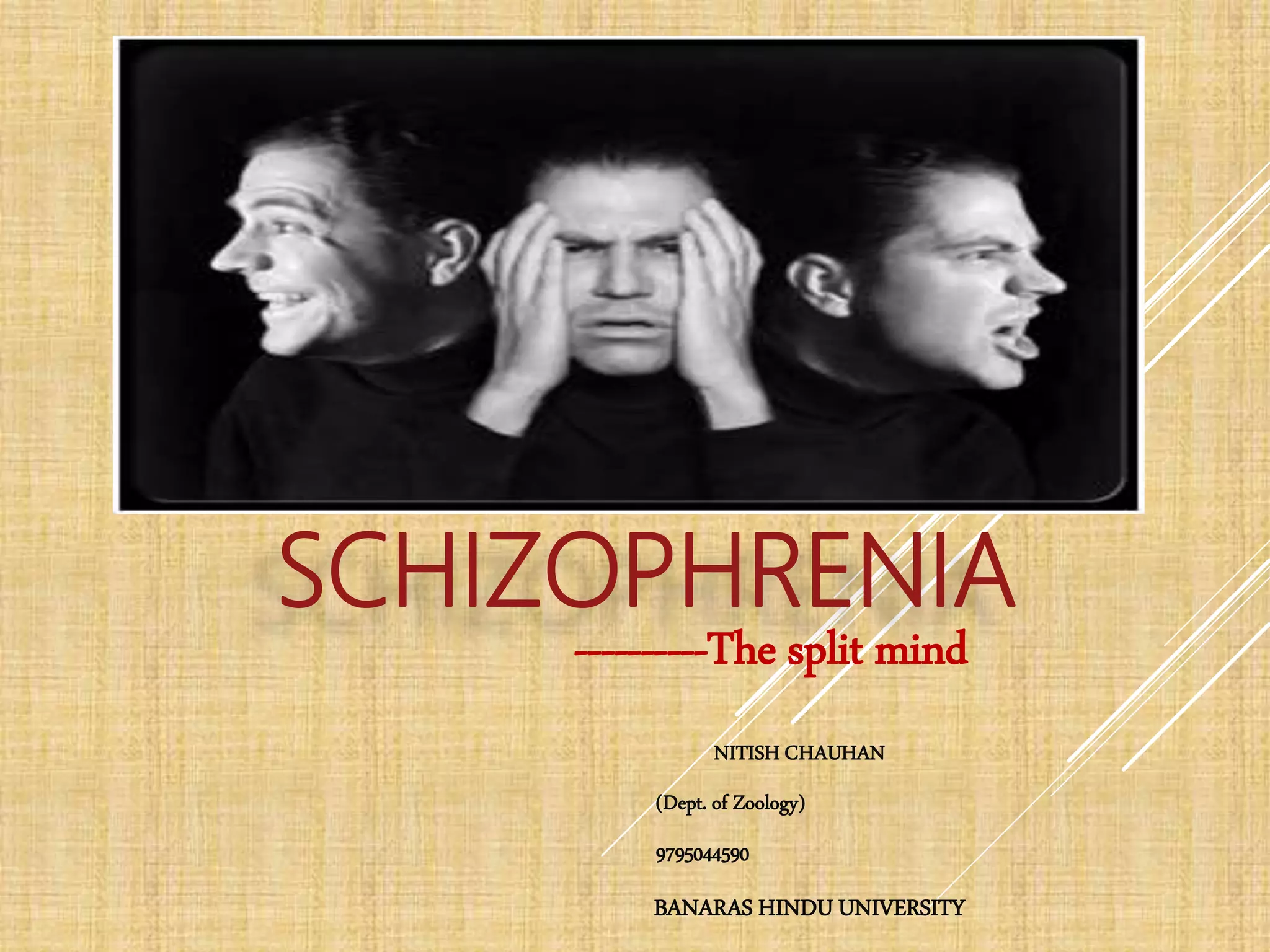
SCHIZOPHRENIA
NITISH CHAUHAN
(Dept. of Zoology)
9795044590
BANARAS HINDU UNIVERSITY
----------The split mind
OUTLINE OF PRESENTATION
WHAT IS SCHIZOPHRENIA ?
HISTORY
EPIDEMIOLOGY
TYPES OF SCHIZOPHRENIA
ETIOLOGY
SYMPTOMS OF SCHIZOPHRENIA
DIAGNOSIS
MANAGEMENT
CONCLUSION
FAMOUS PEOPLE WITH SCHIZOPHRENIA
REFERENCES
WHAT IS SCHIZOPHRENIA ?
 Schizophrenia is a psychological disorder
 Schizophrenia is characterized by the inability to
separate reality from and a non-reality.
 Schizophrenia patients often experience non-existent
stimuli that create perceptions of things that do not exist,
such as voices.
 Symptoms may include: flat effect (exhibiting no
emotion), delusions, hallucinations, or disorganized
thinking.
HISTORY
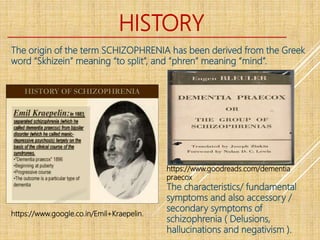
The origin of the term SCHIZOPHRENIA has been derived from the Greek
word “Skhizein” meaning “to split”, and “phren” meaning “mind”.
https://www.goodreads.com/dementia
praecox
The characteristics/ fundamental
symptoms and also accessory /
secondary symptoms of
schizophrenia ( Delusions,
hallucinations and negativism ).
https://www.google.co.in/Emil+Kraepelin.
EPIDEMIOLOGY
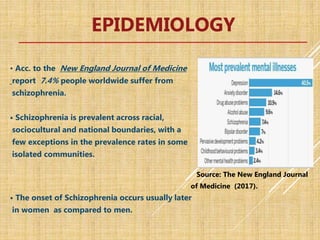
• Acc. to the New England Journal of Medicine
report 7.4% people worldwide suffer from
schizophrenia.
• Schizophrenia is prevalent across racial,
sociocultural and national boundaries, with a
few exceptions in the prevalence rates in some
isolated communities.
Source: The New England Journal
of Medicine (2017).
• The onset of Schizophrenia occurs usually later
in women as compared to men.
TYPES OF SCHIZOPHRENIA
There are five types of schizophrenia:
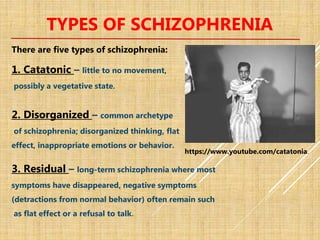
1. Catatonic – little to no movement,
possibly a vegetative state.
2. Disorganized – common archetype
of schizophrenia; disorganized thinking, flat
effect, inappropriate emotions or behavior.
3. Residual – long-term schizophrenia where most
symptoms have disappeared, negative symptoms
(detractions from normal behavior) often remain such
as flat effect or a refusal to talk.
https://www.youtube.com/catatonia.
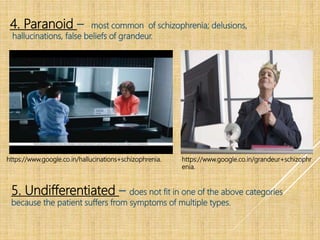
4. Paranoid – most common of schizophrenia; delusions,
hallucinations, false beliefs of grandeur.
https://www.google.co.in/grandeur+schizophr
enia.
https://www.google.co.in/hallucinations+schizophrenia.
5. Undifferentiated – does not fit in one of the above categories
because the patient suffers from symptoms of multiple types.
ETIOLOGY
1. GENETIC PREDISPOSITION:
8% in siblings of affected subjects.
12% in offspring's of one affected parent.
40% in offspring's of two affected parents.
47% in subjects of affected monozygotic twins.
2. BIOCHEMICAL FACTORS:
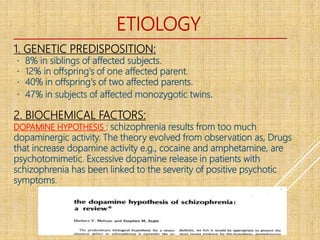
DOPAMINE HYPOTHESIS : schizophrenia results from too much
dopaminergic activity. The theory evolved from observation as, Drugs
that increase dopamine activity e.g., cocaine and amphetamine, are
psychotomimetic. Excessive dopamine release in patients with
schizophrenia has been linked to the severity of positive psychotic
symptoms.
3. ENVIRONMENTAL FACTORS:
Stress inducing environmental factors such as social pressure, physical
or sexual abuse, loss of loved ones, hormones, malnutrition ,and early
exposure to viruses.
4.PSYCHOSOCIAL AND PSYCHOANALYTIC THEORIES:
If schizophrenia is a disease of the brain, it is likely to parallel disease of
other organs whose courses are affected by psychosocial and biological
factors affecting schizophrenia.
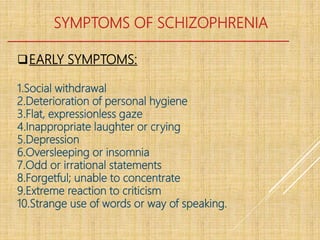
SYMPTOMS OF SCHIZOPHRENIA
EARLY SYMPTOMS:
1.Social withdrawal
2.Deterioration of personal hygiene
3.Flat, expressionless gaze
4.Inappropriate laughter or crying
5.Depression
6.Oversleeping or insomnia
7.Odd or irrational statements
8.Forgetful; unable to concentrate
9.Extreme reaction to criticism
10.Strange use of words or way of speaking.
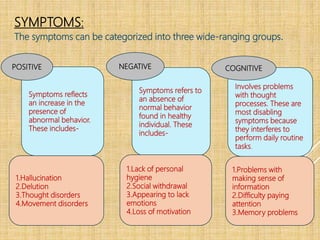
SYMPTOMS:
The symptoms can be categorized into three wide-ranging groups.
Symptoms reflects
an increase in the
presence of
abnormal behavior.
These includes-
Symptoms refers to
an absence of
normal behavior
found in healthy
individual. These
includes-
Involves problems
with thought
processes. These are
most disabling
symptoms because
they interferes to
perform daily routine
tasks.
1.Hallucination
2.Delution
3.Thought disorders
4.Movement disorders
1.Lack of personal
hygiene
2.Social withdrawal
3.Appearing to lack
emotions
4.Loss of motivation
1.Problems with
making sense of
information
2.Difficulty paying
attention
3.Memory problems
POSITIVE NEGATIVE COGNITIVE
DIAGNOSIS:
• Two or more of the following must be present:
1)Hallucinations.
2)Delusions.
3)Disorganized behavior or catatonic behavior .
4)Disorganized speech.
5)Negative symptoms
• The symptoms must last at least for 6 months.
Ref-https://www.nami.org/Learn-More/Mental-Health-
Conditions/Schizophrenia
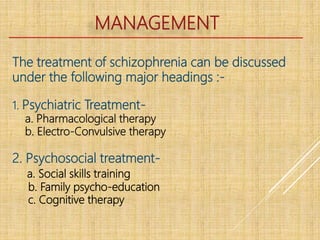
MANAGEMENT
The treatment of schizophrenia can be discussed
under the following major headings :-
1. Psychiatric Treatment-
a. Pharmacological therapy
b. Electro-Convulsive therapy
2. Psychosocial treatment-
a. Social skills training
b. Family psycho-education
c. Cognitive therapy
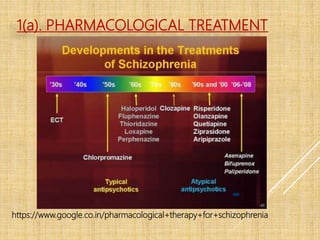
1(a). PHARMACOLOGICAL TREATMENT
https://www.google.co.in/pharmacological+therapy+for+schizophrenia
1(b). ELECTRO-CONVULSIVE THERAPY (ECT)
• ECT is not the primary treatment of choice for schizophrenia
https://www.google.co.in/ELECTRO-
CONVULSIVE+THERAPY+for+
schizophrenia
• The indications of ECT include:-
1.Catatonic stupor
2.Uncontrolled catatonic excitement
3.Acute exacerbation not controlled with drugs
4.Severe side-effects with drugs in the
presence
of schizophrenia
• Usually 8-12 ECT’S are needed (up to 18 in poor responders),
administered 2-3 times a week
CONCLUSION
Schizophrenia is a serious disorder that affects millions and
millions of people over the world. Without proper treatment, this
could cause many serious problems as social withdrawal, loss of
hygiene, hallucinations, disorganized speech, etc. This is
something that shouldn’t be taken lightly so-
• The patient needs to be actively involved in treatment in order
to adopt better standard of life
• Patient should be more optimistic even though the disorder is
life challenging in many ways
• The society should play a vital role in accepting the patients
and give them their deserved chance in this world
• Scientists should strive towards developing more amenable
treatment options for proper resolution of this disorder.
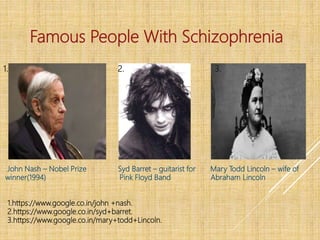
Famous People With Schizophrenia
John Nash – Nobel Prize Syd Barret – guitarist for Mary Todd Lincoln – wife of
winner(1994) Pink Floyd Band Abraham Lincoln
1.https://www.google.co.in/john +nash.
2.https://www.google.co.in/syd+barret.
3.https://www.google.co.in/mary+todd+Lincoln.
1. 2. 3.
REFERENCES
1.Cardno AG, Marshall EJ, Coid B, Macdonald AM, Ribchester TR, Davies NJ.
Heritability estimates for psychotic disorders. Arch Gen Psychiatry 1999;56:162-8.
2. Jablensky A. Epidemiology of schizophrenia: The global burden of disease and
disability. Eur Arch Psychiatry Clin Neurosci 2000;250:274-85.
3. Jones C, Cormac I, Silveira da Mota Neto JI, Campbell C. Cognitive behavioural
therapy for schizophrenia. Cochrane Database Syst Rev 2004;187:245-59.
4.Kaster TS, Daskalakis ZJ, Blumberger DM. Clinical effictiveness and cognitive impacts
of electroconvulsive therapy for schizophrenia : A large retrospective study. J Clin
Psychiatry. 2017;78:382-94.
5. Lieberman JA, Stroup TS, McEvoy JP, Swartz MS, Rosenheck RA,
DO. Effectiveness of antipsychotic drugs in patients with chronic
schizophrenia. N Engl J Med 2005;353:1209-23.
6.McGrath JJ. Variations in the incidence of schizophrenia: data versus
dogma. Schizophr Bull2006;32:195-7.
7. National Institute for Health and Clinical Excellence. Guidance on the
use of newer (atypical) antipsychotic drugs for the treatment of
schizophrenia London: NICE, 2001.(National Institute of Health).
8. Saha S, Chant D, Welham J, McGrath J. A systematic review of the
prevalence of schizophrenia. PloS Med 2005;2:413-33.
THANK YOU

Schizophrenia --the split mind

  • 1.
    SCHIZOPHRENIA NITISH CHAUHAN (Dept. ofZoology) 9795044590 BANARAS HINDU UNIVERSITY ----------The split mind
  • 2.
    OUTLINE OF PRESENTATION WHATIS SCHIZOPHRENIA ? HISTORY EPIDEMIOLOGY TYPES OF SCHIZOPHRENIA ETIOLOGY SYMPTOMS OF SCHIZOPHRENIA DIAGNOSIS MANAGEMENT CONCLUSION FAMOUS PEOPLE WITH SCHIZOPHRENIA REFERENCES
  • 3.
    WHAT IS SCHIZOPHRENIA?  Schizophrenia is a psychological disorder  Schizophrenia is characterized by the inability to separate reality from and a non-reality.  Schizophrenia patients often experience non-existent stimuli that create perceptions of things that do not exist, such as voices.  Symptoms may include: flat effect (exhibiting no emotion), delusions, hallucinations, or disorganized thinking.
  • 4.
    HISTORY The origin ofthe term SCHIZOPHRENIA has been derived from the Greek word “Skhizein” meaning “to split”, and “phren” meaning “mind”. https://www.goodreads.com/dementia praecox The characteristics/ fundamental symptoms and also accessory / secondary symptoms of schizophrenia ( Delusions, hallucinations and negativism ). https://www.google.co.in/Emil+Kraepelin.
  • 5.
    EPIDEMIOLOGY • Acc. tothe New England Journal of Medicine report 7.4% people worldwide suffer from schizophrenia. • Schizophrenia is prevalent across racial, sociocultural and national boundaries, with a few exceptions in the prevalence rates in some isolated communities. Source: The New England Journal of Medicine (2017). • The onset of Schizophrenia occurs usually later in women as compared to men.
  • 6.
    TYPES OF SCHIZOPHRENIA Thereare five types of schizophrenia: 1. Catatonic – little to no movement, possibly a vegetative state. 2. Disorganized – common archetype of schizophrenia; disorganized thinking, flat effect, inappropriate emotions or behavior. 3. Residual – long-term schizophrenia where most symptoms have disappeared, negative symptoms (detractions from normal behavior) often remain such as flat effect or a refusal to talk. https://www.youtube.com/catatonia.
  • 7.
    4. Paranoid –most common of schizophrenia; delusions, hallucinations, false beliefs of grandeur. https://www.google.co.in/grandeur+schizophr enia. https://www.google.co.in/hallucinations+schizophrenia. 5. Undifferentiated – does not fit in one of the above categories because the patient suffers from symptoms of multiple types.
  • 8.
    ETIOLOGY 1. GENETIC PREDISPOSITION: 8%in siblings of affected subjects. 12% in offspring's of one affected parent. 40% in offspring's of two affected parents. 47% in subjects of affected monozygotic twins. 2. BIOCHEMICAL FACTORS: DOPAMINE HYPOTHESIS : schizophrenia results from too much dopaminergic activity. The theory evolved from observation as, Drugs that increase dopamine activity e.g., cocaine and amphetamine, are psychotomimetic. Excessive dopamine release in patients with schizophrenia has been linked to the severity of positive psychotic symptoms.
  • 9.
    3. ENVIRONMENTAL FACTORS: Stressinducing environmental factors such as social pressure, physical or sexual abuse, loss of loved ones, hormones, malnutrition ,and early exposure to viruses. 4.PSYCHOSOCIAL AND PSYCHOANALYTIC THEORIES: If schizophrenia is a disease of the brain, it is likely to parallel disease of other organs whose courses are affected by psychosocial and biological factors affecting schizophrenia.
  • 10.
    SYMPTOMS OF SCHIZOPHRENIA EARLYSYMPTOMS: 1.Social withdrawal 2.Deterioration of personal hygiene 3.Flat, expressionless gaze 4.Inappropriate laughter or crying 5.Depression 6.Oversleeping or insomnia 7.Odd or irrational statements 8.Forgetful; unable to concentrate 9.Extreme reaction to criticism 10.Strange use of words or way of speaking.
  • 11.
    SYMPTOMS: The symptoms canbe categorized into three wide-ranging groups. Symptoms reflects an increase in the presence of abnormal behavior. These includes- Symptoms refers to an absence of normal behavior found in healthy individual. These includes- Involves problems with thought processes. These are most disabling symptoms because they interferes to perform daily routine tasks. 1.Hallucination 2.Delution 3.Thought disorders 4.Movement disorders 1.Lack of personal hygiene 2.Social withdrawal 3.Appearing to lack emotions 4.Loss of motivation 1.Problems with making sense of information 2.Difficulty paying attention 3.Memory problems POSITIVE NEGATIVE COGNITIVE
  • 12.
    DIAGNOSIS: • Two ormore of the following must be present: 1)Hallucinations. 2)Delusions. 3)Disorganized behavior or catatonic behavior . 4)Disorganized speech. 5)Negative symptoms • The symptoms must last at least for 6 months. Ref-https://www.nami.org/Learn-More/Mental-Health- Conditions/Schizophrenia
  • 13.
    MANAGEMENT The treatment ofschizophrenia can be discussed under the following major headings :- 1. Psychiatric Treatment- a. Pharmacological therapy b. Electro-Convulsive therapy 2. Psychosocial treatment- a. Social skills training b. Family psycho-education c. Cognitive therapy
  • 14.
  • 15.
    1(b). ELECTRO-CONVULSIVE THERAPY(ECT) • ECT is not the primary treatment of choice for schizophrenia https://www.google.co.in/ELECTRO- CONVULSIVE+THERAPY+for+ schizophrenia • The indications of ECT include:- 1.Catatonic stupor 2.Uncontrolled catatonic excitement 3.Acute exacerbation not controlled with drugs 4.Severe side-effects with drugs in the presence of schizophrenia • Usually 8-12 ECT’S are needed (up to 18 in poor responders), administered 2-3 times a week
  • 16.
    CONCLUSION Schizophrenia is aserious disorder that affects millions and millions of people over the world. Without proper treatment, this could cause many serious problems as social withdrawal, loss of hygiene, hallucinations, disorganized speech, etc. This is something that shouldn’t be taken lightly so- • The patient needs to be actively involved in treatment in order to adopt better standard of life • Patient should be more optimistic even though the disorder is life challenging in many ways • The society should play a vital role in accepting the patients and give them their deserved chance in this world • Scientists should strive towards developing more amenable treatment options for proper resolution of this disorder.
  • 17.
    Famous People WithSchizophrenia John Nash – Nobel Prize Syd Barret – guitarist for Mary Todd Lincoln – wife of winner(1994) Pink Floyd Band Abraham Lincoln 1.https://www.google.co.in/john +nash. 2.https://www.google.co.in/syd+barret. 3.https://www.google.co.in/mary+todd+Lincoln. 1. 2. 3.
  • 18.
    REFERENCES 1.Cardno AG, MarshallEJ, Coid B, Macdonald AM, Ribchester TR, Davies NJ. Heritability estimates for psychotic disorders. Arch Gen Psychiatry 1999;56:162-8. 2. Jablensky A. Epidemiology of schizophrenia: The global burden of disease and disability. Eur Arch Psychiatry Clin Neurosci 2000;250:274-85. 3. Jones C, Cormac I, Silveira da Mota Neto JI, Campbell C. Cognitive behavioural therapy for schizophrenia. Cochrane Database Syst Rev 2004;187:245-59. 4.Kaster TS, Daskalakis ZJ, Blumberger DM. Clinical effictiveness and cognitive impacts of electroconvulsive therapy for schizophrenia : A large retrospective study. J Clin Psychiatry. 2017;78:382-94.
  • 19.
    5. Lieberman JA,Stroup TS, McEvoy JP, Swartz MS, Rosenheck RA, DO. Effectiveness of antipsychotic drugs in patients with chronic schizophrenia. N Engl J Med 2005;353:1209-23. 6.McGrath JJ. Variations in the incidence of schizophrenia: data versus dogma. Schizophr Bull2006;32:195-7. 7. National Institute for Health and Clinical Excellence. Guidance on the use of newer (atypical) antipsychotic drugs for the treatment of schizophrenia London: NICE, 2001.(National Institute of Health). 8. Saha S, Chant D, Welham J, McGrath J. A systematic review of the prevalence of schizophrenia. PloS Med 2005;2:413-33.
  • 20.