Scheduling Algorithms
- INTRODUCTIO
N
- FCFS
- SJF
- SRTF
- RR
- PRIORITY
Dr.T.Revathi, PSGCAS
Scheduling Algorithms
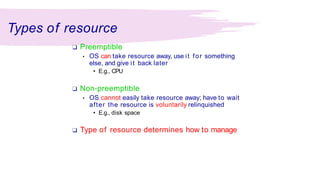
Types of resource
❑ Preemptible
• OS can take resource away, use it for something
else, and give it back later
• E.g., CPU
❑ Non-preemptible
• OS cannot easily take resource away; have to wait
after the resource is voluntarily relinquished
• E.g., disk space
❑ Type of resource determines how to manage
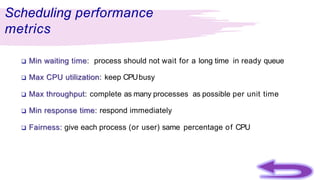
Scheduling performance
metrics
❑ Min waiting time: process should not wait for a long time in ready queue
❑ Max CPU utilization: keep CPUbusy
❑ Max throughput: complete as many processes as possible per unit time
❑ Min response time: respond immediately
❑ Fairness: give each process (or user) same percentage of CPU
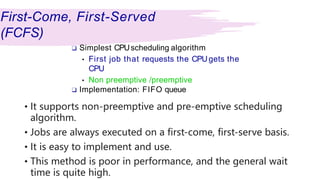
First-Come, First-Served
(FCFS)
❑ Simplest CPUscheduling algorithm
• First job that requests the CPUgets the
CPU
• Non preemptive /preemptive
❑ Implementation: FIFO queue
• It supports non-preemptive and pre-emptive scheduling
algorithm.
• Jobs are always executed on a first-come, first-serve basis.
• It is easy to implement and use.
• This method is poor in performance, and the general wait
time is quite high.
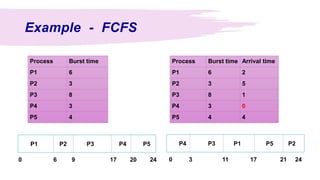
Example - FCFS
Process Burst time
P1 6
P2 3
P3 8
P4 3
P5 4
Process Burst time Arrival time
P1 6 2
P2 3 5
P3 8 1
P4 3 0
P5 4 4
P1 P2 P3 P4 P5
0 6 9 17 20 24
P4 P3 P1 P5 P2
0 3 11 17 21 24
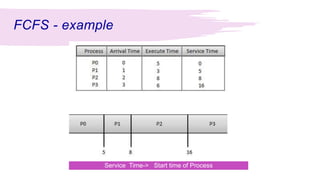
FCFS - example
Service Time-> Start time of Process
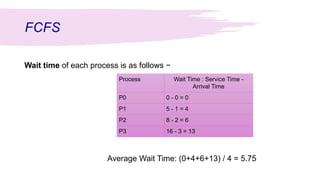
FCFS
Process Wait Time : Service Time -
Arrival Time
P0 0 - 0 = 0
P1 5 - 1 = 4
P2 8 - 2 = 6
P3 16 - 3 = 13
Wait time of each process is as follows −
Average Wait Time: (0+4+6+13) / 4 = 5.75
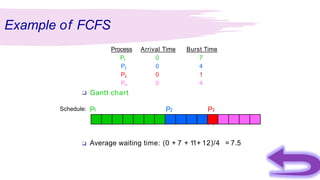
Process Arrival Time Burst Time
P1 0 7
P2 0 4
P3 0 1
P4 0 4
Gantt chart
P1 P2 P3
P4
❑
Schedule:
❑ Average waiting time: (0 + 7 + 11+ 12)/4 = 7.5
Example of FCFS
SJF
• This is also known as shortest job first, or SJF
• This is a non-preemptive, pre-emptive scheduling
algorithm.
• Best approach to minimize waiting time.
• Easy to implement in Batch systems where required CPU
time is known in advance.
• Impossible to implement in interactive systems where
required CPU time is not known.
• The processer should know in advance how much time
process will take.
Shortest Job First
(SJF)
❑ Schedule the process with the shortest time
• FCFS if same time
❑ Advantages
• Minimizes average wait time. Provably optimal
❑ Disadvantages
• Not practical: difficult to predict burst time
• Possible: past predicts future
• May starve long jobs
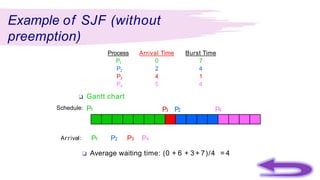
Process Arrival Time Burst Time
P1 0 7
P2 2 4
P3 4 1
P4 5 4
❑ Gantt chart
Schedule: P1
❑ Average waiting time: (0 + 6 + 3 + 7)/4 = 4
Example of SJF (without
preemption)
P1 P2 P3 P4
P3 P2 P4
Arrival:
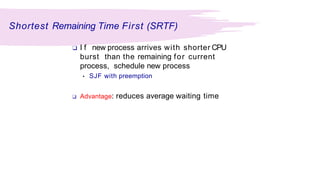
Shortest Remaining Time First (SRTF)
❑ I f new process arrives with shorter CPU
burst than the remaining for current
process, schedule new process
• SJF with preemption
❑ Advantage: reduces average waiting time
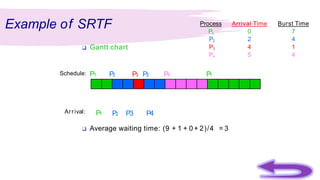
❑ Gantt chart
❑ Average waiting time: (9 + 1 + 0 + 2)/4 = 3
Example of SRTF
P3 P2
Schedule: P1 P2 P4 P1
P1 P2
Arrival: P3 P4
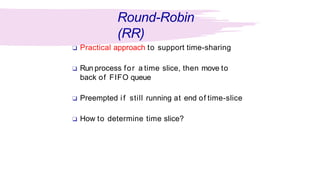
Round-Robin
(RR)
❑ Practical approach to support time-sharing
❑ Run process for a time slice, then move to
back of FIFO queue
❑ Preempted if still running at end of time-slice
❑ How to determine time slice?
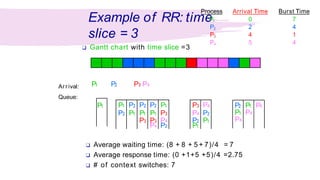
❑ Gantt chart with time slice =3
❑ Average waiting time: (8 + 8 + 5 + 7)/4 = 7
❑ Average response time: (0 +1+5 +5)/4 =2.75
❑ # of context switches: 7
Example of RR: time
slice = 3
P1 P2 P3 P4
Arrival:
Queue:
P1 P1 P2 P2 P2 P1
P2 P1 P1 P1 P3
P3 P3 P4
P4 P2
P3 P4
P4 P2
P2 P1
P1
P2 P1 P4
P1 P4
P4
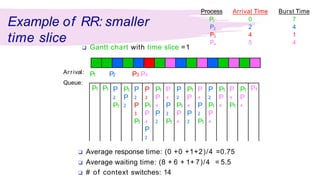
❑ Gantt chart with time slice =1
❑ Average response time: (0 +0 +1+2)/4 =0.75
❑ Average waiting time: (8 + 6 + 1+ 7)/4 = 5.5
❑ # of context switches: 14
Example of RR: smaller
time slice
P1 P2 P3 P4
Arrival:
Queue:
P1 P1 P
2
P1
P1
P
2
P
2
P
3
P1
P
3
P1
P
4
P
2
P1
P
4
P
2
P
4
P
2
P1
P
2
P1
P
4
P1
P
4
P
2
P
4
P
2
P1
P
2
P1
P
4
P1
P
4
P
4
P1
P1
P
4
P4
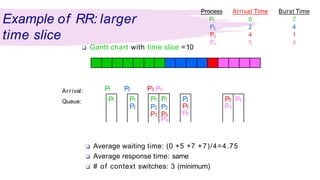
❑ Gantt chart with time slice =10
❑ Average waiting time: (0 +5 +7 +7)/4=4.75
❑ Average response time: same
❑ # of context switches: 3 (minimum)
Example of RR: larger
time slice
P1 P2 P3 P4
Arrival:
Queue: P1 P1
P2
P1 P1
P2 P2
P3 P3
P4
P2
P3
P4
P3 P4
P4
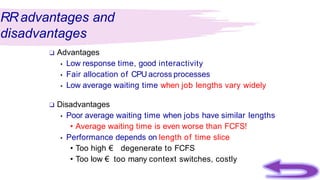
RRadvantages and
disadvantages
❑ Advantages
• Low response time, good interactivity
• Fair allocation of CPU across processes
• Low average waiting time when job lengths vary widely
❑ Disadvantages
• Poor average waiting time when jobs have similar lengths
• Average waiting time is even worse than FCFS!
• Performance depends on length of time slice
• Too high € degenerate to FCFS
• Too low € too many context switches, costly
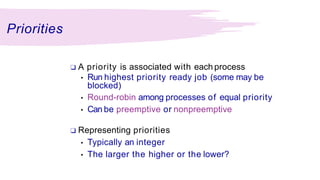
Priorities
❑ A priority is associated with each process
• Run highest priority ready job (some may be
blocked)
• Round-robin among processes of equal priority
• Can be preemptive or nonpreemptive
❑ Representing priorities
• Typically an integer
• The larger the higher or the lower?
Setting priorities
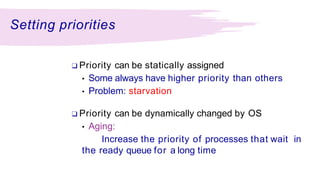
❑ Priority can be statically assigned
• Some always have higher priority than others
• Problem: starvation
❑ Priority can be dynamically changed by OS
• Aging:
Increase the priority of processes that wait in
the ready queue for a long time
Priority scheduling
Process CPU Burst Priority
P1 10 4
P2 4 1
P3 6 3
P4 5 2
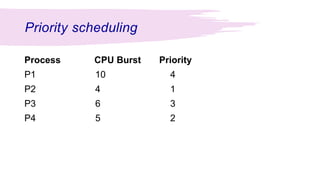
Priority scheduling
Process CPU Burst Priority
P1 10 4
P2 4 1
P3 6 3
P4 5 2
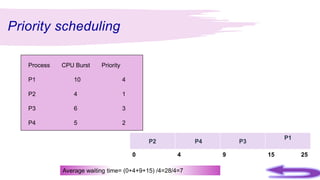
P2 P4 P3
P1
0 4 9 15 25
Average waiting time= (0+4+9+15) /4=28/4=7
Reference: Google and online resources

Scheduling Algorithms-Examples.pptx

  • 1.
    Scheduling Algorithms - INTRODUCTIO N -FCFS - SJF - SRTF - RR - PRIORITY Dr.T.Revathi, PSGCAS Scheduling Algorithms
  • 2.
    Types of resource ❑Preemptible • OS can take resource away, use it for something else, and give it back later • E.g., CPU ❑ Non-preemptible • OS cannot easily take resource away; have to wait after the resource is voluntarily relinquished • E.g., disk space ❑ Type of resource determines how to manage
  • 3.
    Scheduling performance metrics ❑ Minwaiting time: process should not wait for a long time in ready queue ❑ Max CPU utilization: keep CPUbusy ❑ Max throughput: complete as many processes as possible per unit time ❑ Min response time: respond immediately ❑ Fairness: give each process (or user) same percentage of CPU
  • 4.
    First-Come, First-Served (FCFS) ❑ SimplestCPUscheduling algorithm • First job that requests the CPUgets the CPU • Non preemptive /preemptive ❑ Implementation: FIFO queue • It supports non-preemptive and pre-emptive scheduling algorithm. • Jobs are always executed on a first-come, first-serve basis. • It is easy to implement and use. • This method is poor in performance, and the general wait time is quite high.
  • 5.
    Example - FCFS ProcessBurst time P1 6 P2 3 P3 8 P4 3 P5 4 Process Burst time Arrival time P1 6 2 P2 3 5 P3 8 1 P4 3 0 P5 4 4 P1 P2 P3 P4 P5 0 6 9 17 20 24 P4 P3 P1 P5 P2 0 3 11 17 21 24
  • 6.
    FCFS - example ServiceTime-> Start time of Process
  • 7.
    FCFS Process Wait Time: Service Time - Arrival Time P0 0 - 0 = 0 P1 5 - 1 = 4 P2 8 - 2 = 6 P3 16 - 3 = 13 Wait time of each process is as follows − Average Wait Time: (0+4+6+13) / 4 = 5.75
  • 8.
    Process Arrival TimeBurst Time P1 0 7 P2 0 4 P3 0 1 P4 0 4 Gantt chart P1 P2 P3 P4 ❑ Schedule: ❑ Average waiting time: (0 + 7 + 11+ 12)/4 = 7.5 Example of FCFS
  • 9.
    SJF • This isalso known as shortest job first, or SJF • This is a non-preemptive, pre-emptive scheduling algorithm. • Best approach to minimize waiting time. • Easy to implement in Batch systems where required CPU time is known in advance. • Impossible to implement in interactive systems where required CPU time is not known. • The processer should know in advance how much time process will take.
  • 10.
    Shortest Job First (SJF) ❑Schedule the process with the shortest time • FCFS if same time ❑ Advantages • Minimizes average wait time. Provably optimal ❑ Disadvantages • Not practical: difficult to predict burst time • Possible: past predicts future • May starve long jobs
  • 11.
    Process Arrival TimeBurst Time P1 0 7 P2 2 4 P3 4 1 P4 5 4 ❑ Gantt chart Schedule: P1 ❑ Average waiting time: (0 + 6 + 3 + 7)/4 = 4 Example of SJF (without preemption) P1 P2 P3 P4 P3 P2 P4 Arrival:
  • 12.
    Shortest Remaining TimeFirst (SRTF) ❑ I f new process arrives with shorter CPU burst than the remaining for current process, schedule new process • SJF with preemption ❑ Advantage: reduces average waiting time
  • 13.
    ❑ Gantt chart ❑Average waiting time: (9 + 1 + 0 + 2)/4 = 3 Example of SRTF P3 P2 Schedule: P1 P2 P4 P1 P1 P2 Arrival: P3 P4
  • 14.
    Round-Robin (RR) ❑ Practical approachto support time-sharing ❑ Run process for a time slice, then move to back of FIFO queue ❑ Preempted if still running at end of time-slice ❑ How to determine time slice?
  • 15.
    ❑ Gantt chartwith time slice =3 ❑ Average waiting time: (8 + 8 + 5 + 7)/4 = 7 ❑ Average response time: (0 +1+5 +5)/4 =2.75 ❑ # of context switches: 7 Example of RR: time slice = 3 P1 P2 P3 P4 Arrival: Queue: P1 P1 P2 P2 P2 P1 P2 P1 P1 P1 P3 P3 P3 P4 P4 P2 P3 P4 P4 P2 P2 P1 P1 P2 P1 P4 P1 P4 P4
  • 16.
    ❑ Gantt chartwith time slice =1 ❑ Average response time: (0 +0 +1+2)/4 =0.75 ❑ Average waiting time: (8 + 6 + 1+ 7)/4 = 5.5 ❑ # of context switches: 14 Example of RR: smaller time slice P1 P2 P3 P4 Arrival: Queue: P1 P1 P 2 P1 P1 P 2 P 2 P 3 P1 P 3 P1 P 4 P 2 P1 P 4 P 2 P 4 P 2 P1 P 2 P1 P 4 P1 P 4 P 2 P 4 P 2 P1 P 2 P1 P 4 P1 P 4 P 4 P1 P1 P 4 P4
  • 17.
    ❑ Gantt chartwith time slice =10 ❑ Average waiting time: (0 +5 +7 +7)/4=4.75 ❑ Average response time: same ❑ # of context switches: 3 (minimum) Example of RR: larger time slice P1 P2 P3 P4 Arrival: Queue: P1 P1 P2 P1 P1 P2 P2 P3 P3 P4 P2 P3 P4 P3 P4 P4
  • 18.
    RRadvantages and disadvantages ❑ Advantages •Low response time, good interactivity • Fair allocation of CPU across processes • Low average waiting time when job lengths vary widely ❑ Disadvantages • Poor average waiting time when jobs have similar lengths • Average waiting time is even worse than FCFS! • Performance depends on length of time slice • Too high € degenerate to FCFS • Too low € too many context switches, costly
  • 19.
    Priorities ❑ A priorityis associated with each process • Run highest priority ready job (some may be blocked) • Round-robin among processes of equal priority • Can be preemptive or nonpreemptive ❑ Representing priorities • Typically an integer • The larger the higher or the lower?
  • 20.
    Setting priorities ❑ Prioritycan be statically assigned • Some always have higher priority than others • Problem: starvation ❑ Priority can be dynamically changed by OS • Aging: Increase the priority of processes that wait in the ready queue for a long time
  • 21.
    Priority scheduling Process CPUBurst Priority P1 10 4 P2 4 1 P3 6 3 P4 5 2
  • 22.
    Priority scheduling Process CPUBurst Priority P1 10 4 P2 4 1 P3 6 3 P4 5 2 P2 P4 P3 P1 0 4 9 15 25 Average waiting time= (0+4+9+15) /4=28/4=7
  • 23.
    Reference: Google andonline resources