NAME: RICHA PATEL
 Requirement and guideline for permission to
import and/or manufacture of new drugs for
sale or to undertake clinical trials.
 To frame guideline for conduct of clinical
research
 Control and regulation for new drugs
 CDSCO and DTAB formulated GCP under
schedule y in 2005
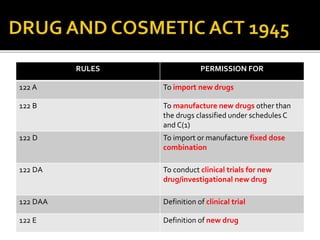
RULES PERMISSION FOR
122 A To import new drugs
122 B To manufacture new drugs other than
the drugs classified under schedules C
and C(1)
122 D To import or manufacture fixed dose
combination
122 DA To conduct clinical trials for new
drug/investigational new drug
122 DAA Definition of clinical trial
122 E Definition of new drug
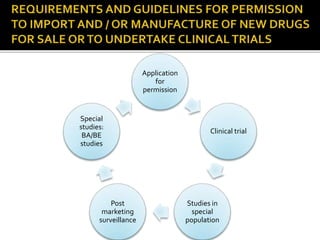
Application
for
permission
Clinical trial
Studies in
special
population
Post
marketing
surveillance
Special
studies:
BA/BE
studies
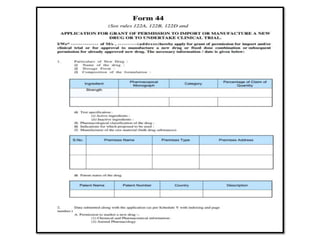
It shall be made in FORM 44 accompanied with following data in accordance with
appendices, namely:
 Chemical and pharmaceutical information(Appendix 1, item 2)
 Animal pharmacology data(Appendix 1 and 4, item 3)
(e.g.. Specific pharmacological action, general pharmacological action,
pharmacokinetic data)
 Animal toxicological data (Appendix 1 and 3, item 4)
 Human clinical pharmacology data (Appendix 1, item 5,6,7)
 Regulatory status in other countries (Appendix 1, item 9.2)
 Prescribing information as a part of NDA for marketing (Appendix 1, item 10)
 Complete testing protocol for QC testing (Appendix 1, item 11)
 FORM 12: To import study drug for examination, test or analysis
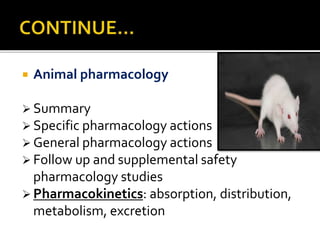
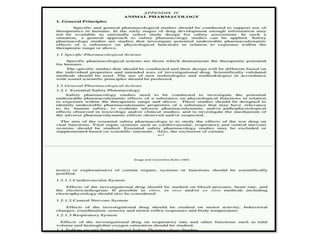
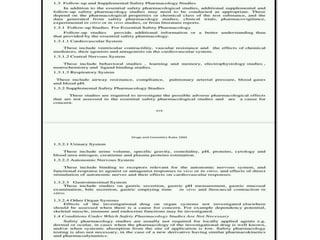
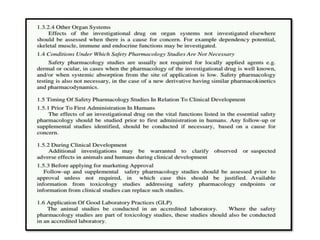
 Animal pharmacology
 Summary
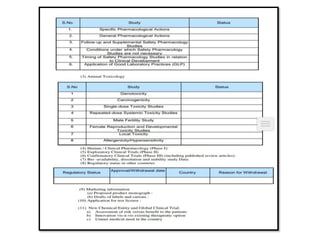
 Specific pharmacology actions
 General pharmacology actions
 Follow up and supplemental safety
pharmacology studies
 Pharmacokinetics: absorption, distribution,
metabolism, excretion
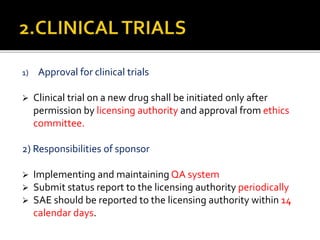
1) Approval for clinical trials
 Clinical trial on a new drug shall be initiated only after
permission by licensing authority and approval from ethics
committee.
2) Responsibilities of sponsor
 Implementing and maintaining QA system
 Submit status report to the licensing authority periodically
 SAE should be reported to the licensing authority within 14
calendar days.
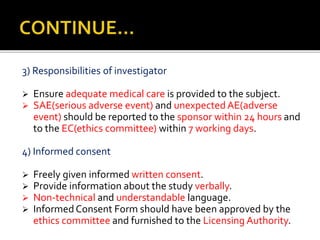
3) Responsibilities of investigator
 Ensure adequate medical care is provided to the subject.
 SAE(serious adverse event) and unexpectedAE(adverse
event) should be reported to the sponsor within 24 hours and
to the EC(ethics committee) within 7 working days.
4) Informed consent
 Freely given informed written consent.
 Provide information about the study verbally.
 Non-technical and understandable language.
 Informed Consent Form should have been approved by the
ethics committee and furnished to the Licensing Authority.
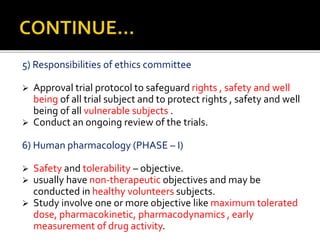
5) Responsibilities of ethics committee
 Approval trial protocol to safeguard rights , safety and well
being of all trial subject and to protect rights , safety and well
being of all vulnerable subjects .
 Conduct an ongoing review of the trials.
6) Human pharmacology (PHASE – I)
 Safety and tolerability – objective.
 usually have non-therapeutic objectives and may be
conducted in healthy volunteers subjects.
 Study involve one or more objective like maximum tolerated
dose, pharmacokinetic, pharmacodynamics , early
measurement of drug activity.
7)Therapeutic exploratory trials (PHASE – II)
 To evaluate the effectiveness of a drug for particular
indication.
 To determine the short term side effects and risk associated
with the drug.
 To determine the dose and regimen for phase III trials.
 Studies in Phase II should be conducted in a group of
patients who are selected by relatively narrow criteria
leading to a relatively homogeneous population.
8)Therapeutic confirmatory trials (PHASE – III)
 Demonstration of therapeutic benefit - objective.
 Drug is safe and effective for use and provide an adequate
basis for marketing approval.
 Studies in Phase III may also further explore the dose-
response relationships (relationships among dose, drug
concentration in blood and clinical response), use of the drug
in wider populations, in different stages of disease, or the
safety and efficacy of the drug in combination with other
drug(s).
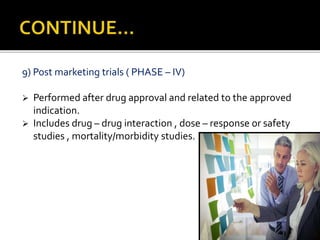
9) Post marketing trials ( PHASE – IV)
 Performed after drug approval and related to the approved
indication.
 Includes drug – drug interaction , dose – response or safety
studies , mortality/morbidity studies.
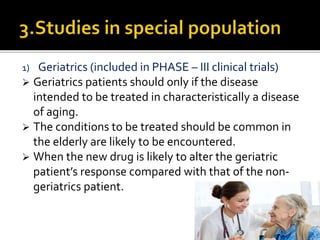
1) Geriatrics (included in PHASE – III clinical trials)
 Geriatrics patients should only if the disease
intended to be treated in characteristically a disease
of aging.
 The conditions to be treated should be common in
the elderly are likely to be encountered.
 When the new drug is likely to alter the geriatric
patient’s response compared with that of the non-
geriatrics patient.
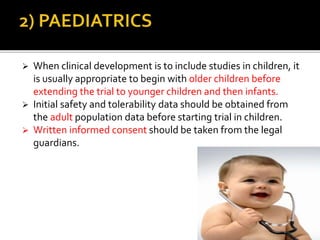
 When clinical development is to include studies in children, it
is usually appropriate to begin with older children before
extending the trial to younger children and then infants.
 Initial safety and tolerability data should be obtained from
the adult population data before starting trial in children.
 Written informed consent should be taken from the legal
guardians.
The paediatric studies should include –
(a) clinical trials,
(b) relative bioequivalence comparisons of the
paediatric formulation with the adult
formulation performed in adults, and
(c) definitive pharmacokinetic studies for dose
selection across the age ranges of paediatric
patients in whom the drug is likely to be used.
These studies should be conducted in the
paediatric patient population with the disease
under study.
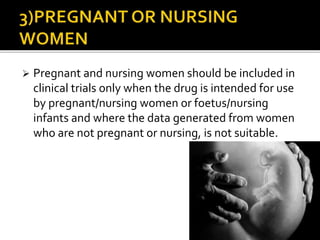
 Pregnant and nursing women should be included in
clinical trials only when the drug is intended for use
by pregnant/nursing women or foetus/nursing
infants and where the data generated from women
who are not pregnant or nursing, is not suitable.
 Closely monitored new drugs clinical study.
 PSUR(periodic safety update reports) – to report all
relevant new information.
 PSUR shall be submitted every 6 months for the first 2
years.
 (a) A title page stating: Periodic safety update report for the
product, applicant‘s name, period covered by the report,
date of approval of new drug, date of marketing of new drug
and date of reporting;
 (b) Introduction,
 (c) Current worldwide market authorization status,
 (d) Update of actions taken for safety reasons,
 (e) Changes to reference safety information,
 (f) Estimated patient exposure,
 (g) Presentation of individual case histories,
 (h) Studies,
 (i) Other information,
 (j) Overall safety evaluation,
 (k) Conclusion,
 (l)Appendix providing material relating to indications,
dosing, pharmacology and other related information.
 Conducted according to the guidelines for BA
and BE studies.
 Evaluation of the effect of food on absorption
following oral administration.
 Data from dissolution studies should also be
submitted for all solid oral dosage forms.
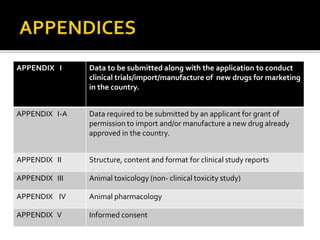
APPENDIX I Data to be submitted along with the application to conduct
clinical trials/import/manufacture of new drugs for marketing
in the country.
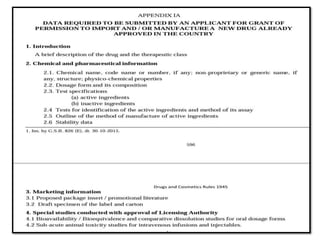
APPENDIX I-A Data required to be submitted by an applicant for grant of
permission to import and/or manufacture a new drug already
approved in the country.
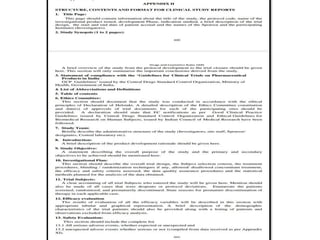
APPENDIX II Structure, content and format for clinical study reports
APPENDIX III Animal toxicology (non- clinical toxicity study)
APPENDIX IV Animal pharmacology
APPENDIX V Informed consent
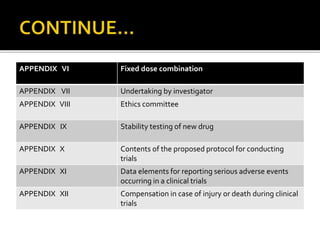
APPENDIX VI Fixed dose combination
APPENDIX VII Undertaking by investigator
APPENDIX VIII Ethics committee
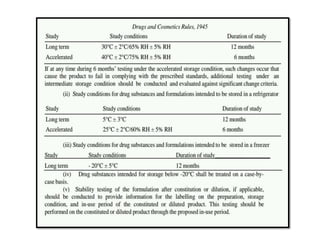
APPENDIX IX Stability testing of new drug
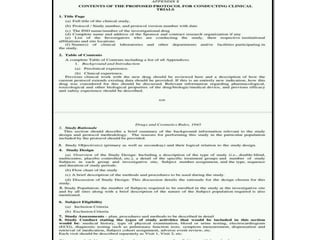
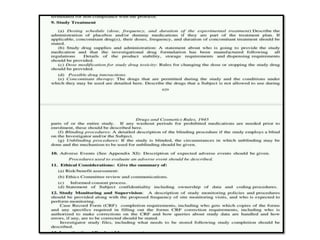
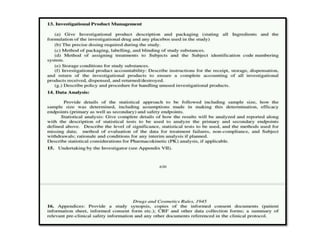
APPENDIX X Contents of the proposed protocol for conducting
trials
APPENDIX XI Data elements for reporting serious adverse events
occurring in a clinical trials
APPENDIX XII Compensation in case of injury or death during clinical
trials
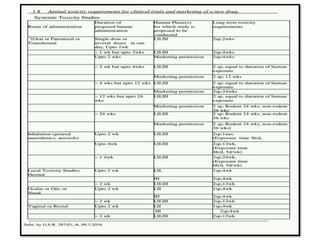
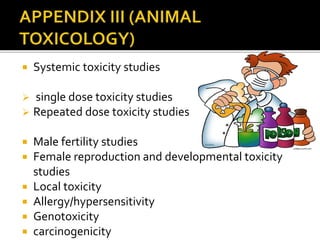
 Systemic toxicity studies
 single dose toxicity studies
 Repeated dose toxicity studies
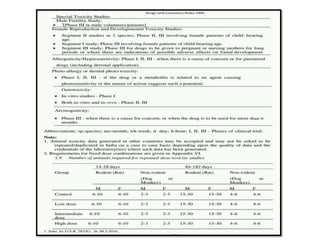
 Male fertility studies
 Female reproduction and developmental toxicity
studies
 Local toxicity
 Allergy/hypersensitivity
 Genotoxicity
 carcinogenicity
 Four graded doses should be given.
 Each group should contain at least 5 animals
of either sex.
 At least animals should be exposed to the
test substances in a single bolus or by
continuous infusion or several doses within
24 hours.
 Animal should be observed for 14 days.
 Minimal lethal dose(LDmin)
 Maximum tolerated dose
 MTD is established from the single dose
toxicity study.
 Study is performed in one rodent and one
non rodent species.
 5 animals in each group and at least 4 graded
doses should be given.
 It is given consequently for 10 days.
 Organ specific toxicity is established.
 Six animals are taken in each group.
 Animals should be treated with the test substance
by the intended route of clinical use for minimum 28
days and maximum 70 days.
 They are paired with female animals of proven
fertility in a ratio of 1:2 for mating for at least 10
days.
 Females getting pregnant , should be examined for
their fertility after day 13 of gestation.
All the male animals should be sacrificed at the end of
the study and organs of reproduction are examined.
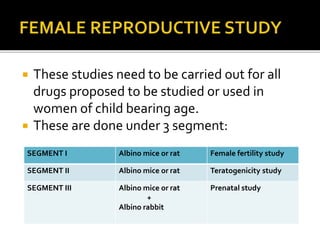
 These studies need to be carried out for all
drugs proposed to be studied or used in
women of child bearing age.
 These are done under 3 segment:
SEGMENT I Albino mice or rat Female fertility study
SEGMENT II Albino mice or rat Teratogenicity study
SEGMENT III Albino mice or rat
+
Albino rabbit
Prenatal study
 These studies are required when the new
drug is proposed to be used by some special
route (other than oral) in humans:
 It includes:
 Dermal toxicity
 Vaginal toxicity
 Rectal toxicity
 Parenteral toxicity : injection site toxicity
 Ocular and inhalational toxicity studies
 It is required for a drug that is intended to be
used for a chronic illness or a drug that is used
for a long period of time(>6 months)
 Genotoxicity data are not required before
PHASE I and PHASE II trials. But these
studies should be completed before applying
for PHASE III trials.
 www.cdsco.nic.in
Schedule Y

Schedule Y

  • 1.
  • 2.
     Requirement andguideline for permission to import and/or manufacture of new drugs for sale or to undertake clinical trials.
  • 3.
     To frameguideline for conduct of clinical research  Control and regulation for new drugs  CDSCO and DTAB formulated GCP under schedule y in 2005
  • 4.
    RULES PERMISSION FOR 122A To import new drugs 122 B To manufacture new drugs other than the drugs classified under schedules C and C(1) 122 D To import or manufacture fixed dose combination 122 DA To conduct clinical trials for new drug/investigational new drug 122 DAA Definition of clinical trial 122 E Definition of new drug
  • 5.
  • 6.
    It shall bemade in FORM 44 accompanied with following data in accordance with appendices, namely:  Chemical and pharmaceutical information(Appendix 1, item 2)  Animal pharmacology data(Appendix 1 and 4, item 3) (e.g.. Specific pharmacological action, general pharmacological action, pharmacokinetic data)  Animal toxicological data (Appendix 1 and 3, item 4)  Human clinical pharmacology data (Appendix 1, item 5,6,7)  Regulatory status in other countries (Appendix 1, item 9.2)  Prescribing information as a part of NDA for marketing (Appendix 1, item 10)  Complete testing protocol for QC testing (Appendix 1, item 11)  FORM 12: To import study drug for examination, test or analysis
  • 7.
     Animal pharmacology Summary  Specific pharmacology actions  General pharmacology actions  Follow up and supplemental safety pharmacology studies  Pharmacokinetics: absorption, distribution, metabolism, excretion
  • 11.
    1) Approval forclinical trials  Clinical trial on a new drug shall be initiated only after permission by licensing authority and approval from ethics committee. 2) Responsibilities of sponsor  Implementing and maintaining QA system  Submit status report to the licensing authority periodically  SAE should be reported to the licensing authority within 14 calendar days.
  • 12.
    3) Responsibilities ofinvestigator  Ensure adequate medical care is provided to the subject.  SAE(serious adverse event) and unexpectedAE(adverse event) should be reported to the sponsor within 24 hours and to the EC(ethics committee) within 7 working days. 4) Informed consent  Freely given informed written consent.  Provide information about the study verbally.  Non-technical and understandable language.  Informed Consent Form should have been approved by the ethics committee and furnished to the Licensing Authority.
  • 13.
    5) Responsibilities ofethics committee  Approval trial protocol to safeguard rights , safety and well being of all trial subject and to protect rights , safety and well being of all vulnerable subjects .  Conduct an ongoing review of the trials. 6) Human pharmacology (PHASE – I)  Safety and tolerability – objective.  usually have non-therapeutic objectives and may be conducted in healthy volunteers subjects.  Study involve one or more objective like maximum tolerated dose, pharmacokinetic, pharmacodynamics , early measurement of drug activity.
  • 14.
    7)Therapeutic exploratory trials(PHASE – II)  To evaluate the effectiveness of a drug for particular indication.  To determine the short term side effects and risk associated with the drug.  To determine the dose and regimen for phase III trials.  Studies in Phase II should be conducted in a group of patients who are selected by relatively narrow criteria leading to a relatively homogeneous population.
  • 15.
    8)Therapeutic confirmatory trials(PHASE – III)  Demonstration of therapeutic benefit - objective.  Drug is safe and effective for use and provide an adequate basis for marketing approval.  Studies in Phase III may also further explore the dose- response relationships (relationships among dose, drug concentration in blood and clinical response), use of the drug in wider populations, in different stages of disease, or the safety and efficacy of the drug in combination with other drug(s).
  • 16.
    9) Post marketingtrials ( PHASE – IV)  Performed after drug approval and related to the approved indication.  Includes drug – drug interaction , dose – response or safety studies , mortality/morbidity studies.
  • 17.
    1) Geriatrics (includedin PHASE – III clinical trials)  Geriatrics patients should only if the disease intended to be treated in characteristically a disease of aging.  The conditions to be treated should be common in the elderly are likely to be encountered.  When the new drug is likely to alter the geriatric patient’s response compared with that of the non- geriatrics patient.
  • 18.
     When clinicaldevelopment is to include studies in children, it is usually appropriate to begin with older children before extending the trial to younger children and then infants.  Initial safety and tolerability data should be obtained from the adult population data before starting trial in children.  Written informed consent should be taken from the legal guardians.
  • 19.
    The paediatric studiesshould include – (a) clinical trials, (b) relative bioequivalence comparisons of the paediatric formulation with the adult formulation performed in adults, and (c) definitive pharmacokinetic studies for dose selection across the age ranges of paediatric patients in whom the drug is likely to be used. These studies should be conducted in the paediatric patient population with the disease under study.
  • 20.
     Pregnant andnursing women should be included in clinical trials only when the drug is intended for use by pregnant/nursing women or foetus/nursing infants and where the data generated from women who are not pregnant or nursing, is not suitable.
  • 21.
     Closely monitorednew drugs clinical study.  PSUR(periodic safety update reports) – to report all relevant new information.  PSUR shall be submitted every 6 months for the first 2 years.
  • 22.
     (a) Atitle page stating: Periodic safety update report for the product, applicant‘s name, period covered by the report, date of approval of new drug, date of marketing of new drug and date of reporting;  (b) Introduction,  (c) Current worldwide market authorization status,  (d) Update of actions taken for safety reasons,  (e) Changes to reference safety information,  (f) Estimated patient exposure,  (g) Presentation of individual case histories,  (h) Studies,  (i) Other information,  (j) Overall safety evaluation,  (k) Conclusion,  (l)Appendix providing material relating to indications, dosing, pharmacology and other related information.
  • 23.
     Conducted accordingto the guidelines for BA and BE studies.  Evaluation of the effect of food on absorption following oral administration.  Data from dissolution studies should also be submitted for all solid oral dosage forms.
  • 24.
    APPENDIX I Datato be submitted along with the application to conduct clinical trials/import/manufacture of new drugs for marketing in the country. APPENDIX I-A Data required to be submitted by an applicant for grant of permission to import and/or manufacture a new drug already approved in the country. APPENDIX II Structure, content and format for clinical study reports APPENDIX III Animal toxicology (non- clinical toxicity study) APPENDIX IV Animal pharmacology APPENDIX V Informed consent
  • 25.
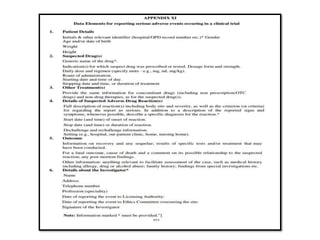
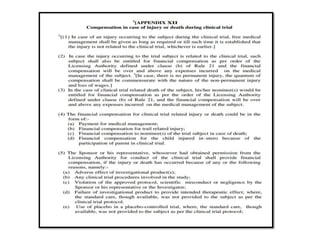
    APPENDIX VI Fixeddose combination APPENDIX VII Undertaking by investigator APPENDIX VIII Ethics committee APPENDIX IX Stability testing of new drug APPENDIX X Contents of the proposed protocol for conducting trials APPENDIX XI Data elements for reporting serious adverse events occurring in a clinical trials APPENDIX XII Compensation in case of injury or death during clinical trials
  • 37.
     Systemic toxicitystudies  single dose toxicity studies  Repeated dose toxicity studies  Male fertility studies  Female reproduction and developmental toxicity studies  Local toxicity  Allergy/hypersensitivity  Genotoxicity  carcinogenicity
  • 38.
     Four gradeddoses should be given.  Each group should contain at least 5 animals of either sex.  At least animals should be exposed to the test substances in a single bolus or by continuous infusion or several doses within 24 hours.  Animal should be observed for 14 days.  Minimal lethal dose(LDmin)  Maximum tolerated dose
  • 39.
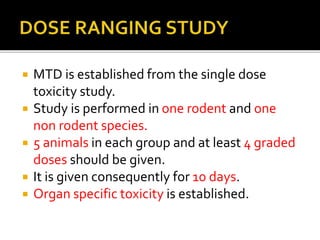
     MTD isestablished from the single dose toxicity study.  Study is performed in one rodent and one non rodent species.  5 animals in each group and at least 4 graded doses should be given.  It is given consequently for 10 days.  Organ specific toxicity is established.
  • 40.
     Six animalsare taken in each group.  Animals should be treated with the test substance by the intended route of clinical use for minimum 28 days and maximum 70 days.  They are paired with female animals of proven fertility in a ratio of 1:2 for mating for at least 10 days.  Females getting pregnant , should be examined for their fertility after day 13 of gestation. All the male animals should be sacrificed at the end of the study and organs of reproduction are examined.
  • 41.
     These studiesneed to be carried out for all drugs proposed to be studied or used in women of child bearing age.  These are done under 3 segment: SEGMENT I Albino mice or rat Female fertility study SEGMENT II Albino mice or rat Teratogenicity study SEGMENT III Albino mice or rat + Albino rabbit Prenatal study
  • 42.
     These studiesare required when the new drug is proposed to be used by some special route (other than oral) in humans:  It includes:  Dermal toxicity  Vaginal toxicity  Rectal toxicity  Parenteral toxicity : injection site toxicity  Ocular and inhalational toxicity studies
  • 43.
     It isrequired for a drug that is intended to be used for a chronic illness or a drug that is used for a long period of time(>6 months)  Genotoxicity data are not required before PHASE I and PHASE II trials. But these studies should be completed before applying for PHASE III trials.
  • 72.