






1
Dr.U.Ramesh
Unit-III: Indian Banking System
Scheduled Banks: Public Sector Banks- Private Sector Banks - Foreign Banks - Regional
Rural Banks(RRBS). Non Schedule Banks: Co-operative Banks-SCB-DCB, Private credit
Societies Static Co-operative Bank-NBFI, Merging of Banks.
What are Scheduled Banks?
 By definition, any bank which is listed in the 2nd schedule of the Reserve Bank of
India Act, 1934 is considered a scheduled bank.
 The Schedule consists of those banks which satisfy various parameters, criteria under
clause 42 of this act.
 The list includes the State Bank of India and its subsidiaries (like State Bank of
Travancore), all nationalised banks (Bank of Baroda, Bank of India etc), regional
rural banks (RRBs), foreign banks (HSBC Holdings Plc, Citibank NA) and some co-
operative banks.
 These also include private sector banks, both classified as old (Karur Vysya Bank)
and new (HDFC Bank Ltd).
 To qualify as a scheduled bank, the paid-up capital and collected funds of the bank
must not be less than Rs5 lakh.
 Scheduled banks are eligible for loans from the Reserve Bank of India at bank rate,
and are given membership to clearing-houses.
Scheduled Banks
Scheduled banks are those which are included in the second schedule of the RBI Act of 1934.
In order to be registered as a scheduled bank, it must satisfy the following conditions:
 Paid-up capital and collected funds should not be less than INR 5 lakhs
 Any activity of the bank should not be detrimental or adversely affect the customers’
interests.
Four types of scheduled commercial banks are:
1. Public sector banks
2
2. Private sector banks
3. Foreign banks
4. Regional Rural banks
What are the figures of scheduled banks as per RBI?
As per the latest data released by the RBI, the following are the number of scheduled banks in
our country:
 Scheduled Public Sector Banks – 12
 Scheduled Private Sector Banks – 22
 Scheduled Small Finance Banks – 11
 Scheduled Payments Banks – 3
 Scheduled Regional Rural Banks – 43
 Scheduled Foreign Banks in India – 46
What are Non-Scheduled Banks?
 Non-scheduled banks by definition are those which are not listed in the 2nd schedule
of the RBI act, 1934.
 They don’t conform to all the criteria under clause 42, but dully follow specific
guidelines as laid down by RBI.
 Banks with a reserve capital of less than 5 lakh rupees qualify as non-scheduled
banks.
 Unlike scheduled banks, they are not entitled to borrow from the RBI for normal
banking purposes, except, in an emergency or abnormal circumstances.
 Bangalore City Co-operative Bank Ltd. Bangalore, Baroda City Co-op. Bank Limited
are a few examples.
Non Scheduled Banks
They are described as “a banking company as defined in clause C of section 5 of the Banking
Regulation Act, 1949 (10 of 1949) which is not a scheduled bank.” RBI is the central bank of
the nation and all the banks in India are required to follow the guidelines issued by the RBI.
3
COMMERCIAL BANKS
 According to the RBI, “Commercial Banks refer to both scheduled and non-scheduled
commercial banks which are regulated under Banking Regulation Act, 1949.”
 Commercial banks operate on a ‘for-profit’ basis.
 They primarily engage in the acceptance of deposits and extend loans to the public,
businesses and the government.
 Nowadays, some commercial banks are also providing housing loans on a long-term
basis to individuals.
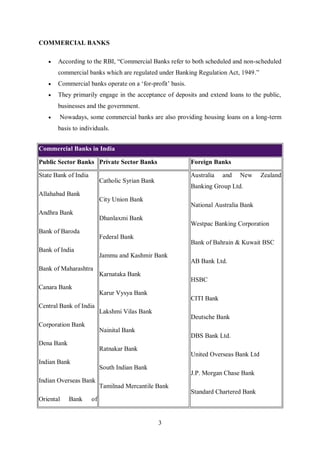
Commercial Banks in India
Public Sector Banks Private Sector Banks Foreign Banks
State Bank of India
Allahabad Bank
Andhra Bank
Bank of Baroda
Bank of India
Bank of Maharashtra
Canara Bank
Central Bank of India
Corporation Bank
Dena Bank
Indian Bank
Indian Overseas Bank
Oriental Bank of
Catholic Syrian Bank
City Union Bank
Dhanlaxmi Bank
Federal Bank
Jammu and Kashmir Bank
Karnataka Bank
Karur Vysya Bank
Lakshmi Vilas Bank
Nainital Bank
Ratnakar Bank
South Indian Bank
Tamilnad Mercantile Bank
Australia and New Zealand
Banking Group Ltd.
National Australia Bank
Westpac Banking Corporation
Bank of Bahrain & Kuwait BSC
AB Bank Ltd.
HSBC
CITI Bank
Deutsche Bank
DBS Bank Ltd.
United Overseas Bank Ltd
J.P. Morgan Chase Bank
Standard Chartered Bank
4
Commerce
Punjab National Bank
Punjab & Sind Bank
Syndicate Bank
Union Bank of India
United Bank of India
UCO Bank
Vijaya Bank
IDBI Bank Ltd.
Axis Bank
Development Credit Bank (DCB
Bank Ltd)
HDFC Bank
ICICI Bank
IndusInd Bank
Kotak Mahindra Bank
Yes Bank
IDFC
Bandhan Bank of Bandhan
Financial Services.
There are over 40 Foreign Banks
in In
These are the most common types of banks and include public sector banks, private sector
banks, and foreign banks. They provide various services like savings and current accounts,
loans, and investments.
PUBLIC SECTOR BANKS
 Public Sector Banks (PSBs) are banks where a common stake (i.e. more than 50%) is
held by a government.
 The shares of these banks are listed on stock exchanges.
 Example- State Bank of India, Corporation Bank, Bank of Baroda, Punjab National
Bank, Canara Bank, Bank of India.
PRIVATE SECTORS BANKS
 In the case of private sector banks, the majority of the share capital of the Bank is held
by private individuals.
 These Banks are registered as companies with limited liability.
5
 Example- ICICI Bank Ltd, ING Vysya Bank.
FOREIGN BANKS
 These banks are registered and have their headquarters in a foreign country but
operate their branches in our country.
 Some foreign banks operating in our country are Hong Kong and Shanghai Banking
Corporation (HSBC), Citibank, American Express Bank, Standard & Chartered Bank.
 The number of foreign banks operating in our country has increased since the
financial sector reforms of 1991.
REGIONAL RURAL BANKS
 Regional Rural Banks or RRBs, simply put, serve the rural areas and agricultural
sectors with basic banking and adequate financial services.
 They were set up in 1975, based on the recommendations of a committee.
 Based in Moradabad, Prathama Bank, established on 2 October 1975, is the first RRB
to open in India. It was sponsored by Syndicate Bank.
 The RRBs are owned by the central government (50%), the state government (15%)
and the sponsor bank (35%).
 Several commercial banks have sponsored RRBs. Prominent examples include the
Maharashtra Gramin Bank (sponsored by the Bank of Maharashtra) and the Himachal
Gramin Bank (sponsored by Punjab National Bank).
 RRBs were set up to eliminate other unorganized financial institutions like
moneylenders and supplement the efforts of cooperative banks.
COOPERATIVE BANKS
These banks are organised under the state government’s act. They give short-term loans to
the agriculture sector and other allied activities.
The main goal of Cooperative Banks is to promote social welfare by providing concessional
loans.
6
They are organised in the 3-tier structure
 Tier 1 (State Level) – State Cooperative Banks (regulated by RBI, State Govt,
NABARD)
o Funded by RBI, the government and NABARD. Money is then distributed to
the public
o Concessional CRR and SLR apply to these banks. (CRR- 3%, SLR- 25%)
o Owned by the state government and top management is elected by members
 Tier 2 (District Level) – Central/District Cooperative Banks
 Tier 3 (Village Level) – Primary Agriculture Cooperative Banks
STANDARD CHARTERED BANK (SCB)
he full form of SCB is the Standard Chartered Bank. Standard Chartered PLC, whose
headquarters is located in London, England, are a British multinational investment bank and
financial firm. It comprises a chain of over 1,200 subsidiaries and branches across more than
seventy countries via subsidiaries, associates, and joint ventures, as well as employs about
87,000 individuals. It is a universal bank with individual, business and institutional finance
and treasury services.
It does not perform retail banking in the UK, given its UK base, and about 90% of its profits
arrive from Asia, Africa, and the Middle East. Standard Chartered is part of the FTSE 100
Index and has a primary listing on the LSE (London Stock Exchange). The title Standard
Chartered comes from the names of Chartered Bank of India, Australia & China and Standard
Bank of British South Africa, the two banks which it was developed by merging in 1969.
DEVELOPMENT CREDIT BANK (DCB)
It got its licence from the Reserve Bank of India in 1995. It has its headquarters in Mumbai
and the current CEO is Murali M. Natrajan. The bank has 367 branches.
Development Credit Bank
Features of Development credit Bank
These are certain features of the bank-:
7
1. State of the art internet banking facility.
2. Customer-friendly branches.
3. Diverse business segment with SME, micro – SME, Retail, Indian Banks, Agriculture,
and Non-banking financial institutions ( NBFC).
4. Around 1,000,000 customers.
5. The promoter and promoter group are the Agha khan Fund of economic development
and the Platinum jubilee investment Ltd holds below 15% stake.
6. Public shareholding is approximately 39.4%.
7. It is listed on the Bombay stock exchange and National stock exchange respectively.
8. The branches are situated in Andhrapradesh, Bihar, Chattisgarh, Delhi/NCR, Goa,
Gujrat, Haryana, Odisha, Tamilnadu, Telangana, Maharashtra, Kerala, Karnataka and
so on.
PRIVATE CREDIT SOCIETIES
Private credit is where a non-bank lender provides loans to companies, typically to small and
medium size enterprises that are non-investment grade. Private credit can serve as a
diversifier in a private markets portfolio as debt is less correlated with equity markets. Plus, it
allows for a shorter J-curve due to the periodic income component from repayments.
STATE COOPERATIVE BANKS are the highest-level cooperative banks in each of the
states. They raise funds and assist in their proper distribution among various sectors.
Individual borrowers receive funds from state cooperative banks via central cooperative
banks and primary credit societies. All-State Apex Cooperative Banks in India have their
own national federation, the National Federation of State Cooperative Banks, which was
founded in 1967 in Mumbai.
State Cooperative Bank – Significance
 Each state has a State Cooperative Bank that oversees the progress and performance
of cooperative credit institutions on a state-by-state basis.
 It is an apex institution tasked with guiding the cooperative movement under the
overall direction of the State Government.
 Their relationships with the Central Cooperative Banks operating at the district level
are similar to the Central Banks' relationships with the Primary Societies.
8
 State cooperative banks make loans and subsidies to Central Cooperative Banks,
inspect them, and act as their banker.
 They raise funds from public deposits, share capital, and loans from state
governments, the Reserve Bank of India, the State Bank of India, and other
commercial banks.
 They alsoassistvarious cooperative organisations in forming alliances, financing the
supply and distribution of essential commodities, and so on.
NON-BANKING FINANCIAL INSTITUTION
A non-banking financial institution (NBFI) is also known as non banking financial company
or Non Banking Financial Corporation (NBFC). It is a financial entity that operates without a
complete banking license. It is not supervised by any national or international banking
regulatory agency.
These financial institutions offer bank-related financial services including risk pooling,
investing, contractual savings, and market brokering. Examples include hedge funds,
insurance firms, pawn shops, cashier's cheque issuers, check cashing locations, payday
lending, currency exchanges, and microloan organizations.
Types of Non Banking Financial Institutions
Different types of Non Banking Financial Intermediaries have distinct and unique
contribution to the financial ecosystem. Non Banking Financial Institutions offer specialized
services as well as traditional banking services.
1. Investment Banks
Investment banks are important in the financial markets, serving as intermediaries between
issuers of securities and the investing public.
2. Mortgage Lenders
Mortgage lenders specialize in issuing loans used for purchasing real estate. While some
mortgage lenders are banks that also accept deposits, many are dedicated institutions focused
solely on mortgage lending.
9
3. Money Market Funds
Money market funds are types of Non Banking financial institutions that invest in highly
liquid, near-term instruments like treasury bills and commercial paper.
4. Insurance Companies
Insurance companies mitigate risk for individuals and businesses by offering various
insurance products, including life, health, property, and casualty insurance.
5. Hedge Funds
Hedge funds are private investment funds that employ diverse strategies to earn active returns
for their investors.
6. Private Equity Funds
Private equity funds gather capital to invest in companies that are not listed on public stock
exchanges.
7. Peer-to-Peer (P2P) Lenders
P2P lending platforms enable individuals to obtain loans directly from other individuals,
cutting out the financial institution as the middleman.
Characteristics of Non-Banking Financial Institutions
Non-Banking Financial Institutions (NBFIs) have the following characteristics that
differentiate them from traditional banking institutions:
1. Lack of Banking License: NBFIs do not hold a banking license and are not allowed
to accept demand deposits from the public.
2. Regulatory Framework: They operate under a different regulatory framework,
which is often less stringent than that governing traditional banks.
3. Specialized Financial Services: NBFIs typically offer specialized financial services,
including investment, risk pooling, contractual savings, and market brokering, among
others.
10
4. Credit Provision: They provide credit and loans to individuals and businesses, often
catering to sectors or clients not served by traditional banks.
5. Investment Opportunities: NBFIs offer various investment products and
opportunities, such as mutual funds, hedge funds, and private equity funds.
6. Risk Management: Through products like insurance, NBFIs offer risk management
solutions to individuals and businesses.
7. Innovation and Flexibility: Non Banking Financial Intermediaries are more flexible
and innovative in their product offerings. These institutions adapt quickly to changes
in demands of the market or consumers.
Functions of Non Banking Financial Intermediaries
NBFIs help in making the economy more stable and efficient. They offer a various financial
services across different areas of the economy, meeting the needs of various groups of
people. The following are the key functions of Non-Banking Financial Institutions:
1. Credit Provision: They extend credit to individuals and businesses that might not
meet the stringent criteria of traditional banks, thereby filling a critical gap in the
credit market. This includes loans for real estate, personal loans, and business
financing.
2. Investment Services: Offering investment opportunities to individuals and
institutions through the management of various funds such as hedge funds, private
equity funds as well as mutual funds. These services help investors with diversifying
their portfolios beyond traditional bank products.
3. Risk Management: Through insurance products, NBFIs provide risk management
solutions to individuals and businesses, covering several risks related to life, health,
property, and casualty.
4. Savings and Retirement Planning: They offer products like annuities and mutual
funds that help individuals save for retirement and other long-term goals, often
providing higher returns compared to traditional savings accounts.
5. Payment and Settlement Systems: Some NBFIs offer payment processing and
settlement services, facilitating transactions between buyers and sellers in various
markets.
6. Financial Advisory Services: Providing expert advice on mergers, acquisitions,
restructuring, and other financial transactions to businesses and individual investors.
11
7. Market Making and Liquidity Provision: By acting as market makers, some NBFIs
contribute to the liquidity and efficiency of financial markets, facilitating trading in
stocks, bonds, and other securities.
8. Peer-to-Peer Lending: Connecting borrowers directly with lenders through online
platforms, bypassing traditional banking channels, and often offering more
competitive rates and terms.
9. Innovation and Financial Inclusion: NBFIs are often at the forefront of financial
innovation, developing new financial products and services that fulfil the
requirements of consumers and businesses. They promote financial inclusion by
reaching potential customers who do not have any banking experience.
10. Capital Market Access: NBFIs facilitate access to the capital markets for both
individuals and corporate entities by offering investment banking services, including
underwriting and acting as intermediaries in the issuance of stocks and bonds.
BANK MERGER
Cos Typically, the merged company is a bigger bank with more resources, which can save
money through economies of scale. Additionally, by merging, the two banks may improve
investment returns, diversify their product offerings, share risks, and enter new markets.
What is the reason behind banks merging?
Banks merge to boost competitiveness, resilience, and efficiency. In India, many small banks
operated independently, reliant on government aid. This setup led to higher costs and limited
innovation. Recognizing the need for a stronger banking system, the Reserve Bank of India
advocated merging these banks. Merging improves access to capital and risk management. It
also enables economies of scale, reducing costs. The announcement in August 2019 initiated
the merger of 10 public sector banks into 4 larger entities. Further consolidations followed,
resulting in 12 public sector banks. These mergers streamline operations and strengthen
balance sheets. They also better equip banks to handle economic fluctuations and global
market dynamics.
Merits of Public Sector Bank Mergers
Given below are the merits of bank merger:
12
Cost Efficiency and Operational Improvements
 Cost Savings through Efficiency: Merging banks can eliminate duplicate processes,
reduce administrative expenses, and negotiate better deals with suppliers due to
increased bargaining power. This leads to overall cost savings for the merged entity.
 Streamlined Operations and Reduced Redundancies: Consolidating operations
allows banks to streamline workflows, eliminate redundant processes, and optimize
staffing levels. By reducing duplication and improving efficiency, merged banks can
operate more smoothly and cost-effectively.
Enhanced Access and Customer Experience
 Broader Geographic Coverage: Merged banks can extend their reach to previously
underserved or remote areas, providing banking services to a larger population. This
broader geographic coverage ensures that more customers have access to essential
financial services.
 Enhanced Access to Banking Services: With an expanded network of branches and
ATMs, customers have more convenient access to banking facilities, leading to
increased convenience and satisfaction.
 Enhanced Customer Experience: Merged banks can leverage their combined
resources to offer better customer service, faster response times, and more
personalized interactions. This results in an overall improved experience for
customers, enhancing loyalty and retention.
Product Diversification and Financial Capacity
 Diversified Product Portfolio: Merged banks can offer a wider range of financial
products and services, including loans, insurance, investment products, and
specialized banking services. This diversification allows customers to access a
comprehensive suite of financial solutions tailored to their needs.
 Increased Financial Capacity: With a larger capital base resulting from the merger,
banks have a greater capacity to extend credit and support larger projects. This
increased financial capacity benefits businesses and individuals seeking financing for
various purposes.
13
Expertise and Best Practices
 Elevated Expertise and Best Practices: By combining teams and resources, merged
banks can leverage the collective expertise and experience of both entities. This leads
to the adoption of best practices, innovation, and continuous improvement in banking
operations, ultimately enhancing efficiency and effectiveness.
Reduced Government Dependency and Sustainability
 Reduced Reliance on Government Support: Merged banks with stronger financial
positions are less reliant on government support or bailouts. This promotes financial
stability and sustainability in the banking sector, reducing the burden on government
resources and taxpayers.
Technological Advancements
 Technological Innovation and Digital Transformation: Merged banks often invest
in modernizing their technological infrastructure, implementing digital banking
solutions, and enhancing cybersecurity measures. This technological innovation
improves operational efficiency, enhances customer experience, and positions the
bank for future growth and competitiveness in the digital era.
Demerits of Bank Merger
Given below are the demerits of a bank merger:
Impact on Decentralization
 Concerns about Local Banking Services: Many public sector banks operate with a
focus on serving specific regions or communities. Mergers may disrupt this regional
focus, leading to concerns about the availability and quality of local banking services.
 Centralization of Decision-Making: Larger merged entities may centralize decision-
making processes, reducing autonomy at the local level. This can lead to slower
response times to local needs and preferences.
14
Governance and Bad Loans
 Governance Challenges: Merging banks with different corporate cultures and
governance structures can create challenges in aligning policies and procedures. This
can lead to inefficiencies and conflicts within the merged entity.
 Burden of Bad Loans: Addressing non-performing assets (NPAs) and bad loans
inherited from merging banks can be a significant challenge. Integrating risk
management practices and resolving bad loan issues require careful planning and
execution.
Challenges Faced by the Banks due to Mergers
Banks may face the below mentioned challenges due to mergers:
 The bank could face governance related issues as there are several departments that
would be merged.
 Both the banks (acquiring and merging) would be required to handle data properly.
 In case of capital need, the capital infusion would have to be higher.
 Bank could face managerial level issue that might lead to downfall.
For further reading
https://www.bankbazaar.com/ifsc/list-of-merged-public-sector-banks-in-india-2021.html

Monetary Economics: Indian Banking System.pdf

  • 1.
    1 Dr.U.Ramesh Unit-III: Indian BankingSystem Scheduled Banks: Public Sector Banks- Private Sector Banks - Foreign Banks - Regional Rural Banks(RRBS). Non Schedule Banks: Co-operative Banks-SCB-DCB, Private credit Societies Static Co-operative Bank-NBFI, Merging of Banks. What are Scheduled Banks?  By definition, any bank which is listed in the 2nd schedule of the Reserve Bank of India Act, 1934 is considered a scheduled bank.  The Schedule consists of those banks which satisfy various parameters, criteria under clause 42 of this act.  The list includes the State Bank of India and its subsidiaries (like State Bank of Travancore), all nationalised banks (Bank of Baroda, Bank of India etc), regional rural banks (RRBs), foreign banks (HSBC Holdings Plc, Citibank NA) and some co- operative banks.  These also include private sector banks, both classified as old (Karur Vysya Bank) and new (HDFC Bank Ltd).  To qualify as a scheduled bank, the paid-up capital and collected funds of the bank must not be less than Rs5 lakh.  Scheduled banks are eligible for loans from the Reserve Bank of India at bank rate, and are given membership to clearing-houses. Scheduled Banks Scheduled banks are those which are included in the second schedule of the RBI Act of 1934. In order to be registered as a scheduled bank, it must satisfy the following conditions:  Paid-up capital and collected funds should not be less than INR 5 lakhs  Any activity of the bank should not be detrimental or adversely affect the customers’ interests. Four types of scheduled commercial banks are: 1. Public sector banks
  • 2.
    2 2. Private sectorbanks 3. Foreign banks 4. Regional Rural banks What are the figures of scheduled banks as per RBI? As per the latest data released by the RBI, the following are the number of scheduled banks in our country:  Scheduled Public Sector Banks – 12  Scheduled Private Sector Banks – 22  Scheduled Small Finance Banks – 11  Scheduled Payments Banks – 3  Scheduled Regional Rural Banks – 43  Scheduled Foreign Banks in India – 46 What are Non-Scheduled Banks?  Non-scheduled banks by definition are those which are not listed in the 2nd schedule of the RBI act, 1934.  They don’t conform to all the criteria under clause 42, but dully follow specific guidelines as laid down by RBI.  Banks with a reserve capital of less than 5 lakh rupees qualify as non-scheduled banks.  Unlike scheduled banks, they are not entitled to borrow from the RBI for normal banking purposes, except, in an emergency or abnormal circumstances.  Bangalore City Co-operative Bank Ltd. Bangalore, Baroda City Co-op. Bank Limited are a few examples. Non Scheduled Banks They are described as “a banking company as defined in clause C of section 5 of the Banking Regulation Act, 1949 (10 of 1949) which is not a scheduled bank.” RBI is the central bank of the nation and all the banks in India are required to follow the guidelines issued by the RBI.
  • 3.
    3 COMMERCIAL BANKS  Accordingto the RBI, “Commercial Banks refer to both scheduled and non-scheduled commercial banks which are regulated under Banking Regulation Act, 1949.”  Commercial banks operate on a ‘for-profit’ basis.  They primarily engage in the acceptance of deposits and extend loans to the public, businesses and the government.  Nowadays, some commercial banks are also providing housing loans on a long-term basis to individuals. Commercial Banks in India Public Sector Banks Private Sector Banks Foreign Banks State Bank of India Allahabad Bank Andhra Bank Bank of Baroda Bank of India Bank of Maharashtra Canara Bank Central Bank of India Corporation Bank Dena Bank Indian Bank Indian Overseas Bank Oriental Bank of Catholic Syrian Bank City Union Bank Dhanlaxmi Bank Federal Bank Jammu and Kashmir Bank Karnataka Bank Karur Vysya Bank Lakshmi Vilas Bank Nainital Bank Ratnakar Bank South Indian Bank Tamilnad Mercantile Bank Australia and New Zealand Banking Group Ltd. National Australia Bank Westpac Banking Corporation Bank of Bahrain & Kuwait BSC AB Bank Ltd. HSBC CITI Bank Deutsche Bank DBS Bank Ltd. United Overseas Bank Ltd J.P. Morgan Chase Bank Standard Chartered Bank
  • 4.
    4 Commerce Punjab National Bank Punjab& Sind Bank Syndicate Bank Union Bank of India United Bank of India UCO Bank Vijaya Bank IDBI Bank Ltd. Axis Bank Development Credit Bank (DCB Bank Ltd) HDFC Bank ICICI Bank IndusInd Bank Kotak Mahindra Bank Yes Bank IDFC Bandhan Bank of Bandhan Financial Services. There are over 40 Foreign Banks in In These are the most common types of banks and include public sector banks, private sector banks, and foreign banks. They provide various services like savings and current accounts, loans, and investments. PUBLIC SECTOR BANKS  Public Sector Banks (PSBs) are banks where a common stake (i.e. more than 50%) is held by a government.  The shares of these banks are listed on stock exchanges.  Example- State Bank of India, Corporation Bank, Bank of Baroda, Punjab National Bank, Canara Bank, Bank of India. PRIVATE SECTORS BANKS  In the case of private sector banks, the majority of the share capital of the Bank is held by private individuals.  These Banks are registered as companies with limited liability.
  • 5.
    5  Example- ICICIBank Ltd, ING Vysya Bank. FOREIGN BANKS  These banks are registered and have their headquarters in a foreign country but operate their branches in our country.  Some foreign banks operating in our country are Hong Kong and Shanghai Banking Corporation (HSBC), Citibank, American Express Bank, Standard & Chartered Bank.  The number of foreign banks operating in our country has increased since the financial sector reforms of 1991. REGIONAL RURAL BANKS  Regional Rural Banks or RRBs, simply put, serve the rural areas and agricultural sectors with basic banking and adequate financial services.  They were set up in 1975, based on the recommendations of a committee.  Based in Moradabad, Prathama Bank, established on 2 October 1975, is the first RRB to open in India. It was sponsored by Syndicate Bank.  The RRBs are owned by the central government (50%), the state government (15%) and the sponsor bank (35%).  Several commercial banks have sponsored RRBs. Prominent examples include the Maharashtra Gramin Bank (sponsored by the Bank of Maharashtra) and the Himachal Gramin Bank (sponsored by Punjab National Bank).  RRBs were set up to eliminate other unorganized financial institutions like moneylenders and supplement the efforts of cooperative banks. COOPERATIVE BANKS These banks are organised under the state government’s act. They give short-term loans to the agriculture sector and other allied activities. The main goal of Cooperative Banks is to promote social welfare by providing concessional loans.
  • 6.
    6 They are organisedin the 3-tier structure  Tier 1 (State Level) – State Cooperative Banks (regulated by RBI, State Govt, NABARD) o Funded by RBI, the government and NABARD. Money is then distributed to the public o Concessional CRR and SLR apply to these banks. (CRR- 3%, SLR- 25%) o Owned by the state government and top management is elected by members  Tier 2 (District Level) – Central/District Cooperative Banks  Tier 3 (Village Level) – Primary Agriculture Cooperative Banks STANDARD CHARTERED BANK (SCB) he full form of SCB is the Standard Chartered Bank. Standard Chartered PLC, whose headquarters is located in London, England, are a British multinational investment bank and financial firm. It comprises a chain of over 1,200 subsidiaries and branches across more than seventy countries via subsidiaries, associates, and joint ventures, as well as employs about 87,000 individuals. It is a universal bank with individual, business and institutional finance and treasury services. It does not perform retail banking in the UK, given its UK base, and about 90% of its profits arrive from Asia, Africa, and the Middle East. Standard Chartered is part of the FTSE 100 Index and has a primary listing on the LSE (London Stock Exchange). The title Standard Chartered comes from the names of Chartered Bank of India, Australia & China and Standard Bank of British South Africa, the two banks which it was developed by merging in 1969. DEVELOPMENT CREDIT BANK (DCB) It got its licence from the Reserve Bank of India in 1995. It has its headquarters in Mumbai and the current CEO is Murali M. Natrajan. The bank has 367 branches. Development Credit Bank Features of Development credit Bank These are certain features of the bank-:
  • 7.
    7 1. State ofthe art internet banking facility. 2. Customer-friendly branches. 3. Diverse business segment with SME, micro – SME, Retail, Indian Banks, Agriculture, and Non-banking financial institutions ( NBFC). 4. Around 1,000,000 customers. 5. The promoter and promoter group are the Agha khan Fund of economic development and the Platinum jubilee investment Ltd holds below 15% stake. 6. Public shareholding is approximately 39.4%. 7. It is listed on the Bombay stock exchange and National stock exchange respectively. 8. The branches are situated in Andhrapradesh, Bihar, Chattisgarh, Delhi/NCR, Goa, Gujrat, Haryana, Odisha, Tamilnadu, Telangana, Maharashtra, Kerala, Karnataka and so on. PRIVATE CREDIT SOCIETIES Private credit is where a non-bank lender provides loans to companies, typically to small and medium size enterprises that are non-investment grade. Private credit can serve as a diversifier in a private markets portfolio as debt is less correlated with equity markets. Plus, it allows for a shorter J-curve due to the periodic income component from repayments. STATE COOPERATIVE BANKS are the highest-level cooperative banks in each of the states. They raise funds and assist in their proper distribution among various sectors. Individual borrowers receive funds from state cooperative banks via central cooperative banks and primary credit societies. All-State Apex Cooperative Banks in India have their own national federation, the National Federation of State Cooperative Banks, which was founded in 1967 in Mumbai. State Cooperative Bank – Significance  Each state has a State Cooperative Bank that oversees the progress and performance of cooperative credit institutions on a state-by-state basis.  It is an apex institution tasked with guiding the cooperative movement under the overall direction of the State Government.  Their relationships with the Central Cooperative Banks operating at the district level are similar to the Central Banks' relationships with the Primary Societies.
  • 8.
    8  State cooperativebanks make loans and subsidies to Central Cooperative Banks, inspect them, and act as their banker.  They raise funds from public deposits, share capital, and loans from state governments, the Reserve Bank of India, the State Bank of India, and other commercial banks.  They alsoassistvarious cooperative organisations in forming alliances, financing the supply and distribution of essential commodities, and so on. NON-BANKING FINANCIAL INSTITUTION A non-banking financial institution (NBFI) is also known as non banking financial company or Non Banking Financial Corporation (NBFC). It is a financial entity that operates without a complete banking license. It is not supervised by any national or international banking regulatory agency. These financial institutions offer bank-related financial services including risk pooling, investing, contractual savings, and market brokering. Examples include hedge funds, insurance firms, pawn shops, cashier's cheque issuers, check cashing locations, payday lending, currency exchanges, and microloan organizations. Types of Non Banking Financial Institutions Different types of Non Banking Financial Intermediaries have distinct and unique contribution to the financial ecosystem. Non Banking Financial Institutions offer specialized services as well as traditional banking services. 1. Investment Banks Investment banks are important in the financial markets, serving as intermediaries between issuers of securities and the investing public. 2. Mortgage Lenders Mortgage lenders specialize in issuing loans used for purchasing real estate. While some mortgage lenders are banks that also accept deposits, many are dedicated institutions focused solely on mortgage lending.
  • 9.
    9 3. Money MarketFunds Money market funds are types of Non Banking financial institutions that invest in highly liquid, near-term instruments like treasury bills and commercial paper. 4. Insurance Companies Insurance companies mitigate risk for individuals and businesses by offering various insurance products, including life, health, property, and casualty insurance. 5. Hedge Funds Hedge funds are private investment funds that employ diverse strategies to earn active returns for their investors. 6. Private Equity Funds Private equity funds gather capital to invest in companies that are not listed on public stock exchanges. 7. Peer-to-Peer (P2P) Lenders P2P lending platforms enable individuals to obtain loans directly from other individuals, cutting out the financial institution as the middleman. Characteristics of Non-Banking Financial Institutions Non-Banking Financial Institutions (NBFIs) have the following characteristics that differentiate them from traditional banking institutions: 1. Lack of Banking License: NBFIs do not hold a banking license and are not allowed to accept demand deposits from the public. 2. Regulatory Framework: They operate under a different regulatory framework, which is often less stringent than that governing traditional banks. 3. Specialized Financial Services: NBFIs typically offer specialized financial services, including investment, risk pooling, contractual savings, and market brokering, among others.
  • 10.
    10 4. Credit Provision:They provide credit and loans to individuals and businesses, often catering to sectors or clients not served by traditional banks. 5. Investment Opportunities: NBFIs offer various investment products and opportunities, such as mutual funds, hedge funds, and private equity funds. 6. Risk Management: Through products like insurance, NBFIs offer risk management solutions to individuals and businesses. 7. Innovation and Flexibility: Non Banking Financial Intermediaries are more flexible and innovative in their product offerings. These institutions adapt quickly to changes in demands of the market or consumers. Functions of Non Banking Financial Intermediaries NBFIs help in making the economy more stable and efficient. They offer a various financial services across different areas of the economy, meeting the needs of various groups of people. The following are the key functions of Non-Banking Financial Institutions: 1. Credit Provision: They extend credit to individuals and businesses that might not meet the stringent criteria of traditional banks, thereby filling a critical gap in the credit market. This includes loans for real estate, personal loans, and business financing. 2. Investment Services: Offering investment opportunities to individuals and institutions through the management of various funds such as hedge funds, private equity funds as well as mutual funds. These services help investors with diversifying their portfolios beyond traditional bank products. 3. Risk Management: Through insurance products, NBFIs provide risk management solutions to individuals and businesses, covering several risks related to life, health, property, and casualty. 4. Savings and Retirement Planning: They offer products like annuities and mutual funds that help individuals save for retirement and other long-term goals, often providing higher returns compared to traditional savings accounts. 5. Payment and Settlement Systems: Some NBFIs offer payment processing and settlement services, facilitating transactions between buyers and sellers in various markets. 6. Financial Advisory Services: Providing expert advice on mergers, acquisitions, restructuring, and other financial transactions to businesses and individual investors.
  • 11.
    11 7. Market Makingand Liquidity Provision: By acting as market makers, some NBFIs contribute to the liquidity and efficiency of financial markets, facilitating trading in stocks, bonds, and other securities. 8. Peer-to-Peer Lending: Connecting borrowers directly with lenders through online platforms, bypassing traditional banking channels, and often offering more competitive rates and terms. 9. Innovation and Financial Inclusion: NBFIs are often at the forefront of financial innovation, developing new financial products and services that fulfil the requirements of consumers and businesses. They promote financial inclusion by reaching potential customers who do not have any banking experience. 10. Capital Market Access: NBFIs facilitate access to the capital markets for both individuals and corporate entities by offering investment banking services, including underwriting and acting as intermediaries in the issuance of stocks and bonds. BANK MERGER Cos Typically, the merged company is a bigger bank with more resources, which can save money through economies of scale. Additionally, by merging, the two banks may improve investment returns, diversify their product offerings, share risks, and enter new markets. What is the reason behind banks merging? Banks merge to boost competitiveness, resilience, and efficiency. In India, many small banks operated independently, reliant on government aid. This setup led to higher costs and limited innovation. Recognizing the need for a stronger banking system, the Reserve Bank of India advocated merging these banks. Merging improves access to capital and risk management. It also enables economies of scale, reducing costs. The announcement in August 2019 initiated the merger of 10 public sector banks into 4 larger entities. Further consolidations followed, resulting in 12 public sector banks. These mergers streamline operations and strengthen balance sheets. They also better equip banks to handle economic fluctuations and global market dynamics. Merits of Public Sector Bank Mergers Given below are the merits of bank merger:
  • 12.
    12 Cost Efficiency andOperational Improvements  Cost Savings through Efficiency: Merging banks can eliminate duplicate processes, reduce administrative expenses, and negotiate better deals with suppliers due to increased bargaining power. This leads to overall cost savings for the merged entity.  Streamlined Operations and Reduced Redundancies: Consolidating operations allows banks to streamline workflows, eliminate redundant processes, and optimize staffing levels. By reducing duplication and improving efficiency, merged banks can operate more smoothly and cost-effectively. Enhanced Access and Customer Experience  Broader Geographic Coverage: Merged banks can extend their reach to previously underserved or remote areas, providing banking services to a larger population. This broader geographic coverage ensures that more customers have access to essential financial services.  Enhanced Access to Banking Services: With an expanded network of branches and ATMs, customers have more convenient access to banking facilities, leading to increased convenience and satisfaction.  Enhanced Customer Experience: Merged banks can leverage their combined resources to offer better customer service, faster response times, and more personalized interactions. This results in an overall improved experience for customers, enhancing loyalty and retention. Product Diversification and Financial Capacity  Diversified Product Portfolio: Merged banks can offer a wider range of financial products and services, including loans, insurance, investment products, and specialized banking services. This diversification allows customers to access a comprehensive suite of financial solutions tailored to their needs.  Increased Financial Capacity: With a larger capital base resulting from the merger, banks have a greater capacity to extend credit and support larger projects. This increased financial capacity benefits businesses and individuals seeking financing for various purposes.
  • 13.
    13 Expertise and BestPractices  Elevated Expertise and Best Practices: By combining teams and resources, merged banks can leverage the collective expertise and experience of both entities. This leads to the adoption of best practices, innovation, and continuous improvement in banking operations, ultimately enhancing efficiency and effectiveness. Reduced Government Dependency and Sustainability  Reduced Reliance on Government Support: Merged banks with stronger financial positions are less reliant on government support or bailouts. This promotes financial stability and sustainability in the banking sector, reducing the burden on government resources and taxpayers. Technological Advancements  Technological Innovation and Digital Transformation: Merged banks often invest in modernizing their technological infrastructure, implementing digital banking solutions, and enhancing cybersecurity measures. This technological innovation improves operational efficiency, enhances customer experience, and positions the bank for future growth and competitiveness in the digital era. Demerits of Bank Merger Given below are the demerits of a bank merger: Impact on Decentralization  Concerns about Local Banking Services: Many public sector banks operate with a focus on serving specific regions or communities. Mergers may disrupt this regional focus, leading to concerns about the availability and quality of local banking services.  Centralization of Decision-Making: Larger merged entities may centralize decision- making processes, reducing autonomy at the local level. This can lead to slower response times to local needs and preferences.
  • 14.
    14 Governance and BadLoans  Governance Challenges: Merging banks with different corporate cultures and governance structures can create challenges in aligning policies and procedures. This can lead to inefficiencies and conflicts within the merged entity.  Burden of Bad Loans: Addressing non-performing assets (NPAs) and bad loans inherited from merging banks can be a significant challenge. Integrating risk management practices and resolving bad loan issues require careful planning and execution. Challenges Faced by the Banks due to Mergers Banks may face the below mentioned challenges due to mergers:  The bank could face governance related issues as there are several departments that would be merged.  Both the banks (acquiring and merging) would be required to handle data properly.  In case of capital need, the capital infusion would have to be higher.  Bank could face managerial level issue that might lead to downfall. For further reading https://www.bankbazaar.com/ifsc/list-of-merged-public-sector-banks-in-india-2021.html