Presented by: (Group-11)
Shivam.
Shubham B.
Karishma.
Akshit.
Gangam.
Class: ( F.Y) B.Com ‘B’
Topic: Commercial Bank
Submitted To: Tushti ma’am
 “Bank is an institute which collects money
from those who are saving it out of their
income and lend this money out to those
who require it.”
 Commercial banks are like other financial
institutions which are in the business of
lending and borrowing of money or credit.
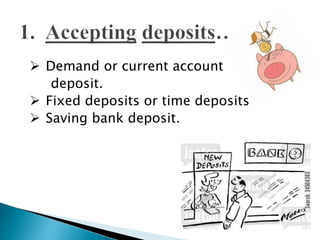
 Demand or current account
deposit.
 Fixed deposits or time deposits
 Saving bank deposit.
• By allowing an over draft facility cheques are
honoured even if deposits is less facility for
businessmen only interest on overdraft amount
• Loans by creating a deposits.
 Banks give loans to people by charging interest •
Bank asks for security
Simply opens an account in name of needy person
and issues a cheque book to transact
Loans granted mostly for business
 If a seller sells some goods to a buyer
who does not pay in cash. But the
seller draws a bill of exchange which
is signed by buyer.
 There is maturity or payment period,
say one month.
 Now the seller can give this exchange
bill to a bank which will give him cash
against it.
 Bank charges interest on it till one
month.
 Collection of bills, cheques.
 Collection of dividends,
interest, premium.
 Purchase and sale of shares
and debentures.
 Payment of insurance
premiums.
 Acts as trustee when
nominated.
 Traveller’s cheques, bank draft
 Safe vaults for valuables
 Supplying trade information
 Economic surveys
 Projects report preparation
1. Accelerating the rate of
capital formation.
2. Provision of Finance and
Credit.
3. Developing
Entrepreneurship.
4. Promoting balanced
regional development.
5. Help to consumers.
 Commercial banks encourage the habit of thrift and
mobilise the savings of people.
 These savings are effectively allocated among the
ultimate users of funds, i.e., investors for productive
investment.
 So, savings of people result in capital formation which
forms the basis of economic development.
 Commercial banks are a very important source
of finance and credit for trade and industry.
 The activities of commercial banks are not
only confined to domestic trade and
commerce, but extend to foreign trade also.
 Banks promote entrepreneurship by underwriting
the shares of new and existing companies and
granting assistance in promoting new ventures or
financing promotional activities.
 Banks finance sick (loss-making) industries for
making them viable units.
 Commercial banks provide credit facilities to rural
people by opening branches in the backward areas.
 The funds collected in developed regions may be
channelised for investments in the under developed
regions of the country.
 In this way, they bring about more balanced regional
development.
 Commercial banks advance credit for purchase of
durable consumer items like Vehicles, T.V.,
refrigerator etc., which are out of reach for some
consumers due to their limited paying capacity.
 In this way, banks help in creating demand for such
consumer goods.
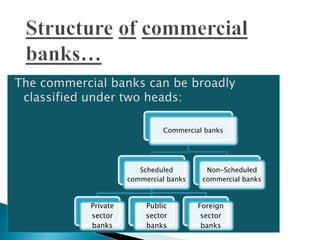
The commercial banks can be broadly
classified under two heads:
Commercial banks
Scheduled
commercial banks
Private
sector
banks
Public
sector
banks
Foreign
sector
banks
Non-Scheduled
commercial banks
 Scheduled banks refer to those
banks which have been included in
the Second Scheduled of Reserve
Bank of India Act, 1934.
 In India, scheduled commercial
banks are of three types:
• Private sector banks.
• Public sector banks.
• Foreign sector banks.
 These banks are owned and controlled by the
government.
 The main objective of these banks is to provide
service to the society, not to make profits.
 State Bank of India, Bank of India, Punjab
National Bank, Canada Bank and Corporation
Bank are some examples of public sector banks.
 These banks are owned and controlled by
private businessmen.
 Their main objective is to earn profits.
 ICICI Bank, HDFC Bank, IDBI Bank
is some examples of private sector banks.
 These banks are owned and controlled by foreign
promoters.
 Their number has grown rapidly since 1991, when
the process of economic liberalization had started in
India.
 Bank of America, American Express Bank,
Standard Chartered Bank are examples of foreign
banks.
 Non-scheduled banks refer to
those banks which are not
included in the Second Schedule
of Reserve Bank of India
Act,1934.
Commercial banks

Commercial banks

  • 1.
    Presented by: (Group-11) Shivam. ShubhamB. Karishma. Akshit. Gangam. Class: ( F.Y) B.Com ‘B’ Topic: Commercial Bank Submitted To: Tushti ma’am
  • 3.
     “Bank isan institute which collects money from those who are saving it out of their income and lend this money out to those who require it.”  Commercial banks are like other financial institutions which are in the business of lending and borrowing of money or credit.
  • 5.
     Demand orcurrent account deposit.  Fixed deposits or time deposits  Saving bank deposit.
  • 6.
    • By allowingan over draft facility cheques are honoured even if deposits is less facility for businessmen only interest on overdraft amount • Loans by creating a deposits.  Banks give loans to people by charging interest • Bank asks for security Simply opens an account in name of needy person and issues a cheque book to transact Loans granted mostly for business
  • 7.
     If aseller sells some goods to a buyer who does not pay in cash. But the seller draws a bill of exchange which is signed by buyer.  There is maturity or payment period, say one month.  Now the seller can give this exchange bill to a bank which will give him cash against it.  Bank charges interest on it till one month.
  • 8.
     Collection ofbills, cheques.  Collection of dividends, interest, premium.  Purchase and sale of shares and debentures.  Payment of insurance premiums.  Acts as trustee when nominated.
  • 9.
     Traveller’s cheques,bank draft  Safe vaults for valuables  Supplying trade information  Economic surveys  Projects report preparation
  • 11.
    1. Accelerating therate of capital formation. 2. Provision of Finance and Credit. 3. Developing Entrepreneurship. 4. Promoting balanced regional development. 5. Help to consumers.
  • 12.
     Commercial banksencourage the habit of thrift and mobilise the savings of people.  These savings are effectively allocated among the ultimate users of funds, i.e., investors for productive investment.  So, savings of people result in capital formation which forms the basis of economic development.
  • 13.
     Commercial banksare a very important source of finance and credit for trade and industry.  The activities of commercial banks are not only confined to domestic trade and commerce, but extend to foreign trade also.
  • 14.
     Banks promoteentrepreneurship by underwriting the shares of new and existing companies and granting assistance in promoting new ventures or financing promotional activities.  Banks finance sick (loss-making) industries for making them viable units.
  • 15.
     Commercial banksprovide credit facilities to rural people by opening branches in the backward areas.  The funds collected in developed regions may be channelised for investments in the under developed regions of the country.  In this way, they bring about more balanced regional development.
  • 16.
     Commercial banksadvance credit for purchase of durable consumer items like Vehicles, T.V., refrigerator etc., which are out of reach for some consumers due to their limited paying capacity.  In this way, banks help in creating demand for such consumer goods.
  • 17.
    The commercial bankscan be broadly classified under two heads: Commercial banks Scheduled commercial banks Private sector banks Public sector banks Foreign sector banks Non-Scheduled commercial banks
  • 18.
     Scheduled banksrefer to those banks which have been included in the Second Scheduled of Reserve Bank of India Act, 1934.  In India, scheduled commercial banks are of three types: • Private sector banks. • Public sector banks. • Foreign sector banks.
  • 19.
     These banksare owned and controlled by the government.  The main objective of these banks is to provide service to the society, not to make profits.  State Bank of India, Bank of India, Punjab National Bank, Canada Bank and Corporation Bank are some examples of public sector banks.
  • 20.
     These banksare owned and controlled by private businessmen.  Their main objective is to earn profits.  ICICI Bank, HDFC Bank, IDBI Bank is some examples of private sector banks.
  • 21.
     These banksare owned and controlled by foreign promoters.  Their number has grown rapidly since 1991, when the process of economic liberalization had started in India.  Bank of America, American Express Bank, Standard Chartered Bank are examples of foreign banks.
  • 22.
     Non-scheduled banksrefer to those banks which are not included in the Second Schedule of Reserve Bank of India Act,1934.