BANKS IN INDIA
Reserve Bank of India
(RBI)
Establishment of RBI
The reserve bank of India was established
on April 1,1935 in accordance with the provisions of
the reserve bank of India Act, 1934.
The central office of the reserve bank was
initially in Calcutta but was permanently moved to
Mumbai in 1937. the central office is where the
governor sits and where policies are formulated.
Objectives of RBI
• To maintain the internal value of the nation’s
currency.
• To preserve the external value of the currency
• To secure reasonable price stability.
• To promote economic growth with rising
levels of employment, out and real income
Functions of a RBI
• Monetary policy functions
• Currency issue and management
• Maintaining value of currency
• Anchor economic growth expectation
• Monetary regulation and management
• Regulation of interest rates
• Financial sector regulation and supervision
• Exchange management and control
• Credit control
• Liquidity management
• Clearing and settlement
• Development of financial market
• Policy oriented research
• Collection of data and publication of reports
• Institution building
Role of the Reserve Bank of India
• Banker to the government
• Banker to the banks
• Bank’s supervision
• Monetary regulation and management
• Foreign exchange and management
• Promotional functions
Supervisory/regulatory function of RBI
• Licensing of banks
• Approval of capital, reserves and liquid assets of
banks
• Branch licensing policy
• Inspection of banks
• Control over management
• Audit
• Credit information service
• Deposit insurance
• Training and banking education
RBI –organization structure
Commercial Banks
Definition of Commercial Banks
• An institution which accepts deposits, makes business loans,
and offers related services.
• Commercial banks also allow for a variety of deposit accounts,
such as current, savings, and time deposit.
• These institutions are run to make a profit and owned by a group
of individuals.
• Commercial banks offer services to individuals; they are primarily
concerned with receiving deposits and lending to businesses.
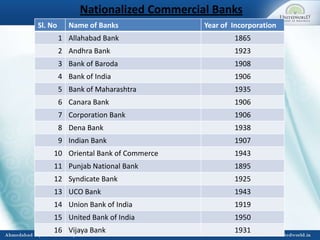
Sl. No Name of Banks Year of Incorporation
1 Allahabad Bank 1865
2 Andhra Bank 1923
3 Bank of Baroda 1908
4 Bank of India 1906
5 Bank of Maharashtra 1935
6 Canara Bank 1906
7 Corporation Bank 1906
8 Dena Bank 1938
9 Indian Bank 1907
10 Oriental Bank of Commerce 1943
11 Punjab National Bank 1895
12 Syndicate Bank 1925
13 UCO Bank 1943
14 Union Bank of India 1919
15 United Bank of India 1950
16 Vijaya Bank 1931
Nationalized Commercial Banks
Functions of Commercial Bank
 Primary Functions
―Accepting Deposits :
•Current Deposits
•Saving Deposits
•Fixed deposits
•Recurring Deposits
•Miscellaneous Deposits.
―Granting Loans and Advances :
Short-term Loans
Cash Credit
Overdraft
Discounting of Bills.
Long-term Loans
Demand Loan
Term Loan.
 Secondary Functions :
― Agency Services :
• Collection and payment of cheques and bills on behalf of the customer;
• Collection of dividends, interest and rent, etc. on behalf of the customer, if so
instructed by them;
• Payment of rent, interest, insurance premium, etc. on behalf
of customers, if so instructed;
• Acting as agents or correspondents on behalf of customers for other banks and
financial institutions at home and abroad.
― General utility Services :
• Issuing letters of credit and travellers' cheques;
• Underwriting of shares, debentures, etc.;
• Safe-keeping of valuables in safe deposit locker;
• Supplying trade information and statistical data useful to customers;
• Acting as a referee regarding the financial status of customers;
• Undertaking foreign exchange business
Continue…
Recent Development in Commercial Banking
• Interest rate deregulation
• Electronic Clearing Services (ECS)
• Electronic Funds Transfer (EFT)
• The opening of new clearing houses, interconnection of clearing
houses through the Indian Financial Network (INFINET)
• The development of a Real-Time Gross Settlement (RTGS) System
• Centralized Funds Management System (CFMS)
• E-banking
• E-payment
• Automated teller machines(ATM)
• Negotiated Dealing System (NDS)
• The Structured Financial Messaging System (SFMS).
What is Foreign Bank ????
• A foreign bank is a bank that was established in a
different country and is also serving customers of
another country.
• Foreign banks operate in India, just the way the
local banks do.
• They are bound by all the rules and regulations
that are applicable to banks based out of India
and they are governed by the Reserve Bank of
India that controls/governs all banks operating in
India.
Some of the foreign banks that operate
in India are:
• Citibank
• HSBC
• Standard Chartered
• Barclays
• Etc.
Foreign Branch Bank
• Banks often open a foreign branch in order to provide more services
to their multinational corporation customers.
• However, operating a foreign branch bank may
be considerably complicated because of the dual banking regulations
that the foreign branch needs to follow.
For example :-
• suppose the Bank of America opens a foreign branch bank in Canada.
The branch would be legally obligated to follow both Canadian and
American banking regulations.
Characteristics Of Foreign Banks
• They tend to increase the efficiency of the local banking
system, bring in more sophisticated financial services
and have the ability to nurse weak banks back to
health.
• It plays a great role in boosting Indian economy and
also lends to those who needs it.
• It also bought latest techniques to serve the customers
in the most effective manner and known for
introducing several banking practices.
Contd..
• Foreign banks are also known for uprooting the
unemployment in India by offering lots of job
opportunities .
• It offers good packages and tantalizes the sense of
youngsters by offerings several other job facilities.
• Besides, it also contributed its tremendous effort to
improve Indian foreign exchange market.
CO-OPERATIVE BANKS
Definition
• A co-operative bank is a financial entity which
belongs to its members, who are at the same time
the owners and the customers of their bank. Co-
operative banks are often created by persons
belonging to the same local or professional
community or sharing a common interest. Co-
operative banks generally provide their members
with a wide range of banking and financial
services (loans, deposits, banking accounts…). In
India co-operative banks are regulated with the
RBI and governed by Banking Regulations Act
1949 and Co-operative Societies Act, 1965.
The Co-operative Banks Act, of 2007 (the Act) defines a co-
operative bank as a co-operative registered as a co-operative
bank in terms of the Act whose members –
• Are of similar occupation or profession or who are employed by a
common employer or who are employed within the same business
district.
• Have common membership in an association or organisation, including
a business, religious, social, co-operative, labour or educational group.
• Have common membership in an association or organisation, including
a business, religious, social, co-operative, labour or educational group.
• Reside within the same defined community or geographical area.
Establishments
• Co-operative bank performs all the main banking functions of deposit
mobilisation, supply of credit and provision of remittance facilities.
• Co-operative Banks belong to the money market as well as to the capital
market.
• Co-operative Banks provide limited banking products and are
functionally specialists in agriculture related products. However, co-
operative banks now provide housing loans also.
•
• UCBs provide working capital loans and term loan as well.
The chief functions of Co-operative banks are :
• To attract deposit from non-agriculturist.
• To use excess funds of some societies
temporarily to make up for shortage in
another.
• To supervise and guide affiliated societies.
Finance Function:
Cooperative banks in India finance rural areas under:
• Farming
• Cattle
• Milk
• Personal
• Finance
Cooperative banks in India finance urban areas under:
• Self-employment
• Industries
• Small scale units
• Home finance
• Consumer finance
• Personal finance
Types of co-operative banks
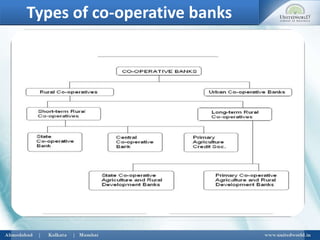
Classification of co-operative banks:
The Co-operative banking structure in India comprises of:
• Urban Co-operative Banks
• Rural Co-operatives
Some co-operative banks are scheduled banks, while others are
non-scheduled banks. For instance, State Co-operative banks and
some Urban Co-operative banks are scheduled banks but other co-
operative banks are non-scheduled banks. Scheduled banks are
those banks which have been included in the second schedule of
the Reserve bank of India act of 1934.
The banks included in this schedule list should fulfil two conditions.
• 1. The paid capital and collected funds of bank should not be less
than Rs. 5lac.
• 2. Any activity of the bank will not adversely affect the interests
of depositors.
SCHEDULED BANKS
Introduction
• Scheduled Banks in India constitute those
banks which have been included in the Second
Schedule of Reserve Bank of India(RBI)
Act, 1934. RBI in turn includes only those
banks in this schedule which satisfy the
criteria laid down vide section 42 (6) (a) of the
Act.
Classification
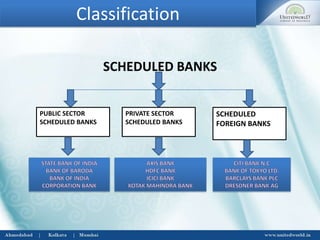
SCHEDULED BANKS
PUBLIC SECTOR
SCHEDULED BANKS
PRIVATE SECTOR
SCHEDULED BANKS
SCHEDULED
FOREIGN BANKS
Functions
• Transfer of funds
• Acceptance of deposits
• Offering those deposits as loans for various
purpose
• Purchase of houses, equipments, capital
investment purposes etc.
• The Indian Government presently hires the
scheduled banks banks for various purposes like
tax collection and refunds, payment of pensions
etc.
Campus Overview
907/A
Uvarshad, Gandhinagar
Highway, Ahmedabad –
382422.
Ahmedabad Kolkata
Infinity Benchmark, 10th
Floor, Plot G1,
Block EP & GP,
Sector V, Salt-Lake,
Kolkata – 700091.
Mumbai
Goldline Business Centre
Linkway Estate,
Next to Chincholi Fire
Brigade, Malad
(West), Mumbai – 400 064.
Thank you

Banking act

  • 2.
  • 3.
    Reserve Bank ofIndia (RBI)
  • 4.
    Establishment of RBI Thereserve bank of India was established on April 1,1935 in accordance with the provisions of the reserve bank of India Act, 1934. The central office of the reserve bank was initially in Calcutta but was permanently moved to Mumbai in 1937. the central office is where the governor sits and where policies are formulated.
  • 5.
    Objectives of RBI •To maintain the internal value of the nation’s currency. • To preserve the external value of the currency • To secure reasonable price stability. • To promote economic growth with rising levels of employment, out and real income
  • 6.
    Functions of aRBI • Monetary policy functions • Currency issue and management • Maintaining value of currency • Anchor economic growth expectation • Monetary regulation and management • Regulation of interest rates • Financial sector regulation and supervision • Exchange management and control • Credit control • Liquidity management • Clearing and settlement • Development of financial market • Policy oriented research • Collection of data and publication of reports • Institution building
  • 7.
    Role of theReserve Bank of India • Banker to the government • Banker to the banks • Bank’s supervision • Monetary regulation and management • Foreign exchange and management • Promotional functions
  • 8.
    Supervisory/regulatory function ofRBI • Licensing of banks • Approval of capital, reserves and liquid assets of banks • Branch licensing policy • Inspection of banks • Control over management • Audit • Credit information service • Deposit insurance • Training and banking education
  • 9.
  • 11.
  • 12.
    Definition of CommercialBanks • An institution which accepts deposits, makes business loans, and offers related services. • Commercial banks also allow for a variety of deposit accounts, such as current, savings, and time deposit. • These institutions are run to make a profit and owned by a group of individuals. • Commercial banks offer services to individuals; they are primarily concerned with receiving deposits and lending to businesses.
  • 13.
    Sl. No Nameof Banks Year of Incorporation 1 Allahabad Bank 1865 2 Andhra Bank 1923 3 Bank of Baroda 1908 4 Bank of India 1906 5 Bank of Maharashtra 1935 6 Canara Bank 1906 7 Corporation Bank 1906 8 Dena Bank 1938 9 Indian Bank 1907 10 Oriental Bank of Commerce 1943 11 Punjab National Bank 1895 12 Syndicate Bank 1925 13 UCO Bank 1943 14 Union Bank of India 1919 15 United Bank of India 1950 16 Vijaya Bank 1931 Nationalized Commercial Banks
  • 14.
    Functions of CommercialBank  Primary Functions ―Accepting Deposits : •Current Deposits •Saving Deposits •Fixed deposits •Recurring Deposits •Miscellaneous Deposits. ―Granting Loans and Advances : Short-term Loans Cash Credit Overdraft Discounting of Bills. Long-term Loans Demand Loan Term Loan.
  • 15.
     Secondary Functions: ― Agency Services : • Collection and payment of cheques and bills on behalf of the customer; • Collection of dividends, interest and rent, etc. on behalf of the customer, if so instructed by them; • Payment of rent, interest, insurance premium, etc. on behalf of customers, if so instructed; • Acting as agents or correspondents on behalf of customers for other banks and financial institutions at home and abroad. ― General utility Services : • Issuing letters of credit and travellers' cheques; • Underwriting of shares, debentures, etc.; • Safe-keeping of valuables in safe deposit locker; • Supplying trade information and statistical data useful to customers; • Acting as a referee regarding the financial status of customers; • Undertaking foreign exchange business Continue…
  • 16.
    Recent Development inCommercial Banking • Interest rate deregulation • Electronic Clearing Services (ECS) • Electronic Funds Transfer (EFT) • The opening of new clearing houses, interconnection of clearing houses through the Indian Financial Network (INFINET) • The development of a Real-Time Gross Settlement (RTGS) System • Centralized Funds Management System (CFMS) • E-banking • E-payment • Automated teller machines(ATM) • Negotiated Dealing System (NDS) • The Structured Financial Messaging System (SFMS).
  • 18.
    What is ForeignBank ???? • A foreign bank is a bank that was established in a different country and is also serving customers of another country. • Foreign banks operate in India, just the way the local banks do. • They are bound by all the rules and regulations that are applicable to banks based out of India and they are governed by the Reserve Bank of India that controls/governs all banks operating in India.
  • 19.
    Some of theforeign banks that operate in India are: • Citibank • HSBC • Standard Chartered • Barclays • Etc.
  • 20.
    Foreign Branch Bank •Banks often open a foreign branch in order to provide more services to their multinational corporation customers. • However, operating a foreign branch bank may be considerably complicated because of the dual banking regulations that the foreign branch needs to follow. For example :- • suppose the Bank of America opens a foreign branch bank in Canada. The branch would be legally obligated to follow both Canadian and American banking regulations.
  • 21.
    Characteristics Of ForeignBanks • They tend to increase the efficiency of the local banking system, bring in more sophisticated financial services and have the ability to nurse weak banks back to health. • It plays a great role in boosting Indian economy and also lends to those who needs it. • It also bought latest techniques to serve the customers in the most effective manner and known for introducing several banking practices.
  • 22.
    Contd.. • Foreign banksare also known for uprooting the unemployment in India by offering lots of job opportunities . • It offers good packages and tantalizes the sense of youngsters by offerings several other job facilities. • Besides, it also contributed its tremendous effort to improve Indian foreign exchange market.
  • 23.
  • 24.
    Definition • A co-operativebank is a financial entity which belongs to its members, who are at the same time the owners and the customers of their bank. Co- operative banks are often created by persons belonging to the same local or professional community or sharing a common interest. Co- operative banks generally provide their members with a wide range of banking and financial services (loans, deposits, banking accounts…). In India co-operative banks are regulated with the RBI and governed by Banking Regulations Act 1949 and Co-operative Societies Act, 1965.
  • 25.
    The Co-operative BanksAct, of 2007 (the Act) defines a co- operative bank as a co-operative registered as a co-operative bank in terms of the Act whose members – • Are of similar occupation or profession or who are employed by a common employer or who are employed within the same business district. • Have common membership in an association or organisation, including a business, religious, social, co-operative, labour or educational group. • Have common membership in an association or organisation, including a business, religious, social, co-operative, labour or educational group. • Reside within the same defined community or geographical area.
  • 26.
    Establishments • Co-operative bankperforms all the main banking functions of deposit mobilisation, supply of credit and provision of remittance facilities. • Co-operative Banks belong to the money market as well as to the capital market. • Co-operative Banks provide limited banking products and are functionally specialists in agriculture related products. However, co- operative banks now provide housing loans also. • • UCBs provide working capital loans and term loan as well.
  • 27.
    The chief functionsof Co-operative banks are : • To attract deposit from non-agriculturist. • To use excess funds of some societies temporarily to make up for shortage in another. • To supervise and guide affiliated societies.
  • 28.
    Finance Function: Cooperative banksin India finance rural areas under: • Farming • Cattle • Milk • Personal • Finance Cooperative banks in India finance urban areas under: • Self-employment • Industries • Small scale units • Home finance • Consumer finance • Personal finance
  • 29.
  • 30.
    Classification of co-operativebanks: The Co-operative banking structure in India comprises of: • Urban Co-operative Banks • Rural Co-operatives Some co-operative banks are scheduled banks, while others are non-scheduled banks. For instance, State Co-operative banks and some Urban Co-operative banks are scheduled banks but other co- operative banks are non-scheduled banks. Scheduled banks are those banks which have been included in the second schedule of the Reserve bank of India act of 1934. The banks included in this schedule list should fulfil two conditions. • 1. The paid capital and collected funds of bank should not be less than Rs. 5lac. • 2. Any activity of the bank will not adversely affect the interests of depositors.
  • 31.
  • 32.
    Introduction • Scheduled Banksin India constitute those banks which have been included in the Second Schedule of Reserve Bank of India(RBI) Act, 1934. RBI in turn includes only those banks in this schedule which satisfy the criteria laid down vide section 42 (6) (a) of the Act.
  • 33.
    Classification SCHEDULED BANKS PUBLIC SECTOR SCHEDULEDBANKS PRIVATE SECTOR SCHEDULED BANKS SCHEDULED FOREIGN BANKS
  • 34.
    Functions • Transfer offunds • Acceptance of deposits • Offering those deposits as loans for various purpose • Purchase of houses, equipments, capital investment purposes etc. • The Indian Government presently hires the scheduled banks banks for various purposes like tax collection and refunds, payment of pensions etc.
  • 35.
    Campus Overview 907/A Uvarshad, Gandhinagar Highway,Ahmedabad – 382422. Ahmedabad Kolkata Infinity Benchmark, 10th Floor, Plot G1, Block EP & GP, Sector V, Salt-Lake, Kolkata – 700091. Mumbai Goldline Business Centre Linkway Estate, Next to Chincholi Fire Brigade, Malad (West), Mumbai – 400 064.
  • 36.